
Student Loans and Credit Cards: Which Debt to Pay First
The credit-card statement arrives just as the student-loan payment comes due. There's enough money to cover the usual bills, but not enough to make meaningful progress on both debts. The card charges more interest, yet the student-loan account may already show a missed payment.
Choosing between student loans and credit cards starts with a distinction that simple payoff advice often misses: required payments protect accounts; extra payments reduce borrowing costs. The highest interest rate usually determines where surplus cash belongs, but an overdue student loan can change that order.
Table of Contents
- How Student Loans and Credit Cards Differ
- Which Payment Comes First in Each Situation
- What Each Dollar of Interest Really Costs
- When Missed Payments Hit Your Credit Report
- How to Protect Student Loans Before Extra Card Payments
- One Budget, Two Debts
- Confirm Your Payment Order This Month
How Student Loans and Credit Cards Differ
A monthly budget may list a credit card and a federal student loan side by side, even though the accounts behave differently. Paying down the card creates room to borrow again. Paying down the loan generally reduces an existing education debt without replenishing a spending limit.
That difference matters because a card payoff plan can unravel if new purchases replace every payment. A student-loan plan faces a different challenge: keeping the required payment affordable while following the correct repayment terms.
Student loans and credit cards side by side
| Feature | Federal student loan | Credit card |
|---|---|---|
| Balance pattern | Set principal that shrinks on a schedule | Revolving; rises and falls with spending |
| Interest rate | Set by loan terms; check whether the loan has a fixed or variable rate | Usually a variable APR |
| How interest accrues | Simple interest on unpaid principal | Charged on revolving balances each billing cycle |
| Required payment | Scheduled or income-based under the repayment plan | Minimum payment, usually a share of the balance |
| Missed payment reported to bureaus | Generally after 90 days | Commonly after 30 days past due |
| Escalation after long nonpayment | Default typically after 270 days | Charge-off commonly around 180 days past due |
| Hardship options | Deferment, forbearance, income-driven plans | Issuer-specific arrangements; hardship programs aren't guaranteed |
These are general federal-loan and card conventions, not a substitute for an account's terms. Older federal loans can have different rate structures, and the repayment schedule may change after an approved adjustment.
Why the minimum payment can mislead
A smaller card minimum doesn't necessarily mean the card is cheaper. It may mean the issuer requires relatively little principal repayment, allowing a balance to remain outstanding while interest continues.
For example, a borrower might pay the card minimum faithfully while continuing to use the card for groceries. The account stays current, but the borrower may make little progress because new purchases offset principal reduction.
A federal loan requires a different review. The borrower needs to identify the repayment plan and confirm whether the billed amount reflects current circumstances. Private student loans shouldn't be assumed to offer federal protections; their hardship arrangements come from the lender's contract.
Students evaluating a card before applying can browse student credit card rankings from HearSmart to identify options for closer review. Rankings are a starting point, not a reason to carry a balance; the application disclosures still deserve attention.
Practical rule: Label each account as revolving debt, federal education debt, or private education debt before choosing a payoff method.
Each account also needs a payment-status label. A recently missed card payment and a long-overdue federal loan create different deadlines, even when they appear beside each other in the same budget.
Which Payment Comes First in Each Situation
The highest-APR-first rule works when both accounts are current and required payments are covered. It directs extra money toward the debt charging the most interest. A delinquent student loan can change that order: default risk and collection exposure may deserve attention before extra card payments.
Which payment to prioritize by situation
| Situation | Pay first | Why |
|---|---|---|
| Both accounts current, extra cash available | Highest-APR credit card | Each extra dollar avoids more interest when the card has the higher rate |
| Student loan delinquent or in collections | Address the student loan | Default and collection risks may outweigh savings on card interest |
| Student loan payment at risk of being missed | Contact the servicer and confirm the amount or arrangement needed; then direct extra cash to the card | An approved income-driven plan may lower the required payment |
| Card utilization near its limit, loan current | Credit card | Paying down the card lowers its balance relative to its limit and reduces interest |
| Both accounts delinquent | Contact both creditors; address student-loan default exposure and any imminent card deadline | The risks and reporting timelines differ, so neither account should be ignored |
The table concerns extra cash. Keep enough for required payments on both accounts and essential living costs first.
The overlap between these debts is common among students. The 2025 Student Financial Wellness Survey found that 54% of students used a credit card during the prior year. Among users at two-year institutions, 47% didn't pay their balances in full each month; at four-year institutions, the figure was 35%.
Payment status belongs ahead of payoff speed
The Federal Reserve's November 2025 Financial Stability Report reported that 10.2% of aggregate student-loan debt was at least 90 days delinquent in the second quarter of 2025, following the resumption of delinquency reporting.
That figure describes student-loan debt overall, not an individual borrower's situation. For a household, the order depends on each account's status, any deadlines, and whether a payment arrangement has been approved.
Suppose a federal student loan is overdue while a credit card is current. Sending every spare dollar to the card may reduce interest, but it leaves the loan delinquency unresolved. Contact the loan servicer to confirm what payment or approved arrangement will address it, then decide how much extra cash remains for the card.
If both debts are overdue, contact both creditors. A card reporting deadline or collection notice may need prompt attention alongside the student loan's default risk. A call alone does not change the amount due; get confirmation of any approved arrangement.
The order is straightforward: keep required payments covered, address existing delinquency and imminent deadlines, then direct extra money toward the highest-APR debt that remains.
What Each Dollar of Interest Really Costs
Once accounts are protected, interest provides a useful comparison. A larger student-loan balance can look more urgent while a smaller, higher-rate card consumes more interest per dollar borrowed.
Payments Dive's account of Federal Reserve figures reports an average credit-card interest rate of 21.4% in 2025, up from 14.6% in 2022; at a constant 21.4%, a hypothetical $10,000 balance produces about $2,140 in simple annual interest, or about $178 a month initially.
Annual and monthly interest on sample balances
The following are illustrative calculations before principal reduction, using the card rate above and a hypothetical student-loan rate.
| Debt | Rate | Annual interest | Monthly interest |
|---|---|---|---|
| $10,000 credit-card balance | 21.4% | $2,140 | About $178 |
| $10,000 student loan | 6% | $600 | About $50 |
| $30,000 federal student loan | 6% | $1,800 | About $150 |
Translate the rate into avoided interest
The arithmetic is balance multiplied by annual rate. Monthly figures divide that annual estimate across the year; they aren't exact billing-cycle forecasts.
In this hypothetical comparison, an extra $100 paid toward the card avoids approximately $21 of annual interest if that principal reduction persists. The same extra payment toward the sample loan avoids approximately $6. Actual savings change with payment timing, subsequent borrowing, fees, and declining balances.
The largest balance isn't automatically the most expensive destination for the next extra payment.
A blended interest rate hides the difference between accounts. A useful payoff calculation keeps each account's APR, billing-cycle balance, minimum-payment formula, and payment date separate. This explanation of how credit-card interest works provides additional context for interpreting a card statement.
Borrowers comparing replacement cards can use Rankozo low interest card rankings to shortlist options, then inspect the actual disclosures. A lower advertised rate doesn't establish savings without considering fees, eligibility, and the rate that applies to the balance being repaid.
The reusable test is extra payment × annual interest rate. It gives an approximate annualized comparison, not a guaranteed payoff result, and applies only after payment-status risks have been addressed.
When Missed Payments Hit Your Credit Report
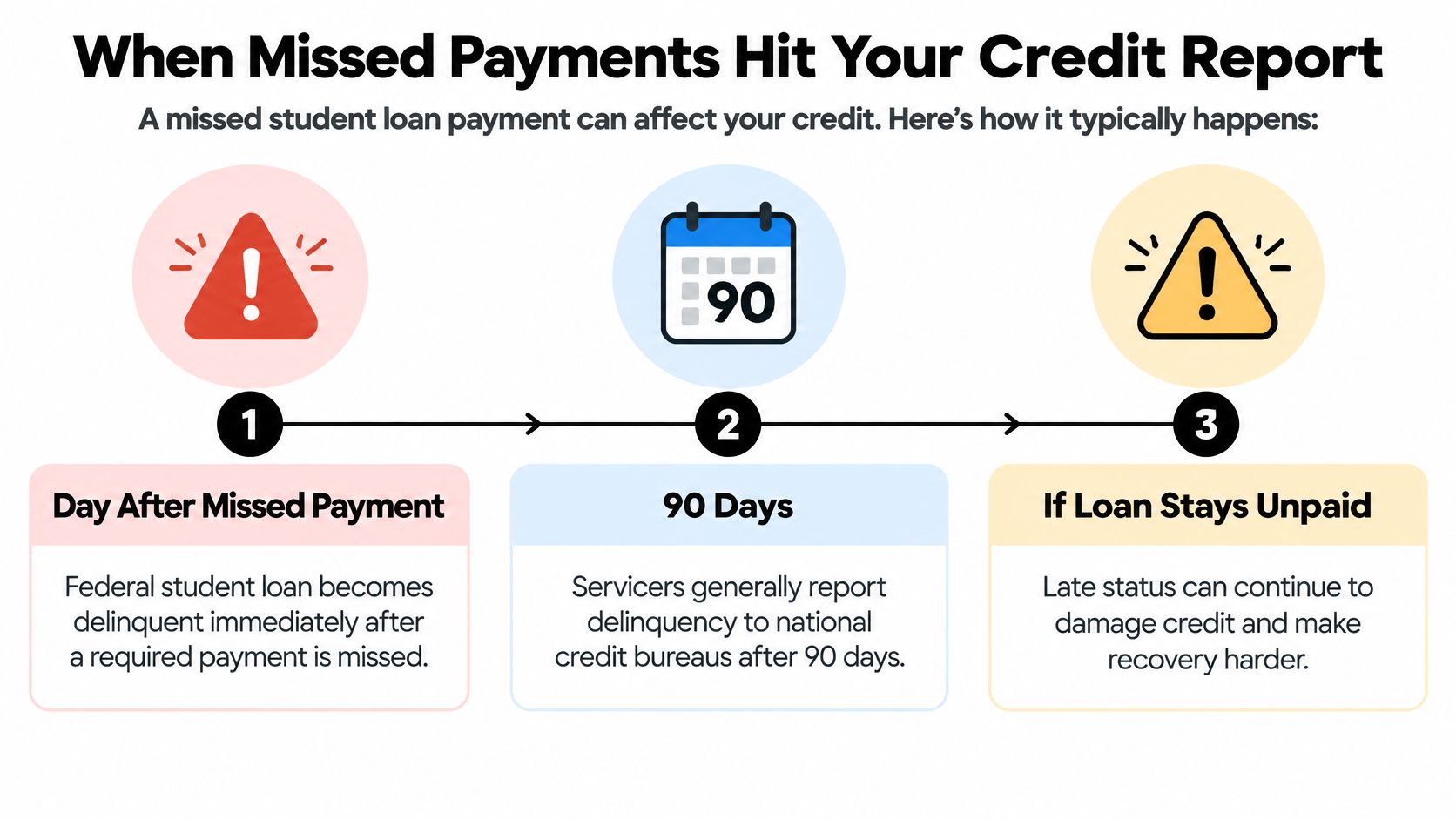
Consider a borrower whose federal student-loan payment is due on April 1. Under the timeline described in Federal Student Aid's exit-counseling guide, the loan becomes delinquent on April 2, servicers generally report delinquency after 90 days, and an unpaid loan typically enters default after 270 days, approximately nine months.
That sequence separates three events borrowers often confuse: missing a payment, having that missed payment reported, and entering default. A delay before credit reporting isn't permission to skip a bill.
The timeline illustrates how an unresolved missed payment can progress.
The first missed bill calls for action
For the April borrower, the useful response isn't to calculate the latest possible rescue date. It's to contact the loan holder promptly and ask which available arrangement can keep the account from progressing.
The borrower should explain whether the problem is temporary or ongoing. A delayed paycheck calls for a different conversation than a lasting income reduction. An income-based payment, deferment, or forbearance may be relevant, but eligibility and approval need confirmation.
- Confirm the status. Ask whether the account is current, delinquent, or already in default.
- Request the required action. Ask what payment or approved arrangement changes that status.
- Keep written confirmation. Save notices, application records, and the effective date of any adjustment.
Credit cards commonly have a shorter missed-payment reporting window, so a borrower shouldn't assume that the federal-loan timeline applies to every bill. A guide to the credit-card payment due date can help distinguish the statement closing date from the actual payment deadline.
On-time payments aren't the only credit factor
A card can also affect credit through utilization, the balance relative to its limit. A card near its limit can therefore create credit concerns even when every minimum payment arrives on time.
An installment loan doesn't have that same revolving spending-limit relationship. Its repayment history and default status remain central concerns, although scoring systems consider other account details too.
The practical response is to track both the calendar and the account status. Neither a payment reminder nor a pending hardship application proves that the creditor has changed the obligation.
How to Protect Student Loans Before Extra Card Payments
Loan protection begins with the amount due, not the payment a borrower hopes will be approved. A repayment application, an old autopay setting, and a current billing statement can show different information during a transition.
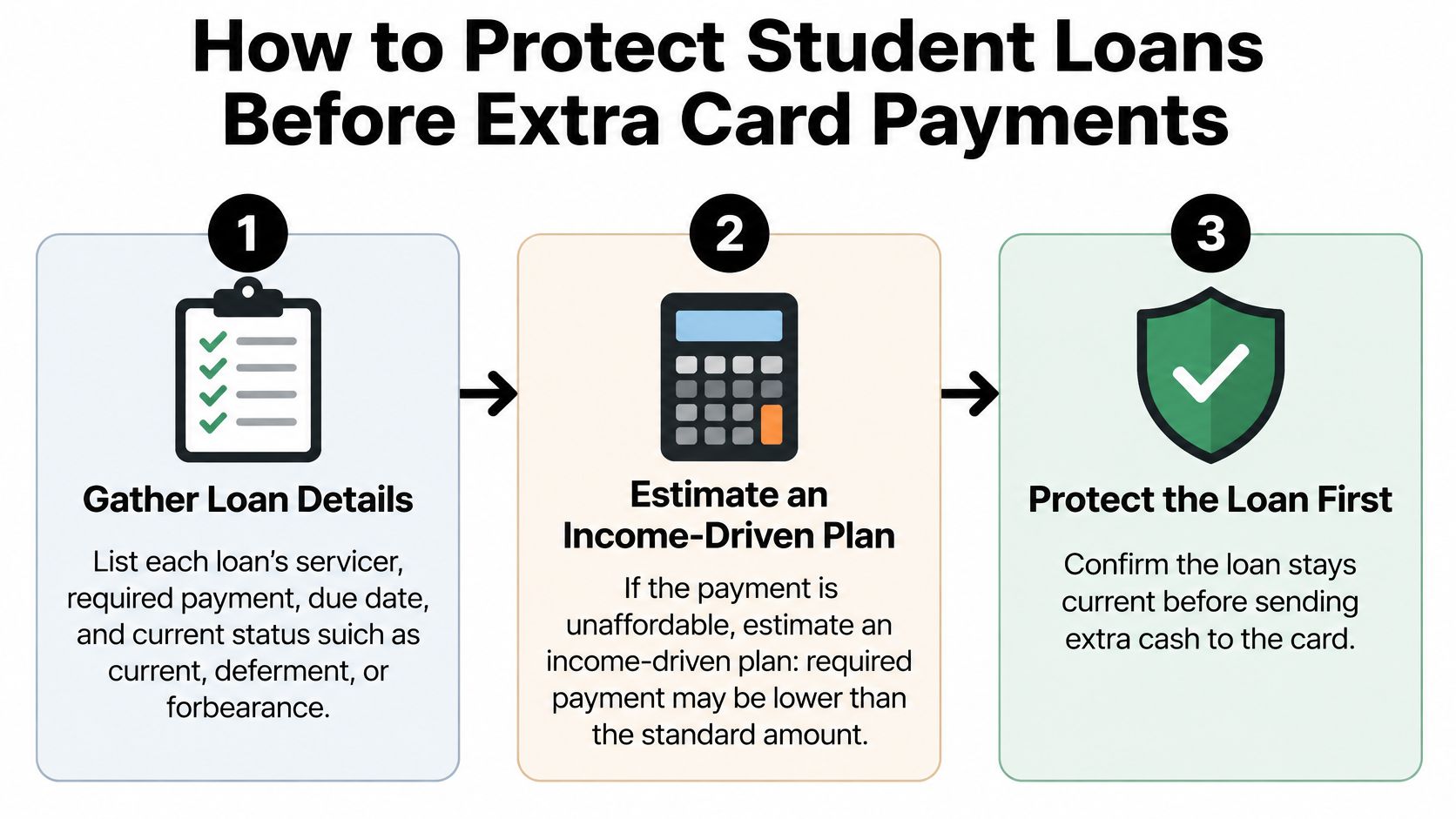
The following process helps separate confirmed obligations from pending changes.
Establish an affordable required payment
Gather the loan details. Record each loan's servicer, required payment, due date, and status. Separate federal from private loans, and distinguish an approved pause from a missed payment.
Evaluate an income-driven option when eligible. Federal Student Aid's repayment guidance describes payments based on adjusted gross income, family size, and applicable poverty-guideline thresholds, with remaining balances potentially discharged after qualifying periods of 20, 25, or 30 years, depending on the plan. Plan availability and eligibility need confirmation before a borrower relies on a projected payment.
Confirm what remains due during processing. Ask the servicer whether the existing bill must still be paid while an application is pending. Obtain the effective date and payment amount in writing rather than treating an application submission as approval.
For example, a borrower whose earnings have fallen shouldn't empty the checking account into a card while waiting for a lower loan payment. The borrower first needs a confirmed amount and enough cash to cover it.
Price a pause before accepting it
Estimate the interest cost. Using the simple-interest calculation described in Federal Student Aid's interest-rate guidance, a hypothetical $30,000 balance at 6% accrues about $1,800 over a year before payments and daily-accrual details. Interest treatment differs by loan and pause type, so the estimate must match the actual account.
Ask about capitalization. Edfinancial's payments, interest, and fees guidance explains how unpaid interest can be added to principal; in a hypothetical example, $20,000 principal plus $1,000 unpaid interest becomes $21,000, raising approximate annual interest at 6% from $1,200 to $1,260. The borrower should ask which event, if any, would trigger capitalization on that specific loan.
Pay accruing interest when affordable. Preventing capitalization can help, but it shouldn't displace essential expenses or required payments elsewhere. A borrower needs the servicer's current accrued-interest figure, not an estimate copied from an older statement.
Recalculate before resuming extra card payments. Changes in earnings, household size, repayment plan, or pause status can alter available surplus. Once the loan obligation is secure, additional cash can return to the selected card.
Before accepting a pause: Ask for the expected interest treatment, the end date, and the payment required afterward.
The decision to pay a student loan off early also deserves a separate review when forgiveness eligibility or other repayment benefits could affect the outcome. Keeping a loan current and accelerating its payoff aren't the same decision.
One Budget, Two Debts
Dana's situation illustrates how a sensible payment order can change without abandoning the payoff plan. Every amount in this scenario is hypothetical, and the interest estimates simplify changing balances and payment dates.
Her paperwork reflects a familiar problem: several obligations competing for the same paycheck.

Month one with both accounts current
Dana has a $10,000 card at 21.4%, a $250 card minimum, and a $30,000 federal loan at 6% with a $350 required payment. After essential expenses and both required payments, she has $400 left.
She sends the surplus to the card, making a hypothetical total card payment of $650. At the opening card balance, simplified monthly interest is about $178, so not all of that payment reduces principal.
The extra payment produces an annualized interest comparison of approximately $86 on the card versus $24 on the loan, assuming the principal reduction persists. These aren't guaranteed annual savings; they show why the card receives the surplus while both accounts remain current.
Month six after an income reduction
Dana loses part of her income, and the loan payment no longer fits her budget. She stops treating the previous surplus as automatically available and contacts the servicer before sending another extra card payment.
In this scenario, she qualifies for an income-driven plan. She confirms the new required payment and effective date, preserves the card minimum, and waits until the revised budget supports additional repayment.
The important change is procedural: she doesn't keep making an aggressive card payment while allowing the loan to become overdue.
A video offers another format for considering competing repayment obligations.
Month nine while considering a pause
Dana considers deferment and estimates that the hypothetical loan would accrue about $150 monthly if its balance remained at the scenario's starting amount and interest continued. She compares that cost with the affordable income-driven payment rather than assuming a pause is free.
She also asks whether unpaid interest would capitalize under her actual loan terms. The answer affects the comparison, but an estimate alone doesn't decide whether a pause is appropriate.
When her cash flow recovers enough to restore the original surplus, the extra $400 returns to the card. Her priorities have changed with her circumstances: reduce expensive debt when stable, protect the loan when income falls, and reconsider temporary relief before accepting it.
Confirm Your Payment Order This Month
A useful payment plan reflects current statements, not remembered balances. A spreadsheet, calendar, or existing debt tracker is enough to record the information needed for the next decision.
Complete the monthly account check
- Record each card's terms. Enter its balance, APR, minimum payment, and due date. Separate promotional balances when different rates apply.
- Document each loan's status. Include the servicer, required payment, repayment plan, and any scheduled capitalization event.
- Reserve required payments. Confirm that the checking account can cover essential expenses and every obligation before an extra payment leaves.
- Choose the surplus destination. Address delinquency and collection exposure before comparing the interest avoided by additional principal payments.
- Call about an endangered loan payment. Request available arrangements promptly and record what remains due while any application is processed.
- Schedule a review. Recheck the order after income, family size, account status, or repayment-plan changes.
Keep the plan realistic
A borrower also needs enough accessible cash to avoid immediately borrowing back an extra payment. Sending the entire available balance to a card can be counterproductive when an unavoidable bill arrives before the next paycheck.
Pending arrangements should remain visibly marked as pending. A tracker should distinguish an estimated payment from a confirmed bill and a submitted request from an approved change.
Toya is not a financial advisor, lender, or credit counseling service, and its AI recommendations are informational suggestions only. Any suggested payment order still needs to align with confirmed account obligations and the household's immediate needs.
Toya AI builds a personalized payoff plan from real account data and shows the user's debt-free date in minutes, helping borrowers compare priorities across student loans and credit cards. It accesses financial account information through Plaid on a read-only basis. Borrowers seeking an account-based starting point can visit Toya AI to build a plan around their existing debts.
Ready to start your debt-free journey?
Toya AI builds a personalized payoff plan so you can see your debt-free date and save on interest.
Get Started Free