
How to Reduce Student Loan Interest in 2026
Most advice on reducing student loan interest starts with refinancing. That's backwards. The lowest advertised rate can become the most expensive choice if it extends repayment, triggers a new capitalization event, or eliminates federal protections that would otherwise reduce payments or lead to forgiveness.
The right order is protect the loan first, stop balance growth second, compare total cost third, and refinance last. Borrowers who follow that sequence can reduce interest without confusing a smaller monthly bill with a cheaper loan.
Table of Contents
- Why Lower Rate Alone Won't Cut Your Total Interest
- Build Your Loan Inventory Before You Touch Anything
- Compare Federal Repayment Plans as Interest Tools
- When Refinancing Actually Pays Off
- Autopay Discounts and Capitalization Traps
- Leverage Forgiveness, Employer Benefits, and Credit
- Your 30-60-90 Day Plan to Cut Interest
Why Lower Rate Alone Won't Cut Your Total Interest
A lower rate is not automatically a lower-cost loan. Lifetime interest depends on the stated APR, capitalization, and the repayment timeline. APR controls how quickly interest accrues. Capitalization adds unpaid interest to principal, so future interest grows from a larger balance. The repayment term determines how long interest continues to accrue.
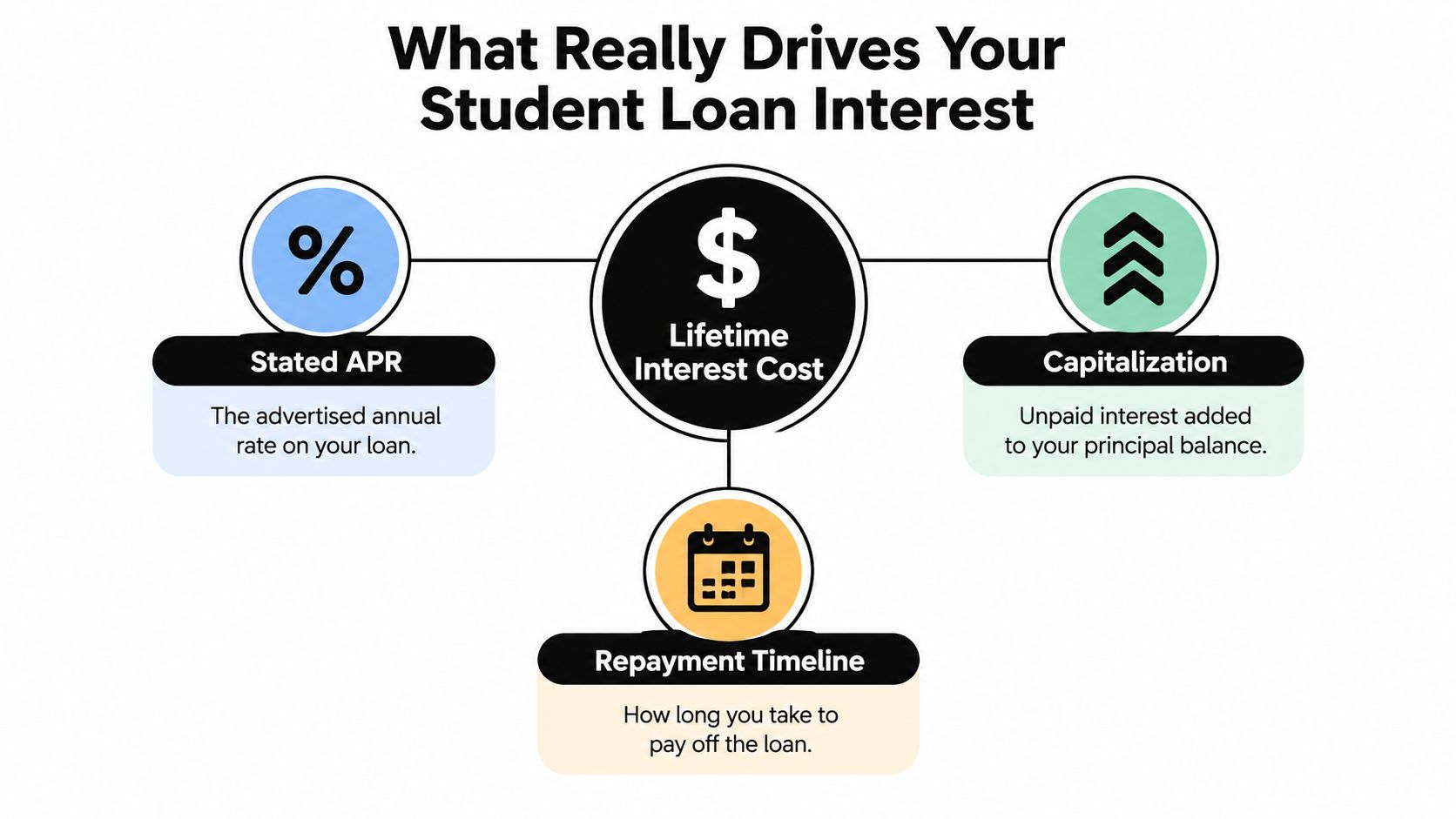
A smaller rate helps when it does not come with a longer payoff period or lost federal protections. Extending a loan can reduce the required payment while keeping the balance outstanding longer. An income-driven repayment plan may lower the required payment and, depending on the plan and your circumstances, cover some unpaid interest. Preventing capitalization keeps a temporary payment problem from becoming permanent principal.
Practical rule: Compare projected lifetime interest and the payoff date, not the monthly payment alone.
Consider an illustrative $35,000 balance at 6.5%. A ten-year schedule produces roughly $12,400 in interest, while a fifteen-year schedule produces about $18,900 at the same rate. The longer option may lower the required payment, but it gives interest more time to accumulate. The difference comes from the repayment timeline, not a change in APR.
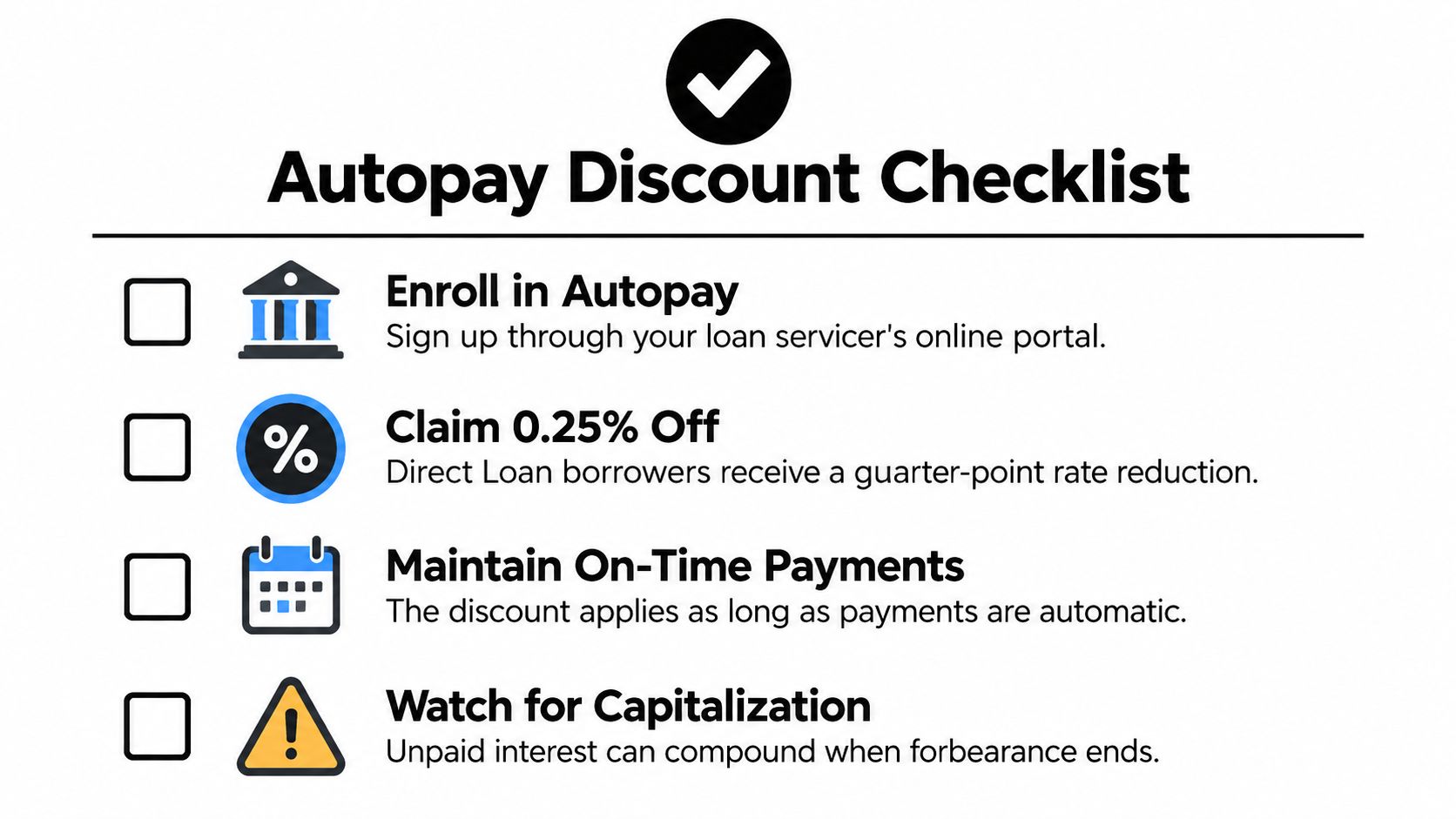
A modest federal rate reduction still helps. Federal Direct Loan borrowers can reduce their rate by 0.25 percentage points through automatic electronic payments, according to Federal Student Aid's repayment guidance. The discount does not reduce the required payment, but it can send more of each payment toward principal or shorten the payoff period.
The right order is straightforward:
- Prevent capitalization: Identify events that could add unpaid interest to principal, using Federal Student Aid's guidance on interest capitalization.
- Protect federal benefits: Check IDR, forgiveness, deferment, and discharge eligibility before considering private refinancing.
- Shorten the timeline deliberately: Apply extra money to principal only after confirming payment allocation and the effect on any forgiveness strategy.
Build Your Loan Inventory Before You Touch Anything
A borrower can't reduce interest intelligently without knowing which loan is creating it. The inventory should include each servicer, balance, APR, fixed or variable status, federal or private status, disbursement date, repayment plan, subsidy status, and capitalization rules.
The disbursement date matters because federal rate rules changed over time. Loans first disbursed after July 1, 2006, generally carry fixed rates for the life of the loan, while many older loans can change annually, according to Federal Student Aid's interest-rate schedule. Undergraduate Direct Subsidized and Unsubsidized Loans carried 2.75% for 2020–21, 3.73% for 2021–22, 4.99% for 2022–23, 5.50% for 2023–24, 6.53% for 2024–25, and 6.39% for loans first disbursed in 2025–26.
The loan inventory checklist
A servicer portal usually provides enough information to build the first version of the map. Each loan should be recorded separately, even when several loans appear under one account.
- Balance and APR: Record the current principal and interest rate, not just the combined account total.
- Loan status: Mark whether the loan is in repayment, deferment, forbearance, grace, or default.
- Federal or private: Federal status can preserve IDR, PSLF, deferment, and discharge options.
- Subsidy flag: A qualifying subsidized loan generally doesn't accrue borrower-responsible interest during approved in-school periods.
- Capitalization terms: Ask the servicer when unpaid interest can be added to principal.
- Disbursement date: Use it to verify the applicable federal rate rules.
A recent graduate might find four federal loans: one subsidized loan and three unsubsidized loans. The subsidized loan may have benefited from interest protection while the borrower was enrolled, while the unsubsidized loans could accrue interest during that period. That distinction changes the order of investigation. The borrower should first confirm the unpaid-interest balance and capitalization status on the unsubsidized loans, rather than blindly directing every extra dollar to the largest balance.
Borrowers who need a payoff method after the inventory is complete can compare the Fintrack guide to debt payoff strategies, particularly the difference between prioritizing the highest APR and prioritizing early psychological wins. Account data can also be centralized through account aggregation services, provided the borrower reviews permissions and confirms that every balance and rate imported correctly.
Compare Federal Repayment Plans as Interest Tools
Income-driven repayment is not merely a way to lower a monthly bill. It can change how unpaid interest is handled. When a required payment is smaller than the interest accrued during the payment period, a borrower may qualify for government coverage of some or all unpaid interest, depending on the repayment plan, loan type, income, and household size.
That makes IDR valuable for borrowers whose payment doesn't cover monthly interest, especially when federal protections matter more than rapid amortization. It can also cost more when unpaid interest remains uncovered, the term stretches, or the borrower misses required income recertification.
Consider a teacher with $50,000 at 6.5%. Under a standard schedule, payments are designed to amortize the balance over the selected term. Under IDR, the required payment may be lower and some accruing interest may receive coverage, but the borrower must verify the specific plan rules and whether unpaid interest capitalizes after a status change. The correct comparison is not “standard payment versus IDR payment.” It is total interest, remaining balance, payoff date, and forgiveness eligibility.
More than 40% of federal borrowers, approximately 12 million people, were enrolled in IDR plans representing over $700 billion in balances, according to Brookings analysis. The same source reported roughly $770 billion across 12.9 million borrowers as of December 2025. Those figures show how central IDR is to federal repayment, not that IDR is automatically cheaper for every borrower.
| Plan | Rate Effect | Lifetime Interest Trajectory | Forgiveness Access |
|---|---|---|---|
| Standard repayment | Usually no direct rate reduction | Predictable amortization, often less interest than a longer term | Can qualify for PSLF when other requirements are met |
| Income-driven repayment | Usually doesn't reduce the stated APR | May reduce cash flow and cover some unpaid interest, but can extend repayment | Can preserve access to qualifying forgiveness pathways |
| Direct Consolidation | Creates a fixed rate based on a weighted average, rounded upward to the nearest 0.125% | May lengthen the term and increase total interest | Can simplify repayment and provide access to certain programs |
Consolidation doesn't assign the lowest existing rate to the new loan. For example, combining $20,000 at 5% with $10,000 at 7% produces a weighted average of about 5.67%, which rounds up to 5.75%, according to MOHELA's consolidation explanation. Borrowers comparing plans can use this student loan repayment plan guide to organize the decision, but the servicer and Federal Student Aid account should remain the final sources for eligibility.
When Refinancing Actually Pays Off
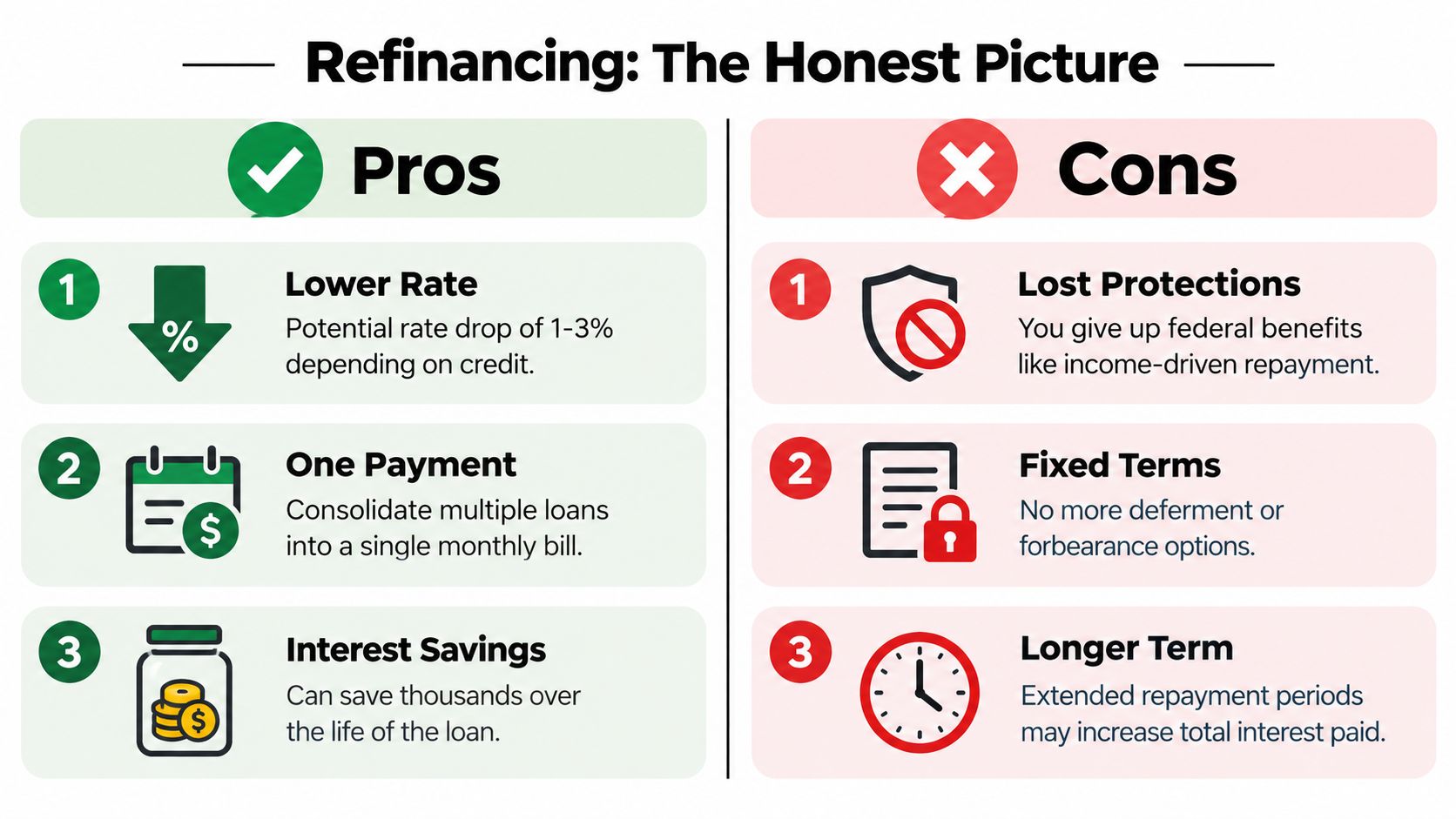
Refinancing is appropriate only when the rate reduction beats the value of federal protections and the new term doesn't inflate lifetime interest. Moving a federal loan to a private lender generally ends access to federal IDR, federal forgiveness programs, and federal deferment or discharge protections. That trade is permanent for the refinanced loan.
Published analysis found that 52.8% of households with education loans could lower their rate, but the average reduction was under two percentage points, from 5.8% to 4.2%, with average savings of $8.17 per month or $941 over the remaining loan life, according to New America's refinancing analysis. Borrowers with at least $44,000 owed averaged $15 per month and $1,929 in total savings in that analysis. Those figures are benchmarks, not guarantees.
The math should run in three passes:
- Same-term comparison: Calculate remaining interest on the federal loan, then calculate the refinanced loan over the same remaining term.
- Shorter-term comparison: Apply the potential payment difference to a faster payoff schedule. A lower rate matters more when the borrower keeps the original payment instead of stretching the debt.
- Federal baseline: Compare the refinance against federal repayment with autopay and any eligible IDR or forgiveness strategy.
A variable private rate deserves stress testing because the payment can rise. A longer private term deserves suspicion because it can lower the bill while increasing lifetime interest. Credit quality also affects approval and pricing, so borrowers with weaker credit may not receive the rate shown in an advertisement.
Refinancing is a payoff strategy, not a default first step. A private loan should earn its place by winning the full comparison, not by displaying a lower APR.
A federal borrower who expects PSLF, needs income-based relief, or may use federal discharge protections should generally remain federal unless the value of those protections has been carefully quantified. Borrowers who have stable income, no realistic need for federal benefits, a strong private offer, and a same-term total-interest advantage have a clearer refinancing case. The student loan consolidation guide can help distinguish federal consolidation from private refinancing, which solve different problems.
Autopay Discounts and Capitalization Traps
Autopay helps, but it should be the last step in an interest-reduction strategy, not the first. Federal Direct Loan borrowers can receive a 0.25 percentage-point rate reduction by enrolling in automatic electronic payments. Federal Student Aid has also announced a temporary 1% reduction for eligible Direct Loan borrowers from July 1, 2026, through June 30, 2028, subject to the program's eligibility and enrollment rules.
On a $30,000 balance, a rate change from 6.00% to 5.75% lowers the initial annual interest calculation by about $75 before amortization, based on the stated balance and rate difference. A temporary change from 6.00% to 5.00% would reduce the initial rate calculation further, but the lifetime effect depends on payment timing, balance changes, and continued eligibility.
Stop capitalization before sending extra money
Capitalization occurs when unpaid interest is added to principal. Future interest then applies to the larger balance. Federal borrowers face this risk after certain deferments, when forbearance ends, or when an income-driven repayment arrangement no longer provides the expected assistance.
Contact the servicer before a deferment, forbearance, or repayment-plan change ends. Ask three specific questions:
- What interest has accrued? Request the amount for each loan.
- What event could capitalize it? Ask for the exact trigger and date.
- How will payments be applied? Confirm whether accrued interest is paid before principal.
Use a calendar for the next ninety days. Confirm autopay enrollment, record the discount, set income-recertification reminders, and request written confirmation after any plan change. The discount can stop if autopay is canceled or the loan enters deferment or forbearance. If the rate rises, check the loan's status before assuming the servicer made an error. A small rate discount cannot offset balance growth caused by capitalization.
Leverage Forgiveness, Employer Benefits, and Credit
The cheapest interest is often the interest that a borrower avoids by using a benefit correctly. Public-sector workers should evaluate PSLF before making extra payments, because aggressive payoff can erase the balance that forgiveness might otherwise address.
PSLF generally requires 120 qualifying monthly payments on a qualifying plan, including IDR plans and the ten-year Standard Repayment Plan, according to Federal Student Aid's PSLF guidance. Under the ten-year Standard Plan, the loan is often fully amortized before forgiveness has a remaining balance to erase.
A public-sector nurse with a $60,000 balance at 6.5% should therefore compare an IDR payment and expected forgiveness amount against a private refinance, even if the refinance appears to save $200 per month in a hypothetical offer. The refinance may reduce the bill while eliminating federal forgiveness access. That lost balance reduction can outweigh the apparent monthly savings.

Coordinate workplace money before extra payments
Employer assistance can change the best use of spare cash. A worker should check whether an employer offers student-loan repayment assistance, tuition reimbursement, or a retirement contribution match. Directing every available dollar to loans can be inefficient if the worker gives up a matching contribution or an employer benefit that could offset education costs.
Credit improvement also belongs in the comparison, but it shouldn't become an excuse to abandon federal protections. A borrower shopping privately can reduce utilization, correct report errors, avoid new missed payments, and compare fixed offers without accepting the first quote. Private underwriting may still produce materially different terms across lenders.
Employees who work for federal agencies can review federal employee debt relief tips alongside the official PSLF rules. The decision should remain centered on qualifying employment, qualifying payments, federal loan status, and total projected cost.
Your 30-60-90 Day Plan to Cut Interest
A lower rate is not automatically the cheapest choice. The right plan first identifies capitalization risks, protects valuable federal benefits, and assigns each decision a deadline. Then it turns those findings into actions that reduce total projected cost.
Days 1 through 30
Finish the loan inventory and save statements for every account. Confirm each APR, balance, loan type, subsidy status, federal or private status, repayment plan, and capitalization rule. Mark any event that could add unpaid interest to the principal.
Enroll eligible federal Direct Loans in autopay, then verify the discount on a later statement. If you use an income-driven repayment plan, record the next income-recertification deadline and update your income information when required. Before sending extra cash to loans, review workplace benefits, including repayment assistance, tuition reimbursement, and retirement contribution matches. An HR guide to financial wellness can help you identify benefits that may change the best use of that cash.
Days 31 through 60
Model at least three scenarios using the same loan information:
- Current plan: Include the existing payment, payoff date, and projected interest.
- IDR plan: Include the required payment, possible unpaid-interest treatment, recertification obligations, and forgiveness eligibility.
- Refinance option: Use the same remaining term first, then test a shorter term. List the federal protections that would disappear after refinancing.
Compare total projected cost, not just the monthly payment. A lower private rate can cost more if it removes forgiveness eligibility or other federal protections. Call the servicer when the model conflicts with an account statement. Calculators help compare options, but the servicer must confirm loan status and capitalization treatment.
Days 61 through 90
Choose the strategy that lowers total projected cost without giving up a benefit worth more than the rate reduction. Set calendar reminders for recertification, autopay review, annual statement checks, and temporary discount expiration. Make the first deliberate extra payment only after confirming how the servicer applies it.
Address balance changes immediately:
- The balance grew despite monthly payments: Ask whether a deferment or forbearance ended, recertification was missed, or unpaid interest capitalized.
- The autopay discount disappeared: Check whether automatic payments were canceled or the loan entered deferment or forbearance. Ask the servicer which status change occurred and what will restore eligibility.
Day 90 is the start of monitoring, not the end of the plan. Toya AI can connect student loan accounts and show how payment allocations affect interest and the payoff timeline. Visit Toya AI to keep the selected strategy organized and review changes before they become costly.
Ready to start your debt-free journey?
Toya AI builds a personalized payoff plan so you can see your debt-free date and save on interest.
Get Started Free