
Student Loan Payment Dates: How They're Set and Managed
A borrower can leave campus with a diploma, a new address, and no clear idea when the first student loan payment will be due. The account may still show no bill, while interest continues to accumulate on some loans and the servicer prepares a repayment schedule. That quiet period feels simple, but several dates matter: the school departure date, the end of the grace period, the first billing statement, the contractual due date, and the date the payment posts.
Student loan payment dates aren't controlled by one national calendar. They depend on the loan program, enrollment status, servicer, repayment arrangement, and any deferment, forbearance, consolidation, or payment pause. A reliable system treats each date as a checkpoint to verify, not an estimate to remember.
Table of Contents
- How Federal Student Loan Payment Dates Are Set
- Understanding the Grace Period and Its Real Impact
- Key Timing Rules That Protect Your Payment Schedule
- The Delinquency Timeline and Credit Consequences
- Real-World Example From Graduation to First Payment
- Tools and Strategies to Track Multiple Payment Dates
- How International Models Change the Payment-Date Question
- Building a Reliable Payment-Date Management Routine
How Federal Student Loan Payment Dates Are Set
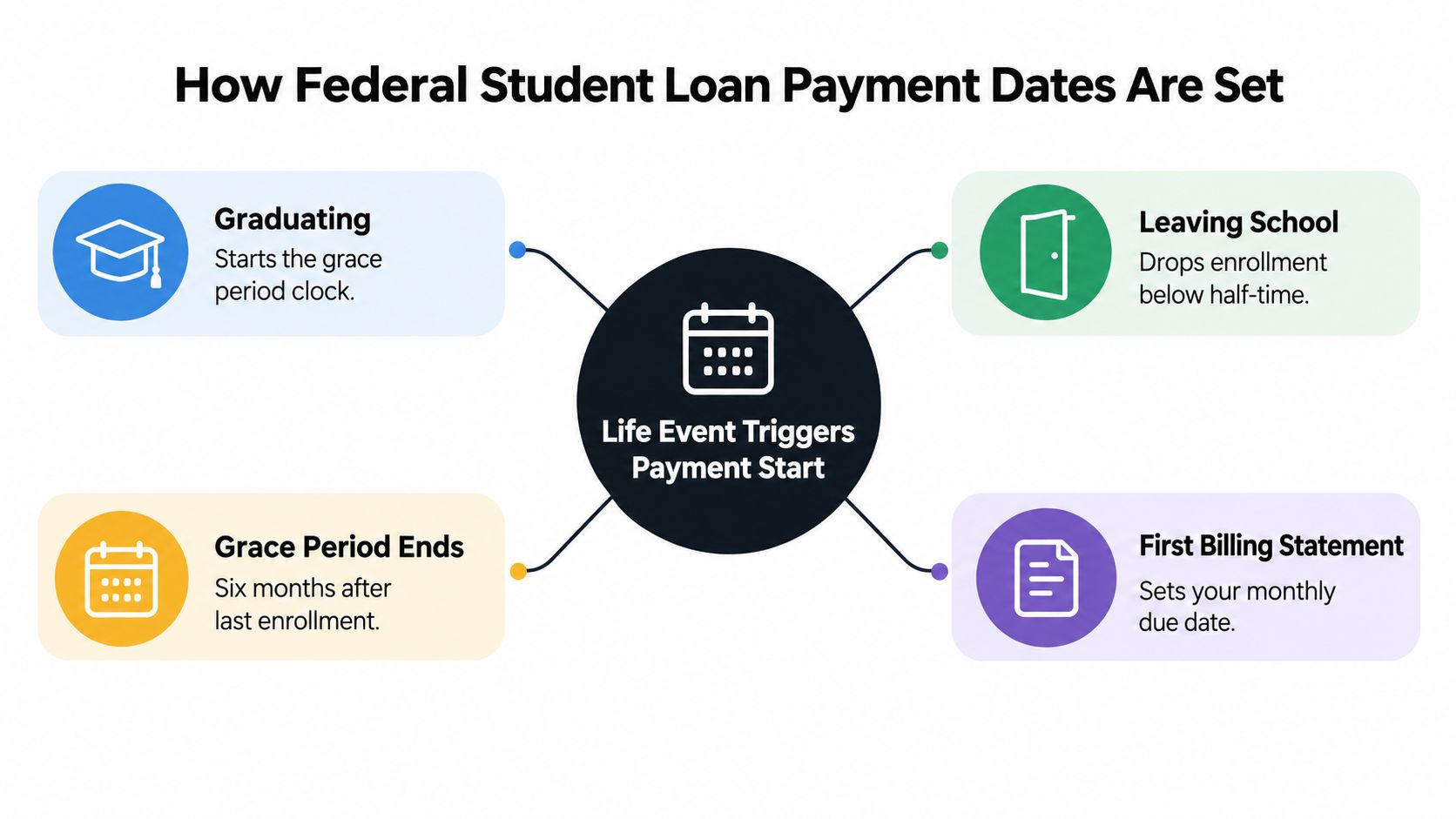
Leaving school in May does not usually mean a bill arrives in June. Federal student loan repayment is set in stages, with the enrollment change starting the clock and the servicer later confirming the account's actual schedule. For most Direct Subsidized and Direct Unsubsidized Loans, a six-month grace period follows graduation, withdrawal, or a drop below half-time enrollment. Federal Perkins Loans historically used a nine-month grace period. Federal Student Aid outlines when repayment begins after enrollment changes.
The grace period provides a planning window, not a final due date. The servicer sends repayment information and identifies the first required payment date. After repayment begins, payments are usually monthly, but the exact day belongs to the individual account. A calendar reminder can flag the transition, while the servicer portal confirms the date that controls.
The dates borrowers should record
Build the timeline in four checkpoints:
- Enrollment change: Record the date of graduation, withdrawal, or the move below half-time enrollment.
- Grace-period estimate: Mark the expected end of the grace period as a planning date, not a promise.
- Servicer notice: Save the formal schedule showing the first due date, payment amount, and frequency.
- Account confirmation: Check the servicer portal and compare its date with your calendar.
This sequence helps separate three events that are easy to blend together: the day repayment is triggered, the day a statement becomes available, and the contractual due date. A statement arriving later does not automatically move the due date, so borrowers should confirm how the account handles billing and posting.
Deferment, forbearance, consolidation, renewed enrollment, or a temporary payment pause can change when billing resumes. After any status change, check the servicer account and save the updated schedule. Keep the due date and the payment-posting date in separate reminders, especially when a weekend or holiday could affect processing.
Understanding the Grace Period and Its Real Impact
A grace period is best understood as a scheduling window, not automatically as an interest-free break. For most federal Direct Subsidized and Direct Unsubsidized Loans, the standard grace period lasts six months after graduation, leaving school, or dropping below half-time enrollment. Perkins Loans historically used nine months. Federal Student Aid describes repayment schedules and interest treatment.
The interest distinction matters. The government covers interest on a Direct Subsidized Loan during the qualifying grace period. Interest generally accrues on most other loans, including Direct Unsubsidized Loans. A borrower who waits passively may therefore reach the first bill with a larger balance than expected.
A simple interest-planning example
Suppose a graduate has both a subsidized loan and an unsubsidized loan. During the grace period, the subsidized loan receives the applicable interest benefit, while interest continues accumulating on the unsubsidized loan. The borrower doesn't need to wait for the first required bill to ask the servicer how voluntary payments would be applied.
Making eligible payments before the first scheduled due date can reduce accrued interest and the balance that may later capitalize. The payment doesn't necessarily change the formal due date, but it can improve the balance entering repayment. The servicer should confirm whether an optional payment will be directed toward accrued interest and then principal.
Practical rule: Use the grace period to prepare, verify, and reduce avoidable interest. Don't treat the absence of a bill as proof that no interest is accumulating.
The graduation date remains useful for estimating the timeline, but it isn't the final authority. The formal servicer notice controls the exact first payment date, amount, and frequency. Borrowers should keep that notice with their account records and compare it with the schedule displayed online.
Key Timing Rules That Protect Your Payment Schedule
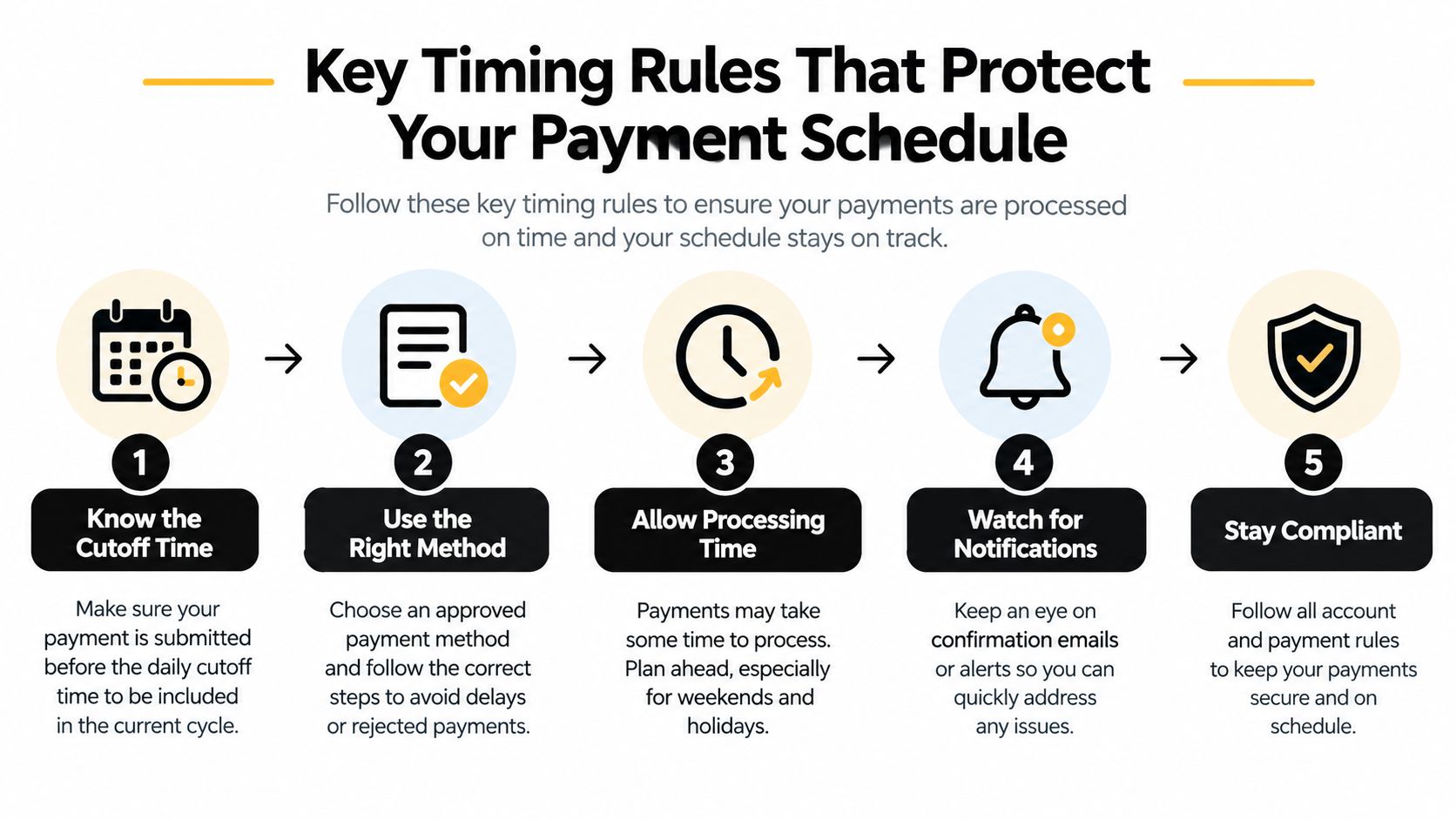
A payment can leave your bank account on time and still need checking. Federal rules require a billing statement to be sent so the payment is due no sooner than 21 days after the statement is transmitted, as described in Federal Student Aid's payment-preparation guidance. That window gives you time to read the bill and arrange payment, but it does not remove the need to confirm how your servicer processes transactions.
The due date is the contractual deadline. The posting date is when the servicer credits the payment to your account. They can differ if you pay near a weekend, federal holiday, daily cutoff time, or processing interruption.
A safer payment workflow
- Read the statement: Check the due date, required amount, account number, and processing instructions.
- Set an early reminder: Choose a personal send-by date several days before the contractual deadline.
- Check calendar conflicts: Review weekends and federal holidays, then allow the processing time your servicer requires.
- Save the confirmation: Keep the confirmation number, timestamp, and payment method.
- Verify posting: Recheck the account until the status changes from scheduled or pending to posted.
A Friday-evening payment before a holiday may remain pending after the calendar due date arrives. The due date itself may stay unchanged, while the transaction takes longer to complete. Your loan terms and servicer instructions determine how that payment is treated, so check them before relying on same-day submission.
Use two dates in your tracker: the contractual due date and your personal send-by date. This small buffer separates pressing “submit” from confirming that the servicer received and posted the payment. If the status does not update as expected, contact the servicer promptly and keep the confirmation available.
The Delinquency Timeline and Credit Consequences
A missed payment becomes delinquent the day after its due date. That status doesn't mean every credit consequence happens immediately, but it begins a timeline that becomes more serious as days pass. The Consumer Financial Protection Bureau's student-loan debt guidance distinguishes the contractual due date from later credit-reporting and default thresholds.
The risk varies by loan ownership:
| Timing point | What it means |
|---|---|
| Day after the due date | The payment is delinquent |
| Around 30 days past due | A private lender may report the delinquency |
| Around 60 days past due | A commercially owned FFEL loan may be reported |
| Around 90 days past due | A federal loan owned by the U.S. Department of Education is typically reported |
| Around 270 days past due | Federal student-loan default generally occurs |
These thresholds aren't permission to wait. A borrower should contact the servicer as soon as a payment is missed, even if credit reporting hasn't occurred. Processing errors, bank reversals, wrong account details, and changes in automatic payment instructions can all create problems that become harder to correct over time.
Why early intervention works
Consider a borrower whose automatic payment fails because a bank account was closed. A reminder before the due date might reveal the problem before the payment is submitted. If the failure is discovered afterward, checking the account immediately, contacting the servicer, and documenting the correction can prevent the missed date from progressing along the delinquency timeline.
The tracker should show more than a red calendar alert. It should distinguish due, pending, posted, past due, and resolved. That language gives the borrower a clearer view of whether the servicer has credited the payment.
A late payment is a process problem first, but it can become a credit problem if nobody acts.
Real-World Example From Graduation to First Payment
Consider a borrower who graduates on May 15 and remains eligible for the standard six-month grace period. The first payment will generally be scheduled around November, but the formal servicer notice determines the exact date. Federal Student Aid's repayment information confirms that the repayment schedule supplies the first due date, payment frequency, and required amount.

The borrower can map the transition like this:
- May 15: Graduation creates the starting point for the grace-period estimate.
- Summer: The borrower checks whether the school reported the enrollment change correctly.
- Before November: The borrower watches for the servicer's repayment notice and reviews the first amount due.
- First bill: The borrower records the exact due date, sets an earlier personal deadline, and checks the account after payment.
- After posting: The borrower saves confirmation and updates the recurring monthly schedule.
The same example can produce different results if the borrower drops below half-time enrollment earlier, returns to school, enters deferment, consolidates loans, or receives a payment pause. Loan type also affects interest treatment, so the borrower shouldn't infer the balance from the calendar alone.
A graduate organizing ceremony expenses may also benefit from practical guidance on Gradshop ordering tips for graduates, especially when graduation planning overlaps with the first repayment transition. The financial task remains separate: the servicer's formal notice, not the ceremony date, establishes the account's actual first due date.
The borrower who relies only on May 15 may miss a notice or misread November as a fixed date. The borrower who treats May 15 as the starting point, then verifies the servicer schedule, has a much stronger system.
A short visual walkthrough can reinforce how the dates fit together:
Tools and Strategies to Track Multiple Payment Dates
One calendar reminder works for one simple loan. It becomes unreliable when a borrower manages several loans, different servicers, changing balances, and separate due dates. A centralized tracker should show the account name, servicer, balance, interest rate, required payment, due date, personal send-by date, and posting status.
A useful workflow looks like this:
- Collect account details: Record each servicer's formal schedule rather than copying dates from memory.
- Set layered alerts: Use an early planning reminder, a payment reminder, and a posting-verification reminder.
- Review the debt picture: Compare balances, APRs, minimum payments, and available cash before choosing where extra money should go.
- Update after every change: Replace old dates after consolidation, deferment, forbearance, enrollment changes, or a new repayment plan.
A borrower with three loans might discover that one payment is due early in the month, another later, and a third has a different servicer portal. A single dashboard makes the schedule visible, while separate confirmation checks ensure that each transaction posts.
Toya AI is one option for this type of organization. It can connect student-loan accounts and display balances, APRs, utilization, and due dates in one dashboard, with reminders and smart alerts before upcoming payments. Borrowers comparing education expenses can also review practical information about paying for caps and gowns, while keeping those purchases separate from the recurring loan schedule.
For borrowers who want to estimate how a different payment amount could affect repayment, a student loan payment estimator can provide a starting point. Estimates should support account verification, not replace the servicer's confirmed due date.
The strongest system separates planning from proof. The calendar plans when to act, the servicer portal confirms what happened, and the debt overview helps the borrower decide how available money should be allocated.
How International Models Change the Payment-Date Question
A borrower moving from the United States to the United Kingdom can keep the same debt but face a different meaning of “payment date.” In the U.S., federal borrowers generally receive a billing statement and send scheduled payments to a servicer. In the UK, collection normally occurs through payroll or tax processes once income exceeds the applicable threshold, so there may be no fixed monthly bill from a loan servicer. The UK government's repayment guidance explains this income-based structure.
| Feature | United States | United Kingdom |
|---|---|---|
| Main collection model | Scheduled payments to a servicer | Payroll or tax collection when income exceeds the threshold |
| Starting trigger | Leaving school, graduation, or dropping below half-time enrollment for most federal Direct Loans | Normally the April after leaving a course |
| Annual reset | The servicer maintains the account schedule | Thresholds are recalculated each year on 6 April |
| Payment pattern | Usually monthly | Connected to payroll periods and earnings |
| Income below the applicable condition | The scheduled bill generally remains relevant unless the account status changes | Repayments automatically stop if employment ends or income falls below the threshold |
The calendar therefore works differently. A U.S. borrower usually tracks a contractual due date, a payment-processing window, and the date the transaction posts to the account. A UK borrower may need to track pay periods, earnings, the applicable plan, and when a deduction reaches the system. A payroll deduction can also appear on a payslip rather than as a familiar loan statement.
Part-time students in the UK may begin repayment in the April four years after the course started if the course lasts longer than four years. Reported annual income thresholds include £26,900, £29,385, £33,795, £25,000 for Plan 5, and £21,000 for postgraduate loans, depending on the plan. Undergraduate deductions are generally 9% above the relevant threshold, while postgraduate deductions are generally 6% above the postgraduate threshold. GOV.UK lists the current plan thresholds and deduction rates.
For students, expats, and cross-border workers, the first task is to identify the country, plan, collection method, and relevant income rule. That prevents a payroll deduction from being mistaken for a missed U.S.-style bill, or a U.S. due date from being treated as an automatic UK deduction.
Building a Reliable Payment-Date Management Routine
A dependable routine begins with the servicer's formal schedule and ends with a posted-payment check. The key steps are straightforward:
- Capture the exact due date: Save the notice and account screenshot.
- Mark the grace-period estimate: Use it for preparation, not as the final authority.
- Set an early personal deadline: Leave room for weekends, holidays, and processing.
- Check the statement: Confirm the amount and due date before sending money.
- Verify posting: Make sure the account records the payment as posted.
- Escalate quickly: Contact the servicer immediately after a missed or reversed payment.
- Review changes: Recheck the schedule after enrollment changes, deferment, forbearance, consolidation, or a payment pause.
Borrowers with several federal loans can also review how to consolidate student loans before making a decision, while remembering that consolidation can change the account structure and repayment schedule. The safest tracker records both the contractual date and the account status, rather than relying on a single recurring calendar alert.
Toya AI helps organize student loans alongside credit cards, auto loans, personal loans, and mortgages by centralizing balances, APRs, utilization, and due dates, then providing payment reminders and payoff planning. Visit Toya AI to connect accounts securely, replace scattered date notes with one dashboard, and build a clearer routine for every upcoming payment.
Ready to start your debt-free journey?
Toya AI builds a personalized payoff plan so you can see your debt-free date and save on interest.
Get Started Free