
What Happens if I Miss a Credit Card Payment in 2026
A missed credit card payment starts two clocks at once. The issuer can charge a late fee within days of the due date, typically about $32, but the credit bureaus usually receive no delinquency report until the payment is at least 30 days past due.
That gap is the whole game. The statement said due on the 15th, the money was there on the 14th, and then a card on file expired or a paycheck landed a day late and the balance now sits past its date. What follows is rarely a question about the definition of delinquency. It's a question about the next hour, and about which clock is running and how much time is left on it.
People who search for what happens if I miss a credit card payment are often picturing a seven-year scar. The realistic picture is a fee, a phone call, and a deadline near the end of the month that decides whether the miss stays a fee or becomes a credit event. Here's how each stage works, in order, with the dollar amounts attached.
Table of Contents
- What Happens Day by Day After a Missed Payment
- Steps to Take in the First 72 Hours After a Missed Payment
- What Late Fees and Penalty APR Add to Your Balance
- How Missed Payments Affect Your Credit Score Over Time
- Which Bills to Protect When You Cannot Pay Everything
- Set Up Due-Date Protection Before Your Next Bill
What Happens Day by Day After a Missed Payment
Two clocks start on the same morning. The first is the issuer's fee clock, which is contractual and fast: it runs from the due date and doesn't care about credit reporting at all. The second is the reporting clock, which is slower and governed by how issuers furnish data to the bureaus.
The scale of that first clock is easy to underestimate. The Consumer Financial Protection Bureau's 2025 credit card market report found that issuers charged approximately $4.2 billion in late fees in the fourth quarter of 2024 alone, and that delinquency rates by year-end 2024 stood at 3.0% for general-purpose cards and 3.8% for private-label cards. A missed payment is common. It is not a rare moral failure, and it is not automatically catastrophic.
Why the fee and the credit mark aren't the same event
The fee arrives when the due date passes. The credit mark arrives much later. As Experian's explanation of late fees sets out, a payment generally isn't reported as delinquent to the three nationwide bureaus until it's at least 30 days past due, so paying before that threshold can prevent the mark even though the fee and any lost promotional benefits remain.
Reporting isn't instant on day 30 either. Experian's answer on whether one 30-day late payment hurts a score notes that creditors typically update bureaus on a monthly cycle, which is why acting immediately beats assuming there's slack in the calendar.
Under the CFPB's guide to reading a card agreement, a penalty APR can apply when a cardholder pays late, exceeds the limit or has a payment returned, and once the account is more than 60 days delinquent that higher rate can reach the existing balance, not just new purchases.
Consequences of a missed credit card payment by days past due
| Days past due | Typical fee and rate effect | Credit reporting | Escalation risk |
|---|---|---|---|
| 1 to 29 days | Late fee, typically about $32; interest continues at the current APR | Usually not reported as delinquent | Fees repeat if the payment stays unpaid |
| 30 days | Late fee plus possible loss of promotional APR | Can be reported as delinquent | Score may drop; issuer may restrict the account |
| 60 days | Late fee; penalty APR may apply to the existing balance | Second delinquency can be reported | Higher interest on old and new balances |
| 90 days | Fees and penalty APR continue; credit line may be reduced | Serious delinquency on the credit report | Account may be suspended or closed |
| About 180 days | Balance may be charged off | Charge-off and collection activity | Debt may be sold or sent to a collection agency |
Two people illustrate the split. Maria's payment is due on the 15th and she pays on the 20th, so she owes the fee and keeps her report clean. Dan is 46 days late, which means the delinquency can already be on his file and the issuer can be pricing his existing balance at a penalty rate. Same missed payment, different clock.
Do this today: find the days-past-due count printed on the statement or in the app, then read the row above that matches it. That number, not the fee, decides the next move.
Steps to Take in the First 72 Hours After a Missed Payment
The first three days are where a fee stays a fee. The sequence below is ordered by what protects the account fastest, and each step carries the reason behind it and the mistake that undoes it.
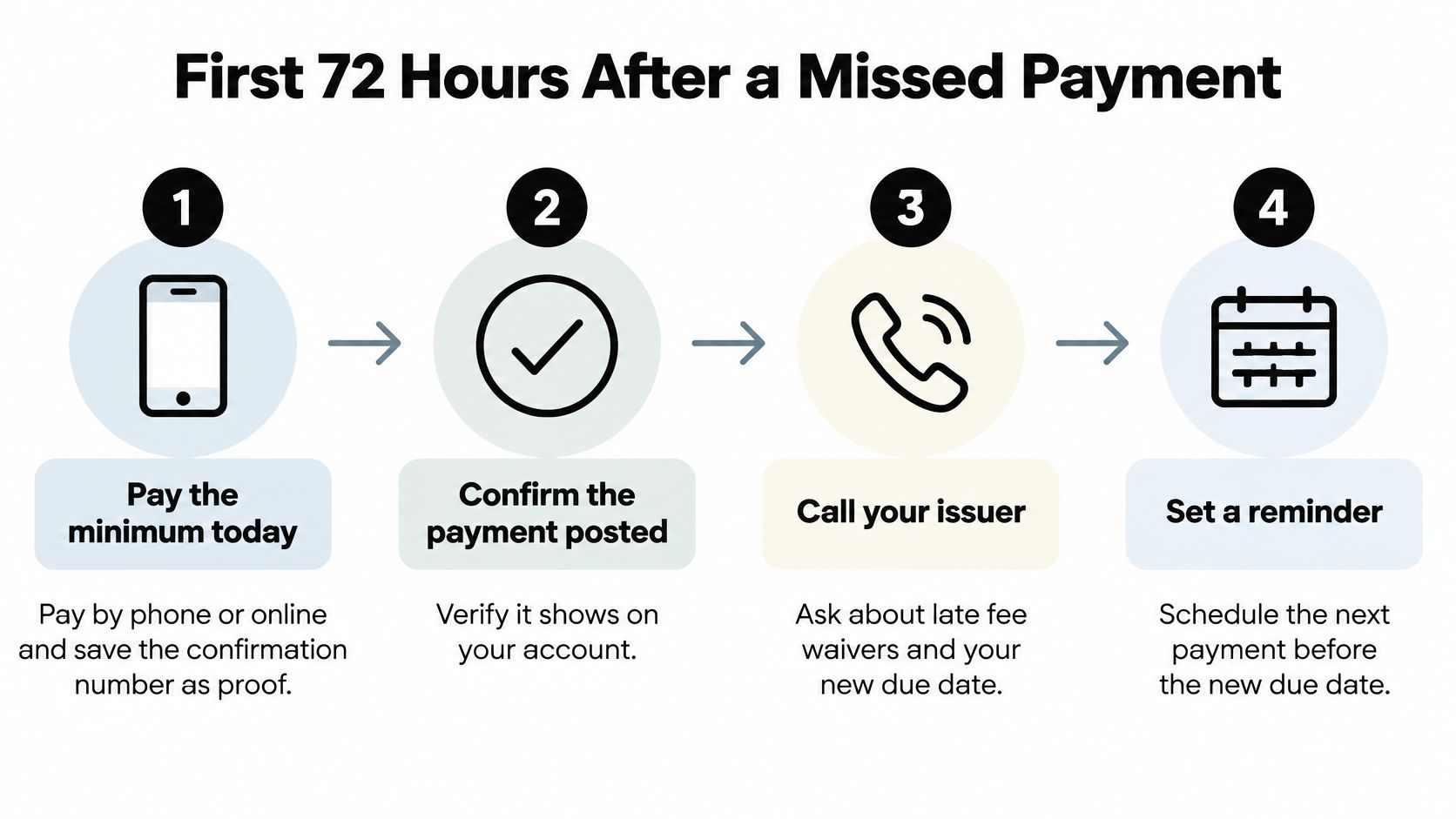
- Pay at least the minimum today, then save the confirmation number. A posted payment is the only evidence that counts if anyone later disputes whether the money arrived on time. The common slip is assuming a phone payment lands the same second it's authorized. Ask the agent when it posts, and whether the fee will be deducted from the payment or billed separately.
- Find out why the payment failed. An expired card, a closed funding account or autopay pointed at a bank the household switched away from are the usual culprits. Fix the source before the next cycle, because an unfixed source produces a second miss and a second fee.
- Call the issuer the same day and ask for the fee waived. One accidental miss against a long run of on-time payments is the strongest case a cardholder can make. Waivers aren't given unasked.
- Ask two specific questions about reporting and pricing. Whether the account has been or will be reported to the bureaus, and whether the rate on the account has changed. Write down the agent's name, the date and the answer.
- Stop new charges until the statement shows current. Fresh purchases can sit at a higher rate, and they muddy the amount that has to be paid to cure the account.
- If cash is short, request hardship terms in writing. The rate, the balance affected and the length of any reduced payment arrangement all need to be on paper, not just spoken on a call.
- Set the next reminder before hanging up, then verify on the statement. Confirming the account reads as current, not just paid, closes the loop.
The mistake that costs the most
A missed payment doesn't appear on a credit report the next day. Creditors commonly report only after the delinquency reaches a reporting threshold, and the FDIC's guidance on credit reports is clear that late payments still damage scores once they're reported. That delay is a working window, not a grace period.
For a walkthrough of the call itself, including how to phrase the waiver request, this video covers the sequence in order.
A phone payment isn't posted until the issuer's system says it is. A waiver isn't granted until someone asks for it. Both assumptions cost money.
What Late Fees and Penalty APR Add to Your Balance
A late fee is a fixed charge, which makes it most expensive precisely when the overdue amount is small. Borrowing a $100 minimum payment for one month and paying an $8 late fee works out to an effective annual percentage rate of 96%, per an analysis in the Federal Register. On a percentage basis, that fee is the most expensive money on the statement.
Interest is the slower, larger cost. Experian's guide to what to do after a missed payment reports that missing two payments can trigger a penalty APR often around 29.99% or higher, potentially applying to the current balance and new purchases, and that some issuers cancel an introductory 0% APR after a single miss. The same guidance notes that when a penalty APR is imposed because of a late payment, the issuer generally must review the account after six months of on-time payments and reduce the rate if the required conditions are met.
Monthly interest on a $5,000 balance at standard and penalty APRs
| APR | Monthly interest on $5,000 | Difference from 19.99% |
|---|---|---|
| 19.99% standard APR | about $83 | $0 |
| 24.99% higher APR | about $104 | about $21 more |
| 29.99% penalty APR | about $125 | about $42 more |
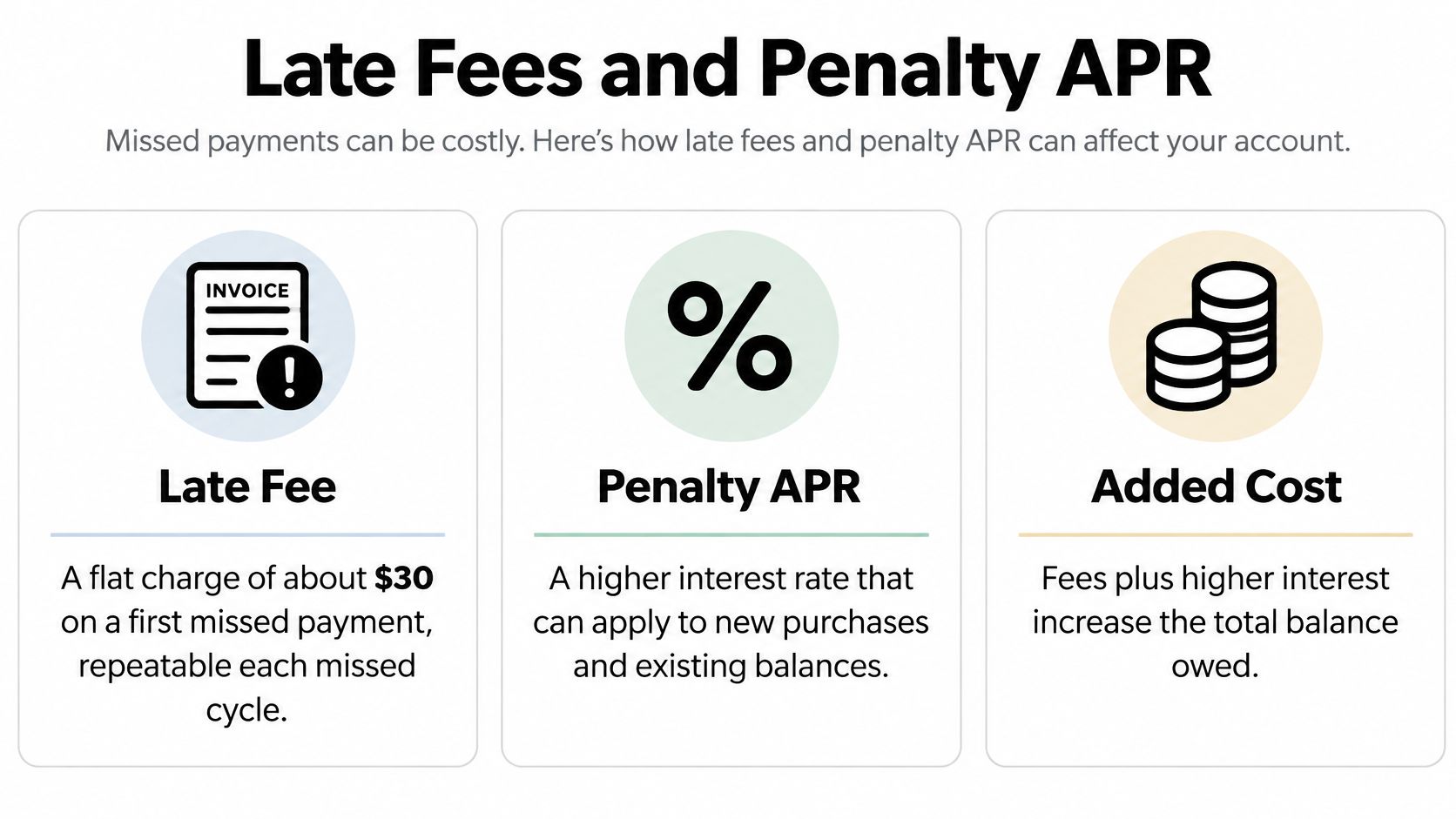
That last row is the one to hold onto. A $42 monthly gap is roughly the size of a modest utility bill, and it buys nothing. If the difference between simple interest and a compounding daily balance is still fuzzy, this explanation of how credit card interest works walks through the daily balance method.
Three numbers to copy from your card agreement
Open the agreement PDF, search for "penalty", and write down three figures: the late fee amount, the penalty APR, and the review date. The review date is the one often overlooked, and it's the date six months of on-time payments could pull the rate back down.
A worked case makes the mechanism concrete. Say a card carries a $1,200 balance at a 0% promotional rate and the promotional terms end because a payment was missed. From the next cycle, interest starts accruing on that $1,200 at the standard or penalty rate, and the balance stops shrinking at the speed the plan assumed.
Practical rule: stop new charges, pay the minimum immediately, and confirm the exact APR and the balance it applies to before the next statement closes.
One more lever matters after the account is cured. Under 12 CFR 226.53, any amount paid above the required minimum generally goes first to the highest-APR balance. On a card with $500 at 29% and $1,000 at a 0% promotional rate, an extra $200 goes to the 29% balance first. The exception is a deferred-interest promotion, where in the final two billing cycles before it expires, excess payments must generally go to that balance instead. Check that expiry date before assuming the extra money hits the expensive debt.
How Missed Payments Affect Your Credit Score Over Time
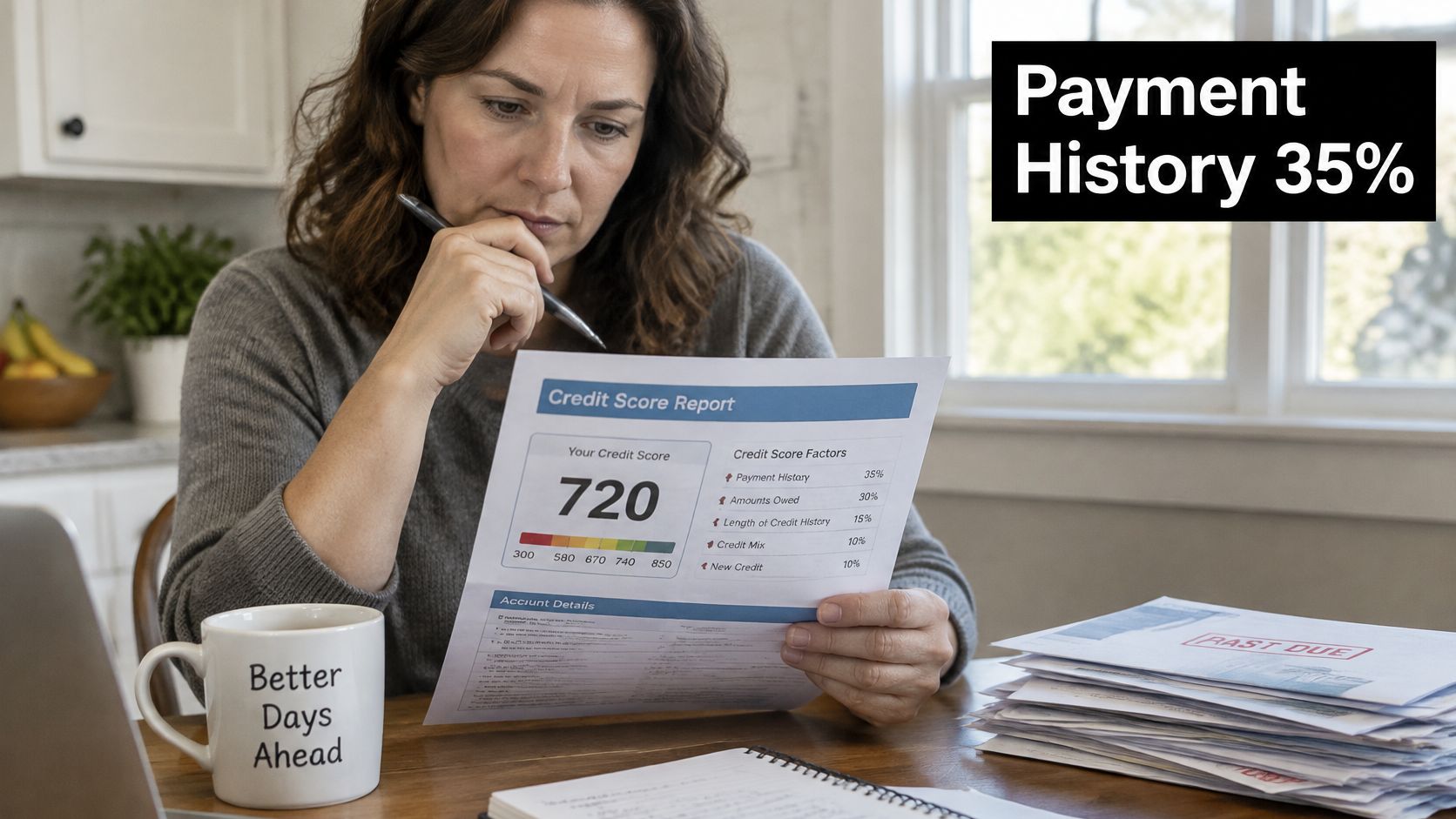
The score doesn't react to the fee. It reacts to the mark. FICO's explanation of late payments states that payment history represents 35% of a FICO Score, making a missed payment one of the most consequential negative events in common U.S. credit scoring, and that its models weigh three things: how recent the late payment is, how severe, and how often it happens.
The ladder, in order
A 30-day mark is the entry point, and it's also the cheapest to recover from. A 60-day mark adds severity, and a 90-day mark is materially worse than either because it signals three full cycles without payment. If the account stays unpaid, it progresses to charge-off or collection activity, which FICO describes as a significant event likely to cause a severe negative impact.
Timing is the part readers underestimate. A reported late payment can remain on a credit report for up to seven years, but its weight fades as consecutive on-time payments accumulate, so rebuilding typically begins long before the mark disappears.
What the damage costs beyond the card
The card is where the mark is recorded. The bill arrives somewhere else. Lower scores raise the price of future borrowing, cut approval odds, and feed into decisions that don't look like lending at all, including rental screening and insurance pricing in states that use credit-based scores.
Consider two renters applying for the same unit. The first has a single 30-day mark from a card payment that slipped during a move; a landlord may still approve, sometimes with a larger deposit. The second has a 90-day delinquency that turned into a charge-off; the application stalls. Same property, different answer.
Recovery has three levers: at least the minimum on autopay every month, balances kept low relative to limits so utilization doesn't compound the damage, and a written goodwill request to the issuer after a single accidental mark on a long clean history.
Then verify. Pull the free reports, find the late payment entry, and check that the reported date matches the statement. A reported late date that doesn't match what the records show is a dispute, and it's one worth filing in writing.
Which Bills to Protect When You Cannot Pay Everything
Spreading scarce cash evenly across every bill feels fair. It's usually the most expensive strategy available, because the bills aren't equally dangerous. The Federal Reserve's note on recent consumer delinquency dynamics put credit card delinquency, defined as balances at least 30 days past due, at 4.14% on June 30, 2025, after rates had reached their highest level since 2010 in the prior year before flattening in the first half of 2025.
The same Fed household data show how people cope: 42% paid one or more bills late and 23% used a credit card to pay a bill over time. Both moves trade a short-term problem for a longer one when the card is the thing already under strain.
Bill priority when cash is short
| Bill | Consequence of falling late | Priority when cash is short |
|---|---|---|
| Rent or mortgage | Late fees within days; eviction or foreclosure after prolonged default | Highest |
| Utilities and essentials | Service disconnection and reconnection fees | High |
| Auto or secured loan | Repossession risk after prolonged default | High |
| Credit card minimum | Late fee; reporting at 30 days; penalty APR possible | Keep under the 30-day mark |
| Student loan | Delinquency reporting; collection after extended default | Contact the servicer about repayment options |
| Personal loan or other unsecured debt | Late fee; reporting at 30 days; collections | Pay the minimum and request a hardship plan |
Working the example
Say a household has $600 available, a $1,000 rent payment, a $60 card minimum and a $150 personal loan payment due in the same week. Rent goes first, full stop, because eviction risk dwarfs every other consequence on the list. The $60 card minimum goes next, because it keeps the account on the safe side of the 30-day line. The personal loan lender gets a call, not a partial payment, asking for a due-date change or a hardship plan.
That call is where bargaining power comes from. A borrower with a clean history asking before the due date has more room than one asking after two missed cycles. What to request, specifically: a hardship program, a temporary reduced rate, or a short payment arrangement, with the terms confirmed in writing so the rate and the balance affected are documented.
The question to answer before paying anything: which payment prevents the greatest long-term damage? It's almost never the smallest bill or the loudest collector.
One warning. A cash advance or a balance transfer with a fee can pull a household out of a missed payment and straight into deeper revolving debt, which is the trap the Fed's household figures describe. Student loans have their own servicer-specific options, covered in this guide to student loans and credit cards, and they shouldn't be funded with a card either.
Set Up Due-Date Protection Before Your Next Bill
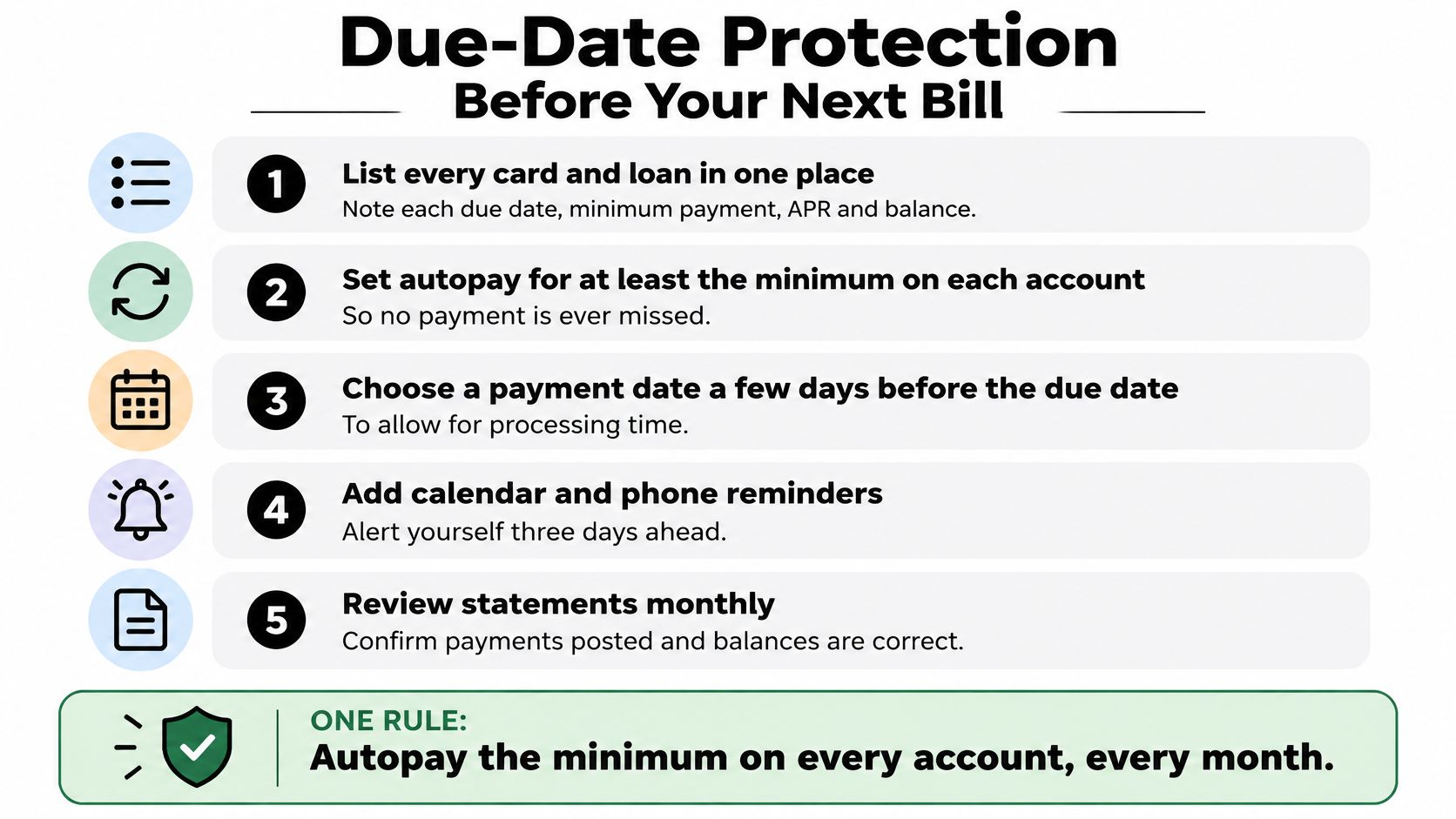
Prevention here is a setup task, not a discipline problem. Five steps remove most of the ways a payment slips.
- List every card and loan in one place. Due date, minimum payment, APR and balance, all on one page. The account that gets missed is almost always the one whose due date nobody wrote down.
- Set autopay for at least the minimum on every account. Fund it from an account that carries a cash buffer, and remember autopay fails when the funding account is short or the card on file has expired. That's the failure nobody catches, because the borrower assumes the system handled it.
- Add reminders a few days before each date. Three days is enough room to move money; a reminder on the due date is a notification, not a plan. Fluidwave's guide to avoiding deadline burnout is useful for the habit side of this, since the same pattern that saves a work deadline saves a payment date.
- Keep a cushion covering one month of all minimum payments. The buffer is what makes the autopay reliable when a paycheck lands a day late.
- Review each statement for fees, a reported late mark or a changed APR. Dispute errors in writing rather than by phone. If the statement closing date and the due date still blur together, this explanation of the credit card payment due date separates them.
Toya AI handles the first and third steps in one place. Its free tier lets users connect unlimited accounts and track balances, APRs and due dates across every debt at no cost, and it offers payment reminders and financial insights so a due date surfaces before it becomes a fee.
One rule to remember: if a payment slips, act within the first days and confirm the account reads as current well before day 30.
Toya AI builds a payoff plan from real balances, APRs and due dates, so one late payment appears against the whole picture instead of in isolation, and the impact on a debt-free date shows up immediately when something changes. The free tier connects unlimited accounts and tracks every due date at no cost, while the Pro trial adds AI-powered planning and next-best-payment guidance. Visit Toya AI to see the next payment before the next due date arrives.
Ready to start your debt-free journey?
Toya AI builds a personalized payoff plan so you can see your debt-free date and save on interest.
Get Started Free