
Loan Payoff with Extra Payments: A Practical Guide
A borrower can make every payment on time and still feel trapped. The balance drops by only a small amount, the interest charge keeps returning, and the original payoff date looks just as distant as it did years ago. That frustration usually comes from the way an amortizing loan allocates each payment, not from a failure to pay.
Loan payoff with extra payments works when surplus cash reaches principal early and consistently. The strategy can shorten the schedule and reduce lifetime interest, but only if the servicer applies the money correctly and the borrower doesn't sacrifice an essential cash buffer. The most effective plan combines amortization math, payment verification, debt prioritization, and regular recalculation.
Table of Contents
- Why Extra Payments Change Your Loan So Dramatically
- The Math Behind Shorter Term, Insane Interest Savings
- How to Direct Extra Cash Straight to Principal
- Avalanche vs Snowball and Which One Wins
- Use a Payoff Calculator Before You Send a Cent
- When Extra Payments Are Not the Smartest Move
- Your 30-Day Loan Payoff Action Plan
Why Extra Payments Change Your Loan So Dramatically
Early in an amortizing loan, the balance is large, so the interest calculation has a large base. The scheduled payment covers accrued interest first, leaving the remaining amount to reduce principal. That's why a borrower can make years of payments and still see the balance move slowly.
An extra payment changes the calculation immediately when it is applied to principal. The next interest charge is based on a smaller balance, so more of the following scheduled payment can reduce principal. The effect repeats across the remaining schedule, which is why an extra dollar paid near the beginning can save more than the same dollar paid near the end.
The Consumer Financial Protection Bureau's repayment advice explains that extra payments can help borrowers save time and interest. The U.S. Department of Education also notes that paying a little extra each month can reduce interest and the total cost over the life of a loan.
Practical rule: An extra payment only does its intended work when the lender applies it to principal rather than treating it as a future installment.
Borrowers who want broader repayment ideas can also review Wealth Collective repayment advice, particularly when deciding between recurring overpayments and occasional lump sums. The core decision remains simple: preserve enough liquidity to handle financial shocks, then direct sustainable surplus cash toward the balance that creates the greatest cost.
The Math Behind Shorter Term, Insane Interest Savings
The mathematics is straightforward. A scheduled payment covers interest calculated on the outstanding principal. When an extra amount reduces that principal, every later interest calculation starts from a lower balance. The borrower then pays interest on less debt and reaches the final payment sooner.
A concrete student-loan example makes the mechanism easy to repeat. On a $20,000 student loan at 5% with a standard 10-year term, NerdWallet gives a monthly payment of $212. Adding $100 per month pays the loan off nearly four years sooner and saves $2,000 in interest, according to its student-loan extra-payment example.
The calculation follows four steps:
- Start with the scheduled balance. The lender calculates interest from the principal still outstanding.
- Apply the extra amount to principal. The balance falls beyond what the regular payment would have achieved.
- Recalculate the next interest charge. The lower balance produces a lower interest amount.
- Repeat the process. The borrower reaches the final payment earlier because each period begins with less debt.
A separate Wells Fargo mortgage illustration shows the same effect at a larger scale. Adding $100 per month can cut the term by more than 4.5 years and reduce total interest by more than $26,500. Adding $200 per month can shorten the term by more than 8 years and reduce interest by more than $44,000, according to Wells Fargo's amortization guidance.
| Extra Payment Impact: Mortgage vs Student Loan | Original Payoff Date | New Payoff Date | Time Saved | Interest Saved |
|---|---|---|---|---|
| Mortgage, $100 extra monthly | Not specified in the example | More than 4.5 years earlier | More than 4.5 years | More than $26,500 |
| Mortgage, $200 extra monthly | Not specified in the example | More than 8 years earlier | More than 8 years | More than $44,000 |
| Student loan, $100 extra monthly | 10 years | Nearly 6 years | Nearly 4 years | $2,000 |
The timing matters as much as the amount. A front-loaded extra payment reduces the balance across more future periods, while a late extra payment has fewer interest calculations left to affect. Even payments made every two weeks can change the schedule. Wells Fargo says paying $477.50 every two weeks instead of one monthly $955 payment can shorten a mortgage term by more than four years and save over $22,000 in interest.
How to Direct Extra Cash Straight to Principal
The borrower should begin with the servicer portal or loan agreement, not with a transfer. The payment screen may offer a choice such as principal only, additional principal, or future payment. The correct selection is the principal option.
A reliable process looks like this:
- Open the payment settings. Confirm whether the portal supports a one-time principal payment and a recurring principal instruction.
- Select the principal designation. Don't assume an amount above the required payment will automatically reduce principal.
- Add a written instruction when available. A memo or payment note should state that the surplus is for principal reduction.
- Check the posting date. A payment made while another payment is still processing can be placed in suspense or handled in an unexpected way.
- Save the confirmation. The confirmation number, date, and selected allocation create a record if the servicer misapplies the money.
The Toya explanation of principal payments gives borrowers a useful foundation for understanding why the allocation matters. The same discipline applies to people comparing repayment with a tax-deductible investment loan strategy, because tax treatment and loan application rules can change the result.
The audit happens after posting. The next statement should show the extra amount under principal reduction, not as a prepaid future installment, unapplied balance, or suspense amount. The new principal balance should also match the borrower's expected calculation closely enough to explain any difference.
A payment confirmation proves that money left the borrower's account. The next statement proves whether the lender used it correctly.
Red flags include a balance that did not fall by the expected extra amount, a payment marked as paid ahead, no visible principal allocation, or a changed due date without a meaningful balance reduction. The borrower should contact the servicer in writing, request correction, and retain both the original instruction and the statement showing the error.
Avalanche vs Snowball and Which One Wins
The debt avalanche directs every surplus dollar to the debt with the highest APR while minimum payments continue on all other accounts. The debt snowball targets the smallest balance first, regardless of rate. Avalanche is the mathematically stronger choice when the goal is minimizing interest, while snowball can create an early psychological win that helps a borrower stay consistent.
A peer-reviewed study summarized in the debt repayment analysis found that, for the median household in one modeled case, snowballing cost 24.5% more interest, or $4,031 more, than avalanche. The same analysis also recognizes the behavioral benefit of closing accounts sooner.
LendingTree examples show why the decision isn't always dramatic. In one scenario, both approaches took 57 months, with total interest of $17,039 for avalanche and $17,068 for snowball. In another, avalanche finished one month sooner and saved $1,292, with interest of $3,842 compared with $5,134 for snowball.
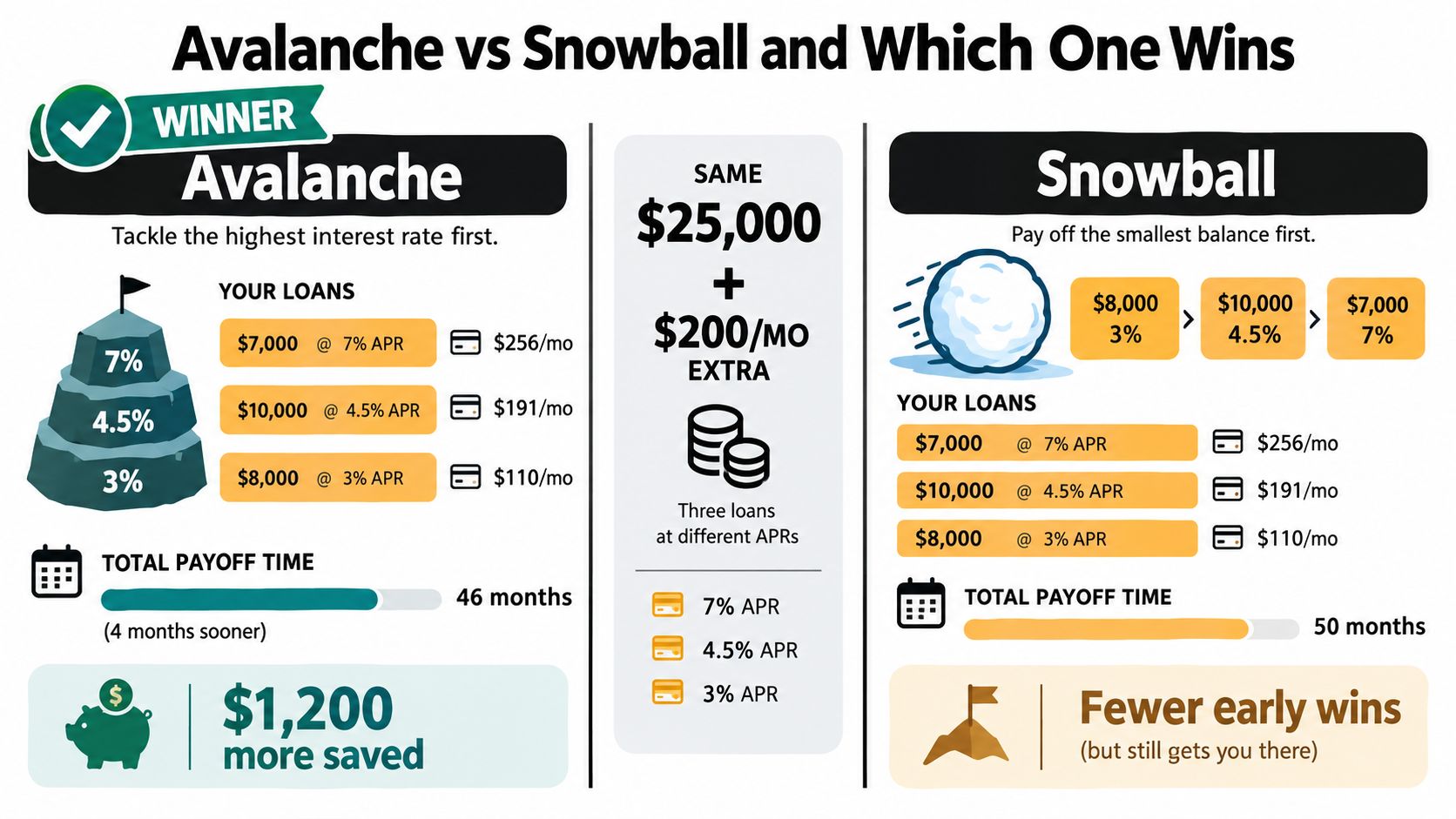
A borrower with stable cash flow and a wide APR gap should choose avalanche. A borrower who repeatedly abandons plans may choose snowball if eliminating a small balance creates the momentum needed to continue. A hybrid can work too, with the smallest balance receiving attention for a quick win while the highest-APR account receives the largest sustainable extra payment.
The interest gap shrinks when the surplus is large enough to eliminate any targeted loan quickly. The behavioral question then matters more: which plan will the borrower follow without missing minimum payments or redirecting the money elsewhere?
For a more detailed prioritization framework, see which debt should be paid off first.
Use a Payoff Calculator Before You Send a Cent
Before sending extra money, run the loan through a calculator. Enter the current balance, interest rate, remaining term, regular payment, and proposed extra amount. Compare the revised payoff date with total interest, then test several payment levels. Use a loan payoff calculator to compare multiple extra-payment scenarios side by side.
The schedule should show each period's interest, principal, and ending balance. That detail matters because a payment can look large while producing a smaller balance reduction than expected. After the payment posts, check your servicer's transaction history and confirm that the extra amount was credited to principal, not held for a future installment. If the balance barely changes, contact the servicer and correct the payment instructions before sending more.
Bankrate's example identifies the inputs needed for a useful calculation: the remaining term, original term, original loan amount, extra payment amount, and interest rate. Its additional mortgage payment calculator helps organize those figures. Total Mortgage's example shows the effect of recurring additions to a 30-year mortgage. An extra $100 per month saves $69,338 in interest and produces a payoff term of 25 years and 10 months. An extra $200 per month saves $116,640 and cuts the term to 22 years and 11 months, according to Total Mortgage's extra-payment calculator.
| Extra payment | Payoff term | Time saved | Interest saved |
|---|---|---|---|
| $100 per month | 25 years and 10 months | 4 years and 2 months | $69,338 |
| $200 per month | 22 years and 11 months | 7 years and 1 month | $116,640 |
Use your own balance and rate for the final decision. Recalculate after a rate change, loan recast, refinance, or escrow adjustment because the required payment or remaining schedule may change. Run one scenario that preserves a cash buffer and another that applies the maximum sustainable amount. In 2026, borrower payment behavior makes that comparison practical: choose the amount you will keep sending, verify every credit, and review refinancing before committing spare cash.
Calculator discipline: Select the largest extra payment that still works during an ordinary difficult month. Then confirm that the servicer applies every additional dollar to principal.
When Extra Payments Are Not the Smartest Move
“Pay extra” is not a universal command. The right amount depends on liquidity, other debts, and available refinancing terms. A borrower who empties savings to reduce a loan balance may become financially weaker after the payment, even if the amortization schedule improves.
Borrower behavior has already shifted with changing rates and household cash pressure. In 2026 coverage, roughly 25% of Rocket Mortgage customers had made at least one extra annual principal payment by the end of January, down from almost 30% in 2022, according to Fast Company's reporting on mortgage paydown behavior. Higher-rate borrowers from the 2023 to 2025 period were less likely to make extra payments, even though they could have more interest to avoid.
The decision should pass three gates:
- Cash buffer: A starter emergency fund comes before aggressive prepayment when income or expenses are unstable.
- Higher-cost debt: Revolving debt with a higher APR usually deserves priority over a lower-rate installment loan.
- Refinancing review: A credible refinance offer can change the best use of surplus cash, especially when the new rate meaningfully lowers the required interest cost.
The practical comparison isn't extra payment versus doing nothing. It is extra principal versus liquid savings versus refinancing, evaluated with current loan terms and household cash flow. A borrower should keep the payment modest or pause it when a major expense is approaching, income is uncertain, or the cash buffer is too thin to absorb a setback.
Your 30-Day Loan Payoff Action Plan
A focused four-week rollout can turn a vague intention into a verified payment system. Each week should produce a concrete result, not another spreadsheet that never changes the borrower's behavior.
Week one, audit. Every statement belongs in one list. The borrower records each balance, APR, minimum payment, servicer, due date, and current payoff date. The checkpoint is simple: can every debt be seen on one page without logging into multiple accounts?
Week two, confirm. The borrower locates the principal-only setting, tests the payment workflow, and asks the servicer in writing how extra funds are applied. The expected outcome is a saved confirmation and a clear answer about whether recurring transfers post directly to principal.
Week three, model. The borrower runs a baseline scenario and then tests sustainable extra-payment amounts, including a recurring amount and a possible lump sum. The calculator should show the payoff date, interest cost, and balance path for each option. Avalanche is the default for interest minimization, while snowball remains valid when early account closures are necessary to maintain consistency.
Week four, automate and track. The chosen principal payment is scheduled, and the borrower creates a compact dashboard showing the balance, next due date, extra amount, and expected payoff date. After the first payment posts, the next statement must confirm principal crediting. If the balance, allocation, or schedule is wrong, the servicer receives a written correction request before another payment is sent.
The final sign-off checklist has four items:
- Every loan is listed with current terms.
- The extra-payment instruction is documented.
- The chosen strategy fits the available cash buffer.
- The first extra payment appears as principal reduction on the next statement.
Toya AI centralizes balances, APRs, utilization, and due dates, then models how extra payments change the debt-free date and total cost across loans. Borrowers can visit Toya AI to test payoff scenarios and build an adaptive plan that can be reviewed as cash flow and loan terms change.
Ready to start your debt-free journey?
Toya AI builds a personalized payoff plan so you can see your debt-free date and save on interest.
Get Started Free