
What Is a Loan Payoff: Terms, Math, and Action Steps
A loan payoff is the date-specific amount required to bring a loan balance to zero and close the account, including principal, accrued interest, and any lender fees. It isn't always the same as the balance displayed on a statement because interest can accrue daily and charges may still be pending.
A borrower selling a car, refinancing a mortgage, or trying to eliminate debt may open an online account and see a clean, reassuring number. The temptation is to send that amount immediately. The safer move is to request a written payoff quote that's valid for the date the lender will receive the funds.
Table of Contents
- The Moment You Realize Your Balance Is Not Your Payoff
- Core Loan Payoff Terms Explained Simply
- How Interest Accrues and Changes Your Payoff
- How to Request and Verify a Payoff Quote
- Payoff Examples Across Four Common Loan Types
- Common Payoff Mistakes and How to Avoid Them
- Building a Plan to Pay Off Loans Faster
- Your Next Steps Toward a Debt-Free Finish Line
The Moment You Realize Your Balance Is Not Your Payoff
A borrower sells a car and checks the lender's website before the buyer arrives. The account shows a balance of $12,450, so the borrower wires exactly $12,450 and assumes the loan is finished.
Two weeks later, a letter arrives. The loan is still open, with a small remaining balance and a returned-payment fee. The problem wasn't necessarily the borrower's intention or the lender's arithmetic. The problem was using a current balance as though it were a final settlement figure.
A payoff amount includes the principal still owed, interest accrued through the requested payoff date, and applicable lender charges. The Consumer Financial Protection Bureau's explanation of payoff amounts makes the central distinction clear: the payoff amount is the exact amount required to satisfy the debt completely, while the current balance may not include accrued interest or other charges.
Practical rule: A statement balance tells a borrower where the account stood when the statement was prepared. A payoff quote tells the borrower what the lender needs on a particular date.
That date matters because mortgage interest accrues daily, and many other loans also calculate interest between scheduled payments. A quote issued for one date may be too low if the funds arrive later. Fees, escrow advances, late charges, or lien-release costs can also change the final figure.
The rest of the payoff process depends on a few terms, a simple understanding of daily interest, and a verification routine. Once those pieces are clear, paying off a loan becomes less like guessing at a balance and more like settling a final invoice.
Core Loan Payoff Terms Explained Simply
The word “payoff” can refer to a number, a document, or an action. Lenders may use the terms slightly differently, so borrowers should read the line items rather than rely on the label alone.
Five terms that prevent confusion
- Payoff amount: The all-in amount needed to satisfy the loan on a specified date. It generally combines remaining principal, accrued interest, and eligible fees.
- Payoff statement: The lender's written document showing the amount due, the calculation date, the good-through date, and the items included in the total. An overview of payoff statements describes why this document differs from a current balance.
- Payoff letter: A formal lender response stating what must be paid to terminate the loan and, for secured debt, release the lender's lien. A discussion of payoff letters in secured lending explains their role when a new lender replaces an old one.
- Payoff balance: A phrase that can mean the amount required to close the loan, but some lenders use it to describe only the principal portion. The document's definitions control.
- Payoff in full: The act of sending the quoted amount and having the lender apply it so the account is satisfied and closed, or otherwise formally released according to the loan agreement.
A restaurant analogy helps. The running tab resembles the current balance. It shows what has been recorded so far, but the final checkout receipt can add tax, a service charge, and a tip. The payoff statement is that final receipt, with the lender's calculation replacing the restaurant's charges.
| Term | What It Means | What It Includes |
|---|---|---|
| Payoff amount | Final amount due on a stated date | Principal, accrued interest, and applicable fees |
| Payoff statement | Written lender calculation | Line items, good-through date, and payment instructions |
| Payoff letter | Formal payoff response | Amount needed to terminate the agreement and release collateral when applicable |
| Payoff balance | Lender-specific balance label | May mean the full payoff or only a principal component |
| Payoff in full | Completed settlement action | Payment application, account satisfaction, and closure or release |
A good-through date is not decorative. If the loan remains open after that date, interest may continue to accrue, requiring a revised amount. Borrowers should also distinguish a pay down from a payoff. A pay down reduces a line's balance while leaving the account available, whereas a payoff brings the balance to zero and closes the line, as explained by this comparison of pay down and payoff.
How Interest Accrues and Changes Your Payoff
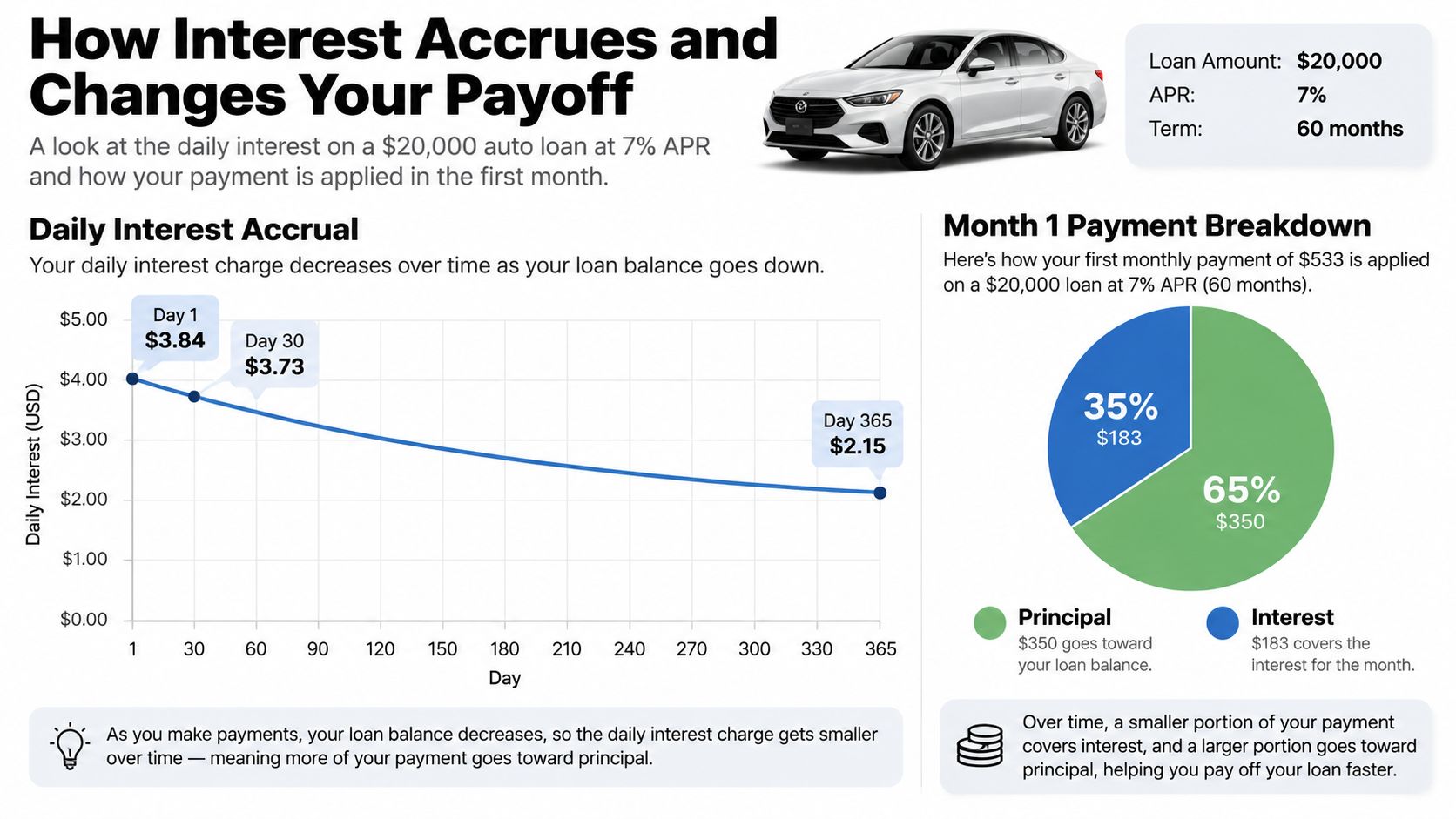
Amortization turns a loan payment into two moving pieces. One portion covers accrued interest, while the rest reduces principal. Early in an amortized loan, interest usually takes the larger share because the balance is larger. As principal declines, the interest portion generally shrinks and more of each scheduled payment reaches principal, as described in the CFPB's amortization explanation for auto loans.
For a simple illustration, consider a $20,000 auto loan at 7% APR. A daily interest estimate starts with the annual rate divided by 365, then applies that daily rate to the outstanding balance. On the opening balance, the daily charge is approximately $3.84, because $20,000 multiplied by 7% and divided by 365 produces that result. As the balance falls, the daily charge falls too. The supplied visualization shows $3.84 on Day 1, $3.73 on Day 30, and $2.15 on Day 365.
A mortgage payoff uses the same basic timing idea when per diem interest applies. On a $240,000 balance, a 7% annual rate would produce approximately $46.03 per day using 1/365 of the annual rate. Across 15 days, that's approximately $690.41 in interest before considering the loan's actual calculation rules, payments, and fees. HUD guidance describes this daily-factor method and notes that certain primary-residence purchases may receive a credit for up to seven calendar days of per diem interest. Borrowers should rely on the lender's quote, not a hand calculation, because contract terms control.
The same principle applies to student loans, but unpaid interest can create a more serious complication. When unpaid interest capitalizes, it's added to principal, and future interest is then charged on the larger base. The CFPB explains how this can contribute to negative amortization, where scheduled payments don't cover accrued interest and the balance rises despite payments.
For a deeper walkthrough of monthly interest mechanics, borrowers can use this monthly interest calculation guide.
A short video can reinforce the difference between principal reduction and interest accrual:
Because interest continues between scheduled payment dates, a payoff quote carries a good-through date. A delay in funding can turn a correct quote into an incomplete payment.
How to Request and Verify a Payoff Quote
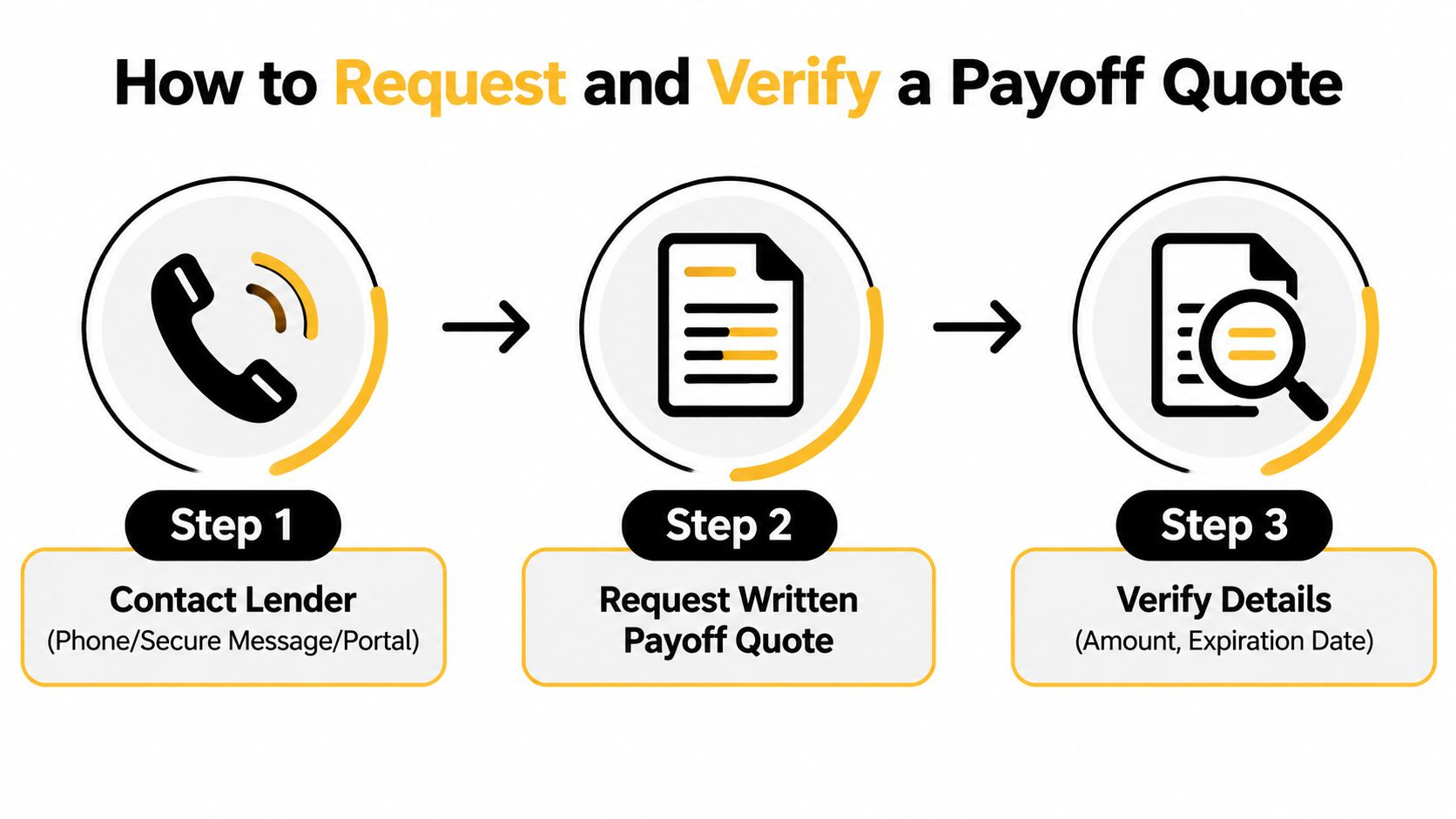
The safest request is specific: ask for a written payoff quote, not the current balance. The request can usually be made by phone, secure message, or the lender's online portal. A borrower should provide the intended payment date and ask how the lender wants the funds delivered.
Request the document
The written quote should identify the payoff amount, the date through which the amount is valid, the per diem interest after that date, and any included fees. For a mortgage, it may also list escrow advances, recording charges, reconveyance fees, or other amounts tied to releasing the lien. Borrowers arranging a refinance or sale should give the quote to the closing agent early enough to coordinate funding.
A lender's payment instructions deserve careful attention. Wire details, certified-funds requirements, ACH timing, and mailing addresses can differ. Borrowers dealing with collection accounts may also need separate guidance on how to negotiate with debt collectors, especially when a settlement amount differs from the full contractual payoff.
Reconcile the total
Compare the quote with the latest statement without expecting the figures to match exactly. Start with the statement's principal balance, add interest from the statement date through the payoff date, then account for listed fees and credits. If the difference remains unclear, ask the lender to explain each line item before funds are sent.
The mortgage payoff process can involve several parties, including a servicer, closing agent, title company, and new lender. A written quote keeps those parties aligned on the amount and timing.
Confirm closure
After payment, the borrower should retain the wire receipt, confirmation number, payoff statement, and lender correspondence. The final check is not merely an online balance of zero. The lender should confirm that the account is paid in full, closed when closure is required, and released from any collateral or lien obligations.
A compact verification checklist looks like this:
- Amount: Confirm the exact quoted total.
- Date: Check the good-through date before sending funds.
- Per diem: Know the daily charge if delivery is delayed.
- Fees: Review every listed charge and credit.
- Application: Confirm the lender applied the money to the intended loan.
- Closure: Obtain written confirmation that the account is satisfied and closed or released.
Payoff Examples Across Four Common Loan Types
The same starting principal can behave very differently depending on the loan contract. The examples below use $20,000 as a comparison point, but the actual quote for any borrower must come from the lender.
A credit card may show a balance that changes as interest posts and new transactions arrive. A borrower who sends the displayed balance can still leave behind trailing interest or fees. The account may also remain open unless the borrower separately asks for closure.
A student loan with fixed amortization usually provides a clearer schedule, but unpaid interest can capitalize in certain situations. That capitalization changes the principal base, so the borrower should request a date-specific quote before a refinance, consolidation, or full settlement.
An auto loan may calculate interest on the outstanding principal each day. At 7% on $20,000, the opening daily estimate is approximately $3.84, so a quote valid for only a short window can change if payment arrives late. Anyone dealing with a financed vehicle after an accident may also benefit from this total loss guide for financed cars.
A mortgage can add another layer through escrow, lien-release, recording, or reconveyance items. The balance shown online may therefore be only one component of the amount needed to complete a sale or refinance.
| Loan Type | Current Balance | Accrued Interest and Fees | Payoff Quote | Quote Window |
|---|---|---|---|---|
| Credit card | $20,000 shown balance | Trailing interest, posted fees, and possible new transactions | Date-specific total from issuer | Changes as interest and activity post |
| Student loan | $20,000 principal reference | Accrued interest and possible capitalized interest | Lender or servicer's dated settlement figure | Good-through date stated by servicer |
| Auto loan | $20,000 principal reference | Daily interest and contract fees | Principal plus interest through the selected date | Often limited to the dates printed by the lender |
| Mortgage | $20,000 principal reference | Per diem interest, escrow items, and release-related charges | Servicer or closing agent's payoff statement | Good-through date, with recalculation after expiration |
The comparison reveals the practical lesson: the starting balance doesn't determine the process by itself. The loan type determines how interest, fees, account status, and collateral release affect the final number.
Common Payoff Mistakes and How to Avoid Them
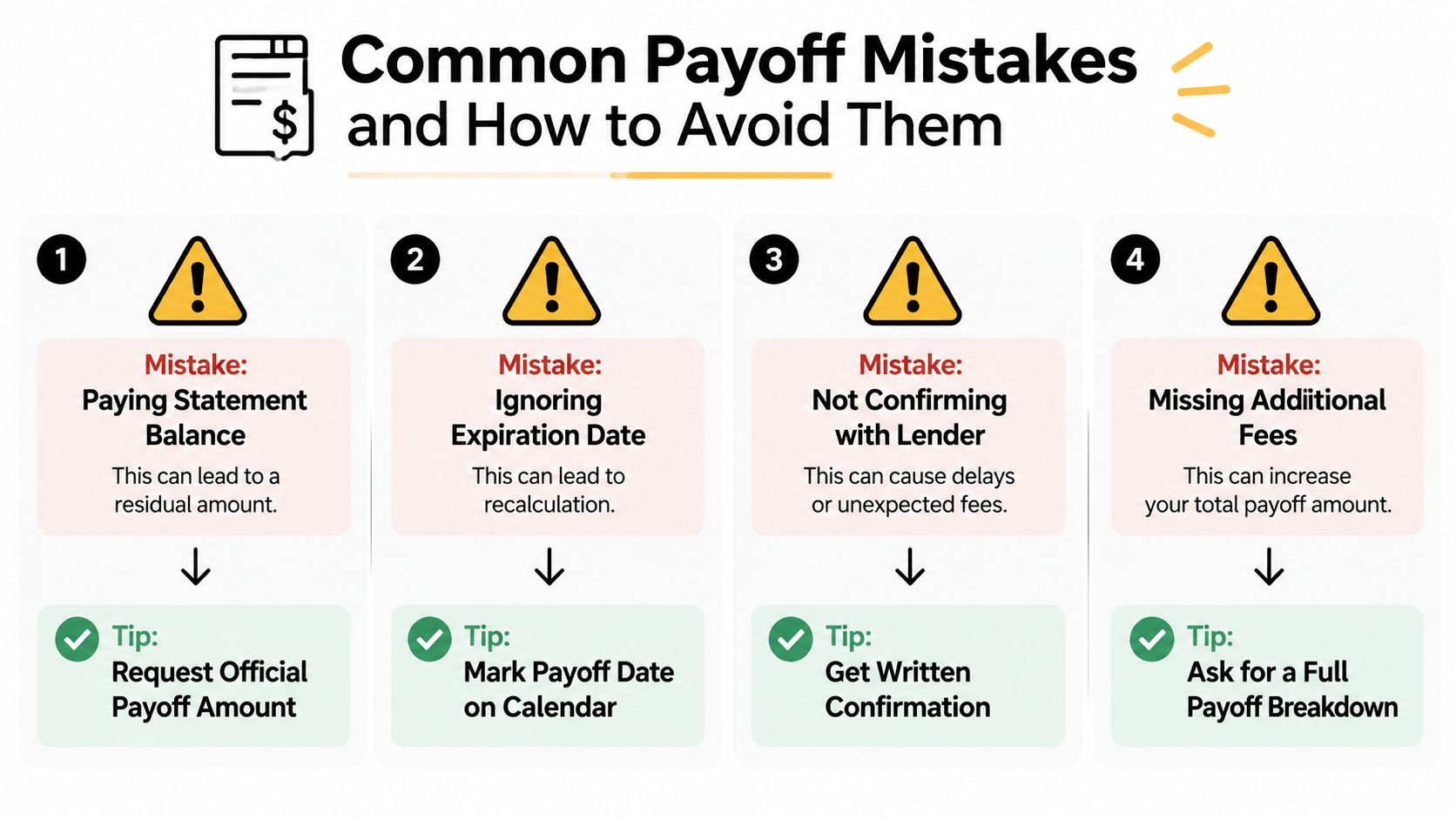
The most expensive mistakes usually begin with a reasonable assumption. A borrower sees a number, pays it, and expects the account to disappear. The lender's accounting may still show interest, fees, or an open line.
Paying the statement balance
A statement balance reflects the statement's reporting date. It may not include interest through the intended payoff date. The fix is simple: request an official payoff statement and use the amount valid for the day the lender will receive funds.
Ignoring contract restrictions
Some loan agreements may contain prepayment penalties or special payoff conditions. The borrower should scan the promissory note, mortgage, auto contract, or line-of-credit agreement, then ask the lender whether any charge applies before authorizing payment.
Missing the expiration date
A quote can become stale when the payment arrives after its good-through date. The borrower should schedule the wire, certified funds, or ACH with enough time for the lender's stated processing window and request an updated quote if the date slips.
Treating a zero balance as closure
A zero balance doesn't always mean an account is closed. A home equity line, for example, can be paid down to zero while remaining available for future draws. The borrower must request closure when closure is the goal and obtain written confirmation.
Skipping the final proof
Online systems can update before all paperwork is complete, or display a zero balance while a final interest adjustment is pending. The borrower should save the payment receipt and obtain a paid-in-full letter, lien release, or account-closure notice as appropriate.
Closure check: The desired result isn't merely “nothing currently due.” It's a documented, fully satisfied obligation with the correct account status.
Building a Plan to Pay Off Loans Faster
Paying a loan faster requires more than sending extra money whenever cash happens to be available. The payment needs a clear destination, and the lender must apply extra funds to principal rather than merely advancing the next due date.
Four levers borrowers can use
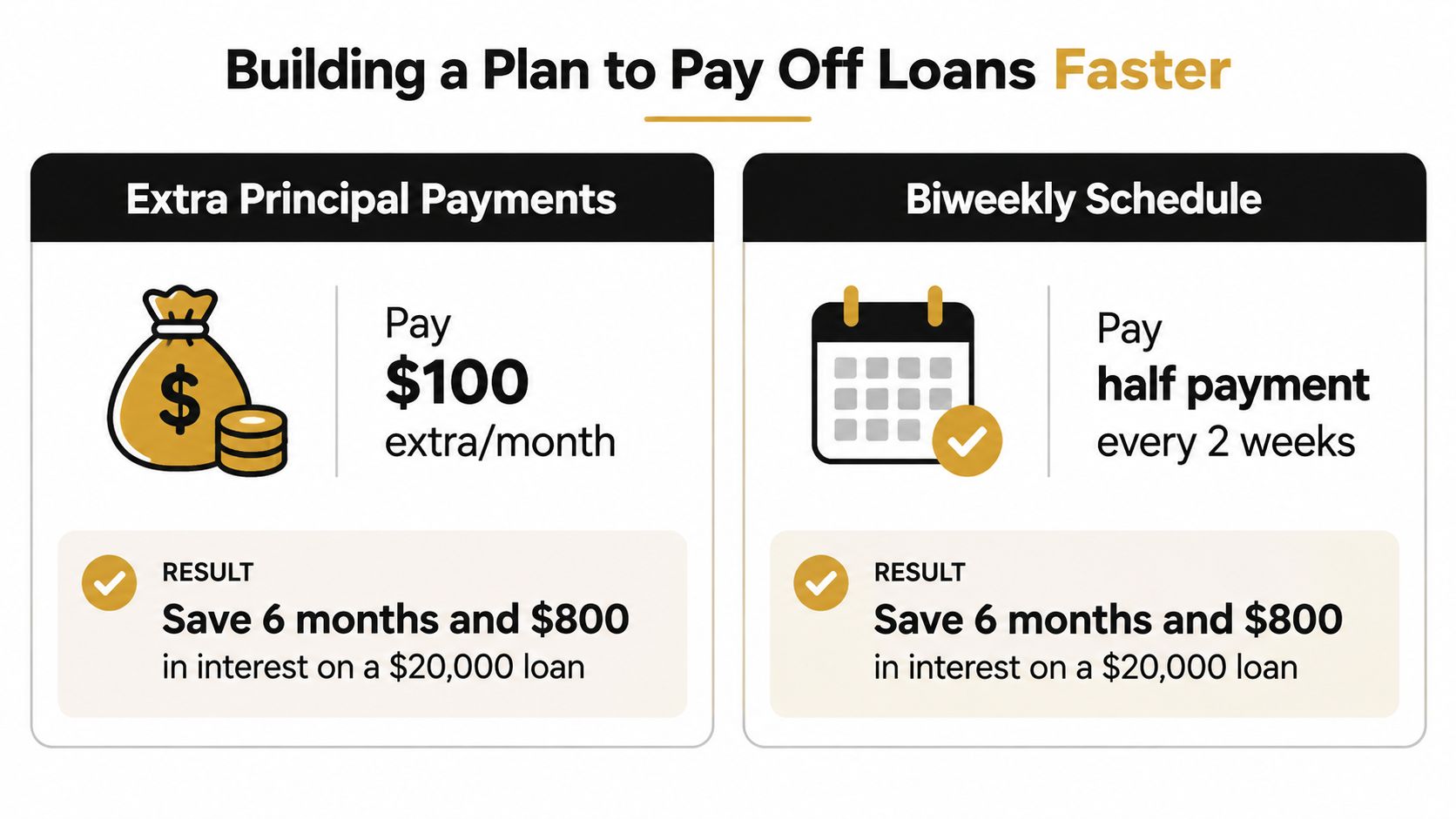
Extra principal reduces the balance used for future interest calculations. A borrower considering an additional $100 or $200 each month should ask the lender how the money will be applied and then compare the revised payoff date with the original schedule. The exact term reduction depends on the balance, rate, payment, and contract.
Biweekly scheduling divides the regular payment into smaller installments made every two weeks. It may change how often principal falls, but the lender's posting rules matter. Borrowers should confirm whether the servicer applies partial payments immediately or holds them until a full scheduled payment accumulates.
Interest-rate targeting directs extra money toward the highest-rate debt first while required payments continue on the others. This approach focuses the acceleration where each additional principal reduction can avoid the most interest, though borrowers should check for penalties and special terms.
Cash-flow reviews keep the plan realistic. A large extra payment that causes missed bills or new credit-card borrowing doesn't create durable progress. A smaller recurring amount can be more useful when it survives changes in income, housing costs, or family obligations.
A useful dashboard should show each balance, APR, due date, current payoff quote, and projected payoff date. When a rate changes, a balance drops, or income shifts, the borrower can recalculate rather than continue following an outdated spreadsheet. The loan payoff calculator can help model different payment amounts before a borrower commits to a new schedule.
Toya AI is one option for centralizing connected credit cards and loans, comparing balances, APRs, utilization, and due dates, and showing how a proposed payment can affect the debt-free date and total cost. Borrowers should still verify final settlement amounts directly with each lender because an app projection isn't a substitute for a formal payoff quote.
Your Next Steps Toward a Debt-Free Finish Line
A payoff plan becomes useful when it produces actions that can be completed this week. The following sequence keeps the work focused:
- Request current quotes: Ask every lender for a written payoff amount tied to a realistic payment date.
- Record good-through dates: Put each expiration date in a calendar and note the per diem amount where the lender provides one.
- Build a payoff tracker: Log the quoted amount, statement balance, accrued interest, fees, payment method, and confirmation number.
- Set extra principal: Choose an amount that fits the budget, then confirm the lender's application rules before activating an automatic payment.
- Schedule a review: Recheck rates, balances, due dates, and income at a regular interval, including a 90-day review of the plan.
Borrowers selling property or refinancing should coordinate the quote with the closing agent and verify that the payment will arrive within the lender's good-through window. Borrowers paying off an auto loan should also confirm how the lender will provide the title or lien release after satisfaction.
Paying off loans is a process, not one transaction. A quote settles the account on a particular date, while consistent tracking keeps the broader plan accurate as balances and circumstances change.
Toya AI can organize balances, APRs, due dates, payoff dates, and acceleration scenarios in one dashboard, helping borrowers compare the next payment rather than guess. Visit Toya AI to start tracking a payoff plan and see how each payment can move the debt-free finish line.
Ready to start your debt-free journey?
Toya AI builds a personalized payoff plan so you can see your debt-free date and save on interest.
Get Started Free