
How to Get Out of Student Loan Debt Faster: Real Numbers
A borrower opens three servicer portals on payday, sees three different balances and due dates, and sends an extra $150 to whichever account happens to be open. The next statement barely moves. That's a common starting point, and it doesn't mean extra payments don't work. It usually means the money wasn't aimed, the servicer applied it to accrued interest first, or a higher cost debt was growing somewhere else. Learning how to get out of student loan debt faster starts with ranking every balance by cost and protection, then making one extra payment do exactly the job intended.
Table of Contents
- Compare Your Options Before Choosing a Strategy
- Repayment Plan Changes That Could Reset Your Timeline
- Refinancing and Forgiveness Trade-Offs to Check
- Which Loan to Attack First
- How Extra Payments Actually Reduce Your Balance
- Build the Monthly Budget That Funds Extra Payments
- Step-by-Step Plan to Pay Off Student Loans Faster
Compare Your Options Before Choosing a Strategy
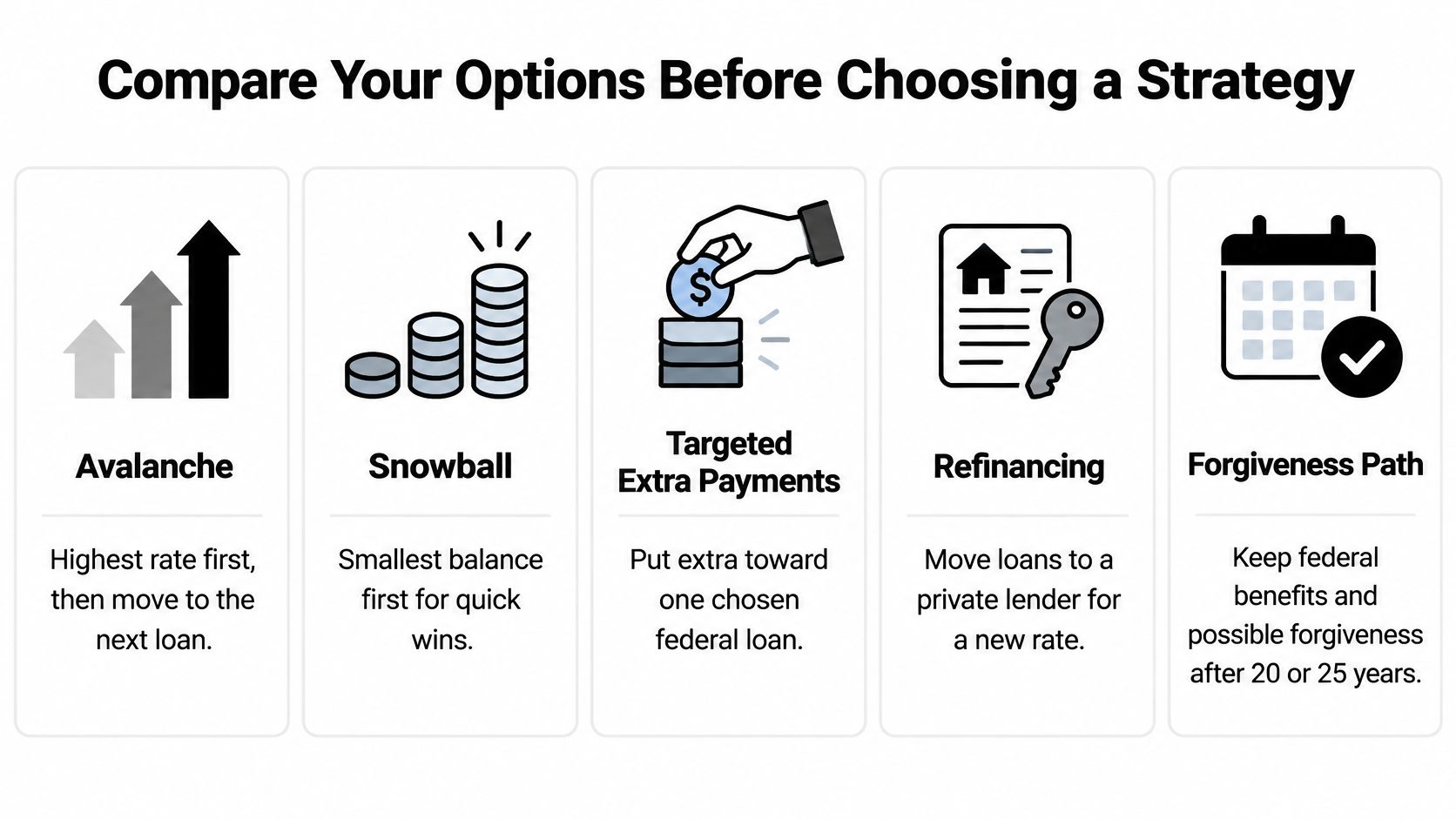
Five approaches solve different problems, so speed alone is a poor ranking tool. The table puts total interest, cash flow, and lost protections side by side.
| Strategy | Targets first | Best when | Main risk |
|---|---|---|---|
| Avalanche (highest rate first) | Highest-APR balance | You want the lowest total interest | Slow early wins if the top-rate loan is large |
| Snowball (smallest balance first) | Smallest balance | You need quick closures to stay motivated | Usually pays more interest than avalanche |
| Targeted extra payments | Federal loan you choose with the servicer | Several federal loans with different rates | Only works if the servicer applies money as instructed |
| Refinance to a private loan | One new loan at a new rate | Strong credit and a clearly lower fixed rate | Permanently loses federal protections |
| Income-driven plan first | Lower required payment | Cash flow is tight or forgiveness is possible | Can extend the term to 20 or 25 years |
A Worked Example With Real Balances
Say a borrower owes $38,000 in federal loans split across three servicers at 6.8%, 5.1%, and 4.5%, plus a $4,200 credit card at 24% APR. The card isn't a student loan, but its interest outranks every federal rate by a wide margin. Sending extra money to the 6.8% loan while the card compounds at 24% costs more each month than it saves.
The practical order is simple. Pay every required minimum on time, send all spare cash to the card until it's gone, then attack the federal loans by rate, starting at 6.8%. Snowball might close the smallest federal loan sooner and feel faster, but it usually leaves the expensive balance alive longer and raises total interest compared with avalanche.
Write These Three Things Down First
- Every balance and APR: List cards, federal loans, and private loans together so the true highest rate is visible.
- Current payment status: Note whether each loan is current, deferred, in forbearance, or behind.
- Forgiveness possibility: Flag any loan that could qualify for forgiveness before deciding to prepay it.
Repayment Plan Changes That Could Reset Your Timeline
A payoff plan built on an old SAVE payment amount may no longer match the account. Federal Student Aid reports that a March 10, 2026, federal court order ended implementation of SAVE and requires affected borrowers whose loans were in SAVE-related forbearance to select another eligible repayment plan and resume repayment. A model using the old figure will misstate required cash flow from the first month.
Servicers notify affected borrowers and give them a window to pick a different plan. Missing that window can mean automatic placement on a plan with a fixed monthly amount, which can look very different from the income-based payment the borrower remembers. Every extra payment decision depends on that baseline, so confirming the active plan comes before any math about accelerating payoff.
A Timing Example
Say a borrower's notice arrived in spring 2026 and landed in a spam folder. By the time it's found, the choice window may have passed and the account may already sit on a fixed plan with a new due date and a higher required payment. Sending the old planned extra payment before checking could leave the new minimum short.
The first check is administrative, not mathematical. Confirm which plan is active today, what the required payment is, and when it's due. Readers weighing a change can review the practical steps for changing a loan repayment plan before contacting the servicer.
Three Actions in Order
- Read and save every servicer message: Keep copies of notices, deadlines, and plan confirmations outside the portal in case access changes.
- Compare plans through the official process: Use the Federal Student Aid process rather than old screenshots or forum estimates.
- Rebuild the payoff model: Enter the new required payment, then decide what extra amount, if any, still fits.
Don't reuse a previous SAVE payment amount or forgiveness projection without checking whether it still applies.
A borrower who completes those steps understands the baseline. Extra payments made after that point accelerate a current plan instead of chasing a timeline that no longer exists.
Refinancing and Forgiveness Trade-Offs to Check
A lower rate looks like an obvious win. It's not always one, because refinancing trades a rate for a set of protections that can't be bought back.
Federal Student Aid lists potential losses including income-driven repayment plans with forgiveness after 20 or 25 years, approved deferment or forbearance, and federal forgiveness or discharge programs such as Public Service Loan Forgiveness, teacher loan forgiveness, total and permanent disability discharge, and borrower-defense discharge. Once a federal loan becomes a private loan, those options are gone for that balance.
The Teacher Example
Say a teacher owes $60,000 in federal loans at 6.5% and receives a private refinance offer at 4.9%. On rate alone, the new loan saves interest every month the balance remains outstanding. But the teacher may also be building qualifying public service toward forgiveness of a remaining balance.
The comparison has to be dollar against dollar. Calculate interest saved at 4.9% over the same remaining term, then compare it with the balance that could plausibly be forgiven if the teacher stays in qualifying work and keeps required payments current. If the forgiveness value is larger, the lower rate loses.
Term length can also reverse the result. A refinance that drops the monthly payment by stretching repayment over more years can cost more in total interest, even at 4.9%. That's why a lower payment isn't evidence of a faster or cheaper payoff. Readers comparing rate options can first review ways to reduce student loan interest that don't require giving up federal status.
A Short Test Before Signing
- Get fixed-rate quotes without extending the term: Compare total interest on the same payoff horizon, not just the monthly payment.
- Stress-test any variable rate: Write down the payment if the rate rises, and check whether the budget still holds.
- Price each lost protection: Assign a dollar value to income-driven payments, pauses, and possible forgiveness.
- Refinance only on a clear margin: Proceed only if guaranteed savings exceed fees and the value of protections given up.
Decision rule: A refinance should win on total cost after protections are valued, not on the advertised rate alone.
Borrowers with private loans only face a simpler choice because there's no federal protection to lose. For federal borrowers, especially public-service workers, keeping the loan federal and paying extra on schedule can be the cheaper path once forgiveness is counted.
Which Loan to Attack First
The right first target depends on what else is in the household balance sheet. This table gives the starting move for five common situations.
| Situation | Attack first | Why |
|---|---|---|
| High-APR credit card balance | The credit card | Card interest is usually far above federal student loan rates |
| Federal loans only, no forgiveness path | Highest-rate federal loan | Each extra dollar removes the most future interest |
| Working toward public-service forgiveness | Minimum payments on forgiveness-eligible loans | Extra principal can be wasted if the balance would later be forgiven |
| Tight budget, no emergency reserve | Build a one to three month reserve | Missed payments or card borrowing can cancel out interest savings |
| Several small loans, need quick wins | Smallest balance | Closing loans builds momentum, though total interest may be higher |
Jordan's $400, in Order
Say Jordan has a $9,000 card at 22%, a $14,000 federal loan at 6.2%, and a $22,000 federal loan at 4.5%, with $400 spare per month. Every loan gets its required minimum first. The full $400 then goes to the card, because each dollar there stops interest at 22% instead of 6.2% or 4.5%.
When the card reaches zero, Jordan doesn't spend the freed money. The $400, plus the card payment no longer owed, moves to the 6.2% federal loan. The 4.5% loan keeps receiving only its minimum until the 6.2% loan is cleared, then it becomes the target.
Two Exceptions That Change the Order
Forgiveness changes the math completely. Prepaying a loan that's likely to be forgiven later can waste money, because the borrower pays principal that a program might have removed. Borrowers on a credible forgiveness path should usually protect qualifying payments and direct spare cash to non-forgivable debt or savings instead.
Private student loans sit in the same ranking as other debts because they carry no federal protections. Rank them by rate alongside federal loans in the avalanche order, but check each private servicer's rules for applying extra money before sending it, since instructions and portals differ by lender. Toya AI calculates the user's debt-free date based on their current payments, which helps a borrower see whether the chosen order shortens the timeline.
How Extra Payments Actually Reduce Your Balance
A borrower sends $500 extra and expects the balance to fall by $500. If $180 in accrued interest is outstanding, only $320 reduces principal. That gap explains many disappointing statements.

Federal Student Aid says borrowers may prepay all or part of a federal student loan at any time without a penalty, including before the due date or above the required monthly payment. Extra money is applied first to outstanding accrued interest and only then to principal. Prepayment is allowed and useful, but it isn't the same as instant principal reduction.
Check How the Servicer Posted the Last Payment
Log in to the servicer account and open the payment history for the most recent extra payment. Look at how much went to interest, how much to principal, and which loan or loan group received it. If the split doesn't match the plan, call or write to the servicer and confirm, in specific terms, that the next extra amount should go to the named loan after accrued interest is satisfied.
Save the confirmation. A borrower who gives a written instruction and verifies posting the following month catches allocation errors while they're still small. A modeling tool such as a student loan debt payoff calculator can then be checked against actual postings rather than assumptions, and Toya AI shows which debt to pay extra on and how much interest the user will save.
The short video below walks through reading a payment breakdown before sending more money.
One Loan Versus Splitting the Money
Say two borrowers each have $150 extra per month and three loans at different rates. One sends all $150 to the highest-rate loan. The other splits it proportionally, so most of the money lands on larger, cheaper balances. The single-loan approach usually cuts interest faster because it shrinks the balance charging the most each day, then frees that loan's payment sooner.
Capitalization can undo progress during pauses. When unpaid interest on certain federal loans is added to principal after a deferment or after leaving income-based repayment, interest then accrues on the larger balance. Paying accruing interest during a pause, when feasible, prevents that jump and keeps projections honest. Any payoff model should therefore show total projected interest, not only the debt-free date.
Build the Monthly Budget That Funds Extra Payments
Extra payment money shouldn't be whatever happens to survive until month end. It's a line item calculated at the start of the month, after essentials and required minimums are protected.
Find the Real Surplus
- Start with take-home pay: Use the amount that reaches the bank account, not salary.
- Subtract essentials: Remove housing, utilities, food, transport, and insurance.
- Subtract every required student loan minimum: Include each servicer separately so none is missed.
- Name what's left: Only the remainder is candidate extra payment money.
For example, a borrower with $3,400 take-home pay, $2,450 in essentials, and $380 in required student loan minimums has $570 left before irregular spending. If $170 is needed for variable basics, the honest extra payment figure is $400, not $570.
Build the Reserve Before Sending Large Extras
Hold a starter reserve of about one month of essential spending before sending large extra amounts, then grow it toward three to six months. If Jordan has $400 spare but no reserve yet, that $400 goes into savings first, not into the card or a loan. It feels slower, but it prevents a car repair from going straight back onto a high-rate card.
A missed payment or new card borrowing to cover a gap can cancel out the interest saved by months of extra payments.
Once the starter reserve exists, write the extra amount as a fixed monthly figure in the budget. Treat it like a bill with a set date. Review it whenever income, rent, insurance, or a card balance changes, because last quarter's surplus may no longer exist. Small, repeatable amounts beat occasional large payments followed by missed minimums.
Step-by-Step Plan to Pay Off Student Loans Faster
The steps below turn the comparisons into one monthly routine. They're ordered so allocation and cash-flow mistakes are caught before money leaves the bank account.
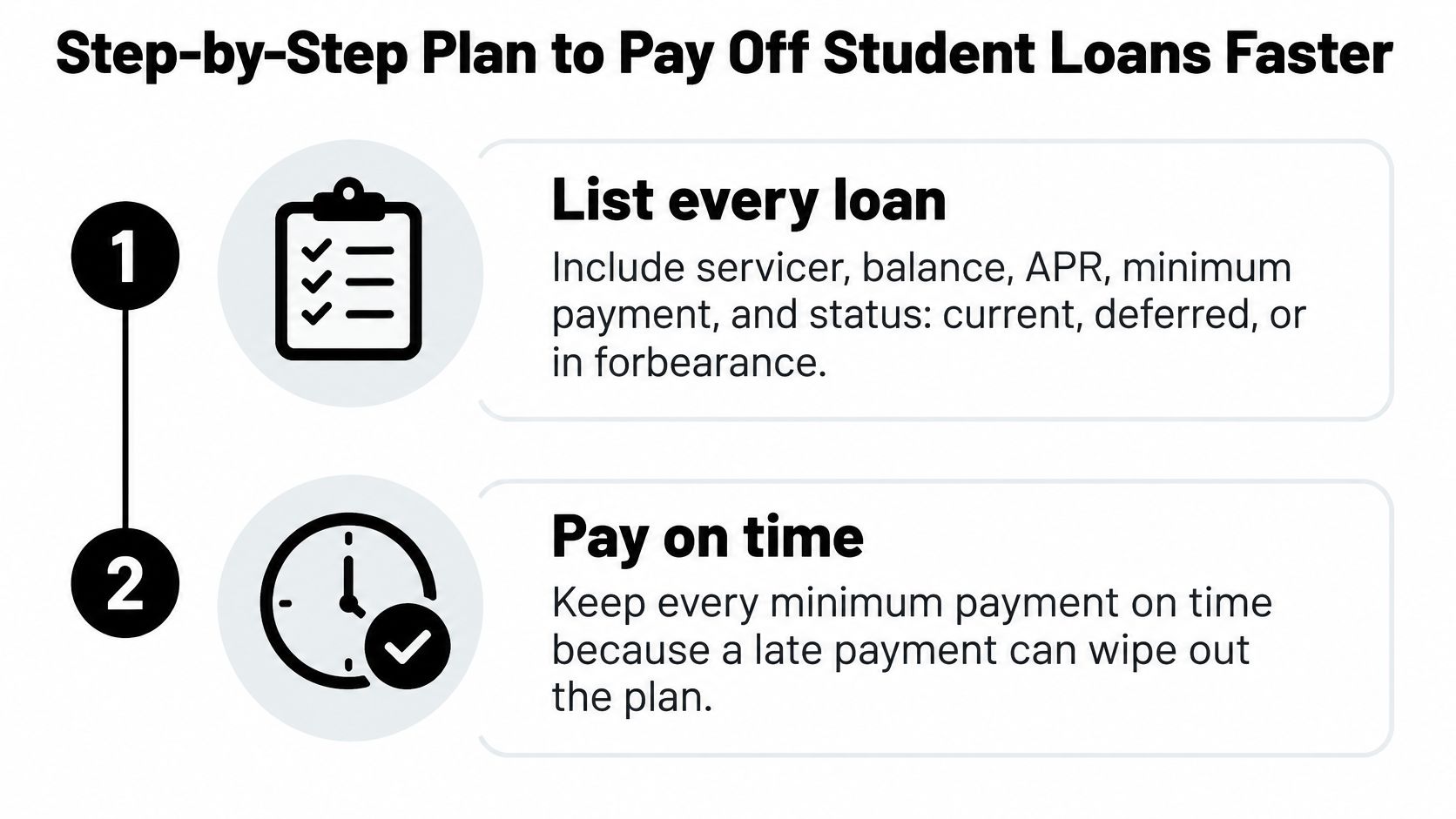
Steps 1 and 2 List Everything and Protect the Minimums
Step 1. List every loan. Write down the servicer, balance, APR, minimum payment, due date, and status for each account, whether current, deferred, or in forbearance. Include credit cards and private loans on the same page, since the highest rate may not be a student loan at all. A list built from memory usually misses a small loan or an old due date.
Step 2. Keep every minimum payment on time. Set autopay or calendar reminders for each servicer. A late payment can add fees, damage progress toward forgiveness, and wipe out the savings from extra money, so minimums come before acceleration in every month, including tight ones.
Steps 3 and 4 Aim and Automate the Extra Payment
Step 3. Choose the target and instruct the servicer in writing. The target is usually the highest-APR loan the borrower isn't trying to have forgiven. Send a written instruction naming that loan and stating that extra money should be applied to it after accrued interest. The common slip is paying extra without instructions and letting the servicer spread the money across loans or advance a due date instead.
Step 4. Set one automatic extra payment. Size it to the budget figure calculated after essentials, minimums, and the starter reserve. Schedule it for the day after payday so the money moves before discretionary spending absorbs it. For Jordan, that's a fixed $400 leaving automatically, not a hopeful transfer at month end.
Steps 5 and 6 Verify and Roll Payments Forward
Step 5. Confirm posting every month. Check the servicer account to confirm the extra payment reached the intended loan and reduced principal after interest, verify every minimum is current, and note the debt-free date under the current plan. Toya AI builds a personalized payoff plan from real account data and shows the user's debt-free date in minutes, which makes month-to-month changes easier to spot. Every new Toya AI account starts with a 14-day Pro trial that includes AI-powered payoff planning and automated payments.
Step 6. Roll the freed payment into the next loan. When the target loan is paid off, add its full former payment to the extra amount and aim the combined sum at the next loan in rate order. Progress looks like principal falling each month and projected total interest dropping, not just a due date moving.
Progress check: If total projected interest isn't falling, the extra money is landing in the wrong place or a balance elsewhere is growing.
Toya is not a financial advisor, lender, or credit counseling service, and its AI recommendations are informational suggestions only. Forgiveness, repayment plan, and refinancing decisions should be confirmed with the servicer or a qualified counselor before acting. The single action to finish today is concrete: open the budget, set this month's extra payment amount, and name the loan it will target. That is the practical core of how to get out of student loan debt faster, repeated monthly until the last balance closes.
Turn the loan list, target order, and monthly extra amount from this plan into one tracked timeline with Toya AI, which shows balances, APRs, due dates, and a projected debt-free date in one place. Connect the relevant accounts, check which payment it recommends next, and compare the projected interest before sending the first targeted extra payment.
Ready to start your debt-free journey?
Toya AI builds a personalized payoff plan so you can see your debt-free date and save on interest.
Get Started Free