
What Is Student Loan Debt and How to Pay It Off Faster
A recent graduate opens a first servicer statement and sees a balance that feels larger than expected, interest beginning to accumulate, and a monthly payment competing with rent, groceries, and retirement contributions. The most useful answer to “what is student loan debt” isn't only “money borrowed for college.” It's a long-term repayment obligation whose loan type, interest rules, payment status, and servicing terms can determine how quickly the balance disappears.
The total is substantial. Americans owed about $1.6 trillion in student loans as of June 2024, a figure 42% higher than a decade earlier, and projections place combined federal and private debt near $1.86 trillion by 2026. Pew Research Center's overview of student loans shows why this isn't a niche financial problem. It affects household cash flow, repayment decisions, and long-term financial mobility.
Table of Contents
- What Student Loan Debt Actually Means for Your Finances
- Federal Versus Private Student Loans and Why It Matters
- How Interest Accrues and Capitalization Work in Practice
- Repayment Plans, Timelines, and What Happens When Payments Stop
- Forgiveness, Deferment, and Refinancing Options Explained
- Choosing the Right Payoff Strategy for Your Situation
- Bringing Your Loans Into One Clear View With Toya AI
What Student Loan Debt Actually Means for Your Finances
Student loan debt is an installment loan used to pay for education-related costs, including tuition, room, board, books, and sometimes living expenses. Unlike a credit card, which lets a borrower repeatedly draw and repay a revolving balance, a student loan usually begins with a defined principal amount and follows a scheduled repayment path. Unlike an auto loan, it often carries special rules connected to enrollment, income, public service, hardship, and federal protections.
A borrower should think of the debt as three connected obligations:
- Principal, the amount originally borrowed and still unpaid.
- Interest, the cost charged for using the lender's money.
- Repayment conditions, including the required payment, due date, term, and available relief options.
The balance alone doesn't tell the full story. A borrower with a moderate balance and a high rate may pay more interest than expected, while another borrower with a similar balance may have access to income-based payments or deferment. The practical question is not only “How much is owed?” but also “What rules control how this balance changes?”
The monthly footprint
Student debt becomes part of an ordinary household budget. Its required payment competes with rent, food, transportation, emergency savings, and retirement contributions. Because the loan can remain active for years, a payment that seems manageable in isolation may still limit choices such as moving, changing jobs, or saving for a home.
Student loans can also appear on a credit report. Payment history and account status may matter when landlords and lenders assess an application. A missed payment can therefore affect more than the loan account itself.
Students and recent graduates who want a broader foundation can learn to manage student money before choosing a payoff method. Understanding cash flow, account balances, and upcoming obligations makes the loan statement easier to interpret.
Two tracks with different rules
The first line of investigation is the lender:
- Federal loans are issued or guaranteed through the federal student aid system and may provide income-driven repayment, deferment, forbearance, and certain discharge or forgiveness routes.
- Private loans come from banks, credit unions, or other private lenders. Their rates, hardship options, and collection procedures depend on the contract and lender.
Federal student debt alone exceeds $1.6 trillion and covers about 43 million borrowers, according to the Congressional Research Service explanation of federal student loans. The Federal Reserve also reports that more than 4 in 10 people who pursued education beyond high school, representing 30% of all adults, said they took out student loans. Most borrowers with outstanding debt owed less than $25,000, and the median education debt among borrowers with debt was between $20,000 and $24,999. The Federal Reserve's household well-being report places those figures in context.
A servicer statement should identify the lender, loan program, interest rate, principal, accrued interest, and repayment status. Those details provide the starting point for every later decision.
Federal Versus Private Student Loans and Why It Matters
A recent graduate can make every required payment and still face a longer route to freedom if the loan's rules change during a hardship. Federal and private loans may show similar balances, but they handle interest rates, payment relief, forgiveness, and default differently. Those rules shape whether a temporary income drop becomes a manageable pause or a repayment crisis.
Federal loans generally provide more repayment flexibility and broader hardship protections. Private lenders may offer useful terms, but their options depend on the contract, lender, and borrower's credit profile. Federal loans also make up roughly 91% of outstanding student debt, while private loans account for about 9%. Private student debt was roughly $138.8 billion by March 2026, according to student loan debt statistics from EducationData.
| Feature | Federal Loans | Private Loans |
|---|---|---|
| Rate source | Fixed rates published for eligible federal loan categories | Fixed or variable rates set by the lender and borrower's credit profile |
| Repayment flexibility | May include income-driven repayment, deferment, and forbearance | Depends on the lender's contract and hardship policy |
| Forgiveness access | Some loans may qualify for federal forgiveness or discharge programs | Broad federal forgiveness programs generally don't apply |
| Default consequences | Federal collection tools and specific rehabilitation or consolidation rules may apply | Contract terms govern collections, acceleration, and available remedies |
How to identify the track
Start with the servicer name, loan type, and account portal. Federal borrowers can review their information through the official federal student aid system. A private loan may appear through a bank, credit union, or specialty education lender, sometimes with a cosigner.
The distinction matters before an extra payment or refinancing application. Refinancing a federal loan into a private loan might lower the interest rate, but it can also remove federal income-driven repayment, deferment, and forgiveness options. A lower rate is useful only if the lost protections will not be needed. Otherwise, a payment that looks cheaper today can extend the time until the debt is gone.
Federal interest rates are fixed for the life of a loan after disbursement. For loans first disbursed between July 1, 2026 and June 30, 2027, published rates are scheduled to be 6.52% for undergraduate Direct Subsidized and Unsubsidized loans, 8.07% for graduate Direct Unsubsidized loans, and 9.07% for Direct PLUS loans, according to Federal Student Aid's interest-rate page. A private loan can use either a fixed or variable rate, so review the statement and contract before comparing payoff choices.
Practical rule: Compare the lender, rate type, repayment options, and missed-payment consequences, not only the balance. Two loans with similar balances can reach freedom on very different timelines.
How Interest Accrues and Capitalization Work in Practice
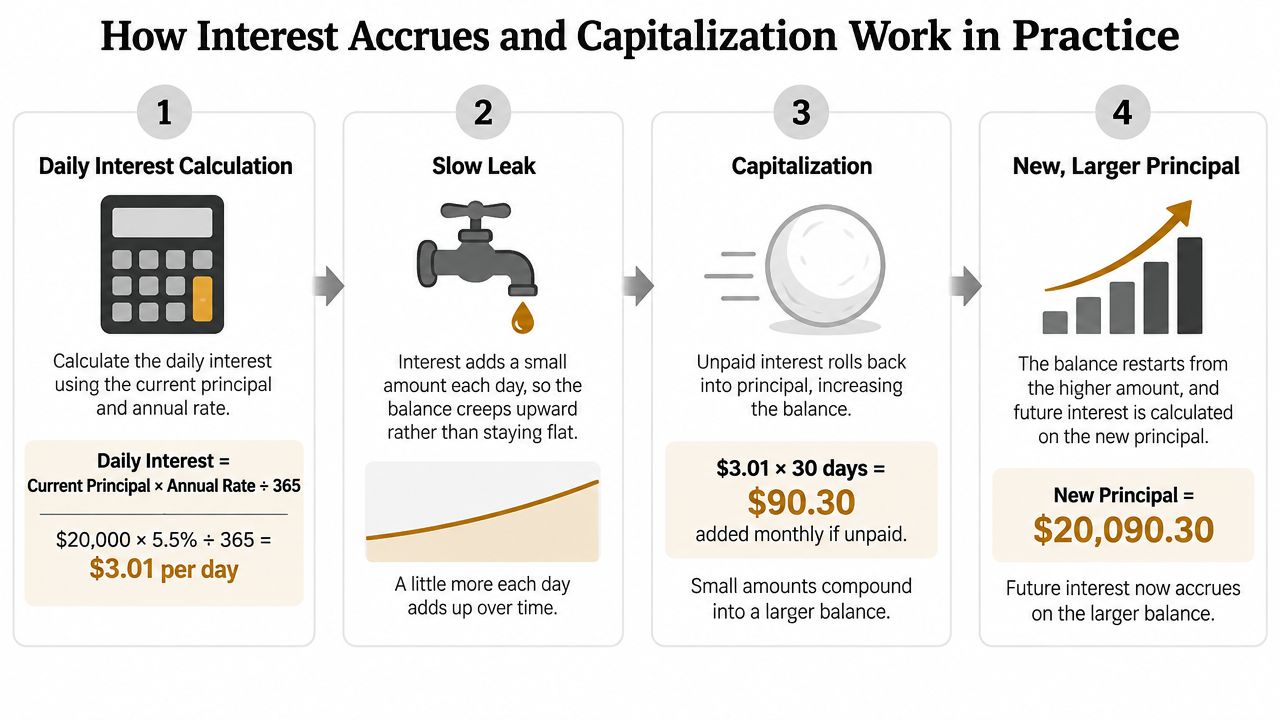
Interest makes a loan balance behave less like a static bill and more like a slow leak. For most federal student loans, interest begins accruing daily after disbursement. The basic calculation is current principal multiplied by the annual interest rate, divided by 365.
For example, a $30,000 unsubsidized loan at 6.5% adds about $5.34 per day before a payment is applied. The borrower doesn't receive a new invoice every day, but the interest still accumulates in the account. A payment first covers outstanding interest under the loan's allocation rules, then reduces principal.
The Consumer Financial Protection Bureau's student loan debt guidance explains the important distinction between subsidized and unsubsidized loans. Interest on an unsubsidized loan begins accruing from disbursement. A subsidized federal loan generally avoids interest during qualifying periods of in-school enrollment, deferment, and the six-month post-school grace period.
Capitalization changes the starting line
Capitalization occurs when unpaid interest is added to principal. After that event, future interest is calculated on the larger principal. The borrower hasn't borrowed new money, but the loan now charges interest on a higher base.
Consider a simplified example. A $30,000 unsubsidized balance accruing at roughly 6.5% could accumulate about $1,950 during a four-year degree if no interest is paid. If that amount capitalizes when repayment begins, the balance becomes about $31,950. If another $2,000 of interest accumulates and capitalizes at the end of a grace period, the starting balance could approach $33,950.
The exact timing depends on the loan's terms and the event that triggers capitalization. The lesson is more durable than the example: unpaid interest can become principal, and the new principal creates additional interest.
Borrowers can explore the mechanics with a monthly interest calculation guide. Even a small voluntary payment during school or a grace period may reduce future capitalization when the loan permits such payments.
Paying earlier doesn't merely reduce today's balance. It can prevent future interest from being calculated on interest that has already been added to principal.
Repayment Plans, Timelines, and What Happens When Payments Stop
A recent graduate may receive a federal loan bill that feels manageable on paper but leaves little room for rent, food, and emergencies. The repayment plan determines how quickly that balance falls, how long interest keeps accruing, and whether a missed payment can turn into a repayment crisis.
The standard federal approach generally uses a fixed payment over a 10-year term. For a $35,000 balance at a current undergraduate federal rate, the schedule produces a payment around $380 and clears the loan through 120 installments. The payment stays predictable, though it may strain a borrower whose income is still developing.
Income-driven plans calculate payments from income and family circumstances instead of relying only on the balance. Depending on the plan and borrower, repayment may last 20 or 25 years, with a remaining balance potentially eligible for forgiveness under the plan's rules. A lower required payment can protect monthly cash flow, but it may also keep interest accruing for longer.
Federal repayment plans at a glance
| Plan | Payment Formula | Term | Forgiveness | Best For |
|---|---|---|---|---|
| Standard | Fixed payment based on balance, rate, and term | 10 years | Possible only through separate qualifying programs | Borrowers with stable income who want a defined end date |
| Income-driven | Based on discretionary income and household circumstances | 20 or 25 years, depending on plan and borrower | Potential remaining-balance forgiveness under qualifying rules | Borrowers whose income makes the standard payment difficult |
| Extended | Lower payment spread over a longer schedule | Longer than the standard term | Depends on separate program eligibility | Borrowers who need a lower required payment |
| Graduated | Payments begin lower and rise over time | Extended schedule may apply | Depends on separate program eligibility | Borrowers expecting income to increase |
Compare the required payment with projected total interest, not only with today's affordability. A lower payment can preserve cash for essentials while extending the months during which interest accrues. A higher fixed payment can shorten the payoff timeline, provided the borrower still has room for emergencies.
The student loan repayment plan guide can help compare monthly relief with long-term cost.
Delinquency comes before default
A missed payment usually creates delinquency first. For federal loans, 90 days or more delinquent is a serious warning point for credit reporting, while 270 days generally moves a loan into default. Federal default can expose a borrower to wage garnishment and tax-refund seizure under applicable collection rules. Private loans follow their contracts and may enter collections sooner, without the same federal rehabilitation structure.
Recent federal portfolio data show about 10.6% of loans were 90 days or more delinquent in Q2 2026. The repayment crisis therefore affects more than borrowers with unusually large balances. Even a manageable principal can become harder to resolve when missed payments trigger collection activity and the account falls further behind.
Contact the servicer before the next missed payment when possible. Early contact gives the borrower a chance to review available payment arrangements, protect account status, and choose a path before collection notices arrive. The practical objective is to keep a temporary income problem from extending the months required to become debt-free.
Forgiveness, Deferment, and Refinancing Options Explained
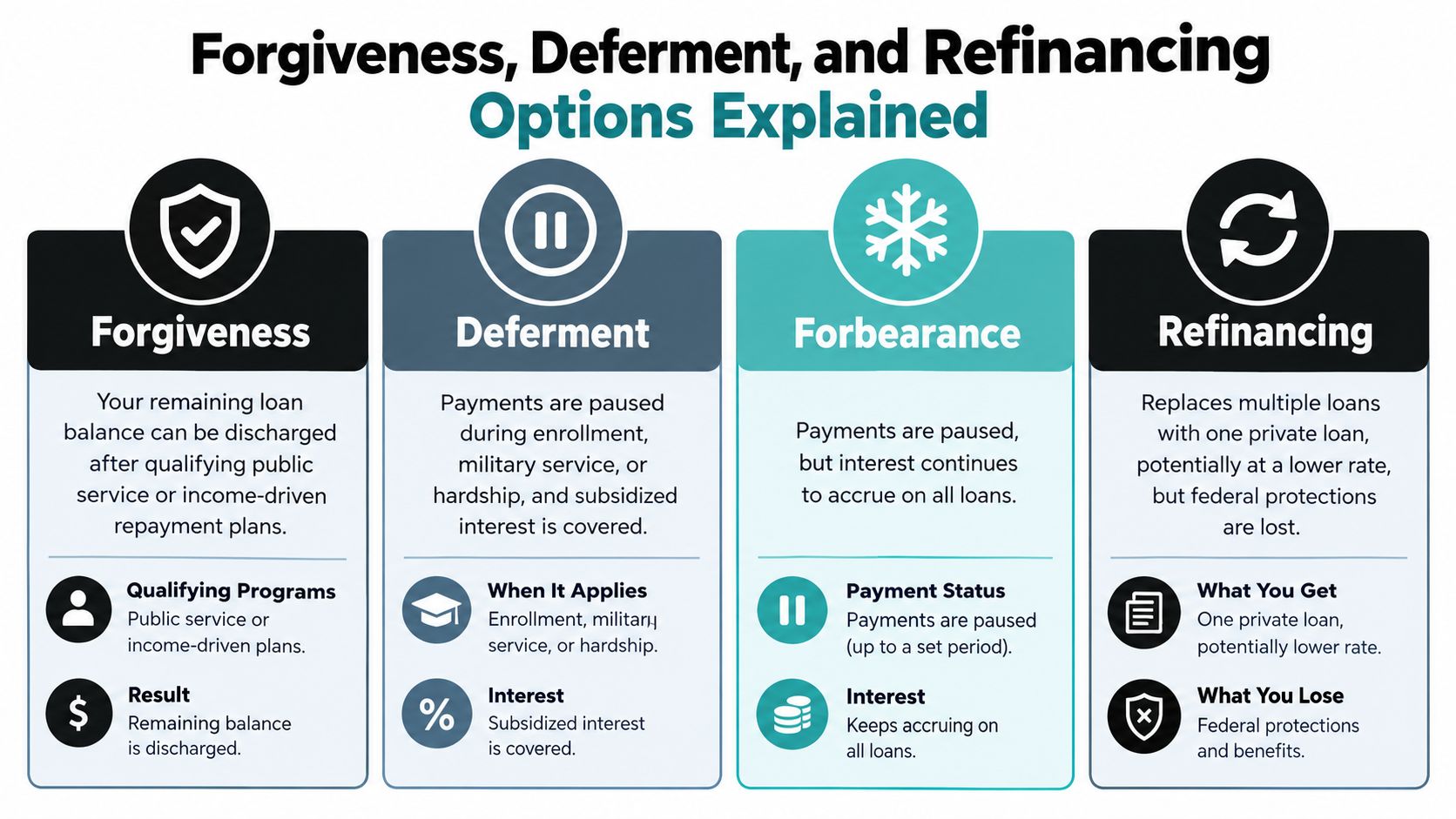
Relief programs don't all do the same job. Deferment and forbearance pause or reduce required payments under qualifying conditions, while forgiveness can remove a remaining balance after the borrower meets program requirements. Refinancing replaces one or more loans with a new private loan, which may change the interest rate and repayment term but can remove federal protections.
A borrower facing temporary unemployment might first investigate deferment. Qualifying enrollment, military service, or economic hardship can support deferment for eligible federal loans. During certain deferments, subsidized loans may avoid interest accrual. Unsubsidized loans generally continue accruing interest.
Forbearance is a different pause mechanism. It can help when deferment isn't available, but interest continues to accrue on every loan type during the pause. A borrower who uses forbearance should ask how much interest will accumulate and whether it may capitalize afterward.
Match the option to the situation
Forgiveness is a long-term qualification pathway, not an automatic discount. Public Service Loan Forgiveness can discharge an eligible remaining balance after 120 qualifying payments under an eligible repayment plan and qualifying public service employment. Teacher Loan Forgiveness can provide up to $17,500 for qualifying teachers. Income-driven repayment plans may also offer forgiveness after 20 to 25 years of qualifying payments, depending on the plan and borrower.
Refinancing can make sense for a borrower with stable income, strong credit, and private debt carrying an expensive rate. The lender may offer a lower rate or a different term. A borrower considering this route should compare the new total cost with the federal benefits being surrendered, including income-driven eligibility, federal deferment, and access to Public Service Loan Forgiveness.
A practical scenario illustrates the choice. A public-sector employee with federal loans may value PSLF eligibility more than a lower private rate. A private-loan borrower with steady income may have fewer federal protections to lose and can focus more directly on the new rate, term, fees, and monthly payment.
The following video provides another overview of the distinctions among common student-loan options:
Before requesting a pause or refinancing offer, the borrower should download current statements, confirm the loan type, and ask the servicer for a written explanation of interest treatment. A lower required payment isn't automatically a lower-cost outcome.
Choosing the Right Payoff Strategy for Your Situation
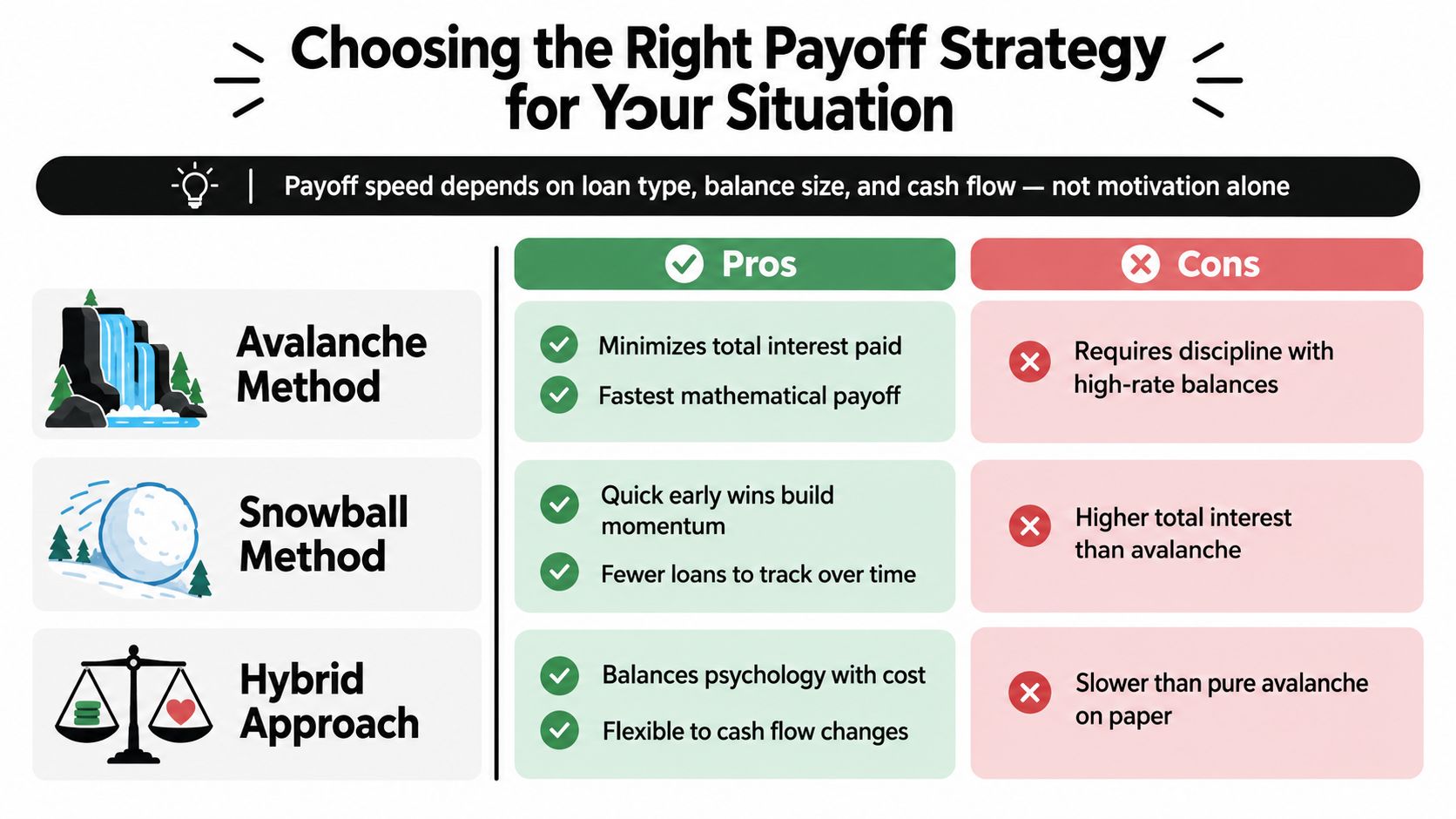
Payoff speed depends on loan type, balance size, interest rate, and cash flow, not motivation alone. A borrower with several loans may have enough money for one extra payment but not enough to accelerate every account. The most effective strategy assigns that extra money deliberately.
The avalanche method directs additional payments to the loan with the highest interest rate while maintaining minimum payments elsewhere. It usually minimizes total interest because expensive balances receive attention first. The drawback is psychological. A high-rate loan may also be the largest balance, so the first victory can take time.
The snowball method targets the smallest balance first. Once that account disappears, its minimum payment rolls into the next target. This method can create visible progress and simplify account management, although it may produce more interest than the avalanche approach when a higher-rate loan remains untouched.
A hybrid method can suit borrowers who need a small early win but still want to respect interest cost. For example, a borrower might clear a very small private balance, then direct all future extra payments to the highest-rate loan.
A practical selection framework
- Choose avalanche when minimizing lifetime interest is the main objective and the borrower can stay committed without frequent quick wins.
- Choose snowball when several small balances create administrative stress or visible progress would make consistent payments easier.
- Choose a hybrid when the borrower needs momentum but doesn't want to ignore a costly private or variable-rate balance.
Refinancing is a separate decision, not just a payoff ordering method. A borrower may consider it after comparing the new rate, new term, monthly payment, and lost protections. The borrower should be especially cautious with federal loans that may qualify for income-driven repayment or public-service forgiveness.
A fixed extra-payment rule keeps the plan operational. The borrower pays every minimum on time, chooses one target account, and sends every additional dollar there. After a raise, job change, household expense increase, or interest-rate change, the borrower should review the order again. A student loan debt payoff calculator can help compare how extra payments change the projected timeline and interest cost.
Decision test: If the strategy can't survive an ordinary month with an unexpected expense, the extra payment is probably too aggressive.
Bringing Your Loans Into One Clear View With Toya AI
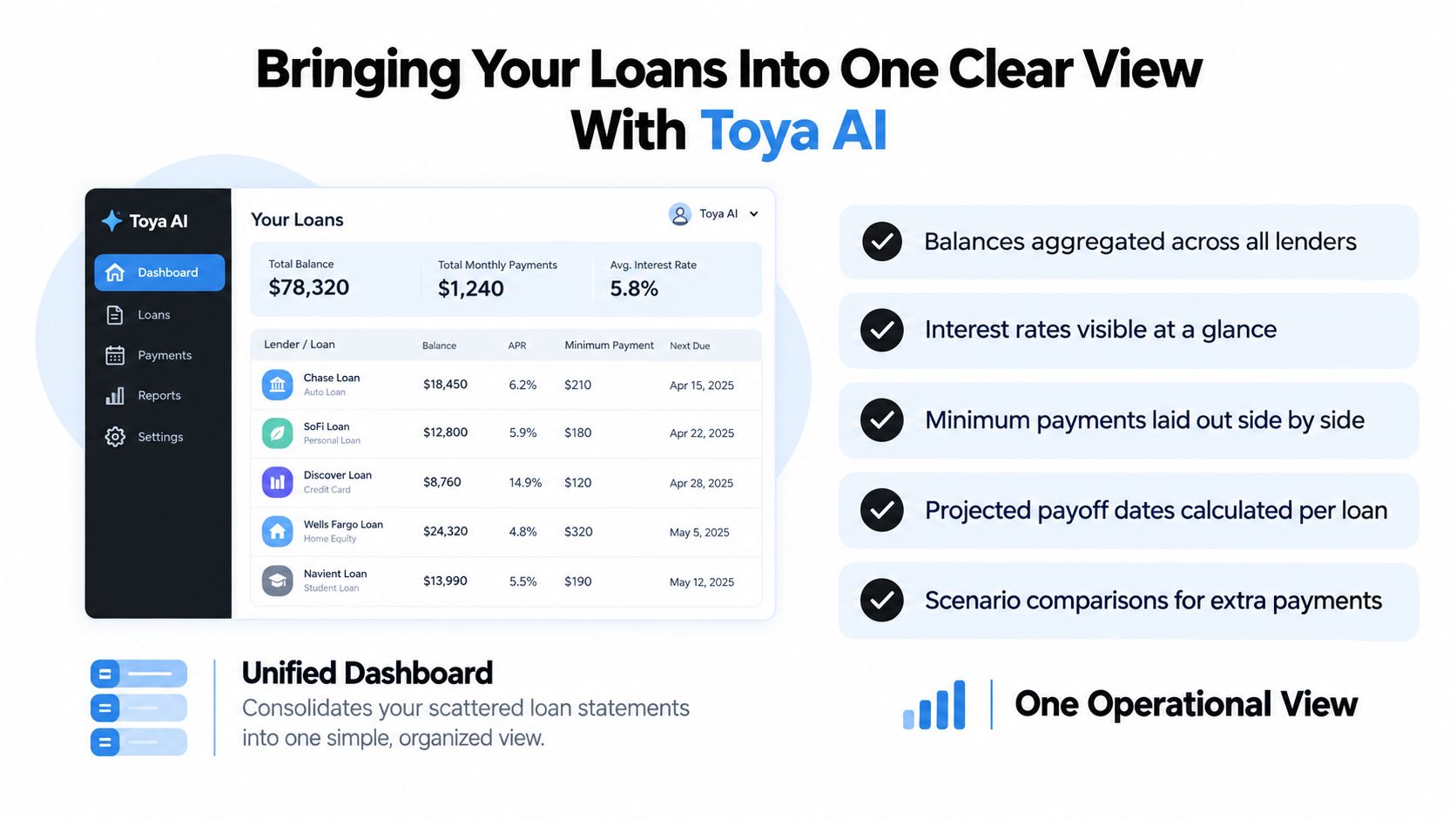
Scattered statements make repayment harder because the borrower has to reconstruct the same information repeatedly. A unified dashboard can place balances, rates, minimum payments, account status, and projected payoff dates side by side for federal and private loans. That view doesn't replace a servicer's official account, but it can make the overall plan easier to monitor.
Toya AI uses a read-only connection model for linked accounts. After a borrower connects each servicer through supported secure account connections, the platform can import outstanding principal, interest rates, and term information. It doesn't execute payments or touch the borrower's funds through that read-only connection, and the account picture can refresh on a schedule.
Turn statements into a working plan
A useful consolidated view should answer practical questions:
- Which loan has the highest interest rate?
- What is the total required payment across accounts?
- Which loan is projected to clear first?
- How much interest remains under the current schedule?
- What changes if the borrower adds a fixed extra amount?
Toya AI can organize connected debts, display rates and due dates, and model payoff sequencing such as avalanche or snowball. The borrower can then compare a plan that prioritizes interest savings with one that prioritizes early account closures. The value comes from seeing the consequences of a payment decision before sending the money.
A sensible first review can follow this order:
- List every servicer and label each loan as federal or private.
- Confirm each account's status, including current, delinquent, deferment, forbearance, or default.
- Request a free annual credit report and compare its account information with the servicer statements.
- Record each rate, principal, minimum payment, and due date.
- Connect eligible accounts to begin tracking monthly progress toward debt freedom.
This process reframes student loan debt from a frightening headline balance into a set of accounts with identifiable rules. The borrower can then focus on the repayment risk that matters most, whether that means preventing delinquency, protecting federal benefits, reducing capitalization, or directing extra cash toward the loan that costs the most.
Toya AI brings student loans and other debts into one read-only dashboard, then uses balances, rates, due dates, and cash flow to model payoff paths and show how extra payments affect the debt-free date. Visit Toya AI to connect the accounts, compare repayment strategies, and turn the next payment into a clear step toward financial freedom.
Ready to start your debt-free journey?
Toya AI builds a personalized payoff plan so you can see your debt-free date and save on interest.
Get Started Free