
How Do Balance Transfers Affect Your Credit Score?

A balance transfer usually causes a small, temporary credit-score dip from the application, then can improve the score if utilization falls and every payment arrives on time. A single hard inquiry typically lowers a FICO Score by fewer than five points, although the new account can affect other scoring factors too.
Why can moving the same debt help one borrower's score and hurt another's? The answer often comes down to the new card's credit limit and whether the old card stays open, not just the amount transferred. Understanding how do balance transfers affect your credit score starts with separating the application, the available credit, and the repayment plan.
Table of Contents
- Whether a Balance Transfer Helps or Hurts Your Score
- Why a New Card Causes an Early Score Dip
- How Utilization Changes With the New Card's Limit
- Whether to Keep or Close the Old Card
- What Transfer Fees and Promo Periods Really Cost
- Late Payments and Expiring Promotions That Hurt Scores
- How to Run a Transfer Without Score Damage
Whether a Balance Transfer Helps or Hurts Your Score
A transfer can hurt initially and help later. The early effects usually come from applying for and opening an account; the potential improvement comes from lower reported utilization and consistent payments.
Credit-scoring models don't treat moving a balance as paying it off. They evaluate the accounts, balances, limits, and payment records that issuers report. Amounts owed represents about 30% of a FICO Score, according to FICO's credit-scoring guide, making the relationship between balances and available credit especially important.
How a balance transfer moves each credit score factor
The approximate weights below describe general FICO scoring categories, not a formula for predicting an individual borrower's score change.
| Score factor | Approx. weight | Short-term effect | Longer-term effect |
|---|---|---|---|
| Amounts owed, including utilization | About 30% | Individual utilization can be high if the new card has a low limit | Utilization generally falls as the balance is paid down |
| Payment history | About 35% | Remains positive when every payment arrives on time | Continued timely payments support credit health; serious lateness can also jeopardize promotional terms |
| New credit | About 10% | The application can cause a small score decline | The inquiry's influence fades as it ages |
| Length of credit history | About 15% | Opening the card lowers average account age | Accounts age as time passes |
| Credit mix | About 10% | Another credit card may add little diversity to an existing card portfolio | Usually offers little additional benefit from the transfer itself |
For a hypothetical example, consider a borrower moving $5,000 to a new card with a $10,000 limit, then paying it down on time over a year. The application and new account may initially weaken the score, while the progressively lower reported balance can support improvement. No particular recovery date or point increase is guaranteed.
Practical rule: Judge a transfer by what happens to each scoring input, not just by whether the old card shows a zero balance.
A promotional interest rate doesn't remove principal. The borrower still owes the transferred amount, and an added transfer fee can increase the balance. A transfer creates an opportunity to repay debt more efficiently, but it doesn't erase the credit risk of carrying it.
Why a New Card Causes an Early Score Dip
The application comes first. When a borrower submits a full credit-card application, the issuer generally checks the credit report through a hard inquiry.
According to myFICO's balance-transfer guidance, a single inquiry usually lowers a score by fewer than five points, while length of credit history represents approximately 15% of a FICO Score. Several applications close together can have a larger cumulative effect, so the inquiry estimate shouldn't be treated as a limit on the total score change.
Inquiry first, account age second
Once approved, the borrower adds a newly opened account to the credit file. That can lower the average age of accounts, particularly when the borrower has a short credit history or few existing accounts.
A borrower with a long-established file may absorb this change differently from someone who recently opened a first card. The same application doesn't produce an identical result for everyone.
The Consumer Financial Protection Bureau's explanation of credit inquiries explains that scoring models consider how recently and frequently someone applies for credit. In a hypothetical comparison, applying for three cards in a month can produce three inquiries and, if approved for all of them, three new accounts; a single successful application creates a smaller set of changes.
Compare before applying
Prequalification can help narrow the options, but the issuer must explicitly state that the check uses a soft inquiry. Prequalification isn't guaranteed approval or a promise of a particular limit.
Before submitting an application, a borrower should compare:
- Approval fit: Whether the offer appears suited to the borrower's credit profile.
- Transfer capacity: Whether the available limit can accommodate the balance and fee.
- Repayment terms: Whether the promotional period supports an affordable payoff schedule.
A declined application can still generate a hard inquiry. Applying repeatedly until a suitable limit appears can therefore add credit costs without solving the repayment problem.
The debt movement itself isn't what creates the application inquiry. The subsequent reported balances and limits create a separate set of scoring effects.
How Utilization Changes With the New Card's Limit
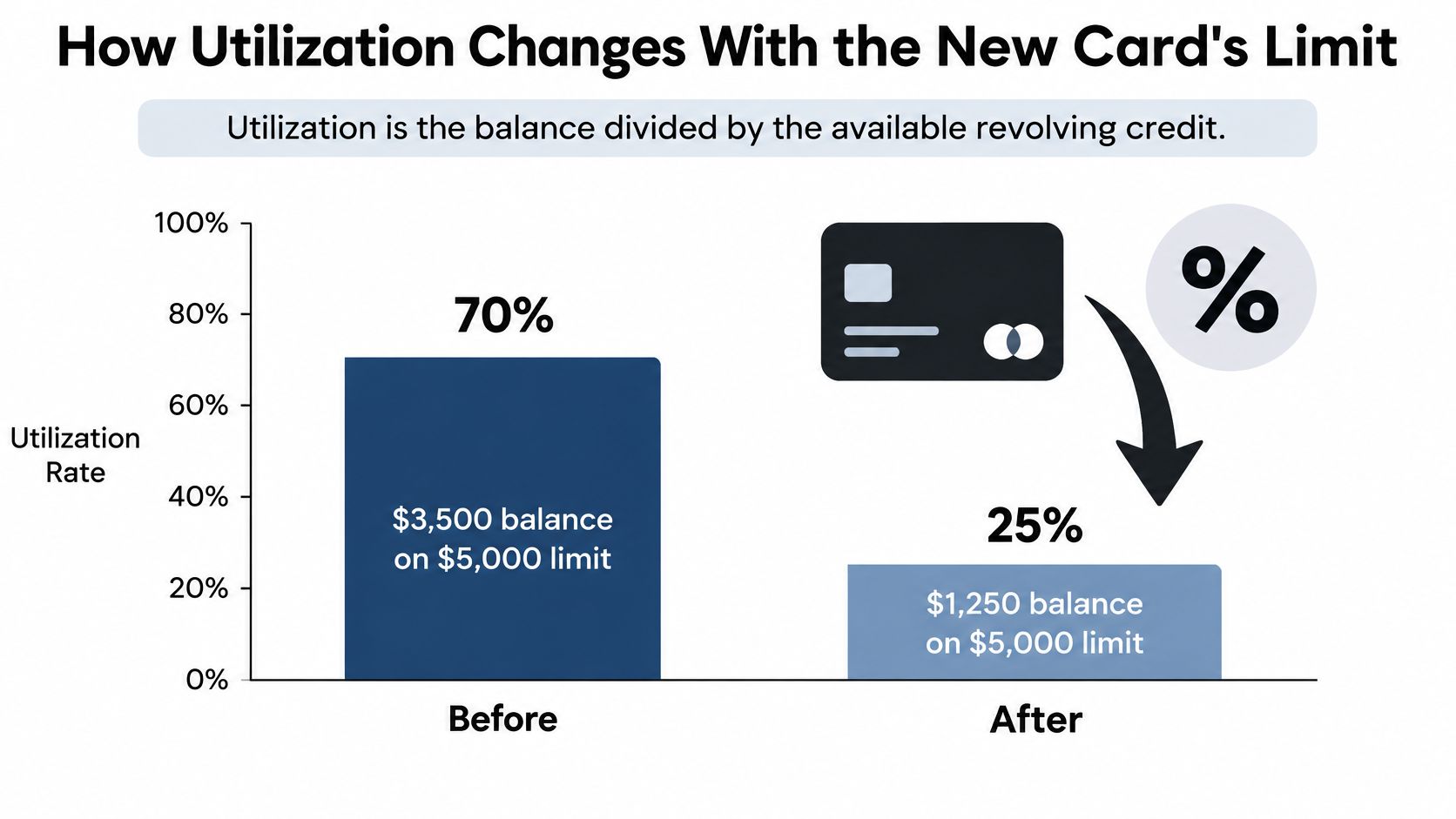
Credit utilization is the balance divided by available revolving credit. The CFPB's financial empowerment toolkit illustrates the calculation with a $3,500 balance on a $5,000 limit, or 70% utilization; reducing that balance to $1,250 brings utilization to 25%.
The following chart illustrates how paying down a balance changes the ratio without changing the credit limit.
The same transfer can produce different results
A transfer changes where the balance sits. Opening an additional credit line can also increase total available credit, but the new card may still have high utilization on its own.
The scenarios below isolate the transferred principal, before any fee or new spending.
Utilization after moving $4,000 to a new card
| Scenario | New card limit | Utilization on new card | Likely score effect |
|---|---|---|---|
| $4,000 moved to a $5,000 card | $5,000 | 80% | High individual utilization can hurt even when the old card reports zero |
| $4,000 moved to a $4,500 card | $4,500 | About 89% | A nearly maxed new card can pull the score down |
| $4,000 moved to a $10,000 card, old card kept open | $10,000 | 40% | Combined utilization falls from 40% to 20% when total limits increase from $10,000 to $20,000 |
The last scenario assumes no additional debt and that the old credit line remains available. It shows why individual-card utilization and overall utilization both matter: an improved combined ratio doesn't make a heavily used new account irrelevant.
Check what actually gets reported
Issuers don't necessarily report balances when a borrower expects. During a transfer, the credit report may temporarily reflect an awkward combination of balances while account updates arrive at different times.
A borrower should confirm the transfer with both issuers and then review the reported balances rather than assuming the score will immediately reflect the completed transaction. Unnecessary purchases can make those balances harder to interpret and harder to reduce.
For additional context, this explanation of how lowering credit utilization affects a score addresses why a lower ratio doesn't translate into a guaranteed point increase.
The accompanying video provides another explanation of the transfer process.
Before committing, the borrower should calculate the new card's expected utilization, including the fee, and the combined ratio across all open cards.
Whether to Keep or Close the Old Card
Could closing the old card erase the utilization benefit of a balance transfer? It can, because the balance stays the same while the available credit shrinks.
For example, $6,000 owed across $20,000 in combined limits equals 30% utilization. Close an unused card with a $10,000 limit, and that same debt is measured against $10,000 of available credit, raising utilization to 60%. The transfer amount matters, but so does whether the old credit line remains open.
Separate the credit decision from the spending decision
An open card can preserve available credit without becoming a reason to spend. Keeping it is useful only if you can manage it without adding debt.
Closing a card does not immediately erase its entire payment history. The immediate utilization effect comes from losing available credit, while account history is a separate consideration. For more on the trade-offs, read whether closing a credit card account is bad.
Keeping the card open may make sense when:
- There's no annual fee: The account doesn't add an ongoing membership cost.
- The issuer permits it: You can follow the account's terms without unnecessary spending.
- Your budget remains protected: Having the card available won't restart the borrowing cycle.
A small recurring charge paid in full can keep the account active, but only if it fits your budget and you reliably review the statement. An overlooked subscription can lead to a missed payment.
An unused credit line can support utilization. If having the card open creates a real risk of new debt, that risk may outweigh the potential scoring benefit. Transaction alerts, statement reviews, and an annual check of the card's fee and usefulness can help you decide whether to keep it.
What Transfer Fees and Promo Periods Really Cost
The useful payoff formula is straightforward: transferred balance plus transfer fee, divided by promotional months. That calculation estimates the monthly payment needed to finish before the promotional rate expires, assuming no new purchases or other charges.
The CFPB's credit-card terms guidance describes balance-transfer fees that commonly range from 3% to 5%, sometimes subject to a fixed minimum. Its market findings reported that the average fee declined from 3.0% in 2020 to 2.8% in 2022, a historical average rather than a promise about an available offer.
Calculate the full balance, not just the amount moved
A fee may be added to the new card's balance and consume part of its available credit. That means an apparently suitable transfer limit can leave less breathing room than expected.
The examples below use a 15-month, interest-free promotion, with no additional purchases or charges. Fees and payments are calculated from the stated percentages.
Transfer fees and monthly payments over a 15-month promotion
| Amount transferred | Fee at 3% | Fee at 5% | Monthly payment over 15 months at 5% fee |
|---|---|---|---|
| $3,000 | $90 | $150 | $210 |
| $5,000 | $150 | $250 | $350 |
| $10,000 | $300 | $500 | $700 |
For example, a $5,000 transfer with a 3% fee adds $150, creating a balance of $5,150. Paying that amount over 15 months requires about $344 per month, rounded upward, before any other charges.
The card's required minimum payment may be much lower than the amount needed to meet that deadline. Paying the minimum can keep an account current without making the promotion a successful payoff strategy.
Build the payment before submitting the application
- Add the fee. Use the issuer's actual fee and check whether a minimum charge applies.
- Divide by the promotional months. Confirm when the promotion starts and when it ends.
- Budget for at least that payment. A payment that requires borrowing elsewhere isn't sustainable.
- Test the outcome in a debt calculator. Enter the balance, applicable rate, and monthly payment to compare the debt-free date and interest costs.
Toya AI builds a payoff plan from existing accounts rather than consolidating or moving debt. It calculates a debt-free date based on current payments and shows which debt should receive extra payments and how much interest the borrower would save.
Budget check: A transfer is only useful when the payment plan works alongside housing, food, transportation, and other required debt payments.
A remaining balance generally becomes subject to the offer's standard APR after the promotion ends. The borrower should compare the entire likely repayment path, not just the introductory rate, before deciding whether the fee buys meaningful savings.
Late Payments and Expiring Promotions That Hurt Scores
A low promotional rate can create breathing room, but it can also make an unchanged debt load feel less urgent. The main failure points are missed payments, an unfinished payoff at expiration, and renewed borrowing on the old card.
Mastercard's balance-transfer overview explains the importance of promotional terms and fees; applicable disclosures can show post-promotion APRs approaching or exceeding 30%, and a payment more than 60 days late can permit a higher rate on all balances, including the transferred amount. The actual agreement controls, so those figures aren't a substitute for reading the offer.
Three situations that deserve attention
- The payment arrives late. A borrower may focus on completing the transfer and overlook a payment still due on the original account. Payments should continue until the transfer is confirmed and any remaining amount is handled.
- The promotion ends with substantial debt remaining. In a hypothetical scenario, a borrower still owing $5,000 in month 15 could face a disclosed standard APR of 28%. That example isn't a market average; it illustrates why the expiration balance matters.
- The old card fills up again. The new card may initially improve utilization while new purchases increase total debt. Minimum-only payments can make this problem harder to notice.
A useful warning sign is a combined balance that remains flat or rises several months after the transfer. A lower interest charge isn't enough if the borrower isn't reducing principal.
Make the deadline visible
A borrower can set a calendar reminder two months before the promotional end date, then divide the remaining balance by the remaining payment opportunities. If the revised payment doesn't fit, the borrower should reassess the plan before the standard rate begins.
Understanding the credit-card payment due date also helps distinguish the payment deadline from the statement closing date. Automatic minimum payments can provide a safeguard, while separately scheduled payoff payments keep progress aligned with the promotional deadline.
How to Run a Transfer Without Score Damage
No application strategy can guarantee an unchanged score. A careful process can, however, reduce avoidable problems and keep repayment ahead of score watching.
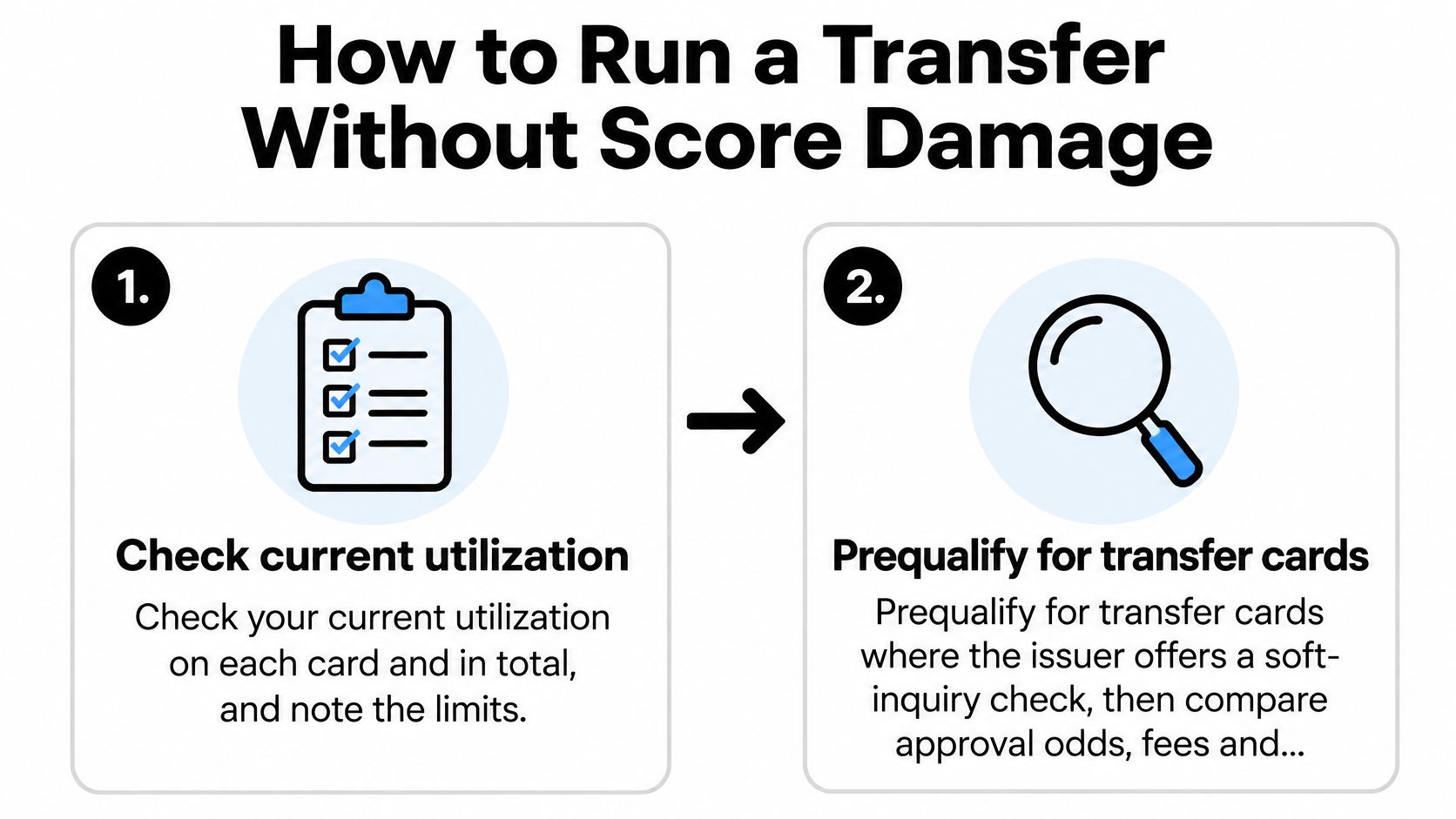
The planning sequence begins with the existing accounts, not the advertised introductory rate.
Prepare, apply, and verify
Record current utilization. The borrower should list every card's balance and limit, then calculate individual and combined utilization. Recent statements and issuer account dashboards provide the starting figures.
Use soft-inquiry prequalification when available. The issuer's disclosure should confirm the type of check. Approval fit, transfer capacity, fees, and promotional length all belong in the comparison.
Leave room below the limit. The transferred balance plus the fee should leave substantial unused capacity. A planning target well below half the new limit offers more breathing room, but it isn't a scoring threshold or a guarantee of improvement.
Calculate the deadline payment. The borrower should use the actual quoted fee and promotional period rather than a general estimate. The resulting payment must fit the budget without relying on additional credit.
Submit a focused application. Applying selectively avoids unnecessary account openings and inquiries. If the approved limit is insufficient, the borrower should reassess instead of immediately submitting more applications.
Verify both sides of the transfer. Payments on the original account should continue until completion is confirmed. Keeping an eligible, fee-free old card open may preserve available credit, but new purchases on either card can undermine the plan.
Automate and inspect. Automatic payments should support the payoff schedule, with enough money available in the payment account. The borrower should review subsequent statements and credit-report updates to confirm that balances and limits are accurate.
Know when another approach deserves consideration
A borrower who needs another card to afford existing minimum payments may need a broader review of the debt situation. LifeBack Law Firm, P.A.’s credit card debt guidance for Minnesota families provides useful context about the risks of using additional credit to manage existing obligations.
At the promotion's end, the decisive questions are whether the transferred balance has been cleared, whether other balances stayed under control, and whether the payment routine remains sustainable. A temporary score movement matters less than ending the process with less debt and dependable payments.
Toya AI brings connected debt balances, APRs, and due dates into one view and builds a personalized payoff plan from existing accounts. Visit Toya AI to compare current payments with a clearer debt-free timeline and identify where extra payments can save interest before committing to a balance transfer.
Ready to start your debt-free journey?
Toya AI builds a personalized payoff plan so you can see your debt-free date and save on interest.
Get Started Free