
Credit Card Debt Balance Transfer: The Smart Strategy
Balance transfers save money only when the promotional window is long enough to repay the principal before the transfer fee and post-promotion rate arrive. In 2024, consumers moved $59.5 billion in credit card balances through balance transfers, but a large market doesn't make every transfer worthwhile.
The useful question isn't “Does the card offer 0% APR?” It's “Will the interest avoided exceed the upfront fee, and can the borrower clear the balance before the regular APR starts?” That break-even calculation separates a genuine payoff tool from an expensive delay.
Table of Contents
- What a Credit Card Balance Transfer Actually Does
- How Balance Transfer Fees and Rates Really Work
- Balance Transfer vs Other Debt Payoff Strategies
- Real Examples of Balance Transfer Savings
- Step-by-Step Guide to Executing a Balance Transfer
- Common Mistakes and When to Skip a Balance Transfer
What a Credit Card Balance Transfer Actually Does
In 2024, consumers moved $59.5 billion in credit card balances through balance transfers, according to the CFPB's 2025 Consumer Credit Card Market Report and highlighted by the Consumer Bankers Association's balance-transfer overview. The figure shows that balance transfers are a major way people manage revolving debt, not a niche tactic reserved for unusual financial situations.
A balance transfer moves an existing credit card balance to another credit card, usually one offering a lower introductory APR. Many current offers use a 0% promotional APR, but the rate applies only for a defined period. The borrower still owes the full principal, and the new account remains a credit product with fees, limits, payment requirements, and a regular APR after the promotion.
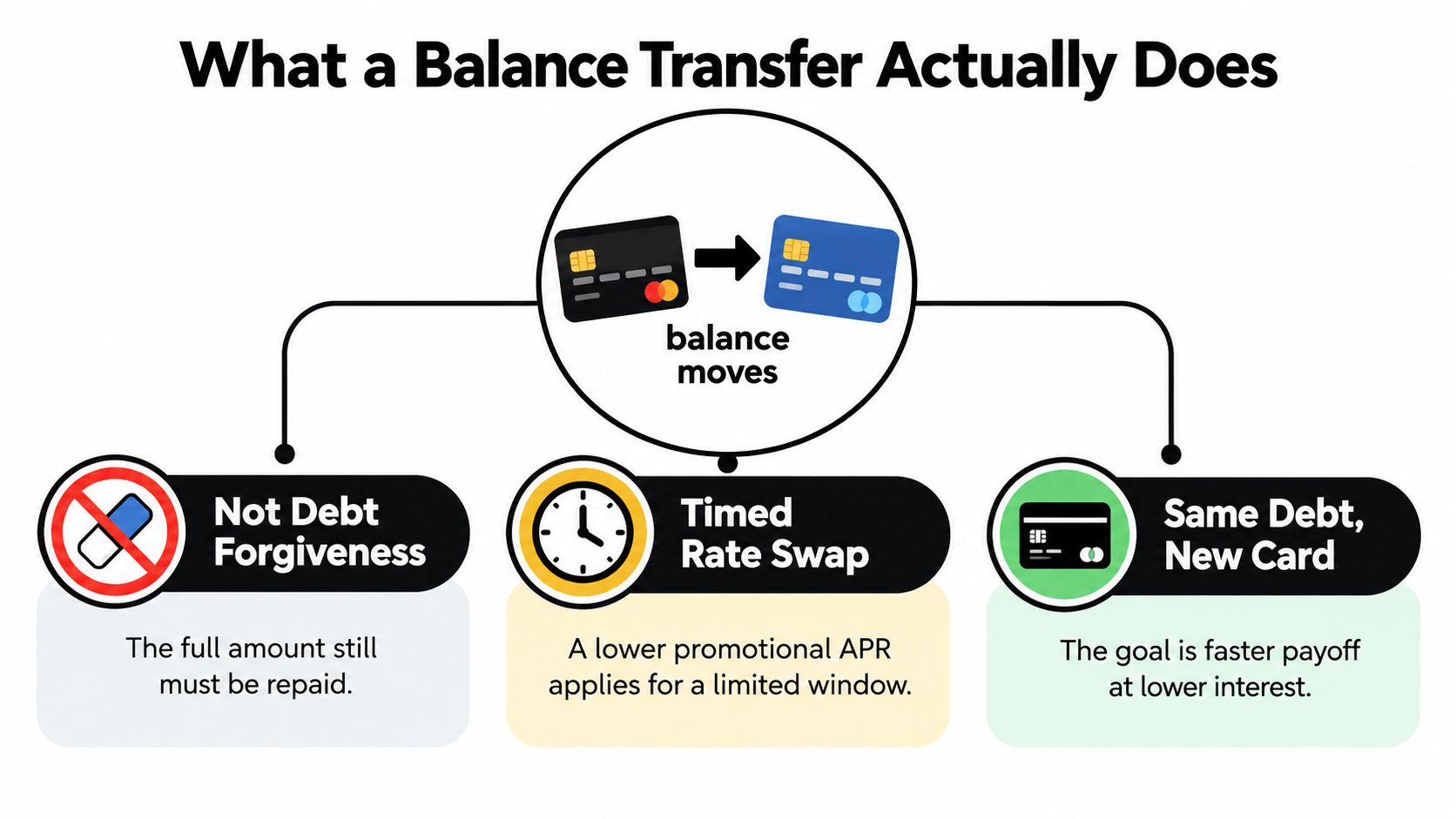
A timed rate swap, not debt forgiveness
The mechanics are straightforward:
- A borrower applies for a balance-transfer card.
- The issuer approves a credit limit and terms.
- The borrower requests that some or all of an existing balance move to the new account.
- The new card charges the promotional APR for the stated period.
- The borrower makes planned payments until the balance reaches zero or the promotion ends.
The debt has changed accounts, not disappeared. A transfer can create breathing room because more of each payment can reduce principal instead of covering interest. That advantage disappears if the borrower keeps making only minimum payments or adds new spending that competes with the transferred balance.
Practical rule: Treat a balance transfer as a repayment deadline with a temporary interest advantage, not as permanent relief.
High revolving rates can make minimum payments feel ineffective because interest consumes part of each payment before the balance meaningfully falls. A promotional window changes that calculation, but only while the offer lasts. The card's post-promotion APR matters from the first day of planning, even when the borrower expects to finish repayment earlier.
How Balance Transfer Fees and Rates Really Work
A balance transfer can save interest, but the fee, promotional period, required payment, and regular APR determine whether it works. Evaluate them together, rather than treating the headline 0% rate as the whole offer.
Modern balance-transfer cards commonly provide a 0% introductory APR for 12 to 21 billing cycles, as described in this guide to avoiding balance-transfer fees. After the promotional period, a variable APR applies. Borrowers should also review a credit card APR explainer to distinguish the introductory rate from the regular rate that follows.
The fee enters the balance immediately
Transfer fees commonly range from 3% to 5% of the amount moved. Some issuers add the charge to the new balance, while others list it separately. The repayment obligation is the same.
Consider a $5,000 transfer with a 5% fee. The fee is $250, so the new balance may begin at $5,250. If the old card charges 22% APR and the borrower would otherwise need 21 months to clear the debt, the avoided interest is roughly $1,050. Subtracting the $250 fee leaves an estimated benefit of about $800, before considering any balance remaining after the promotion.
At a lower old-card rate of 8%, the avoided interest may be closer to $370. After the same $250 fee, only about $120 remains as potential savings. The fee consumes much more of the benefit, even though the transfer still carries a 0% promotional rate.
Use this break-even calculation:
Interest avoided during the promotional period minus transfer fee minus post-promotion interest equals estimated benefit.
The payment schedule tests whether that estimate is realistic. To clear $5,250 within a 21-cycle promotion, the borrower needs to plan for roughly $250 per cycle, assuming no new charges and no other account terms that affect the balance. A smaller payment leaves principal for the regular APR to price later.
The rate reset changes the risk
A 0% offer provides a limited runway. When it ends, the remaining balance can face a variable APR in the high teens or above 25%, depending on the issuer and credit tier. That future rate belongs in the calculation from the beginning, not after the promotion expires.
Use this decision checklist before applying:
- Calculate the fee in dollars.
- Estimate interest the old card would charge.
- Divide the new balance, including the fee, across the promotional cycles.
- Check whether the planned payment fits the monthly budget.
- Estimate interest on any balance likely to remain afterward.
- Skip the transfer if the fee and rate-reset risk outweigh the expected savings.
A longer promotional window can justify a higher fee when it gives the borrower enough time to repay the principal. A shorter window may fail when income is irregular or the plan depends on uncertain future cash flow.
Balance Transfer vs Other Debt Payoff Strategies
A balance transfer changes the interest calculation, but it does not change the amount owed. Compare each strategy by its APR, balance, monthly cash available, credit profile, fees, and ability to meet a fixed payoff schedule.
| Strategy | Best For | Key Risk |
|---|---|---|
| Balance transfer | Borrowers who qualify for a strong offer and can repay within the promotional window | Fees and the post-promotion APR can erase savings |
| Debt snowball | Borrowers who need quick psychological wins from eliminating small balances | Higher-rate debt may remain expensive longer |
| Debt avalanche | Borrowers who can follow the math and want to attack the costliest balance first | Progress can feel slow when the highest-rate balance is large |
| Personal loan consolidation | Borrowers who want one fixed payment and a defined payoff date | The loan may cost more overall or extend repayment |
Snowball and avalanche approaches
The debt snowball puts extra money toward the smallest balance while minimum payments continue elsewhere. Paying off one account can simplify the monthly budget and build motivation, even if another balance has a higher APR. This method can work well when progress and accountability determine whether the plan continues.
The debt avalanche directs extra money to the highest-interest balance first. It suits borrowers who can stay focused on interest cost rather than account size. A balance transfer can support either method, provided the transferred balance receives a deadline-based payment plan.
Personal loan consolidation replaces revolving debt with an installment loan. The rate is generally fixed for the loan term, while scheduled payments create a clearer finish line. Borrowers comparing loan structures can review this balance transfer vs personal loan guide alongside tradie debt consolidation options when assessing solutions for business-related debt.
The decision turns on certainty
Recent offer data shows that 44% of 0% balance-transfer offers charged 4% or 5% in early 2025, compared with 39% a year earlier and 28% in 2022. The same LendingTree offer analysis reports that 82% of offers lasted only 12 or 15 months. Those terms make the repayment schedule central to the break-even calculation.
A transfer may fit when the borrower can substantially reduce the balance before the rate resets, qualifies for a reasonable fee, and has stable cash flow. A snowball may suit someone who needs simplicity and visible progress. An avalanche may produce greater interest savings when rate reduction is the priority. A consolidation loan may be preferable when predictable payments matter more than a temporary 0% period.
The practical test is completion. Choose the strategy that can be paid off on schedule without returning to expensive revolving debt, regardless of how attractive the opening rate appears.
Real Examples of Balance Transfer Savings
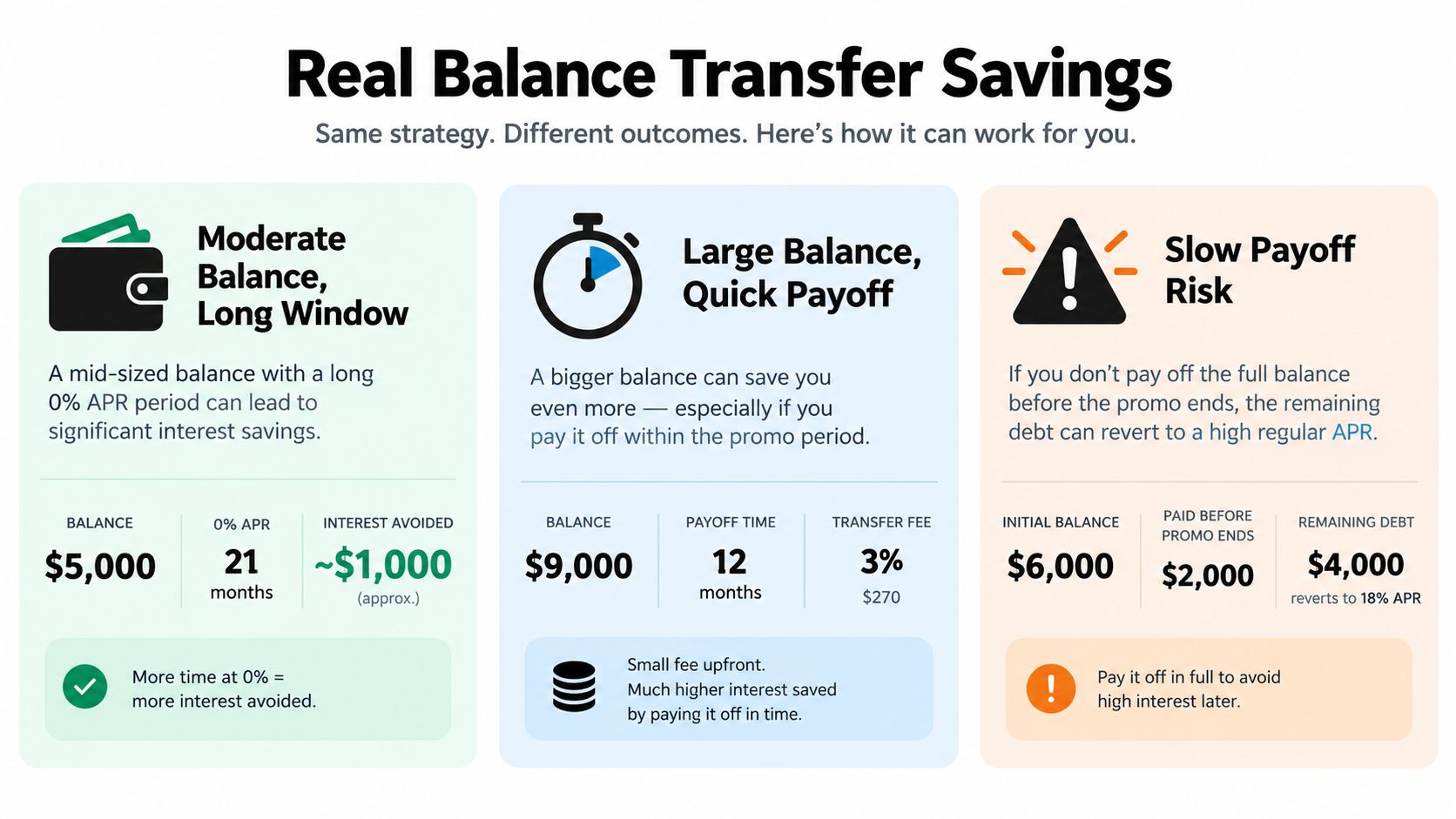
The break-even calculation decides whether a balance transfer helps. For every offer, ask three questions: What does the transfer cost, how much interest will it avoid, and what balance remains when the promotional rate ends? The fee is the entry cost. The payment schedule determines whether the savings survive.
Example one, a moderate balance and a long window
A borrower transfers $5,000 to a card offering 0% APR for 21 months with a 5% fee. The fee is $250, so the starting obligation becomes $5,250 if the issuer adds the charge to the transferred balance.
Dividing $5,250 across 21 months requires about $250 per month. Paying that amount clears the balance before the regular APR begins, so no post-promotion interest accrues on the transferred debt. The net benefit equals the interest avoided on the original high-rate card minus the $250 fee.
The regular APR still belongs in the calculation even when the balance reaches zero on schedule. A missed month or lower payment changes the result immediately because the borrower may carry debt beyond the promotional deadline. Check the payment against the budget, not just the advertised rate.
Example two, a larger balance and a short runway
A borrower transfers $9,000 during a 0% promotional period lasting 12 months. The 3% fee adds $270, creating a total obligation of $9,270. Clearing that amount before the rate resets requires $770 per month.
That payment may exceed the borrower's available cash flow. Paying substantially less leaves a residual balance when the promotion ends. The card then applies its regular variable APR, which current offers can place in the high teens through the high 20s, depending on the account terms.
The transfer may still reduce interest during the promotional period, but the final savings depend on the remaining balance and how long it stays after the reset. A borrower who cannot make the required payment should compare a fixed-rate consolidation loan or an avalanche plan before applying.
Example three, a small balance and a large fee share
A borrower transfers $1,000 with a 5% fee, creating a $50 cost. If the borrower repays quickly, the interest that would have accumulated may be modest. When the old card's rate is only slightly higher than the new card's effective cost, the fee can absorb most of the potential saving.
For a small balance, calculate the interest that would have accumulated during the planned payoff period. Compare that estimate with the fee, then check whether the monthly payment fits the deadline. If the difference is small, paying down the existing card may be simpler and involve less transfer risk.
Residual debt is the main deadline risk. A promotional period can lower the cost temporarily, yet the account still needs a payment plan that reaches zero before the regular rate applies. The fee appears on day one, while the larger loss can emerge later if the schedule falls short.
Step-by-Step Guide to Executing a Balance Transfer
A successful transfer starts before the application. The borrower needs a complete debt picture, a realistic payment amount, and a written deadline.
1. Check the debt and credit profile
List each card's balance, APR, minimum payment, and due date. Then check the borrower's credit profile and estimate whether the desired offer is realistic. Balance-transfer cards are typically designed for borrowers with good to excellent credit, because issuers use the offer to attract relatively lower-risk customers and may pair the promotion with a high revert APR, according to this explanation of credit requirements for balance-transfer cards.
Approval doesn't guarantee a credit limit large enough to move every balance. The transfer fee may also reduce the amount available for the debt itself.
2. Compare the complete offer
Check the promotional APR, number of billing cycles, transfer fee, regular APR, minimum payment rules, transfer deadline, and any conditions that could end the promotion. A card offering a longer window may be preferable even with a higher fee if the borrower's payment schedule requires the extra time.
The balance transfer calculator can help compare the fee against the interest avoided and test whether the planned payment clears the balance before the reset date.
3. Apply and request the transfer
After approval, gather the old creditor's name, account number, and requested transfer amount. Follow the new issuer's instructions precisely. Transfers can take time to process, so the borrower should continue making at least the required payment on the old card until the old balance shows as paid or reduced.
A transfer request isn't the same as a completed transfer. Account statements should confirm when the new balance appears and when the old account receives the payment.
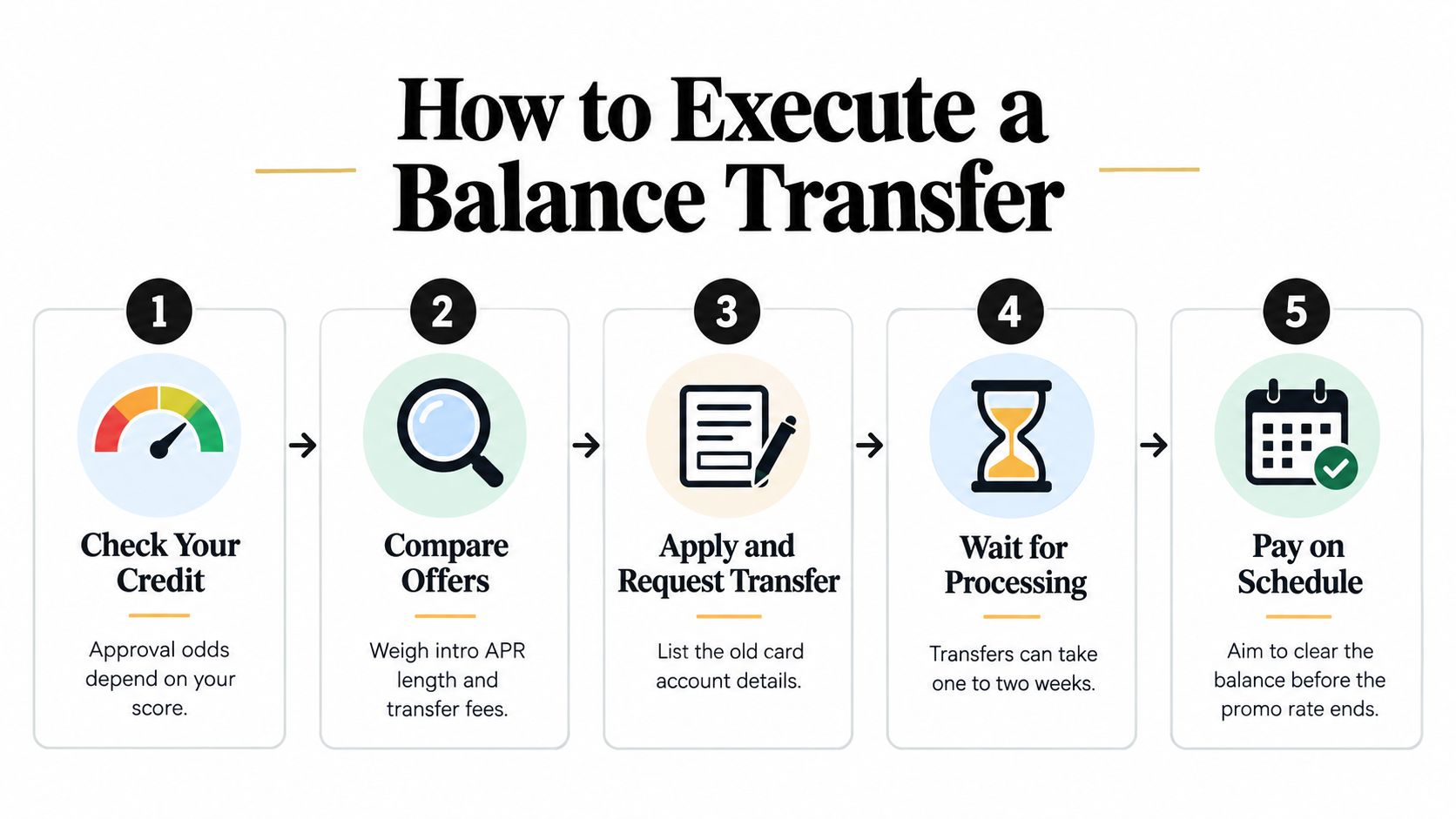
4. Set the payment before the first due date
Calculate the amount needed to clear the transferred balance, including the fee, before the promotional end date. Divide that total by the available billing cycles, then add a margin if the budget allows. Automatic payments can protect against missed due dates, but the borrower should still review statements.
A credit card reconciliation guide can help households or small businesses match statements, payments, fees, and balances so errors don't remain hidden.
5. Keep the old account under control
The old card may remain open after the transfer. New spending on it can rebuild the debt, while purchases on the new card can complicate repayment and may not receive the same promotional treatment. A separate spending plan keeps the transfer focused on debt reduction.
Common Mistakes and When to Skip a Balance Transfer
The most expensive mistake is treating a balance transfer as a permanent interest reduction. It's a temporary bridge, and the borrower must know where the bridge ends.
The Consumer Financial Protection Bureau reports that balance-transfer incidence declined over 2023–2024 after a slight increase in 2021 and early 2022, particularly among credit-score tiers where prime and higher-score consumers had historically used transfers most often, according to the CFPB's 2025 Consumer Credit Card Market Report. That trend challenges the assumption that balance transfers become more useful whenever card rates are high. Access, offer quality, and repayment capacity still determine the outcome.
Mistakes that erase the advantage
- Ignoring the fee: A transfer can look free at 0% APR while the upfront charge consumes the expected interest saving.
- Missing the end date: A balance left after the promotion can face a variable APR in the high teens or above 25%, depending on the offer.
- Adding new purchases: New charges can make the account harder to track, and purchase interest rules may differ from transfer terms.
- Applying repeatedly: Multiple applications can create hard inquiries and make the credit profile less stable.
- Paying only the minimum: Minimum payments may leave too much principal when the promotional window closes.
- Closing the old card immediately: Closing an account can change utilization and reduce available credit, so the borrower should understand the credit impact before acting.
When another strategy is safer
A transfer is usually a weak choice when the borrower can't commit to a fixed payoff amount, has irregular cash flow that makes the deadline unreliable, or can't qualify for a fee and rate combination that beats the existing card. It may also be weaker than a fixed-rate consolidation loan when predictable payments and a defined payoff date matter more than a temporary promotional period.
A simple decision checklist can prevent an expensive application:
- Can the borrower repay the transferred balance before the promotional end date?
- Does the avoided interest exceed the transfer fee by a comfortable margin?
- Is the regular APR acceptable if repayment takes longer?
- Can new spending stop while the transfer is being repaid?
- Would a fixed-rate loan create a more reliable payment schedule?
If any answer is no, accelerating payments on the current card, using the avalanche method, or comparing a consolidation loan may be more appropriate than pursuing a credit card debt balance transfer.
Toya AI centralizes balances, APRs, utilization, and due dates, then models how different payments or a balance transfer could change the payoff date and total cost. Readers can compare their options and build an adaptive debt plan by visiting Toya AI.
Ready to start your debt-free journey?
Toya AI builds a personalized payoff plan so you can see your debt-free date and save on interest.
Get Started Free