
You Need a Budget Alternatives Worth Trying in 2026
A reader opens YNAB after payday, sees a carefully arranged set of categories, and still wonders whether the next credit-card payment will clear before rent. Another household has three loan due dates, irregular freelance income, and no time to reconcile every transaction. A third has stopped using the app because the subscription feels hard to justify when bank connections keep failing.
The best You Need a Budget alternatives aren't interchangeable clones. Each one solves a different money problem. Some are excellent at tracking, others at forecasting, some at debt sequencing, and a few remain useful when the household refuses another subscription. The right choice depends less on the longest feature list than on the job the app must perform every week.
Table of Contents
- Why People Leave YNAB and What They Actually Want Next
- The Best You Need a Budget Alternatives Worth Trying in 2026
- How to Read the Comparison Table Without Getting Fooled
- Matching the Right App to Your Real Situation
- Switching From YNAB Without Losing Your History
- The Honest Verdict on Picking Your Next Budgeting App
Why People Leave YNAB and What They Actually Want Next
YNAB's zero-based approach asks users to assign available money across categories and keep those categories current. That method can be powerful for people with steady income and enough time to maintain the plan. It becomes less comfortable when pay arrives irregularly, several debts compete for extra cash, or the immediate priority is knowing which bill must be paid next.
The pressure behind this search is substantial. The Federal Reserve Bank of New York's household credit data reports that U.S. household debt reached $18.39 trillion in the second quarter of 2025, including $1.21 trillion in credit-card balances, which rose 5.87% year over year. Those balances include more than a budgeting problem. They create competing decisions about minimum payments, interest costs, due dates, and how to direct limited surplus cash.
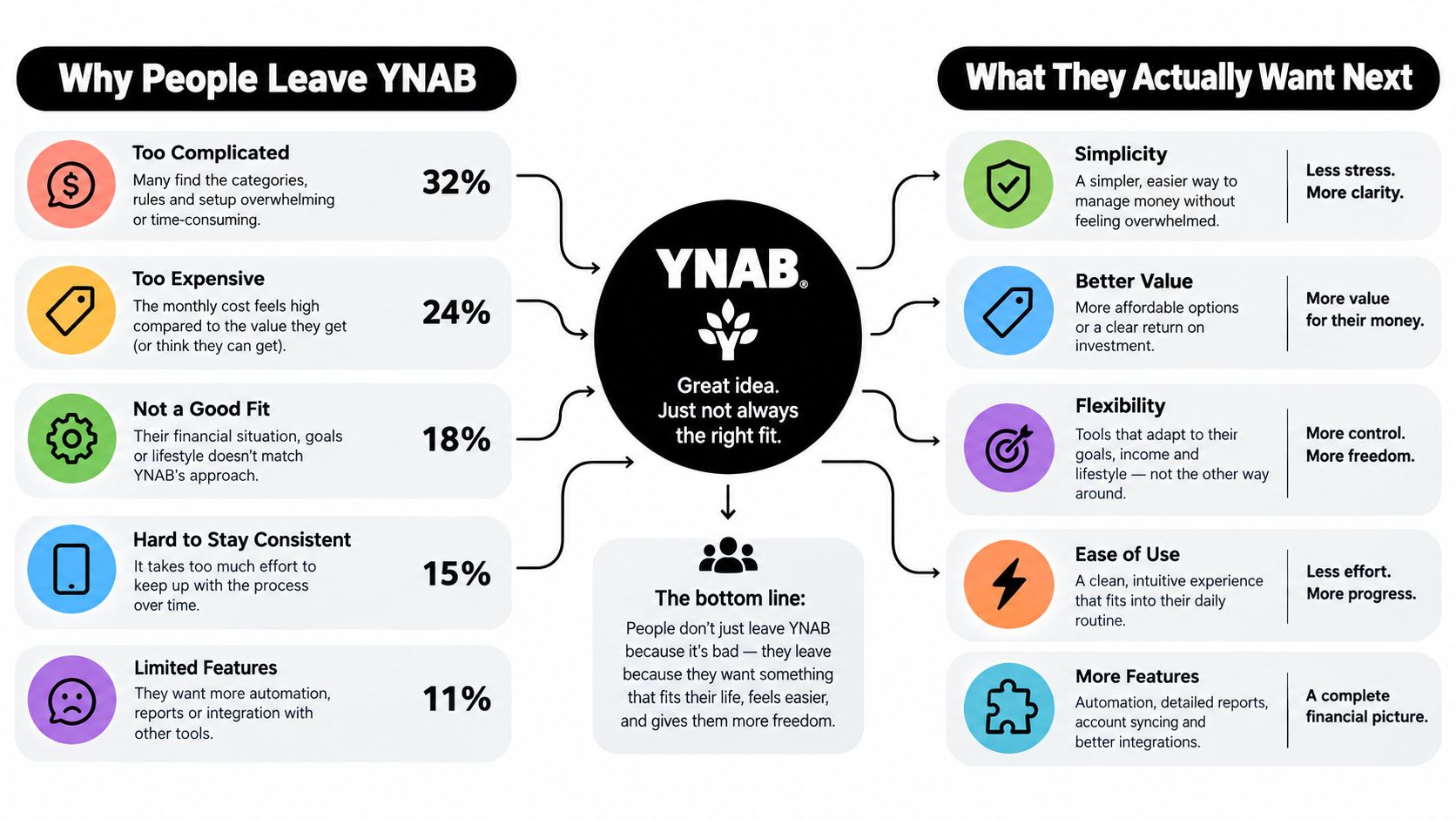
Four jobs matter more than a feature checklist
A serious comparison starts with four questions:
- Tracking discipline: Does the app make spending visible without creating too much upkeep?
- Cash-flow forecasting: Can the household see what remains after upcoming bills, irregular income, and recurring expenses?
- Debt sequencing: Does it show which extra payment has the greatest interest impact?
- Free or affordable access: Does the product remain useful without a subscription or a reliable bank connection?
A linked-account dashboard may solve tracking while doing little for debt decisions. A manual envelope app may build discipline but fail to forecast a difficult month. A polished product can still be the wrong fit if it requires more attention than the user can give it.
Practical rule: The best alternative is the app that solves the household's most expensive failure, whether that's missed due dates, stale balances, overspending, or interest accumulating on the wrong account.
Before comparing products, each reader should identify the dominant failure. Someone who forgets bill dates needs forecasting. Someone with several high-rate cards needs sequencing. Someone who repeatedly abandons apps needs low maintenance. Someone outside a well-supported banking market needs portability and manual fallback.
Security belongs in that first check too. Bank aggregation deserves a closer review of permissions, credential handling, revocation, and deletion policies. Readers who want a separate explanation of those issues can use this guide to financial data security.
The Best You Need a Budget Alternatives Worth Trying in 2026
A budget can be accurate and still fail if you stop opening it. A February 2025 survey of more than 300 active participants found that 45.3% used a digital tool or app to manage finances, while 20.9% used budgeting apps. The Academy Bank survey also found that roughly 50% of budgeting-app users engaged weekly or more. That makes regular use part of the decision, not a minor convenience.
Judge each alternative by personality and by the job it must do: tracking transactions, forecasting cash flow, sequencing debt payments, or staying useful without a subscription. No app wins all four. Pick the one that fixes your most expensive budgeting failure.
Monarch Money for the shared household view
Monarch Money is the strongest choice for a couple or family that wants spending, goals, investments, and shared finances in one dashboard. CNBC lists it at $8.33 per month when billed annually, and reports that it supports linked financial accounts in its comparison at CNBC Select.
Its advantage is broad visibility. Partners can review several accounts together and place the budget inside a wider financial picture. That tracking strength does not automatically determine which debt should receive the next payment. The app also relies on successful institution connections, so test the banks that matter before paying.
Forward cash visibility with Quicken Simplifi
For forward cash visibility, Quicken Simplifi pairs spending tracking with a view of what remains after planned expenses. It supports linked accounts and suits people who want an answer to a practical question: can this month's cash cover what is coming?
That forecast works best when recurring expenses are accurate. It is less useful as a dedicated debt strategy for a household managing several loans. Variable-income users should also check whether changing pay dates and amounts leave the forecast clear enough to guide decisions. Quicken Simplifi earns its place when forecasting matters more than manual envelope control.
The net-worth monitor dashboard
Personal Dashboard, also known as Empower Personal Dashboard, works well for someone focused on total financial position, investments, and account visibility. It supports linked financial accounts in the CNBC comparison, giving users a consolidated view without requiring a fully manual system.
Choose it when tracking assets and spending is the main job. Choose something else when the difficult decision is whether an extra payment belongs on a credit card or a student loan. A clear account view can show the problem without sequencing the solution.
PocketGuard answers the safe-to-spend question
When the priority is a single spending boundary, PocketGuard answers that question directly. It helps users see how much remains after bills and planned commitments. CNBC reports that PocketGuard advertises connections to more than 18,000 institutions through Plaid and Finicity, and lists pricing at $12.99 monthly or $74.99 annually in its comparison.
That approach suits people who dislike detailed category maintenance. The trade-off is limited debt direction. You may know what is available while still lacking a clear answer about which account deserves the next dollar. PocketGuard is a good tracking and spending-control choice, not the strongest debt-sequencing tool.
Rocket Money for recurring-cost cleanup
Rocket Money belongs on the shortlist for someone focused on recurring charges, unwanted subscriptions, and monthly leakage. It suits a reader who wants expense cleanup rather than a full replacement for YNAB's category discipline.
Reducing recurring costs can create breathing room. It does not produce a payoff order across cards, loans, and changing interest rates. Use Rocket Money when recurring bills are the household's visible problem. Pair it with another method if debt sequencing is the larger concern.
Goodbudget gives manual control
Goodbudget is built for households that prefer digital envelopes and do not trust automatic imports. CNBC reports that Goodbudget's free and paid tiers rely on manual entry, while the other linked-account products in its comparison include Quicken Simplifi, Monarch, PocketGuard, and Honeydue.
Its strength is deliberate control. Partners can agree on envelope limits and record spending themselves. Its weakness is the work required to keep balances current. Forget one transaction and the budget may look orderly while reflecting the wrong reality. Readers exploring the behavioral side of physical and digital envelopes can also read CreditCardCult's explanation of cash stuffing.
Debt-focused planners put payment order first
A household carrying credit cards, student loans, auto loans, or personal loans should consider a debt-focused planner, even when it lacks the broad features of a classic budgeting app. The useful feature is an adaptive payoff view showing balances, APRs, minimums, due dates, and the effect of each extra payment.
This category fits borrowers whose main objective is becoming debt-free rather than perfect transaction labeling. It may feel narrow beside an all-purpose financial dashboard, but that trade-off makes sense when interest and payment order create the largest financial cost. Tracking tells you where the money went. A debt planner helps decide where the next dollar should go.
The shortlist is clear. Choose Monarch Money for shared visibility, Quicken Simplifi for cash-flow forecasting, Goodbudget for manual envelopes, PocketGuard for a simple spending boundary, and a debt-focused planner when payment sequencing matters more than category precision. If staying free is the deciding factor, start with the options that offer free access or manual control, then confirm that the trade-off in automation will not make you abandon the system.
How to Read the Comparison Table Without Getting Fooled
A comparison table earns its place only when each column answers a practical household question. Price shows the direct subscription cost. Bank linking shows whether transactions can stay current. Debt payoff depth shows whether the app can help order payments instead of merely displaying balances. Best fit reveals which users can maintain the workflow without constant frustration.
| App | Price | Bank Linking | Debt Payoff Depth | Best Fit |
|---|---|---|---|---|
| Monarch Money | $8.33 monthly, billed annually | Yes | Moderate, general planning | Couples and households wanting a broad dashboard |
| Quicken Simplifi | Pricing varies by offer | Yes | Light to moderate | Cash-flow-focused planners |
| Personal Dashboard (Empower) | Free access available | Yes | Light | Net-worth and account visibility |
| PocketGuard | $12.99 monthly or $74.99 annually | Yes, advertises more than 18,000 institutions | Light to moderate | Users wanting a quick spending boundary |
| Rocket Money | Free and paid options | Product-dependent | Light | Subscription and recurring-cost cleanup |
| Goodbudget | $10 monthly or $80 annually for unlimited envelopes | No, manual entry | Moderate through envelopes | Manual-control households |
| Debt-focused planner | Product-dependent | Product-dependent | High when built for payoff sequencing | Borrowers prioritizing interest and payoff order |
CNBC's comparison confirms that Quicken Simplifi, Monarch, PocketGuard, and Honeydue support linked accounts, while Goodbudget relies on manual entry. Before choosing a linked app, check whether your two most important institutions appear in its connection directory. Then run a seven-day refresh test. A failed connection to a bank or loan servicer matters more than a lower subscription price because missing transactions can undermine both tracking and forecasting.
Price is only the first cost
A low subscription price does not guarantee low effort. A free manual app may require frequent entry, correction, and reconciliation. A paid linked app may save time, yet become poor value if your bank will not connect or imported data goes stale.
Debt depth deserves the same scrutiny. An app can list a card balance without helping you decide whether an extra payment belongs there. If you need background on how linked financial data reaches budgeting tools, read this explanation of account aggregation services.
Score the table in under two minutes
Answer four questions before choosing:
- Tracking: Will manual entry happen consistently, or are linked accounts safer?
- Forecasting: Do you need a future cash view or a record of past spending?
- Debt: Does the app show APRs, minimums, and payment consequences, or only balances?
- Access: Will you keep paying, or do you need a free fallback?
Judge the app by its weakest answer. A product may offer strong tracking and forecasting while failing at debt sequencing. Another may handle payoff order well but demand more maintenance than your household will tolerate. Pick the option that completes your main job and remains usable after the first month.
Matching the Right App to Your Real Situation
The right recommendation changes as soon as income, debt, and household responsibilities change. Five common profiles make the decision clearer than labels such as “best for beginners.”
The gig worker with credit-card debt
A freelancer receives uneven payments and carries balances across more than one card. The priority is not merely categorizing last month's restaurant spending. The priority is seeing upcoming obligations, protecting minimum payments, and directing extra money toward the costliest balance.
A cash-flow-oriented app such as Quicken Simplifi may be the better general budgeting choice, while a debt-focused planner is stronger if payoff sequencing is the central job. A rigid category workflow can become frustrating when the amount available to assign changes every pay cycle.
The young family with competing due dates
A household with childcare, housing, utilities, credit cards, and loans needs a shared calendar of obligations. Monarch Money makes sense when both adults need a broad account view, while PocketGuard suits a couple that wants a quicker spending boundary.
The deciding test is simple: can both adults see what must be paid before deciding what can be spent? If not, the app is optimizing the wrong task. A family should also confirm that every bank and loan provider connects reliably.
The recent graduate with student loans
A graduate may have modest savings, several loan accounts, and a new income that changes as employment settles. The most useful system displays balances, interest rates, minimums, and due dates together. A debt-focused option is preferable when the graduate needs a payoff path rather than another monthly spending chart.
For readers building their financial foundation alongside a budget, Accountant She Ltd's budgeting course offers structured education that can complement the app. The tool should make the next decision obvious, not bury the loan plan beneath categories.

The couple that refuses another subscription
A subscription-averse couple should start with Goodbudget or another manual option, provided both partners accept the entry habit. Goodbudget's manual model can work well when the household prefers deliberate envelope decisions and has a manageable number of accounts.
The hidden price is attention. If transactions go unrecorded, the free option becomes misleading. A linked product can be cheaper in time even when it costs more in cash, so the couple should test a representative week of actual maintenance before deciding.
The coach tracking client progress
A financial coach needs consistency across clients, clear debt milestones, and a workflow that doesn't depend on every person becoming a budgeting expert. A broad dashboard may help clients understand their accounts, but a debt-focused system provides a stronger structure when the program measures balances, payment order, and progress toward payoff.
The cash-flow forecast app guide can help coaches assess whether a product supports forward planning rather than only historical reporting. The best client tool creates a repeatable conversation: what changed, what payment comes next, and what caused the projection to move.
Interest rates should shape every debt recommendation. A 2025 New York Fed staff report puts average credit-card rates near 22%, with roughly an 18-percentage-point spread over the short-term rate. For example, a $5,000 balance at 22% APR produces approximately $1,100 in simple annual interest, or roughly $92 during the first month, before payments and compounding. If two cards compete for one extra payment, the higher-rate card generally deserves priority while minimums continue on both.
Switching From YNAB Without Losing Your History
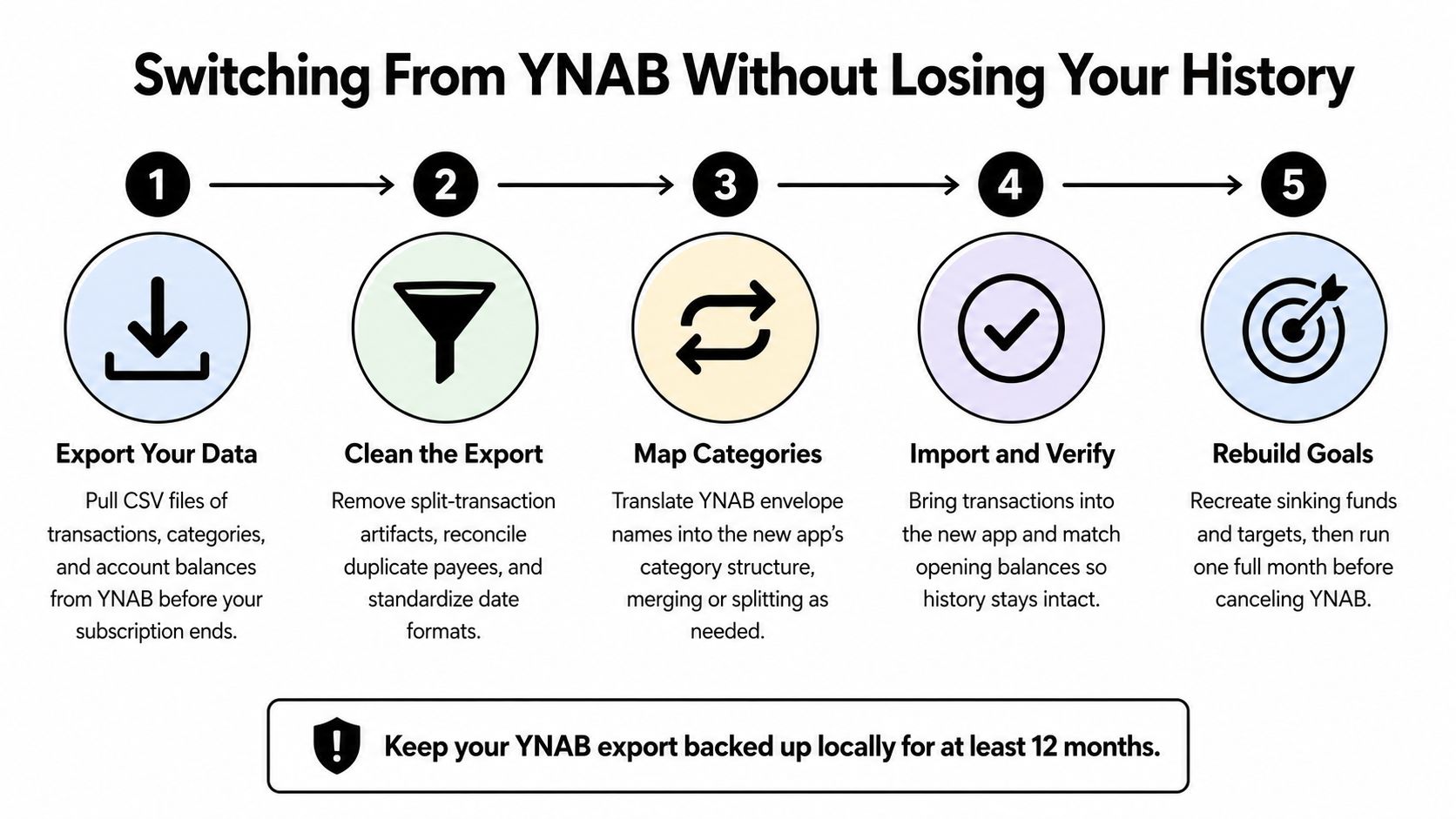
Leaving YNAB doesn't require abandoning the habits that worked. It requires separating useful behavior from unnecessary maintenance and preserving the records that make the transition trustworthy.
Export before changing anything
Start by exporting transactions, categories, and account balances from YNAB. Save the files locally before ending the subscription, then keep the original copy unchanged. The export is the reference point if the new app imports a category incorrectly or creates duplicate transactions.
Next, clean the file. Remove split-transaction artifacts, reconcile duplicate payees, and standardize dates before importing. A messy export creates false history, and false history makes future reports less useful.
Map the old system to the new one
YNAB envelopes may not match the new app's category structure. Map each category deliberately, then decide whether several small envelopes should merge or whether one broad category should split into clearer groups.
The household should also decide which habit survives. Recording spending, reviewing upcoming bills, and assigning money intentionally are useful behaviors. Rebuilding every category exactly as it existed may not be useful if the new app's main advantage is forecasting or debt sequencing.
Run both systems briefly
Import the cleaned history, match opening balances, and compare current account totals. Then operate the new app in shadow mode for a full month while keeping the YNAB export available for reference. The point isn't to maintain two perfect budgets. It's to find missing transactions, broken connections, and confusing workflows before cancellation.
Use the trial period to test an ordinary month, including a pay cycle, recurring bills, a card payment, and an unexpected expense. Commit only when the new app produces answers the old workflow couldn't provide.
Check security before linking accounts
A budgeting app that aggregates financial accounts should answer specific questions:
- Permissions: Does the connection use read-only access where possible?
- Credential handling: Does the aggregator handle credentials rather than the budgeting vendor storing them?
- Protection: What encryption and authentication controls protect data in transit and at rest?
- Revocation: Can users disconnect an account and request deletion?
- Retention: Does the vendor clearly explain how long data remains stored and who receives it?
The USA Today guidance on choosing a budgeting app notes that Plaid states it uses AES-256 encryption for stored data, TLS for data in transit, continuous API monitoring, multifactor authentication within its systems, and external security testing. Those safeguards reduce exposure, but they don't remove aggregation risk. The budgeting vendor's own permissions, sharing, revocation, and retention practices still matter.
The Honest Verdict on Picking Your Next Budgeting App
Two questions settle most YNAB alternative decisions.
First, does the household need a category-discipline tool or a debt-decision tool? Goodbudget and YNAB-style systems suit people who need stronger spending boundaries. Quicken Simplifi and PocketGuard are better for forward cash visibility. A debt-focused planner is the clear choice when the painful decision is where to direct extra money.
Second, how much manual work is acceptable in exchange for lower cost? Manual entry can keep a household independent from bank connectivity, but it creates a recurring responsibility. Linked accounts reduce that effort, yet they need institution coverage, reliable refreshes, and careful security review.
A useful budgeting framework doesn't need to become a rigid rule. The California Department of Financial Protection and Innovation summarizes the CFPB's 50/30/20 framework as 50% of income for needs, 30% for wants, and 20% for savings and debt repayment, with the 20% portion flexible enough to absorb additional debt payments in the DFPI's financial planning guidance. With $4,000 in monthly take-home pay, that starting allocation would be about $2,000 for needs, $1,200 for wants, and $800 for savings plus debt repayment. A household facing expensive card balances can shift part of the wants allocation toward debt without treating the framework as a rigid spending quota.
The final recommendation is straightforward. Choose Monarch Money for shared financial visibility, Quicken Simplifi for cash-flow forecasting, Goodbudget for hands-on envelopes, PocketGuard for a simpler spending boundary, and a debt-focused planner when interest and payoff order dominate the household's concerns. Then test the app against one real month, not an idealized budget.
Toya AI helps households centralize debts, compare payoff choices, and receive adaptive next-best-payment guidance across credit cards, student loans, auto loans, personal loans, and mortgages. Visit Toya AI to track debt for free and see whether a clearer payoff plan fits the household's next financial decision.
Ready to start your debt-free journey?
Toya AI builds a personalized payoff plan so you can see your debt-free date and save on interest.
Get Started Free