
Why Pay Off Student Loans Early? the Honest Answer
“Pay off student loans as fast as possible” is popular advice, but it can be expensive advice for the wrong borrower. Sending every spare dollar to a loan makes little sense if an emergency then forces credit-card borrowing or if those extra payments reduce a balance that could qualify for forgiveness.
The honest answer to why pay off student loans is straightforward: early repayment buys predictable interest savings and eventually removes a required bill. But debt freedom should improve financial security, not drain the cash that keeps a household afloat.
Table of Contents
- The Short Answer on Early Student Loan Payoff
- How Interest Works Against Your Balance
- Five Benefits Beyond Interest Savings
- Worked Example on a $35,000 Loan
- When Paying Off Early Costs You Flexibility
- Ranking Student Loans Against Your Other Goals
- Confirm Your Payoff Plan Before Sending Extra Money
The Short Answer on Early Student Loan Payoff
For borrowers with stable income, a working emergency fund, no forgiveness path, and a fixed rate of 6% or higher, steady extra payments are a strong default. That threshold is an editorial decision rule, not a universal financial law.
Reducing principal produces a predictable saving equal to the interest that principal would otherwise generate. Unlike an investment return, that saving doesn't depend on market performance. However, a tax deduction or expected forgiveness can change its economic value.
Translate the rate into dollars
Using simple annual interest, a $30,000 balance at 6% generates about $1,800 annually. Removing an extra $1,000 of principal avoids about $60 annually while that amount would otherwise remain outstanding, consistent with Federal Student Aid's explanation of interest and principal.
Guaranteed return from each extra $1,000 by interest rate
| Interest rate | Annual interest on $30,000 | Interest avoided per extra $1,000 each year |
|---|---|---|
| 3% | $900 | $30 |
| 4% | $1,200 | $40 |
| 6% | $1,800 | $60 |
| 7% | $2,100 | $70 |
| 9% | $2,700 | $90 |
These are illustrative calculations using principal multiplied by the annual rate, not full repayment forecasts. Actual interest depends on payment timing and the declining balance.
Conditions that reverse the recommendation
Extra payments should wait when a borrower has:
- Unstable cash flow: Essential bills already compete with the required payment.
- Insufficient reserves: An unexpected expense would require new borrowing.
- Higher-cost debt: Another balance charges more than the student loan.
- A credible forgiveness path: Additional repayment could replace money that would otherwise be forgiven.
The verdict isn't “always repay early.” It's repay early when the interest saving is worth more than the liquidity and protections surrendered.
How Interest Works Against Your Balance
A student-loan balance resembles a bucket, with interest acting like a slow drip that adds to the amount owed. The analogy has a limit: interest and principal aren't interchangeable, and understanding that distinction prevents repayment mistakes.
The image captures the ongoing drip, rather than an occasional charge.

Federal Direct Loans accrue interest daily. Borrowers with unsubsidized or PLUS loans are responsible for interest accruing during school, and unpaid interest can later become principal under specified conditions.
Capitalization makes the interest-bearing balance larger
Capitalization means adding accrued, unpaid interest to principal. In the earlier example, capitalizing $1,000 raises principal from $30,000 to $31,000, producing approximately $60 more annual interest at 6% under the same simple-interest calculation.
Triggers can include ending deferment on an unsubsidized loan or leaving certain income-based repayment arrangements. Borrowers should check their specific loan and plan rather than assume every deferment or plan change works identically.
Extra money generally covers outstanding interest before reducing principal. Returning to the bucket analogy, an overpayment doesn't reduce the future drip until it reaches the interest-bearing principal.
Practical rule: A larger payment and a larger principal reduction aren't necessarily the same thing.
Inspect the payment allocation
A useful servicer dashboard separates principal, accrued interest, interest rate, and projected payoff date. A single total balance conceals whether an extra payment paid yesterday's interest or reduced tomorrow's interest expense.
Borrowers comparing loans can use this explanation of student-loan interest rates alongside their statements. The allocation instructions matter as much as the payment amount.
For an additional visual explanation, the following video offers another format.
Understanding repayment mechanics isn't academic. In 2023, 16% of U.S. student-loan borrowers reported being behind on payments or in collections, according to the Federal Reserve's household survey.
Five Benefits Beyond Interest Savings
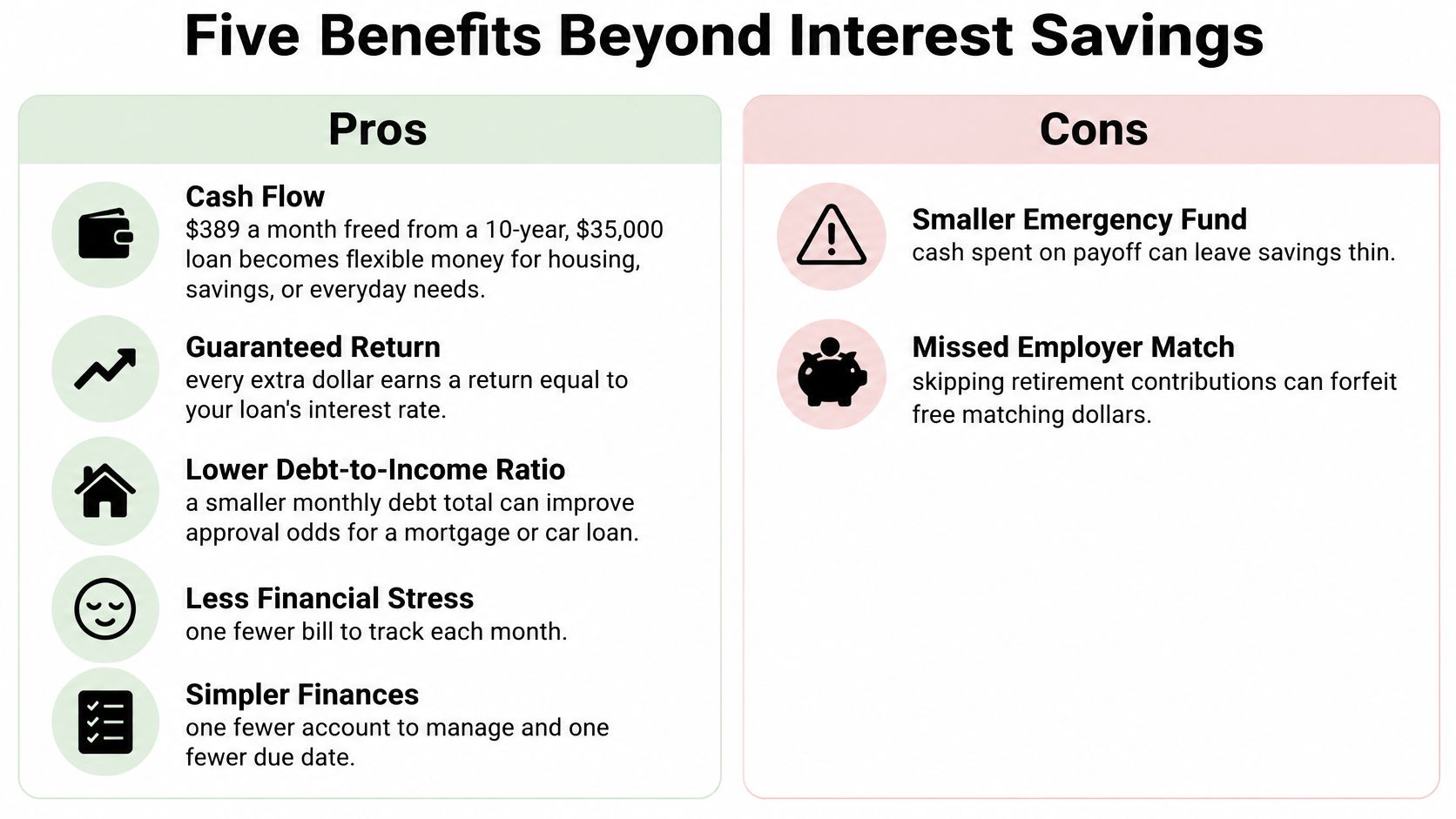
Early payoff offers more than an interest saving, but it is not automatically the best use of spare cash. A guaranteed return matters only if you can afford to give up liquidity and any federal protections tied to the loan.
Cash flow is the clearest day-to-day benefit. Once the loan is repaid, its required monthly payment can go toward other priorities. In the worked example, that would free roughly $389 a month after the hypothetical $35,000, 10-year loan is paid off. Until then, extra payments reduce available cash without removing the required bill.
Lower repayment exposure matters when income drops. A fully repaid loan cannot become delinquent. A smaller balance alone usually does not lower the required payment, so borrowers should not mistake payoff progress for immediate monthly relief. Payment strain is common: 20% of borrowers reported being behind or in collections in 2024, according to the Federal Reserve's report on household economic well-being.
Credit and emotional benefits need realistic expectations
Fewer required debt payments can help with borrowing decisions. A lower monthly obligation may improve the debt-to-income calculation lenders use. Paying off an installment loan does not erase its positive payment history, but it does not guarantee a higher credit score or mortgage approval.
Emotional relief depends on the borrower. Some value having one fewer due date more than the interest savings. Others feel more secure keeping cash on hand, especially when income is unpredictable. Weigh that preference against the cost of tying money up in the loan.
The trade-offs belong beside the benefits:
Fewer obligations create more choices
A lower required monthly income can widen career options. With the loan gone, a borrower may find it easier to consider a lower-paid role, relocation, or self-employment. That does not make a career change affordable on its own. It removes one fixed bill from the decision.
| Potential advantage | Corresponding trade-off |
|---|---|
| More spendable income after payoff | Less available cash while accelerating payments |
| Fewer required obligations | Possible reduction in eventual forgiveness |
| Simpler account management | Other goals may receive less funding |
| Greater freedom over work decisions | An aggressive schedule may strain the current budget |
Pay off early when it removes a burden without creating a cash shortage. Keep enough liquidity for likely expenses and weigh any federal protections or potential forgiveness before sending extra money. A zero balance is a poor result if the next emergency forces you into expensive debt.
Worked Example on a $35,000 Loan
Consider a hypothetical $35,000 federal loan at a fixed 6%, repaid over 10 years, with no capitalization, fees, or forgiveness. A standard monthly amortization calculation produces a payment near $389; federal fixed-payment plans use the balance, interest rate, and repayment period, as explained in Federal Student Aid's repayment-plan guide.
The following estimates use monthly amortization for comparison. Daily accrual, payment dates, rounding, and the final partial payment can change actual servicer results.
Compare the repayment choices
Payoff scenarios on a $35,000 loan at 6% fixed
| Scenario | Monthly payment | Months to payoff | Total interest | Interest saved vs. minimum |
|---|---|---|---|---|
| Minimum 10-year plan | About $389 | 120 | About $11,640 | $0 |
| Add $200 per month | About $589 | About 71 | About $6,600 | About $5,000 |
| One $5,000 lump sum today | About $389 | About 98 | About $8,000 | About $3,600 |
The minimum plan preserves current cash flow but carries the largest interest bill. It may still be appropriate when a borrower needs liquidity or expects qualifying forgiveness. The table measures repayment cost, not whether every available dollar belongs in the loan.
Adding to the monthly payment creates sustained acceleration. The borrower commits more future income throughout repayment, which explains the shorter schedule and larger total savings.
The lump sum works differently: it immediately reduces principal while preserving the original monthly payment. It saves interest without adding a recurring budget commitment, but it removes cash from savings immediately.
The monthly strategy doesn't win because recurring payments are inherently superior. It wins here because the borrower commits substantially more money over time.
For a borrower with a fragile emergency fund, the lump sum's opportunity cost may outweigh its interest savings. That cash could prevent new borrowing after a job interruption, urgent repair, or medical expense.
Account for taxes without overvaluing the deduction
Eligible taxpayers may deduct the lesser of $2,500 or qualified student-loan interest paid, subject to eligibility and income restrictions, according to the IRS student-loan interest deduction guidance. The deduction reduces taxable income, not the loan balance or tax bill dollar-for-dollar.
For illustration, a fully usable $2,500 deduction at a 22% marginal federal rate saves $550. That arithmetic doesn't justify paying interest solely to claim a deduction, and a borrower's actual benefit may be smaller.
To reproduce the comparison, a borrower should enter the current principal, fixed rate, remaining term, and required payment into a loan calculator. Running a baseline, a recurring-extra-payment scenario, and an immediate-principal-reduction scenario makes the trade-off visible in dollars.
The final decision should compare interest saved, cash committed, and cash remaining, not just the earliest payoff date.
When Paying Off Early Costs You Flexibility
Could extra payments cost a borrower valuable protection? Yes. Federal loans can carry repayment and forgiveness options that make aggressive principal reduction the wrong objective.
A federal borrower shouldn't treat the interest rate as the entire decision. The relevant comparison includes the amount likely to be repaid, the amount potentially forgiven, and the value of affordable required payments during an income disruption.
Forgiveness changes the calculation
Public Service Loan Forgiveness can forgive the remaining balance on eligible Direct Loans after 120 qualifying monthly payments while the borrower works full-time for a qualifying government or eligible nonprofit employer. Payments needn't be consecutive, but loan eligibility, repayment-plan requirements, and qualifying employment still matter.
For example, a borrower with a $60,000 Direct Loan balance expecting substantial remaining debt after 10 years of qualifying public service should generally make required qualifying payments rather than accelerate repayment. Extra principal could reduce the amount ultimately forgiven.
A borrower expecting to leave qualifying employment needs a different projection. The sensible comparison is between a realistic forgiveness outcome and the cost of repayment, not between forgiveness and an assumption that employment will never change.
Affordability is a financial asset
Income-driven payments can preserve room for essentials when earnings fluctuate. Leaving certain arrangements can also trigger capitalization, so a borrower should verify the specific consequences before changing plans.
Federal repayment rules require current verification. The Congressional Research Service's discussion of repayment changes and litigation describes disruption surrounding SAVE and warns about delinquency risks following prolonged forbearance; borrowers shouldn't assume an earlier plan remains available on the same terms.
The affordability warning isn't theoretical. In late 2023, 22% of borrowers with a payment due expected to miss at least one scheduled payment during the fourth quarter, according to the Federal Reserve Bank of Philadelphia.
Pay early or hold, by loan situation
| Loan situation | Pay off early? | Main reason |
|---|---|---|
| Federal loan, PSLF-eligible job | No, if meaningful forgiveness is expected | Required qualifying payments preserve the potential remaining benefit |
| Federal loan on an income-driven plan, unstable income | Hold, build cash first | Affordable payments and liquidity deserve priority |
| Federal loan, no forgiveness path, rate 6% or higher, emergency fund in place | Yes, steadily | Predictable savings without relying on an expected forgiveness benefit |
| Private loan, high fixed rate, adequate savings | Usually yes | Federal repayment options aren't attached to the loan |
| Federal loan under about 4%, no forgiveness path | Usually hold | Other uses of cash may offer greater value |
The rate thresholds are decision guidelines, not automatic commands. Even a borrower without expected forgiveness should avoid emptying savings to repay a federal loan.
Private borrowers should examine lender-specific hardship provisions, but shouldn't assume those provisions match federal protections. For anyone choosing between reserves and acceleration, a structured pay-off-debt-or-save comparison helps identify which commitment deserves the next available dollar.
Ranking Student Loans Against Your Other Goals
Extra cash should follow a priority ladder rather than automatically go toward student debt. Staying current and preventing new expensive borrowing come before optimizing a payoff date.
The reason is practical: a household cannot sustain an accelerated plan if ordinary disruptions repeatedly force missed bills. In Pew's survey of federal borrowers, 23% reported no, partial, or irregular student-loan payments; those who paid other bills late were more than four times as likely to report those payment problems, 36% versus 8%.
Fund financial stability before acceleration
The reserve targets below are planning recommendations, not findings from that survey. A household with irregular earnings or dependents may need a different cushion from someone with stable income and fewer commitments.
Priority ladder for extra cash
| Priority | Use of extra cash | Move it up when |
|---|---|---|
| 1 | Required payments on every debt | Always, because missed payments undermine the plan |
| 2 | One-month starter emergency fund | Income is irregular or a shortfall would force borrowing |
| 3 | Balances above the student-loan rate | A credit card or other debt charges more |
| 4 | Employer retirement match | A match is available, subject to its terms and vesting |
| 5 | Full three-to-six-month emergency reserve | Dependents or a single income increase exposure |
| 6 | Student loans at 6% or higher | Earlier needs are funded and no forgiveness path applies |
| 7 | Refinancing or investing | The full trade-off has been evaluated, not just the advertised return |
An employer match may deserve an earlier position if its terms are especially valuable. It isn't accurate to declare every match an immediate, unrestricted return without checking contribution requirements and vesting.
For households juggling several balances, deciding which debt to pay off first starts with comparing rates after required payments and basic liquidity are protected.
Compare refinancing and investing honestly
Using the worked example's monthly-amortization assumptions, refinancing the same hypothetical balance to 4.5% over 10 years produces roughly $8,500 in interest, about $3,100 less than the original schedule. These are illustrative calculations, not a lender quote, and exclude fees.
Refinancing a federal loan into a private loan sacrifices federal repayment and forgiveness options. A lower rate isn't enough by itself; the savings must justify that loss.
Investing introduces another distinction: the return is uncertain, while contractual loan interest remains payable. A market decline doesn't reduce the debt, so an assumed investment average shouldn't be treated as a guaranteed alternative.
Confirm Your Payoff Plan Before Sending Extra Money
Extra payments can earn a guaranteed return through interest avoided, but only if they reach the intended balance and don't put a more valuable goal at risk. Check the math, payment rules, and forgiveness eligibility before sending more.
Turn the decision into a repeatable process
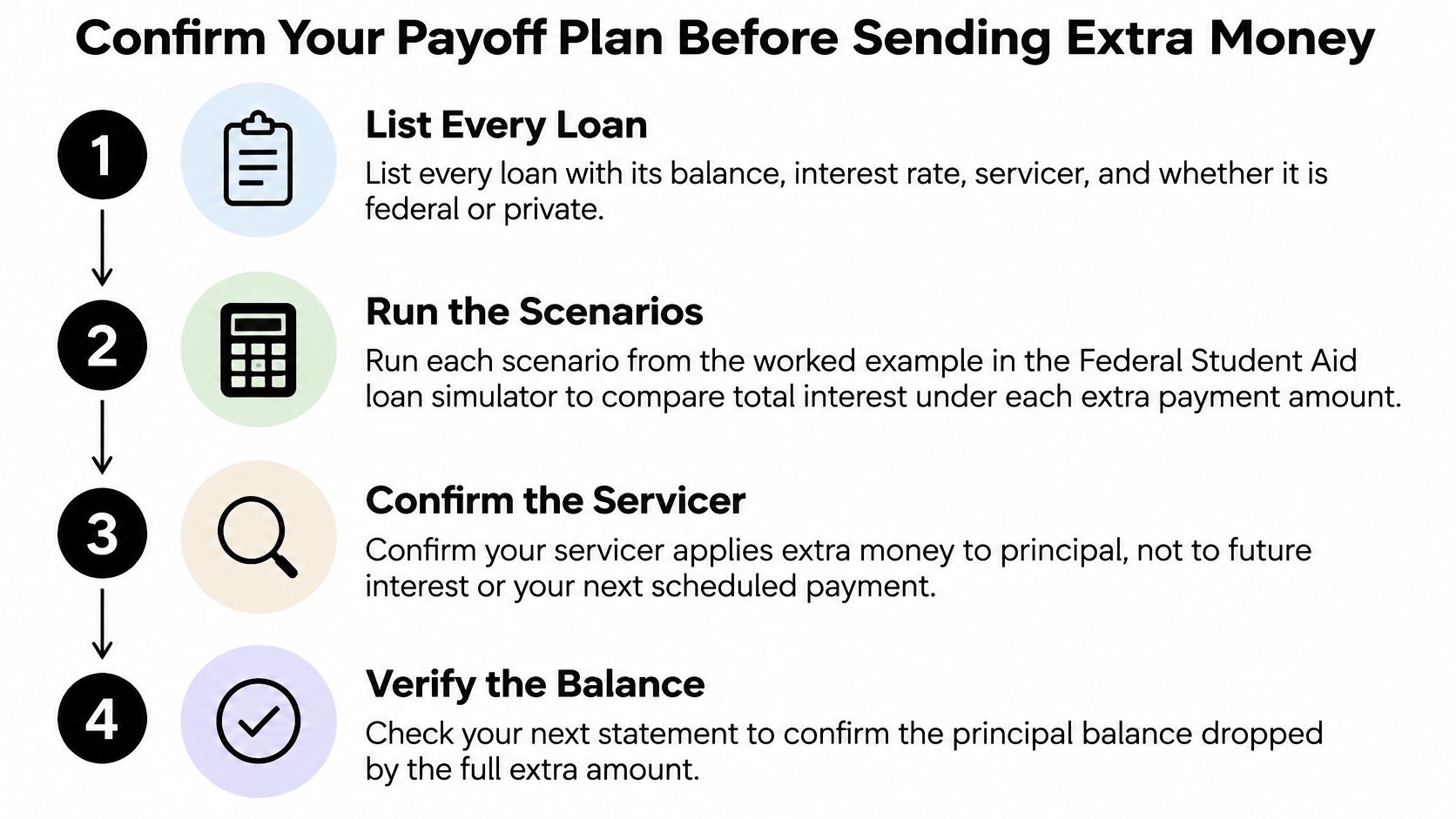
List every loan. Record each balance, interest rate, servicer, and federal or private status. Similar-looking loans may have different repayment terms and protections.
Compare payoff scenarios. Enter the actual loan details in the Federal Student Aid Loan Simulator or an amortization calculator. Compare the current schedule with recurring extra payments and a lump sum, using consistent assumptions.
Confirm payment allocation. Ask the servicer whether an extra payment will cover accrued interest, reduce principal, or go to a specific loan. Check how the payment will be applied before submitting it.
Check forgiveness eligibility. If pursuing PSLF, follow Federal Student Aid's recommendation to submit the employment-certification form annually. Resolve questions about qualifying employment, loans, or payment plans before paying aggressively.
Set the payment order. Apply your household's priorities to debts and savings. Direct extra cash to a high-rate student loan only after accounting for essential bills and other higher-priority needs.
Track and reconcile. Use a spreadsheet or debt-planning app to record balances, rates, due dates, and projected outcomes. Compare projections with servicer statements after every extra payment.
Use the four-step checklist infographic as a visual reminder, alongside these six steps.

Verify the result, not just the transfer
Once the payment posts, check how much went to interest and how much reduced principal. If accrued interest was outstanding, the principal reduction may be less than the extra payment.
Final checkpoint: Keep the plan aligned with your current income, expenses, and repayment assumptions.
Revisit the numbers after an income change, a new balance, or a shift in federal repayment rules. Aim for lasting financial progress, not a zero balance at any cost.
Toya AI offers a centralized debt dashboard and personalized payoff planning for student loans and other balances, including projected interest and debt-free dates. Compare an extra-payment strategy with your cash-flow needs, then check the proposed schedule against servicer statements.
Ready to start your debt-free journey?
Toya AI builds a personalized payoff plan so you can see your debt-free date and save on interest.
Get Started Free