
Why Cash Flow Forecast Is Important and How to Build One

The bank balance looks healthy, but rent, a car payment, and a credit card minimum are all approaching. Another paycheck is coming, yet it's hard to tell whether an extra card payment today would leave enough for everything that happens before payday. The missing information isn't necessarily a better spending target. It's a dated view of the money that will be available.
That's why cash flow forecasting matters for households as well as businesses. A forecast puts deposits and payments in order, so a person can distinguish money that looks available now from money that's already needed for an approaching bill.
Table of Contents
- What a Cash Flow Forecast Tells You Before Problems Start
- A Worked Six-Week Forecast You Can Copy
- Why Profit on Paper Can Still Leave You Short
- How Forecasts Turn Shortfalls Into Earlier Choices
- How to Update Your Forecast Every Week
- Set Your First Forecast Before Your Next Due Date
What a Cash Flow Forecast Tells You Before Problems Start
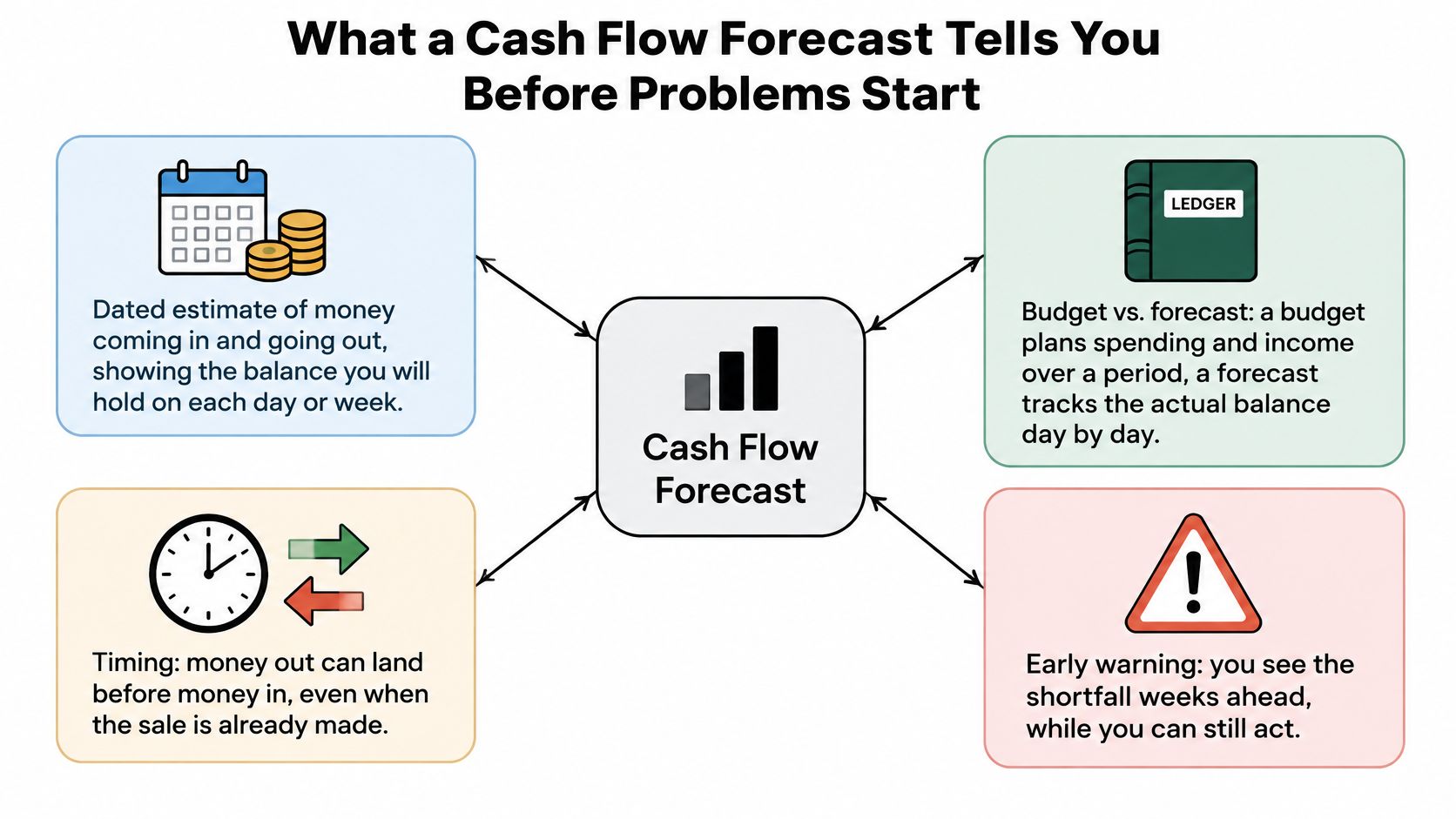
A cash flow forecast is a dated estimate of money coming in and going out, showing the expected balance on each day or week. Its purpose is practical: checking whether cleared cash will cover obligations when they fall due.
A budget sets intentions for income and spending. A forecast tests the timing of those intentions against expected deposits, scheduled payments, and the balance already in the account. A weather forecast doesn't stop a storm, but it gives someone time to carry an umbrella. Cash forecasting provides a similar opportunity to prepare.
A cash flow forecast connects each expected receipt and payment to a date, then calculates the money left afterward.
For a complementary explanation of the underlying process, Jumpstart Partners on cash forecasting provides context for organizing expected receipts and payments. The same basic approach works whether the account belongs to a business or a household.
What the timing view makes possible
The most useful benefits involve decisions rather than accounting terminology:
- Earlier warning: A projected shortage becomes visible while spending or payment arrangements can still change.
- Safer debt repayment: An extra payment can be tested against upcoming obligations before cash leaves the account.
- Clearer comparisons: Delaying a purchase or changing an approved payment date can be evaluated by its effect on the lowest balance.
The diagram summarizes how those benefits connect.
A positive monthly total isn't proof that every payment is covered. In a hypothetical household, a $4,000 salary arriving on the 28th cannot fund rent due on the 1st unless earlier cash covers it. The total income may be sufficient; the sequence still creates a problem.
That distinction explains why a cash flow forecast is important even when spending appears reasonable. The deciding question is whether cleared cash will be in the account on each due date, not whether income exceeds expenses over the month.
A Worked Six-Week Forecast You Can Copy
The following hypothetical six-week household cash flow forecast starts with $1,500 and separates cash movement from the running balance.
| Week | Cash in | Cash out | Net | Running balance |
|---|---|---|---|---|
| Start | $0 | $0 | $0 | $1,500 |
| Week 1 | $2,100 | $1,250 rent | +$850 | $2,350 |
| Week 2 | $0 | $430 groceries and fuel | -$430 | $1,920 |
| Week 3 | $0 | $260 phone and utilities | -$260 | $1,660 |
| Week 4 | $2,100 | $1,380 debt payments | +$720 | $2,380 |
| Week 5 | $0 assumed | $0 entered | $0 | $2,380 |
| Week 6 | $0 assumed | $0 entered | $0 | $2,380 |
The final weeks are deliberately unfilled planning periods, not a claim that household expenses stop. Those balances are provisional until groceries, bills, and any further income are entered. An empty future period isn't evidence of surplus cash.
Reading the balance rather than the weekly net
In Week 1, the paycheck adds $2,100 and rent removes $1,250. Adding the resulting $850 to the opening balance produces $2,350.
Week 2 reduces that balance to $1,920. Week 3 reduces it again to $1,660, the lowest projected week-end balance after the forecast begins. The initial $1,500 still matters, particularly if rent leaves before the first paycheck clears.
Week 4 includes another $2,100 paycheck and these hypothetical payments:
- Credit card minimums: $310.
- Auto loan: $720.
- Student loan: $350.
Together, those payments total $1,380, leaving a weekly gain of $720 and a running balance of $2,380. A list of fixed expenses can help identify recurring commitments before less predictable spending is added.
Turning the table into a payment check
The spreadsheet formulas are straightforward: net equals cash in minus cash out, and running balance equals the previous balance plus net. The running balance is the figure to compare with a chosen safety buffer, such as a month of essential bills.
Weekly totals can still hide a shortage inside a week. Each paycheck and bill therefore needs a dated entry underneath the summary, with transactions arranged in the order they're expected to clear.
Practical rule: An extra debt payment is affordable only if every later projected balance remains above the chosen cash floor.
When a new bill appears, adding a dated transaction should recalculate every subsequent balance. At the next weekly review, the actual reconciled bank balance replaces the old projected opening figure, preventing a forecasting error from carrying forward.
If any projected balance falls below zero or the household's buffer, there's a problem to address before that payment leaves. The table has done its job even if the month still ends positively.
Why Profit on Paper Can Still Leave You Short
A paycheck expected later in the month doesn't settle rent earlier in the month. Businesses face the same timing mismatch when they record a sale before collecting the customer's money. Profit and cash are different things.
The pressure can be visible in ordinary paperwork long before an account becomes overdrawn.

The UK government's 2023 Payment and Cash Flow Review reported that SMEs were owed an estimated average of £22,000 in late payments during 2022, and cited research estimating that 50,000 SMEs go out of business each year with cash flow identified as a cause. Those findings concern business liquidity, not household failure rates, but the underlying timing distinction is useful for either setting.
A sale isn't a cleared deposit
Consider a hypothetical consultancy that invoices £30,000 in January on 30-day terms. The customer pays in February or later, while £18,000 of wages and supplier bills fall due in January. Assuming no available opening cash or other receipts, the consultancy faces an £18,000 funding gap, despite recording a profitable sale.
An owner could request a deposit, follow up on collection, or postpone a nonessential purchase. None of those actions changes whether the sale was profitable. They change whether obligations can be paid on time.
The video offers another way to approach the cash-flow distinction.
Separate the dates that matter
For a household example, suppose a loan auto-debit falls on the 5th, a card statement closes mid-month, and its payment is due on the 20th. A deposit that clears late in the month cannot cover those earlier withdrawals without existing cash.
Each inflow needs distinct timing information:
- Earned: When the work or entitlement arises.
- Due: When the payer is supposed to pay.
- Expected: When payment is realistically likely.
- Processed: When the payment moves through the payment system.
- Cash available: When the bank makes the money usable.
The common mistake is placing income in the month it's earned rather than on the day it clears. A practical fix is an approved bill-date change to after payday, or a buffer sufficient to cover the intervening gap. Any date change needs confirmation before the original deadline is treated as cancelled.
Every obligation needs the same check: will enough cleared cash be in the account on the exact day it's due?
How Forecasts Turn Shortfalls Into Earlier Choices
Suppose a business projects that its balance will fall $25,000 below its minimum operating reserve in six weeks. That hypothetical warning gives the owner time to compare a planned credit line, reduced discretionary spending, customer deposits, and a negotiated payment schedule. Discovering the same gap when payments are already being rejected leaves fewer workable choices.
UK government research on the economic impact of late payments found that more than 1.5 million businesses, or 28% of businesses, are affected by late payments each year, and estimated that 37% of firms experience cash-flow difficulties. The practical lesson is to act while there's still time to negotiate, not to assume borrowing will always be available.
Match the response to the warning window
The following windows are planning guides, not lender approval timelines or guarantees about cost.
Shortfall warning window and the response that still works
| Warning window | Best response | Why timing matters |
|---|---|---|
| More than 6 weeks | Renegotiate due dates, ask for deposits or early payment, plan a credit line | Several potentially lower-cost options remain open |
| 2 to 6 weeks | Pause discretionary spending, move an approved payment date, arrange planned borrowing | Choices narrow, but there's still time to compare terms |
| Under 2 weeks | Protect minimum payments and request a due-date change from the lender | Overdraft charges, late fees, or penalty interest may become risks, depending on account terms |
Planned borrowing starts with a defined amount, purpose, repayment source, and cost comparison. Emergency borrowing often starts with an immediate payment that cannot wait. Waiting until an account is overdrawn may introduce fees, interest, or payment restrictions that earlier action could have avoided.
Apply the same test to extra debt payments
For someone carrying card balances, the highest APR isn't the only consideration. An aggressive extra payment could leave insufficient cash for another account's minimum due before the next deposit. The choice between paying off debt or saving therefore needs a timing check as well as an interest calculation.
Useful responses include:
- Move the extra payment later: Keep the cash available until essential obligations have cleared.
- Request a due-date change: Ask the lender and retain the existing deadline until approval takes effect.
- Postpone a discretionary purchase: Schedule it after the projected low point rather than before it.
A rolling forecast should incorporate actual receipts and payments after each intervention. If the projected low point doesn't improve, the response hasn't closed the gap and another decision is needed.
How to Update Your Forecast Every Week
A forecast becomes dependable through reconciliation, not through an elaborate spreadsheet design. Excel, Google Sheets, or a dated ledger can work, provided expected transactions are checked against the bank account consistently.
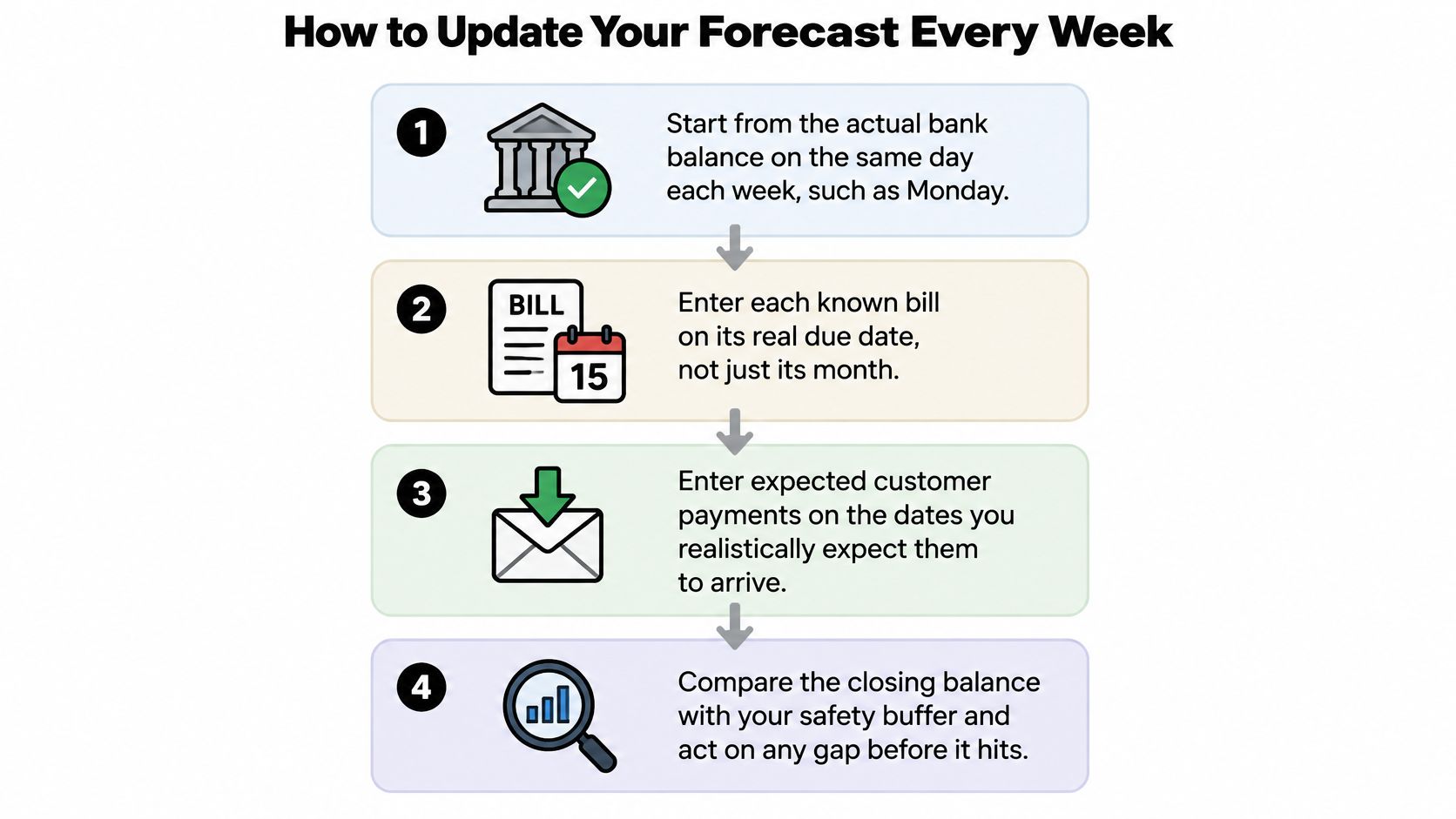
The following routine keeps the forecast connected to actual money movements.
Start from the actual bank balance on the same weekday. Monday can serve as a regular checkpoint. Reconcile pending transactions and confirm what the bank's displayed balance includes, so an already-counted payment isn't subtracted twice.
Enter bills on their real payment dates. Record the due date and any earlier scheduled withdrawal or payment initiation date. Cash must remain available when it leaves, while payment must arrive within the creditor's requirements.
Place income on its expected availability date. A payroll notice, invoice, or refund approval isn't itself usable cash. Uncertain receipts should carry a visible assumption rather than being treated as guaranteed.
Compare the previous forecast with actual transactions. Record differences in amount and timing, including a grocery purchase that cost more or a deposit that arrived later. Correcting the underlying assumption is more useful than replacing the total.
Test an income delay of one week. In this hypothetical stress test, move the expected receipt while leaving unavoidable payments in place. Recalculate the lowest balance to see whether the household could absorb the delay.
Attach a response to the cash floor. A household might choose a month of essential bills as its target, while recognizing that an affordable starting buffer may be smaller. A projected breach should trigger a defined action, such as pausing a discretionary purchase or requesting an approved date change.
The visual below summarizes the core update cycle.
Catch the omissions before they become bills
Insurance renewals, vehicle registration, and other irregular expenses belong in the forecast even when they aren't payable this month. Setting aside a monthly reserve helps build the money gradually, while the actual bill remains listed on its payment date.
Transfers into a reserve account require careful treatment. They reduce the spending account's available cash, but they aren't a second household expense when the reserved money eventually pays the bill.
A review of due-date tracking software can help identify ways to organize reminders and payment calendars. Reminders support the process, but they don't replace checking amounts, settlement timing, and available balances.
A reminder answers when a payment is due. A reconciled forecast answers whether the money will be there.
Updating only during a crisis leaves old assumptions untested. A new card, job change, or raise calls for a fresh forecast because the amounts, payment obligations, or deposit schedule may have changed substantially.
Set Your First Forecast Before Your Next Due Date
The best starting point is a usable forecast before the next payment deadline, not a perfectly categorized record of every past purchase. A household can begin with its bank account, current statements, payroll information, and a spreadsheet. The first decision is whether the next scheduled payments are covered without relying on uncertain income.
A six-week view provides a practical initial planning horizon. The forecast should remain provisional wherever an amount or arrival date still needs confirmation.
Build the first version around commitments
A focused setup sequence keeps the work manageable:
- List every bill and debt payment. Include its exact due date, required minimum, and scheduled withdrawal date where relevant.
- Record the opening bank balance. Reconcile transactions already pending so the starting figure doesn't overstate spendable cash.
- Enter expected income when it should clear. Separate confirmed deposits from estimates or receipts that depend on someone else paying.
- Mark the lowest projected balance. Compare it with the household's chosen minimum floor, including transactions within each week.
- Choose an action for any shortfall. Request an approved payment-date change, pause discretionary spending, or compare planned borrowing and its repayment cost.
For another practical explanation of the setup process, Grow My Acorn's guide to how to forecast cash flow offers a complementary resource. A household version can use the same receipt-and-payment logic without adopting business accounting categories.
Choose extra payments only after protecting commitments
Once required payments and the cash floor are protected, the remaining amount can be considered for extra debt repayment. The useful question isn't how much cash is visible today, but how much remains uncommitted throughout the dated forecast.
A smaller extra payment made safely can be more sustainable than a larger payment followed by renewed borrowing for ordinary bills. Interest savings still matter, but they need to be evaluated alongside the household's ability to meet its next obligations.
If maintaining separate debt records becomes tiring, Toya AI shows balances, APRs, and due dates for connected debts in one view and automatically recalculates the plan when a user loses a job, gets a raise, or adds a new card. It's an option for keeping debt planning current, while the manual table remains a workable starting point this week.
The ongoing habit matters more than the format. A weekly review should replace estimates with actual transactions, extend the forecast forward, and check the next low point. Any change in income or debt should prompt another review before an extra payment is committed.
Toya AI recommends which debt payment to make next and shows its effect on time and interest, helping connect repayment choices with a clear plan. Visit Toya AI to organize connected debts and evaluate the next payment alongside the household's cash-flow forecast.
Ready to start your debt-free journey?
Toya AI builds a personalized payoff plan so you can see your debt-free date and save on interest.
Get Started Free