
Which Is Better Snowball or Avalanche? Decide by Situation
Which method fits better when the lowest-interest option on paper may not be the safest choice for this month's cash flow?
Avalanche generally costs less interest when APRs differ, because extra payments go to the debt accruing interest fastest. Snowball can be easier to sustain when motivation is fragile: paying off a small balance creates an early finish line. The best choice depends not only on interest math, but also on whether the payment plan leaves enough room to keep every account current.
Before ranking debts, check for a missed payment, a promotion rate at risk, or a repossession threat. Those immediate cash-flow risks can outweigh the benefit of optimizing extra payments. Once they're addressed, steady income and a meaningful rate gap favor avalanche; overwhelm or difficulty keeping up with several accounts may favor snowball, or a brief hybrid that clears one small balance before switching to the highest APR.
Table of Contents
- Snowball vs Avalanche at a Glance
- How Each Method Picks Your Next Payment
- Interest Cost Across Real Households
- Motivation, Early Wins and the Hybrid Option
- When Delinquency Risk Overrides Both Methods
- Which Method Fits Your Situation
- Choose Your Method and Run the First Month
Snowball vs Avalanche at a Glance
Avalanche usually costs less interest, while snowball usually gets more people to the finish line.
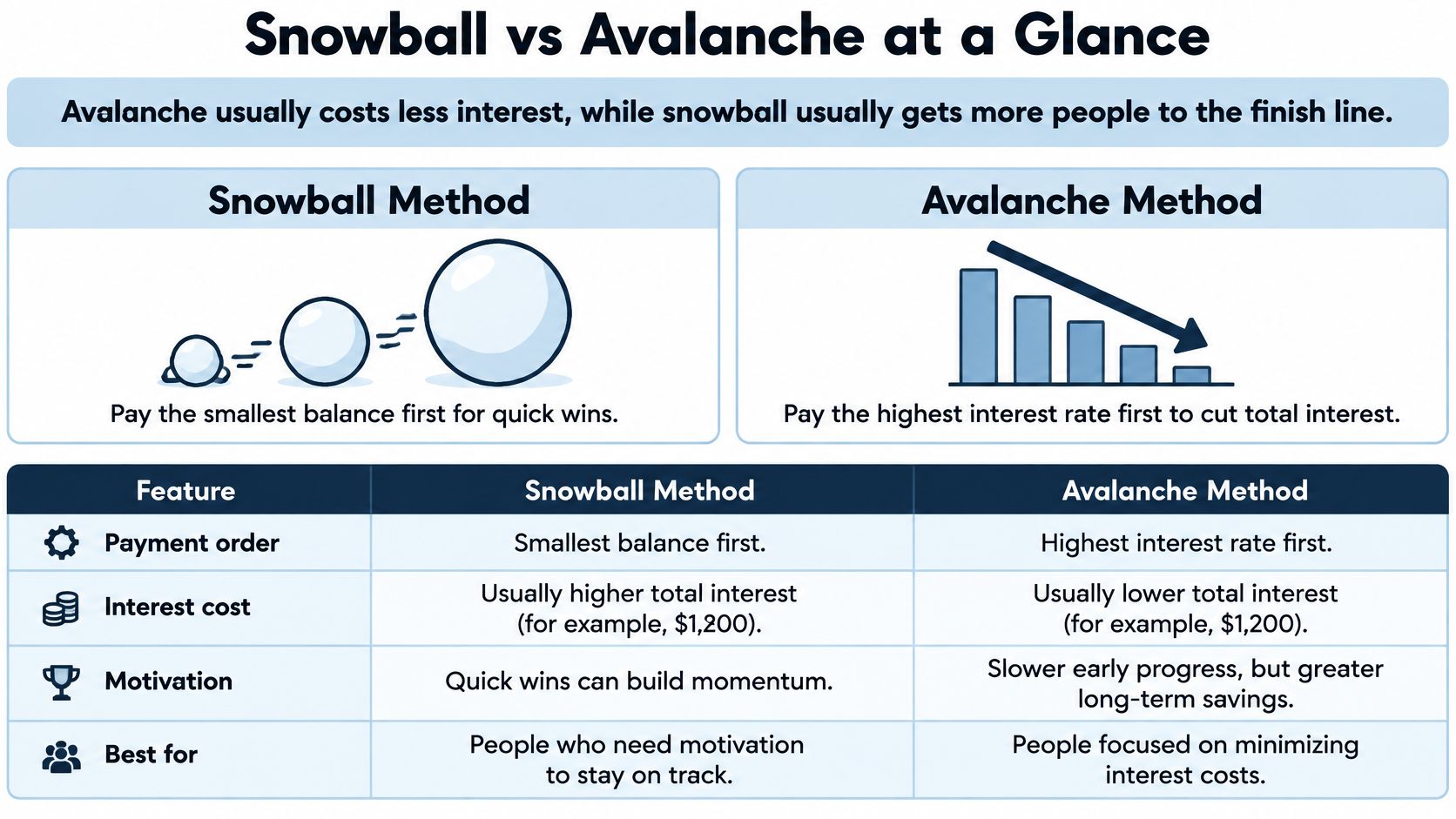
Snowball and avalanche compared on the factors that matter
| Factor | Debt Snowball | Debt Avalanche |
|---|---|---|
| Payment order | Smallest balance first | Highest APR first |
| Total interest | Higher whenever the smallest balance has a lower APR than another debt | Lowest for a fixed payment budget |
| Early wins | Fastest, because a small account closes within months | Slower, because the highest-rate account may be large |
| Behavioral fit | Strongest when motivation or overwhelm is the main risk | Strongest when cash flow is steady and discipline is high |
Payment order is the only mechanical difference. Snowball sends extra cash to the smallest balance. Avalanche sends it to the highest APR. Minimums stay in place on every other account either way.
Total interest rises under snowball whenever that small balance carries a cheaper rate than some other debt still open. Avalanche keeps the interest bill as low as a fixed payment budget allows, because each extra dollar lands where it grows fastest. A Federal Reserve Survey of Consumer Finances analysis of several thousand household portfolios found avalanche more effective in the majority of modeled cases, although snowball performance was often very close.
Early wins belong to snowball. One closed account removes a whole bill. Avalanche can feel stalled when the priciest balance is also large.
Behavioral fit follows from that. Snowball suits someone who loses steam. Avalanche suits reliable cash flow and a habit of paying on the same day each month.
When every APR sits in a tight band, the two orders nearly match and the interest gap shrinks toward nothing.
List each debt with its balance and APR before reading on. Rates far apart point to the avalanche column. Rates close together, with a tiny balance easy to finish, point to the snowball column.
How Each Method Picks Your Next Payment
Say a household holds four debts and has a set amount left after minimums. The next payment isn't a feeling. It's a sort.
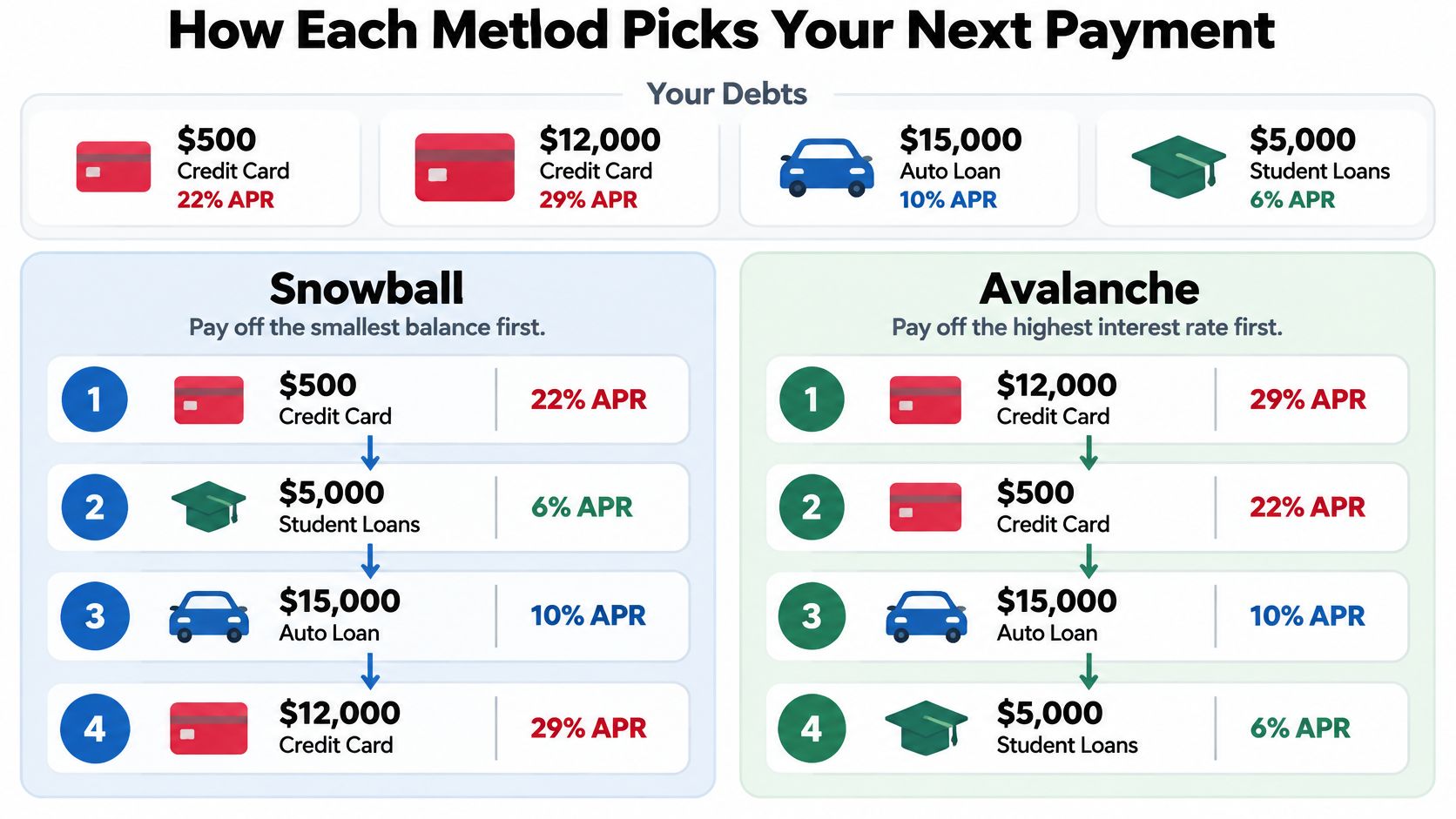
The Simply Money guide from Liberty University walks through this kind of mix: a $15,000 auto loan at 10%, a $500 credit card at 22%, a $12,000 credit card at 29%, and $5,000 of student loans at 6%. Avalanche keeps every minimum current, then puts all extra money on the highest APR, and rolls that payment to the next-highest rate once the first account is gone. Each extra dollar is applied where it accrues most rapidly.
Worked example: payoff order under each method
| Debt | Balance | APR | Snowball order | Avalanche order |
|---|---|---|---|---|
| Credit card A | $500 | 22% | 1 | 2 |
| Credit card B | $12,000 | 29% | 3 | 1 |
| Auto loan | $15,000 | 10% | 4 | 3 |
| Student loans | $5,000 | 6% | 2 | 4 |
Snowball order ignores the rates. The $500 card is first because it's the smallest balance. Student loans at $5,000 come second. The $12,000 card is third. The $15,000 auto loan is last. A person watching the bill stack sees one account disappear fast, then a second.
Avalanche order follows APR only. The $12,000 card at 29% is first, even though it isn't small. The $500 card at 22% is second. The auto loan at 10% is third. Student loans at 6% are last. The auto loan comes before the student loans even though its balance is larger. Rate outranks size. That's the whole rule.
The roll works the same way for both
The monthly motion is identical once the target is chosen.
- Pay every minimum on or before the due date, including the target account.
- Send every extra dollar to that one target. Don't split the extra across cards "to be fair."
- Roll the freed payment into the next target the moment an account hits zero. The old minimum plus the extra becomes the new extra.
Snowball rolls by balance. Avalanche rolls by rate. The budget total doesn't drop when an account closes. It just changes address.
A short video walk-through of the same sequencing makes the roll easier to picture before anyone moves money.
Sort the list twice before the next payment
Write the debts twice. Sort one copy from smallest balance to largest. Sort the other from highest APR to lowest. The name at the top of each list is that method's target. If those two names differ, the household is choosing between an early closed account and a lower interest path, not between two versions of the same plan.
Confirm the target in writing before the transfer. A payment sent to the wrong account still reduces debt, but it doesn't follow the method that was chosen.
Interest Cost Across Real Households
Avalanche is the interest-minimizing order when the goal is the smallest finance charge and the household can stick with it. Minimums stay current. Extra cash climbs from the highest annual percentage rate to the lowest.
A 2023 peer-reviewed analysis in the Southern Economic Journal compared snowball and avalanche across household debt portfolios. The average household using snowball would pay between 1.8% and 4.3% more total interest than under avalanche. For 4.5% to 11.3% of households, snowball interest was more than 10% higher. Estimated average avalanche savings ran $853 to $1,321 per household, depending on the weighting. With balances, rates, minimums, and available cash held constant, extra money on the highest-rate debt generally cuts cumulative interest and can shorten the mathematically optimal payoff path.
What opens the gap
Three things set the size of that gap: the spread between the highest and lowest APRs, the size of the balances sitting at those rates, and how many months the plan runs. Similar balances and similar rates push the gap toward zero. A wide APR spread, especially one nasty card beside a cheap installment loan, is where avalanche earns its keep. It fits borrowers who can hold a consistent plan without needing an early psychological win.
Rate check: Compare one month of interest on the highest-APR balance with one month on the smallest balance. If those two numbers are close, the lost early win may not be worth it. If they aren't close, avalanche is doing real work.
Say the $12,000 card at 29% is still the target. Rough monthly interest on that balance is about $290 ($12,000 × 0.29 / 12). The $500 card at 22% accrues about $9 in the same month. An extra $100 on the 29% card avoids far more interest than the same $100 on the small card. That's the mechanism, not a slogan. Readers who want the month-by-month math can follow how credit card interest works and apply it to their own APRs.
The number of revolving accounts changes the picture too. A practical guide on how many credit cards to hold helps a household see whether several open cards are creating the rate spread in the first place. Fewer high-rate balances means a shorter avalanche list and a smaller chance that snowball parks extra cash on a cheap account while a 29% balance keeps compounding.
Run the comparison on the actual statements. Highest-APR monthly interest versus smallest-balance monthly interest. If the first number dwarfs the second, and paydays are steady, avalanche is the lower-cost column. If the two interest figures are nearly the same, behavior can break the tie without a large penalty.
Motivation, Early Wins and the Hybrid Option
A payoff plan can be mathematically cheaper and still fail if the borrower stops following it. Snowball closes the smallest account first, removing a bill and creating a visible milestone. Avalanche directs extra money to the highest APR, reducing interest more efficiently when the rate gap is substantial.
Research on debt-account aversion suggests that consumers may prefer eliminating smaller accounts even when doing so costs more in interest. Evidence discussed in the Southern Economic Journal's analysis of repayment behavior also connects focused repayment with a stronger sense of progress than spreading extra payments across balances.
Use avalanche when payments are reliable and minimizing interest is the priority. Snowball may fit better when overwhelm or inconsistent follow-through threatens the plan. The relevant comparison is the interest cost of the detour against the risk of abandoning the repayment order.
A hybrid only when the small balance frees cash
Clear a small balance first when its minimum payment would make a meaningful difference to monthly cash flow. Then direct that freed-up amount, along with the existing extra payment, to the highest APR.
For example, a $400 store card at 25% with a $30 minimum could be cleared in a month or two. That would free $30 each month for the more expensive balance. If the minimum were only $15 and the account were not constraining the budget, starting with the higher-rate debt would avoid the detour.
Before choosing an order, check whether the stated APR reflects the actual cost:
- Promotional rates: A 0% offer expiring in four months may change the order once the rate resets.
- Variable APRs: A rate increase can move an account ahead of a fixed-rate loan.
- Fees: A penalty APR or annual fee can add to an account's cost.
- Prepayment rules: Extra payments on some installment loans may not reduce the next bill. Confirm how the lender applies them.
A regular review can help keep the method workable. Advice on how small operators build a healthier money relationship can inform the habit of setting one target and reviewing it on a fixed day, rather than changing the payoff order whenever a bill feels heavy.
Use the last six months as a practical check. If a payment was missed, a snowball or short hybrid may be easier to sustain. If payments stayed current and the APR gap is wide, avalanche is more likely to justify its slower first milestone.
When Delinquency Risk Overrides Both Methods
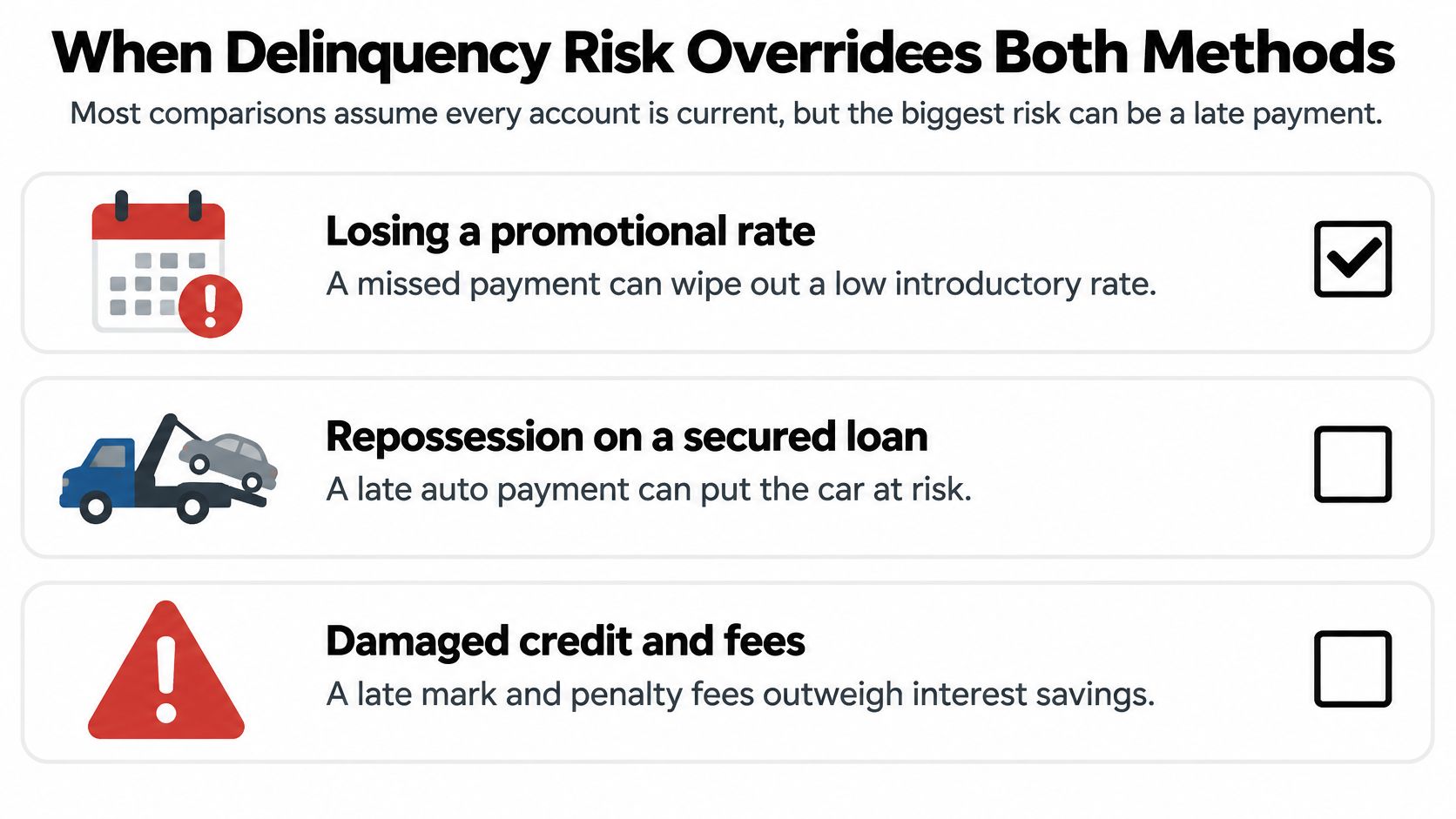
Most snowball-versus-avalanche comparisons assume every account is current. That assumption fails the household whose highest-value move is avoiding a late payment, a lost promo rate, repossession, or a collector picking the account back up.
Recent New York Fed data show that 4.7% of U.S. household debt was delinquent in Q2 2026, while credit-card serious-delinquency flows remained near 7%. An avalanche ranking built only on APR can miss secured-loan consequences and credit-report damage. The same analysis found that the rise in severely delinquent credit-card balances was substantially associated with older charged-off debts remaining in reporting pools, rather than an equivalent surge in new delinquencies. New trouble and old charged-off paper are not the same problem.
Sort accounts into three piles first
New delinquency risk covers anything past due or within days of a due date the household can't meet. That pile outranks rate and size.
Legacy charged-off balances are debts already written off that still need a plan, a dispute, or a settlement conversation. They shouldn't be mixed into this month's extra-payment sort as if they were a current 22% card.
Current high-interest debt is the only pile where snowball or avalanche belongs. These accounts are paid on time and still accruing.
What defaulting on credit card debt can trigger, from penalty pricing to collections, is the reason a current account stays current before any extra dollar moves.
The order that actually comes first
- Bring any past-due account current. One late mark plus fees can wipe out the interest a clever order would save.
- Keep every minimum payment. Autopay the minimums so a busy week doesn't create a new delinquency.
- Mark which loans are secured. A late auto payment can put the car at risk. A late card payment cannot tow anything, but it can kill a promo rate.
- Only then apply extra cash by avalanche, snowball, or the short hybrid.
If any account is past due, neither method applies until it is current. Payoff order is the second decision, not the first.
Which Method Fits Your Situation
Most readers aren't choosing a method for a single card. Toya AI's 2026 Benchmark Report found that the average consumer manages 2.2 types of debt at the same time. Cards, an auto loan, and student loans can all be live in one month, so one rule rarely describes the whole list.
Which method to use by situation
| Situation | Better method | Why it works |
|---|---|---|
| APRs far apart, cash flow steady | Avalanche | The highest-rate debt accrues interest fastest |
| Overwhelmed or close to missing payments | Snowball | Early wins and fewer bills reduce the risk of falling behind |
| Small balance frees meaningful monthly cash | Hybrid: clear the small balance first | Freed minimum payment accelerates the rest of the plan |
| Mix of installment, card and variable-rate debt | Avalanche with APR rechecks | Variable rates can change the ranking over time |
| Income volatile | Snowball target with a cash buffer, then avalanche | Keeps liquidity while building momentum |
Far-apart APRs and a steady paycheck are the clean avalanche case. The expensive balance is compounding every day the extra payment sits somewhere cheaper.
Overwhelm or a near-miss is a snowball case. Fewer due dates next month matter more than a slightly lower lifetime interest total. A closed store card is one less login and one less chance to slip.
A small balance with a real minimum is the hybrid row. Clear it, then move. If the freed payment is tiny, don't pretend it's a strategy.
Installment loans beside cards and variable rates still use avalanche, but the sort isn't permanent. A variable card that jumps two points can pass a personal loan that looked more expensive last quarter. Recheck the APRs when statements arrive, not once a year.
Volatile income needs liquidity before optimization. A small cash buffer plus one snowball target keeps a thin month from creating a new delinquency. Once paychecks are reliable and the extra payment can be larger, switch the extra dollars to the highest APR.
Owners comparing personal piles with business balances can look at ways to manage business debt repayments without assuming a household snowball order should also run the company books. Different creditors, different consequences.
Match the row to the actual mix. A single method rarely covers every account for the whole payoff.
Choose Your Method and Run the First Month
The first month is a sequence, not a personality quiz.
- List every debt with balance, APR, minimum payment, and due date. Include store cards and buy-now-pay-later plans that still have a balance.
- Confirm nothing is past due. Fix any past-due account before choosing a method.
- Name the target. Highest APR if rates are far apart and cash flow is steady. Smallest balance if motivation or missed payments are the risk. The small balance first only if clearing it frees a meaningful minimum.
- Pay all minimums and send the extra to that one target. Don't average the extra across accounts.
- Recheck the ranking when a rate changes, a balance transfer posts, income drops, or an account hits zero.
Choose avalanche if APRs are far apart and cash flow is steady. Choose snowball if motivation or missed payments are the risk.
Philadelphia Federal Reserve data show credit-card balances reached a new high in Q2 2026, even as the share of accounts paid in full reached 37%, matching the pandemic-era peak. That split describes two groups: borrowers who can optimize revolving debt, and borrowers who need a resilience-first plan that preserves liquidity. The second group should run a snowball target beside a small cash buffer, then switch to avalanche once payments are reliable and the budget can carry a larger extra payment.
Avalanche generally minimizes interest when balances, rates, and payments stay stable. Snowball's faster visible wins can help people continue paying when they don't. Neither is a one-time universal choice for fluctuating income or a mix of installment loans, cards, and variable-rate debt. Recalculate after rate changes, balance transfers, income shocks, or payoff milestones.
A free debt payoff calculator can show the interest gap on the same list before the first extra payment goes out. Toya AI, an AI that helps people get out of debt, recommends which payment to make next and shows the impact on time and interest, including which debt to pay extra on and how much interest that saves.
Toya AI builds a payoff plan from the accounts already open, then recommends the next payment and shows how that choice changes time and interest. That is the same decision this article walks through: avalanche when rates are far apart and cash flow is steady, snowball or a short hybrid when motivation or a missed payment is the risk, and no extra-payment method at all until every account is current. Start with the list of balances and APRs, then see the next step on Toya AI.
Ready to start your debt-free journey?
Toya AI builds a personalized payoff plan so you can see your debt-free date and save on interest.
Get Started Free