
Which Debt Should I Pay Off First Smart Payoff Guide
A reader may be staring at two credit cards, a personal loan, and a student loan, each with a different balance, APR, and due date. Every account feels urgent, yet the money available for extra payments only reaches one target. The difficult question is not whether debt should be repaid, but which debt should be paid off first.
The order can affect total interest, the time required to become debt-free, and the stress of managing several bills. A high-rate credit card can keep accumulating expensive interest, while a small balance may offer a quick psychological win. An overdue account can create immediate risks that matter more than either interest rate or balance size.
A practical answer uses three lenses:
- Math: Which balance costs the most to carry?
- Behavior: Which payoff creates enough motivation to keep the plan moving?
- Cash flow: Which eliminated payment would create the most room in the monthly budget?
The right decision starts with keeping every account current, then choosing the extra-payment target that fits the household's actual situation. By the end, a reader should be able to identify urgent debts, compare avalanche and snowball options, evaluate monthly payment relief, and create a payoff order that can survive changing expenses.
Table of Contents
- Introduction Which Debt to Tackle When Everything Feels Urgent
- How Interest and Minimum Payments Actually Work
- Debt Avalanche vs Snowball Compared Side by Side
- The Urgency Check Most Guides Skip
- How to Choose Your Best Payoff Order for Your Situation
- Practical Examples That Show the Math and Motivation
- Your Next Best Action Plan to Start Paying Smarter
Introduction Which Debt to Tackle When Everything Feels Urgent
A household has two credit cards, a personal loan, and student debt. One card carries the highest APR, another has the smallest balance, and the personal loan requires the largest monthly payment. Every minimum payment fits the budget, but there is only enough money for one extra target.
That choice feels confusing because common advice answers different questions. “Pay the smallest balance first” emphasizes a quick visible win. “Pay the highest interest rate first” focuses on reducing borrowing costs. The avalanche method follows the second rule, while the snowball method follows the first. An overdue account adds another layer because immediate consequences may matter more than either balance or APR.
Start with urgency triage. Check whether any account is already past due, close to a serious consequence, or at risk if the next payment is missed. Keep those accounts current before directing extra money elsewhere. This protects the household from avoidable problems while creating a stable base for the payoff plan.
Then compare the remaining debts through three lenses:
- Math: Which balance has the highest APR and is costing the most to carry?
- Cash flow: Which required monthly payment could disappear soonest and create room in the budget?
- Behavior: Which target is realistic enough to maintain when expenses rise or motivation falls?
A strong payoff order handles urgent accounts first, reduces expensive interest next, and uses motivation or cash-flow relief to keep progress going.
The math generally favors the highest APR. Academic research using household balance sheets found that the avalanche approach beat the debt snowball in the majority of cases, while the snowball stayed close enough to offer behavioral benefits such as motivation and habit formation. A later analysis found that snowball-style ordering cost households about 1.8% to 4.3% more in interest, with an estimated aggregate wealth transfer from borrowers to lenders of roughly $46.2 billion to $53.9 billion (research on debt repayment order and borrower costs).
A lower-interest target can still be sensible if removing its payment quickly restores breathing room. The best sequence is the one that controls immediate risk, limits interest, and remains workable month after month.
How Interest and Minimum Payments Actually Work
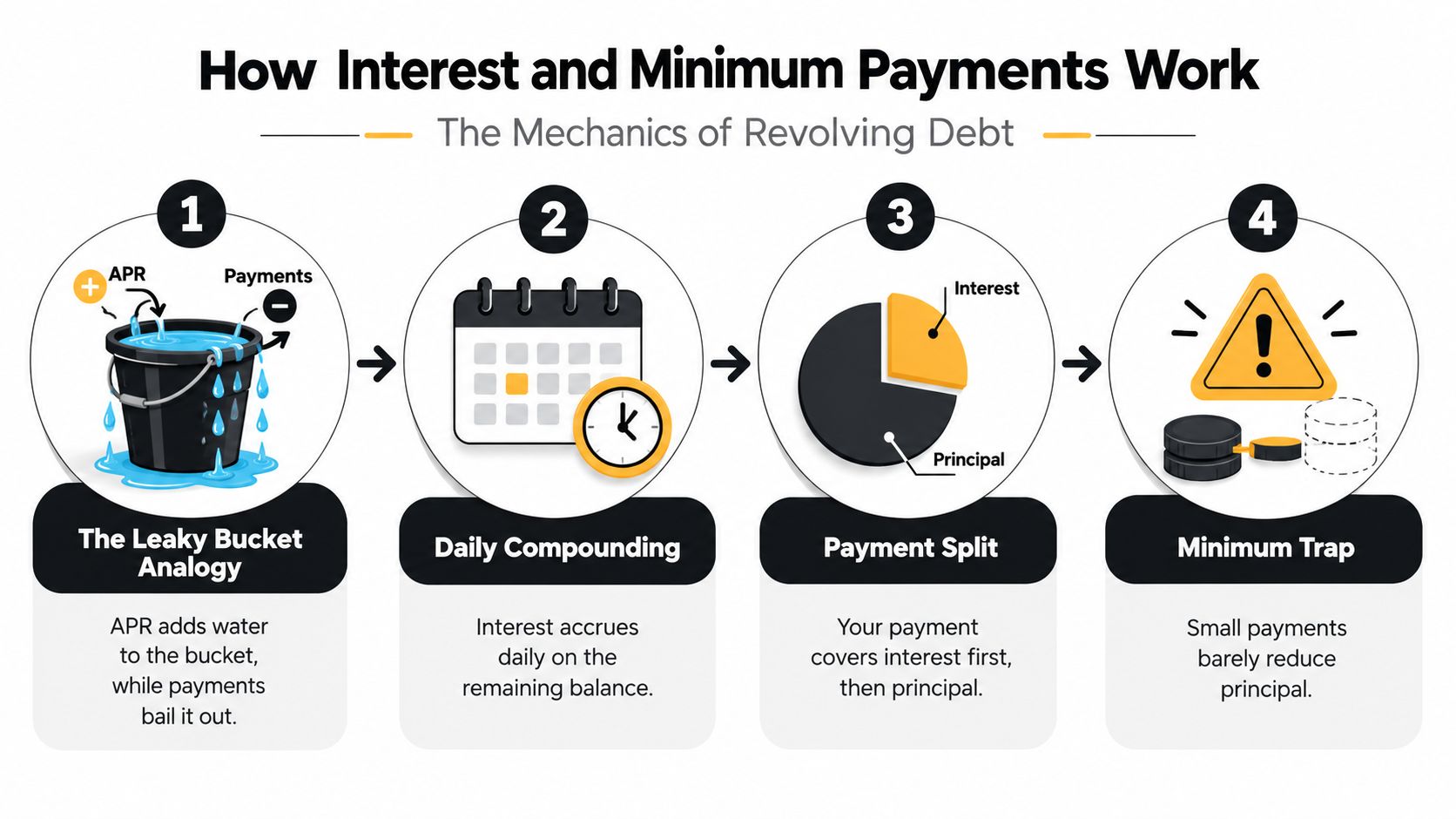
A cardholder can make every required payment and still see the balance barely move. The reason is simple: interest keeps adding to the balance while payments first cover charges that have already accumulated. Revolving debt works like a bucket with a small leak. Payments remove water, while APR keeps adding more as long as water remains.
Credit card interest is generally calculated from the unpaid balance, and interest may continue building each day. When a balance carries into the next billing cycle, issuers commonly apply payments to interest and fees before principal (explanation of why minimum payments may barely reduce a credit card balance).
What the minimum payment really accomplishes
A minimum payment usually keeps the account current. It does not guarantee fast progress. Minimums are often based on 1% to 4% of the balance, sometimes with a required floor amount, while the unpaid portion continues accruing interest (how credit card minimum payments work).
Suppose the payment arrives on time. The account avoids delinquency, but part of the money may cover accumulated interest and fees before the rest reduces principal. The balance can therefore decline slowly even as cash leaves the household budget each month.
Account terms control the exact payment allocation, so read each statement carefully. A credit card minimum payment calculator can illustrate how a larger payment changes the balance and the expected payoff path.
Why APR changes the target
APR is the annual cost of borrowing. Removing a dollar from a high-rate revolving balance generally prevents more future interest than removing a dollar from a lower-rate balance, provided the accounts have comparable terms and remain current.
A Federal Reserve Bank of St. Louis example compares a $5,000 card at 20% APR with a $2,500 card at 14% APR. Paying the higher-rate balance first reduces the interest burden more efficiently than paying the smaller balance first (Federal Reserve Bank of St. Louis explanation of credit card payoff strategy).
Core concept: If minimizing interest is the priority, direct each extra dollar toward the balance where borrowing costs build fastest.
This rule explains why credit cards often deserve attention before installment loans or mortgages, although urgency and monthly cash-flow relief can change the practical order. Mortgage-related protection is a separate issue, covered by information about mortgage protection insurance UK, rather than a method for choosing which debt to repay first.
Debt Avalanche vs Snowball Compared Side by Side
Both methods use the same payment structure. Keep making the minimum payment on every account, then send extra money to one selected debt. After that balance reaches zero, roll its old payment into the next target. The difference is how you choose that target.
The debt avalanche prioritizes the balance with the highest APR. The debt snowball prioritizes the smallest balance, even if another debt has a higher rate. Avalanche usually reduces interest more efficiently, while snowball can produce an earlier visible win.
| Feature | Debt Avalanche | Debt Snowball |
|---|---|---|
| Target rule | Highest APR first | Smallest balance first |
| Main benefit | Reduces total interest | Creates an early payoff win |
| First result | May take longer if the highest-rate debt is large | Often arrives sooner if the smallest debt is modest |
| Behavioral effect | Rewards disciplined cost optimization | Supports motivation and habit formation |
| Payment handling | Roll the cleared payment into the next highest APR debt | Roll the cleared payment into the next smallest balance |
| Best fit | A household focused on minimizing borrowing cost | A household that needs visible momentum to stay consistent |
Suppose you have three current accounts and can pay more than their minimums. With avalanche, the extra amount goes to the high-rate credit card. Once it is gone, the entire payment moves to the debt with the next-highest APR. With snowball, the extra amount goes first to the smallest balance, then its payment rolls into the next-smallest one.
The choice is a trade-off between cost and follow-through. Research comparing repayment orders found that avalanche generally has the mathematical advantage, while snowball can provide behavioral value when an early result helps someone maintain the plan. Choose the rule that addresses your larger obstacle. If interest is the main concern and you can stay consistent, learn how the debt avalanche method works. If repeated payments feel discouraging, a quick first payoff may help you continue.
A simple illustration clarifies the difference. A large balance with a high APR may remain your avalanche target for a long time, so progress can feel slow. A modest balance may disappear sooner under snowball, even though the overall interest savings may be lower.
Whichever method you use, keep the target stable unless your account status or cash-flow needs change. Switching repeatedly can scatter extra payments and make progress difficult to measure.
The Urgency Check Most Guides Skip
A debt that is already overdue belongs in a different category from a current account. The first question isn't always “Which APR is highest?” It may be “Which account could create immediate harm if it remains unpaid?”
Past-due debt can move toward collections, damage credit history, create repossession risk for secured borrowing, or lead to legal action. Those consequences can matter more than a small difference in interest cost, particularly when a missed payment threatens housing, transportation, or access to essential services.
A practical triage order
- Past-due status: Confirm whether any account has missed payments, late fees, or an immediate deadline.
- Collection exposure: Check whether a creditor has warned about collections or transferred the account to a collector.
- Secured collateral: Identify auto loans, mortgages, or other debts tied to an asset that could be repossessed or otherwise placed at risk.
- Legal notices: Treat court papers, collection lawsuits, and formal warnings as urgent documents requiring prompt attention.
- Stabilization: Bring the most exposed accounts current before directing extra money toward an APR strategy.
The borrower should contact the creditor directly, ask what amount brings the account current, and request the available repayment options. For medical bills, checking the bill for errors, insurance processing, financial assistance, and payment-plan options can be important before treating the full amount as an ordinary high-priority debt. A disputed or potentially incorrect bill may need review rather than immediate aggressive repayment.
Urgency comes before optimization. A mathematically efficient order can't compensate for preventable damage from an account left seriously overdue.
Once urgent accounts are stabilized, the borrower can return to the standard comparison. A current high-APR card may become the next target, or a debt with a large required payment may deserve priority if monthly cash flow is the main threat to staying current.
How to Choose Your Best Payoff Order for Your Situation
The most useful answer to “which debt should I pay off first” depends on three inputs: APR, balance size, and required monthly payment. APR measures the cost of carrying debt. Balance size affects how quickly a target can disappear. The required payment determines how much monthly room becomes available after payoff.
Revolving credit deserves close attention in the current rate environment. The Federal Reserve reported revolving consumer credit at about 20.94% interest in mid-2026, while the average rate across all consumer credit accounts was about 21.22% (Federal Reserve consumer credit interest-rate data). Those rates help explain why credit cards often outrank personal loans, auto loans, student loans, and mortgages when the goal is reducing total interest.
Three questions before selecting the target
- Is any account urgent? If yes, address delinquency, collection exposure, repossession risk, or legal action first.
- Which debt has the highest APR? That is usually the strongest target for interest minimization.
- Which payoff would free the most monthly cash? A large required payment may be worth prioritizing if the budget is fragile.
The following matrix turns those questions into a working choice:
| Household situation | Recommended order | Reason |
|---|---|---|
| All accounts are current and APRs vary widely | Highest APR first | Removes the fastest-growing cost |
| The budget is stable but motivation is weak | Smallest balance first | Produces an early, visible result |
| One debt has a large required payment | Cash-flow relief first | Frees monthly money for future payments |
| Income or expenses change frequently | Hybrid order | Balances interest savings with resilience |
| An account is overdue or under immediate threat | Stabilize that account first | Prevents consequences that optimization can't fix |
A hybrid plan might bring an overdue account current, eliminate a small balance that can be cleared quickly, and then switch to the highest APR. Another household may choose the debt with the largest required payment first, then direct the released cash toward the most expensive card.
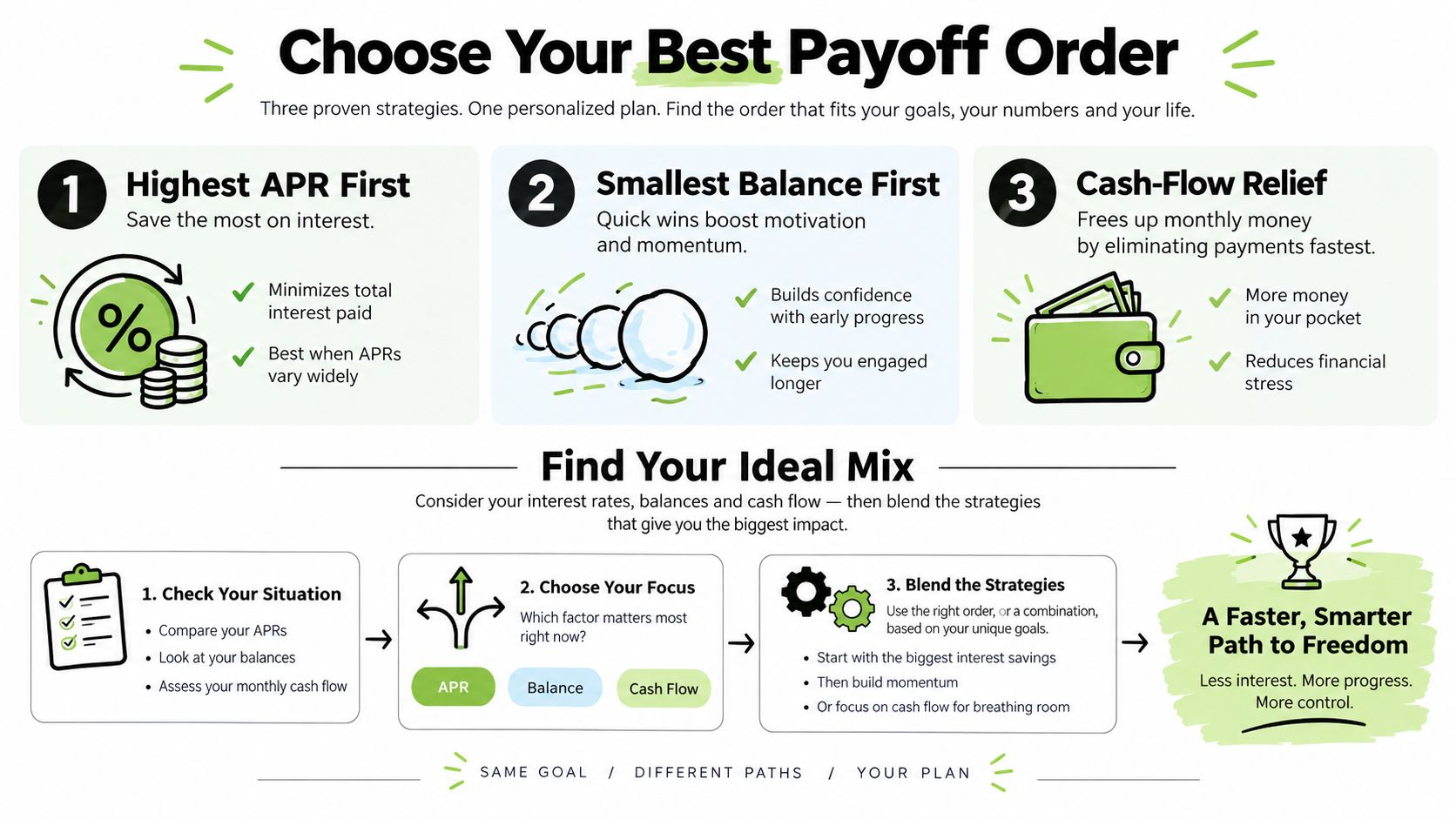
The key is to record the reason for the chosen order. A clear rule prevents emotional switching whenever a new bill appears, while an adaptive plan still allows changes when income, expenses, or account status changes.
Practical Examples That Show the Math and Motivation
The right payoff order can change when the household's priority changes. The examples below show how the same debts can produce different choices. They use the stated APR figures, but they do not promise a precise payoff date or interest total. That calculation also depends on balances, minimum-payment formulas, payment dates, and compounding.

Example A choosing between cost and momentum
A borrower has two cards:
- Card A carries $5,000 at 20% APR.
- Card B carries $2,500 at 14% APR.
The borrower can cover every minimum payment but has extra cash for only one target. The avalanche method sends that extra money to Card A because its APR is higher. The borrower pays down the faster-growing cost first, while Card B remains current through its minimum payment.
The snowball method sends the extra money to Card B. Its smaller balance may disappear sooner, creating a visible win and releasing that payment for Card A. The trade-off is that Card A's higher rate continues applying to its balance for longer. The earlier payoff example from the Federal Reserve Bank of St. Louis illustrates this same cost-versus-momentum choice (the Federal Reserve Bank of St. Louis payoff example).
A simple comparison can show which benefit matters more. Enter each balance, APR, minimum payment, and extra amount into a calculator. Review total interest, the point at which each account reaches zero, and whether an early win makes consistent payments easier.
Example B adding a personal loan and student loan
A second household has a credit card with an APR somewhere between 20% and 29%, plus a personal loan and a student loan. It pays every minimum payment and has only a limited amount available for extra debt payments.
If every account is current and the goal is reducing interest, the credit card will often receive the extra payment first because revolving rates can exceed installment-loan rates. Payoff guidance describes this general ordering, placing cards around 20% to 29% APR ahead of personal loans, auto loans, student loans, and mortgages (guidance on which debt to repay first).
Cash flow can change the answer. Suppose the personal loan requires the largest monthly payment. Paying it off first may create more room in the budget immediately, even if the card has the higher APR. After that payment disappears, the household can redirect the released cash toward the card, provided the card stays current during the process.
That is the second decision layer beyond avalanche or snowball: ask which target reduces financial pressure soonest. Minimums protect the other accounts, while the extra payment follows one clear rule. Recheck the order if an APR changes, an account becomes overdue, or the monthly budget becomes less predictable.
Your Next Best Action Plan to Start Paying Smarter
A workable payoff plan can begin with one page or spreadsheet. The borrower should list every debt, current balance, APR, minimum payment, due date, account status, and whether the debt is secured by an asset. Missing information is a reason to review statements, not a reason to guess.
A simple implementation checklist
- Stabilize accounts: Make required payments and address any past-due balance or immediate consequence.
- Choose the rule: Select highest APR, smallest balance, cash-flow relief, or a documented hybrid approach.
- Automate minimums: Schedule minimum payments so the chosen strategy doesn't create new late payments.
- Name one target: Send all available extra money to that account rather than scattering small overpayments.
- Roll payments forward: After payoff, add the cleared payment to the next target. Guidance on making extra principal payments can help borrowers understand how additional money changes the balance.
- Review after changes: Recalculate when income, expenses, APRs, or account status changes.
Progress should be measured in practical terms: lower monthly interest, fewer active balances, a closer debt-free date, and less pressure around due dates. A plan doesn't need to be perfect to be useful. It needs a clear target, protected minimum payments, and enough flexibility to remain active when life becomes expensive.
Toya AI can centralize balances, APRs, utilization, and due dates, then show the next payment to make and how that choice changes projected interest and the debt-free date. Visit Toya AI to compare payoff paths and turn a confusing list of debts into a clear next action.
Ready to start your debt-free journey?
Toya AI builds a personalized payoff plan so you can see your debt-free date and save on interest.
Get Started Free