
When Will I Be Debt Free? Calculate Your Payoff Date
U.S. credit-card balances reached $1.25 trillion in the first quarter of 2026, according to the Federal Reserve Bank of New York. But the national total can't answer an individual borrower's most practical question: when will the last payment finally clear?
A useful answer starts with balances, interest rates, and affordable payments. It then needs a reality check. The earliest mathematically possible payoff date isn't necessarily the date a household can sustain through repairs, income changes, and everyday expenses.
Table of Contents
- Payoff Time at a Glance for a $1,000 Balance
- How to Calculate Your Own Payoff Date
- Why Minimum Payments Stretch Your Timeline
- Choosing the Order of Extra Payments
- Student Loans and Repayment Plans Change the Endpoint
- Stress-Test Your Date Against Real Life
- Confirm Your Date and Set Your Next Step
Payoff Time at a Glance for a $1,000 Balance
A debt-free date is the month the last included balance reaches zero. Three inputs drive the calculation: the balance, its annual percentage rate (APR), and the monthly payment. New charges, fees, or changing rates can alter the result.
The Consumer Financial Protection Bureau's payment illustration compares a $1,000 balance at 14% interest, showing approximately 110 months and $700 in interest at about $20 monthly, versus 23 months and $150 in interest at about $50, or 12 months and $80 in interest at about $90.
Payoff time for a $1,000 balance at 14% APR
| Monthly payment | Months to repay | Total interest |
|---|---|---|
| Fixed $20 a month | 110 | About $700 |
| Fixed $50 a month | 23 | About $150 |
| Fixed $90 a month | 12 | About $80 |
These are CFPB illustrations, not guaranteed amortization results for every card. In particular, the minimum-payment-like path shouldn't be treated as an exact fixed-payment calculation. Card calculation methods, payment timing, fees, and additional purchases affect actual results.
What a manageable increase changes
Using the illustration, redirecting $30 monthly from discretionary spending raises the payment from $20 to $50. Subtracting the illustrated outcomes gives approximately 87 fewer months and $550 less interest.
The practical lesson isn't that every household must find a large lump sum. A recurring amount that fits the budget can change both the endpoint and the cost.
Practical rule: Choose a payment that can continue through an ordinary expensive month, not just a month when nothing goes wrong.
Before estimating a personal date, a borrower should pull the following from each statement:
- Current balance: Include posted charges and fees rather than relying on an older budget entry.
- APR: Check whether different portions of the account carry different rates.
- Minimum due: Record the required payment, then separately choose the fixed amount the budget supports.
This example covers one account. Multiple debts require a payment order and a rule for transferring freed-up payments. The forecast needs updating whenever the balance, rate, or planned payment changes.
How to Calculate Your Own Payoff Date
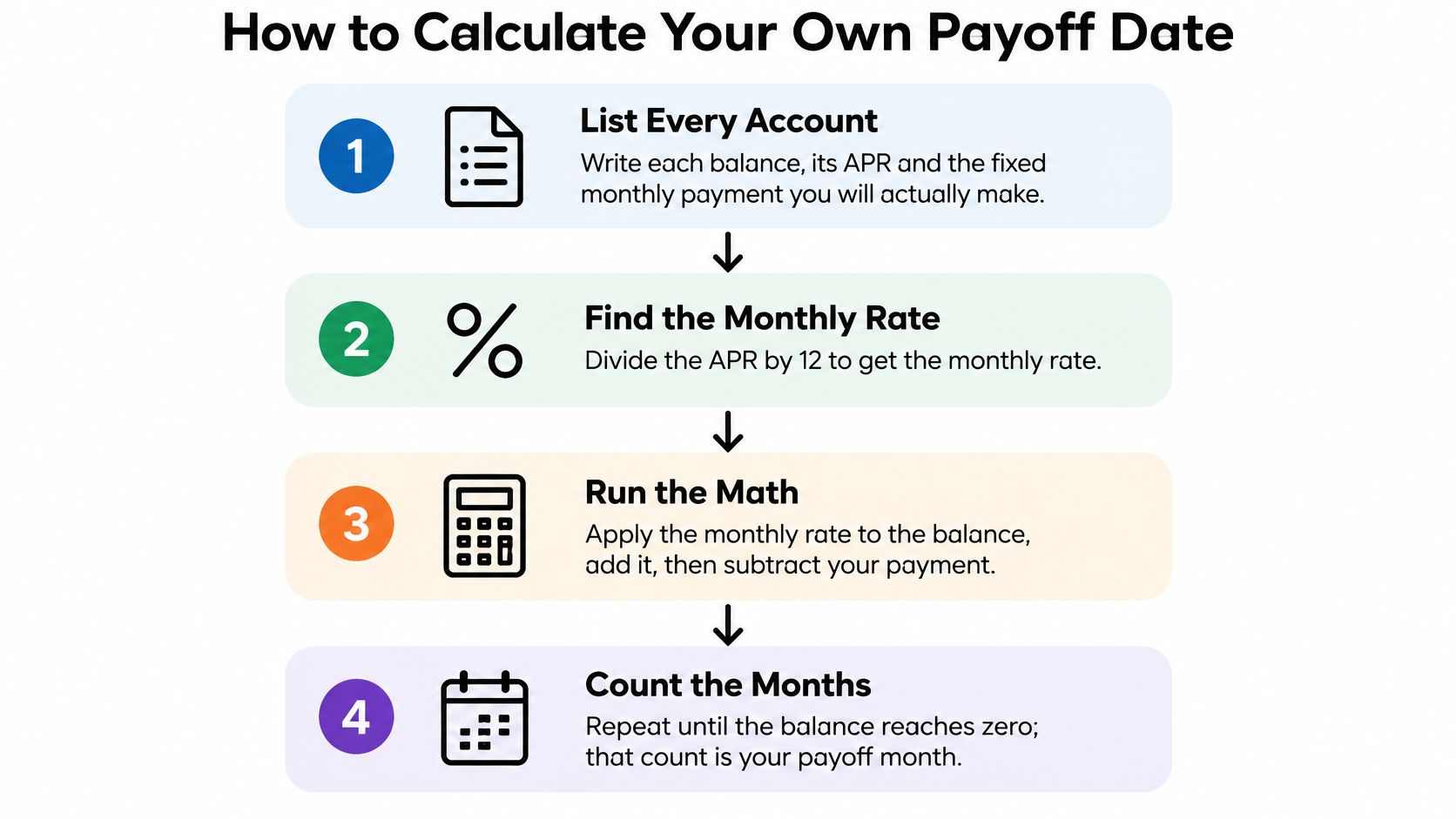
A phone calculator with a scientific mode can estimate repayment time for a fixed-rate balance with equal monthly payments. This simplified model assumes monthly interest, no fees, and no new borrowing. Actual card statements may use daily interest calculations.
For a hypothetical $5,000 balance at 22% APR with a $200 monthly payment, the calculation works as follows.
Run the estimate
Record the inputs. Set the balance to $5,000, APR to 22%, and payment to $200. The payment should reflect available cash after essential expenses.
Find the monthly rate. Divide the decimal APR by 12:
0.22 ÷ 12 = 0.018333, or approximately 1.83% monthly. Keep the unrounded decimal in the calculator.Calculate the opening month's interest. Multiply
$5,000 × 0.018333, giving approximately $91.67. The payment must exceed this amount for the balance to shrink under these assumptions.Calculate x. Divide the opening interest by the payment:
$91.67 ÷ $200 ≈ 0.4583. If x is at least 1, the payment doesn't reduce principal, so this payoff formula has no finite answer.Calculate the months. Enter
−ln(1 − x) ÷ ln(1 + monthly rate). The result is about 33.75 months, which rounds up to 34 payment months;lnis the calculator's natural-log function.Estimate interest. Multiplying the unrounded result by the payment and subtracting the balance gives approximately
$200 × 33.75 − $5,000 = $1,750. Using the rounded month count instead gives a rough upper estimate because the final payment is smaller.
The process can also be followed by repeatedly adding monthly interest and subtracting the payment.
Turn months into a calendar date
As a cross-check, applying the formula to the opening example's middle payment produces 23 payment months, consistent with the illustration. For greater accuracy, a spreadsheet can calculate each month's opening balance, interest, payment, and closing balance, reducing the final payment to the amount owed.
Counting scheduled payment dates, starting with the next payment, produces a projected payoff month for each account. The latest month is the overall endpoint if those payment allocations stay unchanged.
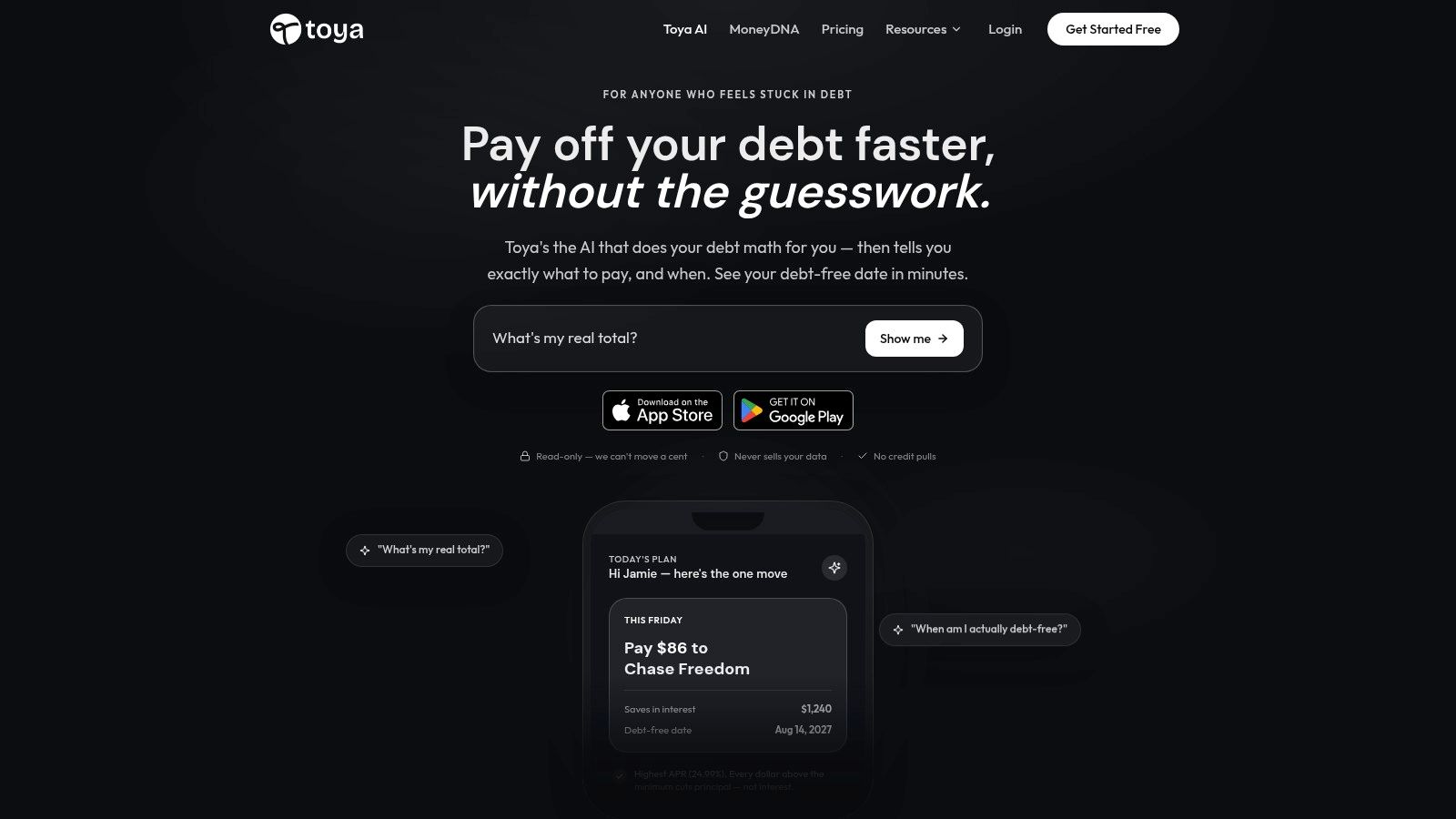
Toya AI calculates a user's debt-free date based on current payments and builds a personalized payoff plan from real account data, showing the date in minutes.
Why Minimum Payments Stretch Your Timeline
A payment isn't the same as a reduction in debt. Some of the money covers interest before the remaining amount reduces principal, the borrowed balance.
A statement review makes that split visible.

The CFPB's minimum-payment worksheet uses a $300 balance at 23% APR, a monthly rate of approximately 1.92%, and a $15 payment. Its balances fall to $290.76, $281.34, and $271.74 after successive months.
Follow the first payment
Using the worksheet's rounded monthly rate, $300 × 1.92% = $5.76 in interest. Subtracting that from the payment leaves $15 − $5.76 = $9.24 for principal, producing $300 − $9.24 = $290.76.
The same process repeats on the smaller balance. Across the illustrated period, payments total $45, but principal falls by only $300 − $271.74 = $28.26; the difference, $16.74, goes to interest.
A borrower can make every required payment and still reduce the balance much more slowly than expected.
The key statement checks are straightforward:
- Interest charged: Compare the statement's interest charge with the amount paid.
- Principal reduction: Check how much the balance fell after accounting for purchases and fees.
- Payment setting: Consider a sustainable fixed payment above the minimum rather than automatically following a declining minimum.
A minimum-payment trap calculator can help compare the current approach with a higher payment. If interest takes most of a payment, increasing principal reduction becomes especially important.
This video provides another format for reviewing debt repayment.
Minimums can be recalculated as balances change. A forecast based on an unchanged payment won't describe a borrower who keeps lowering the payment along with the required minimum.
Choosing the Order of Extra Payments
Under the avalanche method, the borrower pays every minimum and directs extra money to the highest APR, then transfers the cleared debt's full payment to the next-highest rate. Under the snowball method, extra money goes to the smallest balance, with the full payment rolling to the next-smallest balance afterward.
The CFPB's explanation of debt-reduction methods distinguishes the interest-saving benefit of targeting expensive debt from the motivation of clearing smaller balances.
Avalanche and snowball applied to the same debts
| Method | Example set | Extra money goes to | Main benefit |
|---|---|---|---|
| Highest-rate first (avalanche) | A: $500 at 29%, $2,000 at 22%, $10,000 at 7% | $500 card at 29% | Least total interest |
| Smallest balance first (snowball) | A: $500 at 29%, $2,000 at 22%, $10,000 at 7% | $500 card at 29% | Fastest first payoff |
| Highest-rate first (avalanche) | B: $500 at 7%, $2,000 at 29%, $10,000 at 7% | $2,000 card at 29% | Least total interest |
| Smallest balance first (snowball) | B: $500 at 7%, $2,000 at 29%, $10,000 at 7% | $500 card at 7% | Fastest first payoff |
These are illustrative debt sets. In set A, the smallest debt is also the most expensive, so either method starts in the same place. Set B separates the goals: clearing an account quickly versus reducing expensive interest first.
Choose the trade-off deliberately
When rates are close, a visible win may help a borrower continue. When a rate is substantially higher, the financial case for targeting it becomes stronger. The snowball versus avalanche comparison can help frame that decision.
Both methods assume minimums remain covered. If an account is already overdue, bringing it current and protecting essential expenses may need to come before accelerating another balance.
Toya AI shows which debt should receive extra payments and how much interest the user will save.
For a fair comparison, keep the same total monthly debt budget under both methods. A spreadsheet should transfer each freed payment when an account closes, rather than treating every account as an independent fixed-payment loan. Comparing total interest and the final payment month then reveals the actual trade-off.
Student Loans and Repayment Plans Change the Endpoint
For some federal student loans, ordinary amortization isn't the right way to identify the endpoint. A repayment plan and qualifying history may matter more than the payment formula.
The CFPB's student-loan forgiveness guidance explains that eligible income-driven repayment can reduce required payments to $0 when income is sufficiently low, with remaining balances potentially qualifying for forgiveness after 20 or 25 years, depending on the applicable plan. Eligibility and current plan availability must be confirmed rather than assumed.
A low required payment isn't a missed payment
Consider an eligible borrower whose approved income-driven payment is zero. That borrower still needs to recertify income and family information on schedule and verify that qualifying months receive proper credit. Choosing not to pay isn't equivalent to receiving an approved reduced payment.
The distinction matters: 20% of U.S. borrowers reported being behind on payments or in collections for at least one student loan in 2024, according to the Federal Reserve's household-finance report. A missed payment can complicate progress rather than provide the protection of an approved affordable payment.
Before accelerating repayment, the borrower should compare the extra payment with emergency savings, retirement contributions, and the expected value of a qualifying forgiveness path. Paying extra reduces the outstanding balance, but it may also reduce an amount that otherwise could qualify for forgiveness.
The guide to changing a loan repayment plan offers a starting point for evaluating alternatives.
The loan servicer should confirm:
- Plan and loan eligibility: Which repayment options apply to the specific loans?
- Qualifying history: How many qualifying payments or months have been credited?
- Recertification requirements: What information is due, and when?
- Forgiveness conditions: What rules and possible tax treatment apply?
A credible student-loan endpoint requires those answers before a calendar date becomes useful.
Stress-Test Your Date Against Real Life
The fastest theoretical payoff plan is often the most fragile. A household that sends every available dollar to debt may need to borrow again when an unavoidable bill arrives.
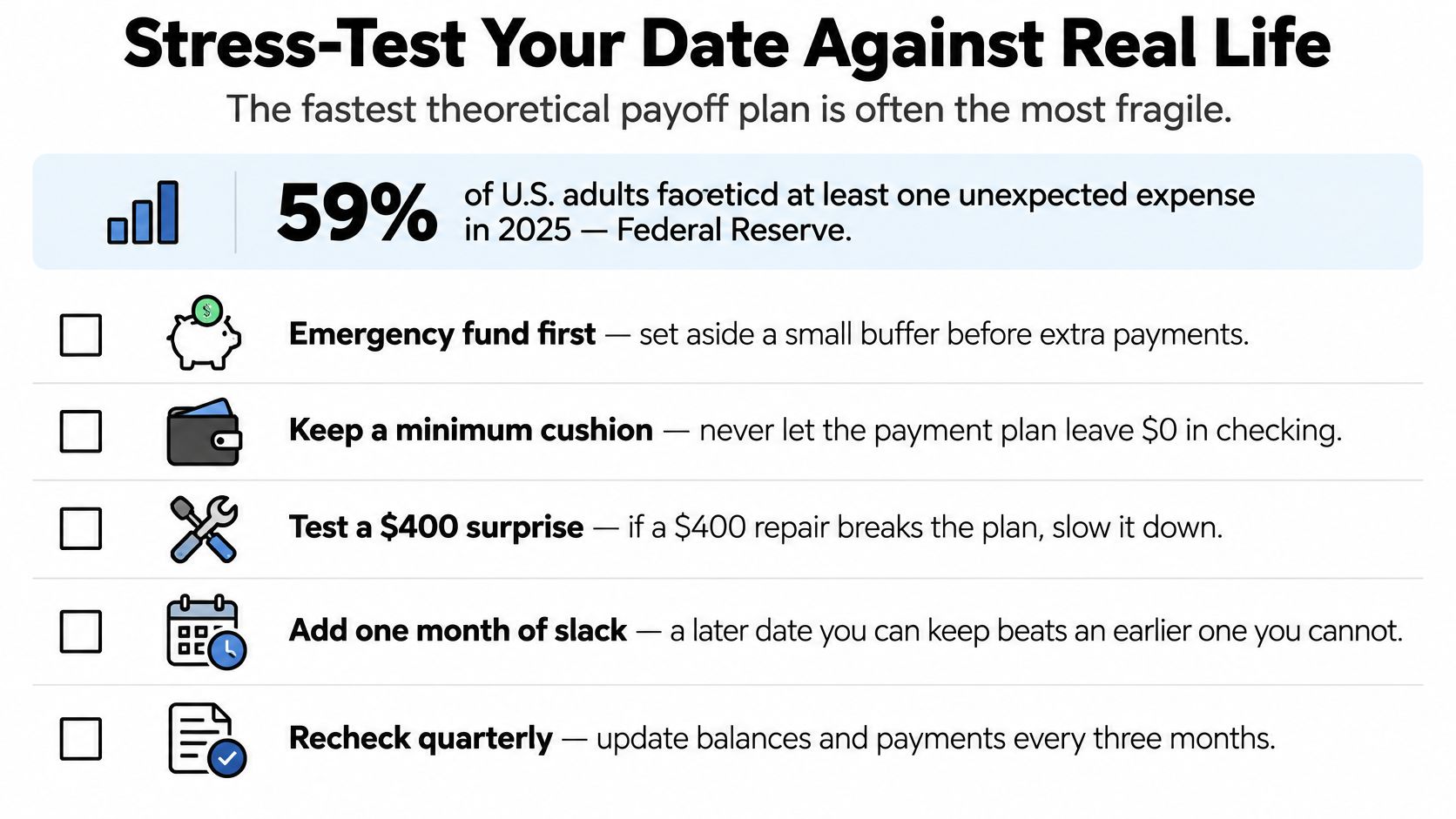
That isn't a remote concern: 59% of U.S. adults experienced at least one unexpected expense in 2025, according to the Federal Reserve's household well-being report.
Compare the same card under a shock
Consider the hypothetical card calculation with an immediate car repair charged before repayment begins. The APR and payment stay unchanged, but the starting balance increases.
Optimistic and disrupted payoff dates for the same card
| Scenario | Monthly payment | Months to repay | Approximate interest |
|---|---|---|---|
| Optimistic plan with no shocks | $200 | 34 | $1,750 |
| After a $1,000 car repair on the same card | $200 | 44 | $2,800 |
These modeled estimates use a 22% APR, with the balance increasing from $5,000 to $6,000. The monthly formula produces approximately 10 additional payment months; interest estimates use unrounded payoff durations, so the exact final-payment calculation will differ slightly.
The repair doesn't merely add its purchase price to repayment. The borrower also pays interest while carrying the additional balance.
A slightly later date supported by cash reserves can be more credible than an earlier date that depends on no surprises.
Build a recovery path
A resilient plan includes an emergency buffer, a payment floor that covers required minimums, and a way to restore extra payments after disruption.
- Job transition: Temporarily lower income may require smaller payments. Recalculate using the reduced amounts during the transition and the planned recovery afterward.
- Rent increase: A temporary increase may reduce available debt payments even without new borrowing. Model that cash-flow reduction for its actual duration.
- New charges: If expenses must go on a card, include both the added balance and subsequent interest.
The checklist provides a practical review framework.
Progress also includes all accounts current, high-interest debt cleared, lower utilization, and finally all balances cleared. Rechecking after each milestone or a change in income or expenses keeps the forecast connected to the household's actual finances.
Confirm Your Date and Set Your Next Step
The overall debt-free month is the latest payoff month across the accounts included in the plan. If payments roll between accounts, that date must come from the combined schedule, not isolated calculations that ignore those transfers.
A useful forecast records its assumptions alongside the date: expected payments, payment order, interest rates, and whether further borrowing is excluded. That makes a later change understandable rather than discouraging.
Actions for the coming week
- Build the account list. Record every balance, APR, due date, minimum, and planned payment from current statements.
- Test the competing priorities. Run the estimate on the highest-rate account and the smallest balance to understand their different repayment paths.
- Commit the extra payment. Choose an ordering method and write down the target account and additional amount.
- Schedule a review. Set a reminder to update the forecast after a milestone or income change.
An optional tool can reduce the work of keeping those inputs together. Toya AI's value preview calculator gives a quick debt-free estimate from three numbers, while connecting accounts in the app gives exact results for the account information and assumptions used. Future changes still require an updated forecast.
The app provides a place to review connected debts together.
The date is a plan to review, not a promise. A payment that remains affordable month after month is worth more than an impressive deadline that can't survive ordinary expenses.
Toya AI builds a personalized payoff plan and shows how payment choices affect the projected debt-free date and interest costs. Visit Toya AI to calculate a starting date and organize the next payment; every account starts with a 14-day Pro trial with no credit card required, and users can keep the Free plan forever or upgrade anytime.
Ready to start your debt-free journey?
Toya AI builds a personalized payoff plan so you can see your debt-free date and save on interest.
Get Started Free