
What Is Principal Payment and How Does It Work
A principal payment is the part of a loan payment that reduces the original amount borrowed, not the interest or fees. On amortizing loans, each payment is split between interest and principal, and the principal share usually rises over time as the balance falls.
That matters because many borrowers look at a statement, see one monthly payment, and assume all of it is shrinking the debt at the same speed every month. It isn't. A mortgage, auto loan, personal loan, and student loan can all look simple from the outside, but the math inside each payment is doing two different jobs at once.
The confusion usually starts the first time a borrower opens a statement and sees separate lines for principal paid and interest paid. The principal line is the part that chips away at what's still owed. The interest line is the lender's charge for letting the borrower use the money.
Most articles stop there. The more useful question is practical: when extra money is available, how does a borrower make sure that money really hits principal, instead of getting pushed into next month's bill? That small operational detail can change whether an extra payment shortens the loan or just rearranges the calendar.
Table of Contents
- What Principal Payment Means in Plain Language
- How Principal and Interest Split Every Payment
- How Amortization Changes Your Balance Over Time
- What Happens When You Pay Extra Toward Principal
- Practical Ways to Make Extra Principal Payments
- When Paying Down Principal Fast Is Not the Right Move
- Using a Debt Tool to Model Principal Payments
- Common Mistakes and Key Questions Answered
What Principal Payment Means in Plain Language
A first-time borrower often notices something strange on a loan statement. The total payment might look substantial, but the principal paid line looks much smaller than expected. That can feel like the debt isn't moving.
The bucket analogy
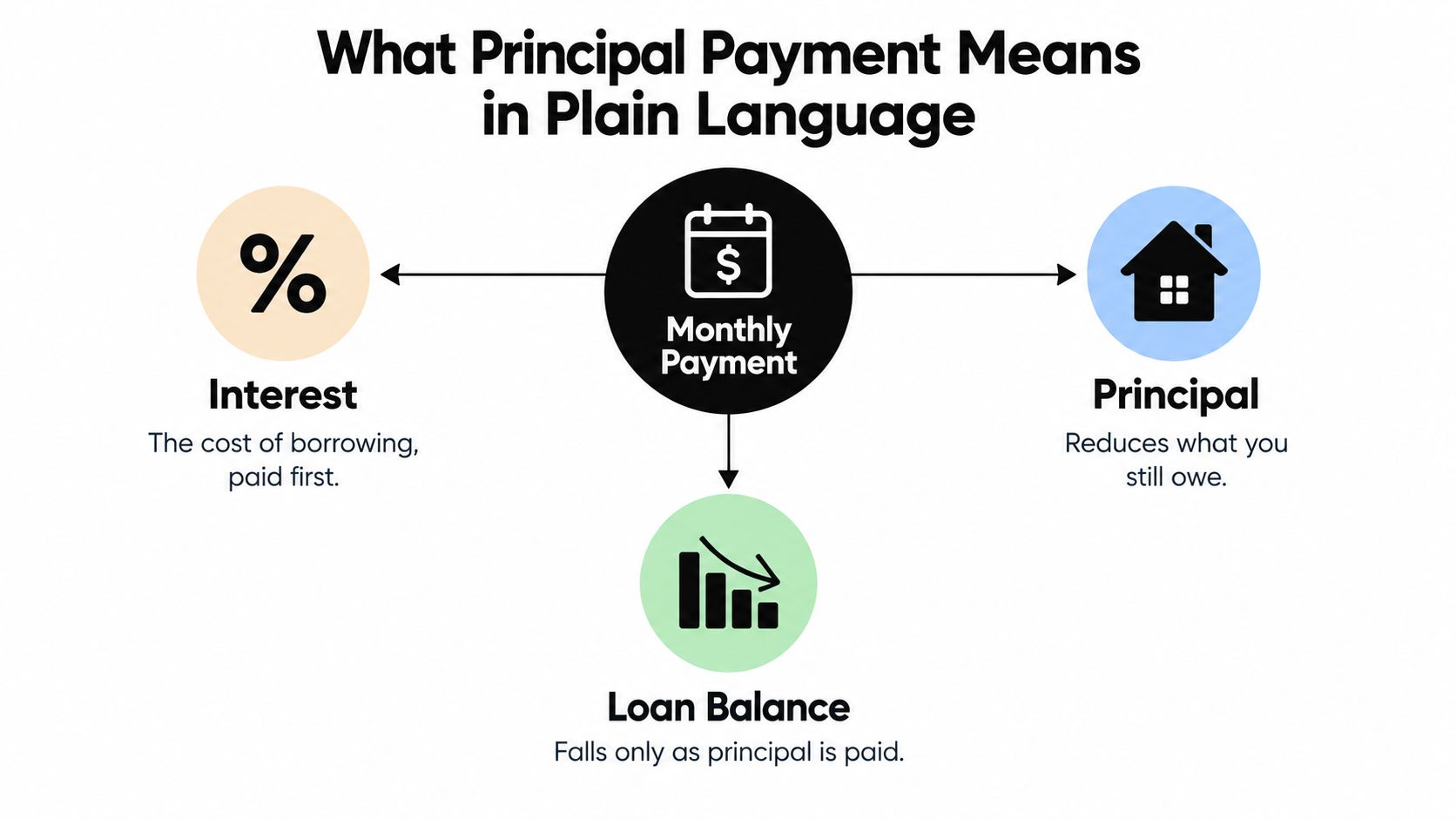
A plain way to understand what principal payment means is to treat the loan like a bucket of borrowed money. The bucket starts full on day one. Every time the borrower makes a payment, only the principal portion removes water from that bucket.
The interest portion doesn't lower the bucket at all. It's the price of borrowing.
Rocket Mortgage explains principal this way: it's the part of a loan payment that reduces the original amount borrowed, while the rest may go to interest or other charges, and amortizing mortgages are structured so the balance is fully repaid over a set term that commonly runs 15 to 30 years in major mortgage markets (Rocket Mortgage explanation of principal and interest).
What counts and what doesn't
A borrower's monthly bill can include several pieces:
- Principal: Reduces the remaining loan balance.
- Interest: Pays the lender for the use of money.
- Fees or escrow: May cover taxes, insurance, or service charges, depending on the loan.
Only the principal piece shrinks the debt itself.
That's why the principal balance matters so much. The principal balance is the amount still owed right now, not the amount originally borrowed and not the amount already paid in interest. If a borrower started with a mortgage balance and has been paying for years, the principal balance is whatever remains after prior principal payments have chipped it down.
Practical rule: If a payment doesn't reduce the balance, it isn't principal.
Why statements confuse people
Loan statements often present one large payment at the top and break out the details below. That layout makes it easy to assume the whole amount works the same way. It doesn't.
For an amortizing loan, each scheduled payment has a split inside it. The split changes over time, and that changing split explains why a borrower may feel little progress early on, then see faster balance reduction later.
How Principal and Interest Split Every Payment
A scheduled loan payment works like filling two buckets in a set order. The interest bucket gets filled first for that month. Whatever money is left goes to principal.
That order is why borrowers sometimes make the same payment every month but see very different progress on the balance.
Why the split changes
Interest is usually based on the balance that is still outstanding. When that balance is high, the monthly interest charge is higher too. When the balance gets smaller, the interest charge shrinks with it.
The result is predictable:
- At the start of the loan, the balance is larger.
- A larger balance creates more interest for that month.
- More of the payment goes to interest first.
- Less is left to reduce principal.
- Later, after the balance has come down, interest takes a smaller bite and principal gets a larger share.
The Debt Math explanation of extra principal payments walks through the same logic. Interest is calculated first, and reducing principal earlier cuts the balance used to calculate future interest.
A seesaw is a good comparison here. Early on, the interest side sits higher. Over time, that side drops and the principal side rises.
A simple example
Say a borrower has a fixed monthly payment of $1,000 on an amortizing loan.
If this month's interest charge is $700, then only $300 goes to principal.
Later in the loan, that same $1,000 payment might include $400 of interest and $600 of principal.
The payment did not change. The split inside it did.
That difference is the part many first-time borrowers miss. They assume a fixed payment means a fixed amount toward the balance each month. On an amortizing loan, it usually does not.
A side-by-side view
| Loan Stage | Remaining Balance | Interest Portion | Principal Portion |
|---|---|---|---|
| Early | Higher | Larger share of payment | Smaller share of payment |
| Middle | Lower than before | More even split | More even split |
| Late | Much lower | Smaller share of payment | Larger share of payment |
This is also why extra principal payments can matter so much, but only if they are applied correctly. If a lender treats extra money as an early payment for next month instead of principal-only, the borrower may not get the balance reduction they expected. Many articles stop at the definition. The practical step is making sure the servicer applies extra funds to principal rather than advancing the due date.
Why credit cards feel different
Installment loans such as mortgages, auto loans, and many personal loans have a built-in payoff schedule. Credit cards usually do not.
A minimum credit card payment may cover interest, fees, and only a small amount of principal. If the cardholder keeps adding new purchases, the balance can stay flat or even grow. That makes revolving debt feel very different from a loan with a set amortization schedule.
A fixed monthly payment does not mean a fixed principal payment.
How Amortization Changes Your Balance Over Time
A loan balance does not fall in a straight line. It falls on a curve.
Early in the loan, interest takes a bigger bite because the balance is still large. Later, the balance is smaller, so less of each payment gets pulled toward interest and more can go to principal. That shifting pattern is amortization.
One way to picture it is to follow a simple month.
A lender starts with your current balance, calculates interest for that month, applies your payment, and then uses what is left to reduce principal. Next month, the lender repeats the same process using the new balance. Because the balance is a little lower, the interest charge is usually a little lower too. That is why principal reduction tends to speed up over time on a standard amortizing loan.
If you want a contrast, an interest-only payment structure works very differently because the scheduled payment may not reduce the balance much, or at all, in the early period.
A simple way to read the pattern
A longer loan term stretches repayment out, so principal reduction starts more slowly. A shorter term compresses the schedule, which means the required payment is higher and the balance gets pushed down faster from the beginning.
| Loan Profile | Avg. Principal Share | Total Interest Paid | Years to Payoff |
|---|---|---|---|
| 30-year mortgage | Lower early, rises gradually | Higher relative cost over time | Longer |
| 15-year mortgage | Higher from the start | Lower relative cost over time | Shorter |
Here is the practical takeaway. Two borrowers can both make every payment on time and still see very different balance reduction if one has a shorter term. The shorter-term borrower is not just paying more each month. More of that payment reaches principal sooner.
Why the early years feel slow
This is often the frustrating part for first-time borrowers. You make payment after payment, but the balance seems to shrink at a crawl.
That usually does not mean the lender changed the rules. It means the math is doing what amortization schedules are designed to do. In the early years, interest is being calculated on the largest balance the loan will ever have after origination. As the balance comes down, interest stops taking as much of each payment.
The Consumer Financial Protection Bureau explains amortization in consumer mortgage materials as a schedule where periodic payments gradually reduce the loan balance over time, with the principal share growing as the balance declines. That is the reason early principal reduction matters so much. Money that lowers the balance sooner can reduce later interest charges too.
That point also explains the warning from the prior section. Extra money only helps in the way borrowers expect if it is applied to principal, not treated as an early payment for a future bill.
What Happens When You Pay Extra Toward Principal
An extra payment can work in two very different ways. It can reduce the balance now, or it can get treated as an early version of the next scheduled payment. Borrowers usually want the first outcome.
The direct effect of extra principal
Corporate Finance Institute describes a principal payment as any amount applied to the loan balance itself rather than to interest, and notes that if an extra mortgage payment is applied to principal, the balance drops immediately and future interest is charged on that lower amount (Corporate Finance Institute on principal payment).
That's the mechanical reason extra principal can be so powerful. The borrower isn't just paying more. The borrower is shrinking the base that future interest is built on.
Wells Fargo gives a concrete mortgage example: paying $100 extra per month toward principal can shorten the loan term by more than 4.5 years and reduce interest by more than $26,500, while $200 extra per month can cut the term by more than 8 years and save more than $44,000 (Wells Fargo amortization and extra payments example).
Mortgage and card balances behave differently
A side-by-side comparison helps.
| Loan Type | Balance & Rate | Original Term | New Term | Interest Saved |
|---|---|---|---|---|
| Mortgage | Savings depend on rate, balance, and servicer treatment | Long scheduled term | Shorter if extra funds hit principal | Can be substantial |
| Credit card | Savings depend on APR, balance, and whether spending stops | No fixed payoff unless payments exceed use | Faster if extra funds reduce balance and new charges stop | Often meaningful because rates are higher |
A mortgage borrower may care most about shortening the loan by years. A credit card borrower may care more about stopping expensive interest from repeating every month. Both benefit from extra principal, but the decision framework differs.
Borrowers trying to reduce the required monthly payment rather than just speed up payoff may also find this cut monthly housing costs guide useful, because the right move isn't always the same as the fastest move.
A borrower who wants to compare payoff scenarios can also review extra principal payments explained to see how small recurring overpayments change the payoff path over time.
Action step: Before sending extra money, confirm whether the lender treats it as a principal-only payment or as an advance on the next due date.
Practical Ways to Make Extra Principal Payments
Knowing the math is useful. Knowing how to make the payment correctly is where borrowers save real time and interest.
A credit union guide points out a common problem: lenders may apply extra money to the next month's bill unless the borrower explicitly requests principal-only treatment, so it's smart to check the loan terms and servicing instructions first (VACU guide on principal-only payments).
Five workable methods
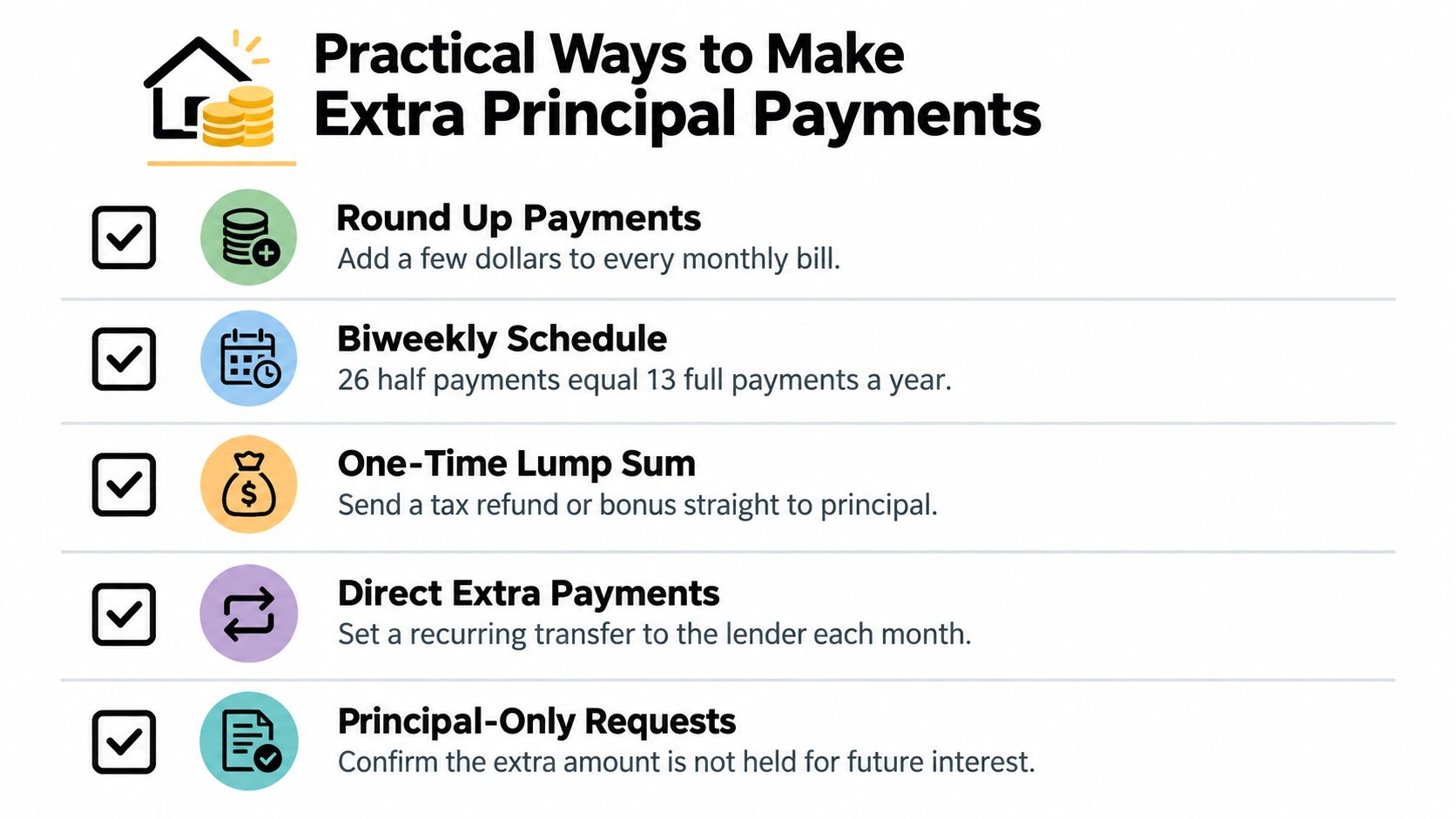
Round up the payment. If the bill is manageable, adding a small amount each month is often the easiest habit to keep. The key is to label the extra amount clearly so it reduces principal instead of just prepaying the next installment.
Switch to biweekly payments. Some borrowers prefer breaking the monthly amount into smaller pieces. This can create an extra full payment over the course of a year, but only if the servicer handles the schedule correctly.
Send a lump sum from irregular income. Tax refunds, bonuses, commissions, or cash gifts can make strong one-time principal reductions. This works especially well for borrowers who don't want a higher fixed monthly commitment.
Set up a separate recurring principal payment. Many servicers let customers schedule a standard payment and a separate extra principal amount. That creates a cleaner paper trail than overpaying the main bill.
Refinance into a shorter term. This is less flexible than occasional extra payments, but it can force a faster principal pace for borrowers with stable cash flow.
How to make sure the lender applies it correctly
Chase gives a practical example: customers may need to select a principal-payment option online or tell a representative they want the extra amount applied to principal, because a generic extra payment may be handled differently (Chase guide to paying down principal).
Borrowers should use language such as:
- Apply additional funds to principal
- Do not advance the due date
- Do not hold funds for the next scheduled payment
Borrowers should save confirmation emails, screenshots, or secure messages when sending extra principal. That record matters if the servicer posts the payment incorrectly.
A short checklist
- Check the note or loan agreement: Look for prepayment rules.
- Review the online payment menu: Some portals have a dedicated principal option.
- Call or message the servicer: Ask exactly how extra funds are posted.
- Confirm after the payment clears: Verify that the balance fell by the expected amount.
- Repeat only after the first one works: Don't automate assumptions.
When Paying Down Principal Fast Is Not the Right Move
Aggressive payoff sounds disciplined, but it isn't always the smartest use of cash.
Cases where keeping cash can be better
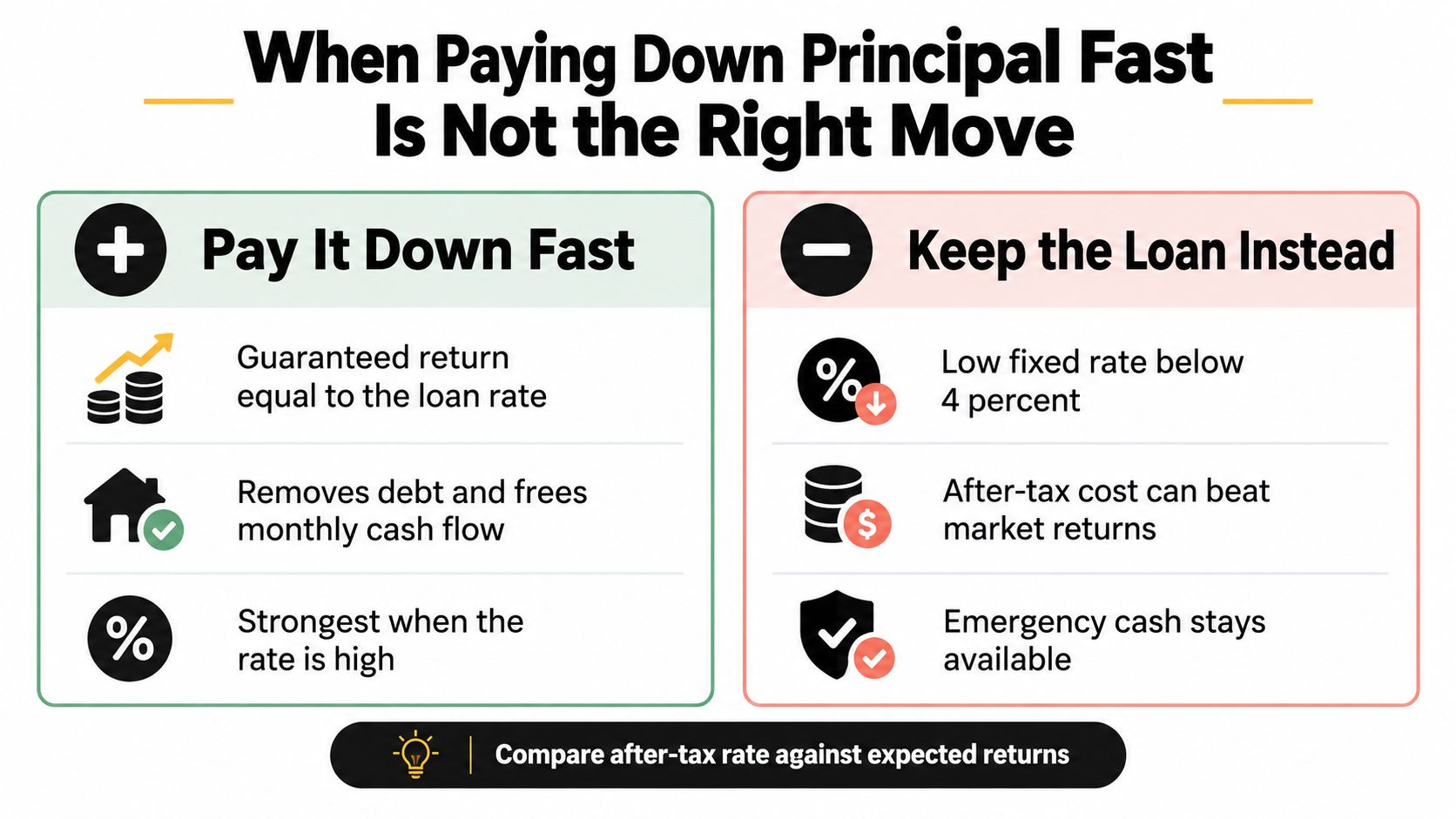
If a household has a thin emergency fund, sending every spare dollar to principal can create a new problem. A paid-down loan doesn't help much if a car repair, medical bill, or job interruption forces borrowing again at a worse rate.
Low-rate debt can also change the math. If the loan cost is modest and the borrower has stronger competing priorities, preserving liquidity may be more valuable than racing to eliminate the balance. That's especially true when a loan has borrower protections, forgiveness considerations, or penalty clauses that make rapid payoff less attractive.
The hidden costs borrowers miss
A borrower should pause before prepaying if any of these apply:
- Prepayment penalties: Some loans charge a fee for early payoff.
- Recasting or processing fees: A lender may charge to rework the payment after a lump sum.
- Cash flow strain: Extra principal is hard to reverse once the money is sent.
- Forgiveness path issues: Some student loan borrowers may benefit more from staying eligible for a repayment or forgiveness strategy than from prepaying quickly.
The affordability side matters too. At the household level, the Federal Reserve's FRED series for debt service and principal payments shows the measure at 11.16414 in Q1 2026, which suggests principal repayment pressure remained materially high in that dataset at that time (FRED household debt service and principal payments series).
A balanced test
If paying extra would leave the borrower with little cash, trigger a penalty, or interfere with a more valuable repayment path, principal reduction may not be the right priority yet.
Paying down debt is a guaranteed return equal to the loan rate only if the borrower can comfortably part with the cash and avoid giving up something more valuable.
Using a Debt Tool to Model Principal Payments
A borrower with one loan can often do the math with a calculator. A borrower with a mortgage, auto loan, student debt, and credit cards usually needs a system.

What a modeling tool actually helps with
The value of a debt tool isn't just storing balances. It helps a borrower compare choices before sending money.
A tool can centralize:
- Current balances
- Interest rates or APRs
- Minimum payments
- Due dates
- Estimated payoff timing under different extra-payment scenarios
That makes it easier to test questions such as whether an extra monthly amount should go to a mortgage, a personal loan, or a high-rate card first. It also helps spot when a servicer's posted balance doesn't match what the borrower expected after a principal-only payment.
Toya AI is one option in this category. It connects loan and credit accounts into one dashboard and models how extra payments affect payoff timing and total cost. Borrowers comparing approaches can use a loan payoff calculator to see how a changed payment amount alters the path.
Why modeling beats guessing
Without a model, borrowers often spread extra money thinly across several accounts because that feels balanced. Sometimes that works. Often it weakens the impact.
A payoff model can rank debts by effective cost and show where an extra dollar does the most work first. It can also help a borrower compare speed against flexibility, which matters in months when cash flow is tight.
A short walkthrough can make that visual.
The point isn't to hand judgment over to software. The point is to turn scattered statements into one decision that can be checked before money leaves the bank account.
Common Mistakes and Key Questions Answered
The biggest mistakes around principal payments usually aren't about math. They're about execution.
Mistakes that cost borrowers time
- Sending extra money without instructions: The servicer may treat it as an early regular payment instead of principal-only.
- Ignoring loan terms: Some borrowers prepay first and discover restrictions later.
- Confusing lower balance with lower next bill: On many loans, paying extra principal won't automatically change the required monthly payment.
- Failing to verify posting: A borrower should check that the balance dropped after the payment settled.
At a larger scale, principal repayment isn't a small bookkeeping detail. The World Bank's International Debt Report 2025 states that long-term principal repayments reached US$78.5 billion, accounted for 66.5% of total debt-service payments, and marked a 19.8% increase from the prior year (World Bank International Debt Report 2025 text). That's sovereign debt data, not a household loan example, but it shows how principal often becomes the central repayment burden in real markets.
Questions borrowers still ask
Does principal affect mortgage-interest tax treatment?
Interest and principal are different. Principal reduces the debt. Interest is the borrowing cost. Borrowers should use tax guidance from a qualified preparer for deductibility questions.
Is recasting the same as refinancing?
No. Recasting usually follows a lump-sum principal reduction and adjusts the payment on the existing loan. Refinancing replaces the loan entirely.
Can extra principal help remove PMI sooner?
It can, because lowering the balance may help a borrower reach the lender's cancellation threshold earlier. The exact process depends on the loan and servicer.
What if the borrower is in forbearance or another special payment status?
The way principal is applied can differ. The borrower should confirm how payments post before sending extra money.
What is principal payment in one sentence?
It's the part of a payment that lowers the amount still owed on the loan.
Toya AI helps borrowers turn this math into a usable payoff plan by pulling balances, rates, and due dates into one place and showing how extra payments change the timeline. For anyone trying to decide where an extra dollar should go, or whether a servicer is applying payments correctly, Toya AI gives a clearer view before the money is sent.
Ready to start your debt-free journey?
Toya AI builds a personalized payoff plan so you can see your debt-free date and save on interest.
Get Started Free