
What Is Average Daily Balance: How It Affects Interest
Your statement lands with three numbers that don't seem to talk to each other: a balance at the top, an interest charge below it, and a minimum payment at the bottom. You paid on time. You paid a real amount, not just the minimum. The interest still looks like it came out of thin air.
It didn't. The issuer built that charge from a number you never see printed on the page, one that shifts every single day of the billing cycle. Understand the average daily balance and the charge stops being mysterious. Better still, it becomes something you can push in your favor without sending an extra dollar.
Table of Contents
- What Average Daily Balance Means and How to Calculate It
- How the Daily Balance Turns Into an Interest Charge
- How Payment Timing Changes Your Average Daily Balance
- Grace Periods, Cash Advances and Separate Balance Types
- How Loan Interest Differs From Card Average Balances
- How to Check Your Statement Against the Agreement
- How to Lower the Interest and Choose Your Next Payment
What Average Daily Balance Means and How to Calculate It
Your average daily balance is the average of what you owed on every day of one billing cycle. It isn't the statement balance, it isn't the current balance in your app, and it isn't the number on the day the statement closed. It's a blend of the whole month, one figure that captures both how much you owed and how long you owed it.
Think about how you'd describe a hot month. You wouldn't read a thermometer once at 11pm on the 30th and call that the month's temperature. You'd note the reading each day and average them, because a single 95-degree afternoon and thirty mild days feel nothing alike. A card issuer looks at your balance the same way. A $1,000 balance carried for thirty days costs more than a $1,000 balance that shows up on day twenty-eight.
The formula is short. Add the balance for every day in the cycle, then divide by the number of days.
| Period | Daily balance | Days |
|---|---|---|
| Days 1-15 | $1,000 | 15 |
| Days 16-30 | $1,500 | 15 |
| All 30 days | $37,500 | 30 |
| Average daily balance (total ÷ 30) | $1,250 | 30 |
Run it once with the numbers above: (($1,000 × 15) + ($1,500 × 15)) ÷ 30 = $1,250. That's the same result the Consumer Financial Protection Bureau's card contract glossary uses to explain the method to cardholders.
What Moves the Balance From Day to Day
Each morning the issuer starts with yesterday's balance. It adds new charges and any interest that accrued, then subtracts payments and credits that posted that day. The result becomes today's balance, and the cycle repeats until the statement closes.
Posting date is what counts, not the date you swiped or the date you scheduled the payment. That single detail explains most of the gap between what people expect to owe and what the statement says. The glossary also points out that the statement-ending balance alone can't tell you the interest charge, because a payment made early in the cycle lowers more daily balances than the same payment made just before the due date.
Each agreement defines which items feed the daily balance, including whether new purchases, fees and interest itself are folded in. Reading that definition in your own contract takes two minutes and settles every later question.
A Three-Step Self-Check
- Find the cycle dates. The statement lists a start and an end date. The day count between them is your divisor, and it isn't always 30.
- List each balance change by date. Start with the opening balance, then add and subtract every posted item in order. Group the days where the balance doesn't move.
- Divide the total by the day count. Multiply each balance by the days it lasted, add those products, then divide.
Do this once on a real statement and the arithmetic becomes routine. Everything that follows builds on that one number.
How the Daily Balance Turns Into an Interest Charge
Once the average exists, calculating the interest is easy. Multiply the average by the daily periodic rate, then by the number of days in the cycle. The daily periodic rate is the annual percentage rate divided into 365 thin slices, and it's applied to the average rather than to the statement balance.
The Capital One card agreement hosted by the CFPB spells out that exact sequence. With a $1,250 average, a 24% APR and a 30-day cycle, the estimate is $1,250 × (0.24 ÷ 365) × 30, or about $24.66.
The rate is the lever, and it moves the same average a long way.
| APR | Interest on $1,250 ADB over 30 days |
|---|---|
| 15% | $15.41 |
| 18% | $18.49 |
| 24% | $24.66 |
Keep a rule of thumb nearby: at 24%, every $100 of average balance costs about $1.97 per 30-day cycle. Halve the average and you halve the charge. That's the whole game.
Why Your Statement Rarely Matches to the Cent
Agreements may apply rounding conventions or minimum-interest provisions, so a hand calculation can land a few cents off the printed figure. Some issuers divide the APR by 360 instead of 365, which nudges the daily rate slightly higher. None of that changes the method, and none of it should stop you from estimating.
Where people go wrong is using one rate for everything. Purchases, cash advances and balance transfers can each carry their own APR, and each balance category gets its own average and its own multiplication. Before estimating a charge, find the rate printed next to each balance type. If you want the wider mechanics of how issuers apply those rates, this explanation of how credit card interest works walks through the compounding side.
How Payment Timing Changes Your Average Daily Balance
Here's the part that surprises people. A $1,000 starting balance and a $500 payment produce two different interest charges depending on the day that payment posts. Same balance, same payment, different cost. The only variable is time.
The payment posts on day 5. Days 1 through 4 carry $1,000, which adds $4,000 to the running total. The payment lands, the balance falls to $500, and that $500 holds for days 5 through 30, adding 26 × $500 = $13,000. Divide $17,000 by 30 and the average is $566.67.
The payment posts on day 28. Now days 1 through 27 carry $1,000, adding $27,000. The final three days carry $500, adding $1,500. Divide $28,500 by 30 and the average is $950.
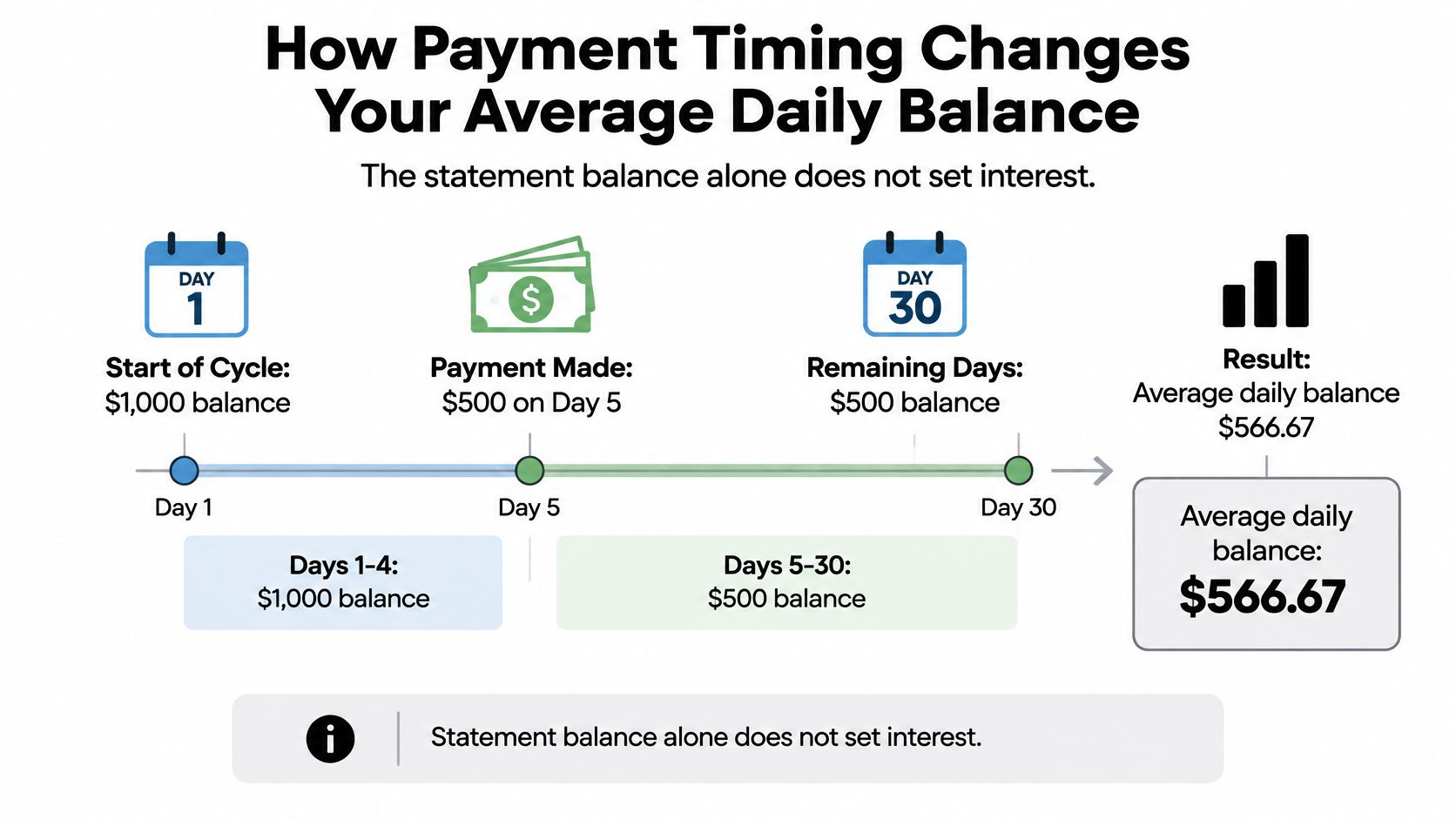
At a 24% APR across that 30-day cycle, the early payment generates about $11.18 of interest and the late one about $18.74. The difference is $7.56, and the payment amount never changed. Not one dollar more left your account.
Practical rule: Every day a payment sits in your checking account instead of posting to the card, it costs you a fraction of a cent per dollar. On a large payment, that fraction adds up.
Purchases follow the same logic in reverse. A charge made on day 2 sits on the balance for 28 days, while the identical charge on day 27 sits for three. That's why holding a purchase until just before the cycle closes lowers the month's interest.
Splitting one payment into two, say half when your paycheck clears and half mid-cycle, pulls the average down further than a single lump at the end. If you want a structured approach to that habit, splitting monthly credit card payments covers the mechanics and the credit-reporting side.
None of this overrides the credit card payment due date. Send the minimum by the due date no matter what, because a late fee and a penalty rate wipe out every cent of interest you saved.
Grace Periods, Cash Advances and Separate Balance Types
A common assumption goes like this: a card that gets paid every month can't possibly charge interest. It sounds airtight. It breaks in a very specific place.
The grace period is what makes the assumption work, and it comes with conditions. A CFPB-hosted credit card agreement states that no interest is charged on new purchases when the entire balance is paid by the monthly due date. Start a cycle with nothing carried over, put $2,000 of purchases on the card, pay the full statement balance on time, and many agreements charge no purchase interest at all.
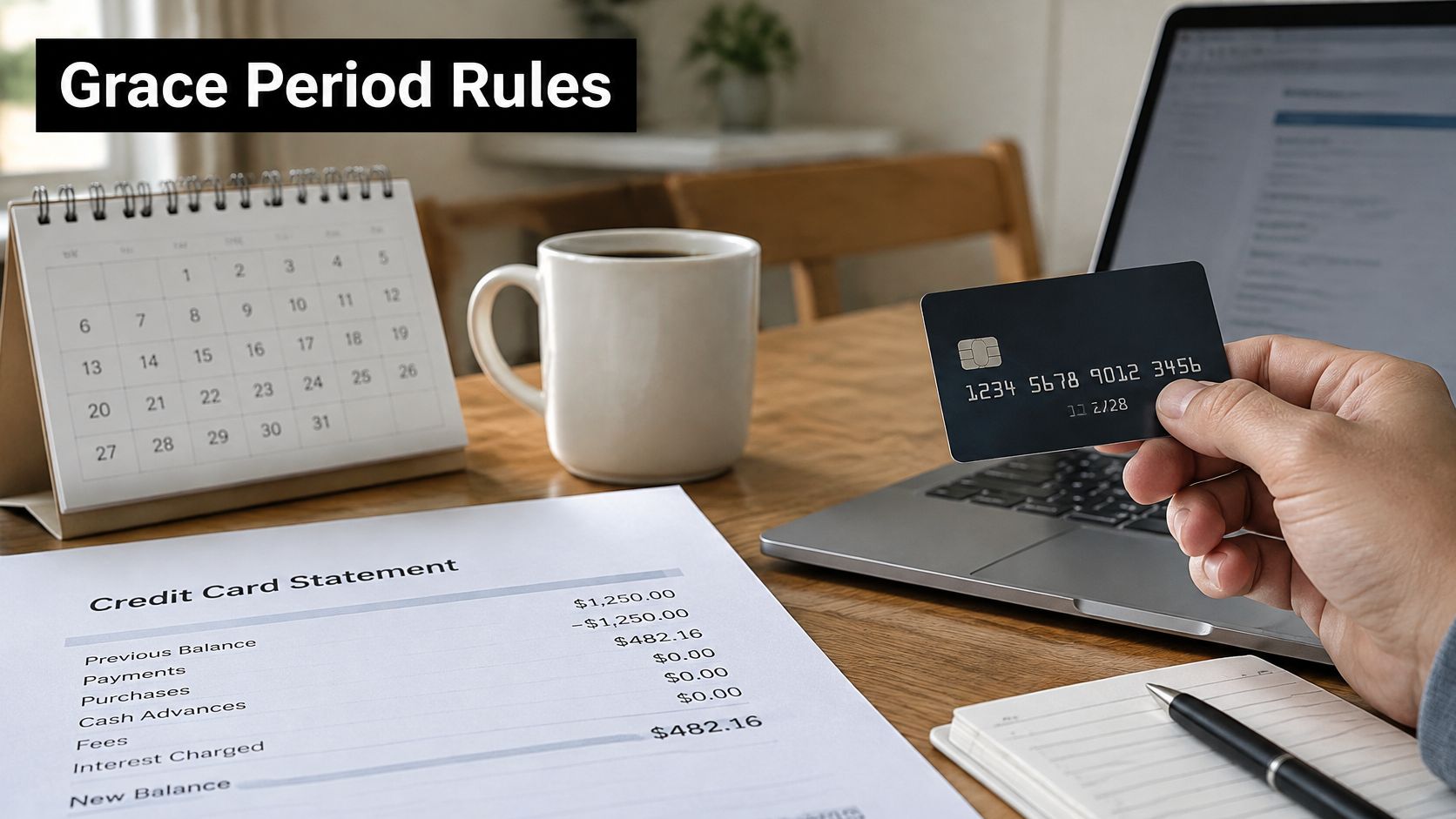
Carry any unpaid balance into the next cycle and the ground shifts. The grace period on new purchases can disappear, which means fresh charges start accruing interest from the day they post. Paying the minimum keeps the account current and does nothing to protect the grace period, because the minimum isn't the full statement balance.
Cash advances live under different rules again. The same agreement calculates their average separately, adding advances and debits and subtracting payments and credits, and most issuers start the clock immediately with no grace period at all.
Four Things to Verify in Your Own Agreement
- Which payment protects the grace period. Look for language about paying the full statement balance, not the minimum.
- The APR per balance type. Purchases, balance transfers and cash advances commonly carry separate rates.
- How the cycle length is set. It sets your day count and your divisor.
- How payments are applied across balances. Issuers generally must send extra money above the minimum to the highest-rate balance first.
How Loan Interest Differs From Card Average Balances
A credit card's average daily balance gives each day's balance a place in the calculation. A typical installment loan instead charges interest on the unpaid principal, so an extra payment can reduce interest once it lowers that principal.
For example, daily simple interest on a $10,000 loan at 8% APR over 30 days is $10,000 × (0.08 ÷ 365) × 30, or $65.75. You can check the same calculation using your loan's balance, APR and number of days.
Payment timing changes the result, even when the payment amount stays the same. If you pay an extra $500 toward principal on day 5 rather than day 28, it reduces the balance for 23 additional days. The extra interest saved is $500 × (0.08 ÷ 365) × 23, or about $2.52. The earlier payment saves measurable interest because the loan charges daily interest on the remaining principal.
A monthly amortization schedule handles interest differently, and the agreement explains which method applies. Before making a large extra payment, ask the lender for a payoff quote that separates principal from accrued interest.
The differences between personal loans versus cards in NZ are specific to that market, so they may not describe the terms of a US loan or card. For a step-by-step explanation of how to calculate monthly interest, use the figures and method stated in your own agreement.
Check the loan disclosures for “average daily balance” or “daily simple interest.” Confirm whether an extra payment reduces principal on the day it posts, then compare the lender's interest figure with your calculation.
How to Check Your Statement Against the Agreement
A statement's interest charge is easier to assess when you compare it with the card agreement and your transaction history. Gather those three items and a calculator, then check the figures in order.
- Circle the interest charge and cycle dates. The dates tell you how many days to include.
- Find the APR for each balance type. Purchases, cash advances and promotional balances may have different rates.
- Rebuild each daily balance. Start with the opening balance, then add or subtract each transaction on the date it posted.
- Calculate the average. Multiply each daily balance by the number of days it applied, add those amounts, and divide by the cycle length.
- Estimate the interest. Multiply the average daily balance by the APR divided by 365, then by the number of days in the cycle.
Check each step against your own statement. For example, if your daily balances total $5,000 across a 30-day cycle, then $5,000 ÷ 30 = $166.67. That is the average daily balance for those figures. The result is a useful arithmetic check, not a substitute for matching your statement's actual balances and cycle dates.
Reading the Gap Between Your Number and Theirs
A difference of a few cents can come from rounding or the issuer's calculation method. A larger gap deserves a closer look.
Call the number on the back of the card and ask how the issuer calculates daily balances, which APR applies to each balance category, and how many days it counted in the cycle. Compare those answers with your agreement and transaction history to find where the figures diverge.
Reproducing the charge gives you a sound basis for comparing offers, payoff plans or payment dates, rather than relying on the headline APR alone.
How to Lower the Interest and Choose Your Next Payment
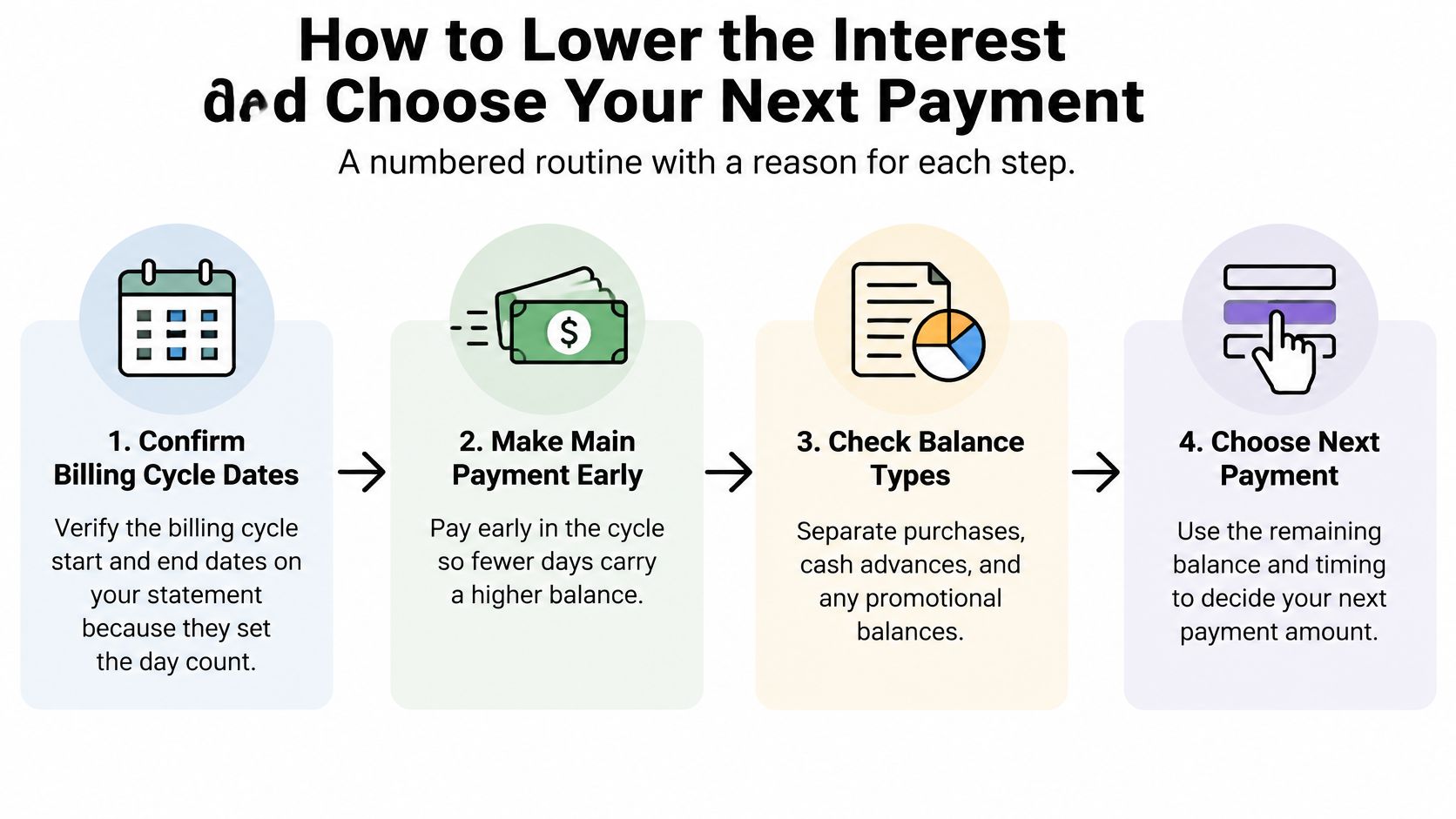
The routine below follows one principle: shrink the balance on as many days as possible, and keep the grace period intact.
- Confirm the cycle start and end dates. They set the day count, so a cycle that runs 33 days costs more than one that runs 28 on the same balance.
- Make your main payment early rather than on the due date. Early payments lower more daily balances. The common mistake is treating a due-date payment as equivalent to one posted two weeks sooner.
- Split a large payment when cash flow allows. Two mid-cycle payments beat one at the end, because the average drops sooner.
- Pay the full statement balance by the due date. This preserves the grace period on purchases. Paying only the minimum forfeits it.
- Skip cash advances unless there's no alternative. They carry their own APR and typically no grace period.
- Direct extra money to the highest-APR balance first. That rate multiplies every daily balance it sits on, so the same dollar saves more there.
- Set a reminder a few days before each cycle closes. Project the average while there's still time to act on it.
Choosing This Cycle's Payment
Run the interest formula twice on the current cycle, once with your planned payment date and once with the same amount moved a week earlier. The gap between the two results is the money on the table. Compare that saving with what the cash would otherwise do, then pick the amount and the date.
A dashboard that holds balances, APRs and due dates in one view makes the projection a two-minute job. Toya AI's free tier connects unlimited accounts and tracks those figures at no cost with no time limit, which is enough for this calculation. Pen and paper on a printed statement works just as well.
One action this week: open your latest statement, write down the cycle start and end dates, and calculate your average daily balance. The number you get is the one your interest is built on, and now you know how to move it.
Toya AI builds a payoff plan from your real account data and shows how a specific extra payment changes both your debt-free date and the interest you pay. Balances, APRs and due dates sit in one dashboard, and the plan recalculates when a card gets added or a raise changes your cash flow. Connect an account and let Toya AI show you which balance to attack next, then test one earlier payment date this month and watch the projection move.
Ready to start your debt-free journey?
Toya AI builds a personalized payoff plan so you can see your debt-free date and save on interest.
Get Started Free