
What Is a Good APR for Credit Card in 2026
A good credit-card APR in 2026 is meaningfully below the Federal Reserve's reported 24.22% average purchase APR for large-bank accounts in the second quarter, so an APR below roughly 20% is comparatively strong for someone carrying a balance. An APR near 28% to 30% is expensive, although the right answer depends on the cardholder's credit profile, balance type, and payoff timeline.
A statement arrives after an ordinary month of groceries, transport, and a few purchases that seemed manageable at the time. The account shows a 28% APR, and the question becomes immediate: is that rate normal, or is the cardholder paying too much? The number matters most when a balance remains after the due date, because revolving debt turns a convenient payment method into an ongoing borrowing cost.
The genuine question behind “what is a good APR for credit card” is usually more personal: Is this card expensive for the balance being carried, and could another option shorten the payoff date? A useful answer needs more than one cutoff. It needs a benchmark, a dollar comparison, and a plan for acting on the result.
Table of Contents
- A Statement That Made You Pause
- What APR Actually Means on a Credit Card
- Low, Average, and High APR Ranges in 2026
- What Determines the APR You Are Offered
- Comparing a Low Ongoing APR to a 0% Balance Transfer
- How to Lower Your APR and Pay Off Debt Faster
- Putting It All Together for Your Situation
A Statement That Made You Pause
The cardholder studies the statement again. The balance is $5,000, the purchase APR is 28%, and the interest charge feels disconnected from the small purchases that created the debt. The issuer hasn't necessarily made an error. The rate may be within the range assigned to that account, but it can still be costly compared with current mainstream offers.
A rate should be judged against three things:
- The current market: A rate can look ordinary in one period and expensive in another.
- The borrower's profile: Issuers price applicants differently based on credit history and other factors.
- The balance behavior: Someone who pays the statement balance in full generally avoids purchase interest under the card's grace-period terms, while someone who revolves a balance pays for access to borrowed money.
The Federal Reserve reported that credit-card accounts assessed interest averaged 21.91% in the first quarter of 2025 and 22.25% in the second quarter. The Consumer Financial Protection Bureau reported broader 2024 average APRs of approximately 25.2% for general-purpose cards and 31.3% for private-label retail cards, the highest levels reported since at least 2015, as described in the Federal Reserve historical credit-card rate data.
The number becomes clearer in dollars
On a constant $5,000 balance, simple annual interest at 28% is about $1,400, before compounding, payments, fees, or new purchases. At 20%, the same illustration is about $1,000, so the difference between those rates is roughly $400 per year.
That example doesn't predict the exact finance charge on a statement. Card issuers commonly calculate interest using periodic rates and changing daily balances. It does show why a rate that looks like a small percentage difference can affect the debt-free date.
Practical rule: A good APR isn't a universal label. It's a rate that compares favorably with current offers for a similar borrower and keeps the total repayment cost manageable.
The sections that follow separate the mechanics from the benchmark. They also address a common trap, choosing a temporary 0% balance-transfer offer without checking fees, the promotional end date, or the rate that follows.
What APR Actually Means on a Credit Card
APR, or annual percentage rate, is the annualized cost of borrowing on a credit-card balance. The issuer displays an annual figure, but interest is generally applied through a periodic rate, often based on a daily calculation. A 24% APR therefore isn't usually charged as one annual bill. It represents an annual rate used to calculate periodic interest as the balance changes.
For a simple illustration, 24% of $5,000 is about $1,200 in one year before payments, compounding, fees, or new purchases. If the balance declines during the year, the actual interest should generally be lower than that constant-balance illustration. If new purchases increase the balance, the cost can rise.
APR and interest rate aren't identical in practice
People often use “interest rate” and “APR” as if they mean exactly the same thing. On a credit card, the APR is the quoted annual borrowing rate, while the issuer uses a periodic rate to calculate the interest applied to the balance. The statement's finance-charge section shows how the issuer handled the balance, and resources about using statements for bookkeeping can help cardholders organize those figures for review.
A grace period can change the result. When a cardholder pays the statement balance in full by the due date and the card's terms provide a purchase grace period, purchase interest is generally avoided. The APR becomes financially important when the cardholder carries part of the balance forward.
The credit-card APR explanation from Toya offers another way to connect the annual figure with the daily cost. The key lesson is simple: the displayed APR matters most on the portion that remains unpaid.
One account can have several APRs
A card may list separate rates for:
- Purchases: The rate applied to ordinary transactions.
- Balance transfers: The rate applied to balances moved from another account, sometimes under a promotional offer.
- Cash advances: A separate rate that may begin accruing interest immediately and may not receive the same grace-period treatment.
The Consumer Financial Protection Bureau explains that statements must show different APR categories and the balances assigned to each category. A card with a 20% purchase APR and a 30% cash-advance APR would produce a simple one-year illustration of $200 in purchase interest versus $300 in cash-advance interest on $1,000, before compounding and fees, based on CFPB credit-card contract definitions.
Variable APRs add another layer. Many cards tie the rate to a benchmark plus an issuer margin, so the APR can move when market conditions change. The rate printed on today's statement may not remain unchanged over the life of the account.
Low, Average, and High APR Ranges in 2026
A practical 2026 benchmark starts with the Federal Reserve's reported 24.22% average purchase APR for large-bank active general-purpose accounts in the second quarter of 2026. A separate Federal Reserve measure put the average rate for accounts assessed interest at 22.15% in May 2026, showing why “the average” depends on which group the data measures, as reflected in the Federal Reserve credit-card APR series.
Those figures support a useful three-part comparison for someone carrying a balance:
| APR range | How it compares | Simple annual interest on $5,000 |
|---|---|---|
| Below roughly 20% | Comparatively strong | About $1,000 |
| Around 24.22% | Close to the large-bank purchase average | About $1,211 |
| Roughly 28% to 30% | Comparatively expensive | About $1,400 to $1,500 |
The $1,211 figure comes from applying 24.22% to a constant $5,000 balance. The $1,500 figure applies 30% to that same balance. These are simple annual-rate illustrations, not forecasts of an actual statement charge, because real balances change and issuers may compound interest.
A one-point reduction has a visible value
On the same $5,000 balance, reducing an APR by one percentage point reduces simple annual interest by about $50. A move from 24.22% to 23.22% therefore represents roughly $50 less annual interest under a constant-balance illustration, while a move from 30% to 29% has the same approximate value.
The broader reduction can be more meaningful. Moving from 25% to 15% lowers simple annual interest on $5,000 from about $1,250 to $750, a difference of roughly $500 before compounding and payments, according to the Federal Reserve benchmark information.
Someone who pays in full each month may care more about annual fees, rewards, grace-period rules, and penalty pricing than the purchase APR. Someone who revolves a balance should focus closely on the assigned APR and the amount of time the balance is expected to remain unpaid.
What Determines the APR You Are Offered
The advertised APR range isn't a promise. The issuer reviews the applicant's circumstances and assigns a rate within its approved pricing structure. Two people can apply for the same card and receive different offers.
Six factors shape the assigned rate
Credit score and credit history
A stronger record of on-time payments and responsible credit use can support access to lower pricing. A borrower researching what a 750 FICO score can mean should still remember that a score alone doesn't guarantee a particular APR.Income and ability to pay
Issuers consider whether reported income supports repayment. Income isn't a direct promise of a low rate, but it helps the issuer evaluate capacity.Existing debt and debt-to-income pressure
Large obligations relative to income can signal less room for another payment. The issuer may respond with a higher rate, a lower limit, or a declined application.Card type
A secured card, student card, rewards card, and premium card can use different pricing structures. The product's benefits, fees, underwriting approach, and intended audience all affect the offer.Promotional versus standard pricing
A temporary purchase or balance-transfer APR can be attractive, but it expires. The post-promotional variable rate belongs in the comparison before an application is submitted.Benchmark-linked variable pricing
Many variable cards combine a benchmark with an issuer margin. If the benchmark changes, the APR can change too, even when the borrower hasn't changed behavior.
Consider two hypothetical applicants with similar incomes. One has a 760 credit score and receives a 19% offer. Another has a 640 score and receives 27% for the same card. Those figures illustrate how a personal offer can differ from the market average. They aren't universal offers or predictions for every applicant.
The number to compare is the post-approval APR assigned to the account, not the lowest number printed in an advertisement. A lower advertised minimum may be available only to applicants with a particular risk profile.
Comparing a Low Ongoing APR to a 0% Balance Transfer
A balance-transfer decision should begin with the payoff date, not the promotional headline. A 0% balance-transfer offer can eliminate purchase interest during its promotional period, but the issuer may charge a transfer fee of 3% to 5% of the amount moved. On a $10,000 transfer, that fee is $300 at 3% or $500 at 5%, payable even while the promotional APR is 0%.
For a $5,000 balance, the same fee range is $150 to $250. A borrower who can clear the balance within the promotional window may accept that upfront cost in exchange for avoiding interest. The calculation changes if repayment extends beyond the offer's expiration.
The payoff horizon determines the winner
A low ongoing APR around 15% to 18% may be more predictable for a borrower who needs several years. At 15%, simple annual interest on a constant $5,000 balance is about $750. At 18%, it is about $900. Those figures provide a baseline for comparing the transfer fee and the interest that would accrue during the same period.
A borrower who can repay $5,000 in one year might find a 0% transfer attractive after paying the 3% to 5% fee, provided the promotion lasts long enough and no other costs undermine the savings. A borrower who needs three years faces a different risk. If the balance remains when the promotion ends, the post-promotional APR can apply, and recent offers may revert to variable rates reaching the high twenties.
| Question | Lower ongoing APR | 0% balance transfer |
|---|---|---|
| Upfront fee | May be absent or different by card | Commonly 3% to 5% of transferred amount |
| Best fit | Longer or uncertain payoff horizon | Fast, disciplined payoff within the promotion |
| Main risk | Interest continues while the balance remains | Promotion expires before repayment |
| Extra concern | Annual fee and assigned APR | Post-promotional APR and new-purchase rules |
New purchases can complicate the calculation. A card may treat purchases differently during a transfer promotion, and missed payments can affect promotional terms. The comparison should include the transfer fee, annual fee, required payment, expiration date, post-promotional APR, missed-payment consequences, residual interest rules, and whether new purchases receive a grace period.
Readers reviewing whether interest on business purchases may be treated differently can consult guidance on deducting interest on business purchases, while repayment decisions should still be based on the card's actual terms. A 0% balance-transfer payoff guide can help organize the timeline before an application is made.
How to Lower Your APR and Pay Off Debt Faster
A rate review becomes useful when it leads to a specific sequence. The following plan separates actions that can reduce the rate from actions that reduce the balance.
Start with the issuer
Call the card issuer and ask whether the account qualifies for a lower APR. The request should mention a consistent payment record, a lower competing offer if one exists, and the goal of keeping the account while reducing borrowing costs. Approval isn't guaranteed, but the call costs nothing and can produce a useful answer.
Next, compare a new lower-rate card or balance-transfer card without applying blindly. The assigned APR, transfer fee, annual fee, credit limit, and promotional expiration date matter more than the marketing headline. A new application can also affect the credit profile, so the borrower should check eligibility criteria first.
Direct extra money to the costliest balance
Pay every minimum payment by its due date. Then direct available extra money toward the balance with the highest APR, especially if it is a cash advance or another balance with unusually expensive pricing. CFPB guidance states that when a cardholder pays more than the minimum, the amount above the minimum generally must be applied first to the highest-interest balance, with remaining amounts applied in descending APR order, as explained in CFPB payment allocation guidance.
Avoid cash advances where possible. They can carry a separate, higher APR and may begin accruing interest immediately, which makes them a poor substitute for ordinary purchases.
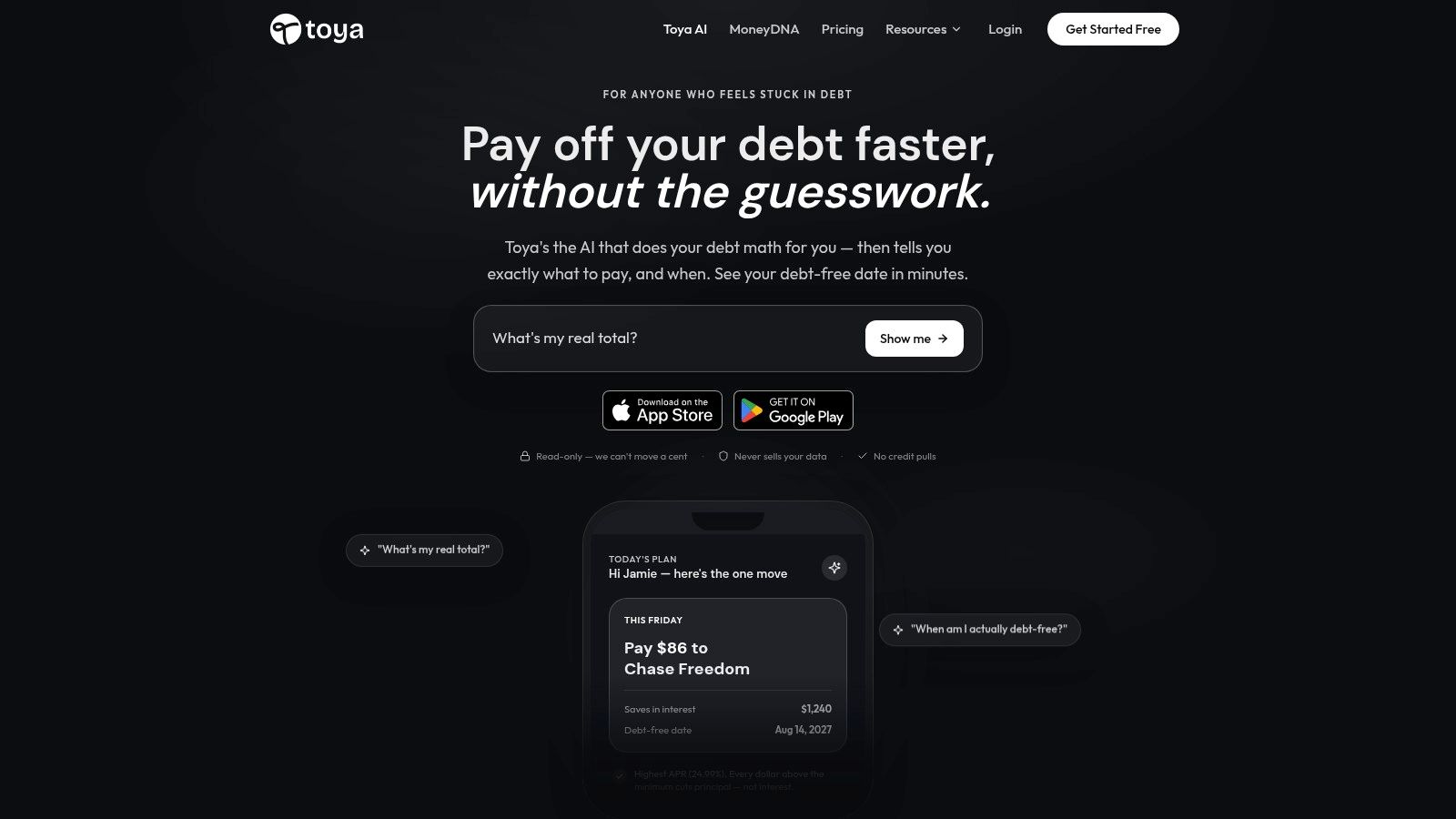
A debt-management tool can centralize balances, APRs, utilization, and due dates. Toya AI uses those inputs to calculate payment strategies and show how a next payment can change monthly interest, total cost, and the debt-free date. It can also update the plan as balances and cash flow change.
The video below provides another practical way to think about APR-driven payoff choices.
A workable weekly routine is straightforward:
- Record every APR: Separate purchase, transfer, and cash-advance rates.
- List every minimum: Missing one payment can disrupt the entire plan.
- Rank the balances: Put the highest APR first when directing extra funds.
- Test the payoff date: Compare a lower-rate transfer with the ongoing APR and all fees.
- Review after each statement: Update balances and check whether the planned order still makes sense.
Putting It All Together for Your Situation
A good APR is the lowest rate a borrower can realistically qualify for, compared with current pricing for a similar account and judged against the borrower's repayment behavior. For a borrower carrying a balance, the 24.22% large-bank purchase average and the 22.15% accounts-assessed-interest average provide useful 2026 reference points, but neither figure replaces the APR assigned to the individual account.
Three actions can turn the benchmark into a decision:
- Pull the current APRs and balances from every statement, including separate rates for transfers and cash advances.
- Compare each purchase APR with the 2026 reference points, then calculate the simple annual interest on the actual balance.
- Request a reduction or create a payoff order, starting with the highest-APR balance while keeping every other account current.
A cardholder who pays in full may prioritize fees and benefits. A cardholder who carries debt should treat the APR as a direct cost and connect every payment to a target payoff date.
Toya AI can centralize credit-card balances, APRs, utilization, and due dates, then model how different payment choices affect interest and the debt-free date. Visit Toya AI to organize the numbers and create a payoff plan based on the rates that apply.
Ready to start your debt-free journey?
Toya AI builds a personalized payoff plan so you can see your debt-free date and save on interest.
Get Started Free