
What Are Fixed Expenses and Why Budgets Start There
In 2024, U.S. consumer units spent an average of $78,535 a year, or about $6,545 a month, with housing taking roughly a third of that total. Fixed expenses are recurring costs that stay relatively stable for a set period, such as rent, insurance, and scheduled loan payments. They're predictable, but not permanent: the amount is committed for the current budget period, not guaranteed to stay the same forever.
That distinction matters when deciding whether a paycheck has room for extra debt payments. A bill can be scheduled and easy to forecast, yet still leave too little flexibility if income falls or the bill changes at renewal. The useful question isn't just which expenses are fixed. It's how much of take-home pay they claim before the month's less predictable costs arrive.
Table of Contents
- What Fixed Expenses Commit You to Each Month
- Sort Every Bill and Forecast the Ones That Move
- A Worked Budget From Paycheck to Leftover Cash
- How Much Fixed Cost Your Paycheck Can Carry
- What Fixed Bills Leave for Extra Debt Payments
- Check the Ratio Before You Raise a Payment
What Fixed Expenses Commit You to Each Month
The U.S. Bureau of Labor Statistics' 2024 Consumer Expenditures report puts average annual consumer spending at $78,535, or about $6,545 a month. Housing accounted for $26,266 a year, equal to 33.4% of spending or about $2,189 a month. Transportation added $13,318 a year, or 17.0%. Together, the two categories represented more than half of average household spending, before anyone sorts through the details of groceries or entertainment.
A fixed expense is a recurring cost that remains relatively stable over a defined period, even if consumption or income dips that month. Typical examples are rent or mortgage payments, insurance premiums, subscription contracts, and scheduled loan payments. A household can usually identify the amount and due date in advance, which makes these bills the starting point for monthly cash-flow planning.
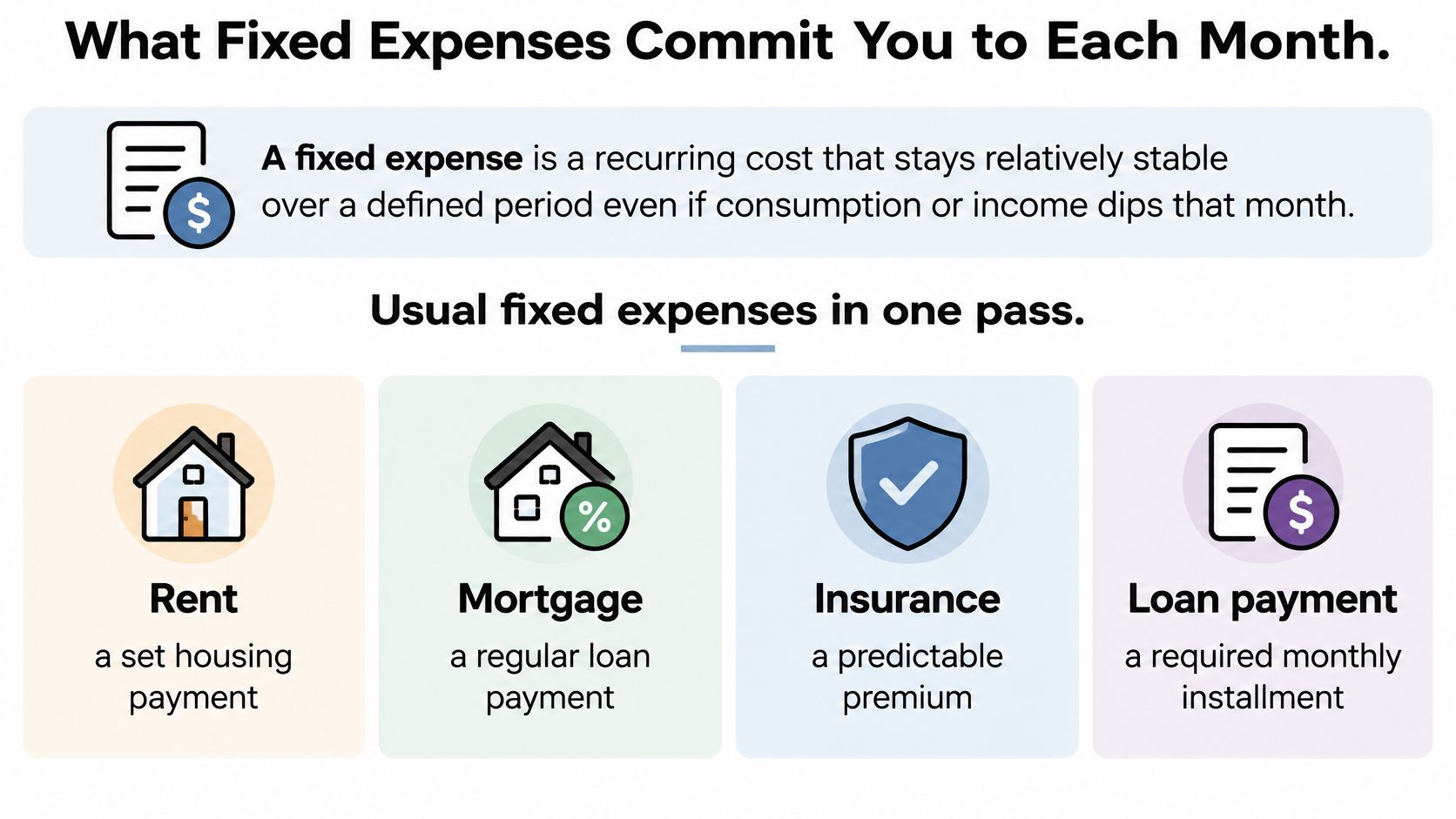
That predictability doesn't mean the bill is unchangeable. Housing spending rose 3.3% from 2023 to 2024; spending on owned dwellings rose 7.0%, while spending on rented dwellings rose 5.4%, according to the same BLS report. A lease, mortgage rate, insurance premium, or subscription contract can reset. The cost is “fixed” because it's committed or difficult to adjust quickly within the current budget period, not because it can never change.
A theater may owe rent whether or not the show sells out. A household faces a similar commitment when its income dips: rent and required loan payments still come due, even when there's less cash to cover them. Restaurant meals, by contrast, can often be reduced this week.
The key is to classify bills accurately, build a paycheck budget, calculate the fixed-cost share of take-home pay, and test that share before calling any remaining money extra debt-payoff cash.
Sort Every Bill and Forecast the Ones That Move
Consider a household paying $1,500 in rent, $2,100 on a fixed-rate mortgage, and $180 for insurance. Those commitments total $3,780 before groceries, utilities, or entertainment. The Federal Reserve budgeting guidance described in Prudential's budgeting overview separates predictable bills like these from variable expenses such as groceries, gasoline, restaurants, and entertainment.
Two questions help sort the rest: Does cash leave on a set schedule? Does the amount stay put within that schedule? A recurring bill doesn't automatically qualify as fixed. Timing and amount behavior are separate clues.
| Category | Typical bills | Amount behavior | Budget treatment |
|---|---|---|---|
| Fixed | Rent, fixed-rate mortgage, level insurance premium, student-loan minimum, phone plan | Same each due date | Enter the known amount first |
| Semi-fixed until renewal | Rent at lease end, insurance at renewal, subscriptions | Stable until the contract resets | Forecast the current amount and note the end date |
| Recurring but variable | Electricity, gas, water, groceries, gasoline | Changes with use | Average the last 12 months and hold a high-month reserve |
| Periodic, not monthly | Auto insurance every six months, property tax | Lump sum on a schedule | Divide into a monthly sinking fund |
| Discretionary variable | Restaurants, shopping, entertainment | Chosen each month | Spend only after commitments, buffers, and savings |
The first row is the easiest: if a bill is due on a known schedule and its amount stays the same each time, enter that amount before planning flexible spending. A rent payment or student-loan minimum fits this pattern. A phone plan may fit too, as long as the contract and charges remain stable.
Semi-fixed costs behave like fixed expenses until a decision point. Rent may stay steady during a lease and change at renewal; an insurance premium may remain level until the next policy period. Record the current amount, but also write down the renewal date so the budget doesn't treat today's figure as permanent.
Utilities are a common source of confusion. The Federal Reserve's budgeting lesson treats utilities as variable unless the household uses a level-payment arrangement. Electricity might cost $140 in summer and $220 in winter: it arrives regularly, but the amount changes with use. In 2024, U.S. consumer units spent an average of $4,736 annually on utilities, fuels, and public services, according to the Bureau of Labor Statistics figures published by FRED.
A bill paid every six months is different again. It may be predictable in total and timing, but it isn't a monthly payment. A $1,200 annual premium calls for a $100 monthly sinking-fund contribution, so the cash is ready when the bill comes due.
Forecast bills that change
Three simple rules keep the budget realistic:
- Respect contract dates: Keep the current amount in the budget until the contract or policy ends, then forecast the renewal rather than assuming the old price will continue.
- Convert infrequent bills: Divide a bill paid less often than monthly by the number of months it covers, and set that amount aside each month.
- Use a seasonal reserve: Review the previous 12 months of statements, average the monthly cost, and reserve extra cash for high-cost months.
For a cleaner bill list, reconciling individual statement entries can help match each transaction to the right category instead of leaving several different charges under a vague “bills” label. A cash-flow forecasting app can also help make upcoming payments and less predictable costs visible together.
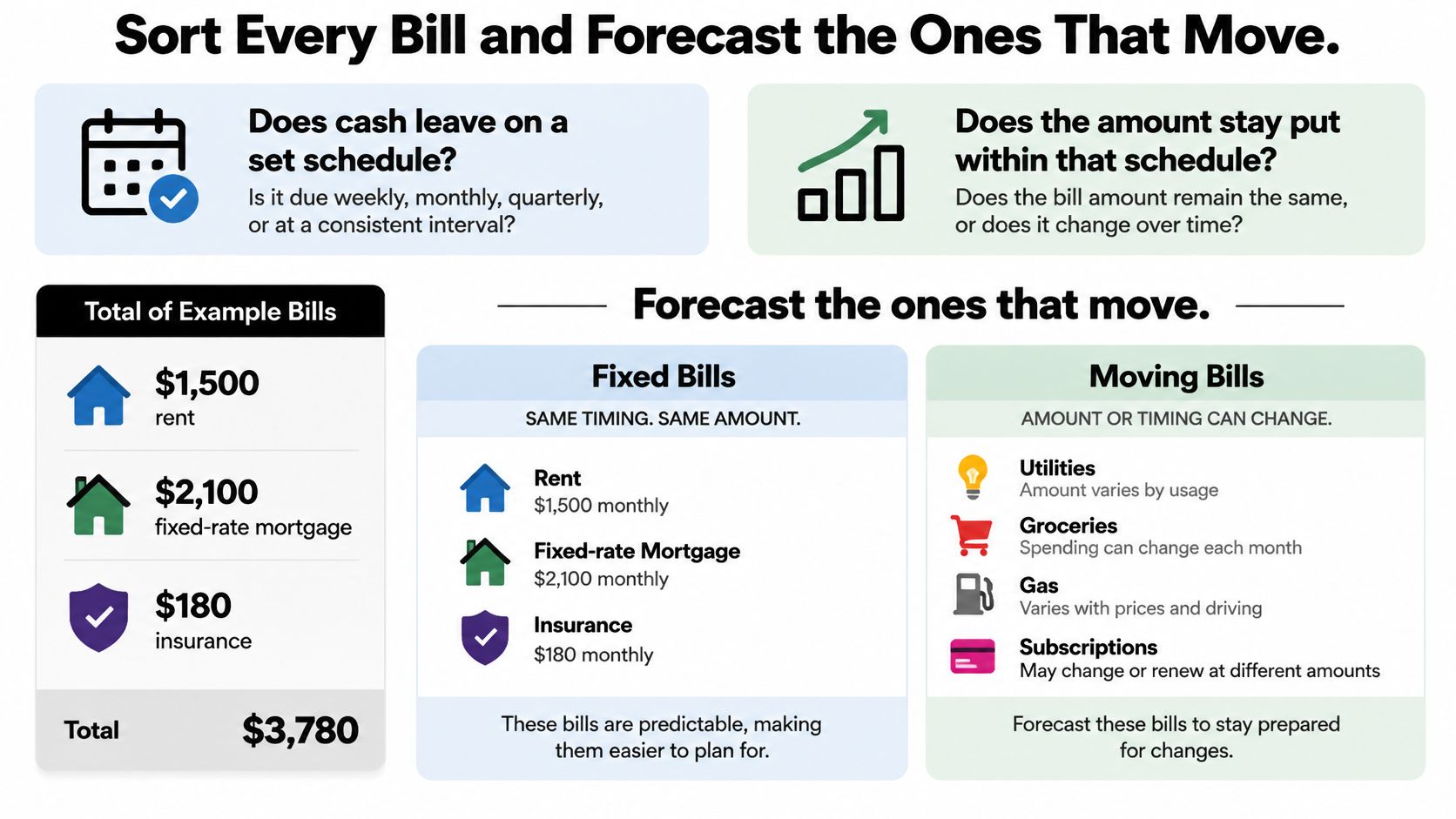
Before totaling expenses, assign each bill to one row in the table. That prevents a variable utility bill or a once-a-year premium from disappearing inside a fixed-cost total.
A Worked Budget From Paycheck to Leftover Cash
Start with take-home pay, not gross salary. Say one earner brings home $4,500 a month and lists scheduled commitments in order: $1,400 rent, $450 for car and student-loan payments, $180 insurance, $120 for phone and internet, and $300 childcare. The total is $2,450, leaving $2,050 for food, utilities, variable transportation, savings, and any extra debt payment.
The Consumer Financial Protection Bureau's monthly-budget worksheet keeps categories such as housing, utilities, groceries, health expenses, transportation, education and childcare, cell phone, internet and cable, pets, and debt payments separate. That detail makes it easier to see which obligations are contractual and which costs still need estimating.
| Line | Monthly amount | Class | Running total of commitments |
|---|---|---|---|
| Take-home pay | $4,500 | Income | $0 |
| Rent | $1,400 | Fixed | $1,400 |
| Car and student-loan minimums | $450 | Fixed | $1,850 |
| Insurance | $180 | Fixed | $2,030 |
| Phone and internet | $120 | Fixed or contract | $2,150 |
| Childcare | $300 | Scheduled | $2,450 |
| Left for food, utilities, variable transport, savings, extra debt | $2,050 | Not yet committed | $2,450 |
The running total shows why minimum debt payments belong beside rent and insurance. The due date doesn't depend on whether the borrower wants to make an extra payment. If the minimum is hidden in a broad “bills” category, the amount available for other needs can look larger than it is.
Use one rule for the full budget: list every expense, total it, and subtract that total from income. If the result is negative, the month is already short. Faster debt repayment should wait until a commitment is cut, refinanced, or supported by more income.
A positive result still isn't all free cash. The sample's $2,050 must also cover flexible essentials, the reserve for high-utility months, and money set aside for bills that come at renewal or less often than monthly. Only what remains after those needs is a candidate for extra principal.
Replace each sample amount with figures from actual statements, then circle only the leftover that isn't already assigned.
How Much Fixed Cost Your Paycheck Can Carry
Fixed-expense ratio = monthly fixed expenses ÷ monthly take-home pay. In the sample budget, $2,450 ÷ $4,500 is about 54%. That leaves $2,050 before food, utilities, variable transportation, and savings. A higher fixed-cost share means less room to handle an unexpected expense or a drop in income.
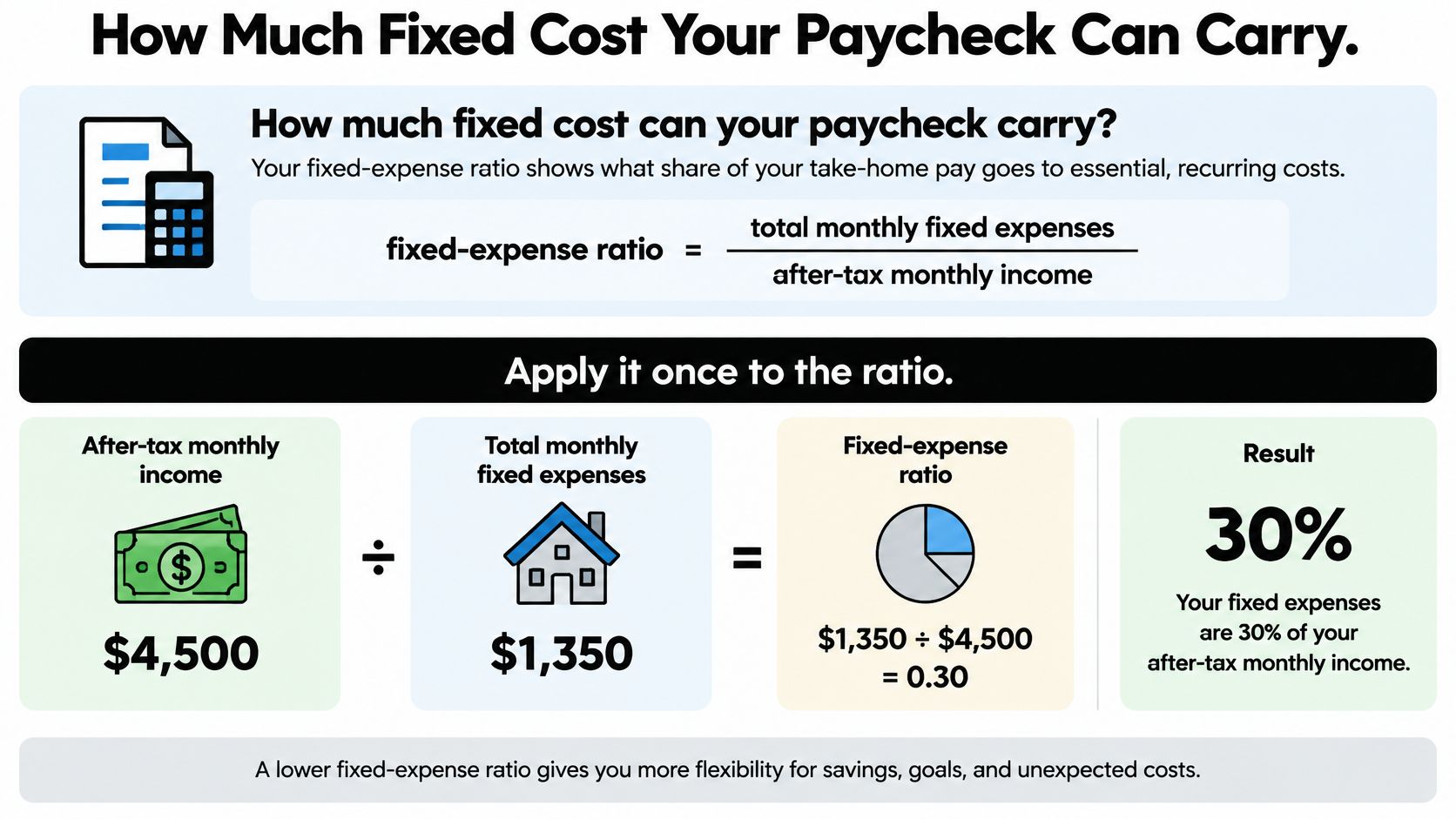
Use these bands as practical planning rules of thumb, not guarantees. A fixed bill is committed for the budget period, but it is not necessarily permanent or the same amount every month. Stress-test the share against your take-home pay before treating any surplus as available for extra debt payments.
| Result | What it means | Next move |
|---|---|---|
| Under 50% of take-home | More room remains after commitments | Fund buffers, then consider extra payments on high-interest debt |
| 50% to 65% | Less room for unexpected costs | Avoid adding contracts unless you cut another commitment |
| Above 65% | Limited cash-flow flexibility | Review cancelable contracts or bills that may be reduced at renewal |
| Income down 10% still covers every minimum | Required payments remain covered in this test | Check that reserves and other needs are covered before scheduling extra payments |
| Income down 10% means a minimum is missed | The budget is vulnerable to an income dip | Build cash or reduce a fixed bill before paying extra |
Some commitments are harder to change quickly than others. Rent and car payments may be difficult to reduce, while a cancelable gym contract or premium streaming bundle may be easier to drop. Separating essential commitments from discretionary fixed costs helps show which bills offer room to adjust.
Test the budget with take-home pay lowered by 10%. Then check whether one missed paycheck would leave a housing or loan payment unfunded. A budget that works only when every paycheck arrives on time has little room for a disruption.
A predictable bill can still be unaffordable. If fixed costs leave too little flexibility, consider reducing a commitment or holding more cash before raising a debt payment. A 50/30/20 budget calculator offers another way to examine how take-home pay is divided.
What Fixed Bills Leave for Extra Debt Payments
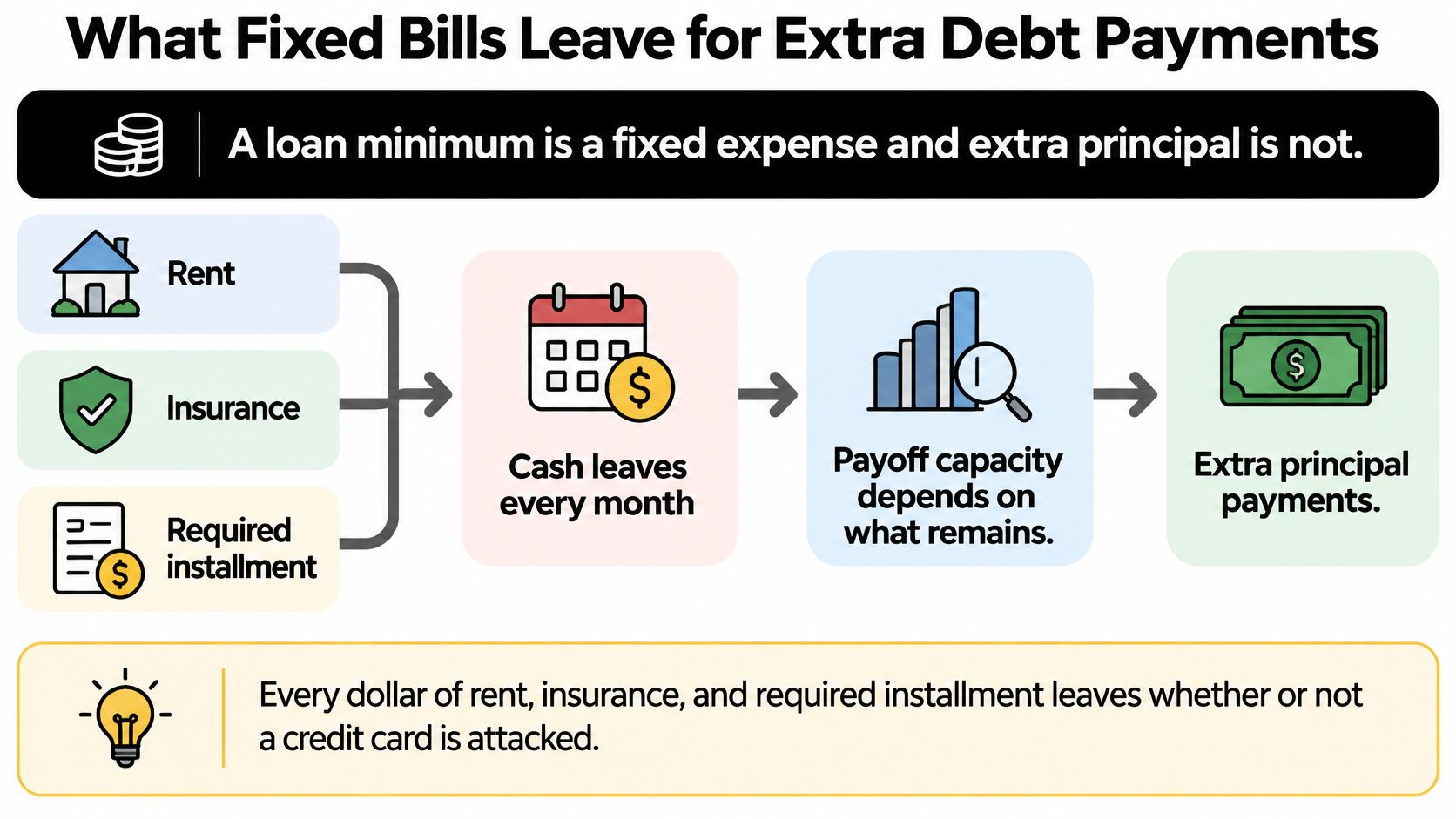
A loan minimum is a fixed expense; extra principal isn't. Rent, insurance, and required installments leave the account whether or not someone makes an additional credit-card payment. So payoff capacity is the amount left after minimums, the renewal buffer, and the reserve for high-cost utility months.
Use this order:
- List every contractual minimum due this month. Include each card, auto loan, student loan, personal loan, or other account with a required payment.
- Subtract minimums and buffers from take-home pay. Keep renewal savings and high-month utility money in the budget instead of counting them as available for debt.
- Run the income-dip test. Use the stress test from the ratio analysis to check whether all required payments remain covered if income falls.
- Send the true surplus to the highest-rate balance. Concentrating extra principal on one balance makes the payoff choice clear.
- Pay every other account only its minimum. This protects the scheduled commitments while limiting extra cash to the selected target.
In the sample, $2,050 remains after $2,450 of scheduled commitments on $4,500 take-home pay. That remainder still has to cover food, utilities, variable transportation, savings, and reserves before any extra principal is safe. The exact surplus may therefore be much smaller than the first subtraction suggests.
Paying off a loan can make a bigger difference to future flexibility than trimming one grocery purchase. Once a car loan is gone, its required monthly installment no longer claims space in each budget period. That creates room automatically, while a small cut in a flexible category has to be repeated.
Don't raid rent money or skip a minimum to make an extra payment. A missed housing or loan payment creates a more urgent problem than a slower payoff. If the income-dip test shows that a minimum would be missed, the apparent surplus isn't real yet.
For a structured payoff sequence, a debt payoff plan can help organize which balance receives extra cash while the other accounts stay current. Before committing, write down three numbers: total minimums due this month, true surplus after buffers, and the single balance that will receive the extra payment.
Check the Ratio Before You Raise a Payment
Write down the fixed-expense ratio before choosing a payoff tactic. Add the fixed and periodic bills, divide by take-home pay, then compare the result with the decision bands. The figure needs to reflect costs that are due, not just the recurring bills that happen to arrive this month.
If the ratio is under 65% and every minimum still clears after an income dip, schedule one extra payment to the highest-rate balance. Keep every other account at its minimum. If the ratio is higher, hold off on raising the payment: cancel a discretionary contract, shop the next renewal, or finish funding the sinking fund first.
Change only one extra-payment amount at a time. Track the resulting debt-free date and interest saved so the impact is visible before the next budget review. Toya AI can be an optional second step after the paper calculation: it shows which debt to pay extra on, how much interest that saves, and the debt-free date based on current payments.
Tonight's action is simple: list the fixed bills, calculate the ratio, and only then decide whether an extra payment is safe.
Toya AI shows which debt to pay extra on, how much interest that saves, and the debt-free date based on current payments. Once the fixed-cost ratio and buffers are clear, visit Toya AI to see how a payoff plan could fit the cash that's available.
Ready to start your debt-free journey?
Toya AI builds a personalized payoff plan so you can see your debt-free date and save on interest.
Get Started Free