
Student Loans Terms Explained: Glossary with Examples
A graduate opens a first loan statement expecting one balance and one payment, then finds several loans, different rates, accrued interest, and words like capitalization and forbearance. None of those words is decorative. Each one changes how much is owed, when payment is due, and whether extra money reduces principal. Understanding student loans terms in dollar terms makes the next decision clearer, whether that decision is paying interest during a grace period, choosing a repayment plan, or deciding which loan deserves an extra payment first.
Table of Contents
- Core Student Loan Terms at a Glance
- Interest Rates by Loan Type and Disbursement Year
- How Interest Starts Accruing and When Grace Periods Apply
- Deferment, Forbearance and Their Interest Effects Compared
- How Capitalization Turns Interest Into Principal
- Repayment Plan Terms That Set Your Payment Length
- Servicers, Delinquency and Credit Reporting Terms
- How Student Loan Terms Differ Outside the U.S.
- Check Your Loan Terms Before Choosing a Payoff Order
Core Student Loan Terms at a Glance
Borrowers meet the same core terms repeatedly, but statements rarely explain what each term costs. The table below works as a lookup. A borrower can scan the Term column for a word on a statement, read the plain meaning, then check the payoff consequence before making a change.
| Term | Plain meaning | Why it changes your payoff |
|---|---|---|
| Grace period | Window after leaving school before regular payments are due, six months for most federal loans | Interest may accrue on unsubsidized loans during it |
| Interest accrual | Interest added daily to the principal balance | Drives total cost even when payments are small |
| Subsidized loan | Government pays interest during school and the grace period | Lower cost than an unsubsidized loan of the same size |
| Unsubsidized loan | Borrower is responsible for all interest from disbursement | Interest builds from the first disbursement date |
| Capitalization | Unpaid interest is added to principal | Future interest is charged on the larger balance |
| Deferment | Approved pause in required payments | Interest on unsubsidized loans may still build |
| Forbearance | Temporary pause or reduction in payments, up to 12 months | Interest continues to accrue on all loans |
| Servicer | Company that bills the borrower, applies payments and processes plan changes | The contact for confirming how terms apply to an account |
| Fixed rate | Interest rate that stays the same for the life of the loan | Cost is set by loan type and disbursement year |
| Income-driven repayment | Payment based on income and family size | Payment can be lower than accrued interest, leaving unpaid interest |
Reading the Table Against a Real Statement
Small numbers explain why definitions matter. For example, a $20,000 unsubsidized loan at 6% accrues about $100 in interest in one month before payments are considered. A borrower who treats the grace period as a cost-free pause could therefore start repayment owing more than expected.
A subsidized loan behaves differently during the same window because the government pays qualifying interest. Two loans with the same original balance can enter repayment at different amounts for that reason alone. Borrowers should not combine them mentally into one average loan.
Keep the glossary beside each statement and circle every term that appears on an actual account. A term that does not appear on any loan does not need an immediate decision.
Three habits prevent common confusion:
- Separate every loan: Record the type, balance, rate, and servicer for each account rather than relying on one combined total.
- Separate principal from accrued interest: The payoff amount can include both, but future daily interest is calculated from principal.
- Confirm pause rules in writing: Deferment and forbearance do not treat interest the same way, and capitalization rules differ by loan type and program.
The practical point is simple. A definition is useful only when a borrower can connect it to a balance, a date, or a payment. Marking the relevant terms first turns an unfamiliar statement into a short list of questions for the servicer.
Interest Rates by Loan Type and Disbursement Year
Two borrowers can graduate from the same college with the same balance and still pay different amounts of interest every month. The reason is often the disbursement year. Federal rates are set by formula once a year: loan type and the July disbursement window do the deciding, and the resulting rate stays fixed for the life of that loan. Students still comparing aid packages can use guidance on interpreting your college financial aid offer to separate grants from loans before accepting money that will accrue interest.
| Loan type | Rate, disbursed 2025–26 | Rate, disbursed 2026–27 | Maximum rate allowed by law |
|---|---|---|---|
| Undergraduate Direct Subsidized and Direct Unsubsidized | 6.39% | 6.52% | 8.25% |
| Graduate or professional Direct Unsubsidized | 7.94% | 8.07% | 9.50% |
| Direct PLUS | 8.94% | 9.07% | 10.50% |
The Federal Student Aid interest rate page lists 6.39% for undergraduate Direct Subsidized and Direct Unsubsidized Loans, 7.94% for graduate or professional Direct Unsubsidized Loans, and 8.94% for Direct PLUS Loans first disbursed between July 1, 2025, and June 30, 2026. The same page shows how quickly the undergraduate rate has moved: 2.75% in 2020–21, 3.73% in 2021–22, 4.99% in 2022–23, 5.50% in 2023–24, and 6.53% in 2024–25.
Why the Disbursement Year Follows the Borrower
For the 2026–27 award year, the Federal Student Aid rate announcement for loans first disbursed on or after July 1, 2026 sets 6.52% for undergraduate Direct Subsidized and Direct Unsubsidized Loans, 8.07% for graduate or professional Direct Unsubsidized Loans, and 9.07% for Direct PLUS Loans. The maximum rates for these loan types, 8.25%, 9.50%, and 10.50% respectively, limit how high any future year's rate can go.
The difference lands in dollars. On a $10,000 undergraduate balance, one year of simple interest runs about $275 at the 2020–21 rate of 2.75%, about $639 at 6.39%, and about $652 at 6.52%, before payments or capitalization are considered. The same principal inside a Direct PLUS Loan at 9.07% produces about $907. Same balance, different disbursement window: that is the whole point of the table.
Loans first disbursed before July 1, 2006 generally carried variable rates that could reset each year. A long-held loan can therefore change its payment math when the rate resets, which surprises borrowers who assumed every federal rate was fixed.
Each rate appears on the servicer account page and the federal loan dashboard. Once every loan's minimum payment is current, extra money generally reduces future interest fastest on the highest-rate balance. A deeper explanation of student loan interest rates by loan and year can help borrowers compare older and newer loans without averaging away the expensive one.
How Interest Starts Accruing and When Grace Periods Apply
Interest accrual sounds slow until it's converted into a daily amount. The timeline below shows how disbursement, grace, and daily interest fit together.
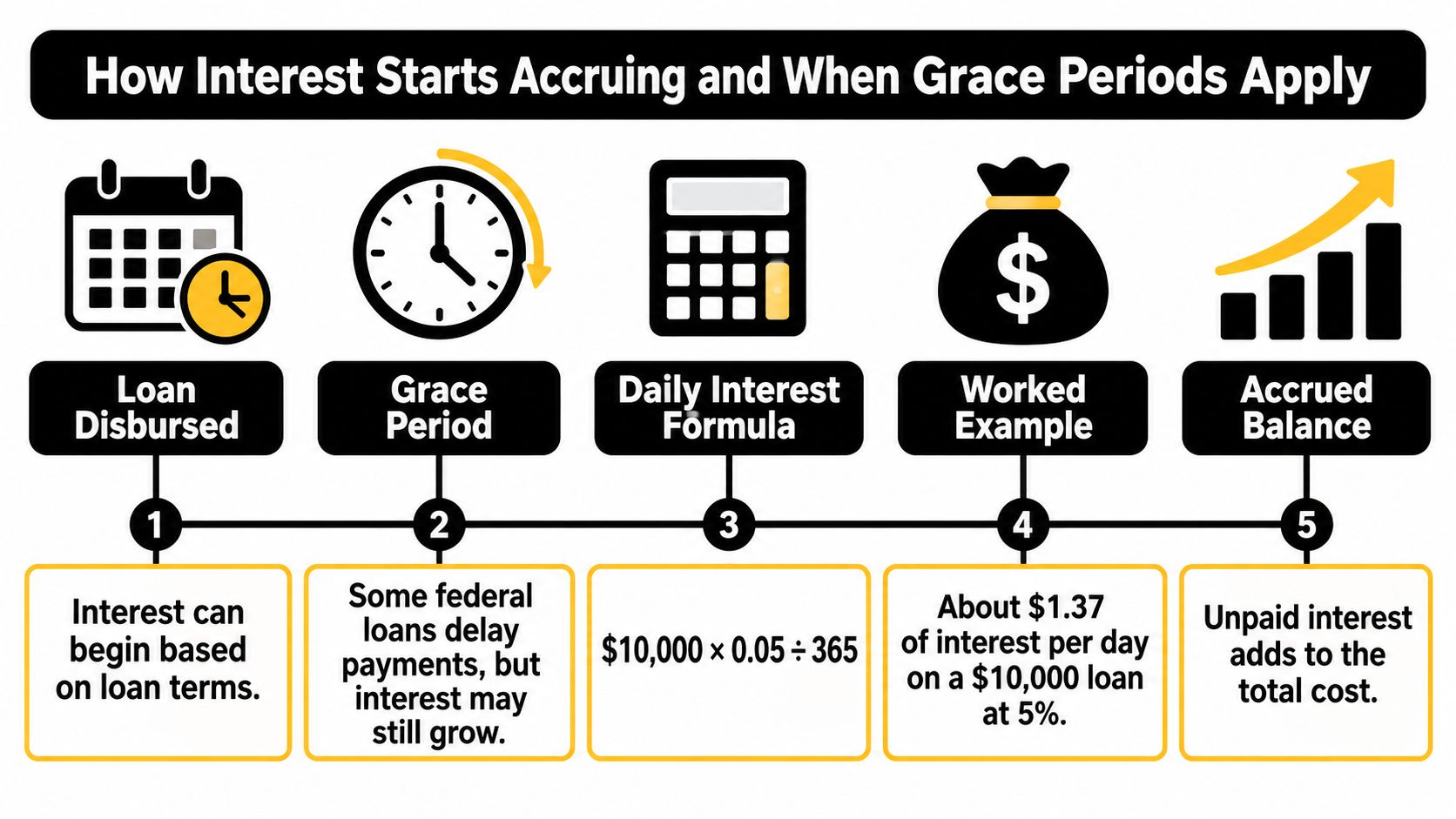
The EdFinancial federal loan FAQ page describes federal interest using a simple daily-interest method, calculated as principal balance × annual interest rate ÷ 365. For example, a $10,000 balance at 6.52% accrues about $1.79 per day. At a 5% rate, the same formula is $10,000 × 0.05 ÷ 365, or about $1.37 per day.
Who Pays Interest Before Repayment Starts
Loan type decides who carries that daily cost. Borrowers generally aren't responsible for interest accruing during in-school periods on subsidized loans. Unsubsidized and PLUS loans accrue borrower-responsible interest during school and other eligible pauses.
The Federal Student Aid repayment page explains that Federal Direct Subsidized, Direct Unsubsidized, and Federal Family Education Loans generally provide a six-month grace period after leaving school, during which regular payments are not required. The government pays interest on qualifying subsidized loans during that period, while interest generally accrues on unsubsidized loans.
A graduate with a $20,000 unsubsidized loan at 6% could accrue about $600 during six months before regular repayment begins. No bill may be due during those months, but the amount owed still grows. That unpaid interest may increase the balance or affect the payment structure once repayment starts.
The video below reinforces the sequence from disbursement to first due date.
A Three-Step Check Before the First Bill
- Confirm loan type: Mark each account as subsidized, unsubsidized, or PLUS.
- Find the grace period end date: Record the exact date for every loan, because loans disbursed at different times can leave grace at different times.
- Ask how accrued interest will be handled: The servicer should confirm whether it will be paid, billed, or capitalized.
Borrowers also need the actual due date, not just the month repayment begins. Guidance on student loan payment dates and first bills helps connect grace period end dates to real payment schedules. Estimating interest from a monthly statement balance can mislead, because each loan has its own disbursement date, subsidy status, principal, and rate.
Deferment, Forbearance and Their Interest Effects Compared
A pause can protect a borrower from a missed payment, but pauses don't all pause interest. The decisive question is who pays interest while required payments stop.
| Option | Payments during pause | Interest during pause | Capitalization risk |
|---|---|---|---|
| Deferment on subsidized federal loan | Paused | Paid by the government | Generally none for subsidized loans |
| Deferment on unsubsidized federal loan | Paused | Accrues on the borrower | Can capitalize when the deferment ends |
| Forbearance on any federal loan, up to 12 months | Paused or reduced | Accrues on all loans | Can capitalize; confirm terms in writing |
| Income-driven plan with payment below interest | Reduced | Unpaid interest accrues | Can capitalize if the borrower leaves the plan or no longer qualifies |
| Grace period on unsubsidized loan | Not required | Accrues on the borrower | Ask the servicer whether accrued interest capitalizes before the first bill |
The Cost of a 12-Month Forbearance
The Consumer Financial Protection Bureau student loan repayment tool explains that during forbearance, payments may be paused or reduced for up to 12 months, but interest continues to accrue on all loans, including federal subsidized loans. A borrower with a $30,000 balance at 6% who makes no interest payments during a 12-month forbearance could accrue roughly $1,800 in interest.
If the servicer capitalizes that amount, repayment could restart at approximately $31,800. Paying monthly interest of about $150 in that example prevents the balance from growing during the pause, even though it does not reduce the original principal.
Deferment can be cheaper for a subsidized borrower because the government covers qualifying interest. For an unsubsidized borrower, deferment stops the required payment but not borrower-responsible interest. The label matters less than the interest treatment attached to the specific loan.
Request rule: A pause is not fully understood until the servicer confirms the end date, interest treatment, and capitalization trigger in writing.
What to Ask Before Requesting a Pause
- Get the terms in writing: Ask for the start date, end date, and restart process.
- Ask about capitalization: Confirm whether interest capitalizes, and name the exact event that triggers it.
- Ask about credit reporting: An approved pause and a delinquency are different events.
- Pay monthly interest if possible: Interest-only payments can stop balance growth when full payments aren't possible.
For a temporary income drop, an approved pause with interest payments may be a bridge. For a lasting income drop, a repayment plan tied to income may fit better than repeated forbearance, because repeated pauses can leave a larger balance without solving the monthly payment problem.
How Capitalization Turns Interest Into Principal
Capitalization is the moment unpaid interest stops being a separate amount and becomes principal. The photo below captures the point where many borrowers first compare statements and notice that principal is higher than the amount originally borrowed.

The Consumer Financial Protection Bureau explanation of interest during school uses a $5,000 loan at a 10% annual rate to show the effect. A 12-month academic program produces $500 of interest, and a six-month grace period produces another $250, for $750 total accrued interest.
If that $750 capitalizes, the balance becomes $5,750. At 10%, the next year's interest would therefore be approximately $575 rather than $500. The borrower is not just paying interest later. The borrower is paying interest on earlier interest.
Common Capitalization Triggers
- End of deferment on an unsubsidized federal loan: Accrued interest can be added to principal when repayment resumes.
- Leaving an income-based repayment plan: Capitalization can occur when a borrower leaves the plan or no longer qualifies.
- End of a private-loan pause: Capitalization commonly occurs when private-loan grace, deferment, or forbearance ends.
Rules vary by loan type and program. A payoff plan should not assume every pause capitalizes on the same date or for the same reason. The servicer should name the trigger for each loan before a borrower approves a change.
Fields to Track for Every Loan
Borrowers need four separate fields, not one balance:
- Principal: The amount on which daily interest is currently calculated.
- Accrued unpaid interest: Interest owed but not yet added to principal.
- Capitalization trigger and date: The event that could merge unpaid interest into principal.
- Qualifying repayment months: The count that may matter for long-term repayment or forgiveness timing.
A quick statement test can reveal whether capitalization already happened. Compare principal before and after the most recent pause. If principal rose by roughly the interest that accrued during that pause, capitalization has likely occurred. Paying accrued interest before a known trigger can prevent that increase, so timing matters as much as payment size.
Repayment Plan Terms That Set Your Payment Length
Repayment plan names tell a borrower two things: how long the debt can remain open and how the monthly bill is calculated. A lower payment can feel safer, yet the longer clock often does more damage than the rate because interest has more years to run.
| Plan | Payment pattern | Typical term | Best fit |
|---|---|---|---|
| Standard | Fixed monthly payment | 10 years | Steady income and the fastest payoff |
| Graduated | Starts low and rises in steps | 10 years | Income expected to grow over time |
| Extended | Fixed or graduated payments | Up to 25 years | Large balances that need a lower monthly payment |
| Income-driven repayment | Based on income and family size | 20 to 25 years before any forgiveness | Low income or high debt relative to income |
A $30,000 Comparison
A $30,000 balance at 6% shows the trade clearly. On a 10-year standard plan, the payment is about $333 per month and total interest is roughly $10,000. Stretch the same balance to a 25-year extended plan and the payment drops to about $193 per month, while total interest rises to roughly $28,000.
The monthly bill falls by about $140. Total interest nearly triples.
That trade-off is sometimes necessary. A borrower with unstable income may need the lower required payment to stay current. The cost becomes a problem when the longer term is chosen by default and never revisited after income rises.
Income-driven repayment adds another term to watch, unpaid interest. If the income-based payment is lower than the interest accruing that month, the shortfall remains owed and can raise later cost if it is capitalized under that plan's rules. Outside the U.S. federal system, collection rules vary by country and program; a page explaining how learner loan repayments are collected offers a useful contrast before assuming every system uses the same servicer-bill model.
Checklist Before Requesting a Plan Change
- Payment share: The required payment should fit take-home pay without crowding out rent, food, insurance, and other minimums.
- Income direction: A graduated plan fits expected income growth less well if income is flat or seasonal.
- Forgiveness goal: A borrower pursuing long-term forgiveness evaluates extra payments differently from a borrower aiming for full payoff.
- Room for extra payments: A lower required payment helps only if freed cash is directed to principal when possible.
Borrowers comparing options can review repayment plan options for different budgets and then request the chosen change from the servicer in writing. The request should confirm the new payment, term, first due date, and treatment of any unpaid interest.
Servicers, Delinquency and Credit Reporting Terms
A payment sent on time can still post late if it goes to the wrong company. The company that bills the borrower, applies payments, and processes repayment plan or pause requests is the servicer. The lender may own the loan, but the servicer is usually the operational contact. That distinction matters when a payment posts late, a plan change stalls, or a pause needs written confirmation.
The Federal Reserve Bank of New York household debt release reported that outstanding U.S. student-loan debt reached $1.63 trillion in the first quarter of 2025, after increasing by $16 billion. In the same quarter, 7.74% of aggregate student debt was reported as 90 or more days delinquent, compared with less than 1% in the fourth quarter of 2024.
Why Delinquency Can Appear Suddenly
That jump did not reflect only newly missed payments. Federal payment reporting to the credit bureaus had been paused for an extended period, and older missed payments began appearing on credit reports once reporting resumed. A borrower could therefore face a major credit consequence when a payment pause ends and delinquency reporting restarts, even though the interest rate and principal balance never changed.
Statement terms become credit terms here. Delinquent means a required payment is past due, and the "90 or more days" label in the figures above describes roughly three missed monthly payments on a standard schedule. An approved deferment or forbearance is different, because the servicer has agreed that the regular payment is paused or reduced for a set period. The dollar effect reaches beyond the loan itself: a reported delinquency can raise the rate offered on the next car loan or credit card, so one missed payment can cost money twice.
A borrower who expects trouble should contact the servicer before the due date, not after a missed payment has already been reported.
A Four-Step Servicer Routine
- List every servicer: Record the company name, phone number, account portal, and loans handled.
- Protect every due date: Use autopay or calendar reminders for each loan group.
- Call before missing a payment: Ask what options keep the account from becoming delinquent.
- Save written confirmation: Store approval notices for plan changes, pauses, payment instructions, and capitalization rules.
Borrowers should also ask whether an approved pause will be reported to credit bureaus and how it will be coded. The answer should be saved with the approval. Clear records turn a disputed due date or missing approval into a document check instead of a memory contest.
How Student Loan Terms Differ Outside the U.S.
Student loans terms are not globally interchangeable. A U.S. federal glossary explains U.S. federal loans, but another country's system may use an income threshold, tax collection, indexation, or a fixed repayment schedule instead.
The OECD Education at a Glance 2025 chapter on tertiary education finance identifies Australia, England, New Zealand, and the United States as examples of systems using income-contingent repayment, in which repayment begins or changes after borrowers reach an income threshold. It identifies Latvia and Lithuania as countries using fixed-term repayment structures, and fixed-repayment systems remain the majority among countries with available data.
The Income Threshold Trade-Off
An income-contingent system can require no payment during a low-income period. That protection helps during unemployment or parental leave, but the balance can remain economically expensive if interest or indexation continues. A fixed installment is more predictable, yet it offers less automatic protection when income falls.
Borrowers should therefore ask two questions together. First, when does repayment start or change? Second, what happens to the balance while no payment is required? A zero payment is not the same as a zero cost.
Terms to Check by Life Event
- Graduation: Check the income threshold, first collection date, and whether repayment runs through an employer, tax system, loan agency, or direct bill.
- Unemployment: Check whether payments stop automatically below the threshold or require an application.
- Moving countries: Check the loan currency, payment currency, overseas income reporting, and whether foreign income is reported automatically.
- Parental leave: Check whether leave income counts toward the threshold and whether interest or indexation continues.
- Income growth: Check whether higher income raises the payment, shortens the term, or both.
Migration creates the most confusion because residence, tax filing, currency, and collection may all change while the legal balance remains. A globally mobile graduate should identify which country's rules govern the loan before comparing it with U.S. examples. The same English word can describe different legal and collection rules in different systems.
Check Your Loan Terms Before Choosing a Payoff Order
Payoff order should come after the terms audit, not before it. A borrower who sends extra money without checking rates, grace dates, and capitalization triggers can easily target the wrong balance.
Five Checks Before Extra Payments
- List every loan: Record type, rate, disbursement date, principal, accrued interest, and servicer. Borrowers who are unsure which company should receive payment can use guidance to find out who owns your debt before sending money.
- Mark subsidized loans and ending grace periods: Interest treatment during the next few months may change the best first move.
- Confirm capitalization triggers: Ask whether an upcoming pause or plan exit will add unpaid interest to principal.
- Keep every minimum current: Extra payments should not create a delinquency on another loan.
- Target the highest rate: Direct extra money to the highest-rate loan after minimums are protected.
For example, with one loan at 6.52% and another at 6%, extra payments go to the 6.52% balance first while the other loan keeps its required minimum. The same logic applies when a smaller, higher-rate loan competes with a larger, lower-rate loan.
Tracking several loans by hand gets difficult when due dates and rates differ. Toya AI shows which debt to pay extra on and how much interest the user will save, and it calculates the user's debt-free date based on their current payments. To use Toya, users must have at least one valid credit card or loan account they want to manage. Borrowers should still use the glossary whenever a new statement arrives, because a changed term can change the payoff order.
Turn those checked rates, due dates, and capitalization triggers into a clear payoff order with Toya AI, which shows which debt to pay extra on, how much interest that choice can save, and the debt-free date based on current payments. Add at least one valid loan or credit card account to start, then use the plan each time a new statement changes the numbers.
Ready to start your debt-free journey?
Toya AI builds a personalized payoff plan so you can see your debt-free date and save on interest.
Get Started Free