
Student Loan Repayment Website: 10 Tools Compared for 2026
Two federal loans, a credit card balance, and an hour on a laptop. The borrower in that chair has one decision to make this week: switch repayment plans, or send the extra $150 to the card. Search results offer twenty websites and no ranking that says which one answers that question.
The difference matters, because the four answers don't overlap. A federal calculator tells you what the Department of Education will bill under each plan. A nonprofit counselor tells you whether you're on the right form and what deadline comes next. A refinance quote tells you what a private lender would charge to replace the loan entirely, which is not the same thing as a lower payment. A payoff planner tells you which balance to attack first once the federal question is settled.
Those are four different questions with four different risk profiles. Treating the tools as interchangeable is how borrowers refinance a federal loan they should have kept, or pay extra on a card while a student loan goes delinquent. Knowing what a tool cannot decide is more valuable than knowing what it can.
The ten entries below are sorted by the decision each one can make. Every one says where its numbers come from, whether they're official, and what happens if you act on them.
Table of Contents
- 1. Toya AI
- 2. Federal Student Aid, StudentAid.gov
- 3. Savi
- 4. Student Loan Planner
- 5. EDCAP, Education Debt Consumer Assistance Program
- 6. TISLA, The Institute of Student Loan Advisors
- 7. Undebt.it
- 8. Debt Payoff Planner
- 9. SoFi Student Loan Refinancing
- 10. Earnest Student Loan Refinancing
- How the 10 Student Loan Repayment Website Options Compare
- Match Your Next Step to the Right Tool
1. Toya AI
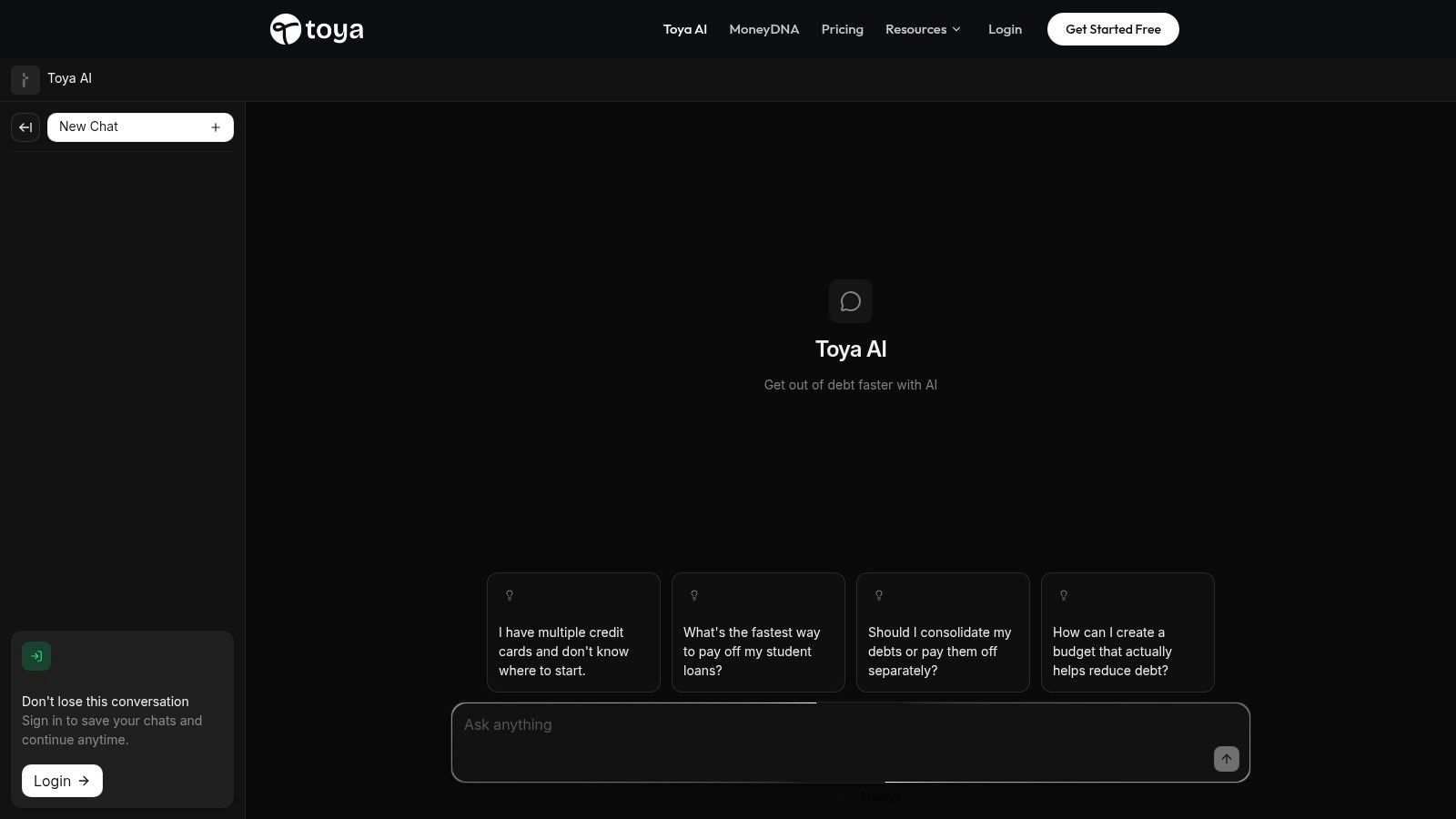
Toya AI targets the borrower in that opening scenario: the one whose problem isn't a single loan but a stack of them. It answers the question "what do I pay next, and what does that buy me" across credit cards, student loans, auto loans, personal loans, and mortgages.
What it actually decides
Connect accounts through partners such as Plaid and Spinwheel with read-only access, and balances, APRs, utilization, and due dates land in one dashboard. The AI weighs rates, timeline, and cash flow, then names the next payment and shows how that choice moves the debt-free date, monthly interest, and total repayment cost. A quick calculator returns a first estimate from three numbers before any account is linked.
Practical example: a $14,000 student loan at 5.5% and a $6,000 card at 24%. Avalanche math says card first, and Toya shows what that order does to the payoff date and to the interest paid, so the recommendation is a projection rather than an opinion.
Where it stops: Toya plans payoff. It doesn't determine federal plan eligibility, certify a qualifying PSLF payment, or file an application. Those answers come from StudentAid.gov and the servicer.
Free tracking covers unlimited accounts with one dashboard for balances, APRs, and due dates. Pro adds AI optimization; automated payments and rewards are described as upcoming rather than live. Data is encrypted, no credit pulls are made, and the stated policy is never to sell user data.
Pros:
- Broad debt coverage: cards, student loans, auto, personal, and mortgages in one plan.
- Impact per choice: payoff timing, monthly interest, and total cost move with the payment.
- Read-only connections through established data partners.
- Free tier plus a calculator for a fast estimate.
- Recommendations update as balances and income change.
Cons:
- Precise projections need account links, which means sharing financial data with data-linking providers.
- AI optimization sits behind Pro, and automated payments and rewards aren't live yet.
2. Federal Student Aid, StudentAid.gov
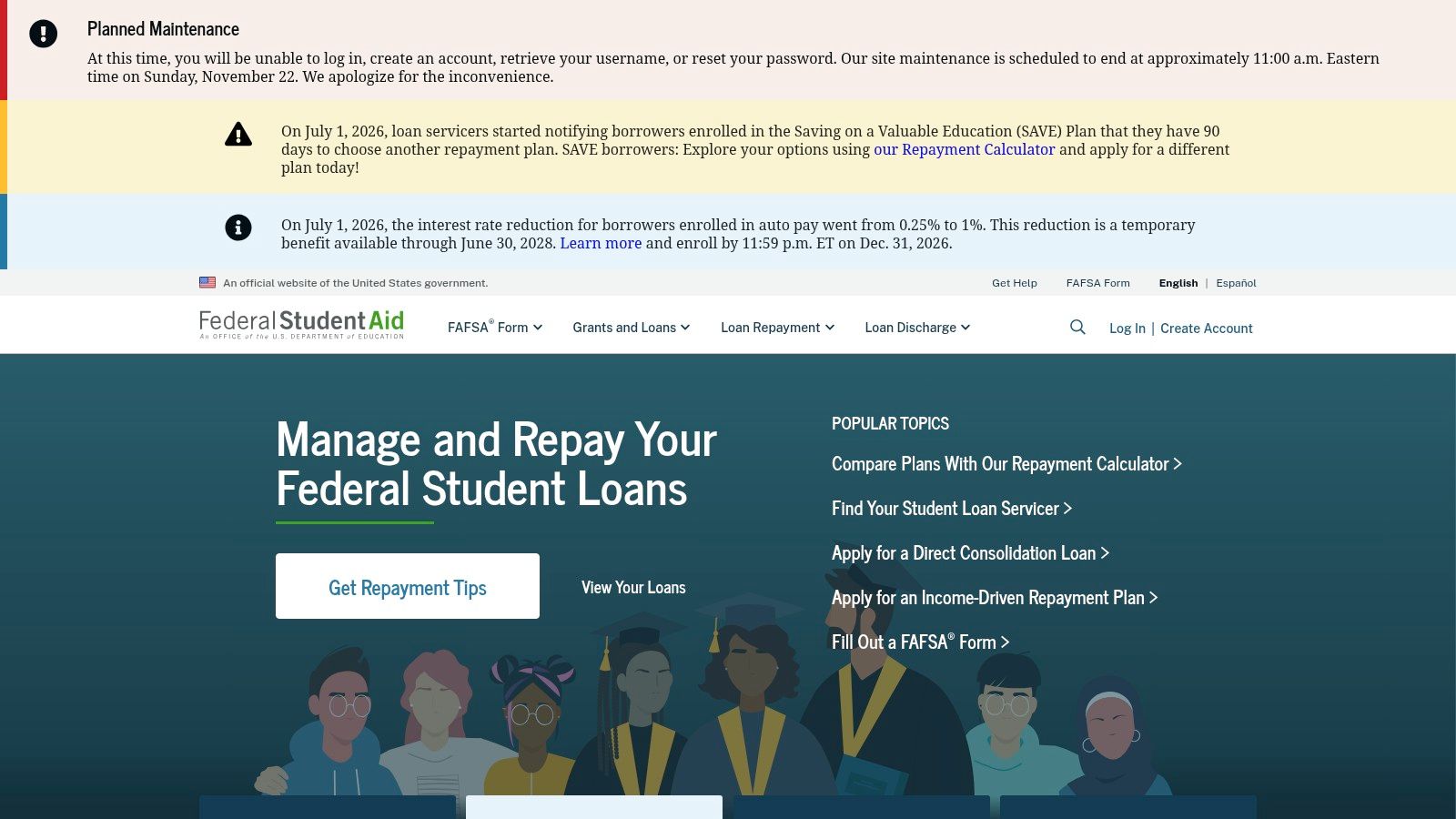
If your balance includes federal loans, StudentAid.gov is the place to check which repayment options your federal records show. It provides official guidance and account information; private loans and other debts fall outside its scope.
The Repayment Calculator compares eligible federal plans and estimates monthly payments, total cost, interest, payoff dates, and projected Public Service Loan Forgiveness (PSLF) discharge. Sign in to use loan records on file, or enter details manually. A scheduled payment of $0 can be part of an active repayment plan. Check your enrollment status and plan terms rather than treating the figure as cancellation or a data error.
Where the numbers stop being official
Federal Student Aid labels calculator results as estimates based on assumptions that may not match an individual borrower's file (Federal Student Aid's repayment calculator guidance). Treat the result as a comparison, not a final decision. Your servicer confirms the terms that apply to your account, and the information used in the estimate affects the comparison.
For example, compare IBR with the Standard plan using both monthly payment and total projected cost. A lower payment may come with a longer repayment period, so consider the monthly relief alongside the total paid.
For a step-by-step guide to working out student loan repayments, start with the servicer, identify the available plan, then check the first bill.
Pros:
- Official federal source for loan records, applications, and repayment guidance.
- Free to use, with account data after sign-in or manual entry.
- Side-by-side estimates of monthly payments, total cost, and payoff dates.
- PSLF projections included in the calculator.
Cons:
- Federal loans only. It does not model private loans or other debts.
- Estimates, not final determinations. The servicer confirms account terms.
- Manual entry may leave gaps if loan records do not load cleanly.
3. Savi
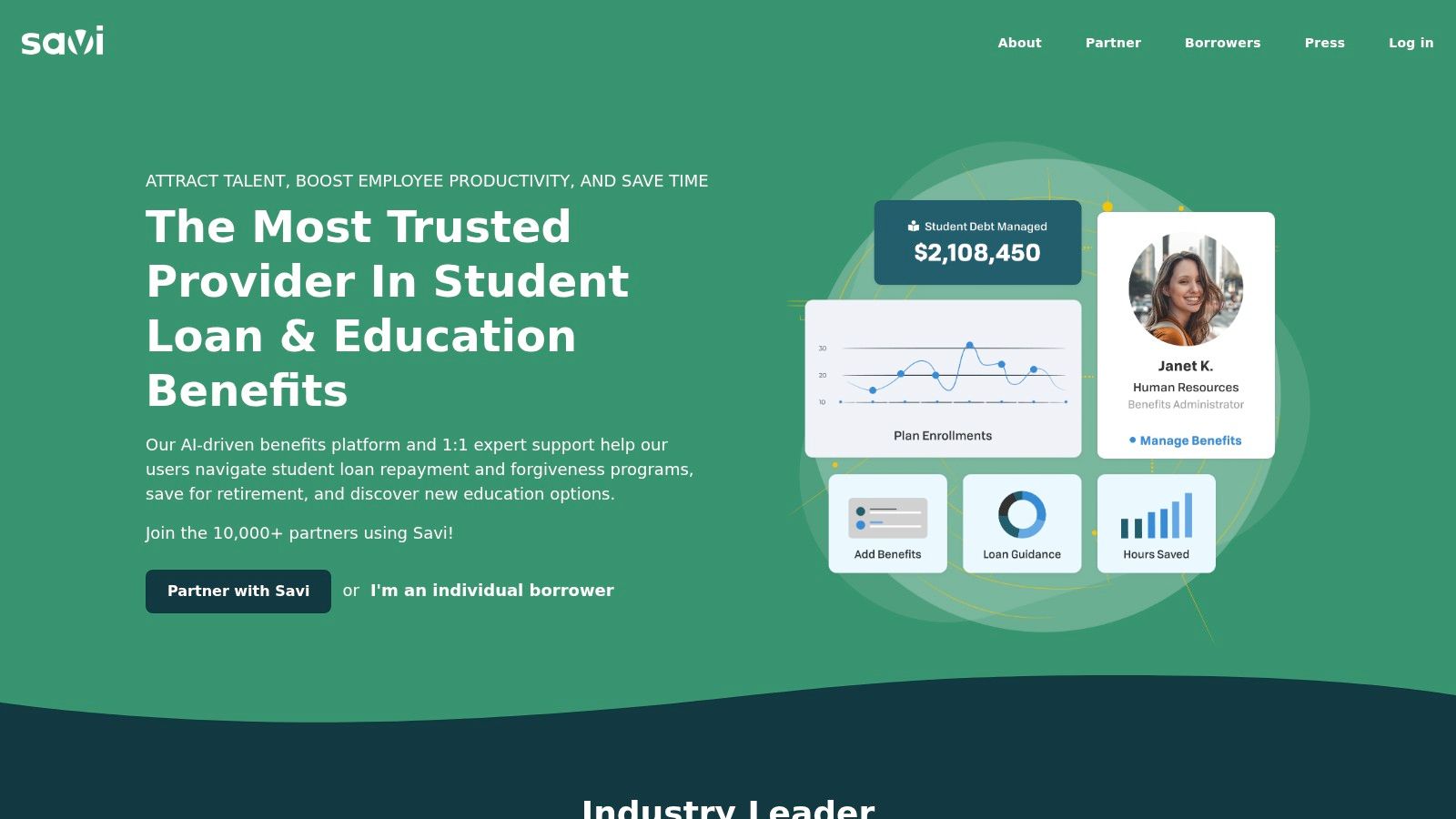
Savi sits between a calculator and a hired hand. The free assessment estimates which federal plans and forgiveness routes might apply. Paid tiers add form preparation, application support, monitoring, and specialist access, and employer, union, or membership programs sometimes cover the cost.
Where the paperwork is the hard part
The math isn't intuitive, which is why borrowers pay someone to run it. Payments come from income and family size, not the balance. Income-Based Repayment charges 10% of discretionary income for borrowers who first borrowed after July 1, 2014 and 15% for earlier borrowers, over 20 and 25 years respectively, while Income-Contingent Repayment charges 20% over 25 years and Pay As You Earn 10% over 20 years (Federal Student Aid's income-driven repayment plans).
Practical example: two borrowers each owe $40,000. One earns $38,000 with two dependents, the other earns $95,000 alone. Same balance, very different required payment. A tool that quotes a number without asking about household size is guessing.
A free assessment is a lead, not an approval. Nothing it produces obligates the Department of Education.
Every form Savi prepares can also be filed through StudentAid.gov at no charge. The fee buys time and fewer errors, not access. Ask which specific documents the paid tier covers before paying, and whether monitoring continues after submission.
Pros:
- Free assessment before any payment.
- Paperwork reduction on IDR, PSLF, and Teacher Loan Forgiveness.
- Monitoring after an application goes in.
- Partner access may lower or cover fees.
Cons:
- Paid help isn't required to apply for federal programs.
- Eligibility estimates aren't approval or a forgiveness guarantee.
- Pricing varies by access route, so confirm before committing.
4. Student Loan Planner
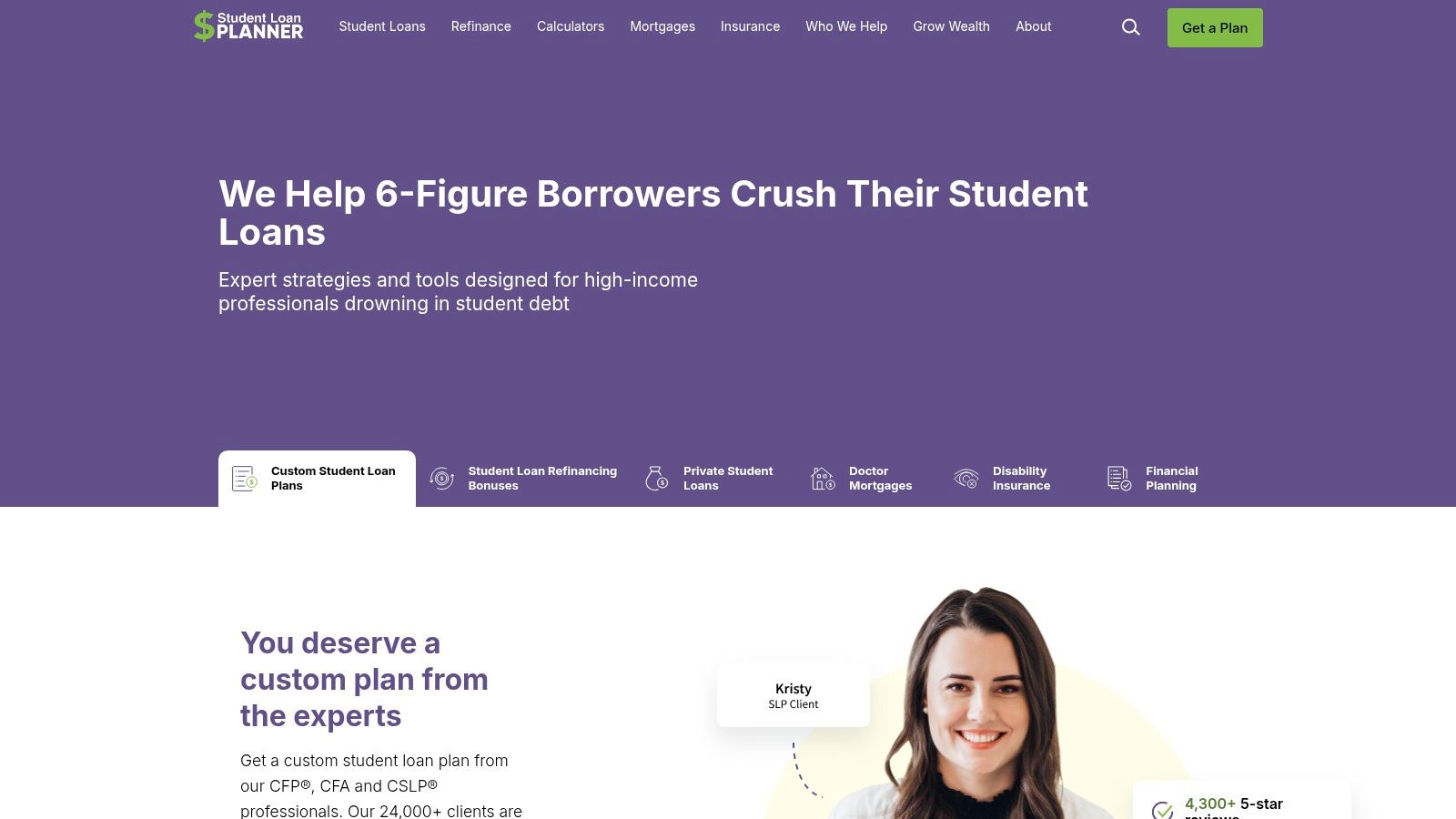
High balances and complicated lives are the target here: dentists, pharmacists, attorneys, physicians, anyone whose forgiveness math runs into six figures. Free calculators and a deep article library, plus paid consultations that model repayment, forgiveness, taxes, and investing together.
Where PSLF flips the ranking
Forgiveness can change which plan is cheapest. Remaining balances on eligible Direct Loans may be forgiven after the equivalent of 120 qualifying monthly payments, normally ten years, while working full time for a qualifying employer and repaying under a qualifying plan (Federal Student Aid's repayment plans).
Practical example: a government employee with 60 qualifying payments on record. A plan projecting $18,000 less in lifetime payments over ten years can still be the wrong pick if it breaks the path to forgiveness at payment 120. Compare projected forgiveness against projected payoff, not payment against payment.
The calculators go deeper than the federal tool on tax treatment and long-run scenarios. They still run on typed inputs, and the site isn't a servicer, so nothing there moves a loan or files a form.
Wondering what an early payoff would save outside of forgiveness? The student loan pay off early calculator runs the other side of that comparison.
Pros:
- Context beyond a payment estimate, including tax and forgiveness sequencing.
- Long-horizon modeling for balances where the answer isn't obvious.
- Specialization in complex, high-balance cases.
- Free educational resources alongside the paid work.
Cons:
- Personalized planning costs money, and the free tier stops at calculators and content.
- Outputs depend on inputs, so a wrong assumption produces a confident wrong answer.
- It isn't a servicer or an application channel.
5. EDCAP, Education Debt Consumer Assistance Program
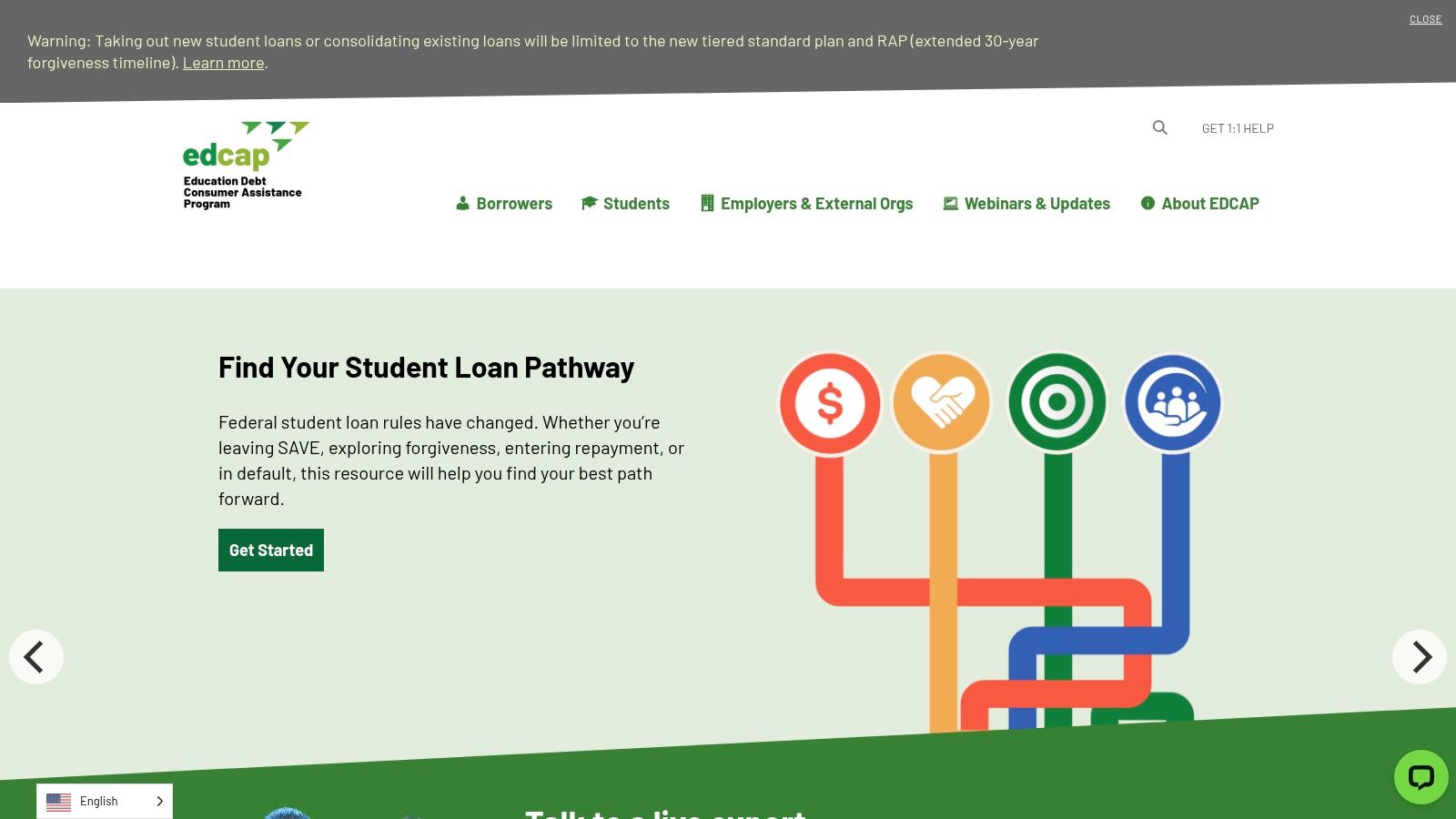
Free counseling, a repayment calculator, and borrower education for New Yorkers working through federal and private loan problems. The value is a person who has read the servicer rules more recently than the borrower has.
The problem isn't missing information
Borrowers aren't short on explainers. They're short on confidence. In a borrower survey, only 7.5% said the federal government gave them clear enough information to repay confidently, 66.2% disagreed or strongly disagreed, and 63.5% reported uncertainty or confusion (Protect Borrowers' review of the survey research).
Task design compounds it. Canada's government tested its own student loan pages and found 57% of users completed a loan-repayment task and 15% updated banking information; after a redesign those rose to 100% and 82%, with overall task performance climbing from 61% to 88% (Canada's student loans design research summary). Fewer steps beat better prose.
Practical example: a borrower holding a 2009 FFEL loan and a 2016 Direct Loan. The useful work is determining which one qualifies for what, and a counselor plus the federal calculator gets there faster than another article.
Two limits. Counseling is New York-focused, and calculator output doesn't establish eligibility or replace an application.
Pros:
- Free counseling for New York borrowers, with no sales pressure.
- Prep work before the servicer call, which shortens the call.
- A second estimate to compare against the federal calculator.
- Education and a calculator in the same place.
Cons:
- Availability is regional, so most readers can't use the counseling.
- Estimates don't establish eligibility or file anything.
- No payment portal. It isn't a servicer.
6. TISLA, The Institute of Student Loan Advisors
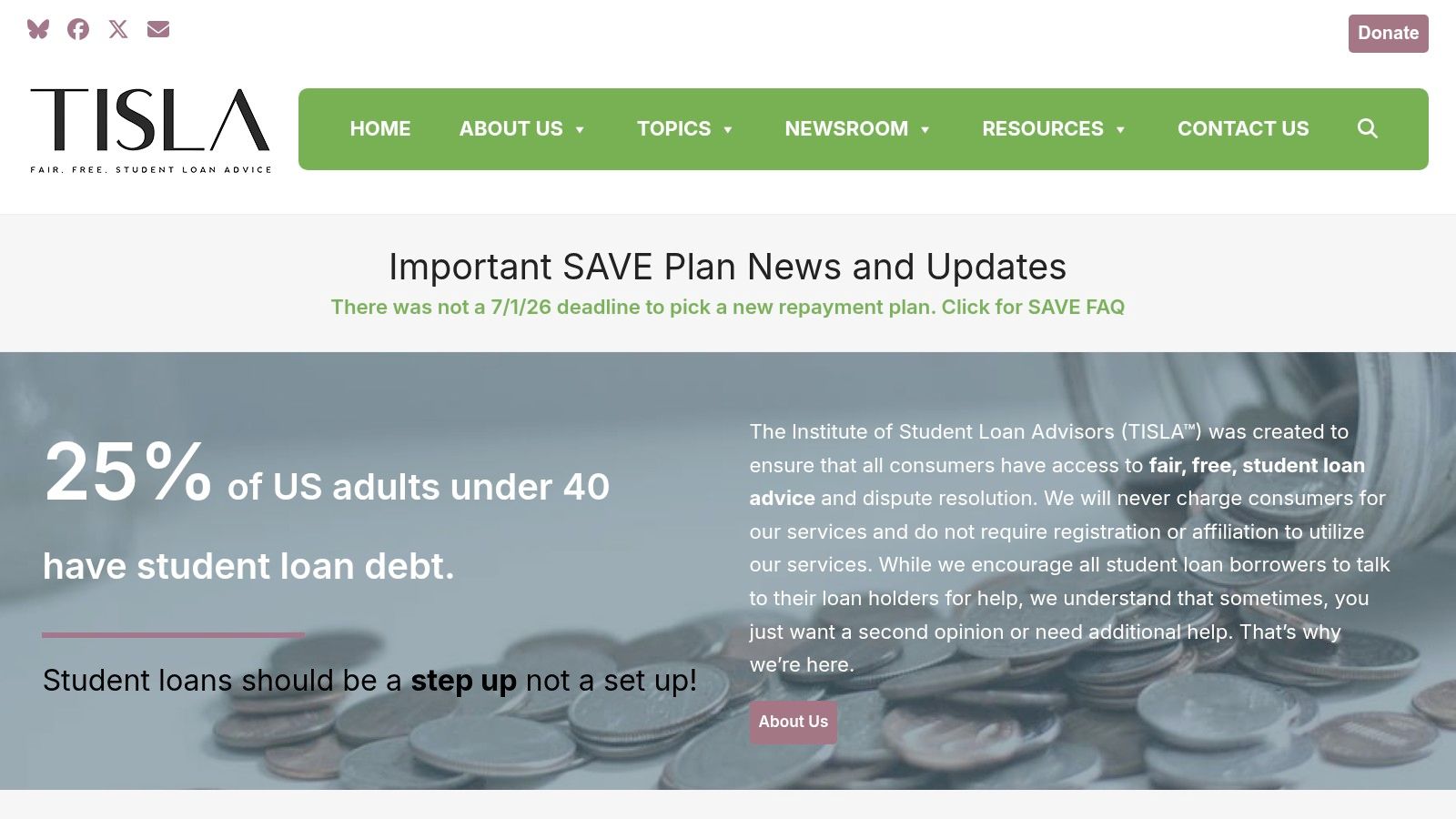
Free, plain-language explanations of repayment plans and loan types from a nonprofit, with pointers to its own studentloanplans.app calculator and the federal one. No fee, no sales call, no application pipeline.
The delinquency conversation most sites skip
Repayment advice usually assumes a borrower who can pay. Federal Student Aid reported that in June 2025, 34.4% of ED-serviced recipients, more than six million people, were more than 30 days delinquent, and the delinquency rate by balance was 29.5% against 12.7% in December 2019 (Federal Student Aid's data center update). A 2025 borrower survey cited in the same update found 42% had traded loan payments against basic needs, and 20% were currently delinquent or in default.
When paying extra means skipping food or rent, the aggressive plan is the wrong plan. A payment you can sustain beats a payoff date you can't fund.
Practical example: a $290 required payment against a $260 monthly shortfall. A $0 income-driven payment that keeps the loan current beats a $400 voluntary payment followed by a missed month and a delinquency mark that follows the credit file for years.
TISLA is education, not execution. It doesn't take payments, file applications, or bind a servicer, so expect to move between the nonprofit site, the calculator, and StudentAid.gov.
Pros:
- Free information and calculator access with nothing to buy.
- Terminology explained in the order a borrower meets it.
- An independent estimate to compare with the federal tool.
- No consultant required to get value.
Cons:
- Estimates aren't eligibility decisions.
- Multiple destinations to visit for one task.
- Not a payment service or servicer, so nothing gets submitted for you.
7. Undebt.it
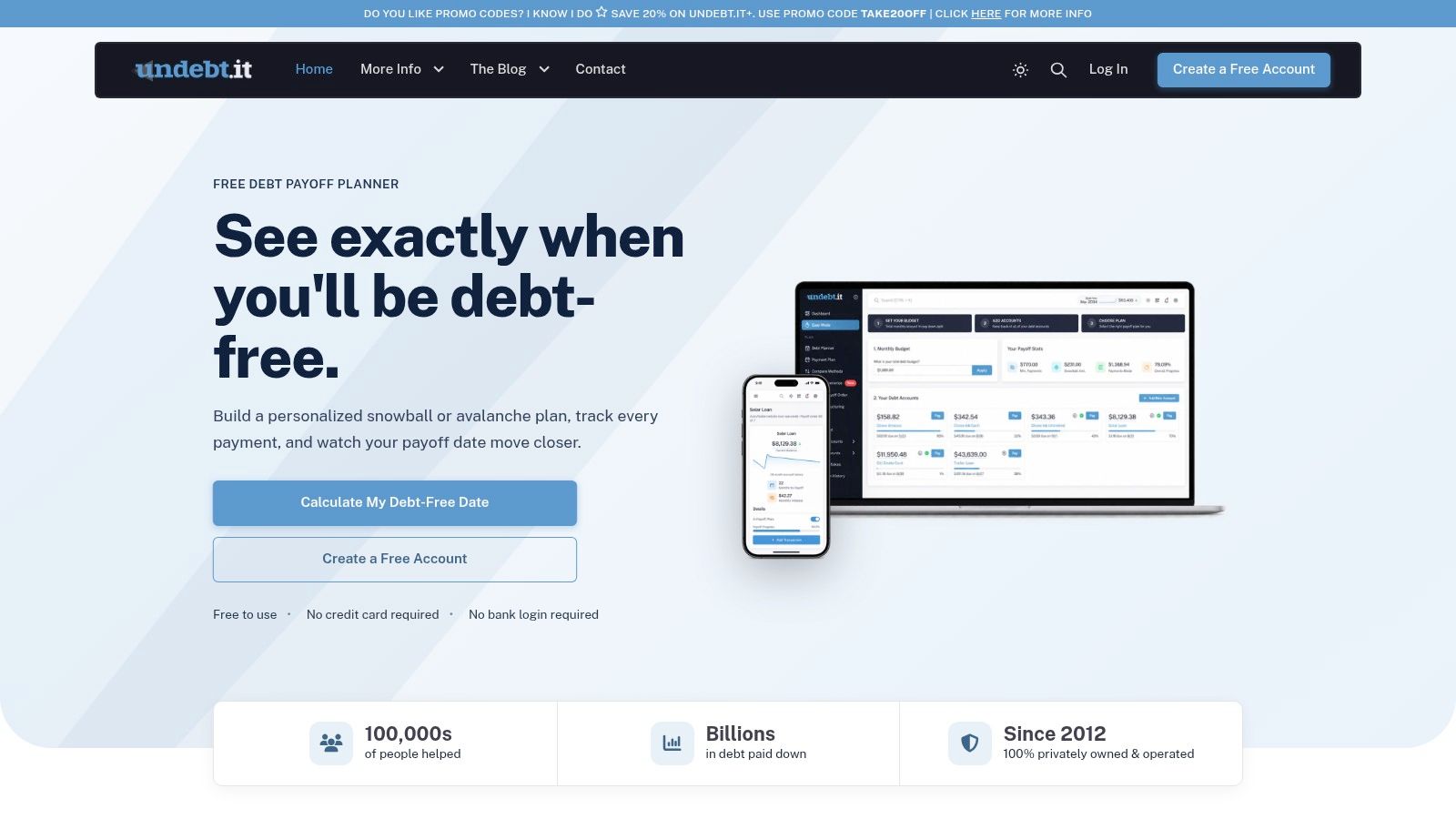
Undebt.it organizes household debts, including student loans, and compares snowball and avalanche payoff orders. It can model extra payments and estimate a debt-free date. Basic access is free, with additional features available through Undebt.it+.
What it decides, and what it ignores
Use Undebt.it to choose how to order payments across debts after you have settled questions about federal repayment options. It does not determine eligibility for federal plans or forgiveness.
The scale of federal student debt makes a sustainable payment order important. As of January 2024, the Department of Education held about $1.5 trillion in federal student-loan debt for nearly 43 million borrowers. Nearly 9.7 million borrowers were past due, representing approximately $290 billion in outstanding loans, according to GAO's overview of federal student loan repayment.
Consider a $1,900 credit-card balance at 26% APR and a $21,000 student loan at 6%. Both snowball and avalanche put the card first because it is both smaller and higher-rate. Add a $19,000 auto loan at 19%, and the methods may rank the debts differently: snowball favors the smallest balance, while avalanche favors the highest rate. The choice is between an early account payoff and reducing interest first.
Undebt.it relies on manual entries. Update balances, rates, and payments after each statement closes; stale figures can make its payoff projection unreliable.
Pros:
- Whole-household view of student loans, credit cards, and auto loans.
- Extra-payment modeling with an estimated debt-free date.
- Free basic access, with optional paid features.
- Browser-based access without installing an app.
Cons:
- No federal repayment or forgiveness guidance.
- Manual updates can leave projections out of date.
- Some features require a subscription.
8. Debt Payoff Planner
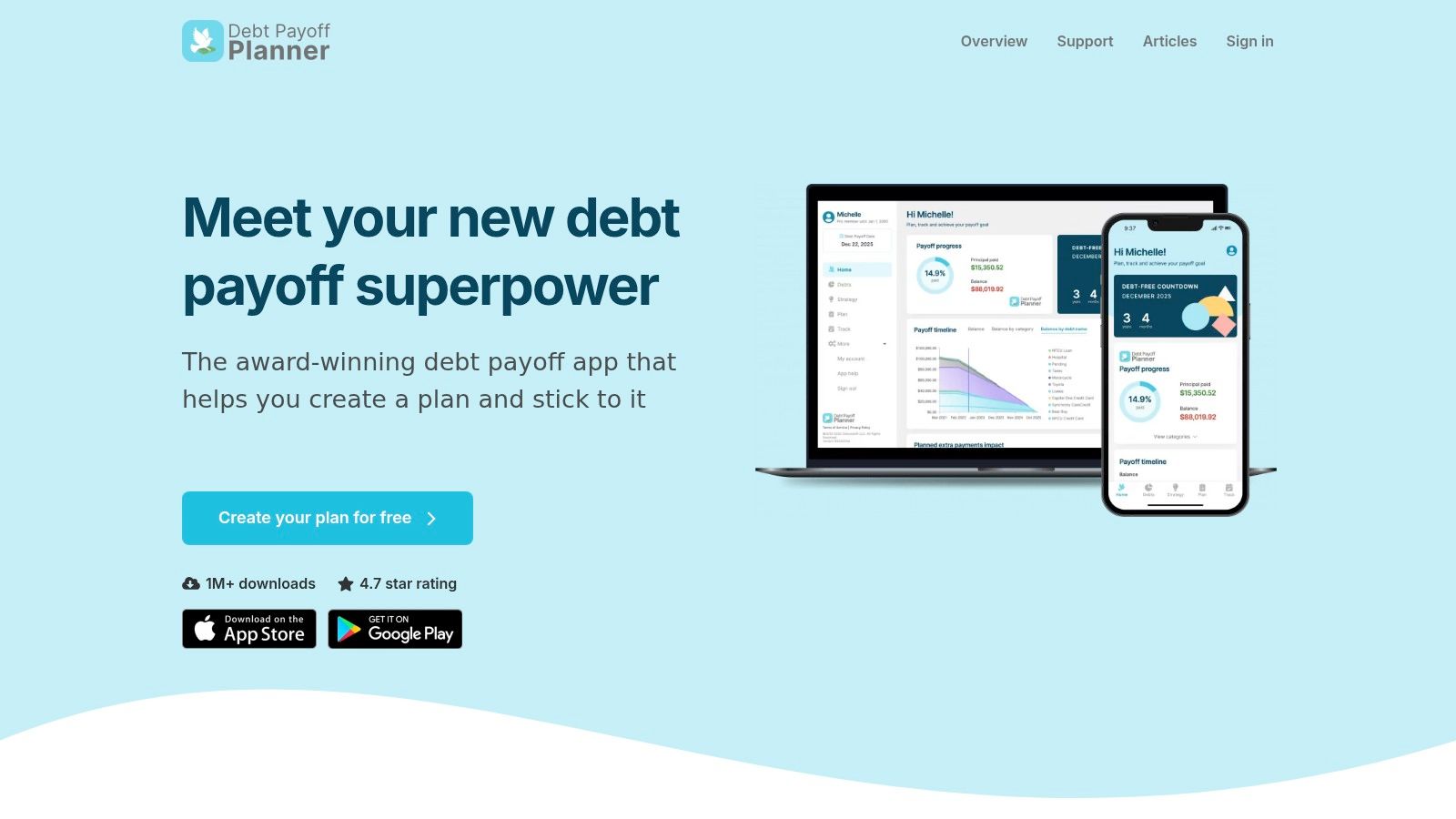
App-first tracking with a step-by-step plan, an estimated debt-free date, and visual progress. Student loans go in alongside everything else, and a free version covers the basics with paid features behind an in-app purchase.
What the progress bar is good for
Whether a payoff plan survives contact with daily life. The strength is the habit loop: log a balance, watch the bar move, keep going. That's a different job from modeling a plan, and for some borrowers the accountability is the missing piece, not the math.
Practical example: someone who has restarted a payoff plan three times. A weekly check-in with a visible progress bar does more than a better algorithm nobody opens.
Two limits matter. Balances, rates, and payments are typed in and need manual refreshes, and the tool has no view on federal eligibility, forgiveness rules, or applications. Treat its debt-free date as motivational arithmetic, not a projection a servicer would recognize.
Pros:
- Visual progress that supports consistency.
- Step-by-step ordering with an estimated finish date.
- Student loans alongside other debts in one list.
- Free version available before any purchase.
Cons:
- General debt tool, not student loan guidance.
- User-entered balances and rates drive every output.
- Advanced features sit behind an in-app purchase.
9. SoFi Student Loan Refinancing
SoFi refinancing replaces eligible existing loans with a new private loan. For borrowers with only private loans, the decision comes down to the offered rate, repayment term, and total cost. A refinance quote answers what a private lender may offer; it does not assess federal repayment options.
The federal trade nobody should skip
Refinancing federal loans turns the refinanced balance into private debt. Federal repayment plans, forgiveness eligibility, PSLF credit, and deferment rights no longer apply to that amount. If you may use any of these protections, compare their value before applying.
Eligible federal Direct Loans currently receive a 0.25-percentage-point rate reduction for automatic monthly electronic debits. Confirm the current rate with your servicer before comparing lenders. On a $30,000 balance at 6%, that reduction brings the rate to 5.75%. The dollar savings depend on the declining balance and payment schedule, so the rate change alone cannot establish a fixed lifetime saving.
A longer term lowers the monthly payment but increases total interest. Compare the new loan's rate, term, and total repayment cost with your current loan. The guide to ways to reduce student loan interest covers options that do not require giving up federal protections.
Pros:
- One loan and payment for multiple eligible balances.
- Potentially lower rates or a different term for qualified applicants.
- Estimates before commitment for comparing offers.
- A private-loan option for borrowers seeking a new repayment structure.
Cons:
- Rates and approval depend on underwriting.
- Refinancing federal loans forfeits federal benefits, including eligible income-driven repayment and forgiveness.
- Longer terms reduce monthly payments but increase total interest.
Visit SoFi
10. Earnest Student Loan Refinancing
Another direct lender to place in the comparison, with repayment-term choices subject to approval and loan estimates returned through an application.
Compare the loan, not the monthly payment
The monthly figure is the least useful number in a refinance offer. Two offers on the same balance can show identical payments with very different total cost, because term length drives the gap. Request the total of payments and the APR, then set both offers beside the current loan's rate.
Practical example: $45,000 of private loans at 8.4%. An offer at 6.9% over five years versus ten years. The ten-year version cuts the monthly obligation substantially and adds years of interest; the shorter version costs more each month and less overall. Neither is wrong without knowing what the emergency fund looks like.
The federal warning is identical. Refinancing a federal loan erases federal repayment-plan and forgiveness eligibility on that amount, permanently, with no reversal path.
Pros:
- Another direct lender for a genuine private refinance comparison.
- Term choices that let a borrower shape the schedule.
- Multiple eligible loans combined into one payment.
- A benchmark against current private-loan terms.
Cons:
- Rates and approval are individual.
- Refinanced federal loans lose federal repayment and forgiveness eligibility.
- Longer terms reduce the monthly payment while increasing total interest.
How the 10 Student Loan Repayment Website Options Compare
| Item | Best For | Loan Types Covered | Free Access | Main Limitation |
|---|---|---|---|---|
| Toya AI (Recommended) | Personalized debt payoff planning | Credit cards, student, auto, personal loans, mortgages | Free tracking and planning; AI optimization is paid | Precise projections require linked financial accounts; AI features require Pro |
| Federal Student Aid, StudentAid.gov | Comparing federal repayment plans | Federal student loans | Free | Focuses on federal loans; calculator results are estimates |
| Savi | Exploring federal repayment and forgiveness options | Federal student loans | Free assessment; hands-on support may be paid | Pricing and support vary; estimates do not guarantee eligibility |
| Student Loan Planner | Complex or high-balance student loan decisions | Student loans | Free educational resources; consultations may be paid | Estimates depend on assumptions; not an official application channel |
| EDCAP, Education Debt Consumer Assistance Program | Free guidance for New York borrowers | Federal and private student loans | Free counseling for New Yorkers | Assistance is New York-focused; calculator estimates are not official determinations |
| TISLA, The Institute of Student Loan Advisors | Understanding repayment options | Student loans, with guidance focused on federal processes | Free information and calculator access | Guidance is not an official eligibility decision |
| Undebt.it | Including student loans in a broader debt payoff plan | Student loans, credit cards, and other debts | Free basic access; premium features are paid | Does not determine federal repayment or forgiveness eligibility |
| Debt Payoff Planner | Visual tracking of multiple debts | Student loans and other debts | Free version; some features are paid | General debt planner, not student-loan-specific guidance |
| SoFi Student Loan Refinancing | Comparing private refinancing options | Eligible federal and private student loans refinanced into private debt | Rate and payment estimates available; loan costs apply | Refinancing federal loans forfeits federal protections |
| Earnest Student Loan Refinancing | Comparing refinance terms for eligible borrowers | Eligible existing student loans | Loan estimates available; loan costs apply | Approval depends on qualifications; refinancing federal loans removes federal protections |
Match Your Next Step to the Right Tool
Run the order, not the menu. If any balance is federal, the official calculator at StudentAid.gov comes first, because every other number is built on top of it. Get plan eligibility, monthly payment, and projected total on one screen before anything else.
Then test alternatives. A nonprofit counselor or a paid planner earns its fee when the decision involves forgiveness, a household budget that doesn't stretch, or paperwork that keeps getting rejected. The test is simple: leave with a specific next action and a date, not a better general understanding of how repayment works.
Then, and only then, look at refinancing. Confirm in writing that you're willing to give up federal protections on the amount you refinance, and keep that confirmation somewhere you'll see it if rates move. Private-loan borrowers have a simpler decision and more reason to shop hard.
A sequence for the next thirty days
- Week one: pull the loan list from StudentAid.gov and note every servicer, balance, rate, and status. Anything missing means a private loan or a record that needs fixing.
- Week two: run the federal calculator on the two or three plans that look plausible, and write down the monthly payment and lifetime total for each.
- Week three: if a $0 payment, a forgiveness path, or a rejected form is involved, get a human involved through a nonprofit or a planner before the next deadline.
- Week four: build the payoff order across all debts, and decide which balance gets any extra dollar.
The rule that saves the most money: never refinance a federal loan to lower a payment until you've checked whether an income-driven plan already gets you there at no cost.
For borrowers juggling student loans with credit cards or other debts, Toya AI offers a free dashboard to track balances, APRs, and due dates in one place, with a 14-day Pro trial available to test its payoff planning. That's the layer the official tools don't cover, because a federal calculator will never tell you whether the card or the loan should get the next $150.
Toya AI builds the payoff plan that sits underneath all of this. Connect student loans, credit cards, and other balances in one dashboard to see your debt-free date, then check what an extra payment changes before you commit a dollar to it. Start free, and use the 14-day Pro trial to test the AI's next-payment recommendations against your own numbers at Toya AI.
Ready to start your debt-free journey?
Toya AI builds a personalized payoff plan so you can see your debt-free date and save on interest.
Get Started Free