
9 Student Loan Payoff Strategies That Work
A borrower can be carrying several student loans at once, each with a different rate, servicer, balance, and due date. Income may change after graduation, while emergency savings, retirement contributions, rent, credit cards, and family expenses compete for the same monthly surplus. In that situation, choosing among student loan payoff strategies isn't a matter of finding one universally superior method. The right approach depends on loan type, eligibility, cash flow, motivation, and the value of keeping federal protections.
The Avalanche method prioritizes interest savings. Snowball creates quicker psychological wins. Income-driven repayment, including PAYE, REPAYE, IBR, and ICR, can protect borrowers whose income is limited or unstable. PSLF can be more valuable than rapid payoff for qualifying public-service workers. Consolidation, refinancing, extra payments, lump sums, and payment automation solve different execution problems.
This guide compares when each strategy works, how to implement it, what it can change about payoff time and interest, and where it can fail. Examples are illustrative unless linked to verified data. Actual projections depend on each loan's balance, rate, payment, repayment status, eligibility, and the rules in effect when a borrower acts.
Table of Contents
- 1. The Avalanche Method Prioritizes the Highest Rate
- 2. The Snowball Method Builds Momentum With Small Balances
- 3. Income-Driven Repayment Plans Protect Cash Flow
- 4. Federal Loan Consolidation Simplifies Federal Debt
- 5. Private Loan Refinancing Can Reduce Expensive Interest
- 6. Strategic Extra Payments Turn Surplus Into Principal
- 7. Lump-Sum Application Depends on Timing and Targeting
- 8. The PSLF Strategy Uses Qualifying Employment
- 9. The Bi-Weekly Strategy Changes Payment Frequency
- Student Loan Payoff: 9-Strategy Comparison
- Turn the Best Strategy Into a Repeatable System
1. The Avalanche Method Prioritizes the Highest Rate
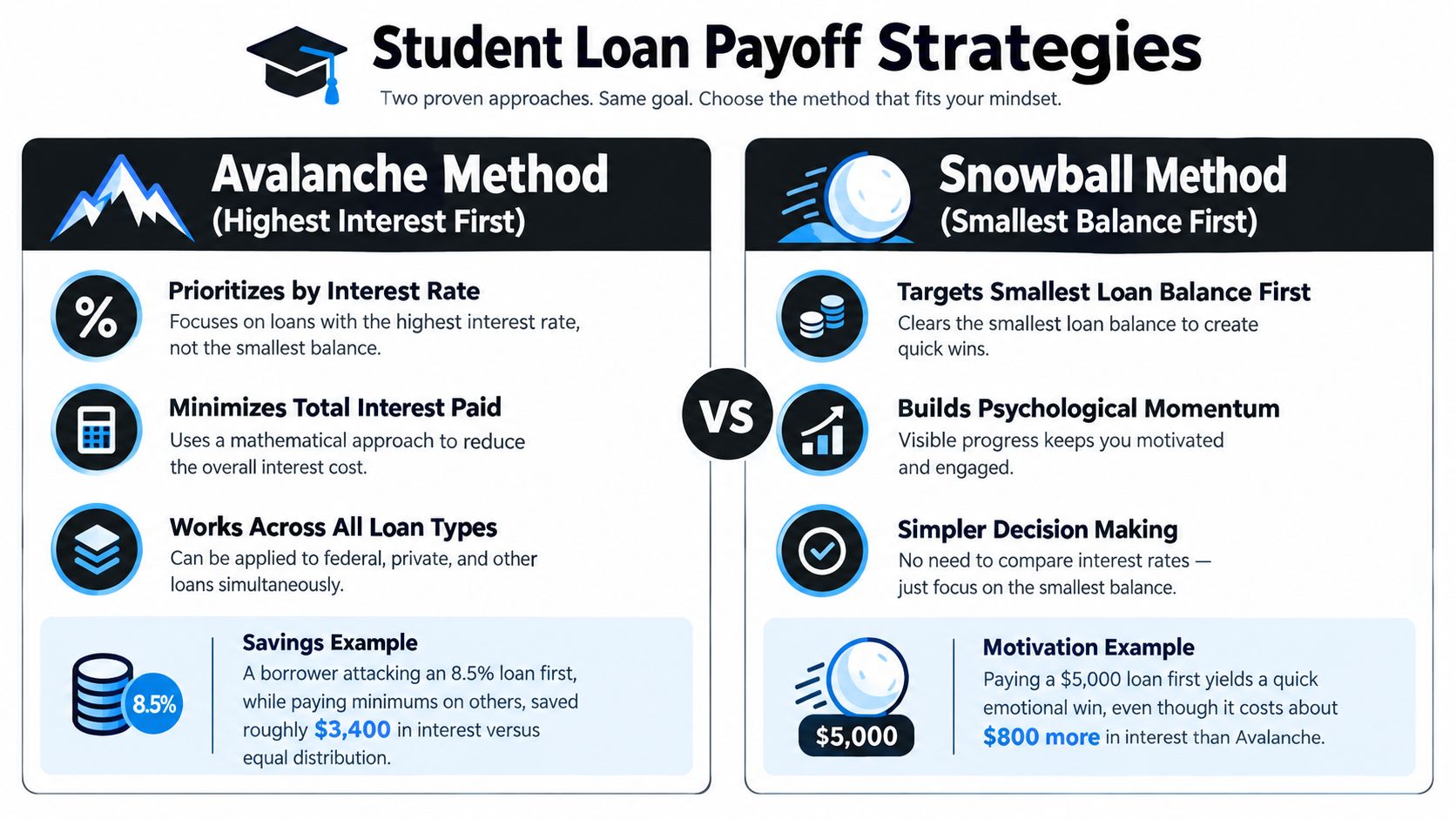
The Avalanche method directs extra money toward the loan with the highest annual percentage rate, while minimum payments continue on every other loan. Once that balance reaches zero, the former payment rolls into the next-highest-rate loan. This approach is designed to reduce the interest charged by leaving expensive debt outstanding for less time.
For example, a graduate with a $15,000 private loan at 8.5%, a $25,000 federal loan at 5.8%, and a $10,000 federal loan at 4.5% would direct the largest available payment to the 8.5% loan. The borrower shouldn't split extra money evenly merely because the balances look different. A spreadsheet or payoff tool can rank every loan by rate and show how the order changes the projected payoff date.
When the math should lead
Avalanche tends to fit borrowers who can tolerate slow visible progress and want to minimize total interest. It can be especially useful when one private loan carries a materially higher rate than the federal loans, but the borrower must first confirm that the federal loans aren't being preserved for IDR or PSLF.
A practical setup looks like this:
- List every loan: Record the servicer, balance, rate, minimum payment, federal or private status, and repayment plan.
- Automate the floor: Schedule minimum payments on all loans so the high-rate focus doesn't create missed-payment risk elsewhere.
- Name the target: Direct every extra dollar to the highest-rate loan and confirm how the servicer applies overpayments.
- Recalculate regularly: Review the order quarterly, particularly if rates are variable or a loan enters a different status.
Practical rule: The mathematically best order isn't useful if the borrower can't maintain it. A sustainable extra payment beats an aggressive target that causes repeated payment gaps.
Use a debt payoff calculator to compare total interest and payoff dates, then verify the Avalanche order against current loan data. Toya AI can help aggregate balances and rates, but borrowers still need to confirm servicer rules before making additional payments.
2. The Snowball Method Builds Momentum With Small Balances
A borrower with $5,000 at 6.5%, $12,000 at 5.2%, and $18,000 at 4.1% may choose the $5,000 loan first, even though it does not carry the highest rate. Directing $2,000 per month toward that balance can create an early payoff milestone. Once it closes, the borrower rolls the same payment into the $12,000 loan.
The Snowball method ranks loans by balance, not interest rate. Minimum payments continue on every other loan, while each finished balance frees cash for the next target. The result is a simple sequence of visible wins. The cost is potential interest savings, because a higher-rate loan can remain open longer than it would under Avalanche.
Motivation and cash-flow relief can justify that trade-off. A graduate with $8,000, $11,000, and $19,000 in loans might select the first balance because an early result makes continued repayment easier. A household with a $6,000 parent PLUS loan at 8%, a $9,000 loan at 5%, and a $14,000 loan at 4.2% may make the same choice, despite the higher projected interest cost.
Use the method as an execution system, not just an ordering rule:
- Sort by balance: List each loan and estimate when the smallest one could be paid off.
- Automate the target: Schedule the larger payment on that loan, keep minimums current elsewhere, and verify each servicer's overpayment rules.
- Mark the milestone: Record the payoff date in a calendar or progress tracker so the freed payment has a defined next destination.
- Review the order: After a quick win, compare Snowball with Avalanche if a high-rate balance still drives substantial interest.
Before committing, compare projected interest and payoff dates, then confirm that the first extra payment will not reduce emergency cash below a workable level. Toya AI can help track balances and progress, but borrowers should verify loan-specific rules before changing payment instructions.

3. Income-Driven Repayment Plans Protect Cash Flow
A borrower entering a lower-income career may need a payment that fits current cash flow rather than the original balance. Income-driven repayment plans base required payments on income and household circumstances, which can help during career transitions or months with little reliable surplus. They may also support a long-term forgiveness strategy, provided the borrower confirms eligibility and annual certification requirements.
The decision requires more than choosing the lowest bill. Compare the required payment, expected income growth, interest behavior, forgiveness timeline, tax treatment, and the cost of making aggressive extra payments that could reduce a potential forgiveness benefit.
Match the plan to the career path
A nonprofit social worker with $45,000 in federal loans might use PAYE while income is modest, then raise payments as earnings grow. A teacher with $60,000 in loans could choose an income-based plan while establishing a stable budget, then add extra money if forgiveness no longer fits the plan. Occupation alone does not determine the right choice. Model the borrower's actual loans, income, and expected changes.
IBR formulas can vary based on when the borrower first received loans. One reported version uses 10% of discretionary income for newer loans and 15% for older loans, with forgiveness after 20 or 25 years, according to this explanation of IBR rules. PAYE is described as capping payments at 10% of discretionary income and limiting them so they do not exceed a 10-year Standard Repayment amount, according to this overview of PAYE.
Set up the plan with four checks:
- Compare official estimates: Use Federal Student Aid resources and confirm that the plan remains available.
- Set certification reminders: Recertify income and family information before each required deadline.
- Separate loan types: Federal and private loans may require different repayment choices.
- Model the exit: Recalculate after income rises, family size changes, or forgiveness becomes less likely.
For a structured comparison, review the best student loan repayment plan options. Check employer programs as well, including employer student loan relief through 2025. Verify current rules with the servicer before switching plans, changing payment instructions, or making extra payments.
4. Federal Loan Consolidation Simplifies Federal Debt
A Direct Consolidation Loan can turn several eligible federal loans into one federal loan, one servicer, and one monthly payment. The new rate is based on a weighted average of the loans included, so consolidation usually changes administration rather than reducing interest. Its practical value is continued access to eligible federal repayment protections, subject to current rules.
Consider a borrower with $25,000 at 6.5%, $18,000 at 5.8%, and $12,000 at 4.2%. Consolidating could produce an illustrative weighted-average rate near 5.5%. One due date may reduce missed-payment risk, while a lower monthly bill may reflect a longer repayment period and higher total interest.
Check the trade-offs before combining loans
Consolidation can affect PSLF progress or other benefits, depending on the loans, timing, and rules involved. The decision should rest on more than reducing account logins. Compare the existing and proposed payment, projected interest, forgiveness treatment, and payment-count implications before submitting an application.
Start with a written loan inventory:
- Confirm federal status: Keep private loans out of a federal consolidation application.
- Review qualifying history: Verify how prior payments and program progress will be counted after consolidation.
- Compare total cost: Model the full repayment period, not only the new monthly amount.
- Save records: Download statements, payment histories, and plan details before an account transfers.
For process details, review how to consolidate student loans. After approval, confirm the new servicer, payment amount, due date, interest rate, and treatment of any overpayment. Set those details in payment automation, then use payoff projections or Toya AI tracking to monitor whether consolidation is improving organization without slowing the payoff plan. Verify loan-specific rules with the servicer before applying or changing payment instructions.
5. Private Loan Refinancing Can Reduce Expensive Interest
A borrower with private loans of $35,000 at 8.2%, 7.9%, and 6.5% may qualify for one fixed loan at 5.8% over 10 years. Refinancing could reduce interest, but the new payment alone does not show the full result. Compare total interest, fees, term length, variable-rate exposure, cosigner treatment, and any protections lost when the original loans are replaced.
Refinancing replaces existing debt with a new private loan. It may suit high-rate private loans when income and credit are stable. A lower rate can shorten the payoff timeline or leave room in the budget, while a longer term can reduce the monthly bill and increase total interest.
Decide which loans can safely move
Keep federal loans separate when access to federal protections matters. For example, a physician could refinance only the private portion while keeping federal loans in an income-driven repayment plan. That approach may reduce the private-rate burden without giving up federal options. A borrower pursuing PSLF, expecting unstable income, or concerned about future hardship should avoid treating federal refinancing as a routine rate comparison.
Use a written offer comparison before applying:
- Separate the portfolio: Confirm which loans are private and which are federal.
- Test rate risk: For a variable offer, model the payment if the rate rises.
- Compare terms: Calculate total interest under the current and proposed schedules.
- Review protections: Check forbearance, discharge, cosigner release, and hardship provisions.
- Test affordability: Recalculate the payment after job loss or an income reduction.
Review student loan interest rates before requesting offers. Lender underwriting differs, and a quoted rate is not guaranteed. Before accepting, verify eligibility for IDR, PSLF, deferment, forbearance, and other federal protections with the servicer. If refinancing fits, automate the new payment and use payoff projections or Toya AI tracking to confirm the expected savings. Verify the lender's payment-allocation and prepayment rules before changing instructions.
6. Strategic Extra Payments Turn Surplus Into Principal
A surplus works harder when assigned before it arrives. Set a recurring extra amount after confirming that rent, utilities, insurance, minimum debt payments, and a reasonable cash buffer remain covered. For example, adding $150 per month to a $25,000 loan at 5.5% lets a borrower compare the original schedule with an accelerated payoff projection. A borrower expecting a $2,000 annual bonus can also decide in advance how much belongs to debt, savings, and current needs.
Use the highest-rate loan as the default target. Choose a different balance only when a forgiveness plan, a Snowball milestone, or a payment-allocation goal offers greater value. Before changing the payment, verify the loan's prepayment rules and the servicer's instructions.
Turn an intention into a posted principal reduction
A scheduled extra payment may not reduce the intended balance automatically. Servicers can apply overpayments according to account settings, advance the next due date, or hold funds under their procedures. Check the allocation options, then review the next statement after the payment posts.
- Automate a manageable increment: Add a fixed amount to autopay so the plan does not depend on monthly willpower.
- Set a windfall rule: Decide how bonuses will be divided before the money arrives.
- Name the target loan: Confirm that the extra amount is directed to the selected loan and principal.
- Check the result: Compare the posted principal, interest, due date, and remaining balance with your projection.
Cash-flow protection comes first. The Consumer Financial Protection Bureau's 2023–2024 survey found that 63% of borrowers had ever had difficulty making payments and 37% had missed at least one payment, with higher hardship rates among several borrower groups, including Black and Hispanic borrowers, Pell Grant recipients, and people without a four-year degree, as reported in the CFPB borrower survey. If income is uncertain, lower the recurring extra amount, pause it when necessary, and use payoff projections or Toya AI tracking to reassess the plan. Verify the servicer's rules before acting.
7. Lump-Sum Application Depends on Timing and Targeting
A tax refund, bonus, or inheritance creates a one-time payoff decision. Applying the full amount across every loan may feel balanced, but directing it toward a high-rate balance usually produces a clearer interest benefit because that principal stops generating interest under the loan's terms. A smaller balance can still be the better target if eliminating it frees meaningful monthly cash flow or lowers the risk of a missed payment.
Run two payoff projections before sending the money: one that targets the highest-rate loan and another that removes a smaller balance. Compare interest, monthly obligations, and the projected payoff date. Borrowers pursuing forgiveness should add a third scenario, because an aggressive payment could reduce a balance that might otherwise be forgiven. Verify forgiveness and payment-application rules for the specific loans before acting.
Keep the windfall available when cash flow is uncertain
A lump sum should not leave the household unable to cover rent, utilities, insurance, or minimum debt obligations. Set aside an emergency reserve suited to personal circumstances, then commit only the amount that can safely go toward principal. An unstable-income borrower may gain more from retaining cash than from making an irreversible payment.
Use a short decision record rather than a fixed formula:
- Check available cash: Identify likely disruptions and preserve enough accessible savings to handle them.
- Choose the target: Select the highest-rate loan, a smaller balance, or a forgiveness-preservation approach based on the projections.
- Confirm application rules: Ask the servicer how the payment will be applied to the chosen loan and principal, and verify whether any payment changes the due date.
- Review the posting: Compare the balance, interest charge, and projected payoff date before and after the payment.
A windfall should improve the payoff plan without making the next financial emergency more dangerous. Record the decision in Toya AI tracking if you use it, then revisit the projection when income, loan terms, or forgiveness eligibility changes. Verify the servicer's loan-specific rules before acting.
8. The PSLF Strategy Uses Qualifying Employment
A public-school teacher with eligible federal loans may face a different payoff decision from a borrower in private employment. Public Service Loan Forgiveness can make qualifying employment, an eligible repayment plan, and accurate payment records more important than rapid principal reduction.
Start by confirming the employer and loan structure before sending extra money. A qualifying nonprofit worker should review current official guidance, check whether the loans qualify, and verify that the chosen repayment plan supports the intended path. Refinancing federal loans into a private loan generally removes access to the federal forgiveness pathway, so that choice requires careful comparison.
Build the decision around the borrower's record
PSLF depends on details that generic payoff examples cannot capture. Employment certification, payment history, loan type, repayment status, and qualifying payment counts all affect the outcome. A borrower with $65,000 in federal loans should compare an accelerated-payoff projection with the expected qualifying-payment path, then verify the result through the current federal servicing process.
Use a recordkeeping routine:
- Confirm employer eligibility: Check current official guidance before treating a job as qualifying.
- Track employment: Store forms, pay records, and servicer correspondence together.
- Review payment counts: Compare the recorded count with personal payment records and ask about discrepancies.
- Check loan type: FFELP loans may require consolidation into a Direct Consolidation Loan, and timing can affect the result.
- Test extra payments: Project whether additional principal would reduce a balance that might otherwise qualify for forgiveness.
A smaller balance or uncertain employment may justify a faster payoff. A borrower expecting to remain in qualifying work may preserve cash instead, provided the payment path remains compliant. Households with combined balances should assess each borrower separately because qualifying employment and payment records can differ.
Record the employment status, loan type, payment plan, and projection in Toya AI tracking if you use it. Automate the required payment, review the count periodically, and update the projection when income, employment, loan terms, or eligibility changes. Verify loan-specific rules with the servicer and current federal guidance before consolidating, refinancing, or directing extra payments.
The following video can help borrowers orient themselves to the program:
9. The Bi-Weekly Strategy Changes Payment Frequency
A borrower paid every other Friday can divide the regular monthly amount between paychecks and align transfers with income. Because the calendar has more two-week intervals than monthly billing cycles, this schedule may produce an additional full-payment equivalent without deliberately raising the monthly budget. The result depends on the servicer's processing method, posting dates, loan terms, and whether money reaches principal immediately.
If the servicer does not support true bi-weekly processing, smaller additional payments can approximate the schedule. Monitor the account closely. Some servicers may hold partial funds or treat them as payments for future installments rather than applying them when received.
Principal reduction determines whether frequency helps
The approach has value only when payment timing leads to earlier principal reduction. Ask how the servicer handles partial payments, due-date advancement, and principal-only instructions. Some accounts require the full scheduled payment before excess funds are allocated.
Use the borrower's cash-flow pattern to set up the method:
- Align transfers with paydays: Schedule money after income arrives and essential bills clear.
- Confirm posting behavior: Ask whether payments post immediately or remain pending until the due date.
- Review the first statements: Check the amounts applied to interest and principal.
- Update the payoff projection: Use actual posting dates and balances, not the planned schedule.
- Track the setup in Toya AI: Record the payment frequency, expected transfer amounts, and projected payoff date.
A bi-weekly schedule is not automatically better than monthly payments with occasional extras. Someone with volatile income may keep monthly payments and send surplus only when available, preserving flexibility. Someone with predictable paychecks may prefer automated transfers that reduce the chance of spending the intended extra payment.
Before activating automation, verify the servicer's rules, confirm that transfers fit household cash flow, and revise the projection when income or loan terms change.
Student Loan Payoff: 9-Strategy Comparison
| Strategy | Implementation complexity | Resource requirements | Expected outcomes | Ideal use cases | Key advantages |
|---|---|---|---|---|---|
| The Avalanche Method (Highest Interest First) | Moderate–High: requires tracking rates and reordering loans | Consistent extra payment capacity; spreadsheet/app to track APRs | Lowest total interest paid; faster overall payoff | Borrowers with mixed-rate loans focused on cost minimization | Minimizes interest; mathematically optimal |
| The Snowball Method (Smallest Balance First) | Low: simple smallest-to-largest ordering | Steady payments; visual tracker for motivation | Faster account eliminations; higher total interest than Avalanche | Borrowers who need quick wins and behavioral momentum | Simple to follow; strong psychological motivation |
| Income-Driven Repayment (PAYE, REPAYE, IBR, ICR) | Moderate: enrollment and annual recertification required | Income documentation, tax returns, servicer interaction | Lower monthly payments; potential long-term forgiveness but more interest if only minima paid | Federal borrowers with income fluctuations or pursuing PSLF | Payment safety net; PSLF compatibility; affordability in low-income periods |
| Federal Loan Consolidation (Direct Consolidation Loan) | Low–Moderate: one-time application and rate calculation | Only federal loans; servicer/process time | Single payment with weighted-average rate; retains many federal benefits | Borrowers with many federal loans who want simplicity | Simplifies servicing; preserves IDR/PSLF eligibility |
| Private Loan Refinancing (Rate Reduction) | Moderate: shop lenders, credit check and docs | Good credit/income; multiple lender offers | Lower interest/shorter term possible; forfeits federal protections | Borrowers with high-rate private loans and strong credit | Potential large interest reduction and predictable fixed rates |
| Strategic Extra Payments | Low–Moderate: decide allocation and ensure correct application | Extra cash flow (bonuses, side income); instruct servicer to apply to principal | Accelerated payoff and meaningful interest savings | Borrowers with irregular income or disciplined budgets | Flexible; multiplies effects of other strategies; immediate principal reduction |
| Lump Sum Application: Timing & Targeting | Low: one decision plus servicer confirmation | Significant one-time funds; emergency fund recommended | Substantial immediate interest savings and shorter term | Recipients of windfalls who want maximal impact | Large, fast reduction in interest from a single payment |
| The PSLF Strategy (Public Service Loan Forgiveness) | High: 10-year qualifying payment timeline and strict documentation | Qualifying employer, IDR enrollment, annual employment certification | Remaining federal balance forgiven after 120 qualifying payments (tax-free) | Long-term public service employees with large federal debt | Potential tax-free elimination of large balances |
| Bi-Weekly Payment Strategy (Frequency Over Volume) | Low: setup may require servicer approval or manual scheduling | Regular bi-weekly cash flow alignment; servicer acceptance | About one extra payment per year → modest interest and term reduction | Borrowers paid bi-weekly or wanting automated incremental acceleration | Simple automation that yields extra annual payment without raising budget |
Turn the Best Strategy Into a Repeatable System
The strongest student loan payoff strategies begin with eligibility protection, not an extra payment. Separate federal loans from private loans, identify whether any balance is tied to IDR or PSLF, and check whether consolidation or refinancing would remove a protection that could be worth more than a lower rate. In the United States, nearly 43 million people, about one in six adults, hold federal student loan debt, and the federal portfolio exceeds $1.6 trillion, according to Federal Student Loans data from the U.S. Department for Education. The size of the system doesn't determine an individual plan, but it shows why loan-specific decisions matter.
Use PSLF or IDR when qualifying employment, income, loan type, and projected forgiveness make payment flexibility more valuable than rapid payoff. Use Avalanche when minimizing interest is the priority and the borrower can maintain consistent extra payments. Use Snowball when quick wins are the difference between following a plan and abandoning it. Add recurring extras, lump sums, or bi-weekly payments only after the required payments, emergency liquidity, and competing high-cost debts are under control.
A practical system has three operating layers:
- Automated execution: Schedule minimum payments on every account, then automate the chosen extra amount toward the target loan.
- Projection tracking: Record balances, rates, due dates, payment status, projected payoff date, and estimated interest cost.
- Decision updates: Recalculate when income, family circumstances, rates, repayment plans, employment, or loan rules change.
The need for this flexibility is clear in repayment data. The Congressional Budget Office found that among loans entering repayment between 2009 and 2019, balances increased in some way for 57% of loans, while only a quarter fell by at least half during the first six years. Borrowers made payments greater than $10 in only 38% of months when a payment was due, and loans were in repayment status for 45% of months, as described in the Congressional Budget Office analysis. A plan that assumes uninterrupted amortization can therefore produce misleading payoff dates.
Toya AI can support the execution layer by securely aggregating read-only account data through stated trusted partners such as Plaid, Fincity, Spinwheel, and Quiltt, without credit pulls. Its dashboard centralizes balances, APRs, utilization, and due dates, while its AI models next-best payments and shows how an action can change the debt-free date, monthly interest, and total cost. Borrowers can start with a calculator, then connect accounts for more precise projections. Plans update as cash flow changes, but the borrower still needs to verify account accuracy and servicer instructions.
A monthly review should confirm that every payment posted correctly and that the target balance is falling. A quarterly recalculation should revisit rates, balances, due dates, repayment status, payoff date, and total interest. Borrowers should verify current federal program rules before making irreversible changes, especially refinancing, consolidation, or abandoning a forgiveness path. Tools can organize the decision, but eligibility and payment application remain the borrower's responsibility.
Toya AI connects student loans and other debts into a personalized payoff plan, recommends which debt to prioritize and how much to pay, and tracks the projected debt-free date as circumstances change. Visit Toya AI to start organizing student loan balances, due dates, and payoff actions in one place.
Ready to start your debt-free journey?
Toya AI builds a personalized payoff plan so you can see your debt-free date and save on interest.
Get Started Free