
Student Loan Pay Off Early Calculator Guide

A borrower can make every required payment, check the servicer portal, and still feel as if the balance barely moves. The frustration usually comes from seeing a familiar monthly bill without seeing the alternative: how much sooner the loan could end, how much interest could disappear, and whether an extra payment reaches principal.
A student loan pay off early calculator turns that frustration into a set of testable choices. It can compare the current minimum-payment path with recurring extra payments, biweekly payments, or irregular lump sums. The result isn't a promise from the servicer, but it can give borrowers a practical target and expose assumptions that deserve verification.
Table of Contents
- Why Standard Repayment Plans Fall Short
- Gathering Your Loan Details for Accurate Inputs
- Running Payoff Scenarios and Interpreting Results
- Handling Real-World Variables and Capitalization Events
- Turning Calculator Results Into an Actionable Payoff Plan
- Automating Your Debt-Free Journey With Toya AI
Why Standard Repayment Plans Fall Short
A borrower named Jordan might open a loan account after making payments for months and discover that the principal has fallen far less than expected. Jordan hasn't necessarily done anything wrong. A required payment first covers accrued interest, and only the remaining amount reduces principal. If the payment is small relative to the balance and rate, progress can look painfully slow.
The default schedule also encourages passive behavior. The portal displays the minimum, the due date, and perhaps an estimated payoff date. It usually doesn't show what happens if Jordan adds a manageable amount after each payday, sends a work bonus directly to principal, or pauses an aggressive plan to preserve cash during an uncertain month.
The minimum payment is a baseline, not a strategy
A repayment schedule answers one question, how much must be paid under the current arrangement. It doesn't answer whether that arrangement fits the borrower's priorities. A calculator provides the missing comparison by placing the minimum schedule beside an accelerated schedule.
For example, Jordan can enter the current balance, annual interest rate, required payment, and remaining term. The tool can then model a fixed extra payment and report the revised debt-free date, interest paid, and months removed from the original schedule. Those outputs help Jordan decide whether the proposed extra amount is realistic, rather than relying on the emotional appeal of paying “as much as possible.”
Practical rule: A payment plan becomes useful when it survives an ordinary month, not when it only works during a perfect month.
The scale of the problem makes this planning more than a niche exercise. In the United States, the federal student loan portfolio grew from $516 billion across 28.3 million students to about $1.6 trillion across 42.7 million students over 17 years, according to the student-loan financial data cited in the source material. A large, active portfolio means borrowers need tools that translate complicated repayment choices into understandable scenarios.
Shift from bill payer to debt strategist
The first useful question isn't “How fast can Jordan eliminate the loan?” It's “What payment can Jordan repeat without damaging other priorities?” A borrower may choose a conservative monthly extra, reserve irregular windfalls for principal, or keep the minimum while assessing forgiveness eligibility.
Borrowers comparing repayment structures can also use this guide to student loan repayment plans before committing extra cash. Early payoff can be sensible, but it shouldn't override emergency savings, employer retirement matches, or a repayment path where forgiveness may matter.
Gathering Your Loan Details for Accurate Inputs
A calculator is only as reliable as its inputs. An outdated balance, an incorrect rate, or a term that reflects the original loan rather than the remaining term can make an attractive projection nearly useless.
The borrower should collect the latest statement and, where several loans exist, record each loan separately before combining results. Different rates and balances can make a single weighted figure convenient for a rough estimate, but separate loan groups provide better guidance about where an extra payment should go.
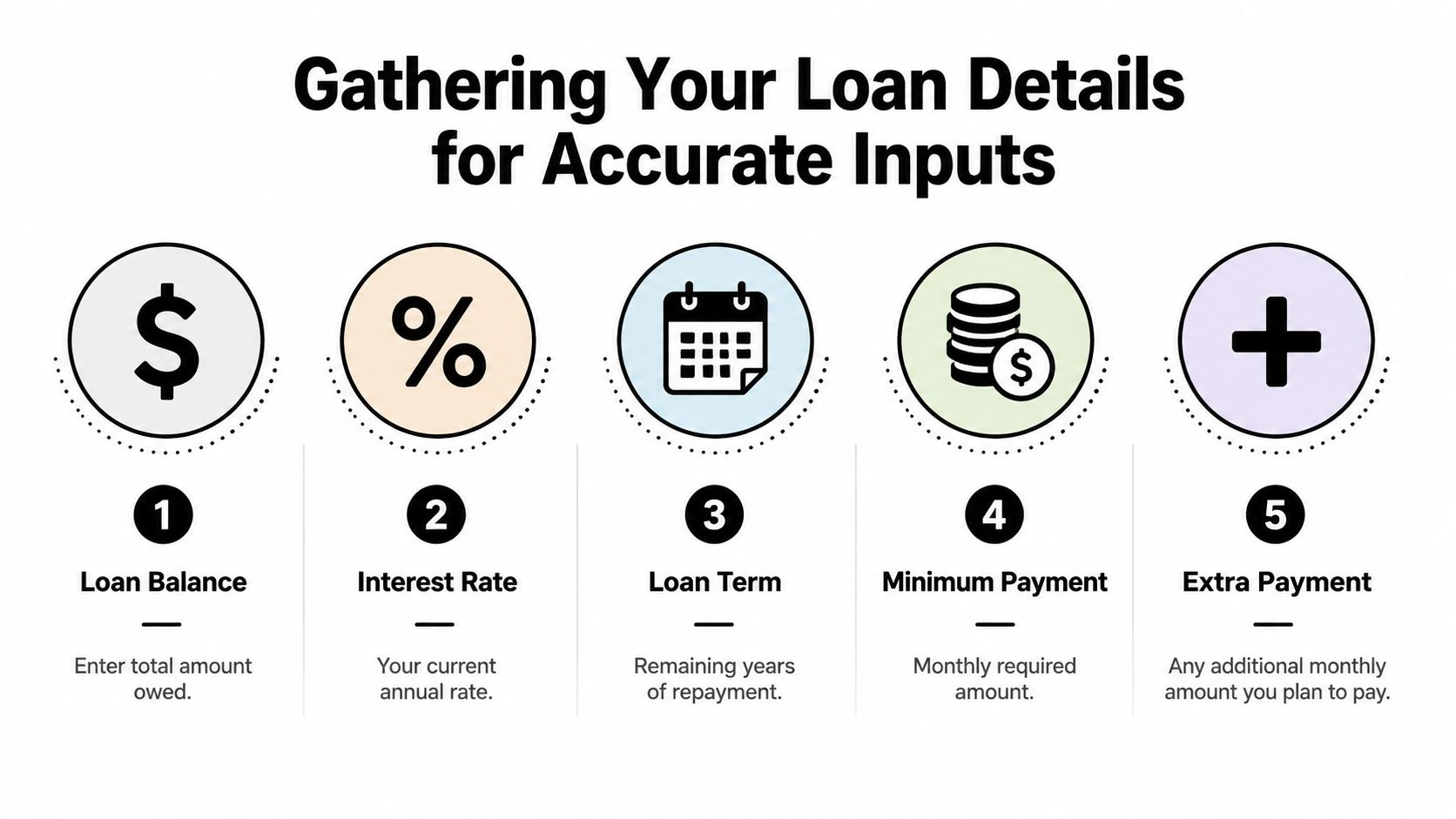
Build the input sheet carefully
Current principal balance: Use the outstanding principal shown by the servicer, not the original amount borrowed. If the account displays accrued interest separately, record that amount too because the calculator may handle it differently.
Annual interest rate: Enter the current rate for each loan group. Borrowers managing multiple balances can review this student loan interest rates guide to understand why a weighted average may hide meaningful differences between loans.
Remaining repayment term: Use the time left, not the original schedule. A loan that began with a long term but has already received payments needs a remaining-term input.
Required monthly payment: Enter the amount currently due under the applicable plan. Income-driven repayment arrangements may not behave like a fixed amortizing schedule, so the result needs additional caution.
Extra payment design: Specify whether the proposed extra is monthly, biweekly, annual, or a one-time lump sum. Include the month when the additional payment begins.
A practical example shows why the distinction matters. Suppose a borrower enters the total balance for three loans and adds one monthly extra amount. The output may be directionally helpful, but it won't identify which loan should receive the extra principal. Entering the loans separately allows the borrower to test a highest-rate-first approach against an equal-allocation approach.
Understand the model behind the estimate
A calculator should use a month-by-month amortization model. It converts APR to a monthly rate by dividing by 12, applies each payment to accrued interest first, reduces principal with the remainder, and stops when the remaining balance reaches zero. The student loan payoff calculator methodology also supports capping the final payment at the remaining balance plus that month's interest, rather than assuming another full installment.
Federal loans can create a small but important difference because interest accrues daily in real-world servicing. Payment timing and allocation can therefore produce a payoff amount that differs from a simplified monthly estimate. The calculator should be treated as a planning model, while the servicer's current payoff quote controls the final transaction.
Running Payoff Scenarios and Interpreting Results
Once the baseline matches the account statement reasonably well, the borrower can test behavior instead of guessing. The strongest comparison starts with the current required payment, then changes one variable at a time. That makes it easier to understand whether the improvement comes from a recurring extra, a lump sum, or a different payment frequency.
A borrower with uneven income might model three paths. The first adds a fixed amount every month. The second adds a larger annual payment when a bonus or tax refund arrives. The third combines a smaller recurring amount with occasional windfalls. Each path can reach the same broad objective through a different cash-flow pattern.
Use the outputs to make a decision
The calculator's core outputs deserve equal attention:
- New payoff date: Shows when the accelerated schedule reaches a zero balance under the model.
- Interest saved: Estimates the interest avoided compared with the minimum-payment path.
- Months eliminated: Converts the payoff-date difference into a time measure that fits a household budget.
- Remaining balance over time: Helps reveal whether early payments are producing visible principal reduction.
The Consumer Financial Protection Bureau found that the median final payment on a student loan was 55 times larger than the scheduled payment, indicating that borrowers often finish with irregular lump sums rather than a smooth pattern of fixed monthly overpayments. That finding is documented in the CFPB research on student loan repayment and broader household borrowing.
A steady extra payment may be easier to automate, but a lump sum can suit a borrower whose income changes throughout the year. The right scenario is the one that reflects actual behavior. A plan built around a recurring amount that regularly gets skipped can be less useful than a smaller automatic payment paired with a clearly defined windfall rule.
Scenario impact comparison
| Strategy | Extra Amount | Time Saved | Interest Saved |
|---|---|---|---|
| Minimum payment only | None | Baseline | Baseline |
| Recurring monthly extra | Fixed additional amount each month | Calculator result | Calculator result |
| One-time lump sum | Single additional payment | Calculator result | Calculator result |
| Mixed approach | Smaller recurring payment plus occasional lump sums | Calculator result | Calculator result |
The table should contain the borrower's actual figures, not generic promises. For instance, the borrower can first enter the minimum schedule, then add a recurring amount, and finally replace that recurring amount with a lump sum. Comparing the three outputs shows whether convenience, speed, or flexibility matters most.
An irregular payment isn't a failed plan. It becomes effective when the borrower models it in advance and sends it with clear allocation instructions.
Handling Real-World Variables and Capitalization Events
A fixed-rate monthly calculator can be mathematically consistent and still miss what appears on a real servicing account. Federal loans accrue interest daily, and the balance can change based on the date a payment arrives, how the servicer allocates it, and whether unpaid interest capitalizes.
Capitalization matters because unpaid interest may be added to principal. Once added, future interest can accrue on the larger principal amount. A calculator that assumes the balance never changes except through scheduled monthly amortization can understate the effect of a deferment, a status change, or a plan-specific event.
Ask whether capitalization applies
Most capitalization events on Direct Loans were eliminated on July 1, 2023, but some remain, including exiting deferment on unsubsidized loans and certain IBR-related events, as explained in this overview of student loan interest capitalization events. Loan type matters, so borrowers should identify whether an account is Direct, FFEL, or private before trusting an accelerated projection.
A borrower leaving deferment can therefore receive a different result from a borrower making extra payments during ordinary repayment. The calculator should ask about deferment status, the loan program, and relevant income-driven repayment timing. If it doesn't, the output should be labeled as a simplified estimate.
The Department of Education's Loan Simulator also uses assumptions when estimating payments and total cost across repayment plans. That makes plan-specific projections especially important for income-driven repayment, forgiveness programs, changing income, and capitalization events. A standard amortization result shouldn't be presented as a guaranteed outcome for every repayment plan.
Control how the servicer applies extra money
Extra payments generally go first toward interest due and then toward principal. If a payment exceeds the regular installment, the borrower should specify whether the extra amount is intended to reduce principal or advance the next due date. The Federal Student Aid repayment guidance explains why allocation instructions matter.
Consider a borrower who sends a bonus payment larger than the monthly bill. Without a clear instruction, the servicer may move the next due date forward while leaving the regular schedule largely intact. A borrower focused on early payoff should request principal application, retain confirmation, and check the next statement to verify the result.
Servicer checkpoint: The calculator estimates the consequence of a payment. The servicer determines how the payment is posted. Both records need to agree.
Turning Calculator Results Into an Actionable Payoff Plan
A projected debt-free date has no power until it becomes a repeatable cash-flow system. The borrower should choose a payment method that fits the timing of income, the reliability of expenses, and the possibility of an interruption.
A practical plan starts with the calculator's most sustainable scenario, not the fastest scenario. If the model shows that a fixed extra payment works only when every month goes perfectly, the borrower can lower the recurring amount and create a separate rule for bonuses, refunds, or other windfalls.
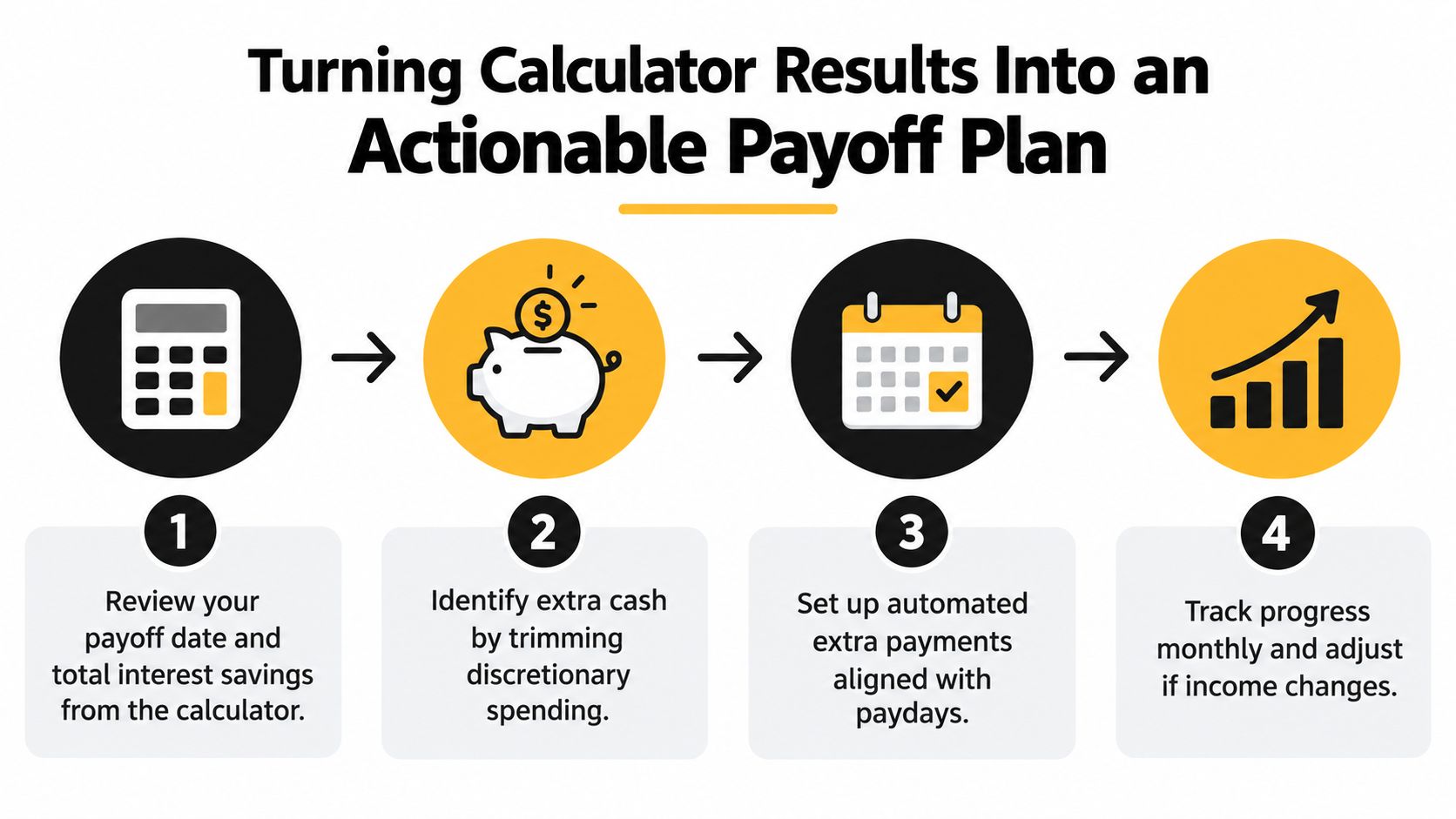
Convert the projection into habits
- Match payments to paydays: A borrower paid twice monthly can schedule smaller additional transfers around those income dates, provided the servicer accepts the chosen frequency and applies the money as intended.
- Separate recurring and irregular money: A fixed extra payment belongs in the monthly budget. A tax refund or bonus should follow a separate written rule so the decision doesn't get postponed when the money arrives.
- Track principal, not only the due date: The balance and accrued interest reveal whether the payment is producing the modeled result. A moved due date alone doesn't prove that payoff has accelerated.
- Recalculate after meaningful changes: A new rate, repayment plan, deferment, income change, or capitalization event can make the earlier projection obsolete.
For federal education loans, borrowers can prepay all or part of the loan at any time without penalty. If a servicer receives an early payment before repayment is scheduled to begin, the payment is treated as a prepayment and applied entirely to principal, according to this guidance on paying student loans while in school. A borrower making an early payment during school or a grace period should still verify the posting on the account.
The plan also needs a recovery rule. If a medical bill or income disruption makes the extra payment impossible, the borrower can return temporarily to the required payment, record the change, and rerun the scenario later. That approach protects consistency without treating one difficult month as a permanent failure.
Automating Your Debt-Free Journey With Toya AI
Manual spreadsheets work well for an initial estimate, but they become difficult when balances, due dates, rates, and cash flow change across several accounts. A connected dashboard can reduce repeated data entry and make the projection easier to maintain.
Toya AI is one option that connects debt accounts through trusted partners and centralizes balances, APRs, utilization, and due dates. Its calculator can preview a debt-free date, while the connected plan can compare payment approaches and update projections as account information changes. The platform includes student loans alongside credit cards, auto loans, personal loans, and mortgages.

The useful distinction is between calculation and execution. A standalone student loan pay off early calculator can show what a payment might accomplish. An automated system can help the borrower keep the plan current, identify the next payment decision, and monitor whether changing cash flow requires a different allocation. Account connections use read-only access through trusted partners, and users should still review servicer records before sending a large payment.
A short product overview can help borrowers assess whether an automated workflow fits their needs:
The strongest workflow combines both tools. First, the borrower checks the loan terms and tests a few realistic scenarios. Then the borrower uses automation to monitor balances, preserve the chosen payment rhythm, and revisit the plan when income or repayment status changes.
Toya AI centralizes student loans and other debts, compares payoff strategies, and turns calculator results into an adaptive payment plan with next-best-action guidance. Visit Toya AI to connect the numbers to a practical debt-free routine and start tracking a clearer path forward.
Ready to start your debt-free journey?
Toya AI builds a personalized payoff plan so you can see your debt-free date and save on interest.
Get Started Free