
Should I Pay Off My Car Loan Early? a Decision Guide
What if paying off a car loan early makes a household less safe, not more? Conventional advice treats a zero balance as the win and treats cash in the bank, a possible payoff fee, and an upcoming mortgage application as footnotes. A stronger test asks a different question for anyone wondering should I pay off my car loan early: what does the same cash protect or earn if it isn't sent to the auto lender today?
Table of Contents
- Quick Verdict on Paying Off Your Car Loan Early
- What Early Payoff Saves on a $25,000 Loan
- How to Get the Real Payoff Figure and Fee
- How Much Cash to Keep After Payoff
- How an Early Payoff Affects Your Credit Score
- Who Should Pay Off Early and Who Should Wait
- Check Your Numbers Before You Pay Off the Loan
Quick Verdict on Paying Off Your Car Loan Early
Paying off early usually makes sense when the loan carries a high APR, many payments remain, the cash reserve stays intact, and no more expensive debt is waiting. Keeping payments usually wins when the rate is low, savings are thin, or a credit card charges more. Four inputs decide the math: the APR, the remaining balance and term, any prepayment penalty, and the cash left after paying.
Rate context matters because auto loans don't price alike. Federal Reserve finance-company data cited by Experian's auto loan guide show that in 2025, average new-car loan rates ranged from 6.13% to 6.61%, while used-car loan rates ranged from 16.41% to 17.00%, and auto-loan terms commonly span 36 to 96 months. A borrower near the used-car end of that range has far more interest to avoid than a borrower near the new-car end.
Early Payoff Verdict by Situation
| Situation | Lean | Deciding factor |
|---|---|---|
| Car APR above 10% and a cash reserve of three or more months | Pay off early | Interest avoided is larger than the return the cash would earn |
| Car loan under 6% and a credit card charging a higher rate | Pay the card first | The card's rate is the higher guaranteed saving |
| No emergency fund or unstable income | Keep payments and build cash | A reserve covers repairs, job loss and transportation |
| Prepayment fee larger than the interest still due | Keep payments | The fee cancels the interest savings |
| Mortgage application within one or two months | Time the payoff after the application | An active installment account closing can lower the score temporarily |
| Several other installment loans and a clean payment history | Pay off early | The credit effect is usually small and short-lived |
The practical move is simple. Find the row that matches the loan, then note the deciding factor that would change the answer if it shifted.
What Early Payoff Saves on a $25,000 Loan
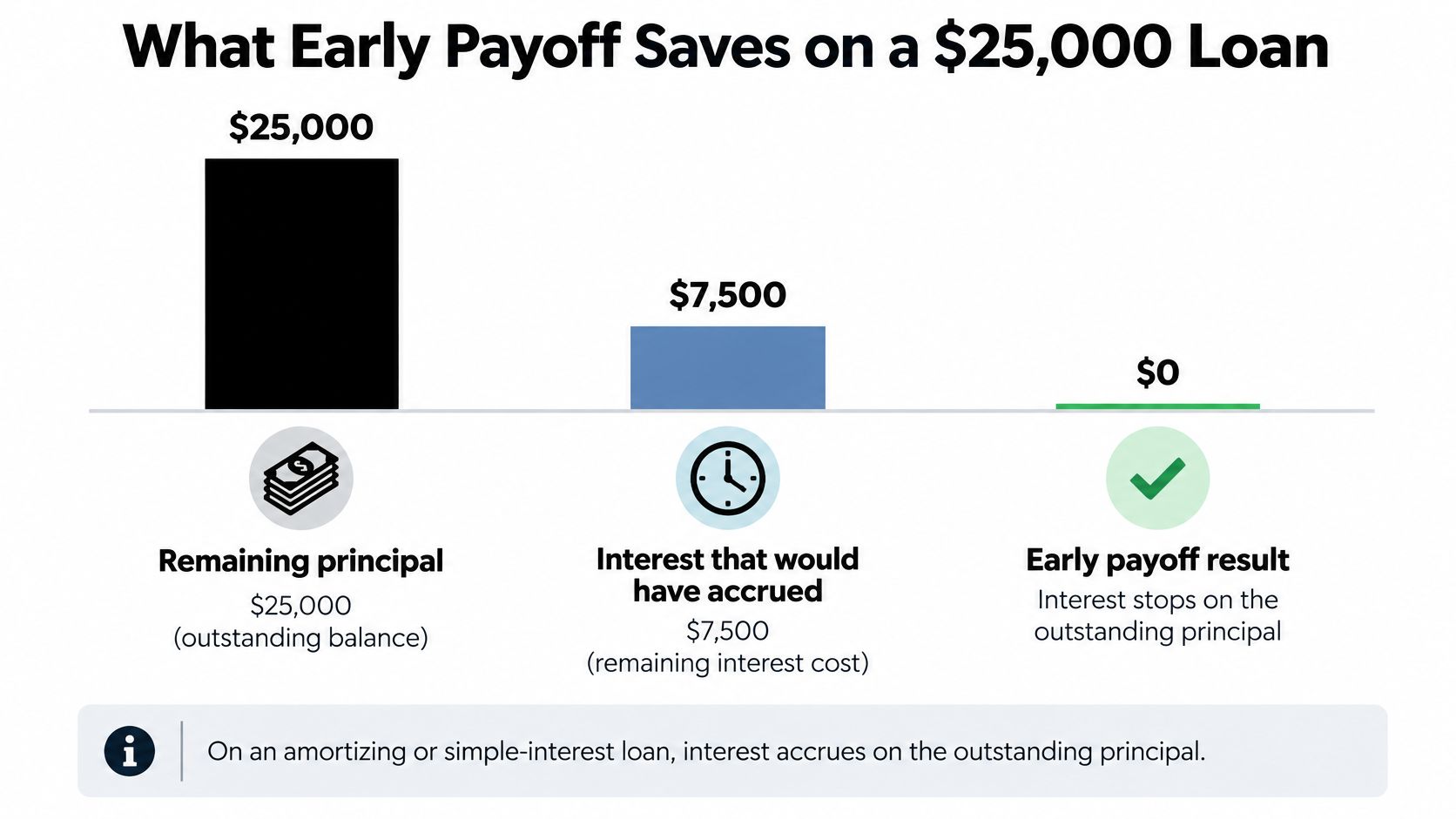
On an amortizing or simple-interest loan, interest accrues on the outstanding principal, so a lump-sum payoff stops interest that would have accrued on the remaining balance. The Consumer Financial Protection Bureau explanation of simple and precomputed interest describes the simple-interest structure as one where interest accrues daily or monthly on the outstanding principal, so an early lump-sum payoff eliminates future interest that would otherwise accrue.
That mechanism explains why rate dominates every other variable. Apply standard amortization to a $25,000 loan over 60 months at two rates and the gap is wide.
The Worked Example at Month 24
At 6% APR, the monthly payment is about $483 and total interest over the full term is about $4,000. After 24 payments, the balance sits near $15,900 and about $1,500 of interest remains. At 17% APR, the payment is about $621 and total interest reaches about $12,300. After 24 payments, the balance is near $17,400 and about $4,900 of interest remains.
Paying off at month 24 avoids that remaining scheduled interest. The 17% borrower therefore gains more than three times the savings of the 6% borrower, even though both started with the same principal and term. Early action also matters because interest is front-loaded in effect. A balance paid down sooner carries a smaller base for every later month, which is the mirror image of compounding growth in savings. Readers who want the underlying math explained step by step can use a finance student's guide to compounding from Finzer.
Early Payoff Example on a $25,000 Loan Over 60 Months
| Loan | Interest left at month 24 |
|---|---|
| $25,000 at 6% APR | about $1,500 |
| $25,000 at 17% APR | about $4,900 |
These figures are illustrative and assume standard amortization with no fees. The lender's own schedule governs any real decision.
Three-number rule: Remaining interest, minus any payoff fee, minus what the cash would earn elsewhere, equals the true benefit. If that result is small or negative, the payoff is mostly emotional.
Repeating the Calculation With Real Numbers
A borrower can repeat this in minutes with three inputs from the loan statement or lender app. The needed figures are the current balance, the APR, and the months left. Enter them into any amortization calculator, such as the loan calculator in a banking app or a spreadsheet using the PMT function, and read the remaining interest column.
Then compare that remaining interest with two deductions. First, subtract any fee in the payoff quote. Second, subtract the interest the cash would earn if it stayed in savings over the same months. What's left is the guaranteed saving, and that's the only number worth comparing against other uses of the cash, such as clearing a card balance or capturing an employer retirement match.
How to Get the Real Payoff Figure and Fee
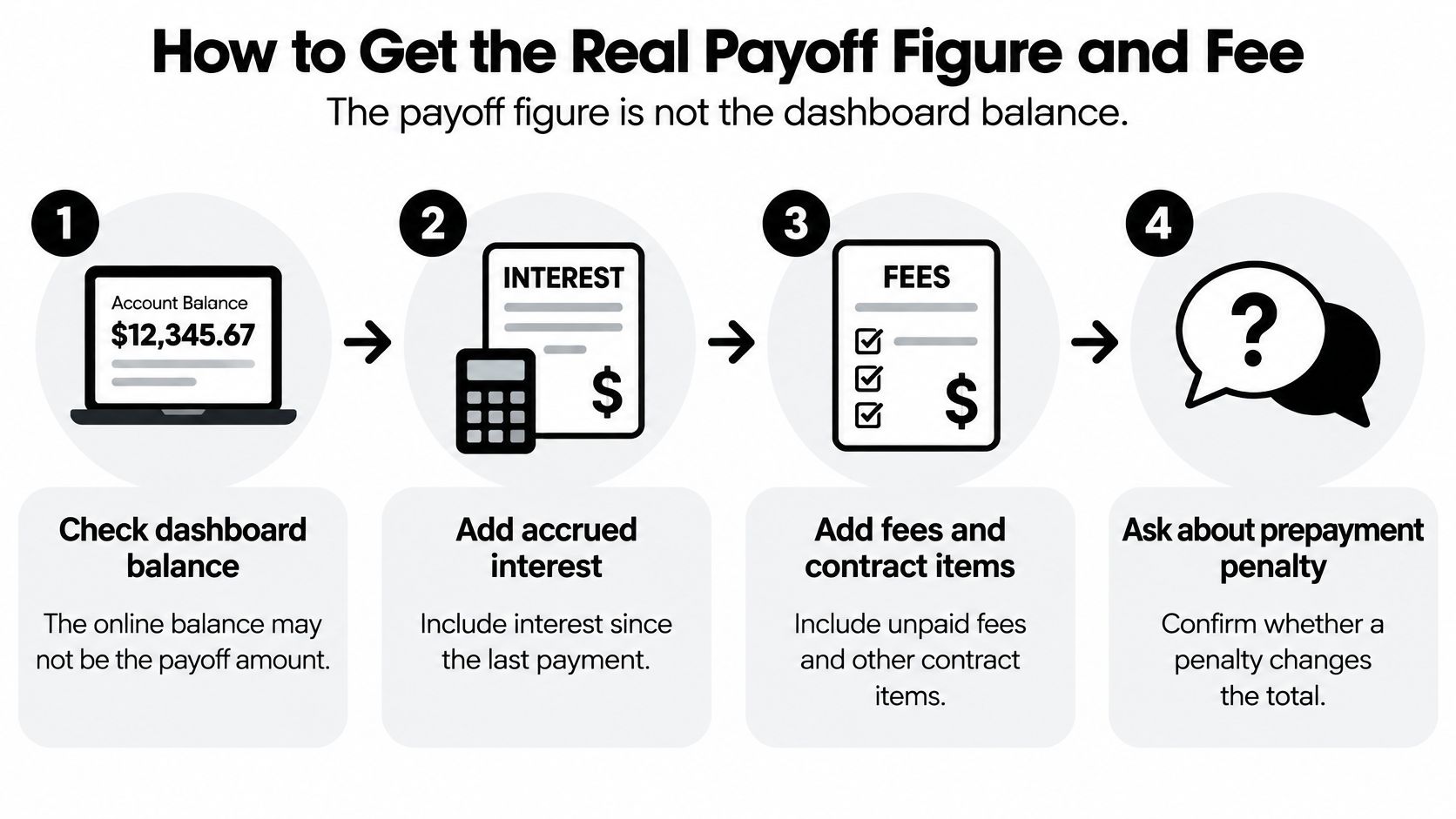
The payoff figure isn't the dashboard balance. It may include interest accrued since the last payment, unpaid fees, and other contract items, and a prepayment penalty can change the economics completely. Anyone asking should I pay off my car loan early needs the lender's number in writing before doing any math.
Five Steps to the Real Figure
- Read the contract first: The Consumer Financial Protection Bureau guidance on prepaying a loan states that the loan contract and state law determine whether early repayment is allowed without a charge. Search the agreement for "prepayment" and "early payoff" before calling.
- Request a written payoff quote: Ask for the total and the exact date it's valid through. A quote that expires in ten days can change if payment arrives late, so the date matters as much as the amount.
- Check what's inside the quote: Confirm whether it includes accrued interest, late fees, or other charges. A small unpaid fee left behind can keep the account open and generate another statement cycle.
- Ask how extra payments are applied: Payments generally cover fees and accrued interest before principal. A borrower making a partial payment should request principal-only application in writing, because advancing the next due date doesn't cut interest the same way. A clear breakdown of what a loan payoff amount includes helps when comparing the quote against the statement balance.
- Subtract any fee from the remaining interest: This is the step that decides whether the payoff still pays.
The fee test is blunt. If remaining interest is $1,200 and the lender charges a $500 early-payoff fee, the maximum gross benefit is only $700 before counting lost savings or investment returns. A fee larger than the interest still due makes early payoff a net loss, full stop in financial terms even if the borrower values owning the car outright.
Borrowers still shopping for financing have one more lever. The CFPB advises asking whether a penalty exists and negotiating to have it removed when arranging financing, since it's far easier to strike the clause before signing than after. The next move for an existing borrower is to obtain the quote, confirm the total directly with the lender, and compare it with the cash earmarked for payoff.
How Much Cash to Keep After Payoff
Debt-free status isn't automatically safer than resilience. Paying off the loan removes the monthly payment, but it also spends the cash that covers repairs, insurance deductibles, medical bills, a gap in income, or a replacement vehicle. The image below captures the tension, a loan statement on one side and an emergency list on the other.
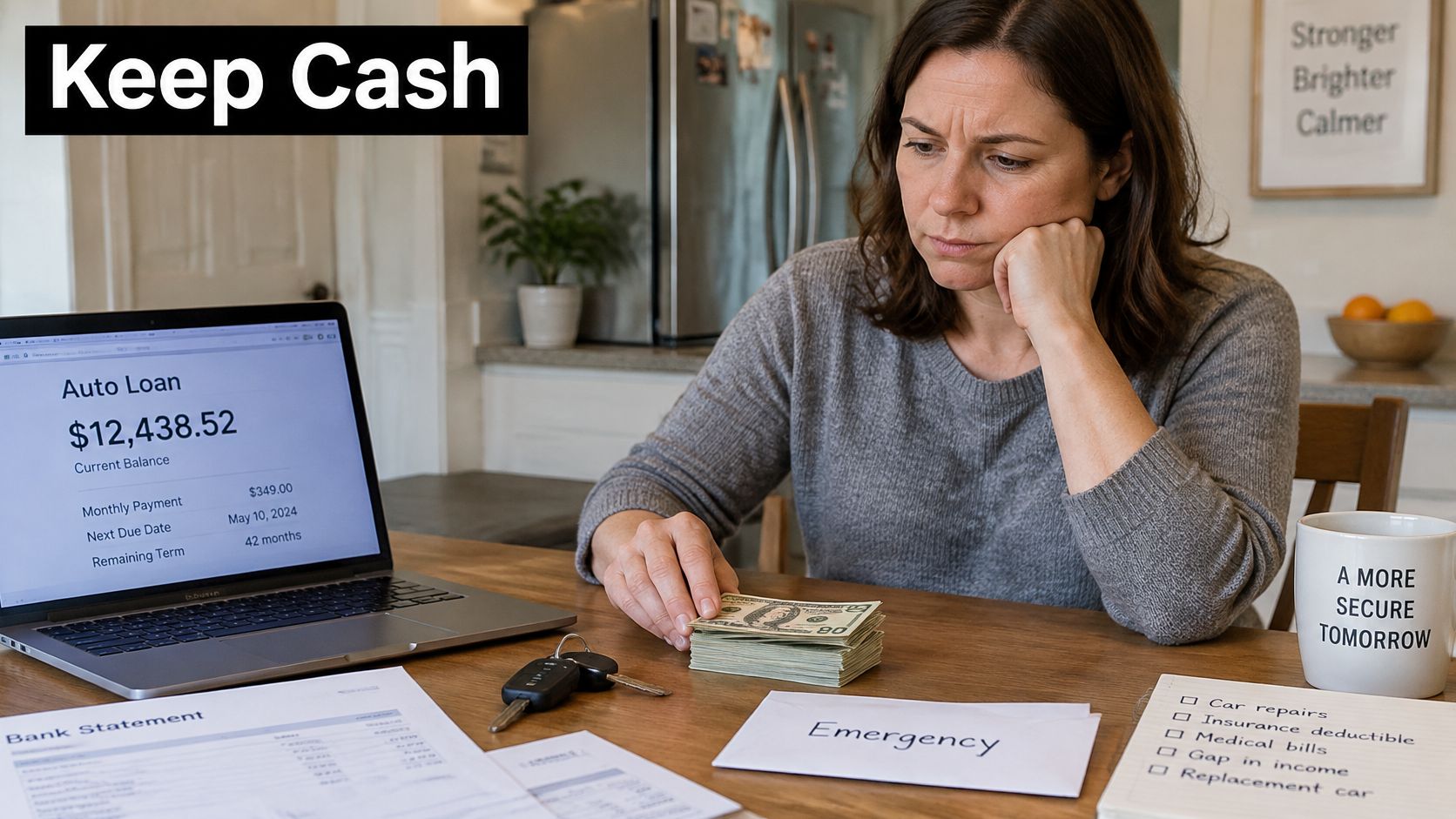
Recent stress data show why liquidity deserves weight, since reporting on auto loan delinquency and longer terms notes that in August 2025, more than 6% of subprime auto borrowers were at least 60 days delinquent, while longer-than-72-month loans increased during the third quarter as lenders stretched terms to reduce monthly payments.
A Repair Bill That Erases the Win
Say a borrower holds $12,000 in savings and pays off an $11,000 balance. The car payment disappears, but only $1,000 remains. A $1,800 transmission repair two months later goes on a credit card, and interest at a card rate can erase the auto interest saved. The household traded a manageable installment payment for expensive revolving debt and no reserve.
The video below walks through the broader trade-off between clearing debt and keeping cash available.
Four Options Worth Testing Side by Side
- Full payoff: Maximum interest saved, maximum cash spent. It suits a high APR and a reserve that survives the payment.
- Partial principal reduction: A lump sum cuts the balance and future interest while keeping part of the reserve. The monthly payment usually stays the same, but the loan ends sooner.
- Accelerated payments: Extra principal each month spreads the cash cost over time. Savings are smaller than a lump sum, but liquidity is never drained at once.
- Preserving cash: No interest saved, but the buffer stays whole. This wins when income is unstable or the car is essential for work.
Rank each option by interest saved, months of expenses still covered, and risk of a missed payment. The right question isn't whether three or six months is the magic number. It's how large the buffer should be after payoff given income volatility, dependence on the car for work, the insurance deductible, and other debts. A fuller framework for choosing between paying off debt and saving sets out that ordering in detail.
The buffer should be sized, not maximized. Holding a large balance in a low-yield account while carrying a high-rate auto loan is also costly, since the loan charges more than the account pays. A reasonable starting target is enough cash to cover essential expenses for the household's realistic job-search window, plus the insurance deductible and one typical repair. If the payoff leaves less than that, a partial reduction usually beats a full payoff.
How an Early Payoff Affects Your Credit Score
Paying off a car loan isn't a missed payment or a negative mark. The effect comes from closure. The active installment account ends, which can change the account mix and age profile that scoring models use, and the score can dip for a short period.
Experian's guidance on paying off a car loan early reports that the impact is usually short-lived, often recovering within a few months, and may be more noticeable when the car loan is the only installment account, one of the oldest accounts, or an important part of the borrower's credit mix.
Two Borrowers, Two Different Answers
Consider a borrower whose only installment account is the car loan and who plans to apply for a mortgage next month. That borrower has a sound reason to ask the mortgage lender or a credit counselor about timing before closing the account. Even a small, temporary dip could matter if the score sits near a pricing threshold for the mortgage rate.
Contrast that with a borrower holding a student loan, several credit cards, and a ten-year record of on-time payments. Closing the auto loan changes little in that profile, because other installment history remains and the overall account age is well established. The detailed mechanics behind why closing a paid loan can move a credit score explain why the same action lands differently on different files.
A temporary score dip is a timing problem, not a reason to keep paying interest for years. It only deserves real weight when a major application is close.
Steps to Take After the Payoff
- Check both credit reports: Confirm the account shows as paid and closed with a zero balance. A stale balance can distort debt-to-income calculations on a later application.
- Allow a billing cycle or two: Lenders report on their own schedules, so a short lag is normal before the closure appears.
- Keep older revolving accounts open where possible: Closing a long-held card at the same time compounds the change to account age and available credit.
Weighed against the cash benefit of losing the monthly payment and the interest saved, the temporary change is usually the smaller number. If no large credit application is near, the credit effect rarely outweighs the savings.
Who Should Pay Off Early and Who Should Wait
Which borrower should use spare cash to clear a car loan, and who should keep the payments? The answer depends on more than the APR: compare interest avoided with the cash buffer that remains, the payoff quote, other debts, and any upcoming credit application. Four profiles show how those factors change the decision.
Dana
Dana owes $18,000 at 14% APR with 42 months left and has $30,000 in savings. Paying off the loan would leave $12,000, enough for about three months of her $4,000 monthly expenses, while avoiding roughly $4,900 in remaining interest. With that reserve intact, paying early looks reasonable. A large payoff fee could reduce the savings enough to change the calculation, as could unstable income that makes the remaining cash especially important.
Marcus
Marcus owes $9,000 at 4.5% APR with 24 months left, has only a $1,500 emergency fund, and earns unstable freelance income. About $430 in interest remains. Paying off the loan would use his entire reserve to avoid that relatively small amount, leaving him less able to handle an unexpected expense. Keeping the scheduled payments while building savings is the stronger choice. The same general trade-off appears in the downsides of repaying low-interest mortgages early: paying off low-rate debt with scarce cash can cost flexibility. Marcus's decision could change once he has several months of expenses saved.
Priya and Ana
Priya owes $7,000 on her car at 9% APR and $4,000 on a credit card at 24%. Each dollar paid toward the card avoids more interest than a dollar sent to the car loan, so the card should come first. Once that balance is cleared, the car loan may become the priority among her debts.
Ana plans to apply for a mortgage in six weeks, and her auto loan is her only installment account. Waiting until after the application, or asking her lender about timing, may be sensible. Her decision turns on when the account closes, not the interest calculation. If the closure affects her credit profile, the timing could matter during the mortgage application.
Verdicts for Four Borrower Profiles
| Profile | Balance and APR | Cash after decision | Verdict | Deciding number |
|---|---|---|---|---|
| Dana | $18,000 at 14% APR, 42 months left | $12,000 left from $30,000 savings | Pay off early | About $4,900 interest avoided |
| Marcus | $9,000 at 4.5% APR, 24 months left | $1,500 emergency fund kept, no payoff | Keep payments and build cash | Only about $430 interest remains |
| Priya | $7,000 car at 9% APR, $4,000 card at 24% | Card paid first | Pay the card first | The card costs more per dollar |
| Ana | Only installment account, mortgage application in six weeks | No payoff yet | Wait until after the application | Credit timing risk |
The same cash has competing uses: paying down costly debt, preserving a reserve, or avoiding a payment during a sensitive credit window. Match the closest profile to your own, then compare the actual payoff quote and fee with the interest left, cash on hand, and timing of any major application.
Check Your Numbers Before You Pay Off the Loan
Six checks convert the analysis into a go or no-go decision before any extra money moves. Each check takes minutes, and failing any one of them changes the answer.
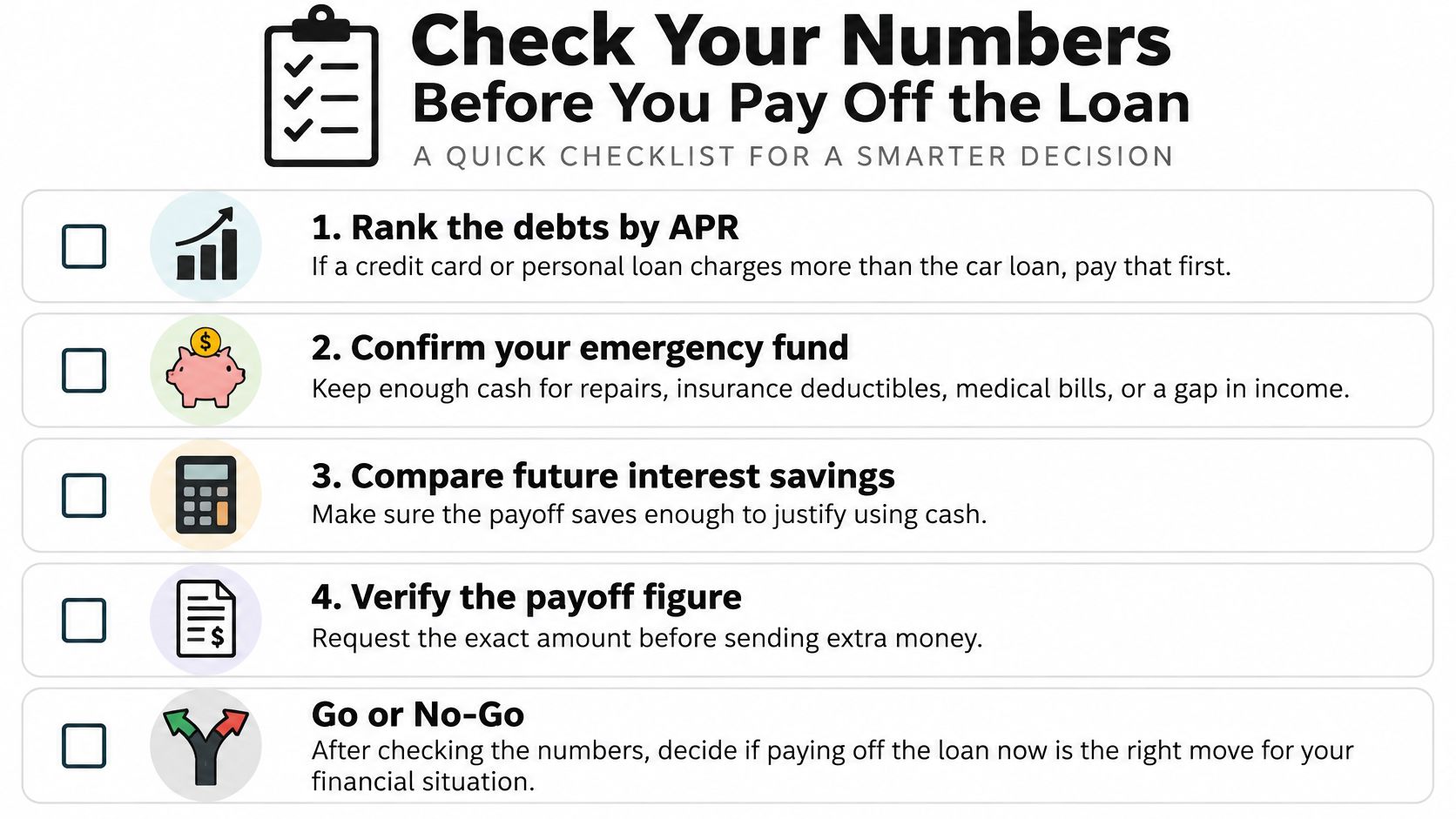
The Six Checks in Order
- Rank the debts by APR: If a credit card or personal loan charges more than the car loan, extra cash goes there first. The highest rate is the highest guaranteed saving per dollar.
- Check the cash buffer: Confirm the cash left after payoff covers the target months of expenses, plus the insurance deductible and a plan for a replacement car. A payoff that empties the account fails here.
- Check the fee: Take the written payoff quote and subtract any prepayment charge from the interest still due. The result must be positive by a margin worth the effort.
- Check the calendar: Confirm no mortgage or other major credit application falls within the next few months. If one does, waiting until it closes protects the score at the moment it matters most.
- Check the remaining term: A loan with only a few months left rarely justifies draining cash, because most of its interest is already paid. Compare the small interest left with the cash and time involved.
- Estimate the result: Using the payoff quote, the APR, and the months left, calculate the debt-free date and the interest saved, then compare both with the return the same cash could earn elsewhere.
That last estimate doesn't require a spreadsheet built from scratch. Toya AI calculates the user's debt-free date based on their current payments and shows which debt to pay extra on and how much interest the user will save. The value preview calculator gives a quick debt-free estimate from three numbers, and connecting accounts in the app gives exact results. Running the car loan through that kind of comparison puts the payoff saving next to every other debt competing for the same cash, which is exactly where the decision belongs.
Go or no-go rule: Pay off early if all six checks pass. If any check fails, keep payments, fix the failing item, and rerun the checks when the balance, rate, or savings change.
The rule holds because each check guards a different failure mode. The APR ranking prevents saving pennies on the car while a card charges dollars. The buffer check prevents a repair bill from becoming new debt. The fee and calendar checks prevent avoidable losses that have nothing to do with the interest rate. A borrower who runs all six has answered the early payoff question with evidence instead of impulse, and that's the standard a five-figure payment deserves.
Ready to see the numbers behind the early payoff decision? Toya AI shows the debt-free date under current payments, which debt deserves extra money first, and how much interest each option saves, so the car loan can be judged against every other use of the same cash. Start with the quick calculator estimate, then connect accounts for exact figures before sending a single extra dollar to the lender.
Ready to start your debt-free journey?
Toya AI builds a personalized payoff plan so you can see your debt-free date and save on interest.
Get Started Free