
Should I Pay Off Debt or Save? a Practical Decision Guide
The question usually arrives at the worst possible time. A couple sits at the kitchen table with a credit-card statement, a nearly empty checking account, and a surprise repair bill waiting in the background. They know extra money should go somewhere, but they can't decide whether to erase debt or create breathing room.
The right answer to “should I pay off debt or save” isn't universal. High-interest debt usually deserves aggressive attention, but cash prevents a bad month from forcing even more borrowing. The strongest plan protects basic liquidity first, then directs surplus toward the liability producing the highest guaranteed cost.
Table of Contents
- The Choice That Shapes Your Next Two Years
- The Four Variables That Drive the Answer
- Three Real Households, Three Different Splits
- Why High-Interest Debt Beats Almost Any Savings Yield
- A Five-Minute Decision Test You Can Run Tonight
- When the Math Says Pay Debt but Your Life Says Save
- Letting an Adaptive Planner Run the Numbers
- Your Next Step and the One Habit That Holds It Together
The Choice That Shapes Your Next Two Years
Consider a household with a $9,400 credit-card balance at 24% APR and $1,200 in savings. Those figures come from a representative decision scenario, not a reported case study. The couple can send every available dollar to the card, or preserve more cash and accept additional interest. Neither choice is emotionally neutral.
Paying the card down faster can reduce future interest and free monthly cash flow. Keeping savings intact can cover a repair, medical bill, or income interruption without sending the household back to the same card. The decision affects cash flow, access to credit, and stress over the following two years.
The stakes are sharper because many households are carrying debt and savings simultaneously. A Federal Reserve Bank of Philadelphia paper reports that U.S. household debt reached $17.8 trillion in the second quarter of 2024, required minimum debt payments were about 10% of total disposable income, and the personal saving rate was below 4% of disposable income. That combination turns each extra dollar into a meaningful choice.
Two competing timelines
The debt-first timeline creates a predictable benefit. Every dollar applied to a balance reduces the interest charged at that balance's APR, assuming the account terms don't introduce a different complication.
The savings-first timeline creates resilience. Cash can stop an unexpected expense from becoming another card balance, even though the money may earn less than the debt costs. A household with irregular income often needs more liquidity than a household with stable pay and dependable benefits.
| Situation | Immediate priority | Why |
|---|---|---|
| No cash and expensive revolving debt | Build a starter buffer, then attack the card | Avoids replacing one emergency with new borrowing |
| Cash cushion and high APR debt | Direct most surplus to the debt | The interest avoided is usually higher than savings yield |
| Low-rate debt and unstable income | Preserve liquidity | Cash-flow risk can outweigh the interest spread |
| Employer match available | Capture the match while meeting obligations | The match can provide a return unavailable from ordinary saving |
The couple at the table shouldn't ask which option sounds more responsible. They should compare the debt APR, available cash, income reliability, essential expenses, and any employer match. Those inputs determine whether the next dollar should buy interest savings or financial resilience.
The Four Variables That Drive the Answer
A useful decision starts with four inputs. They don't carry equal weight, and a severe weakness in one category can override the others.
APR spread
The APR spread compares the cost of debt with the yield on cash. If a card charges more than a savings account earns, paying the balance produces a stronger certain result, because the household avoids interest rather than hoping for investment growth. The interest-savings explanation helps translate an APR into the dollars a payoff could preserve.
Debt terms matter. A revolving card balance, a fixed car loan, and a mortgage shouldn't be treated as interchangeable because all three are debts.
Cash cushion
The cash cushion is the amount below which the household starts borrowing to cover essentials. A practical starting point is enough money for roughly one month of non-discretionary expenses, with the final amount adjusted for dependents, insurance gaps, repairs, and income volatility.
Cash needs a job. An emergency reserve belongs in a separate savings account rather than mixed with daily spending, so the household can identify what is available for genuine shocks.
Cash-flow stability
Income stability measures how predictable the next pay cycle is. A salaried worker with dependable employment faces a different risk from a freelancer whose largest clients can delay payment. Tenure, industry conditions, contract concentration, and benefit coverage all belong in the assessment.
A household with uneven income should be cautious about using every available dollar for debt. The mathematically strongest move can fail if the next month produces less income than expected.
Tax and employer-match considerations
Retirement contributions can change the order. An employer match on a 401(k) can create an immediate benefit that ordinary savings and debt repayment can't replicate. The household still needs minimum payments and an appropriate cash reserve, but ignoring available matching dollars can leave compensation unused.
Practical rule: Protect essential bills and minimum payments first. Then compare the APR spread only after checking whether cash reserves and employer benefits are adequate.
Three Real Households, Three Different Splits
The same question produces different answers because households don't share the same risk. The profiles below use editorial examples to show how the variables interact.
| Profile | Highest Debt APR | Cash Buffer | Income Stability | Recommended Split |
|---|---|---|---|---|
| A, dual-income renter | 22% card | Two months of expenses | Stable W-2 jobs | 70% card, 30% cash |
| B, single freelancer | 14% card | No buffer | Two clients represent 70% of income | Build one-month cushion first, then attack card |
| C, dual-income homeowner | 6% mortgage and 6% car loan | Not specified | Two incomes | Capture full 401(k) match first, then split evenly |
Profile A
The renter has $14,000 on a 22% card, two months of expenses saved, and stable W-2 income. The reserve already provides meaningful protection, so the household can send 70% of extra cash to the card and 30% to savings.
For every $100 of surplus, $70 reduces the expensive balance and $30 maintains the cash position. The split isn't a claim that the reserve must remain unchanged forever. Once the card is gone, the same monthly amount can rebuild savings more aggressively.
Profile B
The freelancer carries $6,000 on a 14% card, has no buffer, and depends on two clients for 70% of income. This household shouldn't copy Profile A. The first priority is a one-month cushion, funded through automatic transfers and expense reductions, while minimum card payments remain current.
After that cushion exists, extra cash can move toward the 14% card. The debt is costly, but the income concentration makes a cash shortage more dangerous. If a client delays payment, the reserve can cover essentials without adding a fresh balance.
Profile C
The homeowner has a 6% mortgage, a 6% car loan, $22,000 in a 401(k), and access to a 4% employer match. Extra debt payments aren't the first move. The household should capture the full match, keep obligations current, and then divide surplus between savings and additional principal.
An even split can be sensible because both debts are low-rate relative to high-interest revolving debt, while the match has separate value. The examples show why a single APR rule misses the decision. Stability, liquidity, debt type, and benefits change the allocation.
Why High-Interest Debt Beats Almost Any Savings Yield
High-interest debt usually wins because the comparison is direct. A MoneySavingExpert example shows £1,000 at 30% costing about £300 in annual interest, while £1,000 saved at 4% earns about £40. Leaving the money in savings makes the saver roughly £260 worse off over a year, before considering taxes or account conditions.
Another comparison places $6,000 in savings at about 4%, producing about $240 annually, against the same amount left on a 21% credit-card balance, costing about $1,260 annually. The Kronos debt-versus-savings example shows why repayment can function like a risk-free return equal to the debt APR.
The break-even calculation
The basic calculation is:
After-tax savings yield compared with debt APR
If savings earns less than the debt costs, the household loses the spread by retaining cash beyond its necessary emergency reserve. A 22% card payoff is economically similar to earning a guaranteed 22% return on the amount removed from the balance. A savings account can't normally match that result without taking a different kind of risk.
| Account Type | APR or Yield | Annual $ Impact on $5,000 | Direction |
|---|---|---|---|
| Credit card example | 24% APR | About $1,200 interest | Pay down |
| High-yield savings example | 4.5% yield | $225 interest | Keep only necessary liquidity |
| Credit card benchmark | 21% APR | About $1,050 interest | Pay down |
| Savings benchmark | 4% yield | About $200 interest | Save for emergency needs |
The Fidelity debt-versus-investing guidance identifies debt above about 6% to 7% APR as generally deserving priority over investing or saving beyond a small emergency buffer. That threshold isn't a substitute for judgment, but it gives households a practical dividing line.
The exceptions are narrow. A low-interest debt, an employer-match window, or potentially deductible interest can justify preserving more cash or investing after the starter reserve is protected. For revolving card balances, the default should be aggressive payoff. A household carrying $5,000 at roughly 22.15% APR could face about $1,100 in annual interest if the balance remains unchanged, based on Federal Reserve-based 2026 card data.
Readers who need help choosing a payoff order can compare best debt snowball calculators, then verify the result against actual APRs and cash needs.
A Five-Minute Decision Test You Can Run Tonight
A short test can produce a useful first recommendation. It won't replace a complete budget, but it prevents the most common mistake, sending every dollar to debt without checking whether the household can survive a disruption.
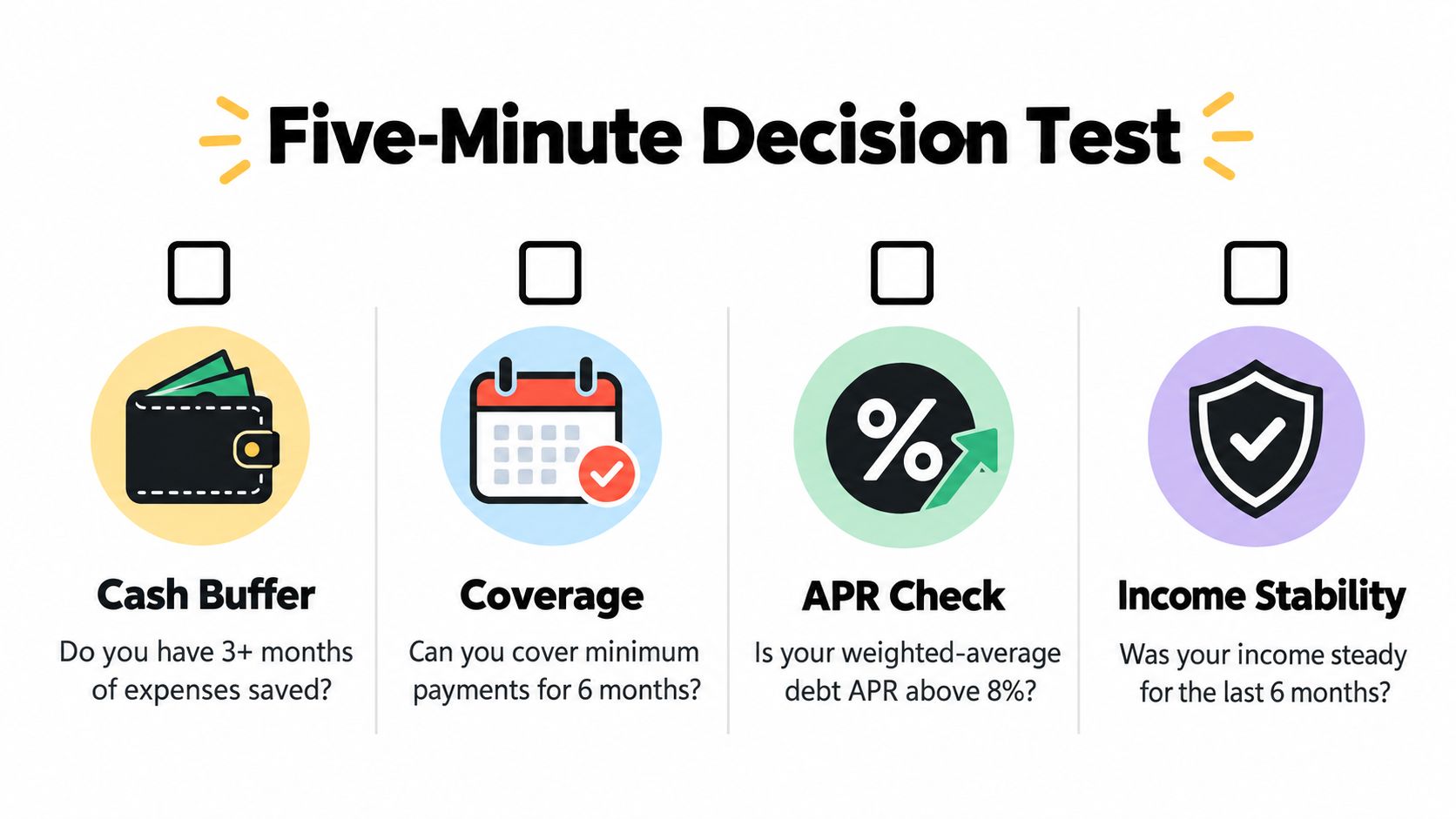
Check the four inputs
Write the answers down rather than relying on memory.
- Cash buffer: How many months of essential expenses can current savings cover? If the answer is zero, build a starter reserve before aggressive repayment unless the household has another reliable safety net.
- Payment coverage: Can the household cover minimum debt payments and essential bills during a short income interruption? If not, savings deserves immediate attention.
- Weighted APR: Calculate the weighted-average rate across debts. Debt above roughly 8% APR should receive more surplus after basic liquidity is protected, while high-teens and above deserves especially forceful repayment. The threshold is a decision aid, not a law.
- Income stability: Review the previous six months qualitatively. Stable wages support a debt-heavy split. Variable income, active job searching, or concentrated clients call for more cash.
Map the result to a split
A household with no buffer and debt above 20% APR should build only a starter cushion while directing the remaining surplus to debt. A stable-income household with mixed-rate debt can use a 60% debt and 40% savings split until the reserve feels durable. Someone actively searching for work or experiencing highly variable income may need to direct 100% of surplus to savings after minimum payments.
Use the free debt payoff calculator to test the payoff side of the decision, then compare the result with the cash required for essential bills.
Five-minute checklist: Current savings, minimum payments, weighted APR, income reliability, and the next realistic financial shock.
The test is a starting point, not a verdict. Account balances, interest rates, and income can change, so the recommendation should change too.
When the Math Says Pay Debt but Your Life Says Save
A spreadsheet can identify the cheapest path and still recommend a plan that collapses. Three risks deserve attention before a household empties its reserve.
Liquidity risk appears when an emergency forces new borrowing. A freelancer may attack a 14% card, face a delayed client payment, and use the card again for groceries or repairs. The balance then returns, and the household has lost cash without solving the underlying vulnerability.
Payment shock occurs when a tight plan depends on every month going well. A large bill, reduced hours, or delayed contract can make the required payment impossible. Minimum payments still matter, and missed obligations can create fees and credit damage that a simple interest comparison doesn't capture.
Behavioral burnout is just as real. A plan that leaves no room for ordinary life can become so restrictive that the household abandons it. A slightly slower payoff supported by a real reserve often beats a theoretically optimal plan that lasts only briefly.
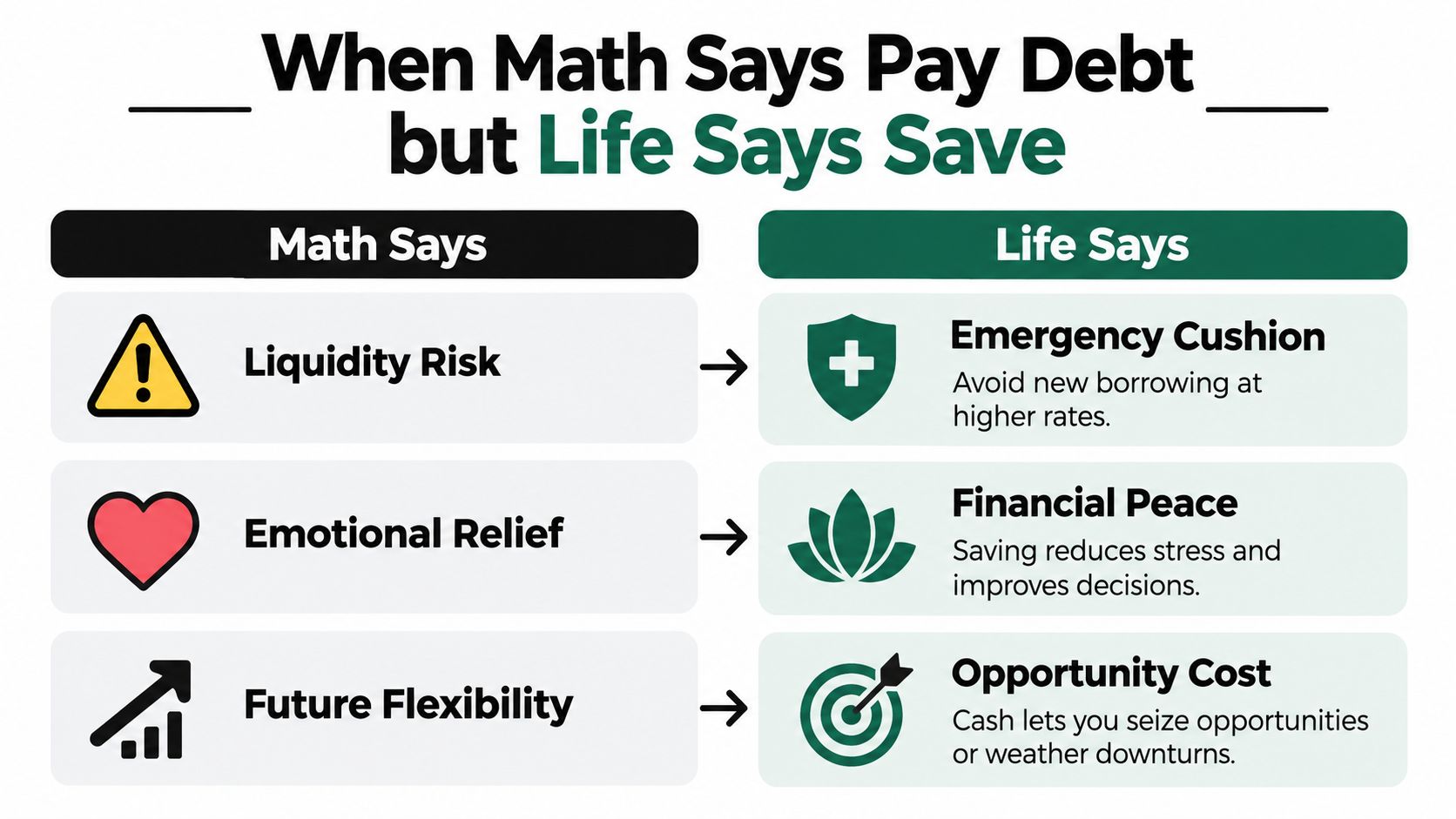
The right response isn't to ignore APR. It's to define a floor. Once savings can absorb a realistic smaller shock, the household can pursue the highest-rate balance with much less risk of reversing course.
Emergency assistance can also change the calculation. Households facing a genuine crisis may review emergency assistance programs before liquidating every reserve dollar or adding expensive debt.
The following video offers another perspective on balancing repayment and financial stability.
Cash isn't automatically the better choice. It becomes the better choice when losing liquidity would likely create a larger problem than the interest saved.
Letting an Adaptive Planner Run the Numbers
Static calculators struggle with real household conditions. They often assume fixed income, steady expenses, and one APR, while actual households juggle variable pay, multiple cards, changing bills, and different due dates.
An account-connected planner can organize transactions, balances, APRs, utilization, and payment dates in one place. It can project near-term cash flow, test a debt-heavy split against a repair or income interruption, and show when additional repayment would leave too little liquidity.
What adaptive planning adds
The key benefit is not automation for its own sake. It's the ability to compare paths using current information. A spreadsheet may say that debt payoff saves interest, but an adaptive model can show whether the proposed payment leaves enough cash for upcoming obligations.
Toya AI is one example of an automated debt-payoff planner. It connects financial accounts through read-only access, analyzes debt and cash flow, recommends a personalized payment split, and recalibrates the plan as balances and circumstances change.

The planner should serve as a second opinion, not a substitute for judgment. A household still decides how much uncertainty it can tolerate, which expenses are essential, and whether a proposed reserve feels adequate.
The practical move is simple: enter current information, test both paths, and inspect the effect on interest, cash availability, and payoff timing. That turns an anxious either-or question into a decision that can be reviewed with evidence.
Your Next Step and the One Habit That Holds It Together
A workable plan starts with a short checklist:
- Cover minimums: Keep essential bills and every minimum debt payment current.
- Set a reserve: Build a starter buffer equal to one month of essential expenses.
- Pull APRs: Check the current rate on every card, loan, and line of credit.
- Track cash flow: Log income and spending for 30 days so the proposed split reflects reality.
- Choose a direction: Apply the five-minute test, then send surplus toward the highest-rate debt or necessary savings.
The first month is diagnostic. It should reveal whether expenses were underestimated, whether income arrives when expected, and whether the reserve is realistic. Adjust the allocation when the data changes instead of treating the original decision as permanent.
The habit that keeps the plan alive is a 20-minute Sunday review. Check the previous week's spending, redirect any windfall, identify upcoming bills, and rebalance debt payments if income shifted. That brief appointment can prevent a car repair, bonus, or slow month from wrecking the entire strategy.
The answer to “should I pay off debt or save” becomes clearer when the household stops searching for a universal rule and starts monitoring its own numbers. High-interest debt generally deserves the surplus after basic protection is in place, but a plan only works if it survives real life.
Pick a direction this week, not when conditions are perfect.
Toya AI can connect account information, organize balances and APRs, and show how different payment and savings choices affect the debt-free timeline. Visit Toya AI to test a personalized plan and replace the debate with a concrete next step.
Ready to start your debt-free journey?
Toya AI builds a personalized payoff plan so you can see your debt-free date and save on interest.
Get Started Free