
Set Up and Pay Off Debt with an Automated Plan
Maya has her banking app open, a credit-card statement beside her, and enough money left after bills for an extra payment on just one account. In this hypothetical example, she has a $3,000 card at 18% APR and a $1,000 card at 14%. The smaller balance looks easier to finish; the higher rate looks more expensive to ignore.
That's the challenge when someone wants to set up and pay off debt: choosing a payment that saves money without leaving the checking account too thin. Automation helps only after the borrower has checked the math, protected essential spending, and decided what should happen when life interrupts the schedule.
Table of Contents
- Payoff Math Before You Automate Anything
- Check Student Loans Before Extra Payments
- Choose Avalanche or Snowball With the Same Cash
- Set Up Accounts, Schedule Payments, and Start Tracking
- Pause Extra Payments Without Missing Minimums
Payoff Math Before You Automate Anything
Months and interest at common card payments
The Consumer Financial Protection Bureau's credit-card comparison guide supplies the larger-balance examples below, including the $232 additional interest and three additional months at the higher rate; its paying-more-than-the-minimum guide supplies the smaller-balance examples and the roughly $550 interest savings and 87-month reduction from increasing the payment by $30.
| Balance and APR | Monthly payment | Months to payoff | Interest paid |
|---|---|---|---|
| $3,000 at 18% | $100 | 41 | $1,015 |
| $3,000 at 15% | $100 | 38 | $783 |
| $1,000 at 14% | about $20 | 110 | about $700 |
| $1,000 at 14% | about $50 | 23 | about $150 |
| $1,000 at 14% | about $90 | 12 | about $80 |
These CFPB examples assume the stated APR, fixed payments, and no new charges. They illustrate separate payoff schedules, not a combined projection for Maya's household.
Turn the rows into decisions
The larger-balance comparison isolates the cost of the interest rate. The smaller-balance comparison shows how strongly the payment amount can change the outcome. Neither means Maya can afford the illustrated payment because a calculator accepts it.
A useful calculation starts with the amount available after required payments and essential spending, not an aspirational amount borrowed from next month's grocery budget. Toya's guide to calculating monthly interest can help a borrower distinguish the payment sent from the portion that reduces principal.
Maya should also distinguish an extra payment from the total payment. Entering surplus cash as the entire monthly payment can produce an unusable schedule, particularly when the account's required minimum is higher.
Practical rule: A payoff estimate is a conditional forecast, not permission to empty the checking account.
Inventory the whole household
Toya AI's 2026 Benchmark Report shows that 60% of consumers carry credit-card debt while also managing student or auto loans. It also found that the average consumer manages 2.2 types of debt at the same time. Maya's card math is therefore a template, not a complete household plan.
Different debts also need different contract checks. For a borrower with a land installment agreement, Dollar Land Store's a repayment guide for owner-financed land is a relevant companion when reviewing accelerated payments alongside the agreement's terms.
Before scheduling anything, record these eight fields for every debt:
- Creditor: The lender or servicer receiving payment.
- Balance: The current amount owed, with the statement date.
- APR: The rate currently applying to the balance.
- Minimum payment: The required amount, not the preferred payment.
- Due date: The billing-cycle deadline.
- Promotional-rate expiration: The date a temporary offer ends.
- Delinquency status: Whether anything is already overdue.
- Interest calculation: Whether interest accrues daily or monthly.
An overdue account needs attention before an otherwise tidy ranking. A promotional balance needs an expiration date, not merely today's attractive rate.
Check Student Loans Before Extra Payments
A federal student loan shouldn't enter an accelerated payoff schedule until the borrower has confirmed its type, repayment options, and potential forgiveness path. A high balance alone doesn't establish that paying it faster is the best use of cash.
Verify eligibility before choosing a target
A verification checklist keeps uncertain benefits separate from ordinary interest calculations:
- Identify the loan: Label each account federal or private rather than assuming the servicer's name establishes its type.
- Confirm account status: Check the servicer, repayment plan, required payment, and any overdue amount.
- Review payment options: Determine whether an income-driven plan or another available arrangement could lower the required payment.
- Check forgiveness: Verify whether employment, loan type, and payment history could support a public-service or other forgiveness path.
- Document the answer: Save the eligibility information and servicer correspondence before authorizing recurring extras.
The TICAS student-debt survey found that 42% of federal student-loan borrowers made trade-offs between loan payments and basic needs, while 20% reported being delinquent or in default. The same survey found that 15% had heard nothing about income-driven repayment plans and 51% had heard only a little.
Those findings support a verification-first approach, not an assumption that every borrower should accelerate repayment. Toya's guide to choosing a student-loan repayment plan offers a starting point for organizing that comparison.
A document review should include the loan agreement and current repayment information, not just the dashboard balance.

For borrowers financing medical training internationally, Medical School Programs' explanation of medical school financial aid eligibility abroad helps frame the funding questions. Eligibility for education funding and eligibility for repayment relief are separate checks.
Understand where the extra payment goes
Federal Student Aid's repayment guidance illustrates a $10,000 Direct Unsubsidized Loan at 6.8% accruing approximately $1.86 daily, with a Standard Repayment Plan payment of about $115. Extra payments may arrive before the due date or exceed the amount due, but accrued interest is satisfied before principal.
That distinction matters when a borrower expects the entire extra payment to reduce the loan balance. Outstanding interest can absorb the payment first.
Federal Student Aid's interest guidance explains that traditional Standard, Graduated, or Extended payments cover interest accruing between payments, while an income-driven payment may not; its example leaves $30 unpaid when monthly interest is $100 and the payment is $70. If unpaid interest later capitalizes, the borrower owes interest on a larger principal balance.
The decision test is practical: compare an extra dollar sent to a potentially forgivable loan with a dollar sent to Maya's expensive, non-forgivable card or retained for rent. Student-loan extras should wait until required payments are secure and forgiveness has been ruled out or deliberately evaluated.
Once acceleration makes sense, the borrower should give the servicer allocation instructions for the intended loan and request principal application after accrued interest is satisfied. The posted transaction, not the instruction alone, confirms the result.
Choose Avalanche or Snowball With the Same Cash
Avalanche versus snowball on the same surplus
| Rule | Extra payment goes to | Choose it when | Main trade-off |
|---|---|---|---|
| Avalanche | Highest APR still accruing interest | Rates are stable and the borrower will keep paying | Lowest interest if the borrower sticks with it |
| Snowball | Smallest balance | Early account closures support consistency | Can cost more interest than avalanche |
| Re-rank trigger | Whichever rule the borrower chose | A promotional rate ends, a penalty APR appears, or a payment is missed | A static list goes stale |
Maya's comparison should use identical cash flow under both rules. In a hypothetical run with an extra $100 available monthly, avalanche sends that surplus to her higher-rate card while preserving the smaller card's required payment; snowball reverses those targets.
The comparison isn't valid if the snowball model assumes more money, a different starting date, or fewer expenses. The borrower needs the total interest difference in dollars beside the difference in final payoff dates, plus the date of the first account payoff.
Calculate the behavioral trade-off
The repayment research summarized in the Journal of Consumer Research found that concentrated payments increased motivation in a field study and three experiments, especially when they proportionally reduced the smallest account; among nearly 6,000 debt-settlement clients, smallest-balance-first borrowers were about 14% more likely to eliminate debt after one year and 43% more likely by year four.
Those debt-settlement findings don't establish that snowball is universally better for cardholders. They do establish a reason to take persistence seriously rather than treating it as an irrelevant preference.
A borrower who will maintain payments despite slow visible progress should generally choose avalanche; a borrower whose consistency improves materially after an account payoff should consider snowball when the modeled interest penalty is modest.
A cheaper schedule that gets abandoned can cost more than a slightly pricier schedule the borrower completes.
Maya shouldn't choose based only on which balance feels satisfying to erase. The comparison needs an honest answer about whether an early payoff will change her behavior or merely feel pleasant that afternoon.
Separate progress from savings
Experimental findings in the Journal of Public Policy & Marketing describe borrowers prioritizing a smallest or nearly payable card over a higher-APR account, particularly when spending a windfall or reward. A bonus therefore deserves the same target review as regular earnings.
Each candidate payment should be assessed on distinct outcomes:
- Balance reduction: How much principal disappears after interest and fees?
- Interest avoided: What financing cost does this allocation prevent compared with the alternative?
- Plan continuation: Will the remaining budget support the next scheduled payment?
A zero balance answers the first question, not all of them. Closing an account balance also doesn't require closing the credit account itself; that is a separate decision.
The ranking must change when account conditions change. An expired promotion, penalty rate, missed payment, or revised minimum can make yesterday's target inappropriate.
A reliable comparison also includes promotional resets, fees, interest calculation methods, and changing minimums. Snowball is a behavioral option with a measurable price, not a claim that smaller balances are always cheaper to repay.
Set Up Accounts, Schedule Payments, and Start Tracking
A workable setup has a clear finish line: the selected target has a scheduled extra payment, the other accounts have protected minimums, and a review date sits on the calendar. Planning and payment execution remain separate tasks until the lender confirms the arrangements.
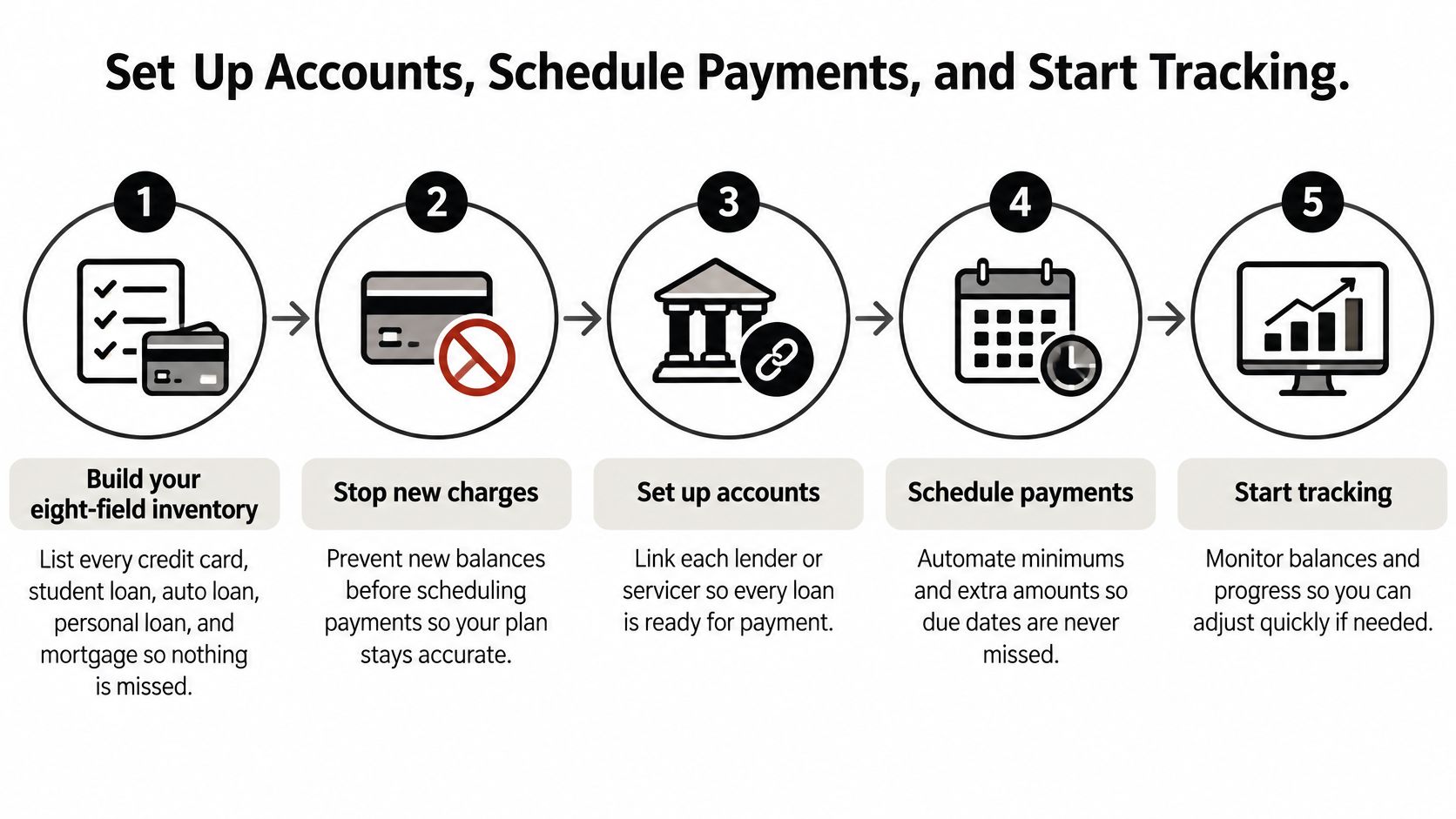
The workflow below keeps account preparation ahead of payment scheduling.
Prepare the accounts and available cash
Complete the inventory across every debt type, including credit cards, student loans, auto loans, personal loans, and mortgages, because a missing account produces an overstated surplus. Use the fields already collected and reconcile each entry with the lender's current statement.
Stop new charges on payoff cards, because purchases make the projected balance inaccurate and can undermine the planned interest savings. Move recurring charges to a funded payment method rather than merely putting the physical card away.
Connect accounts for a consolidated view, because scattered statements make rate changes and approaching deadlines easier to miss. Toya AI's first connection step securely links credit cards and loans via Plaid with read-only access and no credit pull; it builds a personalized plan from real account data and shows a debt-free date in minutes, based on current payments.
Establish the spendable surplus, because a payment drawn from money already committed elsewhere isn't affordable. List take-home income and must-pay bills, then retain enough cash for an identifiable irregular bill before assigning the remainder to accelerated payoff.
Before connecting accounts, Toya AI's preview calculator can estimate a debt-free date from three numbers; connected balances provide precise account-based projections. At least one valid credit card or loan is needed, and Toya AI builds around existing debts rather than consolidating or moving them.
Schedule execution and verify results
Automate required payments through the lender or servicer, allowing processing time before each deadline because initiating a transfer isn't the same as receiving payment. Toya's explanation of the credit-card payment due date helps distinguish billing deadlines from other statement dates.
Schedule the entire extra amount to the selected target, using the payday after required payments have cleared because that sequence reduces accidental overcommitment. Add a reminder and check whether the lender's regular autopay will still occur after a separate payment.
Roll a paid-off account's former minimum into the next target, keeping the total debt budget unchanged because otherwise the household gives up repayment capacity. Confirm any residual interest and the final posted balance before redirecting that amount.
Review transactions each payday, because pending payments, changed minimums, and income changes can invalidate the schedule. Confirm posted amounts, reconcile balances, and recalculate after a job loss, raise, or newly opened card; Toya AI automatically recalculates its plan when those circumstances change.
The most consequential setup slip is assuming a read-only connection authorizes lender payments. Borrowers should verify actual payment enrollment and confirmation separately, rather than treating an account appearing on a dashboard as proof that its bill will be paid.
For renters also organizing payment records, Mediation & Negotiation Services (M&N) explains considerations for building a stronger renter credit profile. That task belongs alongside reliable bill administration, not ahead of the money needed for housing.
Completion check: A saved plan isn't an executed payment. The lender's confirmation and posted transaction establish whether the money arrived.
This video provides an additional walkthrough alongside the account setup process.
Once the arrangements are active, the household needs a review habit rather than constant tinkering. Routine verification catches errors without turning every balance fluctuation into a reason to abandon the chosen strategy.
Pause Extra Payments Without Missing Minimums
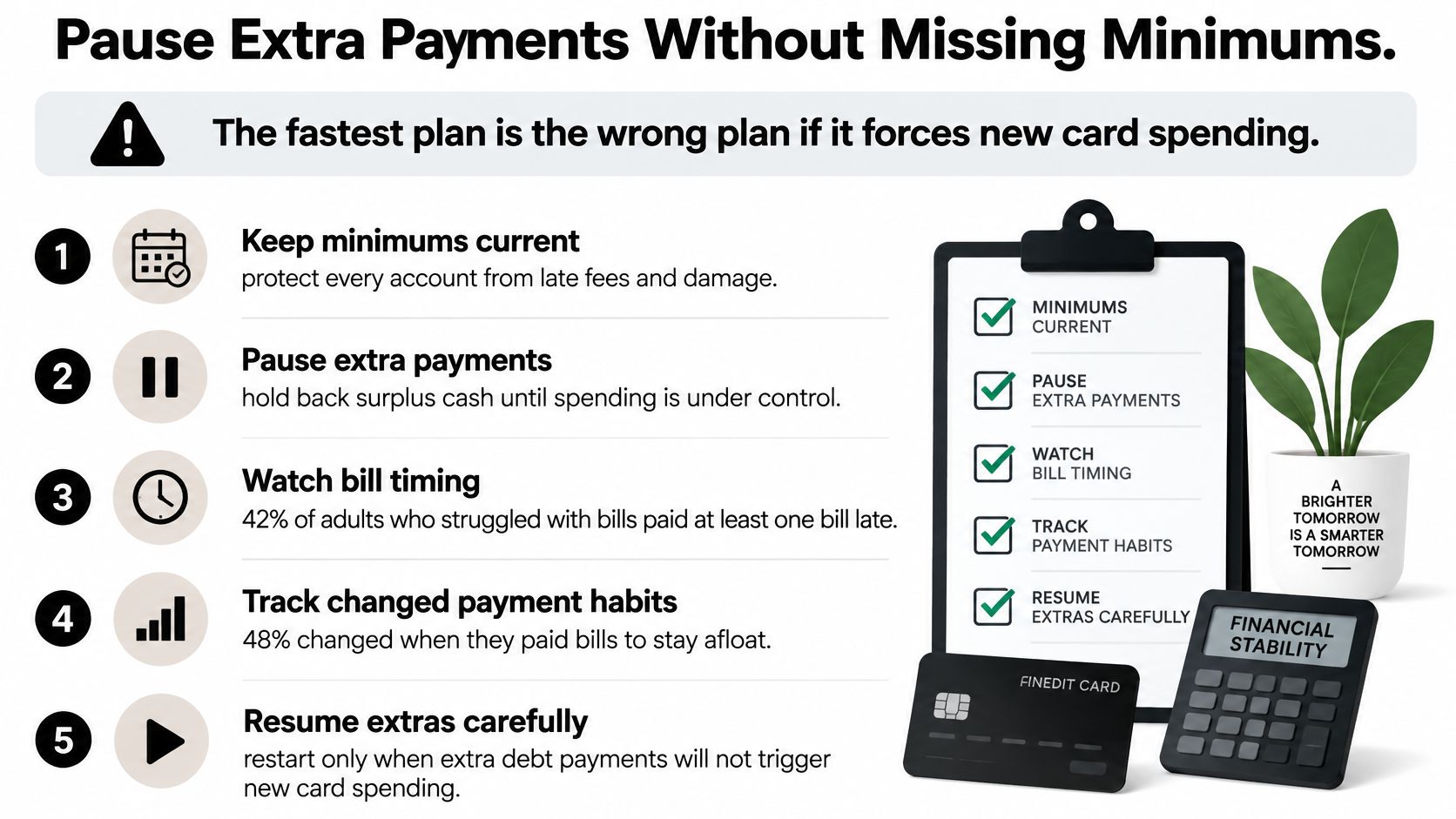
Among adults who struggled with bills, 42% paid at least one bill late, 48% adjusted payment timing, and 23% used a credit card to pay a bill over time, according to the Federal Reserve's household economic-hardship findings. The same findings show average credit-card balances rose more than 35% since 2023 among people who said they were finding it difficult to get by.
The fastest plan is the wrong plan if it forces new card spending. A temporary pause can protect the household from replacing repaid debt with fresh borrowing.
Protect a stability floor
Available cash needs an explicit order before any accelerated payment leaves checking:
- Debt minimums: Reserve the required payments across accounts.
- Immediate-risk bills: Protect housing, utilities, insurance, and other obligations carrying immediate penalties or service risks.
- Cash buffer: Retain money for a plausible, identifiable expense.
- Target surplus: Send only the remainder toward accelerated payoff.
If income can't cover that floor, the borrower needs hardship arrangements and essential-expense triage, not a more aggressive target. A shutoff or housing emergency can require immediate attention rather than mechanically following a spreadsheet's order.
The checklist makes the distinction between pausing acceleration and abandoning required payments.
Maya's repair changes the next payment
Suppose Maya faces a hypothetical $400 car repair, has $200 already reserved, and can retain her usual $100 surplus across two payment cycles. Skipping those two extra payments completes the repair fund while she keeps both card minimums current.
Without the existing reserve, two skipped extras wouldn't cover the repair. That missing cash must be acknowledged rather than hidden inside an optimistic restart date.
If Maya instead uses the repair reserve to finish a lower-rate balance and then charges the repair to her higher-rate card, she substitutes expensive borrowing for liquidity. In this hypothetical case, a $400 charge at 18% APR produces about $6 in a month's interest using the simplified calculation of balance multiplied by APR divided by twelve; actual charges follow the card's daily balance and billing terms.
The repair posting isn't, by itself, a signal to resume extras. Maya should restart on the next payday only when the repair is funded, any resulting card charge is cleared, and upcoming essentials remain covered.
Make a pause temporary and specific
A job loss, medical bill, or named seasonal expense can justify retaining surplus. A sudden APR jump calls for recalculation first; it warrants a pause only when the revised obligation threatens cash needed for essentials.
A useful adaptive comparison shows the projected debt-free date under two choices: making the extra payment now or retaining the cash. The later date may be the better decision when it prevents another borrowing cycle.
Restarting requires confirmed posted balances, on-time minimums, and an affordable surplus directed to the current target. Success means less debt without a new emergency balance, not merely a faster-looking forecast.
Toya AI builds a personalized payoff plan from connected account data and shows which payment comes next and how it affects interest and timing. Visit Toya AI to compare a repayment path with a cash-flow-aware plan that can adjust when circumstances change.
Ready to start your debt-free journey?
Toya AI builds a personalized payoff plan so you can see your debt-free date and save on interest.
Get Started Free