
How to Calculate Savings Per Month for Your Goals

A household may be trying to pay down a credit card, build a cash cushion, and save for a home down payment at the same time. The question isn't how much to save each month. It's how to set a contribution for each goal without letting one undermine the others.
A useful plan starts with the amount needed, the deadline, what's already saved, and the room left in the monthly budget after essentials and required debt payments. That turns savings per month from a vague target into an amount the household can check, automate, and adjust.
Table of Contents
- Why Monthly Savings Targets Differ by Goal
- Build Your Savings Goal From the Deadline Backward
- Account for Interest Without Overcomplicating the Estimate
- Compare Debt, Emergency, and Down Payment Targets
- Preview Outcomes With a Quick Calculator
- Turn the Estimate Into an Adaptive Monthly Plan
- Commit to a Savings Plan You Can Verify
Why Monthly Savings Targets Differ by Goal
Consider a household juggling a credit card balance, an emergency reserve, and a down payment. The credit card has an interest cost and a required minimum payment. The emergency reserve needs to stay accessible. The down payment has a target tied to a future home purchase, but its deadline may shift. One catch-all savings number can't reflect all those differences.
Instead, the household should give each goal its own target and contribution. Required debt payments belong in the budget as obligations, not as optional savings. Any additional debt payment is a deliberate choice that competes with other goals, so the trade-off should be visible rather than buried in a general “save more” rule. For a household weighing debt payoff against building savings, guidance on whether to pay off debt or save can help frame that decision.
Emergency savings also deserves a clear place in the plan. In the Federal Reserve's 2024 Survey of Household Economics and Decisionmaking, 55% of U.S. adults reported having enough set aside to cover three months of expenses, compared with 47% in 2015; the share reached a high of 59% in 2021 (Federal Reserve household savings data). Those figures describe how many people had a reserve, not what every household should contribute. A target still needs to fit the household's expenses, risks, and cash flow.
The best monthly target isn't simply the largest affordable number. It's an amount the household can sustain, automate, and review.
Build Your Savings Goal From the Deadline Backward
The simplest way to calculate a monthly contribution is to work backward from the goal. The calculation needs four inputs: the target amount, the current savings balance, the months remaining, and the planned monthly contribution.
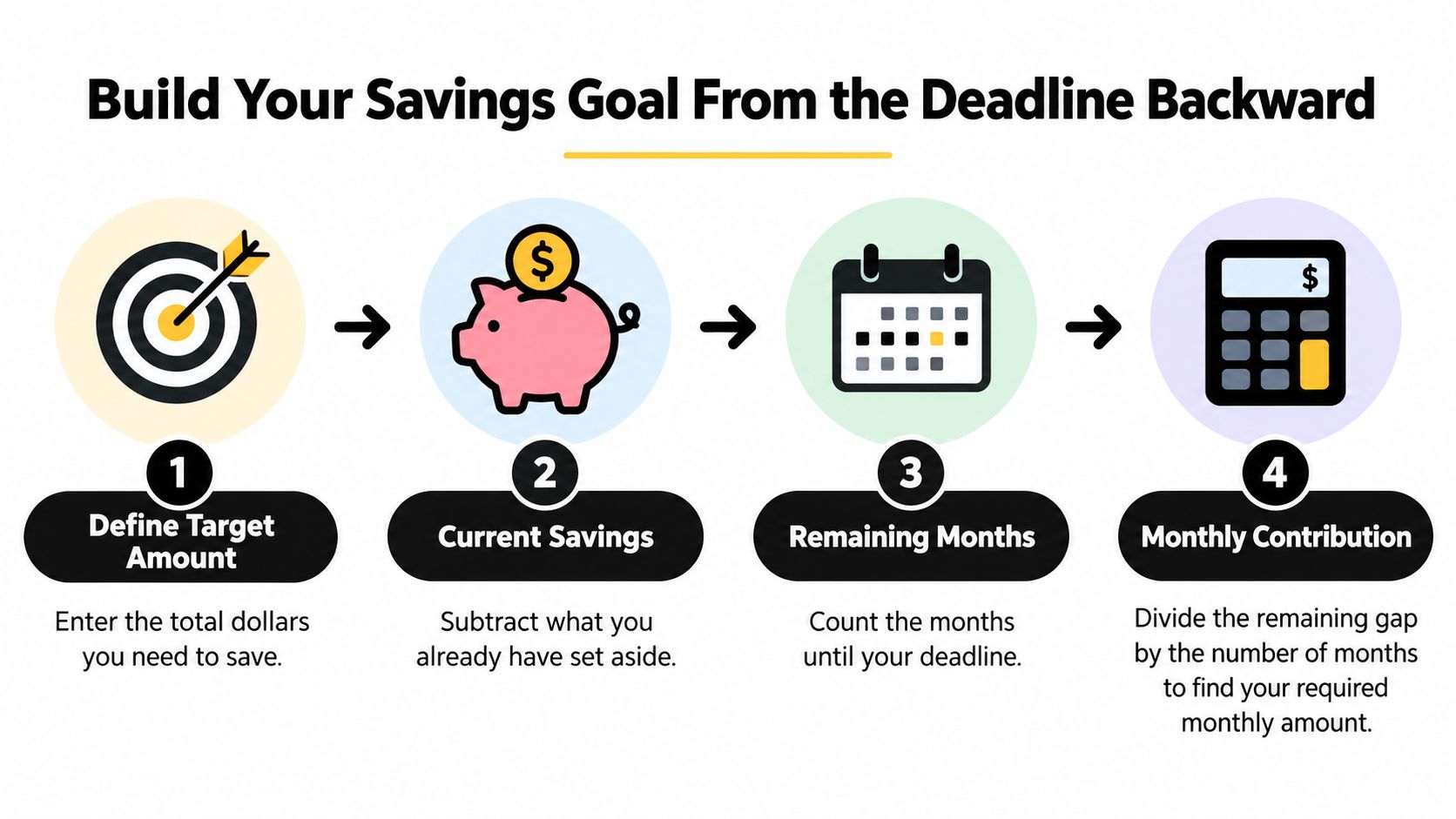
For a first estimate that doesn't count interest, use this formula:
Monthly contribution = (target amount − current savings) ÷ months remaining
For example, a person who wants $2,400 in 12 months and has $0 saved needs to contribute $200 per month. With $600 already saved, the remaining gap is smaller, and the required contribution falls to $150 per month. The starting balance matters because the monthly deposit only has to cover what's left.
The deadline changes the amount too. A $2,400 goal reached with $200 monthly contributions takes one year; contributing $100 monthly requires two years. Neither schedule is automatically better. The right choice depends on when the money is needed and whether the contribution fits the budget.
The SEC's Investor.gov savings-goal calculator asks for a desired final balance, initial investment, saving period, estimated annual interest rate, and compounding frequency before calculating a monthly contribution. It can help test the math, but the household still needs to choose a realistic target and deadline.
Before setting up a transfer, record the goal, target, starting balance, deadline, monthly contribution, and remaining gap. That keeps the balance milestone separate from the action required to reach it.
Account for Interest Without Overcomplicating the Estimate
Interest can help an interest-bearing account grow, but it shouldn't rescue a contribution that the household can't afford. Start with the no-interest calculation. That gives a clear baseline without relying on a future return that may differ from the estimate.
Then use interest as a second pass. Investor.gov's compound-interest calculator accepts an initial investment, monthly contribution, number of years, and estimated interest rate so users can compare how recurring deposits affect an outcome. The calculator is useful for testing assumptions, not for guaranteeing a particular result.
The contribution itself often matters more to a near-term goal than a small change in the interest assumption. Contributing $250 per month for 12 months adds $3,000 before interest. Raising the monthly amount to $300 adds $3,600, a $600 difference before interest. That gap comes directly from the larger deposits.
A practical approach is to calculate twice:
- First, find the affordable baseline. Divide the remaining goal amount by the months available, without counting interest.
- Then, preview a return. Enter a cautious interest estimate and compare the result, while keeping the planned contribution within the household's budget.
If the calculator suggests the goal might be reached sooner, treat that as a possible upside. Don't spend the projected interest in advance or lower the contribution until the revised plan still works under a less favorable outcome.
Compare Debt, Emergency, and Down Payment Targets
These goals need different inputs, so they shouldn't share one formula without adjustment. Debt payoff depends on the balance, interest, required minimums, and how long the household wants to take to repay. An emergency reserve depends on essential expenses and the risks the household needs to cover. A down payment depends on a property target, the amount already saved, and the purchase timeline.
| Goal | Key Inputs | Calculation Focus | When to Recalculate |
|---|---|---|---|
| Debt payoff | Balance, interest rate, minimum payment, payoff deadline | Required payments plus any extra amount directed to principal | After a rate, balance, or budget change |
| Emergency savings | Essential expenses, current reserve, household risks | Target reserve minus current savings, spread across the chosen timeline | After a withdrawal, income change, or major life event |
| Down payment | Home price, required percentage, current savings, purchase deadline | Target down payment minus existing savings, divided across remaining deposits | When the expected price or deadline changes |
For a debt-payoff arithmetic example, divide the balance by the available payoff months to estimate a basic monthly principal target. That estimate isn't the full payment when interest applies, and it doesn't replace required minimums. The household must account for both before deciding how much extra to direct toward the balance.
For emergency savings, define a target in months of essential expenses rather than choosing a universal percentage of income. Subtract the reserve already set aside, then divide the remaining gap by the planned saving period. An emergency fund calculator can help organize those inputs.
For a down payment, multiply the planned home price by the required percentage to find the target, subtract existing savings, and divide the remaining amount by the months until purchase. The property price and timeline set the size of the task. A household exploring eligibility and local options can also review information about first-time buyer grant programs.
These examples show how the arithmetic changes by goal. They aren't universal recommendations: a debt plan needs an interest-aware payment strategy, an emergency reserve protects financial continuity, and a down payment has a target shaped by a specific purchase.
Preview Outcomes With a Quick Calculator
A quick calculator makes it easier to compare plans before a household commits to a transfer. Enter the target, starting balance, time horizon, and monthly contribution. If the tool supports interest assumptions, add them only after the basic estimate is clear.

Change one input at a time. For a $2,400 goal, compare what happens with $200 per month against $100 per month. The first contribution reaches the target in a year without interest; the second requires two years. That comparison shows whether the household should protect the deadline, lower the monthly amount, or revisit the target.
A calculator preview is also useful for longer timelines. A household can enter its starting balance, monthly deposit, years, and estimated interest rate, then see how recurring deposits affect the projected balance. If the result depends heavily on an optimistic interest assumption, the contribution or deadline needs another look.
Debt planning is a separate calculation. Toya AI offers a personalized debt-payoff workflow: after users connect accounts through supported trusted partners, it uses read-only access and no credit pulls to organize balances, APRs, utilization, due dates, and cash flow. Its projections show how payment choices affect the debt-free date, monthly interest, and total cost. That can help compare debt-payoff options, but it isn't a general household savings calculator.
A fast estimate is most useful when the inputs are visible and easy to change. The following video offers another way to review the goal-planning process.
Turn the Estimate Into an Adaptive Monthly Plan
A calculated contribution only works if the household can repeat it without shortchanging essentials. Schedule the transfer after payday, choose an amount that fits current cash flow, and review it against the goal rather than relying on whatever remains at month's end. If income varies, a base contribution can provide consistency, with a chosen share of unusually large paychecks or windfalls directed toward the largest remaining gap.
Irregular expenses need their own monthly line. In 2025, 59% of U.S. adults reported at least one major unexpected expense during the previous year; common examples included major vehicle repairs or replacement (30%), house or appliance repairs (22%), and major medical expenses (21%) (Federal Reserve Bank of St. Louis, household expenses). When a cost is expected to recur, estimate its annual total and divide by the number of monthly deposits before it comes due. That creates a sinking fund instead of leaving the bill to compete with emergency savings.
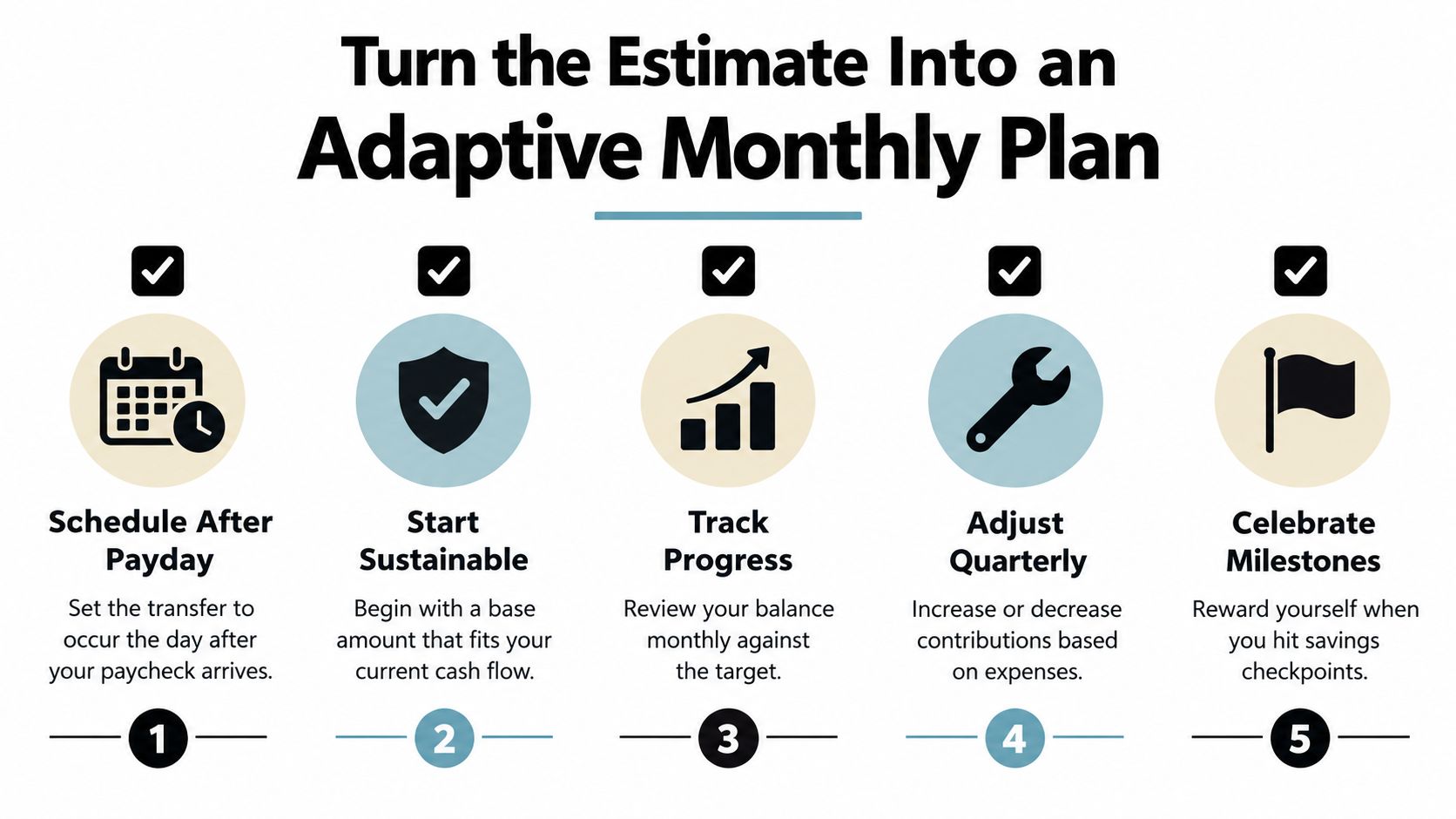
Track three figures together: the planned monthly contribution, the time elapsed, and the amount still needed. A balance by itself doesn't show whether the household is on schedule. A withdrawal, pay change, major bill, debt-rate change, or life event can alter the plan, so recalculate when one changes the available cash or the goal.
A household may need to redirect contributions between an emergency reserve and high-interest debt as circumstances shift. That isn't a budgeting failure; it's a fresh decision about risk and cost. A budget-planning guide can help make those competing obligations visible before changing transfers.
Commit to a Savings Plan You Can Verify
A useful plan can be checked without guesswork. The household should be able to identify what the goal is for, how much remains, when the money is needed, and whether the monthly contribution leaves enough cash for essential obligations and required debt payments.
Before automating a transfer, compare at least two contribution-and-deadline combinations. A higher contribution may protect a deadline but leave less room for bills; a lower amount may preserve flexibility but delay the goal. Write down the option chosen and the point at which the calculation will be reviewed again.
The plan should also distinguish a fixed commitment from a flexible contribution. Required payments and essential costs come first. A savings transfer should be sustainable enough to continue, with adjustments made deliberately when income, balances, or priorities change.
A sound savings-per-month target is specific, affordable, and adaptable.
Today, calculate one simple goal from its target, current balance, and deadline. Test a lower and a higher monthly contribution, automate the amount that fits, and revisit the result after the next meaningful change in income, balances, or goals.
Toya AI helps people organize debts and compare personalized payoff plans, including how payment choices affect interest and payoff timing. For a clearer view of debt alongside monthly savings goals, visit Toya AI and explore its debt-planning tools.
Ready to start your debt-free journey?
Toya AI builds a personalized payoff plan so you can see your debt-free date and save on interest.
Get Started Free