
Personal Loan vs Credit Card Debt: The Real Cost
The popular advice is simple: take out a personal loan because its interest rate is lower than a credit card's. That advice is incomplete. A personal loan can reduce interest and create a finish line, but only if the borrower qualifies for a meaningfully lower APR, understands the fees, and can handle a fixed payment through bad months as well as good ones.
The right question in a personal loan vs credit card debt decision isn't which product looks better in an advertisement. It's which structure will cost less and remain sustainable until the balance reaches zero.
Table of Contents
- Rethinking the Standard Debt Advice
- Mechanical Differences in Repayment Structures
- Calculating the True Cost of Borrowing
- Navigating Credit Scores and Rate Eligibility
- Real World Scenarios and Situational Choices
- Your Step by Step Decision Framework
- Automating Your Payoff Strategy with Toya AI
Rethinking the Standard Debt Advice
A lower headline APR doesn't automatically make a personal loan the superior choice. The advertised rate may be reserved for borrowers with excellent credit, while another applicant receives an offer close to the rate already charged by the credit card. Origination fees can narrow the gap further, and a fixed installment payment can become dangerous when income changes from month to month.
Rate eligibility is the first filter. LendingTree's 2026 analysis found that a borrower with a 760+ credit score could save $1,750 and finish six months sooner by moving $10,000 of card debt to a personal loan, but the calculation assumed a 13.34% personal-loan APR versus a 20.18% credit-card APR. The result is useful, but it isn't a promise. It shows that the savings came from securing a substantial rate difference, not from the word “loan” itself. (LendingTree's comparison of personal loans and credit card debt)
A borrower offered a personal-loan APR near the existing card APR doesn't get the same benefit. If that offer also carries an origination fee, the loan may simplify the bills without reducing the true cost. Simplification has value, but it doesn't justify pretending an expensive offer is a bargain.
The payment can be the real risk
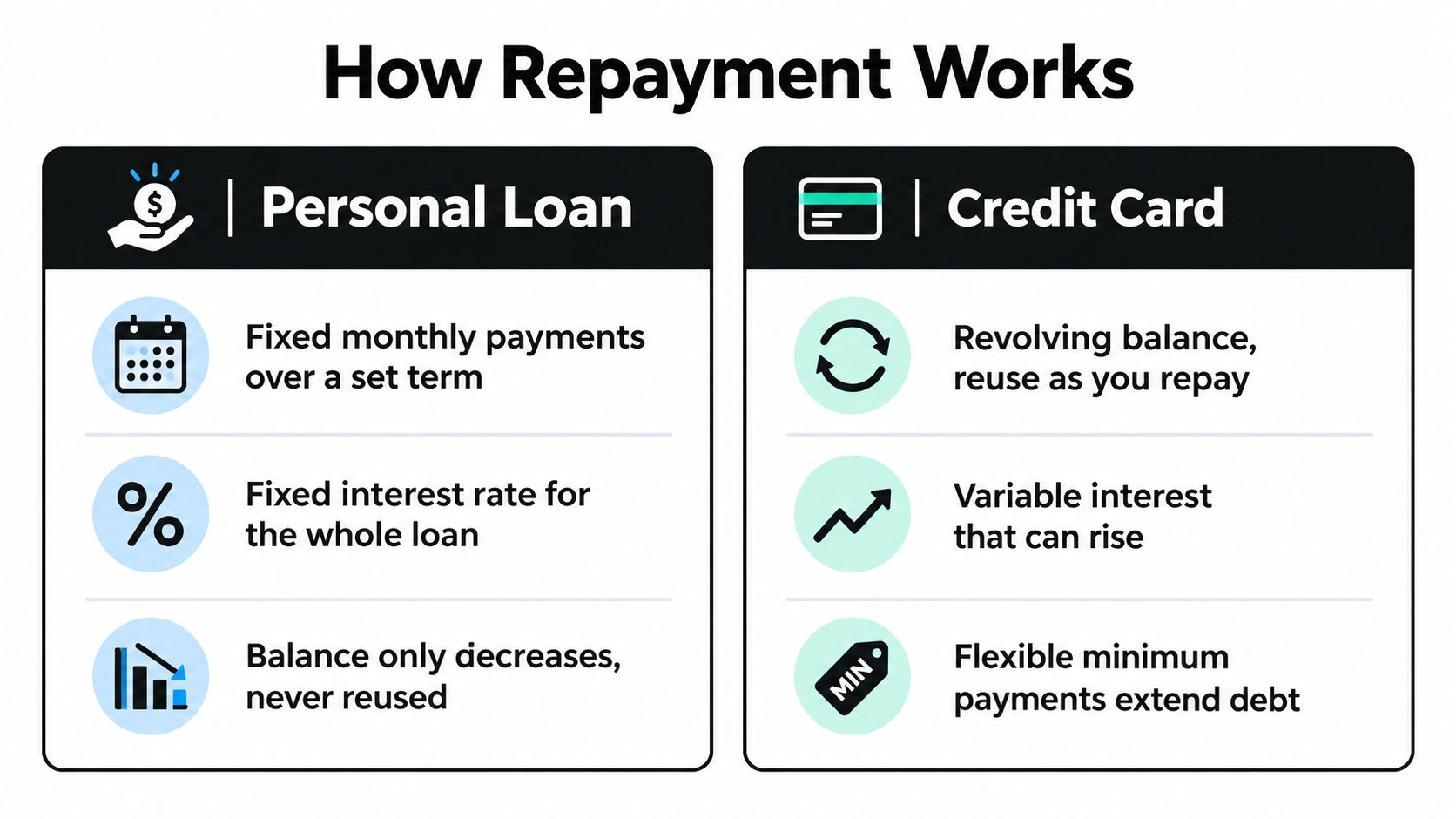
Credit cards provide flexibility because the required payment can fall as the balance falls. That flexibility can protect a household during an uneven month, but it also permits debt to linger. Personal loans reverse the arrangement. The borrower gets a fixed bill and a defined end date, which can create discipline but removes room to reduce the payment voluntarily.
A freelancer with irregular invoices may be able to pay aggressively after a strong month and pay less during a slow month. A personal loan doesn't usually accommodate that pattern. Missing the fixed obligation can create a more immediate problem than making a smaller card payment.
Practical rule: A personal loan is a good consolidation tool only when the lower cost comes with a payment the borrower can sustain without using the cards again.
The decision therefore has two tests. First, does the loan's APR and total repayment beat the card? Second, can the borrower make the fixed payment while preserving enough cash for essentials and irregular expenses? If either answer is no, the lower advertised rate is irrelevant.
Mechanical Differences in Repayment Structures
The product design often matters more than the advertised rate. A credit card is revolving debt: you can spend, repay, and spend again, with no built-in payoff date. A personal loan is installment debt: you receive a lump sum and repay principal and interest through scheduled payments over a defined term.
Those mechanics determine where your money goes. Credit card minimum payments are commonly only 1% to 4% of the balance, so principal can fall painfully slowly even when every payment arrives on time. Personal loans amortize principal from the first payment and commonly use terms ranging from 12 to 84 months, giving you a scheduled end date. See U.S. Bank's explanation of credit card minimum payments for the mechanics behind minimum-payment calculations.
Why minimum payments create a trap
A minimum payment keeps the account current, not necessarily under control. As the balance declines, the required payment may decline too. Interest takes its share first, leaving less of each payment to reduce principal.
The card also preserves access to repaid credit. You pay down part of the balance, available credit returns, and another purchase fills the gap. The balance then stalls or rises. The card is functioning as designed, but that flexibility can undermine the payoff plan.
Why amortization changes behavior
An installment loan creates a countdown. Every scheduled payment includes principal, the balance moves lower, and the borrower can identify when the debt ends. Repaid principal is no longer available for new spending, which removes one common route back into debt.
The tradeoff is a fixed cash-flow obligation. A borrower with commissions, seasonal work, or irregular contracts cannot just choose a smaller payment during a weak month. A personal loan can impose a tighter strain than a card minimum, especially when an origination fee reduces the funds delivered or the approved rate reflects a weaker credit tier.
Recommendation: choose the loan only if its APR and total repayment improve the debt and its fixed payment remains affordable during low-income months. Keep a cash buffer for essentials and irregular expenses. If the payment would force renewed card use, the consolidation has failed, regardless of the lower advertised rate.
Calculating the True Cost of Borrowing
A lower advertised rate does not automatically make a personal loan cheaper. Compare APR, monthly payment, total interest, fees, and the amount actually received. An origination fee can reduce the cash available to clear your cards, even when the loan's nominal rate looks attractive.
The following benchmark uses a $5,000 balance repaid over 24 months. It compares an 11.65% personal loan with a 20.97% credit card.
| Debt Type | APR / Rate | Monthly Payment | Total Interest Cost |
|---|---|---|---|
| Personal loan | 11.65% | $234.55 | $629.22 |
| Credit card | 20.97% | $256.85 | $1,164.51 |
The personal loan costs less interest and requires a lower monthly payment in this example. That advantage depends on receiving a comparable offer and completing repayment over the stated period. A borrower with variable income should test the fixed payment against a weak month before signing. A lower total cost is irrelevant if the payment forces new card spending.
A second illustration compares a $5,000 balance at 20% APR over 24 months. The credit card would cost about $1,107 in interest, while a 12% personal loan would cost about $649, with the monthly payment falling from roughly $254 to $235. The estimated interest difference is about $458. (CNBC Select's credit card and personal-loan comparison)
Origination fees can change the answer
Personal-loan origination fees are commonly 1% to 10% of the loan amount, and they may be higher for borrowers with weaker credit. The lender often deducts the fee from the proceeds, and the charge generally is not refundable. A $20,000 loan with a 5% origination fee delivers $19,000, while the borrower repays the full $20,000 plus interest. (CNBC Select's explanation of personal-loan origination fees)
The cash delivered matters when the goal is to eliminate card balances. A deduction may leave debt behind, require a larger loan, or consume savings that should cover emergencies. Compare the loan's APR and total repayment with an aggressive card payoff plan, and calculate the cost using the funds received. For the card side, review this guide to credit card APR mechanics. A loan wins only when its savings survive the fee and its required payment remains workable during low-income months.
Navigating Credit Scores and Rate Eligibility
The best personal-loan rate is not a universal rate. Lenders price risk, so a borrower's credit profile influences approval, APR, loan amount, and fees. A person comparing products should estimate the likely offer before treating consolidation as a solution.
As of February 2026, the average credit card interest rate was about 21%, compared with about 11.40% for 24-month personal loans, a spread of nearly 9.6 percentage points. Bankrate also reported that 47% of U.S. credit cardholders carried a balance in December 2025. (Experian's comparison of credit card and personal-loan rates)
Those averages explain why consolidation often works. They don't tell an individual borrower what a lender will offer. A borrower with weaker credit may receive a rate that leaves little room for savings after fees, while a borrower with stronger credit may obtain enough of a spread to reduce both interest and repayment time.
Check the offer before committing
The sensible sequence is to review prequalification terms where available, then compare the complete offer. A soft inquiry may allow rate shopping without the same effect as a formal application, but lenders use different processes, so the borrower should verify the inquiry type before submitting an application.
The offer needs more than an APR. It should show:
- Net proceeds: How much money reaches the borrower after any origination fee?
- Monthly obligation: Can the payment fit after essential expenses, minimums on other debts, and irregular costs?
- Total repayment: How much will the borrower repay from start to finish?
- Term: Does a lower payment come from stretching the debt longer?
- Prepayment terms: Can extra payments reduce the balance without a penalty?
Paying off cards with a loan may reduce revolving utilization, but that benefit doesn't rescue an unaffordable loan. A credit score improvement is secondary to avoiding missed payments and new borrowing.
The only offer worth accepting is one whose full cost is lower and whose payment remains workable during an ordinary bad month.
If the lender's actual offer is close to the current card APR, the borrower should reject the loan rather than consolidate for emotional relief. A disciplined avalanche strategy, aimed at the highest APR while maintaining required payments elsewhere, may be cheaper.
Real World Scenarios and Situational Choices
The right answer depends on the borrower's behavior and income pattern, not just the product label. A personal loan can be a powerful forcing mechanism for someone who wants a fixed finish line. It can also create a monthly cash-flow problem for someone whose income regularly swings.

The aggressive payoff strategist
Consider a salaried borrower with several cards, stable essential expenses, and a history of paying only the required amount. A personal loan may fit if its complete APR is materially lower and the fixed payment fits the budget. The loan removes multiple due dates and makes the payoff date visible.
That borrower should also stop using the paid-off cards for discretionary spending. Otherwise, the household ends up with the personal-loan payment plus new revolving balances. Consolidation changes the account structure, not the spending pattern.
The variable-income freelancer
A freelancer with uneven monthly receipts needs more caution. A card's flexible minimum may prevent a missed payment during a slow period, although the balance can remain expensive and open-ended. A personal loan could still work if the borrower maintains a cash reserve and budgets the fixed payment from conservative income rather than from the strongest month.
The correct test is not whether the payment works in an excellent month. It's whether the borrower can meet it after essential bills when income is ordinary or weak. If the payment requires new card borrowing, the loan has made the cash-flow system less stable.
The chronic overspender
A borrower who repeatedly spends after paying down cards shouldn't treat a personal loan as a reset button. The loan may clear the cards, but available credit returns immediately. Freezing cards, removing them from digital wallets, and creating a spending limit may be more important than the rate comparison.
Households also manage obligations beyond cards and personal loans. New York Fed household-debt data for 2026Q2 showed credit-card balances rose by $21 billion, a reminder that a locked-in payment must fit alongside other debts rather than being evaluated in isolation. (New York Fed household-debt data for 2026Q2)
For families dealing with a death, debt ownership and responsibility can become complicated, so a resource on handling debts when someone dies can help clarify the broader household context. Borrowers comparing a transfer offer with a loan can also review balance transfers versus personal loans, especially when payment timing and fees matter.
Your Step by Step Decision Framework
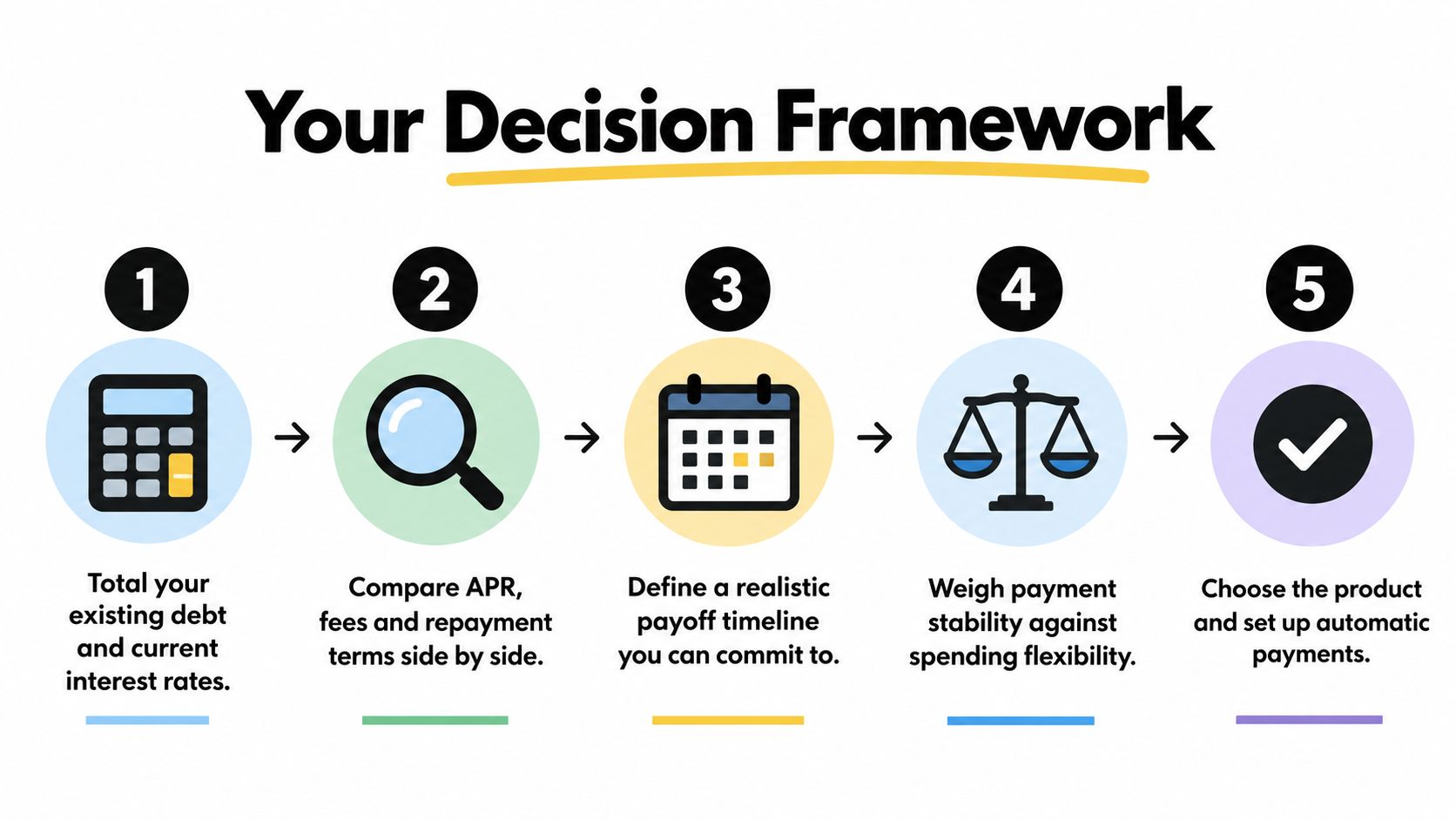
A sound decision can be made with a short sequence. The purpose is to prevent urgency from turning an expensive offer into a permanent obligation.
Start with the existing debt
List every card balance, APR, minimum payment, due date, and available credit. Include personal loans and other required debts in the monthly cash-flow picture. A single consolidated balance can look tidy while the household remains overcommitted overall.
Next, estimate the realistic payoff timeline under the current plan. If the borrower can eliminate the card balance quickly with an aggressive payment, a loan may add fees and immediate interest without enough benefit. If the balance barely moves, the loan deserves a serious comparison.
Test the loan offer
Request terms without assuming approval. Compare the proposed APR with each card's APR, then account for the origination fee and the amount disbursed. The offer should lower total repayment, not merely lower the minimum payment.
Use this checklist:
- Total the balances. Include all debts the loan would replace.
- Compare complete costs. Review APR, fees, monthly payment, and total repayment.
- Choose a credible timeline. The scheduled term must fit the borrower's budget.
- Stress-test the payment. Remove variable income and discretionary spending from the calculation.
- Prevent reborrowing. Freeze or restrict cards if continued access creates predictable risk.
A useful benchmark shows why minimum-payment comfort can mislead. For a $6,000 balance at 20% APR, paying only a $180 monthly minimum can take over four years and cost about $2,830 in interest. Moving that balance to a three-year personal loan at 10% APR raises the payment slightly to $193, but cuts interest to about $969. (Yahoo Finance's personal-loan consolidation example)
Choose decisively
Choose the personal loan when the borrower qualifies for a clearly lower complete APR, needs forced amortization, and can sustain the payment. Stay with the cards when the loan offer is too expensive, income is too unstable for a fixed bill, or the borrower can clear the balance quickly with a verified payment plan.
Set automatic payments either way. Automation prevents missed due dates, but it doesn't replace a cash-flow review. The payment must be scheduled after essentials are covered, not before the household knows what remains.
Automating Your Payoff Strategy with Toya AI
Choosing the product is only the beginning. Execution fails when borrowers lose track of due dates, direct extra money to the wrong balance, or repay a card with a loan and then start charging again.
In the U.S., personal-loan balances were about $281 billion in Q2 2026, while credit-card debt was about $1.263 trillion, making card debt roughly 4.5 times larger. That scale reinforces a practical point: households carrying multiple accounts need a structured way to track balances, rates, and payment priorities. (Experian's consumer debt study)
Turn the plan into a repeatable system
A payoff system should identify the next payment, preserve required minimums, and show how the choice changes the debt-free date. It should also account for cash flow, because sending every spare dollar to debt can force a borrower back onto a card when an irregular expense arrives.
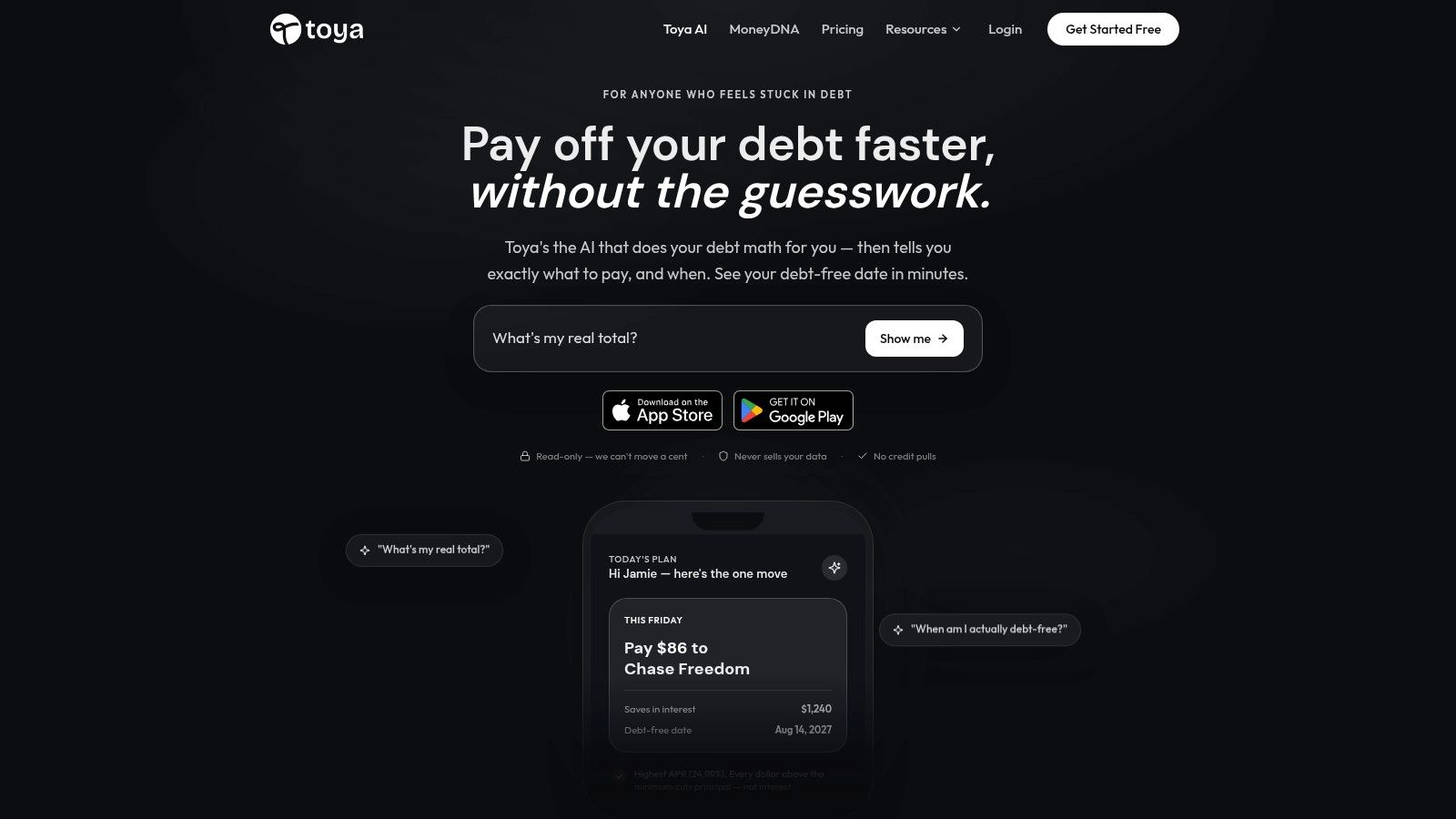
Toya AI connects accounts through trusted partners such as Plaid, Fincity, Spinwheel, and Quiltt using read-only access and no credit pulls. It centralizes balances, APRs, utilization, and due dates, then uses that information to recommend a next payment across credit cards, student loans, auto loans, personal loans, and mortgages. (Toya AI's debt-payoff planning tool)
The borrower can compare highest-APR prioritization, smallest-balance motivation, and cash-flow relief rather than relying on a generic rule. A calculator can preview possible outcomes, while connected accounts support more precise projections. Plans update as balances and circumstances change, which matters when income, rates, or required payments shift.
A personal loan still needs guardrails. The paid-off cards should be frozen or assigned a narrow purpose, and the borrower should review the dashboard after each payment. Automation works best when it prevents both missed payments and the quiet return of new card balances.
A short demonstration can help borrowers understand how an automated payoff plan turns several obligations into a sequence of next actions.
The strongest choice in a personal loan vs credit card debt decision is the one that survives real cash flow. A lower APR matters, but so do fees, eligibility, payment stability, and the behavior that follows consolidation.
Toya AI offers a centralized dashboard for balances, APRs, utilization, due dates, and personalized next-payment guidance across cards and loans. Borrowers comparing consolidation with an aggressive card payoff plan can visit Toya AI to start tracking and building a clearer path to zero.
Ready to start your debt-free journey?
Toya AI builds a personalized payoff plan so you can see your debt-free date and save on interest.
Get Started Free