
Personal Loan Repayment Schedule: How to Build One

A fixed payment lands on the same calendar square every month, and the payoff date still sits more than a year out. Rent, groceries, and another bill already claim the week before that due date. The statement shows a balance and an APR, but it doesn't show what happens if payday shifts by a week or if one extra payment goes to principal instead of sitting in checking.
A personal loan repayment schedule answers those timing questions. It is the month-by-month path from today's balance to a zero balance, and it only helps when it matches real cash flow, not just the original contract.
Table of Contents
- What a Personal Loan Repayment Schedule Shows
- Build an Amortization Table You Can Check
- Choose a Faster Payoff or a Safer Buffer
- Reset the Schedule After a Pause
- Keep the Schedule Updated with the Right Tool
- Put This Month's Schedule into Action
What a Personal Loan Repayment Schedule Shows
Most borrowers open the lender portal, see one required payment, and stop there. That single number hides the fields that actually move total interest and the debt-free date. Before any spreadsheet, a useful personal loan repayment schedule needs the original principal, the annual rate, the payment frequency, the number of payments, each due date, the payment amount, the interest portion, the principal portion, the remaining balance, and the projected payoff date.
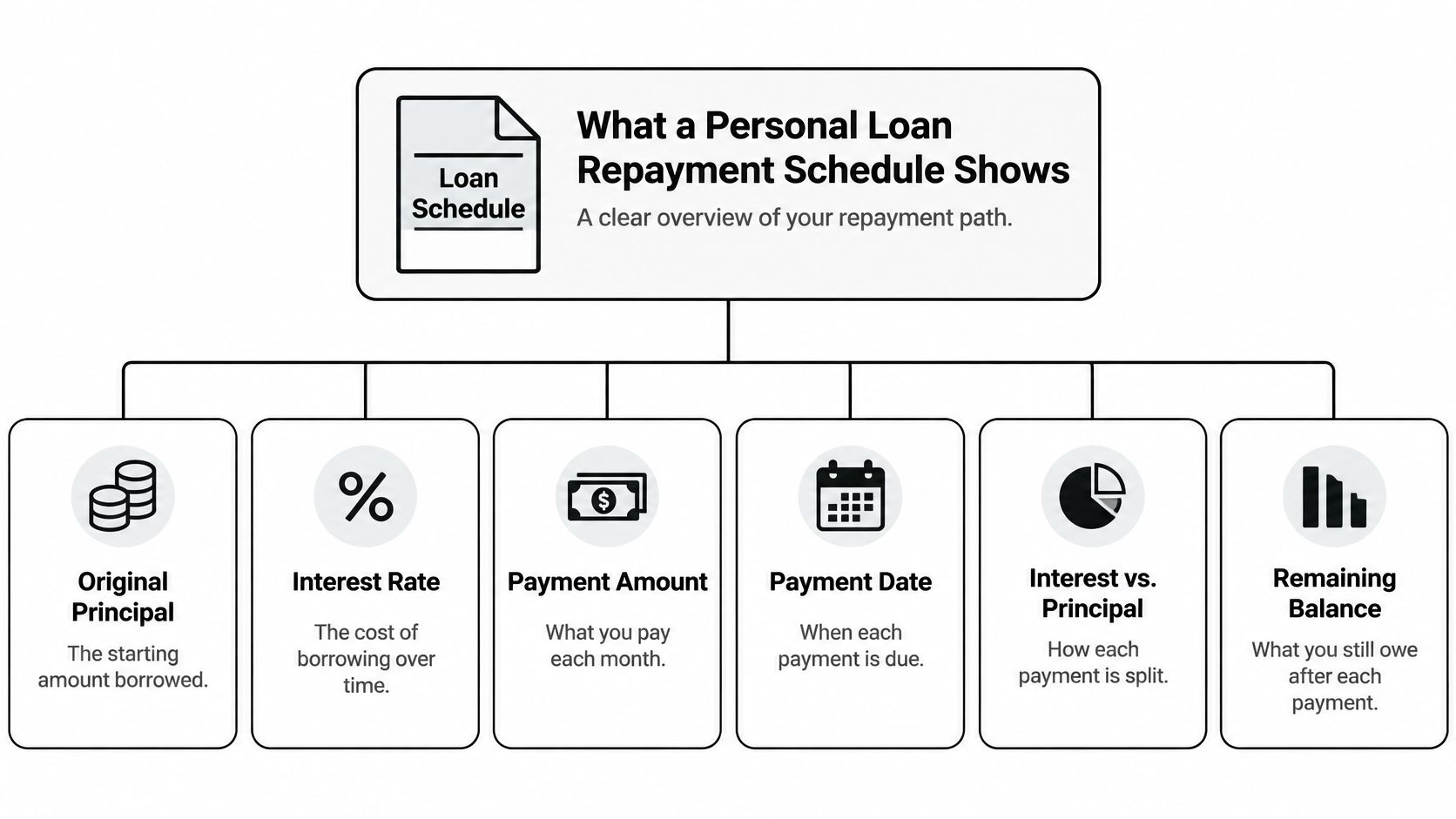
A standard personal loan is a fully amortizing installment plan. Each payment covers interest that has accrued since the last due date and then reduces principal. Interest is calculated on the opening balance for that period, so early payments carry a heavier interest share. Later payments flip. The same dollar amount retires more principal once the balance is smaller.
Why the term changes the cost
Lender type already shows how different those timelines are. A Federal Reserve analysis of U.S. personal loans found average maturities of about 2.9 years (35 months) at banks, 2.7 years (32 months) at thrifts, 2.6 years (31 months) at credit unions, and 1.5 years (18 months) at personal-loan companies. Sales-finance-company loans averaged 2.4 years, and miscellaneous-company loans averaged 1.25 years.
Stretch the same borrowed amount from 18 or 24 months out to 36 or 48 months and the monthly payment falls. More interest-bearing periods usually raise total interest. The lower bill is real. So is the longer clock.
Compare these three first: term, required payment, and projected payoff date. A payoff hack that ignores them is just a guess.
The same logic shows up on larger equipment notes, where financing rates for veterinary equipment depend on term as much as on the rate itself. For a household loan, write those ten fields on one page before changing a single payment.
Build an Amortization Table You Can Check
Definitions don't catch a wrong rate. Rows do. Take one fixed-rate example a borrower can rebuild by hand: $5,000 principal, 12% APR, 24 monthly payments, due on the 15th. This is a teaching loan, not a market average.
The order of the math
Work in this order, and don't skip the rate conversion.
- Turn the annual rate into a monthly rate. 12% divided by 12 is 1%, or 0.01. A guide to how monthly interest is calculated is the right cross-check if that step feels fuzzy.
- Solve the fixed payment from principal, periodic rate, and number of payments. On this example the payment is about $235.37.
- Split payment one. Opening balance times 0.01 is $50.00 of interest. Payment minus interest is $185.37 of principal. New balance is $4,814.63.
- Repeat for payments two and three so the shift is visible, then glance at the last row.
| Payment | Due focus | Interest portion | Principal portion | Remaining balance |
|---|---|---|---|---|
| 1 | 15th, month 1 | $50.00 | $185.37 | $4,814.63 |
| 2 | 15th, month 2 | $48.15 | $187.22 | $4,627.41 |
| 3 | 15th, month 3 | $46.27 | $189.10 | $4,438.31 |
| 24 | 15th, month 24 | small | nearly the whole payment | $0 after a rounding adjustment |
Interest drops by a couple of dollars each month while principal rises by the same amount. The payment never changes. Only the split does. Rounding across 24 rows can leave a few cents on the final payment, so the last installment is often a small adjustment rather than a perfect copy of row one.
Use a calculator as a check, not a black box
Run the same inputs through a loan amortization calculator. If its payoff date, total interest, or remaining balance disagrees with the hand-built rows, recheck three things: the term in months, whether the rate was divided by 12, and whether an origination fee was folded into principal.
Customize only what the lender will honor. Biweekly dates belong on the sheet only if the servicer applies them that way. Add a note column for confirmation numbers, and keep a running total of interest paid so the cost of the remaining term stays visible.
Choose a Faster Payoff or a Safer Buffer
The contractual table is the floor. What a borrower does with surplus cash is a separate decision, and the mathematically fastest path isn't always the safer one.
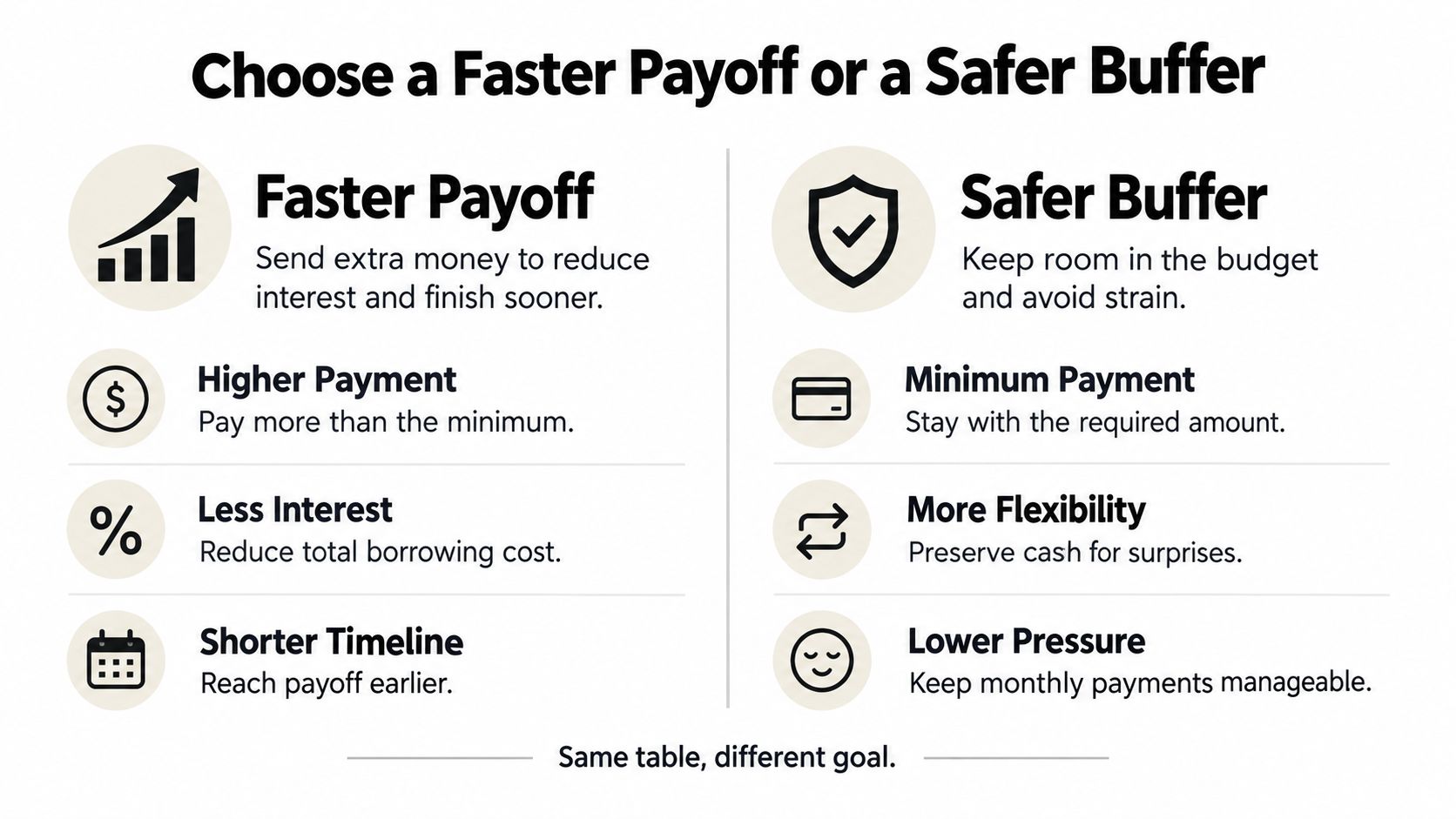
On the $5,000 example, an interest-minimizing plan sends every spare dollar to principal. A $100 extra payment in month one drops the balance to $4,714.63 before the next interest charge. Next month's interest is calculated on that lower balance, the payoff date moves in, and lifetime interest falls. The mechanics of extra principal payments only work if the lender applies the extra to principal immediately and doesn't charge a prepayment fee.
A resilience-first plan uses the same surplus differently. The first dollars fund a small cash buffer. Only what remains goes to principal. A perfect amortization plan still fails if payday moves or three bills land in one week.
Who each plan fits
An Achieve survey of U.S. debt holders found that 36% reported difficulty paying debts on time. Among those struggling, 68% cited insufficient income, 36% cited too many accounts, and 27% cited cash-flow problems.
- Faster payoff fits a borrower with stable pay, one loan, and a buffer already in place. The next three actions are: confirm no prepayment penalty, pay the minimum on time, then send a set extra amount on the due date and rewrite the payoff date.
- Safer buffer fits irregular or seasonal income, or a week when several accounts collide. Park the surplus first, test a smaller extra payment for one cycle, and only then commit the rest.
Directing every spare dollar at principal can raise the odds of a missed payment the month income drops.
People comparing big training costs, including those who explore flight school financing, face the same split between a shorter note and cash left for ordinary bills. Pick one plan and write the next three actions on the schedule.
The short walkthrough below shows how a fixed installment is built, which is the table both plans start from.
Reset the Schedule After a Pause
A deferral, hardship pause, or skipped installment doesn't leave the old payoff date intact. Interest may have kept accruing. The maturity date may have moved. Other bills may now land on the restart week. Treating the pause as a free month is how borrowers walk back into the same squeeze.
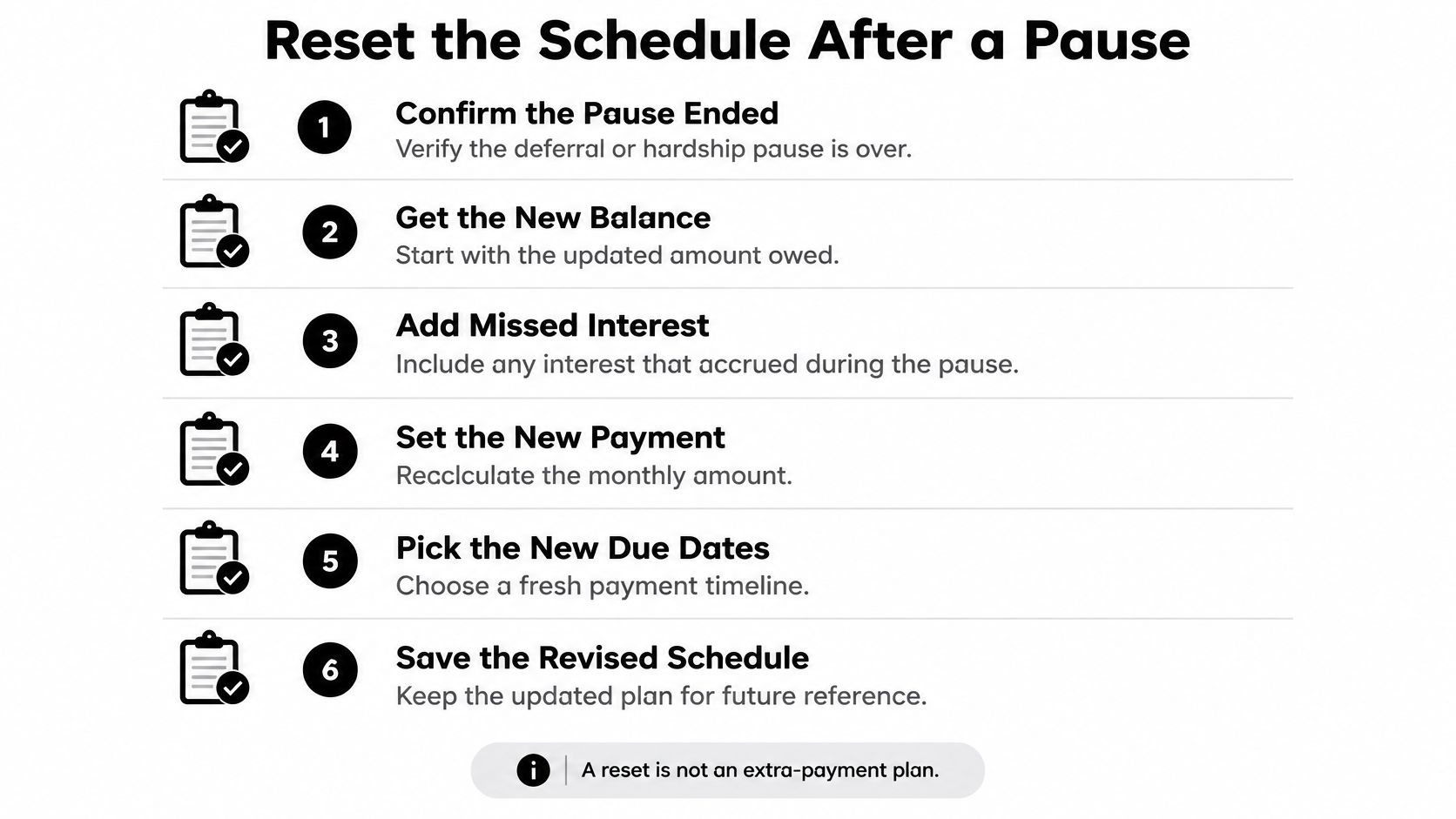
A reset checklist
Confirm four facts with the servicer before modeling anything.
- Deferred interest: Was it added to principal, or billed as a separate catch-up amount?
- Maturity: Did the final due date stay put or slide forward?
- New required payment: Is it the old installment, a lower one, or a temporary amount?
- Collisions: Which other bills share the restart week?
Recent survey coverage of borrowers with personal or student loans found that 55% had deferred payments that were now due, and 74% had some concern about meeting their obligations, according to reporting on renewed payment worry. That worry is about the restart, not the original quote.
Three paths on the same loan
Use the post-pause balance, not the original $5,000.
Resume the original payment. Cash need stays familiar. Interest cost sits in the middle. The debt-free date is whatever the new balance supports at the old installment.
Extend the term. The restarted payment drops, which protects next month. More periods usually raise lifetime interest, and the zero-balance date moves out. This is the affordability path, not the cheap path.
Pay extra to restore the old payoff date. Monthly cash need jumps. Total interest falls relative to the extended term. The risk is recreating the hardship that caused the pause.
If one missed paycheck would break the restarted payment, the aggressive path isn't the working plan.
Run that stress test on paper: list next month's bills, subtract the restarted loan payment, and see what remains. A short contractual grace period isn't the same thing as a safe miss. Once an installment sits unpaid long enough to cross the lender's delinquency line, the schedule problem becomes a credit problem. A lower restarted payment can buy the next month. Rushing back to the old timeline can spend it.
Keep the Schedule Updated with the Right Tool
Your payday shifts from Friday to Monday, or an extra payment changes next month's balance. A schedule built once can no longer show whether the payment date still fits your cash flow. Choose a tool that makes updates easy, so the schedule stays useful between statements.
Spreadsheet, calculator, or connected plan
A spreadsheet shows each interest calculation and payment clearly. It works well for one loan with a stable due date, as long as you update it after a payment, rate change, or date shift. Treat it like a map: helpful when current, misleading when the road changes.
A one-time calculator checks a payment estimate, interest cost, and payoff date. Use it to compare options, then update the schedule when your circumstances change. It does not track your calendar or other bills.
An account-connected planner can help when several loans and due dates make manual updates harder. Toya AI organizes connected accounts, including personal loans, and creates an adaptive repayment plan. Its product information says accounts connect read-only through partners such as Plaid, Finicity, Spinwheel, and Quiltt, without credit pulls. The planner displays balances, APRs, utilization, and due dates. Toya AI can recommend a next payment and project how a payment choice may affect the debt-free date, monthly interest, and total cost. A calculator is available to preview outcomes before connecting accounts. The company says tracking can start free, with Pro features for AI optimization, next-action guidance, and planned automated payments and rewards.

Why a stale date is an operational problem
The Federal Reserve's delinquency definitions classify a loan as delinquent when it is at least 30 days past due and still accruing, or when it is in nonaccrual status. A personal-loan due date that no longer matches your payday can leave less time to move money into the account before the payment is due.
If your pay date shifts, pair the loan schedule with a cash flow forecast to see whether the installment fits the week your income arrives. A spreadsheet suits one steady loan; a calculator checks a what-if; a connected planner can reduce manual work across several accounts. Whichever you choose, update the schedule when your pay date, loan terms, or payment amount changes.
Put This Month's Schedule into Action
The useful test isn't whether the formula is elegant. It's whether this month's payment is named, dated, and still payable if income dips.
Finish these four steps today.
- Copy the live loan, not last year's note. Current balance, rate, next due date, and required payment go on one schedule. Rebuild the next three rows and match them to the statement. If interest or balance disagrees, fix the rate or the term before doing anything else.
- Mark the path already chosen. Extra principal, buffer first, or a post-pause restart. Write the dollar amount that still leaves the minimum affordable if that week's paycheck is short. On the sample loan, that might mean the $235.37 minimum plus a modest extra, or the minimum alone while the buffer refills.
- Set the reminder before the grace period, not on the day a 30-day late mark becomes possible. The alert should name the amount and the account it must clear from.
- Choose the update method. Manual rows if there is one simple loan. A connected plan if several accounts and shifting cash flow make hand updates unreliable. When a connected plan fits, start free, preview the payoff with the calculator, and connect accounts only when precise projections of the debt-free date, monthly interest, and total cost are worth the setup.
A good personal loan repayment schedule lets the borrower say three things out loud: this month's payment, the date it must clear, and what happens to the payoff date if only the minimum goes out. If any of the three is a blank, the sheet isn't finished yet.
Toya AI turns that monthly check into an adaptive plan across credit cards, student loans, auto and personal loans, and mortgages, showing how each payment changes the debt-free date, monthly interest, and total cost. Start free to track balances and due dates, then connect accounts when you want precise projections instead of a one-time calculator guess. Visit Toya AI and put this month's personal loan repayment schedule where the next payment is hard to miss.
Ready to start your debt-free journey?
Toya AI builds a personalized payoff plan so you can see your debt-free date and save on interest.
Get Started Free