
10 Payment Plan Apps Compared for Smarter Payoff
A planned laptop purchase can look manageable when the checkout screen offers four smaller payments. The same household may also be carrying credit-card balances, student loans, an auto loan, and several monthly due dates. Those are different payment problems, so the right payment plan app depends on whether a consumer needs to finance a new purchase or reduce existing debt.
The comparison below separates purchase-financing services from genuine payoff and automation tools. Each option is evaluated through the same practical lens: plan structure, total cost, merchant or lender coverage, automation, account connections, privacy, and the effort required to stay on track. A short example shows how each app works in a realistic situation, including where fees, eligibility rules, repayment timing, or incomplete automation could create risk.
The distinction matters because household payment workloads remain fragmented. In 2023, Americans received and paid more than 16.8 monthly bills on average, while only 4 in 10 bills used autopay, leaving about 10 billion bills to be paid individually each month, according to industry analysis of digital bill management. Payment plan apps can reduce friction, but an installment checkout tool isn't automatically a debt-reduction system.
Table of Contents
- 1. Toya AI
- 2. Affirm
- 3. Afterpay
- 4. Klarna
- 5. PayPal Pay Later
- 6. Zip
- 7. Sezzle
- 8. Shop Pay Installments
- 9. Splitit
- 10. Changed
- Top 10 Payment Plan Apps, Feature & Pricing Comparison
- Choose the App That Matches Your Payment Goal
1. Toya AI
Toya AI is the strongest fit for consumers who already have debt and need a prioritized payoff plan rather than another way to borrow. The app centralizes credit cards, student loans, auto loans, personal loans, and mortgages, then uses balances, APRs, utilization, due dates, and cash-flow changes to recommend the next best payment.
After a consumer connects accounts through read-only partners such as Plaid, Fincity, Spinwheel, and Quiltt, Toya can show the projected debt-free date, monthly interest, and total cost associated with a payment choice. Its quick calculator also lets users compare actions before committing money. The plan can update when balances or financial circumstances change, which is more useful than a static snowball or avalanche worksheet.
Why Toya stands apart
Toya's free tier supports tracking and planning without requiring a credit card. A 14-day Pro trial is available at signup, followed by $8.99 per month or $75 per year, with the annual option described as saving about 30%. Pro adds AI-powered payoff optimization, next-best-action guidance, priority support, and planned features such as automated payments and rewards. Details can change, so consumers should confirm current terms on the Toya AI website.
Practical rule: A payoff recommendation is only useful when the app makes the next action clear and the user can verify that the underlying balance and due date are current.
Toya emphasizes 256-bit encryption, read-only access, soft pulls that don't affect credit scores, and a stated policy to never sell user data. Account aggregation remains an implementation dependency, however. Some lenders may not connect successfully, and payment processing and rewards aren't live yet. Consumers who want planning, prioritization, and measurable projections should explore account aggregation services and their role in debt management.
Practical example: A recent graduate with student loans, two credit cards, and an auto loan could connect each account, compare the interest impact of extra payments, and follow one recommended next action instead of dividing spare cash arbitrarily. Toya recommends and updates the plan, but the borrower still executes the payments.
Best for: Existing-debt payoff planning, multi-loan households, and consumers who want data-driven guidance without handing payment execution to the app.
2. Affirm
Affirm is designed primarily for purchase financing, not for organizing an existing debt portfolio. At participating merchants, consumers can choose Pay in 4 with no interest or longer monthly financing, with the available terms and total repayment amount displayed before checkout. Eligibility decisions use soft credit checks, so a consumer can review an offer without treating the initial check as a hard inquiry.
Affirm's attraction is the combination of broad retailer integration and upfront pricing. Monthly financing can carry an APR from 0% to 36%, depending on the consumer, merchant, and offer, while some purchases may require a down payment. There are no late fees, but a no-late-fee policy doesn't make an expensive purchase affordable if the monthly obligation competes with existing bills. Consumers should compare the complete repayment amount, not just the displayed installment.
Purchase financing in practice
A consumer replacing a broken appliance could select a short plan if the purchase fits comfortably within the household's existing cash flow. A longer plan may lower the monthly amount but can add interest and extend the obligation. Approval and terms vary, so the checkout offer is the only reliable basis for the final comparison.
The main limitation is conceptual. Affirm can make one purchase easier to schedule, but it doesn't create a consolidated view of credit cards, student loans, or mortgages. Consumers seeking a system that analyzes all existing obligations should compare it with AI debt management approaches rather than treating a checkout loan as a payoff strategy.
Best for: A specific purchase at a participating U.S. merchant, when the total cost and repayment schedule are acceptable.
3. Afterpay
Afterpay focuses on short installment purchases, especially its Pay in 4 structure over six weeks. The service works online and in stores through the Afterpay Card, giving consumers a way to split a participating purchase without applying for a conventional long-term loan.
Automated payments can reduce the chance of forgetting a scheduled installment, and Afterpay provides a grace period with capped late fees. Late fees can still apply in the U.S. after that grace period. Certain longer or financed products may also carry a finance fee or APR, so the phrase “split payment” shouldn't be treated as a guarantee of a cost-free plan.
The useful boundary
Afterpay is practical when the purchase is already necessary and the first payment fits alongside rent, utilities, and existing debt minimums. It is less suitable when a consumer is using repeated short plans to cover ordinary spending. A payment calendar can show the upcoming installments, but it won't decide whether another purchase should be added to a strained budget.
Practical example: A shopper buying clothing for a required event could use Pay in 4 at a participating retailer, keep automatic withdrawals active, and check the payment schedule before placing another order. If the next installments overlap with a credit-card due date, the apparent convenience becomes a cash-flow risk.
Order approval considers factors such as account tenure and payment history, while merchant participation determines where the service works. Afterpay's simple checkout is useful, but its value ends at purchase scheduling. It doesn't calculate the best payment across a consumer's existing debts.
Best for: Short, defined purchases at participating online or in-store merchants, provided the consumer can fund every scheduled installment.
4. Klarna
Klarna offers several purchase-financing formats, including Pay in 4, Pay in 30 days, and longer monthly financing. That range can suit different cash-flow patterns, but it also means consumers need to identify the exact product presented at checkout rather than assuming every Klarna plan has the same cost.
The app provides reminders and a late-fee policy with caps related to order value. Late fees can still occur when payments fail repeatedly, and financing APRs vary by offer. Availability also depends on the U.S. region and address, so an option visible to one consumer may not be available to another.
Matching the plan to cash flow
Pay in 30 days may suit a consumer waiting for a known income event, while Pay in 4 spreads the obligation across shorter intervals. Monthly financing may reduce the immediate installment but can keep the purchase on the household's books for longer and may add interest.
Practical example: A family purchasing a replacement household item could compare Pay in 4 with monthly financing by recording both the full repayment amount and every due date. If the monthly plan costs more overall, the lower periodic payment only makes sense if it protects essential cash flow without encouraging additional borrowing.
Klarna's merchant coverage is broad where supported, but it remains a purchase tool. It doesn't consolidate unrelated balances, recommend which creditor should receive extra money, or verify that a consumer's broader debt strategy is improving.
Best for: Consumers who want several checkout structures and can confirm regional eligibility, fees, and the full repayment amount before accepting.
5. PayPal Pay Later
PayPal Pay Later combines Pay in 4 with Pay Monthly. Pay in 4 divides a purchase into four bi-weekly interest-free payments with no late fees. Pay Monthly is a fixed-APR installment loan issued by WebBank, with terms of 3 to 24 months, and it has no prepayment penalty.
The product benefits from PayPal's existing checkout presence. Many consumers can receive an eligibility decision through an existing PayPal account, while availability varies by state. Pay Monthly APRs can range from about 9.99% to 35.99%, depending on the offer, so the interest-free label applies to Pay in 4, not every Pay Later option.
Existing-account convenience
PayPal's account connection can make checkout quick, but convenience can conceal the need for a full comparison. A consumer who selects Pay Monthly should record the APR, scheduled amount, total repayment, and final payment date before confirming the order. The absence of a prepayment penalty is helpful if the balance can later be cleared early, but it doesn't remove the original financing cost.
Practical example: A small business owner buying a needed device through a PayPal merchant could compare Pay in 4 with Pay Monthly. If the owner has enough cash to meet the short schedule, Pay in 4 may avoid interest. If not, the longer plan should be assessed against existing card debt and business cash flow.
Consumers should also review financial data security considerations before connecting accounts or storing additional payment methods. PayPal Pay Later schedules one purchase, while a debt-payoff app evaluates the entire liability picture.
Best for: PayPal users making an eligible purchase where the exact Pay Later terms are clear and affordable.
6. Zip
Zip offers app-based Pay in 4 over six weeks, along with virtual and physical cards that can extend acceptance beyond merchants with native BNPL integration. That card-based approach can help a consumer use installments at a retailer that doesn't display a standard BNPL button.
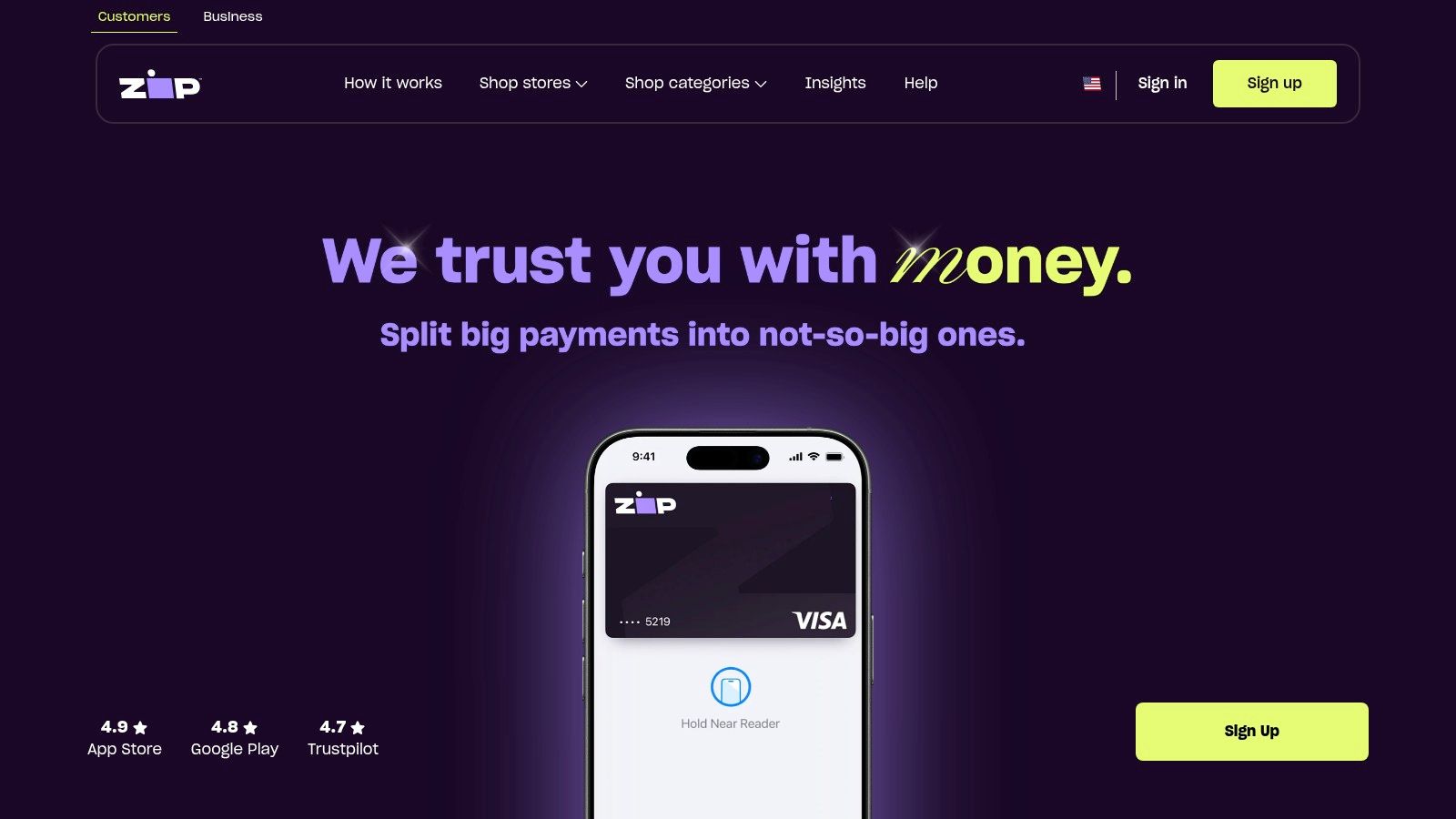
Zip supports auto-charge across multiple stored payment methods if the primary method fails. That feature can reduce a missed-payment event, but it also creates an account-management responsibility. Consumers need to know which backup card or bank account could be charged and whether the available funds are sufficient.
Read the state-specific terms
Zip publishes Retail Installment Agreement disclosures and state-specific fee information. Late fees may apply, and policies can vary by state, product, and approval amount. A card that expands merchant acceptance also makes it easier to create plans in places where the consumer might otherwise have paused before buying.
Practical example: A consumer purchasing a mattress from a merchant without native installment checkout could use a Zip card, review the agreement, and disable additional purchases until the schedule is complete. Auto-charge should be treated as a repayment safeguard, not as proof that the purchase fits the budget.
Zip can be useful for a defined purchase, but it doesn't optimize payments across multiple creditors. Its strongest feature is acceptance flexibility, while its central implementation risk is the possibility of stacking plans through a broadly usable card.
Best for: Consumers who need installment access at a merchant without direct BNPL integration and can monitor state-specific fees and backup charges.
7. Sezzle
Sezzle offers Pay in 4 and longer financing options, with a published schedule covering late, failed-payment, and reschedule fees. It also provides Sezzle Up, an optional route for reporting eligible payment history to major credit bureaus, which gives the service a credit-building angle that isn't central to every purchase-financing app.
The public fee schedule is important because a plan advertised as interest-free can still become costly after failed payments, rescheduling, or service charges. On-Demand purchases may include a small origination or service fee. Sezzle's broad network of small and mid-size merchants can make it accessible, but merchant acceptance still controls where the plan can be used.
Credit building needs careful context
Sezzle Up may appeal to a consumer who wants eligible payment history reported to credit bureaus. That benefit depends on eligibility and successful payment behavior, and it shouldn't justify taking on a purchase that the household can't afford.
Practical example: A young worker buying a necessary work accessory could compare the purchase price, any service fee, and the payment dates before using Pay in 4. If the consumer expects an irregular paycheck, the rescheduling and failed-payment rules deserve review before checkout.
Sezzle helps schedule a purchase and may support credit-building goals. It doesn't offer the multi-debt prioritization, interest comparison, or adaptive payoff planning needed by someone already carrying several balances.
Best for: Consumers who value merchant coverage or eligible credit reporting and can avoid late, failed-payment, and reschedule fees.
8. Shop Pay Installments
A consumer buying specialist equipment from one Shopify merchant can select Pay in 4, confirm the payment dates, and keep the repayment method funded. The lower installment may look easier than a single payment, but a monthly option can cost more overall when interest applies.
Shop Pay Installments brings Affirm underwriting into Shopify's checkout. Eligible consumers may choose interest-free bi-weekly Pay in 4 or interest-bearing monthly plans, with no late fees on eligible plans. Automatic scheduling and the option to change the payment method during repayment can make one purchase easier to manage.
The main advantage is speed. One-tap checkout reduces data entry at supported Shopify stores, but it can also leave less time for an affordability check. Monthly plans may carry APRs up to 36%, depending on eligibility, and Affirm approves applications case by case. Consumers should review the offer's total cost, payment dates, and information requirements before accepting it.
A narrow but polished use case
Shop Pay Installments applies to a purchase through one Shopify store. It does not combine unrelated transactions into a shared payoff plan, so overlapping bi-weekly withdrawals need separate review. Each transaction also creates its own repayment obligation.
Shop Pay Installments can simplify a purchase, but it is not a debt-payoff dashboard. It does not compare existing balances, coordinate credit-card repayment, or show whether a new installment is delaying a student-loan obligation. Consumers managing several debts need a separate payoff or automation tool, rather than another purchase-financing account.
Best for: Eligible Shopify purchases where checkout simplicity matters and the consumer has reviewed the Affirm terms, total cost, payment schedule, and repayment method attached to the offer.
9. Splitit
Splitit uses an existing credit-card line to divide an eligible purchase into installments. It typically doesn't create a new loan or require a hard credit inquiry, and standard consumer plans generally have no Splitit-added interest or fees. The card issuer's terms still apply, however, and an authorization hold reduces available credit until installments are paid.
The model can preserve credit-card rewards and purchase protections while avoiding a new tradeline. It also creates a different risk from conventional BNPL. The consumer may feel that the purchase is separate from the credit card, but the available credit is still being used, and issuer interest can apply if the balance revolves.
The authorization hold changes the calculation
A consumer needs enough available credit for the temporary authorization. Merchant adoption determines availability, so the product isn't universal even when a consumer's card is eligible.
Practical example: A traveler booking a purchase through a participating merchant could use Splitit to preserve card rewards, then ensure the full card statement balance is paid according to the issuer's terms. If the consumer only makes minimum card payments, the issuer's interest can erase the apparent cost advantage.
Interest-free BNPL with existing cards describes the basic model, but consumers still need to read the merchant and card-provider terms. Splitit helps spread one purchase against existing credit. It doesn't lower the interest rate on an existing revolving balance or select the most efficient debt to repay.
Best for: Cardholders with sufficient available credit who want installment scheduling without opening a new loan, and who can manage the underlying card balance responsibly.
10. Changed
Changed is an automation tool for existing debt, not a purchase-financing checkout service. It rounds up everyday purchases and directs spare-change contributions or scheduled “snowflake” payments toward student loans, credit cards, auto loans, mortgages, and other supported debts. Consumers can configure thresholds and distribution rules, then view the estimated interest and payoff impact.
The appeal is behavioral. Small, regular extra payments can happen without requiring a consumer to manually recalculate a debt strategy after every purchase. Changed can complement a debt-first plan, but the subscription fee may reduce the net benefit when round-ups remain very small. Payment timing and processing also depend on lender policies.
Automation doesn't replace prioritization
Changed works best when a borrower already knows where extra money should go or has configured a clear distribution rule. It can automate execution of additional payments, but it isn't the same as a system that compares every balance, APR, due date, and changing cash-flow condition to identify the next best action.
Practical example: A borrower with a credit card and auto loan could set a threshold for round-ups, direct accumulated funds toward the selected debt, and review whether the subscription costs less than the interest saved. If the lender delays posting extra payments, the borrower should verify that the expected payoff projection matches the account's actual history.
Federal student-loan borrowers can enroll in autopay, and servicers must provide at least a 21-day payment reminder before the due date. A loan that remains unpaid for more than 270 days typically defaults, which makes reliable due-date tracking important for any automation workflow. These repayment details appear in Federal Student Aid's payment preparation guidance.
Best for: Consumers who want automatic extra payments toward existing debts and can verify fees, lender processing, and the size of the resulting savings.
Top 10 Payment Plan Apps, Feature & Pricing Comparison
| Product | Core offering | Key features | Target audience | Pricing / Value | Unique selling point |
|---|---|---|---|---|---|
| Toya AI (Recommended) | AI-driven debt payoff planner that aggregates all debts and recommends the single next-best payment | Account aggregation (Plaid/Fincity/etc.), AI optimization, quick payoff calculator, adaptive plans, 256-bit encryption | People with multiple debts who want an optimized, measurable payoff path | Free forever for tracking; Pro $8.99/mo or $75/yr; 14-day Pro trial | Precise next-best-payment impact previews (debt-free date, interest saved) + strict privacy |
| Affirm | BNPL for merchants: interest-free short plans and longer monthly financing | Pay in 4, monthly loans (0–36% APR), soft eligibility checks, merchant integrations | Shoppers wanting flexible checkout financing across many retailers | Interest-free short plans; APRs vary for longer terms up to ~36% | Wide merchant coverage and transparent total-cost displays |
| Afterpay | Short-term BNPL (Pay in 4) with in-store wallet card | Pay in 4, Afterpay Card, automated payments, capped late fees | Shoppers who prefer simple short installments and in-store use | Typically interest-free short splits; late fees/grace periods apply; some longer plans may carry fees | In-store wallet card + capped late fees for clearer penalty exposure |
| Klarna | Multi-option BNPL: Pay in 4, Pay in 30, monthly financing | Multiple plan types, app reminders, capped late-fee policy, broad merchant network | Shoppers wanting choice of short or longer plans across many merchants | Interest-free short options; APR varies for monthly plans; availability region-dependent | Flexible plan selection with strong merchant reach where available |
| PayPal Pay Later | Pay in 4 and fixed-term Pay Monthly loans via WebBank | Pay in 4 (no late fees), Pay Monthly (3–24 mo fixed APR), wide merchant acceptance | Existing PayPal users and frequent online shoppers | Pay in 4 interest-free; Pay Monthly APRs ~9.99%–35.99%; no prepayment penalty | Trusted PayPal brand and broad acceptance across merchants |
| Zip (formerly Quadpay) | Pay in 4 plus virtual/physical card for wider acceptance | Pay in 4, Zip virtual/physical card, auto-charge, state-specific disclosures | Shoppers needing BNPL where merchants lack native support | Interest-free short plans; late fees and terms vary by state | Card rails for BNPL at merchants without direct integration |
| Sezzle | BNPL with optional credit-building path and transparent fees | Pay in 4, monthly options, Sezzle Up (credit reporting), published fee schedule | Shoppers who want installments plus potential credit building | Interest-free plans available; fees for late/failed/reschedule per schedule | Optional reporting to credit bureaus to build credit history |
| Shop Pay Installments (Affirm) | Shopify-native installments powering one-tap checkout | Pay in 4 and monthly plans (Affirm underwriting), automatic scheduling, no late fees on eligible plans | Shopify shoppers seeking seamless checkout financing | Interest-free Pay in 4 on eligible orders; monthly APRs vary up to ~36% | Extremely seamless one-tap Shopify checkout experience |
| Splitit | Installments using existing credit card line, no new loan | Uses existing card credit, no hard credit check, authorization hold reduces with payments, typically no Splitit interest | Users who want installments without opening new credit or losing card rewards | Typically no added Splitit interest/fees; depends on card issuer terms | Keeps credit card rewards and protections; avoids new tradelines |
| Changed (formerly ChangEd) | Automates spare-change and micro-payments to accelerate debt payoff | Round-ups, scheduled "snowflake" payments, multi-debt support, payoff visualization | Users who prefer set-and-forget extra payments to reduce balances | Subscription-based (tiered fees); effectiveness depends on round-up volume | Automated spare-change contributions that funnel extra principal to debts |
Choose the App That Matches Your Payment Goal
The first decision is not which brand has the smoothest interface. It is whether the household needs to finance a purchase or pay down debt already owed.
Toya AI and Changed fit the second problem. Toya AI organizes multiple debts, compares payoff actions, and adapts the plan as balances or cash flow change. Changed automates small additional payments through round-ups and scheduled contributions. Toya is the better fit when prioritization and scenario analysis are the main obstacles. Changed is more useful when the borrower already has a repayment direction and needs help following through consistently.
Affirm, Afterpay, Klarna, PayPal Pay Later, Zip, Sezzle, Shop Pay Installments, and Splitit fit the first problem. They can divide a specific purchase, but they don't automatically make that purchase financially beneficial. A short interest-free plan may be reasonable when the item is necessary and the repayment dates fit existing cash flow. A longer APR-bearing plan deserves the same scrutiny as any other borrowing.
Credit-card repayment math illustrates why the total cost matters. At a 24% APR, paying $300 per month can clear a card in 4 years and 8 months, compared with 21 years and 4 months when paying only the minimum. The total cost in that example falls from $28,219 to $16,644, according to credit-card payoff guidance from Debt.org. The relevant lesson is not that every consumer should use the same payment amount. It is that a lower monthly obligation can conceal a much longer and more expensive outcome.
Before connecting an account or accepting a checkout offer, consumers should use this checklist:
- Calculate the full repayment amount: Include interest, service charges, origination fees, late fees, rescheduling fees, and any required down payment.
- Confirm the payment mechanism: Check whether the app only recommends payments, schedules withdrawals, or sends money to the lender.
- Review failure rules: Identify what happens after a declined card, insufficient funds, missed installment, or changed payment method.
- Check eligibility: Confirm merchant participation, state availability, regional limits, lender connectivity, and approval conditions.
- Avoid stacking plans: Record every installment on one calendar before adding another purchase-financing obligation.
- Test before connecting: Use a calculator, demo, or manual scenario to understand the result before sharing account data or checking out.
Student-loan borrowers should also compare fixed-payment options with income- or balance-based alternatives. Federal repayment plans can depend on the amount owed, interest rate, and repayment period, while some programs have minimum payments such as $10 or $50. One option requires at least $50 per month and can last 10 to 30 years, depending on the consolidated balance, as described in Federal Student Aid's repayment-plan information. Autopay can typically reduce a federal student-loan interest rate by 0.25%, and a servicer has described a temporary 1% reduction running from July 1, 2026 through June 30, 2028. A borrower with a $20,000 balance at 6.5% could save about $50 per year from a 0.25-point reduction before making additional principal payments, according to Federal Student Aid's repayment guidance.
The broader consumer context favors careful selection. More than 80% of respondents in a 2023 American Consumer Credit Counseling survey already used mobile apps for banking, budgeting, financial planning, or credit tracking, and nearly 80% said they were at least somewhat likely to use one app combining budgeting, household planning, credit monitoring, and debt payoff tools, according to the survey summary. Yet familiarity with mobile finance doesn't eliminate repayment risk.
Purchase financing and debt payoff also produce different satisfaction expectations. A Philadelphia Fed survey found 68.5% of BNPL users were satisfied or very satisfied, compared with 81.1% of credit-card users and more than 75% of debit and peer-to-peer users. The same survey found 89.3% of users made all payments in full and on time, reinforcing the importance of clear due dates, installment burden, and payoff progress rather than checkout speed alone. The Philadelphia Fed discussion paper provides the underlying figures.
Toya AI's distinction is therefore specific. It is an adaptive debt-payoff planner, not a purchase-financing checkout tool. It can help a consumer understand which existing debt deserves the next payment and how that action changes the projected outcome, while its payment-processing and rewards features aren't yet live. Consumers looking for installment financing should compare the purchase apps on total cost, fees, merchant coverage, and repayment timing. Consumers trying to become debt-free should begin with the complete liability picture, then choose the tool that reduces guesswork without creating another balance.
Toya AI centralizes credit cards, student loans, auto and personal loans, and mortgages into an adaptive payoff plan that shows the impact of each next payment. Consumers carrying multiple balances can start free, test the calculator, and explore Toya AI before deciding whether AI-powered optimization fits their repayment routine.
Ready to start your debt-free journey?
Toya AI builds a personalized payoff plan so you can see your debt-free date and save on interest.
Get Started Free