
Paying Credit Card Early: Does It Really Save Interest?
Paying a credit card early saves interest when a balance is accruing interest, but usually adds no purchase-interest savings when the full statement balance is paid by the due date with a grace period intact. It lowers the balance reported at statement closing only if the payment posts before that cutoff.
What good is an early payment if the issuer records it after taking the balance snapshot? Paying credit card early involves more than choosing a date on a calendar: the payment must reach the account in time, and enough cash must remain available for ordinary bills.
Table of Contents
- Does Paying a Credit Card Early Really Save Money?
- The Dates That Decide What Gets Reported
- Utilization Math With Real Card Balances
- How to Time an Early Payment Step by Step
- Keeping Enough Cash While You Pay Early
- Mistakes That Cancel Out an Early Payment
- Choosing Which Card to Pay Down First
Does Paying a Credit Card Early Really Save Money?
An early payment helps most when the card already carries an interest-bearing balance. The issuer calculates interest using daily balances, so reducing the balance sooner generally reduces interest. For a cardholder who retains a purchase grace period and pays the full statement balance by its due date, moving that payment earlier usually adds little or no purchase-interest savings.
The distinction is between paying early to reduce interest and paying early to change the reported balance. Those goals can require different timing.
Interest and utilization effect by payment situation
| Situation | Interest Effect | Utilization Effect |
|---|---|---|
| Full statement balance paid by the due date | Little or no purchase interest with an intact grace period, so early payment adds little | Reported balance is generally the statement amount unless reduced before closing |
| Carrying a balance, paid before the statement closes | Lower average daily balance, so less interest | Reported balance drops if the payment posts before the issuer's snapshot |
| Carrying a balance, paid only at the due date | Interest keeps accruing on the daily balance until payment | The already-issued statement retains its closing balance |
| Payment posts after the closing date | Interest saved only for the days the interest-bearing balance is lower | No change to that statement; the payment can affect the next cycle |
For a hypothetical example, a $1,000 balance at 24% APR accrues about $0.66 per day, using a simple daily-interest estimate. Paying that balance fifteen days earlier saves roughly $10, assuming the balance would otherwise remain unchanged. Actual charges reflect the card's calculation method, which the guide to average daily balance explains.
Interest check: An earlier payment can't save interest that wouldn't have been charged.
Most issuers end the purchase grace period when a balance is carried. New purchases can then accrue interest from their purchase dates, and restoring the grace period may require more than submitting a payoff payment.
The useful starting checks are whether the previous statement was paid in full and when the next statement closes. Those answers identify which table row best describes the account.
The Dates That Decide What Gets Reported
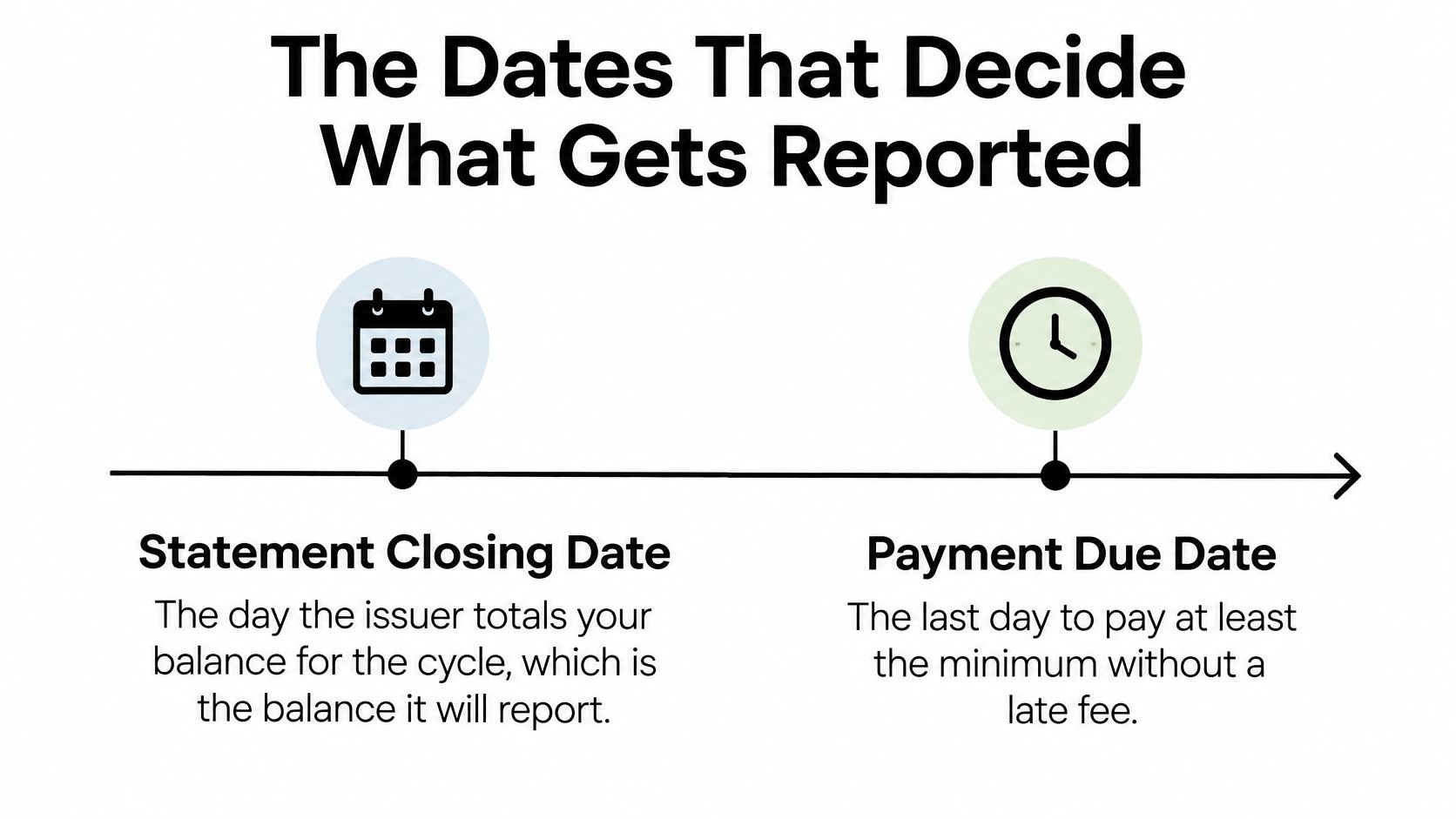
The submission date isn't necessarily the posting date. A payment confirmation shows that the issuer received a request, not that the balance reduction was recorded before its reporting cutoff. A reported balance works like a photo taken at a fixed moment: whatever the account shows when the snapshot happens is what appears, regardless of a payment already on its way.
Capital One's explanation of early credit card payments describes statement closing as the point when the issuer calculates the statement and records the outstanding balance that it eventually reports. Reporting practices still vary by issuer, so a closing-date strategy should be confirmed in the card's own terms rather than treated as a universal guarantee.
Billing and reporting dates explained
| Term | What It Means | Typical Timing |
|---|---|---|
| Statement closing date | Last day of the billing cycle, when the issuer totals the balance | Scheduled monthly by the issuer; check the current statement |
| Payment due date | Deadline to pay at least the minimum without a late fee | Printed on the statement, after that statement closes |
| Posting date | Day the issuer records the payment on the account | After submission, according to the issuer's processing schedule |
| Reporting date | Day the issuer sends account information to the credit bureaus | Issuer-specific, often near statement closing |
| Pending transactions | Charges authorized but not yet posted | Can become posted balances after a payment is made |
Following a hypothetical billing cycle
Suppose a statement closes March 15 and its payment is due April 9. A payment posting April 2 reduces the balance before the next closing on April 15, provided new purchases do not replace it. A payment posting April 16 misses that snapshot, so the higher balance is what gets reported even though the money was already sent.
The order matters more than the calendar gap.
The sequence runs March 15 closing, April 2 payment posting, April 9 due date, April 15 next closing, April 16 later payment posting. The April due date belongs to the earlier statement, not the one still being built, which is why paying only by the due date can leave a large balance on the following report.
Before relying on a schedule, confirm the closing date, the payment-processing cutoff, and the reporting practice in the issuer's app or through support. A purchase that posts late may warrant another payment after closing, though that payment cannot rewrite an already-issued statement.
What gets reported covers more than balances. Whether each payment arrived on time is also sent to the bureaus, so the due date still matters even when the utilization goal points toward paying earlier. For an account carrying past late marks, Mega Income Stream's guide on how to repair a damaged payment record covers that separate repair process.
Utilization Math With Real Card Balances
Credit utilization is the reported balance divided by the credit limit. A statement balance is often the practical starting estimate, but the actual reported balance is what matters. Credit scoring can consider both individual cards and total revolving balances across cards.
Consider a hypothetical card with a $1,800 balance and a $5,000 limit. Dividing the balance by the limit gives 36% utilization. If a $1,000 payment posts before the balance snapshot and no other transactions intervene, the remaining $800 represents 16% utilization.
Utilization at different statement balances
| Statement Balance | Credit Limit | Utilization | Reading |
|---|---|---|---|
| $1,800 | $5,000 | 36% | Above the common 30% guideline |
| $800 | $5,000 | 16% | Under 30% |
| $400 | $5,000 | 8% | Under 10% |
These are hypothetical calculations, not predictions of a score change. The commonly cited under 30% and under 10% bands are planning guidelines, not fixed scoring rules or guarantees. The explanation of how lowering credit utilization can affect a credit score helps distinguish a lower ratio from a promised score increase.
Why the combined figure can hide a crowded card
Consider another hypothetical household: Card A carries $2,500 against a $3,000 limit, or about 83% utilization. Card B has no balance and a $4,000 limit. Together, the cards have $2,500 outstanding against $7,000 available, or about 36% utilization.
The combined percentage looks much less strained than Card A's individual percentage. A payment to Card A reduces both measures, while a payment can't reduce Card B's already-empty balance.
A lower overall ratio doesn't mean every individual card has a low balance relative to its limit.
The practical calculation runs backward from the intended reported balance. First, divide that balance by the limit to check the target ratio. Then subtract the target balance from the expected closing balance to estimate the required payment, allowing for purchases and interest that may post before closing.
How to Time an Early Payment Step by Step
A workable schedule connects the billing calendar, the expected balance, and the available cash. A reminder alone isn't enough if it names the wrong date or assumes a pending purchase has disappeared.
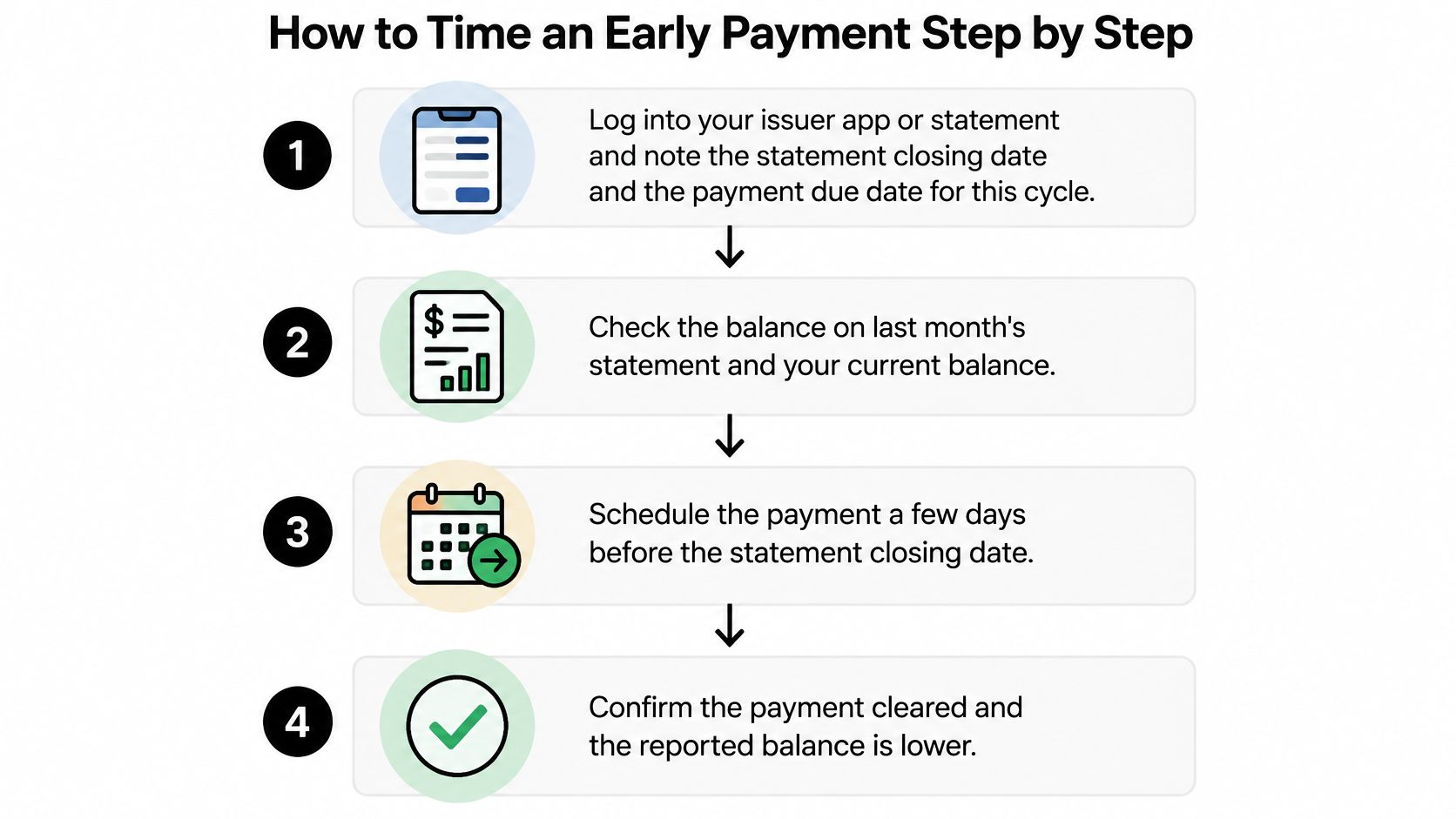
Build the payment schedule
Record the current closing and due dates. Open the issuer's app or latest statement and copy both dates into a calendar, labeling each clearly. The common slip is treating the due date as the deadline for changing the statement balance.
Separate the statement balance from the current balance. The statement balance is a completed-cycle snapshot; the current balance reflects subsequent posted activity. Pending charges should be listed alongside it rather than assumed to be included.
Estimate the balance at closing. Add expected purchases, recurring subscriptions, and likely interest to the posted balance, then subtract payments already scheduled. Overlooking a recurring bill is a common reason the final balance exceeds the target.
Choose a target that the budget can support. For a hypothetical $5,000 limit, a target balance of $1,000 represents 20% utilization; an expected closing balance of $1,700 would require a $700 payment. Choosing a ratio without checking available cash can force fresh borrowing for essentials.
Schedule ahead of the processing cutoff. As a planning cushion, scheduling two to three business days before closing is safer than choosing closing day, but the issuer's processing rules take priority. Weekends, holidays, and late-day submissions can make a same-day assumption unreliable.
Verify the posted payment and resulting balance. Check the account after processing, rather than relying solely on the scheduled-payment confirmation. The common mistake is assuming a submitted payment has completed successfully.
Review late-posting charges separately. If a large purchase posts after closing, another payment may reduce ongoing interest or the next reported balance. That payment shouldn't be mistaken for a correction to the statement that already closed.
For help organizing payment methods and routine bill handling, the Fintrack guide to card bill payments offers a companion resource. The issuer's own confirmation remains the place to verify whether a particular payment posted.
Calendar rule: The written plan should name the closing date, target balance, and posting deadline, not just the day a payment is submitted.
An early payment also deserves a quick autopay check. Issuers can handle manual payments and scheduled automatic payments differently, so the cardholder should verify the remaining automatic withdrawal before committing the same bank-account cash elsewhere.
Keeping Enough Cash While You Pay Early
An early payment reduces available bank cash immediately, even when its credit-reporting benefit arrives later. Sending every spare dollar to a card can leave rent, groceries, or a necessary repair dependent on more borrowing.
This trade-off affects many households. In 2025, 45% of U.S. credit-card adopters reported carrying an unpaid balance during the previous 12 months, according to the Federal Reserve's household economic well-being credit report.

Set the cash floor before the payment
The practical rule is available cash minus upcoming essentials minus an emergency buffer. Only the remainder is available for an optional early payment. Required minimum payments still need a place in the bill calendar.
For a hypothetical household with $1,800 left after scheduled bills, retaining a $1,000 buffer leaves $800 available for an early payment. A larger payment might produce a lower reported balance, but it would breach that household's chosen cash floor.
| Hypothetical cash-calendar item | Treatment |
|---|---|
| Rent and utilities before payday | Reserve the money before calculating the early payment |
| Cash remaining after those bills | $1,800 |
| Emergency buffer | Keep $1,000 accessible |
| Optional early payment | Limit to $800 |
| Next paycheck | Reassess after income arrives |
The calendar matters as much as the total. A paycheck arriving after rent is due can't cover rent beforehand, even if the month's income exceeds the month's spending.
The discussion of whether to pay off debt or save helps frame this choice as a balance between borrowing costs and accessible reserves. Pending card purchases deserve their own allowance, because they can increase the debt after the early payment.
A second payment can be considered once income arrives or an uncertain expense becomes clear. Protecting essential cash isn't a failure to optimize utilization; it's a way to avoid paying down a card only to charge necessities back onto it.
Mistakes That Cancel Out an Early Payment
Treating an early minimum payment as a payoff strategy can leave most of an expensive balance untouched. The timing may be better, but the amount still determines how much debt remains subject to interest.
Paying only the minimum early. The minimum can satisfy the account's required payment without making much progress toward a lower balance. The fix is to distinguish the required minimum from the additional payment needed for a realistic payoff or utilization target.
Closing a card immediately after paying it down. Closing an account can reduce total available revolving credit, raising utilization on balances that remain elsewhere. If an annual fee drives the decision, the cardholder can ask the issuer whether a no-fee product change is available, while weighing the account's other costs and benefits.
Replacing the payment with new purchases. In a hypothetical example, paying $1,000 from a $1,800 balance on a $5,000 limit leaves 16% utilization. A subsequent $600 purchase before closing raises the balance to $1,400, or 28%, assuming no other activity.
Check what happened after the payment
The spending fix is to pause discretionary purchases on the card until closing or use a budgeted alternative. Moving purchases to another credit card doesn't reduce total debt, so it shouldn't be treated as repayment progress.
A review of the last two statements can reveal whether minimum-only payments, account closures, or replacement spending undermined the plan. The useful question is whether the ending balance fell as intended, not merely whether a payment appeared in the transaction list.
Choosing Which Card to Pay Down First
After confirming each card's posting deadline, the cardholder can decide where extra cash does the most useful work. The highest-APR balance generally offers the greatest interest savings per dollar paid, while utilization goals require comparing each balance with its own limit.
Consider these hypothetical choices:
| Card | Starting Balance and Limit | APR | Effect of an $800 Payment |
|---|---|---|---|
| Card A | $2,500 on $3,000 | 29% | Utilization falls from about 83% to 57%; estimated monthly interest savings of about $19 |
| Card B | $1,200 on $1,500 | 19% | Utilization falls from 80% to about 27%; estimated monthly interest savings of about $13 |
The monthly savings estimates use payment × APR ÷ 12, not an exact billing calculation. Card A wins on estimated interest savings, while Card B produces the larger percentage-point reduction in individual utilization and moves below a commonly used planning band. Either payment reduces the combined balance by the same amount.
Toya AI recommends which payment to make next, identifies which debt should receive extra money, and shows the impact on payoff time and interest savings.
The cash buffer should remain intact whichever card is selected. Each month's decision should use current balances and APRs, with one chosen card, a specific extra-payment amount, and a posting deadline recorded before the payment is scheduled.
Toya AI offers personalized payoff guidance that shows which debt to pay extra on and how much interest that payment can save. Visit Toya AI to compare the next payment's impact on interest and payoff time, then use the card issuer's posting schedule to put the plan into action.
Ready to start your debt-free journey?
Toya AI builds a personalized payoff plan so you can see your debt-free date and save on interest.
Get Started Free