
Pay Off Student Loan Faster Without the Wrong Move
Sending every spare dollar to student loans isn't always smart. A borrower can pay off student loan debt faster and still make a worse financial decision by ignoring expensive credit cards, draining emergency cash, or prepaying a balance that could qualify for forgiveness. Extra principal belongs at the end of the decision, not the beginning.
The right payment protects essential cash, beats competing interest costs, and preserves benefits worth keeping. Only then should a borrower chase an earlier debt-free date.
Table of Contents
- Which Payoff Path Fits Your Loans
- Decide When a Refinance Beats Federal Loans
- How to Set Up a Faster Repayment Plan
- Send Extra Cash to Principal the Right Way
- Stay on Income-Driven Plans Without a Growing Balance
- Confirm Every Payment Before You Send More
- Lock In One Payoff Target This Week
Which Payoff Path Fits Your Loans
Consider a hypothetical borrower with $32,000 in federal loans at 6.5% and $4,200 on a credit card at 22%. With required payments and a basic cash reserve covered, a tax refund belongs on the card. Paying the student loan first would leave the more expensive debt untouched.
Which student-loan move fits your situation
| Situation | Primary move | Time horizon | Do not |
|---|---|---|---|
| Federal loans and PSLF-eligible work | Stay on a qualifying income-driven plan and reach 120 payments | 10 years | Prepay principal that forgiveness would erase |
| Federal loans, no PSLF, long IDR horizon | Compare income-driven total cost with aggressive payoff | 20 or 25 years | Chase the lowest monthly bill alone |
| Private or already refinanced loans | Send extra cash to the highest rate | Remaining term | Assume federal protections still apply |
| Credit card or other debt above the student rate | Attack the higher APR and keep student loans current | Until that APR falls below the loan | Skip the student-loan autopay |
| Emergency cash under one billing cycle | Fund the buffer, then resume extra principal | One month of the loan bill | Drain cash into an irreversible extra payment |
| Stable income and no forgiveness path | Avalanche surplus to the highest student-loan rate | Shortest interest-cost path | Let the servicer advance the due date |
Current doesn't mean comfortable
Pew's look at new student-loan borrowers found that 92% of new borrowers making payments were in good standing, including those making $0 income-driven payments, yet 52% said their monthly payment was difficult to afford and 36% found student loans more stressful than other bills. A current account therefore isn't proof that a household can afford aggressive repayment.
The public-service borrower should protect qualifying payment credit and verify eligibility before sending more. Extra principal can reduce the amount eventually forgiven without bringing forgiveness any closer.
A borrower considering long-term income-driven repayment needs a different comparison: projected payments, possible taxes, and the remaining balance against the cost of paying everything off. The smallest monthly bill isn't automatically the cheapest outcome.
Choose a priority, not several competing goals
Private-loan borrowers generally have a simpler interest-cost decision. Once required payments and cash reserves are safe, surplus should target the highest effective rate rather than being divided evenly among balances.
The borrower carrying more expensive credit-card debt should attack that debt while maintaining student-loan payments. Retirement contributions also deserve a deliberate review, particularly when an employer match is available, rather than being automatically sacrificed for extra student-loan principal.
Practical rule: Cash already sent to a lender can't cover the next unexpected bill.
For someone without enough cash to cover the next billing cycle, building that reserve takes priority. That amount is a starting floor, not a complete emergency fund, especially for a household with unstable earnings.
A stable earner without a forgiveness path can use the debt avalanche, directing surplus toward the highest-rate student loan while maintaining every minimum. The borrower should mark the applicable row and keep that priority until income, family size, employer status, or debt terms change.
Decide When a Refinance Beats Federal Loans
Refinancing is a replacement-loan decision, not an extra-payment tactic. A lower advertised payment doesn't establish that the replacement is cheaper, and a lower interest rate doesn't establish that losing federal benefits is worthwhile.
Consider hypothetical borrowers Priya and Sam. Priya owes $40,000 in private loans at 11% and receives a 7% fixed-rate quote after strengthening her credit profile; Sam works at a nonprofit and is three years from completing his qualifying public-service payments. Priya has a rate reduction worth modeling, while Sam could surrender valuable forgiveness for a discount he doesn't need.
The paperwork should be compared before either borrower accepts a replacement loan.
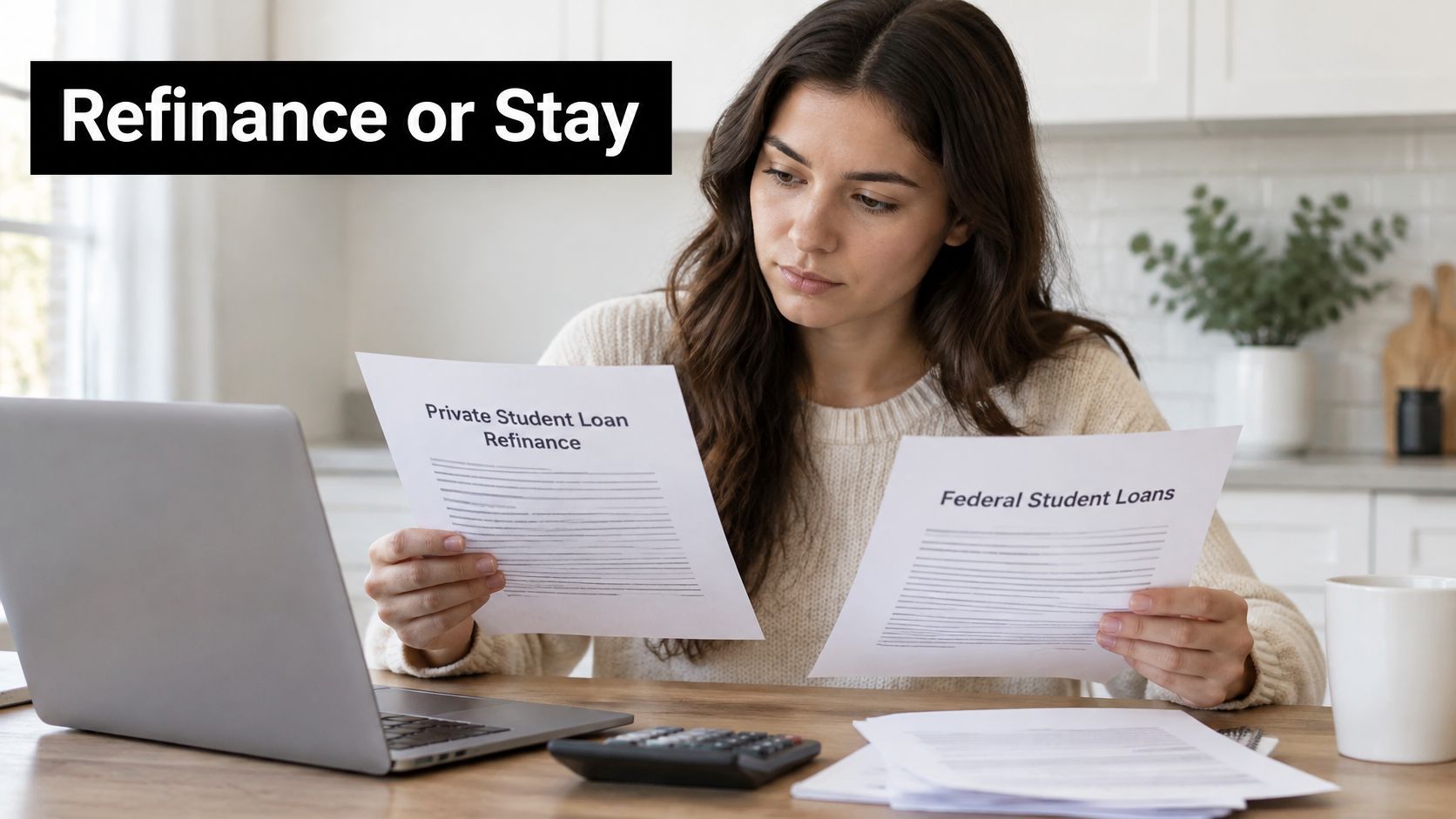
Stay federal or take a private refinance
| Test | Keep the federal loan | Move to a private refinance |
|---|---|---|
| Forgiveness | PSLF or 20-25 year income-driven forgiveness is still possible | No qualifying job and no income-driven advantage left |
| Rate | Federal rate is already near the quote | Private quote is meaningfully lower and preferably fixed |
| Cash buffer | Less than one billing cycle is saved | The buffer still survives the new payment |
| Income | Pay is volatile or just changed | Income can support a payment that won't shrink |
| Protections | Deferment, forbearance, or discharge may be needed | Those options are knowingly given up |
| What the product does | Federal consolidation combines federal loans at a weighted-average rate | Private refinance replaces the loan and the servicer |
Consolidation isn't a rate-shopping shortcut
Federal consolidation combines eligible federal loans into a new Direct Consolidation Loan. It can simplify payment administration and sometimes establish eligibility for a repayment option, but its weighted-average rate, rounded up, isn't a market-rate discount.
A private refinance replaces existing debt with a private loan. When federal debt is refinanced privately, the borrower gives up federal income-driven repayment, Public Service Loan Forgiveness, and access to many federal deferment, forbearance, and discharge options.
The distinction deserves attention before any application. This guide to how to consolidate student loans explains the consolidation route separately from private refinancing.
Use the quote as a gate, not a sales pitch
Priya should compare the fixed rate, remaining term, new term, required payment, fees, and total scheduled cost. Extending repayment can lower the bill while keeping her indebted longer, so comparing monthly payments alone isn't enough.
Sam should verify his qualifying employment and payment history rather than refinance based on the headline rate. Neither federal consolidation nor private refinancing is the same as an app that plans payments while leaving existing loans in place.
The recommendation is narrow: refinance private loans for a meaningfully lower fixed rate after protecting cash reserves. Refinance federal loans only after writing down every benefit being surrendered and deciding that none is worth keeping.
How to Set Up a Faster Repayment Plan
A useful repayment plan states which debt receives surplus, how much the household can sustain, and what would trigger a revision. It shouldn't rely on whatever cash happens to remain at the end of the month.
The setup starts with complete loan records and ends with an affordable payment instruction.
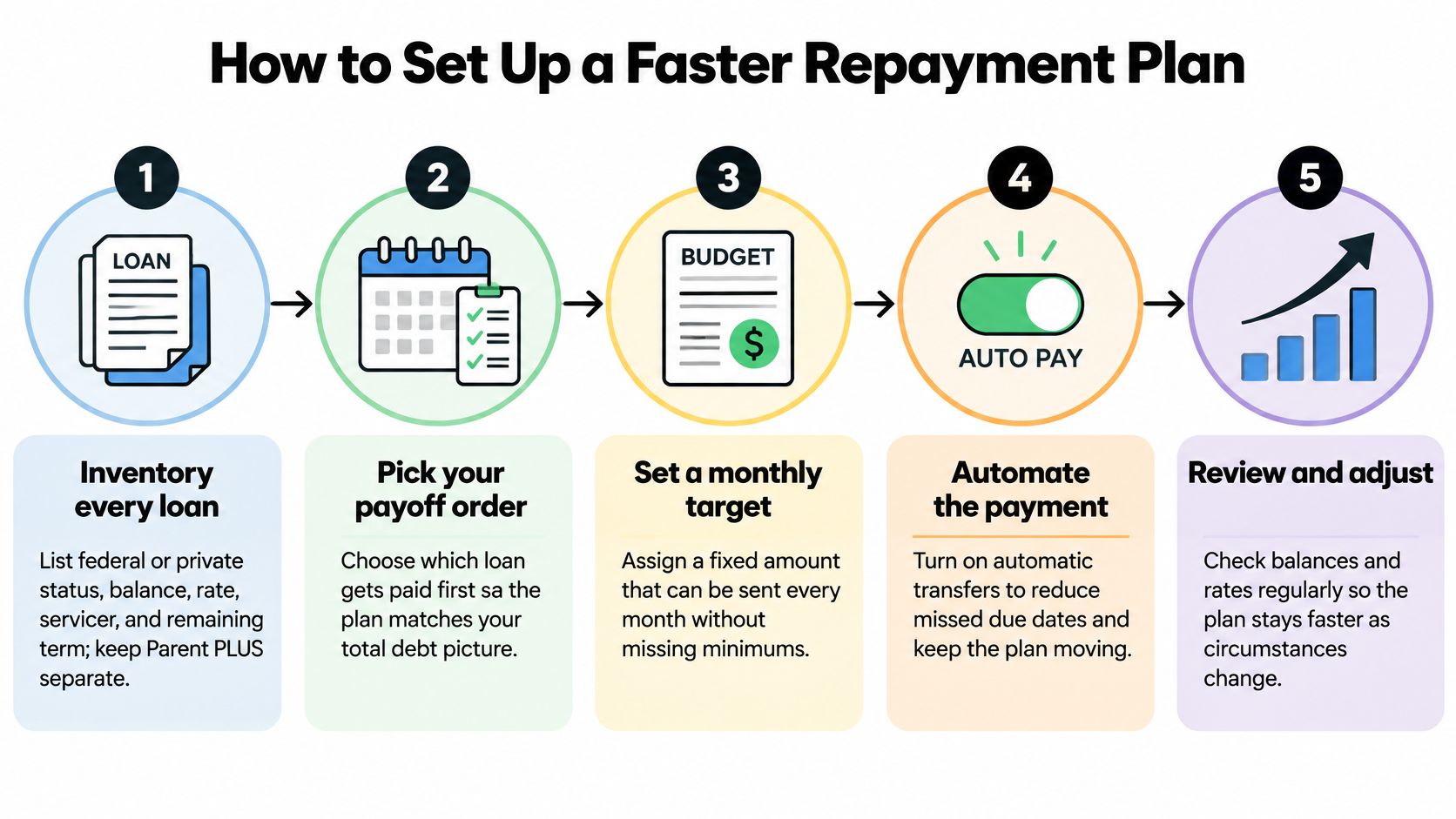
Build the plan from actual account details
Inventory every loan. Record federal or private status, balance, interest rate, servicer, required payment, and remaining term. Keep Parent PLUS debt separate from the student's own loans because the legal borrower and available options aren't interchangeable.
Compare eligible federal plans. Use the Department of Education's Repayment Calculator and save estimated monthly payments alongside lifetime costs. A low bill can help cash flow without producing the lowest overall cost, and the output remains an estimate rather than an approval.
Model payoff beside forgiveness. The Department of Education's repayment-calculator guidance identifies 120 qualifying monthly payments, effectively 10 years, for Public Service Loan Forgiveness, and potential income-driven forgiveness after 20 or 25 years, depending on the plan and borrower circumstances. Employment eligibility, qualifying counts, and recertification requirements need confirmation with Federal Student Aid and the servicer before surplus is committed.
Choose the lower expected after-tax cost that preserves essential benefits. Include realistic income changes, the cost of retaining debt, potential forgiveness taxes, and a cash reserve sufficient for the next billing cycle. A projection that requires uninterrupted bonuses or perfect employment isn't a dependable household plan.
Automate an affordable amount and write the surplus rule. Schedule payments after dependable income where the servicer allows it. The instruction should identify the target loan and the conditions under which extra payments stop, such as a reduced cash reserve or an employment change.
Give every extra dollar a destination
Consider hypothetical borrower Maya, who has $28,000 in federal loans at 5.5% and $6,000 in private loans at 9%. After checking benefits and protecting her cash reserve, she autopays both minimums and directs an additional $150 only to the private loan.
Splitting that surplus across both loans would dilute the highest-rate payoff. Maya's written rule also prevents a larger federal balance from receiving extra money because it looks more intimidating on the dashboard.
For borrowers coordinating student loans with other obligations, Wealth Collective's practical ways to repay debt faster offers broader repayment context. Those tactics should support the chosen priority, not replace the federal eligibility check.
Once accounts are linked, Toya AI calculates a debt-free date based on current payments and shows which debt should receive extra money and how much interest that would save. That projection supports payment planning; it doesn't replace the federal calculator or determine forgiveness eligibility.
A repayment walkthrough can supplement the saved calculations.
Before any surplus leaves the bank account, the borrower should save the calculator result and the allocation note together. Those records make later comparisons possible when the payment, income, or projected payoff date changes.
Send Extra Cash to Principal the Right Way
A later due date isn't the same as a well-targeted principal reduction. Paid-ahead status can also tempt a borrower to skip the next scheduled payment, undermining the intended payoff pace.
Consider hypothetical borrower Jordan, whose $200 extra payment advanced the due date while barely reducing principal because much of the payment covered outstanding interest. After confirming that interest was satisfied, Jordan sent the same extra amount with a targeted allocation instruction and checked the resulting principal reduction.
Specify the loan and the treatment
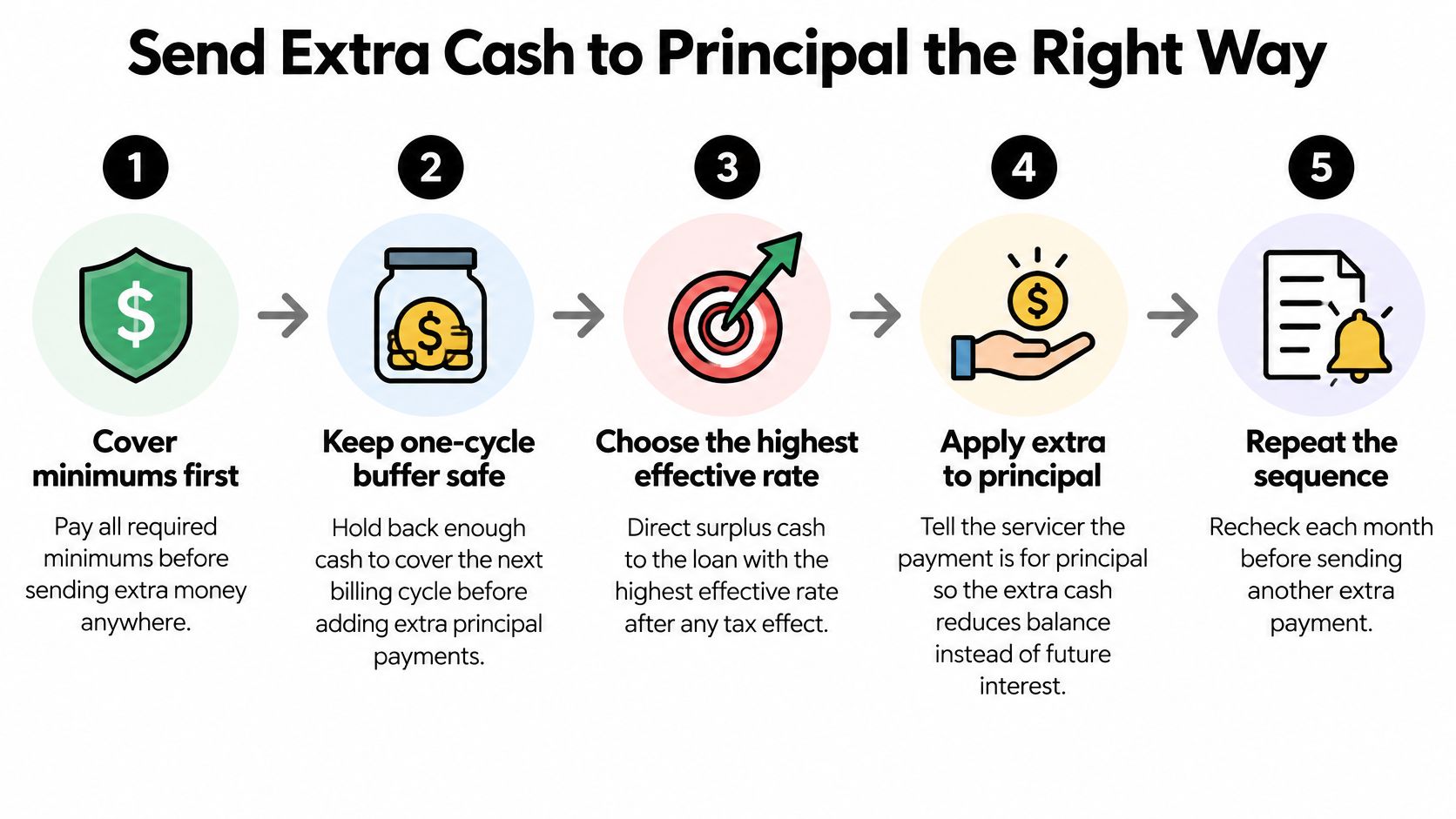
- Cover every amount due. Required payments come before discretionary overpayments, even when another loan has a much higher rate.
- Protect the cash reserve. Surplus means money remaining after essential expenses and the next billing cycle are funded.
- Name the target loan group. Send written instructions identifying the highest effective-rate loan after any applicable tax effects.
- Request the right allocation. Ask that excess funds reduce the selected loan's principal after required interest is satisfied, without advancing the due date.
- Inspect the result. Review principal, interest, loan-group allocation, and the next scheduled payment rather than relying on a payment-success email.
An instruction can't override the loan's payment-order rules. Borrowers with unpaid interest should confirm how much must be satisfied before any extra amount reaches principal; this explanation of what a principal payment means helps distinguish balance reduction from a routine payment.
The sequence should remain consistent even when the extra money comes from a bonus.
A payment pause can increase the amount owed
The Federal Student Aid interest guide explains capitalization; for example, $25,000 in principal plus $1,000 in capitalized unpaid interest becomes $26,000, raising approximate annual interest at 6% from $1,500 to $1,560, before daily-accrual and repayment effects. The borrower then pays interest on a larger principal amount.
Capitalization can occur around a grace period, deferment, or forbearance depending on the loan and circumstances. Interest can also accrue without immediately becoming principal, so an unchanged principal figure doesn't necessarily mean the pause was cost-free.
Before postponing payments, the borrower should ask whether unpaid interest will capitalize and request the projected dollar amount. Paying accruing interest during the pause, when affordable, can prevent that unpaid interest from increasing principal later.
Employer money deserves the same attention. A workplace match or student-loan repayment benefit can accelerate progress, but the borrower should confirm whether the employer pays the servicer directly and how the funds are allocated.
The final check is simple: principal down, due date unchanged, and the regular payment still scheduled.
Stay on Income-Driven Plans Without a Growing Balance
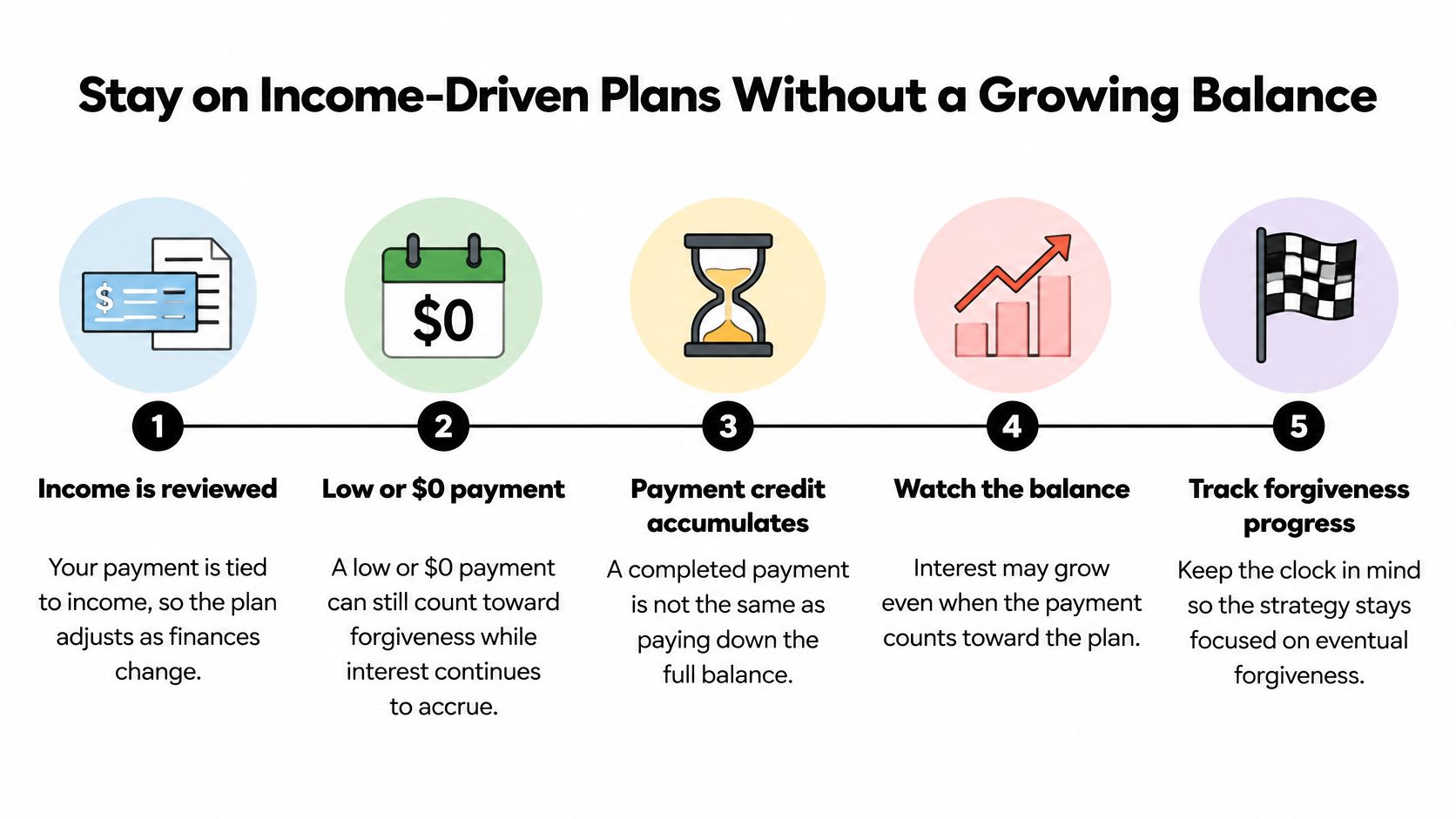
A payment that counts toward forgiveness and a payment that reduces debt are different outcomes. Income-driven repayment should be managed against an expected forgiveness result, not judged solely by the monthly bill.
The Government Accountability Office's repayment review found that about 4.5 million borrowers current on income-driven plans had scheduled payments of $0; it also reported that nearly 30% of federal borrowers, about 9.7 million people with approximately $290 billion outstanding, were past due as of January 31, 2024. Staying current matters, but it doesn't establish that the balance is shrinking.
Separate payment credit from interest growth
Consider hypothetical borrower Alex with $35,000 at 6.5% and a required $0 payment. Assuming interest accrues without an applicable subsidy or waiver, that balance generates approximately $2,275 in interest over a year, before daily-accrual and payment effects.
Alex can remain current and retain qualifying payment credit while the total amount owed increases. In stronger months, covering the accruing interest can keep the balance from growing without requiring him to leave the plan, provided the payments cover all interest accruing over the period.
That isn't automatically the cheapest move. If Alex reasonably expects the remaining balance to be forgiven, voluntary interest payments might reduce cash without improving the expected outcome.
The operating distinction is worth keeping visible.
Maintain eligibility and test the economics
- Recertify on schedule. Income and family-size information should be submitted by the applicable deadline rather than after an unexpected bill arrives.
- Verify qualifying progress. Public-service borrowers need confirmed employment and payment counts, not an assumption based on years worked.
- Recalculate after changes. A raise, job change, or household change can alter the comparison between forgiveness and full repayment.
- Review statements regularly. Alex checks each quarter for accrued interest, principal changes, and payment credit rather than watching the amount due alone.
The public-service path requires qualifying monthly payments; the longer income-driven path may forgive a remaining balance after the applicable repayment period. Neither outcome follows merely from staying enrolled without maintaining eligibility.
For application preparation, Morgan & Morgan Attorneys at Law P.C.’s guide to apply for student loan forgiveness in 2026 can help organize questions and documentation. Current eligibility and program availability still require confirmation through Federal Student Aid.
Borrowers considering voluntary interest payments can also compare ways to reduce student-loan interest, without treating every interest-saving tactic as appropriate for forgiveness.
Keep the plan when its projected after-tax forgiveness outcome beats full repayment or when affordability requires it. Any possible tax on forgiveness belongs in a discussion with a tax professional, not an unsupported assumption in a payoff spreadsheet.
Confirm Every Payment Before You Send More
A 2025 Data for Progress survey, discussed by The Institute for College Access & Success, reported that 48% of borrowers who sought help faced long waits, 24% said their servicer provided inaccurate information, and 11% believed their displayed balance was incorrect. A carefully chosen strategy still needs accurate account administration.
A quiet servicer isn't proof that relief is unavailable. Borrowers should investigate eligibility directly rather than assuming that every available option will appear in an account notification.
Use a pause-and-verify routine
- Download payment history after extra payments and repayment-plan changes. Save the statement as well as the transaction confirmation.
- Match the accounting. Compare the amount sent, posting date, loan group, and division between principal and interest.
- Preserve communications. Keep emails, secure messages, representative names, and dated call notes in the same folder.
- Dispute unexplained discrepancies in writing. Request a transaction-level explanation and pause further discretionary payments until the credit is confirmed. Required payments should continue unless an authorized arrangement says otherwise.
- Recheck before a lump sum. Job loss, a raise, or a new loan should trigger an eligibility and cash-flow review before money becomes difficult to recover.
Hold the bonus until the records agree
Consider hypothetical borrower Casey, whose dashboard showed $1,100 more than her downloaded account history. She held her bonus payment, requested an explanation, and obtained a correction for an uncredited transaction before directing the bonus to principal.
Not every discrepancy is an error. Accrued interest, different reporting dates, or pending transactions can explain a mismatch, which is why the written request should identify the specific transaction rather than assert that the balance is wrong.
An unverified extra payment isn't a faster payoff. It's an unresolved transaction.
The useful evidence is a posted payment on the intended loan, with an understandable principal-and-interest breakdown. Only after that confirmation should the next discretionary payment proceed.
Lock In One Payoff Target This Week
The borrower needs a committed next action, not a collection of competing payoff tactics. The selected priority should determine this week's task.
- Forgiveness priority. Open the qualifying-payment record, confirm any employment documentation still needed, and record the next income-recertification deadline. Leave discretionary principal alone until the expected benefit is verified.
- Highest-rate payoff priority. Send a written allocation instruction naming the loan group, maintain affordable minimum-payment autopay, and verify the result on the next statement.
- Cash-reserve priority. Build enough cash for a full billing cycle before sending surplus to principal. That reserve is the week's target, even if the student-loan balance doesn't fall.
Keep the target in one place
The record should contain the target balance, interest rate, monthly payment, and expected payoff date or forgiveness milestone. A cash-reserve target should sit beside those details so it doesn't disappear behind an appealing acceleration estimate.
Toya AI can build a payoff plan from existing linked accounts; it isn't debt consolidation and doesn't consolidate or move debt. A repayment target should never be mistaken for a change to the underlying loan contract.
By the end of the week, the borrower should have a confirmed strategy, an affordable payment arrangement, and a recorded date or milestone to reassess after the next statement. Progress means following the right plan, not merely sending more money.
Toya AI offers a free tier with unlimited connected accounts, a single debt dashboard, and balance, APR, and due-date tracking at no cost and with no time limit. Every new account starts with a 14-day Pro trial that includes AI-powered payoff planning and automated payments. Borrowers can visit Toya AI to compare their student loans with competing debts and turn a chosen repayment priority into a measurable payoff plan.
Ready to start your debt-free journey?
Toya AI builds a personalized payoff plan so you can see your debt-free date and save on interest.
Get Started Free