
Pay Off Mortgage in 5 Years Calculator: Plan Your Payoff

The mortgage statement arrives, the balance still looks stubbornly large, and the household starts wondering whether being mortgage-free sooner is realistic. There may be a raise, a bonus, or growing frustration with sending money to interest every month.
A pay off mortgage in 5 years calculator turns that frustration into a payment target. The useful result isn't just a debt-free date. It's the gap between the payment the household makes today and the payment its budget would have to support, followed by a contract check before any extra money moves.
Table of Contents
- How to Enter Your Numbers Into the Calculator
- Your Required Monthly Payment at a Glance
- Extra Principal and How Much It Saves
- Prepayment Penalties and Refinancing Checks
- Should Every Spare Dollar Go to Your Mortgage?
- Confirm Your Plan and Start This Week
How to Enter Your Numbers Into the Calculator
Accurate inputs matter more than an ambitious payoff date. A calculator can produce a precise-looking answer from the wrong balance, an outdated rate, or a payment that includes escrow.
Build the calculation from the statement
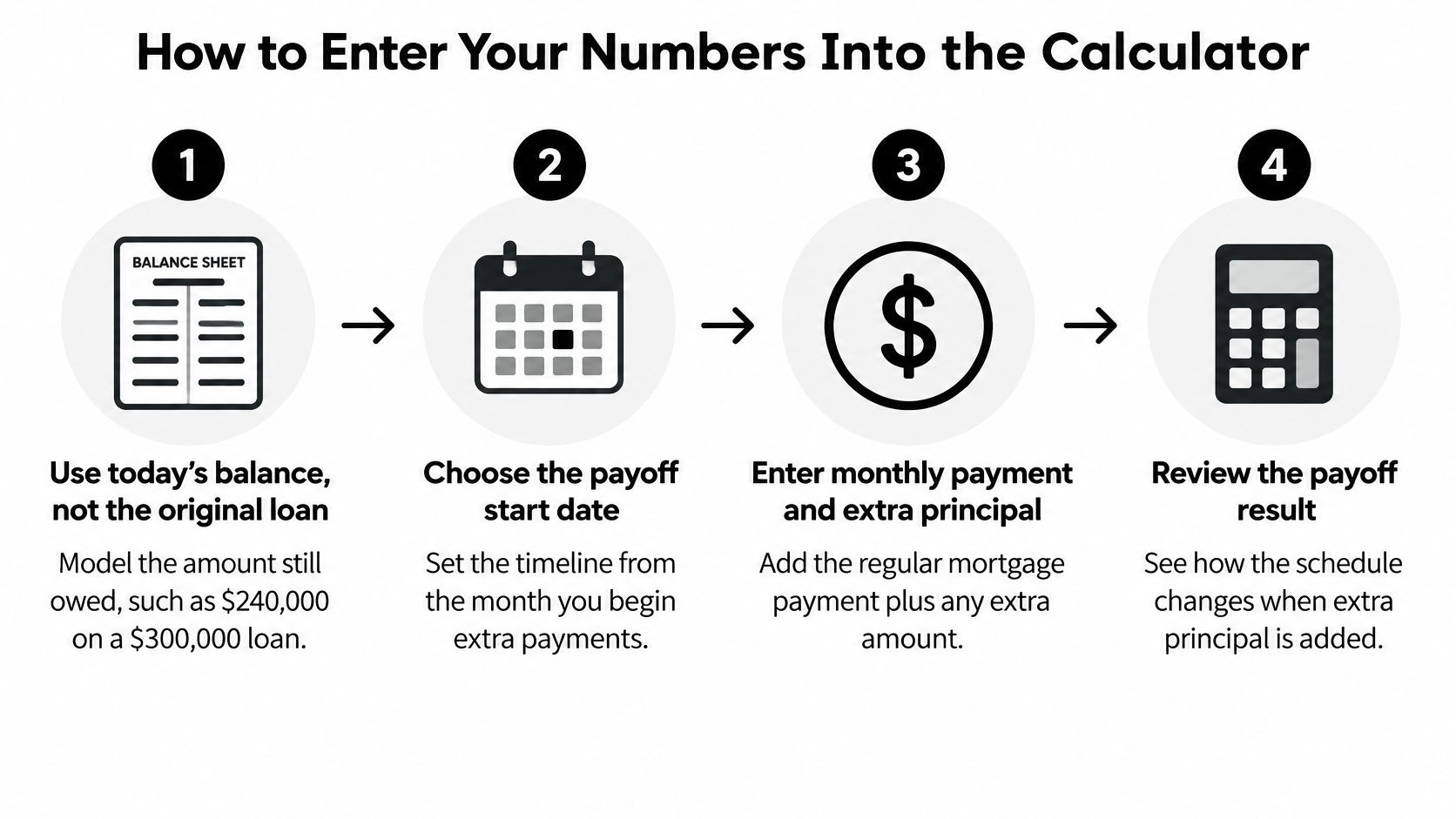
Use today's principal balance. For example, a borrower with $240,000 remaining on an original $300,000 loan should model the remaining balance, consistent with the inputs described in the Consumer Financial Protection Bureau's affordability guide. The latest statement supplies the starting point; the purchase price and original loan amount don't.
Enter the actual interest rate. Use the contractual interest rate charged on the balance, not a generic advertised rate or an APR that incorporates financing costs. For an adjustable-rate mortgage, model the next reset rate when known; otherwise, run a higher-rate scenario rather than assuming today's payment requirement will last.
Set the repayment period to 60 monthly payments. That models the five-year objective even when the original mortgage had a much longer term. A calculator that asks for the existing term instead needs an extra-payment or target-date setting.
Separate the loan payment from housing costs. Keep property taxes, homeowners insurance, mortgage insurance, and escrow outside the principal-and-interest field. Those costs belong on separate budget lines because paying off the loan won't eliminate every cost of owning the property.
Choose extra principal from available cash flow. In a hypothetical budget, a calculator might require $5,800 while the household can sustain only $4,900 toward principal and interest after other costs. That shortfall calls for a different target, not an assumption that spending will somehow shrink.
Match the start date and payment frequency to reality. Use the month extra payments will begin and distinguish monthly payments from payments tied to each payday. Timing assumptions should match the servicer's posting practices, not merely the household's payroll calendar.
Check the result against the household budget
The input sequence should remain straightforward.
An international purchase needs its own financing assumptions. For someone planning a luxury European property purchase, Bluevectis provides a mortgage-calculation resource for exploring purchase financing, but local payment conventions and lender terms still need to match the proposed loan.
Budget test: The right target survives ordinary expenses, irregular bills, and a disappointing month. A payment that works only when nothing goes wrong is too high.
Before committing, the borrower should compare the proposed payment with actual spending records. If the household can't sustain it, extend the payoff period or reduce the planned extra principal.
Your Required Monthly Payment at a Glance
A $300,000 balance at a fixed 6% annual rate requires approximately $5,800 per month, with roughly $48,000 in interest over the five-year payoff period, using the amortization example accompanying the FRED mortgage-series notes. That payment covers principal and interest only.
The number is demanding because the borrower is compressing repayment, not merely trimming interest. A lower rate helps, but the principal still has to be repaid within a short window.
Required monthly payment for a 60-month payoff
The following are calculated illustrations using monthly amortization and the rate scenarios described in Freddie Mac's mortgage-rate series preserved by FRED, with smaller balances scaled proportionally and payments and interest rounded.
| Balance | Annual rate | Monthly principal and interest | Total interest |
|---|---|---|---|
| $200,000 | 4% | About $3,683 | About $21,000 |
| $200,000 | 6% | About $3,867 | About $32,000 |
| $200,000 | 8% | About $4,055 | About $43,300 |
| $240,000 | 4% | About $4,420 | About $25,200 |
| $240,000 | 6% | About $4,640 | About $38,400 |
| $240,000 | 8% | About $4,866 | About $52,000 |
| $300,000 | 4% | About $5,525 | About $31,500 |
| $300,000 | 6% | About $5,800 | About $48,000 |
| $300,000 | 8% | About $6,083 | About $65,000 |
The borrower should locate the balance and rate, then read both payment and interest across the row. A calculator using an intermediate balance should calculate that balance directly rather than rounding it up to the next row.
Measure the gap, not just the target
For comparison, the scheduled principal-and-interest payment on that same balance and rate over a standard long-term mortgage is about $1,799 under the FRED-linked example. The accelerated target therefore more than triples the scheduled payment.
That comparison matters more than an attractive interest-savings total. Extra principal, reliable lump sums, or a smaller starting balance must close the difference; enthusiasm doesn't fund it.
A household should also distinguish a recurring surplus from occasional money. A dependable salary increase can support an automatic payment, while a discretionary bonus belongs in a separate scenario until it arrives.
A calculator result is a financing requirement, not evidence that the household can afford it.
If the required payment exceeds the cash available after housing costs and other obligations, choose a longer target or partial acceleration. Entering a larger assumed surplus only makes the forecast less useful.
Extra Principal and How Much It Saves
Interest accrues on the unpaid balance. Freddie Mac's mortgage-payoff guidance explains that early payments contain a larger interest share and gives the practical example of rounding a $1,123 payment to $1,200, directing an additional $77 toward principal when the servicer applies it correctly.
The payment schedule is worth reviewing alongside the bank statement.

Small extras help, but the target requires scale
In a hypothetical plan, an annual $2,000 lump sum supplies roughly the same cash as $167 a month, although the timing changes the interest outcome. That's useful acceleration, but it isn't a substitute for the much larger recurring contribution an aggressive payoff often requires.
A borrower should test a modest extra-payment scenario and a more demanding alternative before selecting either. For example, hypothetical monthly extras of $500 and $1,000 can reveal whether the faster payoff justifies the tighter budget.
The extra-principal payment guide provides a framework for comparing those options. Each scenario should display the regular payment, added principal, payoff date, and total interest, rather than showing savings without the cash commitment.
How the annual payment split changes
Year-by-year amortization for $300,000 at 6% over 60 payments
This calculated illustration rounds the monthly payment to approximately $5,800 and annual figures to the nearest hundred; the final payment is adjusted to clear the balance. Rounded annual totals can differ slightly from an exact calculator schedule.
| Year | Total paid | Principal | Interest | Balance at year end |
|---|---|---|---|---|
| Year 1 | $69,600 | $53,000 | $16,600 | $247,000 |
| Year 2 | $69,600 | $56,300 | $13,300 | $190,700 |
| Year 3 | $69,600 | $59,800 | $9,800 | $130,900 |
| Year 4 | $69,600 | $63,500 | $6,100 | $67,400 |
| Year 5 | $69,600 | $67,400 | $2,200 | $0 |
| Total | $348,000 | $300,000 | $48,000 | $0 |
The declining interest column shows why earlier principal reductions matter. The borrower reduces the balance used to calculate subsequent interest rather than merely changing the label on a future payment.
The accompanying video offers another format for reviewing payoff mechanics.
A biweekly arrangement can also accelerate repayment when it creates additional annual principal payments. However, a payment service that holds partial payments or charges unnecessary fees deserves scrutiny.
The operational check is simple: the statement should show the intended principal reduction. Advancing the next due date isn't sufficient evidence that the extra money was handled correctly.
Prepayment Penalties and Refinancing Checks
A large lump-sum payment can trigger a fee even when ordinary extra payments don't. The Consumer Financial Protection Bureau's prepayment-penalty explanation says penalties can apply to full payoff through a sale or refinance and sometimes to a large one-time principal payment; smaller extra-principal payments generally don't trigger them.
That makes the loan agreement the starting point for choosing a payoff pattern. A mathematically efficient schedule can become an expensive mistake if it ignores contractual charges.
Check the clause before choosing the pattern
Locate the governing documents. Find the loan note and relevant closing disclosures, then identify the prepayment provision. Search for language covering partial prepayments, full payoff, refinancing, and any applicable penalty period.
Identify which transaction triggers a charge. A recurring extra payment, annual lump sum, refinance, and sale may receive different treatment. In a hypothetical comparison, a $10,000 lump sum on a $300,000 loan could receive different treatment from an extra $200 each month; only the contract establishes whether either incurs a fee.
Get the servicer's answer in writing. Request the permitted amount, timing rules, fee calculation, and payment-posting instructions. A vague assurance that extra payments are allowed doesn't answer whether the proposed amount is penalty-free.
Compare refinancing costs with actual savings. Obtain an itemized Loan Estimate rather than relying on a generic closing-cost percentage. Include lender charges, third-party costs, any prepayment penalty, and the effect of financing those costs into the new balance.
Select the lowest-cost permitted pattern. Scheduled extra principal or payments within an annual allowance may be preferable to an unrestricted-looking lump sum. Neither pattern should be called safe until the contract confirms it.
A shorter loan isn't automatically a better loan
A refinance replaces the existing mortgage. A borrower may be able to create a shorter effective payoff period by increasing principal payments under the current agreement.
For example, a household with an attractive existing rate and flexible prepayment rights should compare voluntary acceleration against refinancing, not assume a shorter advertised term is superior. The relevant comparison is total remaining cost over the intended holding period.
Contract check: Before money moves, the borrower should know whether the proposed payment triggers a charge and whether the remaining interest savings still justify it.
Should Every Spare Dollar Go to Your Mortgage?
A fast mortgage payoff isn't automatically the strongest financial decision. A household can reduce its home-loan balance while leaving expensive card debt untouched or making itself vulnerable to the next repair bill.
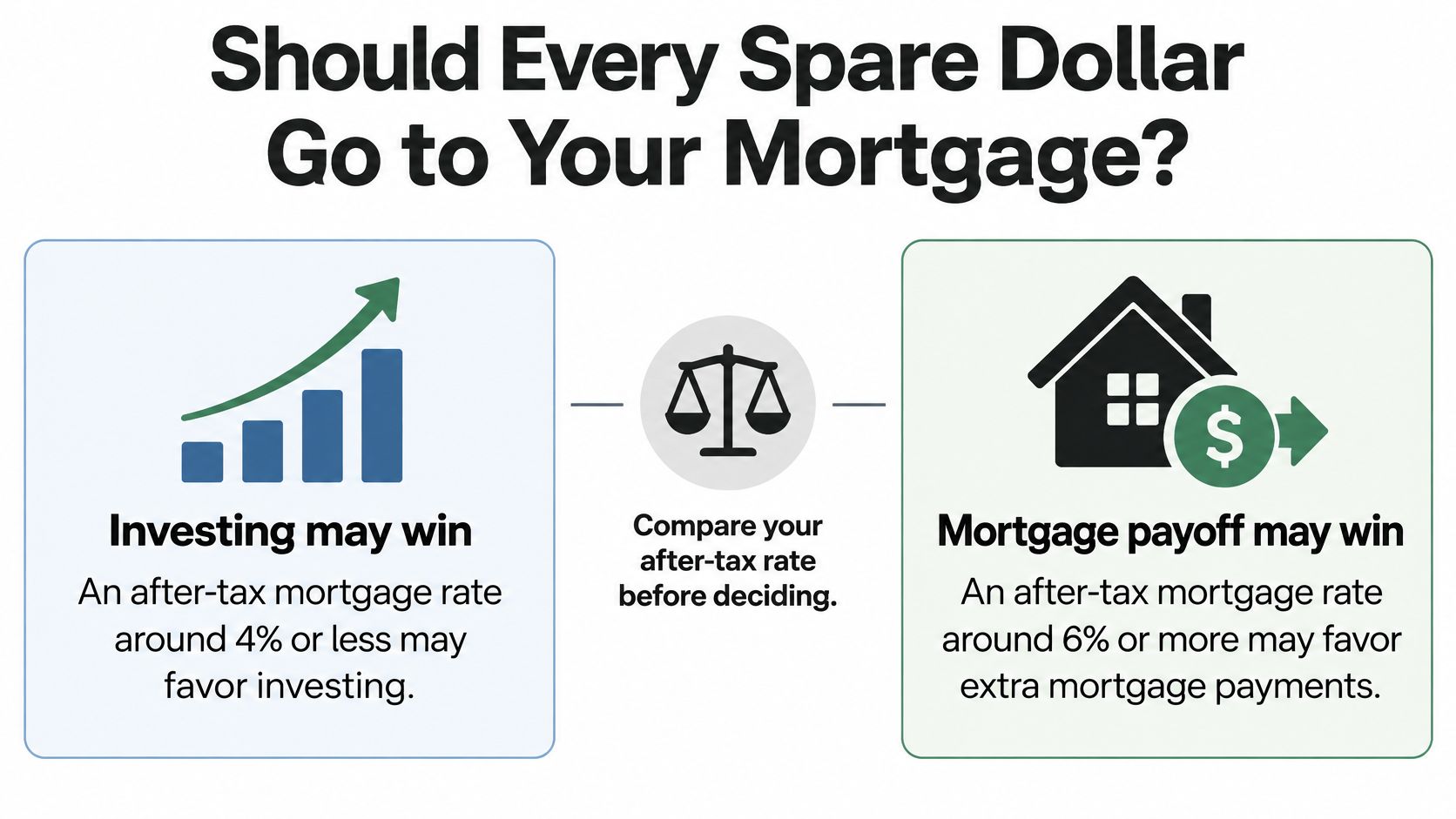
Canter Wealth's payoff-versus-investing analysis frames the comparison around the mortgage's after-tax cost, suggesting that rates around 4% or less may favor investing, while rates around 6% or more can make accelerated repayment more attractive. Those are decision guides, not guaranteed investment outcomes.
Which strategy fits your situation
| Strategy | Best when | Main trade-off |
|---|---|---|
| Mortgage-only acceleration | Mortgage rate around 6% or higher and emergency fund already full | Cash is locked into home equity and is harder to reach |
| Highest-APR debt first | Credit card balances at high APR are still open | Mortgage keeps its original pace for longer |
| Emergency fund first | Less than three months of expenses saved | Delays the five-year payoff date |
| Blended plan | Several debts and a modest monthly surplus | Slower mortgage payoff with more balanced risk |
| Invest the surplus | After-tax mortgage rate around 4% or lower | Market risk and no guaranteed return |
The emergency-fund condition is a planning recommendation, not a legal requirement or a claim that the same reserve suits every household. Variable earnings, dependents, and a fragile employment situation justify more cash before aggressive principal payments.
The comparison is easier to evaluate when liquidity stays visible.
Give expensive debt priority
Consider a hypothetical household with a $240,000 mortgage at 6%, a $600 monthly surplus, and a credit card charging 24% APR. After preserving necessary cash, the stronger recommendation is to direct that surplus to the card rather than the mortgage.
Toya AI shows which debt to pay extra on and how much interest the user will save. That helps evaluate the household's debts together instead of treating the mortgage as an isolated project.
The mortgage early-payoff decision guide can support the broader comparison. Mortgage prepayments create interest savings, but home equity isn't a substitute for accessible emergency cash, and investment returns aren't guaranteed.
The practical sequence is expensive debt first, adequate reserves next, and sustainable mortgage acceleration after that. A blended plan may produce a later mortgage-free date while leaving the household financially stronger.
Confirm Your Plan and Start This Week
The decision should end with a documented payment plan, not a saved calculator screenshot. A borrower needs a baseline, a workable extra amount, and a way to recognize when circumstances require a change.
Toya AI calculates the user's debt-free date based on current payments. The value preview calculator gives a quick debt-free estimate from three numbers, and connecting accounts in the app gives exact results.
The mortgage payoff process guide can help organize the administrative work alongside the payment plan. The household should retain statements, written servicing instructions, and scenario results together so that both the financial assumptions and payment handling remain clear.
A practical checklist for the coming week
Day one, collect the baseline. Pull the latest mortgage statement and record the current principal, contractual rate, required loan payment, and escrow amount. Note any pending rate adjustment or unexplained charge.
Day two, calculate the target. Run the desired payoff period and compare the output with the household's complete budget. Keep the result separate from the amount the household merely hopes to afford.
Day three, verify the contract. Read the prepayment provision and obtain confirmation of how additional funds will be posted. Save the response rather than relying on a telephone conversation alone.
Day four, automate the approved amount. Schedule the extra payment after payday, leaving room for essential bills. The automatic amount should reflect dependable income rather than occasional windfalls.
Day five, test a lower commitment. Compare the preferred payment with a more flexible alternative. Record the payoff date and total interest for each, along with the cash retained.
Day six, document review triggers. Save the selected figures and establish a quarterly reminder. A raise, job change, new debt, or rate reset should also trigger a fresh calculation.
Day seven, confirm agreement. Every adult responsible for the budget should understand the payment and the conditions for reducing or pausing extras. Then verify the initial transaction after it posts.
The five-year target works only when the monthly payment is one the household can keep making throughout the plan.
Toya AI builds a personalized debt-payoff plan and shows how payment choices change the debt-free date and interest cost. Visit Toya AI to compare a faster mortgage payoff with the household's other debts and choose a sustainable next payment.
Ready to start your debt-free journey?
Toya AI builds a personalized payoff plan so you can see your debt-free date and save on interest.
Get Started Free