
How to Pay Off Debt Quicker with a Smarter Plan
Credit card balances in the United States have climbed to $1.23 trillion, and a borrower carrying a balance month after month pays for that delay in interest, stress, and lost flexibility. The fix isn't a perfect spreadsheet. It's a resilient system that directs extra money to the right account, survives a bad month, and shows visible progress. Anyone trying to pay off debt quicker needs that system before motivation fades.
Table of Contents
- Why Paying Off Debt Quicker Matters Right Now
- Assessing Your Balances and Interest Rates
- Choosing Between Snowball, Avalanche, and Hybrid Payoff
- Freeing Up Cash Flow for Extra Payments
- Using Calculators to See Your New Payoff Date
- Comparing Manual Tracking, Spreadsheets, and Payoff Apps
- Staying on Track When Life Gets in the Way
Why Paying Off Debt Quicker Matters Right Now
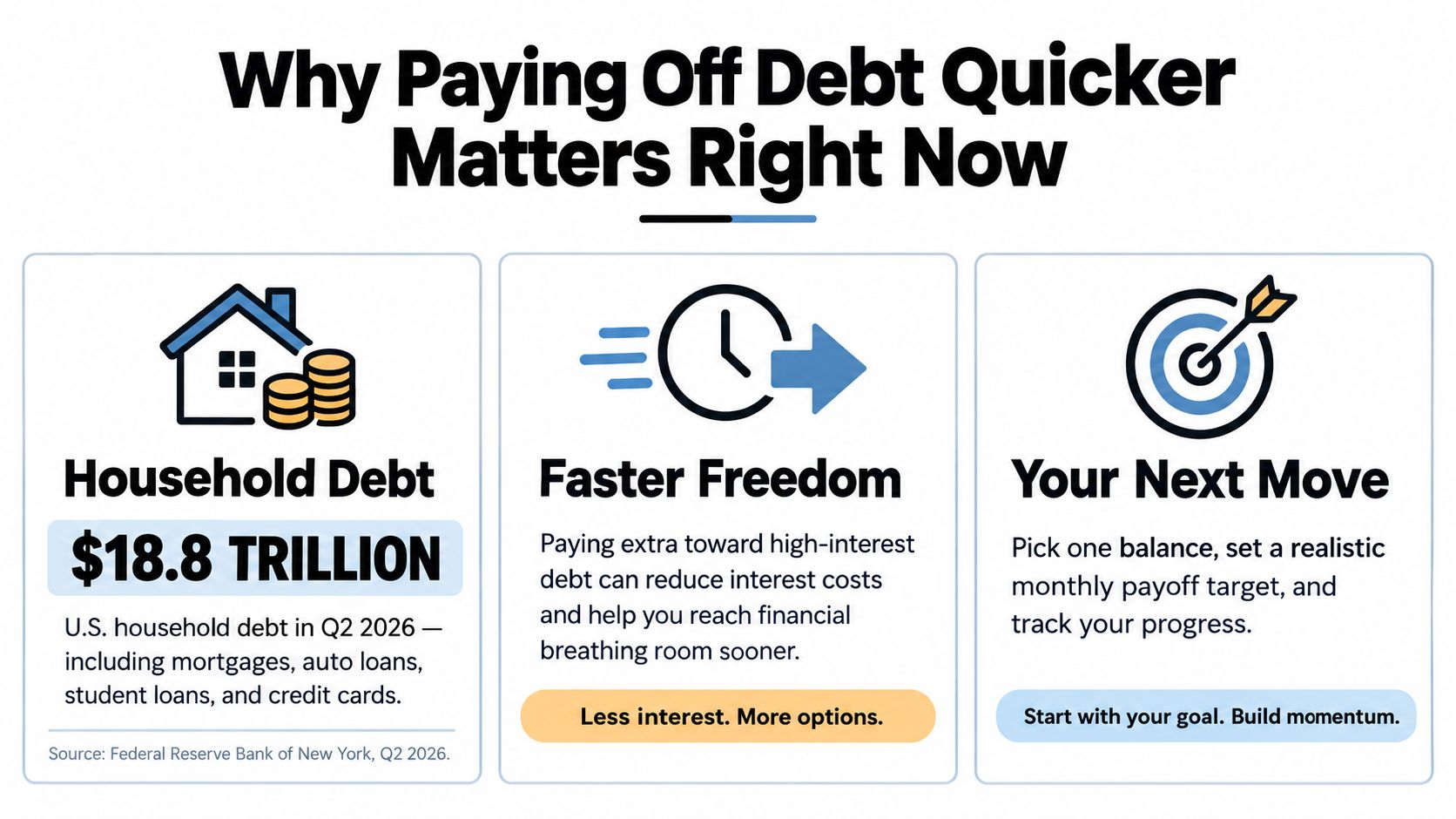
U.S. credit-card balances climbed by $24 billion in the third quarter of 2025, reaching $1.23 trillion, according to the Federal Reserve's report on the financial well-being of U.S. households. That figure makes the cost of waiting concrete, but national totals do not set your payoff date. Your balances, interest rates, and payments do.
Every month a balance remains, interest adds to what you owe. That leaves less money for an emergency fund, retirement savings, or a necessary repair. I know how easy it is to treat a minimum payment as a plan. It keeps the account current, but it can leave the balance hanging around and interest building.
The longer a balance stays, the more interest takes from your future budget. Shortening the payoff timeline gives that money back sooner.
What Faster Actually Means
Paying debt faster means keeping up with required payments on every account and sending extra money to one target at a time. The target gets your focus until it is paid off. That discipline reduces principal sooner and limits future interest, but the plan has to fit real life. A missed payment or income drop can change the schedule, so build in automation and review the numbers when circumstances shift.
The payoff sequence should be clear:
- Assess first: Gather your balances, rates, minimums, and due dates.
- Choose one order: Select snowball, avalanche, or a hybrid approach.
- Free up cash: Set a monthly extra payment you can sustain.
- Automate and recalculate: Schedule payments, then revise the plan after a change in income or expenses.
A payoff date turns a general goal into something you can track. It may move when life intervenes. Recalculate rather than abandoning the plan, and keep the required payments running while you adjust the extra amount or target.
The infographic below pairs the national debt picture with the personal decision to act.
Assessing Your Balances and Interest Rates
No strategy works without a complete inventory. A borrower needs one list with every account, current balance, APR, minimum payment, and due date. Statements, issuer apps, and loan servicer portals supply those figures. Guessing leads to missed due dates and extra money sent to the wrong account.
APR deserves more attention than balance size. A smaller balance at a high rate can cost more each month than a larger balance at a low rate. Readers who need a refresher on how that rate is built and applied can review how credit card APR works in practice before ranking accounts.
Building the One-Page Inventory
A practical inventory takes less than an evening:
- List every debt: Include credit cards, student loans, auto loans, personal loans, and any financed purchases.
- Record the APR next to each balance: Rate determines how expensive each dollar of debt is.
- Add minimums and due dates: Required payments protect credit and prevent late fees.
- Note how extra payments are applied: Principal reduction and advancing a due date are not the same thing.
That last point catches many borrowers off guard. Federal Student Aid allows payment before the due date or extra money each month and recommends contacting the servicer about how additional payments should be handled. If a borrower owes $350 monthly but pays $400, the additional $50 accelerates principal reduction only if the servicer applies the excess that way instead of merely advancing the next due date. Checking the account afterward to confirm the principal declined takes minutes and prevents months of wasted effort.
Reading the Statement for the Real Cost
Credit card statements include a minimum-payment warning showing how long payoff takes at the minimum and how much interest accumulates. That box is blunt, and it's useful. It turns an abstract APR into years and dollars.
The inventory should also flag assets tied to a balance. A financed phone is a common example, and anyone considering selling one should first understand the rules around phone resale with an unpaid balance so a sale intended to raise cash doesn't create a carrier problem.
Practical rule: Rank accounts by interest cost first, emotional weight second. The ranking can change later for motivational reasons, but it should start with math.
With three accounts, for example, a borrower lists them, circles the highest APR, and identifies the smallest balance. Those two markers set up the strategy choice. Without them, extra payments get scattered and no account disappears.
Choosing Between Snowball, Avalanche, and Hybrid Payoff
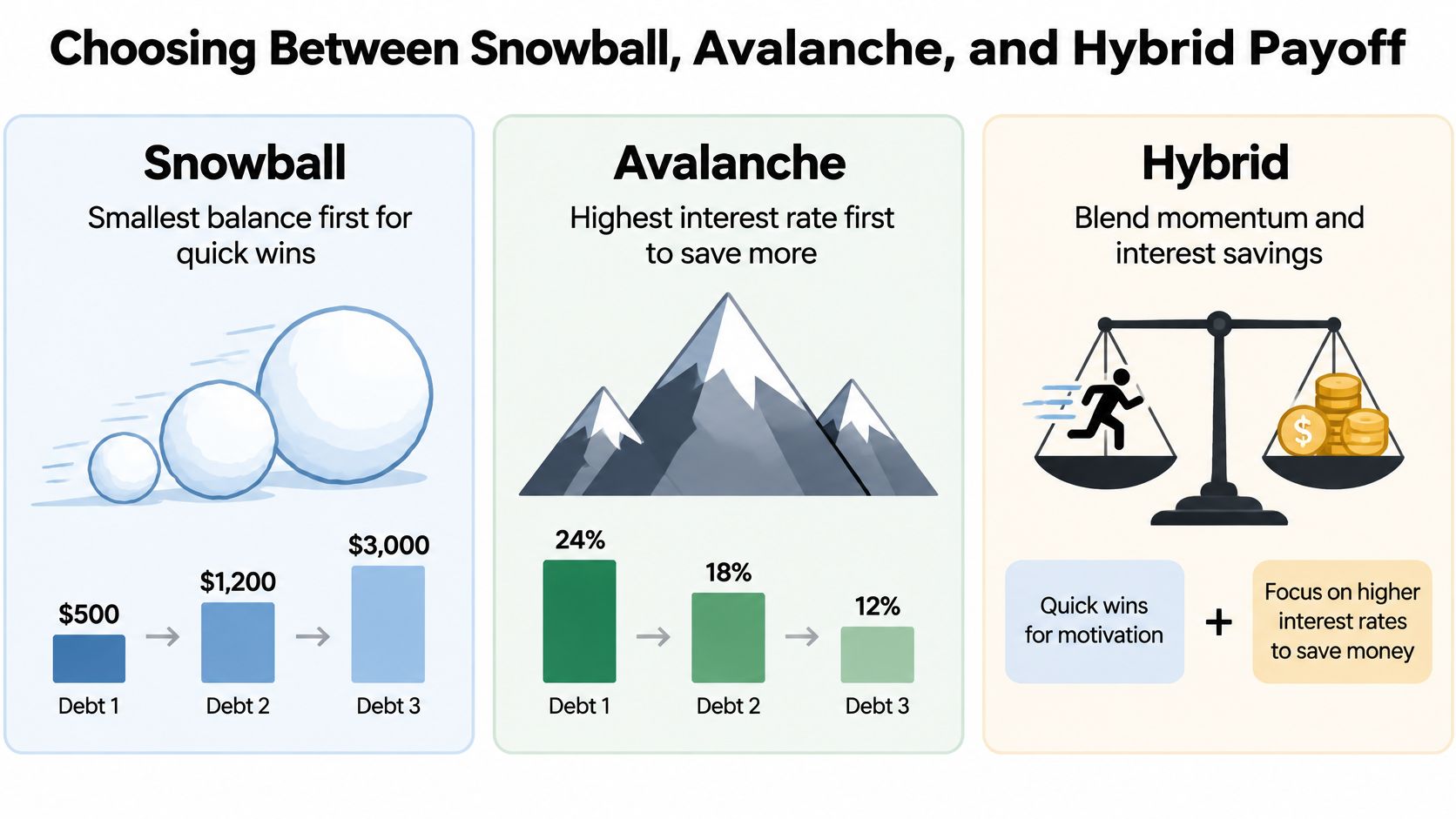
Three ordering methods dominate debt payoff, and none is universally right. The comparison below uses the same logic for each.
How Each Method Orders Payments
Snowball targets the smallest balance first while minimums continue everywhere else. The first account disappears sooner, which gives visible proof that the plan works. The cost is that a high-rate account may keep generating interest while a cheaper small balance gets attention.
Avalanche targets the highest interest rate first. Total interest paid is lower because the most expensive debt shrinks first. The drawback is patience. If the highest-rate balance is also large, months can pass before any account reaches zero.
Hybrid starts with one small win, then pivots to the highest rate. A borrower clears a minor balance for momentum, then applies avalanche discipline for the rest of the plan.
| Strategy | First Target | Best For | Main Trade-Off |
|---|---|---|---|
| Snowball | Smallest balance | Borrowers who need quick visible wins | May pay more total interest |
| Avalanche | Highest interest rate | Borrowers motivated by lowest total cost | First payoff may take longer |
| Hybrid | One small balance, then highest rate | Borrowers who want momentum and savings | Requires a clear pivot point |
The Servicer Default Many Borrowers Miss
Federal student loans often apply an automatic avalanche. Federal student-loan overpayments are generally allocated to the loan with the highest interest rate first unless the borrower gives different instructions. With a $6,000 loan at 7.5% and a $4,000 loan at 4.5%, a $200 overpayment goes to the 7.5% loan first under that default. Borrowers should still review allocation rules, because equal-rate loans may be split differently and payments can first cover delinquent amounts or accrued interest.
A borrower who prefers snowball order for student loans must give explicit instructions. Otherwise the servicer chooses avalanche.
The short video below walks through the ordering decision visually for readers who think better with a worked sequence.
The honest decision guide is simple. A borrower who stays motivated by spreadsheets and shrinking interest charges should choose avalanche. A borrower who has quit plans before because progress felt invisible should choose snowball. A borrower who wants one early win without ignoring rate for years should choose hybrid and write down the pivot in advance.
The mathematically optimal plan loses to a slightly costlier plan that a borrower actually finishes. Completion beats theoretical perfection.
Freeing Up Cash Flow for Extra Payments
A strategy without extra money is just a ranking. The extra amount doesn't need to be large, but it does need to be fixed and repeatable. Irregular good intentions don't shorten a timeline nearly as reliably as a modest automated payment.
Start with recurring charges. Subscriptions, unused memberships, duplicate services, and forgotten free trials drain cash unnoticed. Cancelling even a few creates a permanent monthly amount that can be redirected the same week, before it gets absorbed into general spending.

Where to Look First
- Recurring bills: Phone, insurance, internet, and streaming plans can often be renegotiated or switched.
- Timing: Scheduling the extra payment right after payday removes the temptation to spend it first.
- Windfalls: Tax refunds, bonuses, and freelance payments can become one-time principal payments instead of lifestyle upgrades.
- Selling unused items: Resale income works best when it's planned, and readers running regular sales can build a resale cash flow forecast to predict what can safely go to debt.
Forecasting matters beyond resale. A household that maps expected income and bills for the next few months can spot tight weeks before they cause a missed payment, which is one of the core benefits of cash flow forecasting for households. That forward view turns extra payments from guesswork into a scheduled amount.
The Emergency Buffer Question
Sending every spare dollar to debt while keeping nothing in reserve is fragile. One car repair goes back on a credit card and the plan reverses. A small starter buffer, kept in a separate savings account, protects the payoff schedule from ordinary surprises.
The balance is deliberate. Build a modest buffer first, then direct extra cash to the target debt, then grow the buffer further once high-interest balances are gone. A borrower who skips the buffer entirely isn't being aggressive. That borrower is one expense away from restarting.
Guardrail: Automate the extra payment on payday, not at month end. Money scheduled first survives. Money left over rarely exists.
A concrete routine helps. A borrower cancels unused subscriptions, renegotiates one bill, and routes the combined savings as an automatic extra payment to the target account each payday. The amount stays fixed until income rises, then it increases. No monthly decision is required, which is exactly why it works.
Using Calculators to See Your New Payoff Date
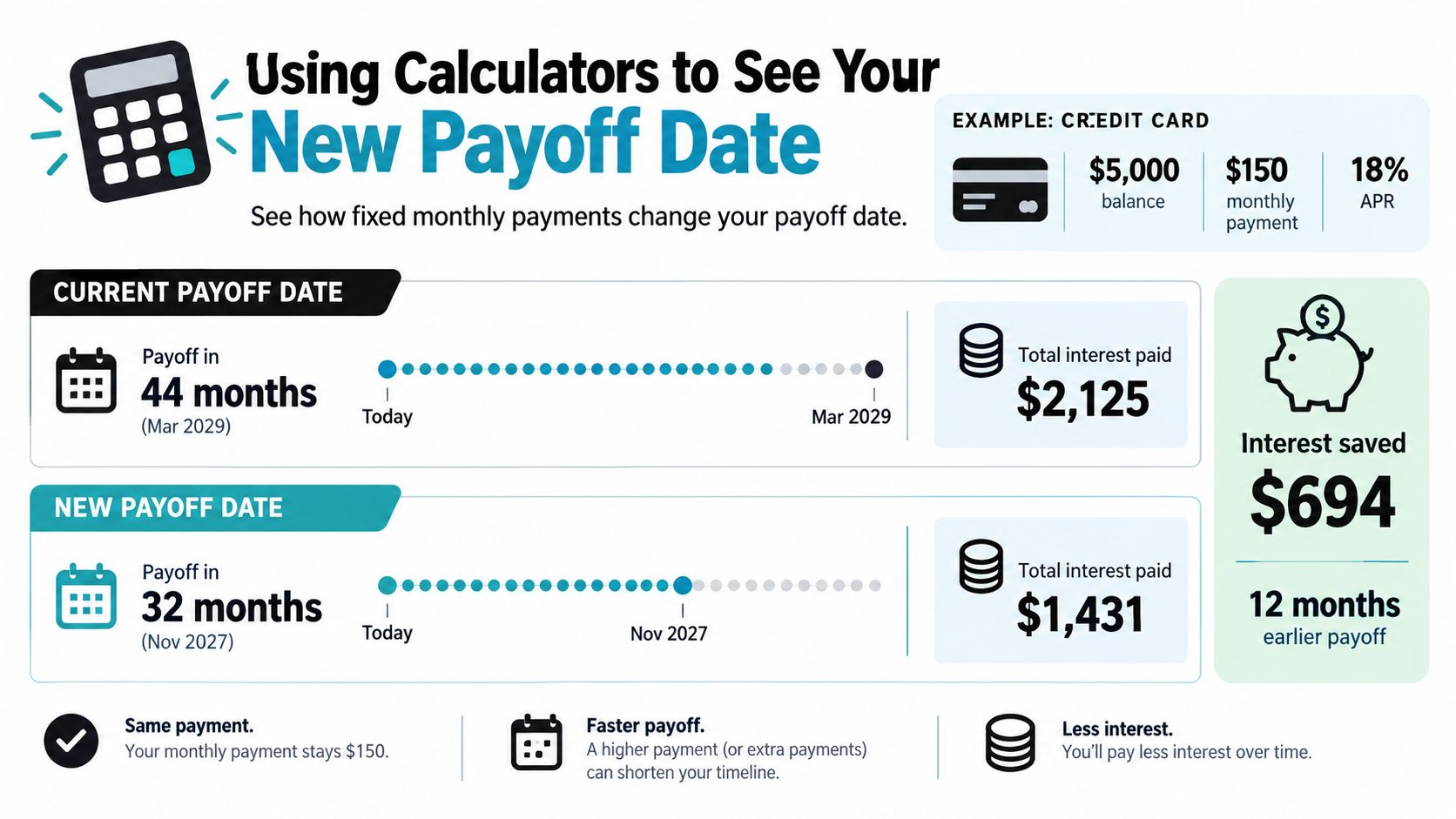
A $5,000 balance at a 22.15% APR shows why a fixed payment amount matters. With payments held constant and interest compounded monthly, paying $100 a month takes about 127 months and costs roughly $7,700 in interest. Raising the payment to $125 cuts the payoff period to about 73 months and interest to roughly $4,000. At $200 a month, the balance is paid off in about 34 months, with around $1,700 in interest. These are estimates, and the calculator should use the same fixed-payment assumption for each option.
An extra $25 a month can remove years from the schedule. An extra $100 shortens it to under three years. The key is choosing an amount you can keep paying when the month gets tight, then automating it so the plan does not depend on remembering.
How to Test a Plan in Minutes
Enter each account's balance, APR, and planned monthly payment. Change the payment to compare projected payoff dates and total interest, then choose the highest amount that still leaves room for essentials and your emergency buffer. Use a free debt payoff calculator to preview a new payoff date before you commit. Automate the selected payment and keep the calculation's assumptions consistent with your actual plan.
Manual entry gives you a useful estimate, but it can go stale when rates or balances change. Update the inputs after a change in your account terms, a new charge, or a missed payment. Recalculating helps you adjust the schedule instead of treating an outdated payoff date as a promise.
Verifying the Projection
A calculator is only as accurate as its assumptions:
- APR changes: A rate increase or decrease changes the payoff date.
- New purchases: Charges added to the balance extend the projected timeline.
- Fees: Late or annual fees add costs a simple model may not include.
- Issuer formulas: Minimum-payment calculations vary by issuer.
Compare the projection with your monthly statement. If the projected date slips, check whether the payment was made as planned, whether the rate changed, or whether new spending added to the balance. Then update the inputs and reset the payment amount if needed. A projection is a working schedule, not a guarantee.
Pick a fixed extra payment and automate it. If a missed payment or income shock disrupts the plan, recalculate before resuming, rather than relying on the old payoff date.
Comparing Manual Tracking, Spreadsheets, and Payoff Apps
A plan needs a home. Three options cover most borrowers, and the right choice depends on how much maintenance a person will tolerate.
Manual tracking means a notebook or simple list updated by hand. It's free, private, and flexible. It's also the easiest to abandon, because every balance change requires effort and nothing recalculates automatically. Borrowers who enjoy writing things down can make it work. Borrowers who don't will stop within a few months.
What Spreadsheets Add and Where They Strain
A spreadsheet adds formulas. It can rank accounts by APR, project payoff dates, and show total interest under different payment amounts. For a borrower comfortable with formulas, that's real power at no cost.
The strain is upkeep. Balances change monthly, rates adjust, and due dates shift. Someone has to enter every update, fix broken formulas, and re-sort the priority order after each payoff. A spreadsheet that's two months stale gives confident, wrong answers.
What Automated Apps Do Differently
Payoff apps centralize balances, APRs, utilization, and due dates in one dashboard. Toya AI, for example, connects accounts through read-only partners, analyzes interest rates, timelines, and cash flow, recommends the next best payment, and shows how each action changes the debt-free date, monthly interest, and total cost. A quick calculator previews outcomes in seconds, while connected accounts produce more precise projections that update as circumstances change.
That automation solves the spreadsheet problem, but it requires comfort with connecting financial accounts. Borrowers who prefer full manual control may accept slower updates in exchange for that control.
- Choose manual tracking if debts are few, balances change slowly, and writing by hand is satisfying.
- Choose a spreadsheet if formulas are comfortable and monthly updates feel like a routine, not a chore.
- Choose an app if accounts are numerous, due dates are scattered, and past systems failed because upkeep lapsed.
Selection test: Pick the system that will still be updated during a stressful, busy month. That's the real system, not the one that works on a quiet weekend.
The tool matters less than the feedback loop. Any system that shows a current debt-free date, the next target account, and the effect of the next payment gives a borrower enough information to act. A system that hides those three things, however elegant, will slow progress to pay off debt quicker because every month starts with recalculation instead of action.
Staying on Track When Life Gets in the Way
Plans rarely fail on math. They fail on missed payments, income shocks, and progress too slow to see. The CFPB's 2025 credit-card market report says the share of cardholders making only minimum payments was at its highest level since at least 2015, and recent student research found that 31% of students who don't pay balances in full struggle to make payments on time, 88% worry about covering basic expenses, and 60% report difficulty concentrating on schoolwork because of financial stress.
Guardrails address that reality directly:
- Automate minimums on every account: Automation prevents late fees, but payment dates should sit after payday to avoid overdrafts.
- Recalculate after any shock: A missed payment or income drop means rerunning the numbers that week, not abandoning the plan.
- Track milestones visibly: Each account closed and each thousand of principal gone deserves a mark somewhere visible.
For federal student loans, a two-step approach protects the plan. An income-driven plan can keep required payments affordable and prevent delinquency, then voluntary extra payments above the required amount accelerate payoff when cash flow allows. Annual recertification reminders belong on a calendar, since a missed renewal can change the required payment.
The next step takes one evening. List every debt, pick one strategy, and automate one extra payment to the first target account.
Toya AI builds a personalized payoff plan across credit cards and loans, recommends the next best payment, and updates the debt-free date as balances and cash flow change. Borrowers ready to replace scattered statements and stale spreadsheets with one adaptive plan can start at Toya AI and preview a faster payoff date today.
Ready to start your debt-free journey?
Toya AI builds a personalized payoff plan so you can see your debt-free date and save on interest.
Get Started Free