
Pay Off Credit Card Debt Plan
A reader often reaches the breaking point after opening several statements in the same week. One card has a balance left from an emergency, another carries everyday purchases, and a third has a promotional rate that's about to change. Minimum payments leave the accounts technically current, yet the balances barely move. A workable pay off credit card debt plan turns that confusion into an ordered set of decisions, with room for income changes, unexpected bills, and the psychological strain of a long repayment period.
Table of Contents
- Why You Need a Structured Payoff Strategy
- Taking Stock of Your Debts and Cash Flow
- Choosing Between the Snowball and Avalanche Methods
- Using Tools and Tactics to Accelerate Progress
- Building a Safety Net to Prevent Setbacks
- Tracking Progress and Staying Motivated
Why You Need a Structured Payoff Strategy
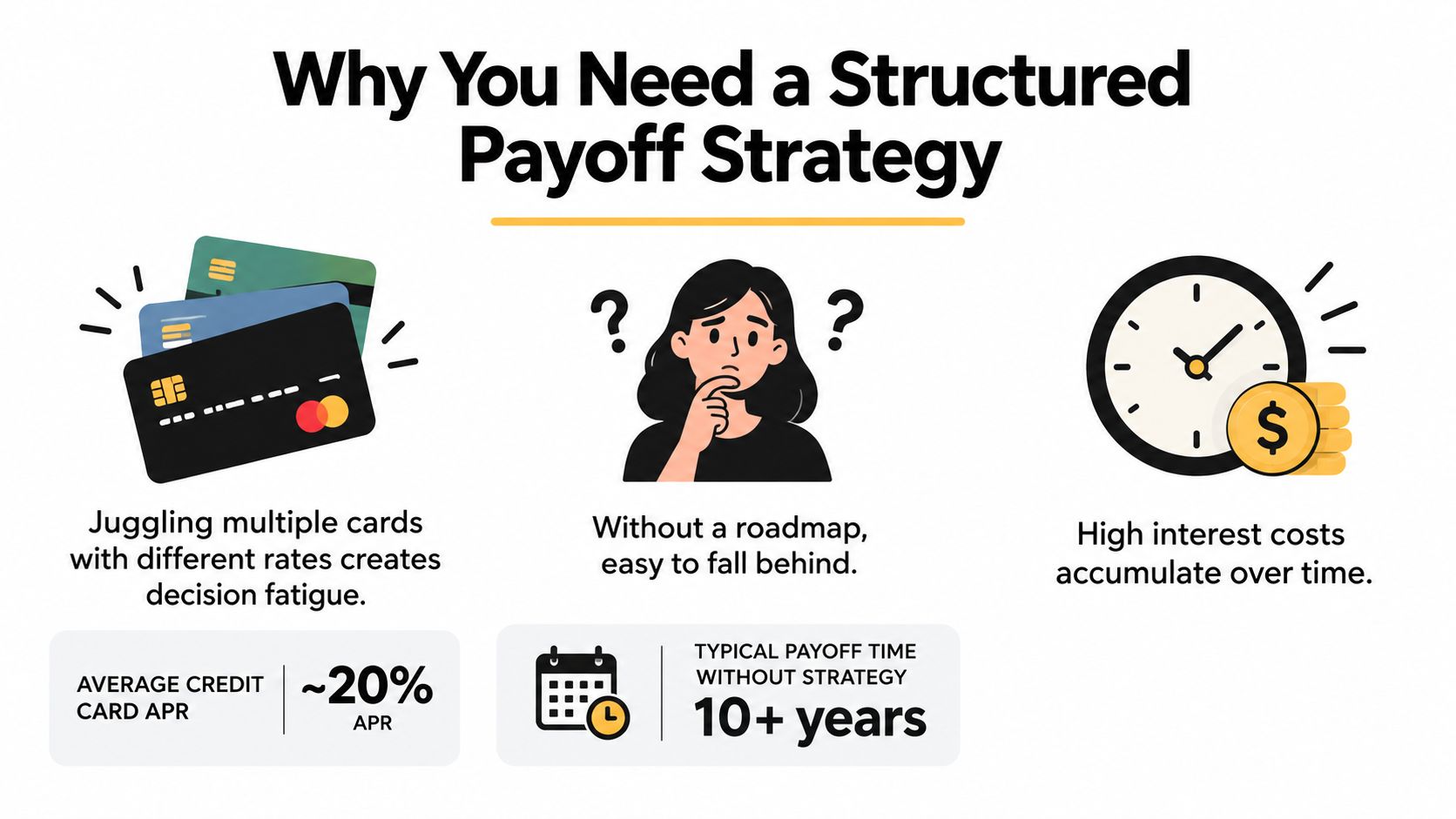
Consider a borrower with three cards, different due dates, and no clear target. Extra money goes to whichever bill feels most urgent that month. The borrower may pay a little more than the minimum on every account, but no balance receives enough attention to disappear. Meanwhile, interest continues to accumulate on revolving balances.
Credit card debt affects a broad portion of households. The Federal Reserve's 2022 Survey of Consumer Finances found that 46% of U.S. households held credit card debt, while credit card balances represented about 2% of overall household debt. The same Federal Reserve analysis reported an average credit card interest rate of approximately 15% in November 2021, and an average indebted household paid about $76 per month in credit card interest. See the Federal Reserve analysis of household credit card debt for the underlying figures.
Random payments rarely solve the core problem
A minimum payment is a compliance floor, not a payoff strategy. A borrower can make every required payment on time and still carry a balance long enough to generate repeated interest charges. Treating every card equally also ignores the fact that an additional dollar reduces more interest when it reaches a higher-APR balance.
The first decision is therefore structural:
- Protect every account: Pay at least the required minimum by its due date.
- Choose one target: Direct available extra money to one balance rather than scattering it.
- Freeze new revolving debt: New purchases can cancel out the progress created by extra payments.
- Review the plan regularly: A changed APR, promotional-rate expiration, fee, or income shock can alter the best target.
The borrower's method matters, but sustainability matters more. An avalanche plan that causes missed payments or forces new borrowing isn't effective in real life. A structured plan gives each dollar a job, keeps payment dates visible, and makes the debt-free timeline measurable instead of hopeful.
Taking Stock of Your Debts and Cash Flow
A payoff strategy starts with accurate inputs. Guessing balances or using an optimistic estimate of available cash creates a payment commitment that may collapse after the first unexpected expense.
Build the debt inventory
Create one row for every credit card and record:
- Current balance: Use the latest statement or account balance.
- APR: Record the purchase rate and note whether it's variable or promotional.
- Minimum payment: Capture the exact required amount.
- Due date: Include the statement closing date as well, because it helps explain when balances and utilization are reported.
- Fees and deadlines: Mark annual fees, promotional-rate expiration dates, and any hardship-program terms.
A spreadsheet is enough. An expense report template from Smart Receipts can help organize transactions and reveal which spending categories are absorbing cash that could otherwise support repayment. For readers who need a clearer explanation of how interest rates work, this guide to credit card APR provides useful terminology for reviewing account statements.
Calculate the amount that can actually go to debt
Start with reliable monthly take-home income. Subtract housing, utilities, food, transportation, insurance, health costs, taxes not already withheld, and other essential expenses. Then subtract the minimum payment on every card.
The remainder is not automatically the extra-payment amount. Keep room for irregular costs, a small emergency buffer, and ordinary spending that would otherwise go back onto a card. A plan that allocates every remaining dollar may look efficient on paper but fail after one repair bill or medical expense.
Use a simple dashboard with these fields:
| Field | Purpose |
|---|---|
| Total take-home income | Establishes the monthly starting point |
| Essential expenses | Protects necessary bills before debt acceleration |
| Total minimum payments | Preserves payment reliability |
| Available extra payment | Defines the target-card budget |
| Target card | Prevents scattered payments |
| Projected payoff date | Creates a measurable reference point |
Only after this inventory should the borrower choose a method. A person who needs visible wins may prefer the snowball. Someone focused on minimizing interest may choose the avalanche. Either approach requires the same foundation, minimums on every account and all remaining money directed to one target.
Choosing Between the Snowball and Avalanche Methods
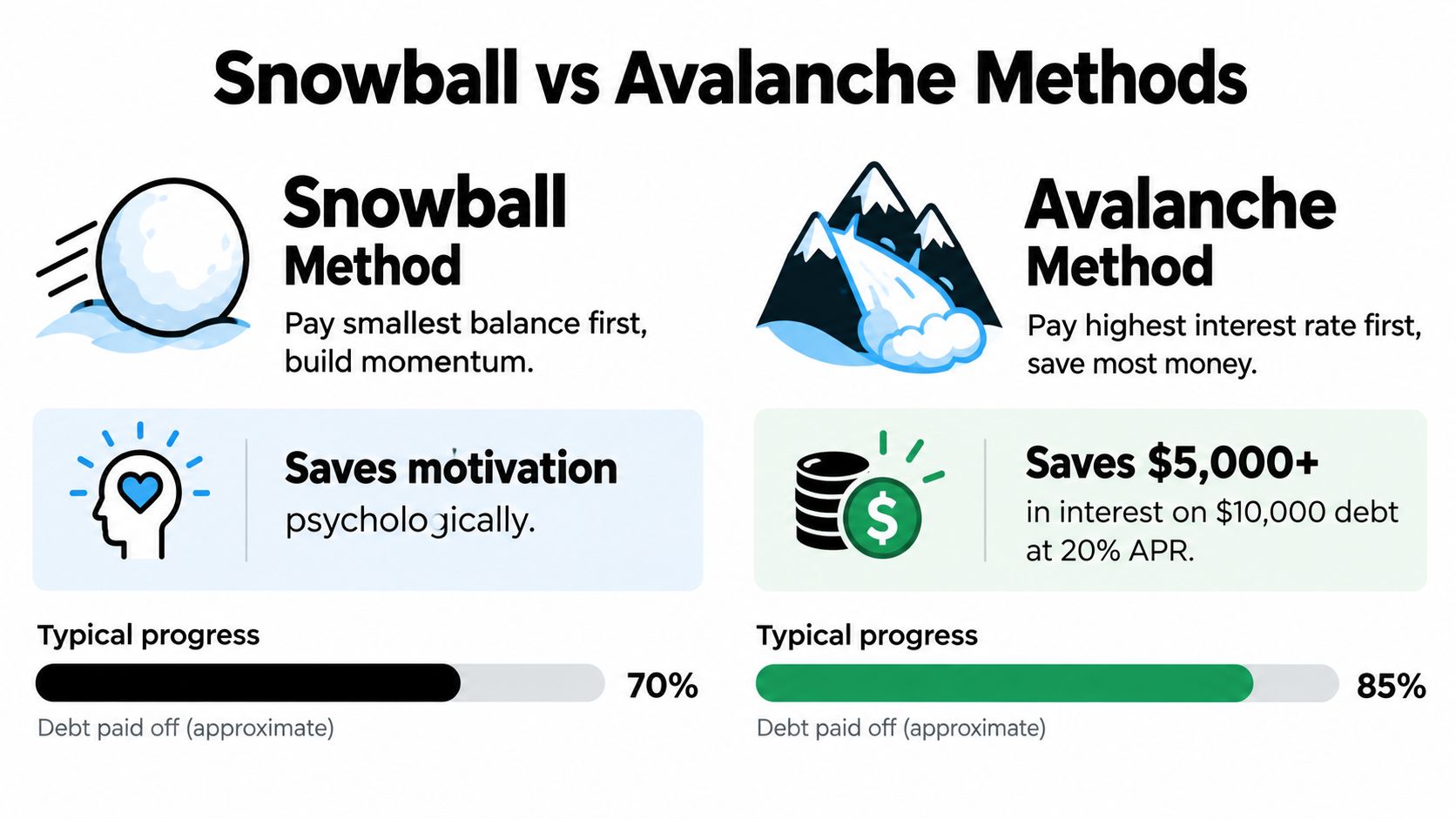
The debt avalanche ranks cards by APR. The borrower pays the minimum on every account, then directs extra money to the highest-rate balance. Once that card reaches zero, the entire payment rolls into the next-highest APR card. The Michigan financial education guide to paying off credit card debt describes this same sequence.
The debt snowball ranks cards by balance. The borrower targets the smallest balance first, regardless of its APR, then rolls that completed payment into the next-smallest balance. This approach can produce a faster visible milestone and simplify bill management, although it may cost more interest when a larger balance carries a substantially higher rate.
The math and the psychology
Suppose Card A carries a 24.99% APR and Card B carries 19.99% APR. If the balances are otherwise comparable and the borrower has a fixed extra-payment budget, avalanche logic sends the extra money to Card A because each dollar reduces the more expensive finance charge. By contrast, a borrower with a $450 balance at 29% APR and a $2,400 balance at 19% APR would target the $450 account under the snowball method, while the avalanche would target the 29% account. Those examples illustrate the trade-off, not a universal winner.
Minimum-only repayment can be especially costly at high APRs. A CFPB example reviewed in a 2025 analysis uses a $2,000 balance at a 29% APR. Under a minimum-payment formula equal to interest plus 1% of the balance, repayment would take nearly 10 years and cost more than $3,000 in interest. Increasing the payment to 2% of the balance would shorten repayment to slightly more than six and a half years, while a 4.25% payment would reduce interest below $1,000 and eliminate the balance in just over four years. The comparison appears in this review of the CFPB credit card repayment example.
Practical rule: Choose the method that the borrower can follow during an ordinary difficult month, not only during an optimistic month.
When standard avalanche needs adjustment
A risk-adjusted approach considers more than APR. The Philadelphia Federal Reserve reported 2025 average purchase APRs of about 24.5% for general-purpose cards and 31.3% for private-label cards, with rates near historical series highs. At those rates, directing an extra $500 toward a 31.3% store card instead of a 24.5% card saves roughly $34 more annualized interest before compounding. Those figures are detailed in the Philadelphia Federal Reserve large-bank survey.
A borrower can rank each card by interest cost, utilization pressure, approaching rate changes, fees, and the likelihood of maintaining minimum payments. A high-APR card usually remains the primary target, but a promotional deadline or severe utilization issue may justify a temporary adjustment. The guide to deciding which debt to pay first can help frame that decision without reducing it to balance size alone.
Using Tools and Tactics to Accelerate Progress
A payoff method determines where extra money goes. Tactics determine how much extra money becomes available and whether the plan survives contact with daily life.
Compare the available levers
Rate negotiation is often the simplest first call. The Federal Trade Commission advises consumers to contact creditors promptly, explain the situation, request an affordable payment arrangement, and ask whether the interest rate can be reduced. CFPB guidance also notes that issuers may sometimes reduce minimum payments, waive fees, lower rates, or change a due date. Any revised terms should be confirmed in writing, including the new payment, rate, fees, start date, and consequences of missing a payment. The FTC guidance on getting out of debt provides a starting point for that conversation.
Balance transfers can reduce interest temporarily when the borrower qualifies and can repay within the promotional period. The transfer fee, expiration date, post-promotion APR, and risk of renewed card spending all matter. A transfer that merely moves the balance without a fixed repayment schedule can postpone the problem.
Consolidation loans replace several revolving balances with one installment payment. The comparison should include the total repayment cost, origination fees, term, and whether the borrower can avoid rebuilding card balances afterward. Consolidation simplifies administration, but a lower monthly payment may reflect a longer repayment period rather than a lower total cost.
Issuer hardship arrangements deserve attention before delinquency. If required payments are unaffordable, contacting the issuer early creates more options than waiting for missed payments. Households facing severe financial pressure may also need to review relief options for struggling homeowners with qualified legal guidance, particularly when housing obligations are at risk.
A payoff calculator can compare payment amounts and timelines before a borrower changes accounts. The debt payoff calculator from Toya is useful for testing scenarios such as a fixed extra payment, a changed APR, or a different target order.
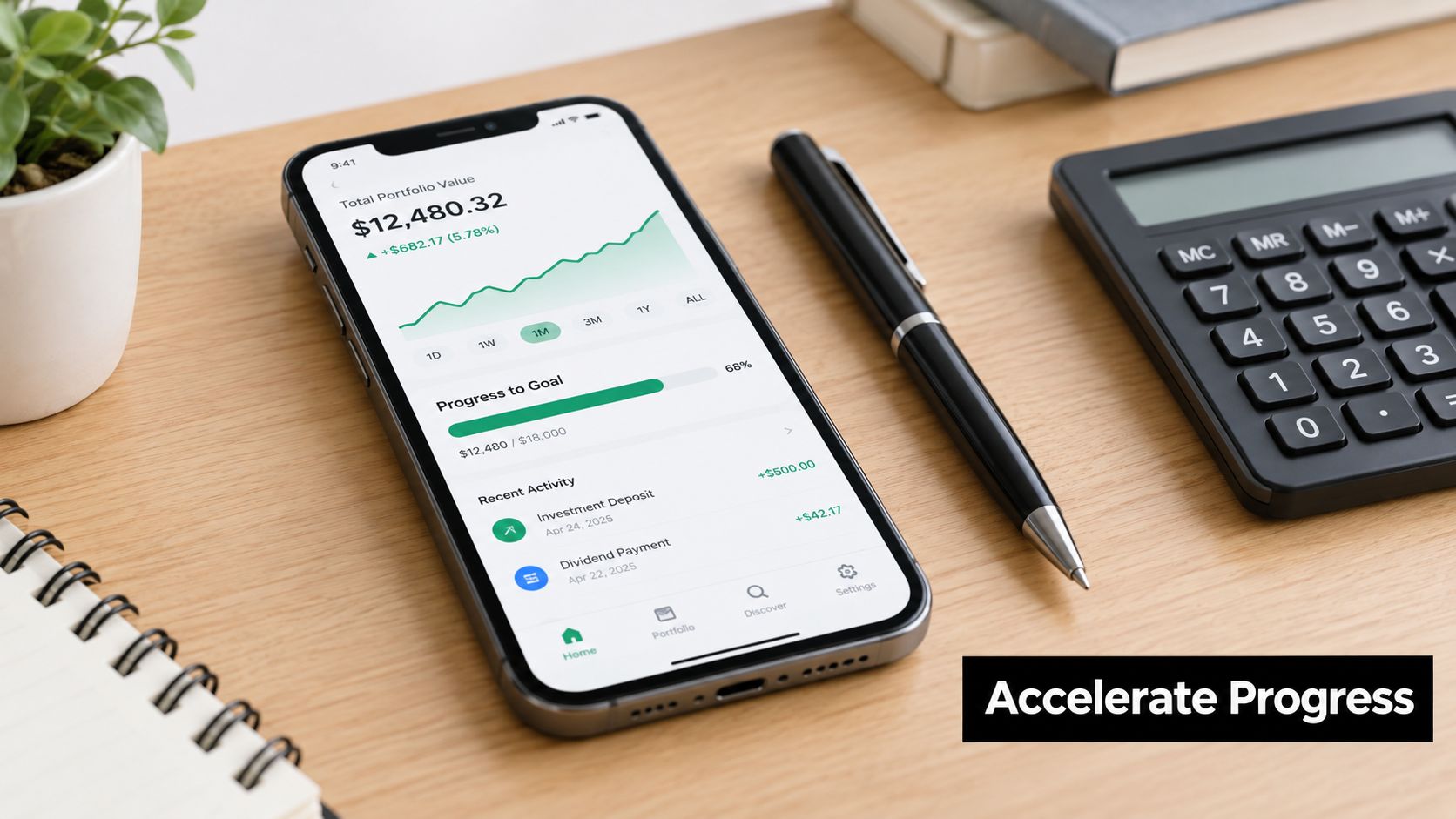
Automation handles execution, not judgment. Schedule every minimum before its due date, send the extra payment to the selected target, and direct suitable windfalls toward principal after essential needs and the emergency buffer are covered. A budgeting app can support visibility, but no tool can make an unaffordable payment sustainable.
A connected dashboard can also reduce manual tracking. Toya AI connects credit accounts through read-only access, centralizes balances, APRs, utilization, and due dates, and recalculates suggested payments as cash flow or account conditions change. It's one option among spreadsheets, budgeting software, creditor portals, and professional counseling.
The video below offers another way to think about organizing a repayment process before choosing specific tactics.
Building a Safety Net to Prevent Setbacks
Aggressive repayment becomes fragile when it leaves no cash for ordinary surprises. A borrower who sends every available dollar to a card may need to use that same card again when a tire fails, a prescription costs more than expected, or income arrives late.
A small emergency buffer belongs inside the plan, not after it. The amount should reflect the household's immediate risks and cash flow, while still allowing required payments to continue. The point isn't to build a perfect reserve before making progress. It's to prevent a manageable disruption from creating a new revolving balance.
Use a priority order during a shock
When income drops or an unexpected bill appears, the borrower should adjust the plan in this order:
- Protect essentials: Preserve housing, utilities, food, insurance, transportation, and necessary health costs.
- Preserve payment reliability: Make required minimums where possible and contact issuers before delinquency.
- Pause acceleration if necessary: Reduce or temporarily stop the extra payment rather than borrowing again to maintain an unrealistic schedule.
- Resume deliberately: When cash flow recovers, restore the target payment and update the projected debt-free date.
This isn't failure. It's risk control. Federal Reserve data show that credit card balances rose 11% over two years overall, but rose only 1% among adults living comfortably and 37%, more than $2,500, among those finding it difficult to get by. The Federal Reserve report on household economic well-being supports a practical conclusion: static payment schedules don't fit every household.
A 2025 NFCC survey also found that the share reporting payments below the required minimum rose from 8% in spring to 13% in August, while 53% reported a negative change in personal finances over the prior six months. Those findings make adaptability essential, especially for households with variable income.
Build flexibility into automation
Automation should protect minimum payments, but the extra-payment instruction should be adjustable. A borrower can maintain a baseline payment toward the planned target while reviewing income and essential expenses before sending additional discretionary money.
When the plan pauses, the dashboard should show the cost of pausing rather than labeling the month as a failure. That visibility makes it easier to resume without shame, and it prevents a temporary setback from becoming permanent avoidance.
Tracking Progress and Staying Motivated
Debt reduction needs a monthly control panel. The balance alone doesn't explain why progress changed, so each review should compare the current month with the original baseline.
Use a compact monthly checklist
Record:
- Actual payment: Compare the amount sent with the planned amount.
- Ending balance: Confirm whether principal fell as expected.
- Interest charged: Investigate an unexpected increase.
- Utilization ratio: Divide total revolving balances by total credit limits.
- Fees and residual interest: Check for charges that changed the forecast.
- Projected debt-free date: Update it after every major payment or cash-flow change.
- New spending: Identify purchases that slowed or reversed progress.
Credit card statements provide a useful benchmark. Federal disclosure rules require statements to show the time and cost of making only minimum payments, along with the payment needed to repay the balance within three years. In the cited example, a $3,000 balance at 14.4% interest would take about 11 years and cost $4,745 under the minimum-payment scenario. Paying $103 per month would repay it in three years for a total of $3,712, implying approximately $1,033 in avoided payments. The example is documented in this explanation of credit card statement repayment disclosures.
Interpret deviations instead of guessing
Suppose the target card's balance falls less than projected. The borrower should check for daily-balance interest, a fee, a variable APR change, residual interest, a lower-than-planned payment, or renewed spending. The U.S. News summary of minimum-payment and delinquency data notes that the New York Federal Reserve reported $1.18 trillion in U.S. credit card balances in March 2025, with 4.3% of outstanding household debt in some delinquency stage. Payment reliability comes before optimization.
Motivation improves when milestones are visible and specific. Mark each account closure, update the forecast after a difficult month, and share progress with a trusted person if accountability helps. For readers who need support with the emotional side of setbacks, resources on overcoming obstacles with holistic counseling may complement the financial work.
Review the plan on a consistent schedule, but change it whenever the facts change. A payoff plan is successful when it keeps the borrower current, reduces expensive balances, and remains usable during real life.
Toya AI can connect credit accounts, organize balances, APRs, utilization, and due dates, then model how payment changes affect the projected debt-free date and total cost. Visit Toya AI to start tracking a personalized plan and turn the next payment into a clear, measurable step.
Ready to start your debt-free journey?
Toya AI builds a personalized payoff plan so you can see your debt-free date and save on interest.
Get Started Free