
Pay Credit Card in Full: A Step-by-Step Plan for 2026
The statement email arrives while dinner is cooking, rent is due in nine days, and the card app shows three different numbers. There's a minimum payment, a statement balance, and a higher live balance that keeps changing with every coffee and grocery run. Paying the wrong one feels harmless in the moment, yet a small leftover amount can end the interest free window and turn next month's ordinary spending into borrowing.
The fix isn't willpower alone. It's a timing system built around three separate dates, each with a different job. Get the statement balance, the due date and the reporting date in the right order, and the routine to pay credit card in full becomes mechanical rather than stressful.
Table of Contents
- Pay the Statement Balance on Time Every Cycle
- Budget Cash Flow and Windfalls to Fund the Full Payment
- What Carrying a Balance Really Costs Each Month
- Paying Above the Minimum When You Cannot Clear It
- Timing Payments to Lower Reported Utilization
- Set Up Your Payment Plan This Week
Pay the Statement Balance on Time Every Cycle
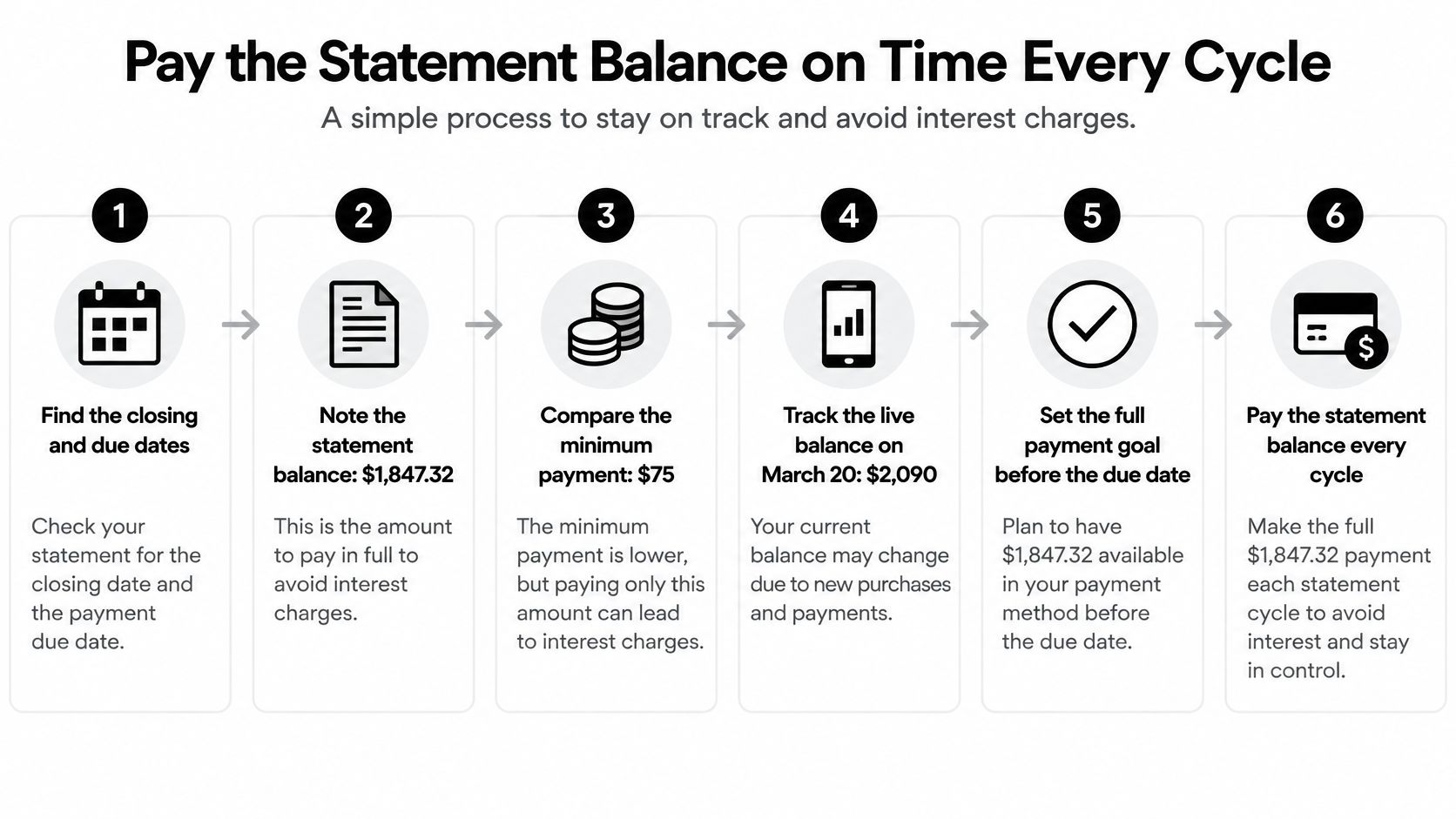
Start with one real cycle. Say a statement closes on March 12 at $1,847.32, with a $75 minimum payment. By March 20, new spending pushes the live balance in the app to $2,090. The amount that protects the account this cycle is still $1,847.32, because that's the balance the statement closed with. The extra spending after March 12 belongs to the next cycle, even though the app blends both cycles into one number.
The Six Steps for Every Statement
- Find the closing and due dates. Open the actual statement, not just the app home screen, and write both dates down. The usual slip is guessing the due date from last month, which fails when weekends or a changed cycle shift it.
- Note the statement balance and minimum. Record $1,847.32 as the target and $75 as the floor, then ignore the $2,090 live balance for this payment. Paying a rounded guess instead of the exact statement balance can leave a few dollars behind to start interest.
- Check pending items and credits. Scan for pending purchases, refunds and merchant credits, and confirm whether a credit landed before or after the closing date. A refund that posts after closing usually doesn't reduce the statement balance already issued, so the full statement amount still needs paying.
- Schedule the full payment early. Set the electronic payment for the full statement balance at least three business days before the due date. Scheduling on the due date itself leaves no room for a bank delay, a wrong account number or a returned payment.
- Confirm it posted. Two days later, check that the payment shows as posted and the balance fell as expected. A scheduled payment isn't a completed payment, and a missed minimum can trigger late fees, penalty pricing and credit reporting problems.
- Repeat with a cash buffer. Keep enough in the payment account so the transfer never overdraws it or forces new borrowing to cover rent. The routine only works when it's boring and identical every cycle.
That workflow, treating the statement balance rather than the current balance as the target, matches the approach described in the Federal Reserve review of consumer experiences with credit cards, which found that the share of bankcard holders who reported almost always paying in full increased from 50% in 2000 to 62% in 2012. Cash advances, balance transfers, fees and promotional balances can follow different interest rules, so each one deserves a separate check on the statement rather than an assumption.
Why the Grace Period Makes Autopay Settings Matter
Set autopay to the statement balance as the default. The Consumer Financial Protection Bureau guidance on grace periods defines a grace period as the time between the end of a billing cycle and the payment due date, and explains that when an issuer offers one, no interest may be charged on purchases if the balance is paid in full by the due date. Issuers aren't legally required to offer a grace period, so the card agreement controls, and failing to pay in full can mean losing that window until the full balance is paid on time for the number of cycles the agreement specifies.
Autopay settings compared
| Autopay option | What it pays | Interest risk | Best for |
|---|---|---|---|
| Statement balance | Full statement amount | No interest on purchases while the grace period holds | Most cardholders with steady cash flow |
| Fixed amount | A chosen amount | Interest on the unpaid remainder | Only when the fixed sum always covers the statement |
| Minimum payment | Minimum due only | Interest on most of the balance and grace period lost | Emergency fallback for one cycle, not a plan |
Fixed amount autopay looks tidy and fails. A $500 fixed payment against an $1,850 statement leaves $1,350 outstanding, accruing roughly $27 a month at a 24% APR in a simple monthly approximation. Minimum payment autopay keeps the account current, but it lets most of the balance revolve, so it belongs in the one bad month category rather than the long term plan category.
Practical rule: Recheck autopay after any card reissue, limit change or banking app update, because a reset setting can silently drop the payment back to the minimum.
Done right, the result is unglamorous and valuable. The balance lands at zero or near zero, no purchase interest appears on the next statement, and the next cycle starts clean.
Budget Cash Flow and Windfalls to Fund the Full Payment
A full payment plan collapses when card spending has no ceiling tied to actual cash. Take a household with $3,400 in monthly take-home pay and $2,300 in fixed bills such as rent, utilities, insurance and transport. Holding back a $300 buffer leaves $800 for card spending and everything else. If the card carries roughly $650 of spending each cycle, the statement gets paid in full with $150 to spare. That $650 becomes the cap on card use, not a vague intention to spend less.
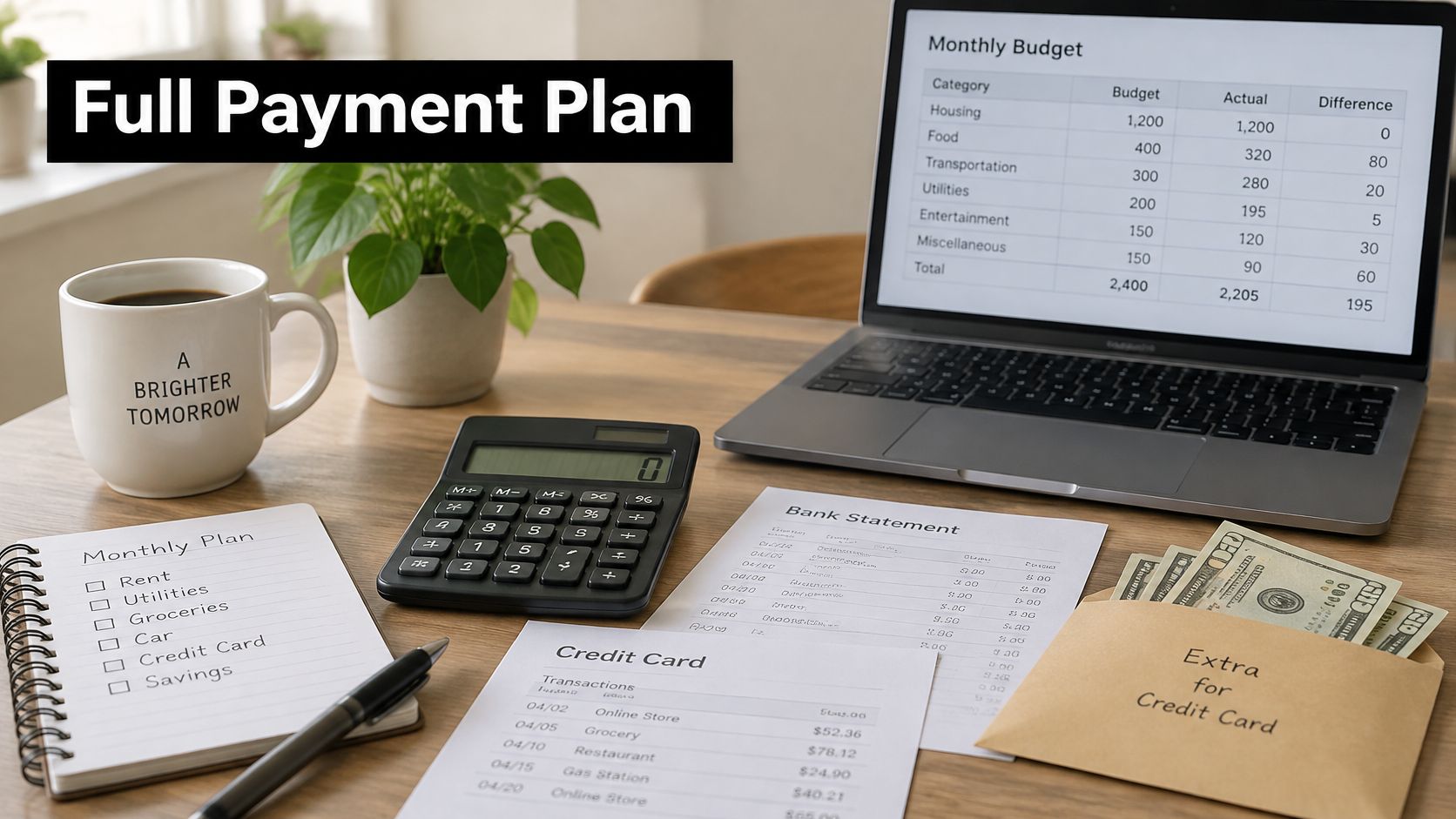
Turn the cap into plumbing. On payday, move the card spending budget into a separate checking account or a named sub-account, so the statement payment is funded before discretionary spending starts competing for the same dollars. Forecasting that timing gap between income and bills is the same discipline behind cash flow forecast benefits, and small operators juggling irregular income face a version of it in liquidity guidance for small business owners from Blue Sage Tax & Accounting Inc.
Putting Windfalls in the Right Order
Irregular money needs a preset destination or it evaporates. A $1,200 tax refund, a work bonus or proceeds from selling unused items should follow a fixed order every time. First, keep one month of essential expenses in savings, because an empty emergency fund sends the next car repair straight back onto the card. Second, send the windfall to the current statement balance. Third, direct anything left to the highest rate balance still outstanding.
Before any large purchase goes on the card, run one test. Will the next statement still be payable in full from the next paycheck, after fixed bills and the buffer? If the answer needs optimistic math, the purchase waits or goes on debit, because a deliberate delay costs nothing while a revolved balance charges interest every day it sits there.
- Set the cap: Derive it from take-home pay minus fixed bills minus the buffer.
- Fund the sub-account on payday: Move the money before spending begins.
- Log every windfall: Record the amount and which step of the order it filled.
- Recheck quarterly: Adjust the cap when rent, insurance or income changes.
What Carrying a Balance Really Costs Each Month
A $3,000 statement that does not get paid in full by the due date stops being last month's spending. It becomes this month's rented money, and the rent is set by two different dates. The due date decides whether interest starts. The reporting date decides what balance gets sent to the bureaus. Miss the distinction and you can pay on time yet still pay interest, or still show high utilization.
Start with the price of the due date miss. Monthly interest is approximately the balance multiplied by the APR, divided by 12. Card agreements usually accrue daily, so timing shifts the final cents. The estimate is close enough to budget against. For the rate mechanics behind that math, read how APR shapes credit card interest charges before you run your own numbers.
Approximate monthly and yearly interest by balance and APR
| Balance | APR | Approx. monthly interest | Approx. yearly interest if carried |
|---|---|---|---|
| $1,000 | 24% | $20 | $240 |
| $3,000 | 24% | $60 | $720 |
| $5,000 | 24% | $100 | $1,200 |
| $1,000 | 18% | $15 | $180 |
| $3,000 | 18% | $45 | $540 |
| $5,000 | 18% | $75 | $900 |
A $5,000 balance at 24% charges about $100 per month for nothing new. No groceries, no points value, just the fee for letting the old balance sit. Even at 18%, a $3,000 carry costs $45 a month, which totals $540 across a year of standing still. Small mistake, large bill. Paying three days after the due date instead of three days before can trigger a full cycle of those charges on the average daily balance.
The Minimum Payment Trap in Plain Numbers
Minimum payments keep the account current while barely touching principal. The CFPB guide to getting a credit card and using it wisely illustrates a $3,000 balance where the issuer calculates a minimum payment as 2% of principal, making the initial principal component $60 before interest or fees, while interest at a 24% APR adds about another $60 in that simplified first month. A $120 payment therefore reduces principal by only about $60. The same guide notes that cardholders may repay in full each month or carry an unpaid balance, with interest charged on the outstanding balance.
Credit cards generally have no fixed payoff date while the required minimum is paid, so a balance can linger for years without a single missed payment.
That open ended schedule punishes slow payers twice. Each month the minimum recalculates on a slightly smaller balance, so the required payment drops and the timeline stretches. Interest keeps billing on what remains.
Use one rule on statement day. Compare the monthly interest row from the table above with what checking can cover by the due date. Every dollar of statement balance cleared before that date stops accruing. Leave the reporting date for the next decision.
Paying Above the Minimum When You Cannot Clear It
Some months the full statement balance is not there, and the goal shifts to making a partial payment do maximum work. Consider a statement holding a $2,000 purchase balance at 20% APR and a $1,000 cash advance at 30% APR, with a $100 minimum payment and $400 available to pay. Guessing where that $400 lands leads to bad decisions, because the two balances charge very different prices for every month they survive.
The Consumer Financial Protection Bureau explanation of interest calculation states that federal payment allocation rules generally require the amount above the minimum to be applied first to the balance with the highest annual percentage rate, then to lower APR balances in descending order. In this example, the $300 above the minimum goes first toward the 30% cash advance, pulling it from $1,000 toward $700. The issuer can generally decide how to allocate the minimum payment portion, so the agreement or statement disclosure, not an assumption, determines where the first $100 lands.
Where a $400 payment goes on a split statement
| Balance | APR | Where the payment goes |
|---|---|---|
| Cash advance | 30% | $300 above the $100 minimum, applied first |
| Purchases | 20% | $100 minimum share, split as the issuer's agreement sets |
Steps for a Partial Payment Month
- List every balance separately. Write down purchases, cash advances and transfers with an APR and type for each, straight from the statement.
- Cover every minimum by its due date. Protecting payment history on all cards comes before extra principal on any one card.
- Send extra money to the highest APR. Each dollar there removes the most expensive interest first.
- Freeze new expensive borrowing. Stop cash advances and new balance transfers while paying down, since fresh high rate balances refill the hole.
- Verify the next statement. Confirm the allocation hit the highest rate balance, and flag promotional or deferred interest balances, which follow separate rules and can produce a large charge if a deadline gets missed.
Paying the entire statement balance sidesteps this whole allocation puzzle, which is one more reason full payment stays the target. In a partial month, though, directing money deliberately beats spreading it evenly and hoping.
Timing Payments to Lower Reported Utilization
Two dates do two different jobs, and confusing them explains a common frustration. The due date protects the grace period, so the full statement balance must arrive by then to keep purchases interest free. The reporting date is when the issuer typically sends a balance to the credit bureaus, often near the statement closing date. A card paid in full every month can therefore still show a sizable reported balance because the snapshot happened before the payment landed.
That snapshot matters because reported balances feed credit scores. According to FICO's breakdown of what's in a credit score, payment history contributes approximately 35% of a score while amounts owed, including revolving utilization, contribute about 30%, with utilization calculated as outstanding revolving balances divided by total available revolving limits. FICO doesn't offer one universal utilization percentage that guarantees a particular outcome, and carrying interest bearing debt doesn't improve scores. A deeper look at how much lowering credit utilization will affect a score helps set realistic expectations before chasing a specific number.
Early payment to reach a lower reported utilization
| Card limit | Reported balance | Utilization | Early payment | New utilization |
|---|---|---|---|---|
| $5,000 | $2,000 | 40% | $1,500 | 10% |
| $10,000 | $3,000 | 30% | $2,000 | 10% |
| $2,000 | $1,500 | 75% | $1,100 | 20% |
The arithmetic is plain division. A $2,000 reported balance on a $5,000 limit is 40%, and an early payment of $1,500 before the statement closes brings the reported figure to $500, or 10%. Small limit cards swing hardest, since $1,500 on a $2,000 limit reads as 75% even when the household pays every statement in full.
Track each card on its own as well as the combined total. A single nearly maxed out card can signal higher risk even when the overall average looks moderate, so spreading a large purchase or prepaying the small limit card first often matters more than trimming the biggest balance.
If a mortgage, auto loan or rental application is near, make an early payment before the statement closes and still pay the full statement balance by the due date.
Liquidity sets the limit on this tactic. An early payment that drains rent money or the emergency buffer trades a scoring nicety for real financial risk, and that's a bad trade. Skip the prepayment in tight months, keep the due date payment intact, and let utilization improve naturally as balances fall.
Set Up Your Payment Plan This Week
Seven days is enough to convert good intentions to pay credit card in full into a running system.
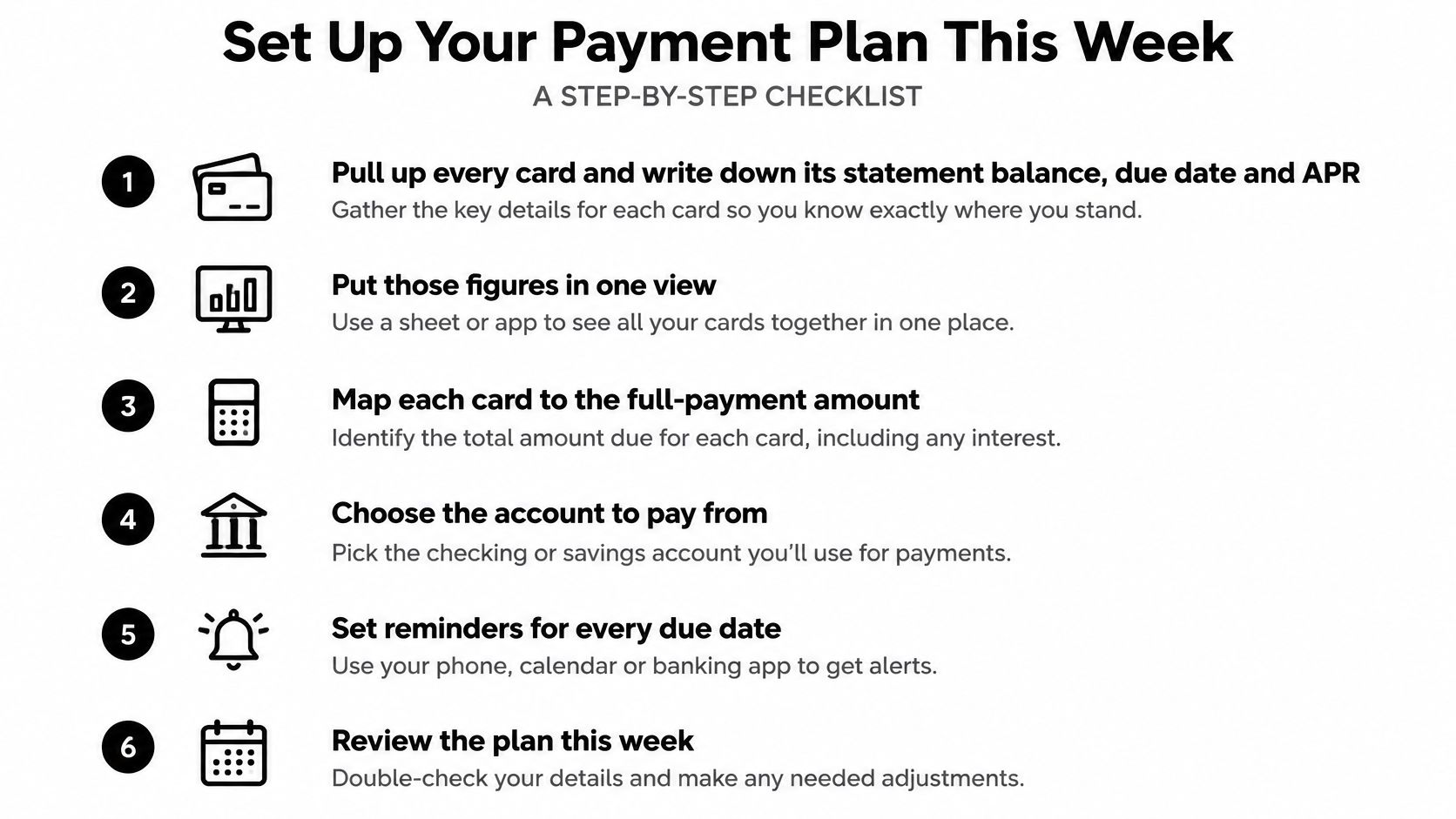
- Pull up every card. Write down each statement balance, due date and APR, since those three numbers drive the whole routine.
- Put the figures in one view. Link credit cards and loans to Toya AI securely via Plaid, with read-only access, so balances, APRs and due dates sit side by side instead of scattered across apps.
- Set autopay to the statement balance. Schedule each payment at least three business days before its due date.
- Fund the spending cap. Move the cap amount into a separate sub-account on payday, before spending starts.
- Pick one monthly review date. Check each new statement against the plan, note which payment Toya AI recommends making next, and see the impact on time and interest alongside the calculated debt-free date based on current payments.
Make the first decision today. Choose the autopay option for each card before leaving this page, because an unset autopay is the most common reason a solid plan never runs.
Ready to turn these dates and balances into one clear payoff plan? Toya AI brings connected cards and loans into a single dashboard, recommends which payment to make next, and shows exactly how each payment moves the debt-free date and total interest. Connect accounts today and put the full payment routine on a system that updates as life changes.
Ready to start your debt-free journey?
Toya AI builds a personalized payoff plan so you can see your debt-free date and save on interest.
Get Started Free