
Paid Off Credit Card Still Charged Interest: Why It Happens
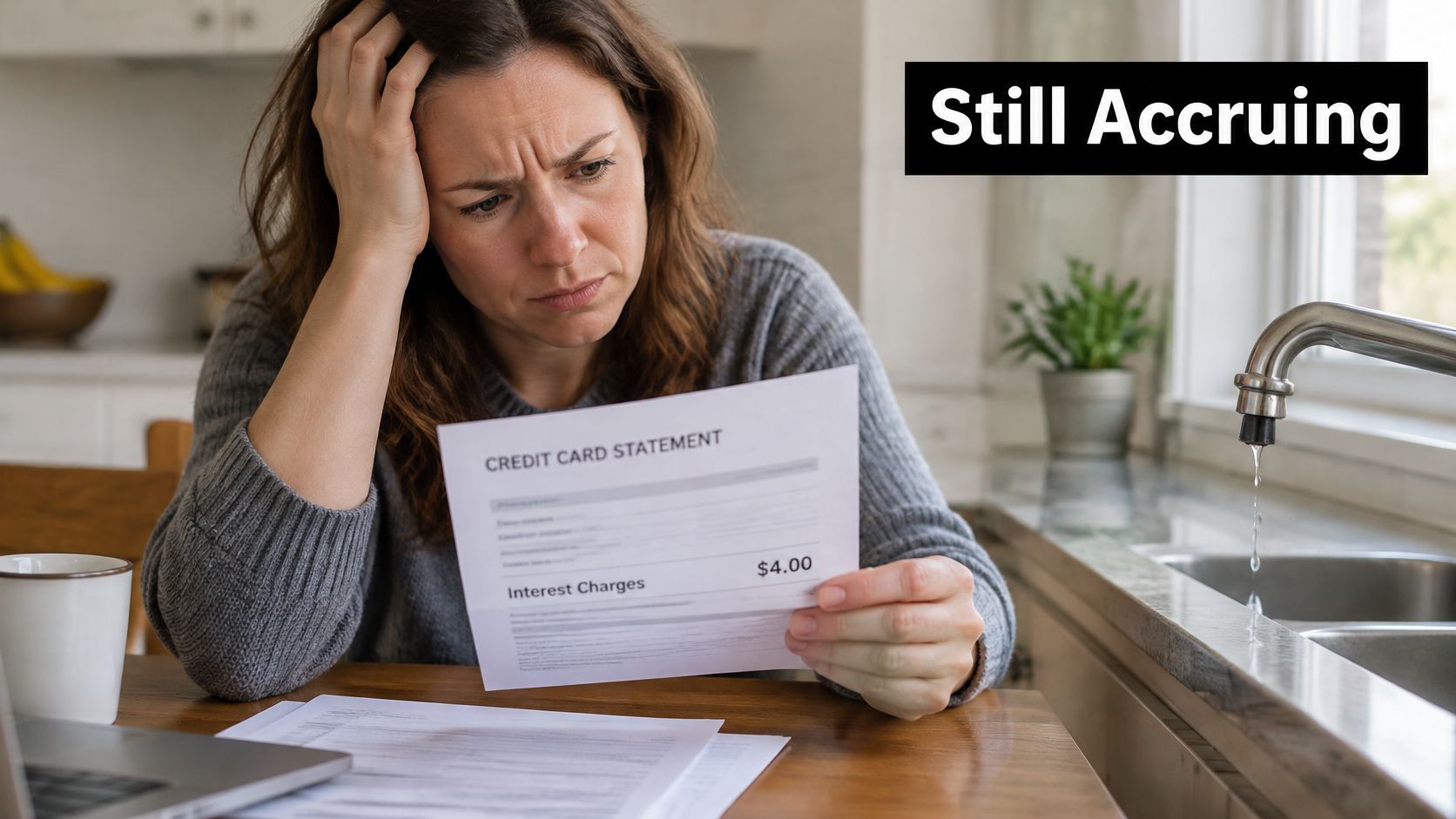
A cardholder makes the final payment, watches the balance fall to $0, and finally relaxes. Then the next statement arrives with a $4 interest charge. In this hypothetical situation, the payment hasn't necessarily failed, and the issuer hasn't necessarily made a mistake. The missing piece is often interest that accumulated before the payment reached the account but hadn't yet appeared on a statement.
Table of Contents
- Why a Zero Balance Can Still Carry Interest
- Statement, Current and Payoff Balances Compared
- How Much Residual Interest to Expect
- Causes Behind an Unexpected Charge and Fixes
- Payment Timing and Alerts That Stop Repeat Charges
- Confirm Zero Interest Before Deciding to Keep or Close
Why a Zero Balance Can Still Carry Interest
Credit card interest can behave like a dripping tap. The statement records the drips through its closing date, but an interest-bearing balance keeps dripping until the payment shuts off the flow. Paying the amount printed on that statement can leave some unbilled drips behind.
The Consumer Financial Protection Bureau's explanation of credit card interest confirms that interest can accumulate daily when an account doesn't have an applicable grace period. Interest accrued between statement closing and payment can appear later as trailing interest, also called residual interest.
What the screen leaves out
A displayed zero usually describes the account's posted balance. It doesn't necessarily include interest already earned by the issuer but not yet billed. Once the underlying balance has been paid, that balance stops generating interest, but previously accrued interest can still arrive afterward.
An eligible purchase balance generally avoids interest when the full statement balance is paid by the due date and the account retains its grace period. That protection shouldn't be assumed after carrying debt, and cash advances usually receive different treatment. The guide to how credit card interest works explains the broader billing mechanics.
Practical distinction: A zero balance can mean the posted debt is gone without meaning every finance charge has appeared.
The calculation starts with the card's daily periodic rate, not a monthly charge added on statement day. A small post-payoff charge can therefore be an ordinary timing effect, but its dates and balance category still need checking. A zero on the screen isn't final confirmation until the following statement has been reviewed.
Statement, Current and Payoff Balances Compared
Which balance to use for each decision
| Balance figure | What it includes | When it changes | Use it to decide |
|---|---|---|---|
| Statement balance | Purchases, fees and interest billed through closing, net of payments and credits | Once per cycle, on the statement date | What must be paid by the due date under the applicable grace-period terms |
| Current balance | All posted payments, purchases and charges as of today | As transactions post | What the account currently shows as owed |
| Payoff amount | Current balance plus accrued but unbilled interest, subject to the quote's terms | As interest accrues until payment takes effect | The amount needed to settle the balance on a specified date |
| Promotional balance | Debt covered by a deferred-interest or promotional-rate offer | As payments and eligible transactions are allocated; its deadline is separate | Whether the promotion will be cleared before its end date |
These figures answer different questions. The Federal Trade Commission's credit card guidance explains that grace-period protection turns on the card's terms and timely full payment. A deferred-interest promotion isn't the same thing as an ordinary purchase grace period.
A hypothetical payoff gap
Suppose a revolving account has a $420 statement balance, due on the 15th. A $25 payment posts, reducing the current balance to $395. The issuer then supplies a hypothetical $401.80 payoff quote, including $6.80 of accrued, unbilled interest.
The statement remains a historical snapshot; it doesn't rewrite itself after the payment. The current balance reflects the posted payment but omits the unbilled interest in this example. The payoff quote addresses the amount needed for a particular payment date.
Paying a statement balance alone can leave accrued interest behind when the account was already interest-bearing. Conversely, blindly paying an old statement amount after other payments have posted can mean sending more than the remaining posted balance.
Payoff rule: Request a written payoff amount for a specific payment date, then compare it with the current balance that same day.
The quote should explain how long it remains valid and whether pending transactions are excluded. For a useful audit record, save:
- Statement closing date and due date, which identify the billing window and deadline.
- Payment receipt, crediting and posting dates, which help explain timing differences.
- Applicable APR and interest charged, separated by purchase, transfer and advance balances.
How Much Residual Interest to Expect
For a simple estimate on a constant interest-bearing balance:
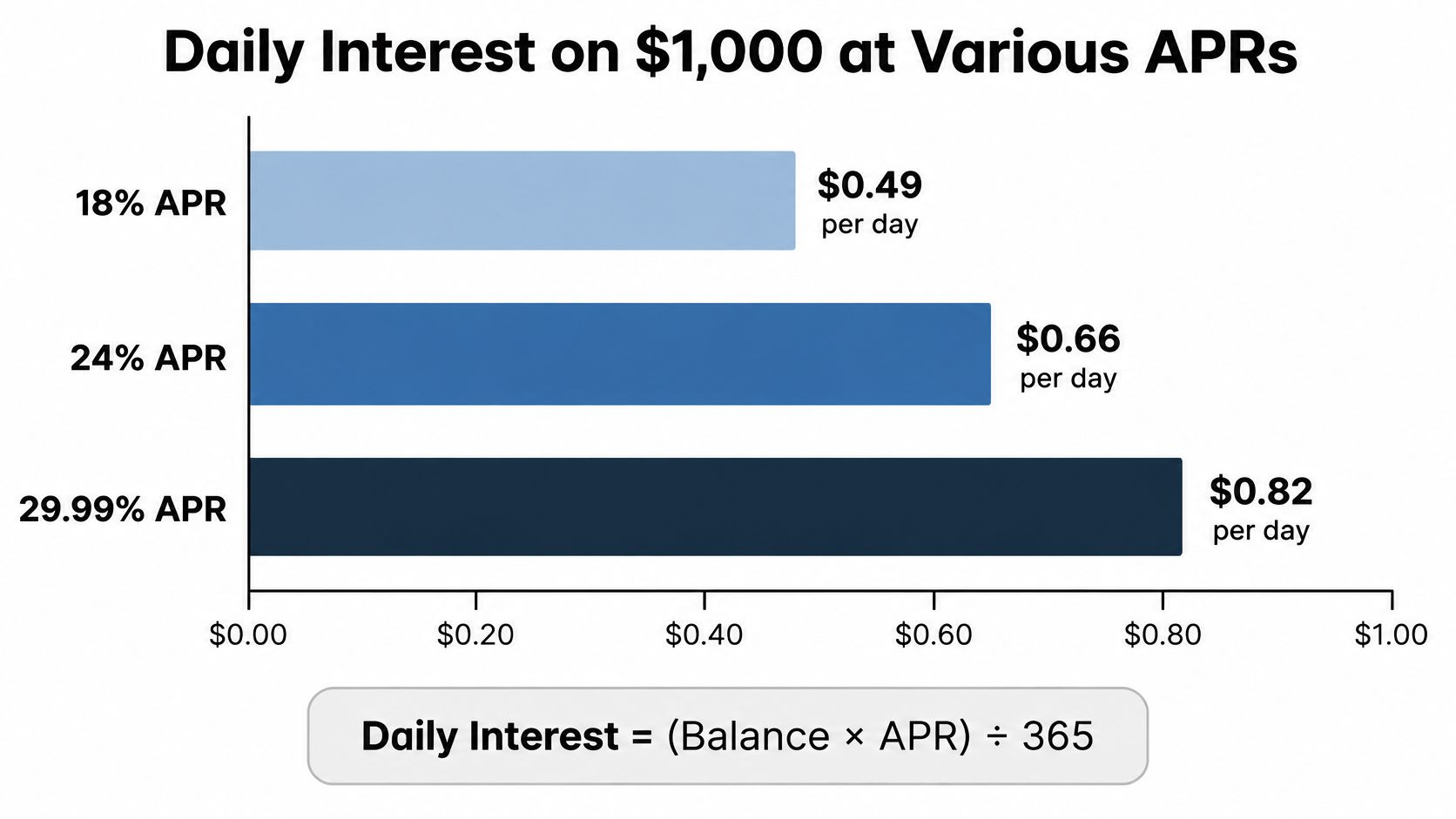
Daily interest = balance × APR expressed as a decimal ÷ 365
Estimated residual interest = unrounded daily interest × applicable days
The CFPB's residual-interest example describes interest on a $1,000 balance running from April 1 through April 24, with the charge appearing on a statement issued May 3. Using an illustrative daily cost of $0.50, that 24-day interval would produce approximately $12.
The following hypothetical lookup table applies the simple daily formula to a constant balance. These aren't quoted card offers or a claim about prevailing rates.
Residual interest on $1,000 by APR and gap length
| APR | Daily interest | 10-day gap | 20-day gap |
|---|---|---|---|
| 18% | $0.49 | $4.93 | $9.86 |
| 24% | $0.66 | $6.58 | $13.15 |
| 29.99% | $0.82 | $8.22 | $16.43 |
The chart makes the difference between the illustrative daily costs easier to compare.
Scaling the estimate
For another hypothetical calculation, a $3,000 balance at 24% APR generates approximately $1.97 daily. Applying the unrounded daily result across a seven-day gap produces approximately $13.81. Keeping the unrounded result until the final step avoids introducing unnecessary rounding differences.
For residual interest on a balance carried into the new cycle, start with the days after statement closing through the effective payment date. Don't count only from the payment due date. Where the account displays separate receipt and posting dates, the issuer should identify which date it used to credit the payment.
This calculation is a reasonableness check, not a substitute for the issuer's balance calculation. Purchases, partial payments, different APR categories, rounding and the agreement's daily-balance method can change the result.
A modest charge may fit a timing gap, but there's no reliable small-dollar cutoff that proves a charge is valid. A larger charge can still be legitimate on a larger balance. The useful test is whether the amount fits the balance, applicable rate and actual accrual period.
Causes Behind an Unexpected Charge and Fixes
A post-payoff charge isn't always an error. The fastest diagnosis starts by matching the interest line to a balance category and date range, rather than treating every unexpected amount as residual interest.
Symptoms, causes and fixes for post-payoff interest
| Symptom | Likely cause | Check | Fix |
|---|---|---|---|
| Small interest line after a zero balance | Residual interest accrued before payment took effect | Interest-period dates and payment crediting date | Pay a legitimate residual amount by its due date |
| Interest on a purchase paid in full | Grace period lost after an earlier carried balance | Prior statements and agreement's grace terms | Meet the required full-payment conditions or request restoration |
| Interest tied to an old cash advance | No applicable cash-advance grace period | Transaction category and advance APR | Obtain a dated payoff amount covering the advance |
| Interest on a promotional balance | Deferred-interest deadline wasn't met | Promotion end date and remaining promotional balance | Clear it before the deadline; if already charged, request an explanation |
| Charge after paying a payoff quote | Payment arrived outside the quote's validity period, or crediting was incorrect | Quote, confirmation and effective payment date | Request recalculation and dispute a documented discrepancy in writing |
Purchases and advances aren't interchangeable
In a hypothetical example, paying a $500 purchase balance can avoid purchase interest when a grace period applies, while a $500 cash advance from the same week can accrue interest until paid. A CFPB-hosted card agreement explicitly distinguishes these categories and provides no grace period for cash advances or balance transfers.
The agreement also matters when a payment appears late on the screen. A visible posting delay isn't automatically proof that the issuer credited the payment late. Payment receipt, effective crediting and display dates need to be reconciled.
Grace-period restoration deserves a separate check. The CFPB's credit card key terms explain why carrying debt can expose new purchases to interest; the agreement determines the conditions for restoring protection. A full payment shouldn't be treated as an automatic reset.
Promotions and refunds need separate tracking
Deferred interest isn't a reduced promotional APR. Missing its payoff deadline can make previously accrued interest payable under the offer's terms. The purchase date, promotion deadline and remaining promotional balance should be reviewed together.
A pending merchant refund can also complicate reconciliation. The refund tracking tips from Smart Receipts can help organize refund records, but an expected refund shouldn't be treated as a posted payment.
A charge warrants closer investigation when it matches none of these causes or the issuer can't reconcile it with the dates. The written request should ask for the balance category, APR, interest-bearing days and calculation, with statements and payment confirmations attached.
Payment Timing and Alerts That Stop Repeat Charges
The most useful account settings make a new charge visible before the account slips out of attention. A payoff routine needs both payment controls and a follow-up review.
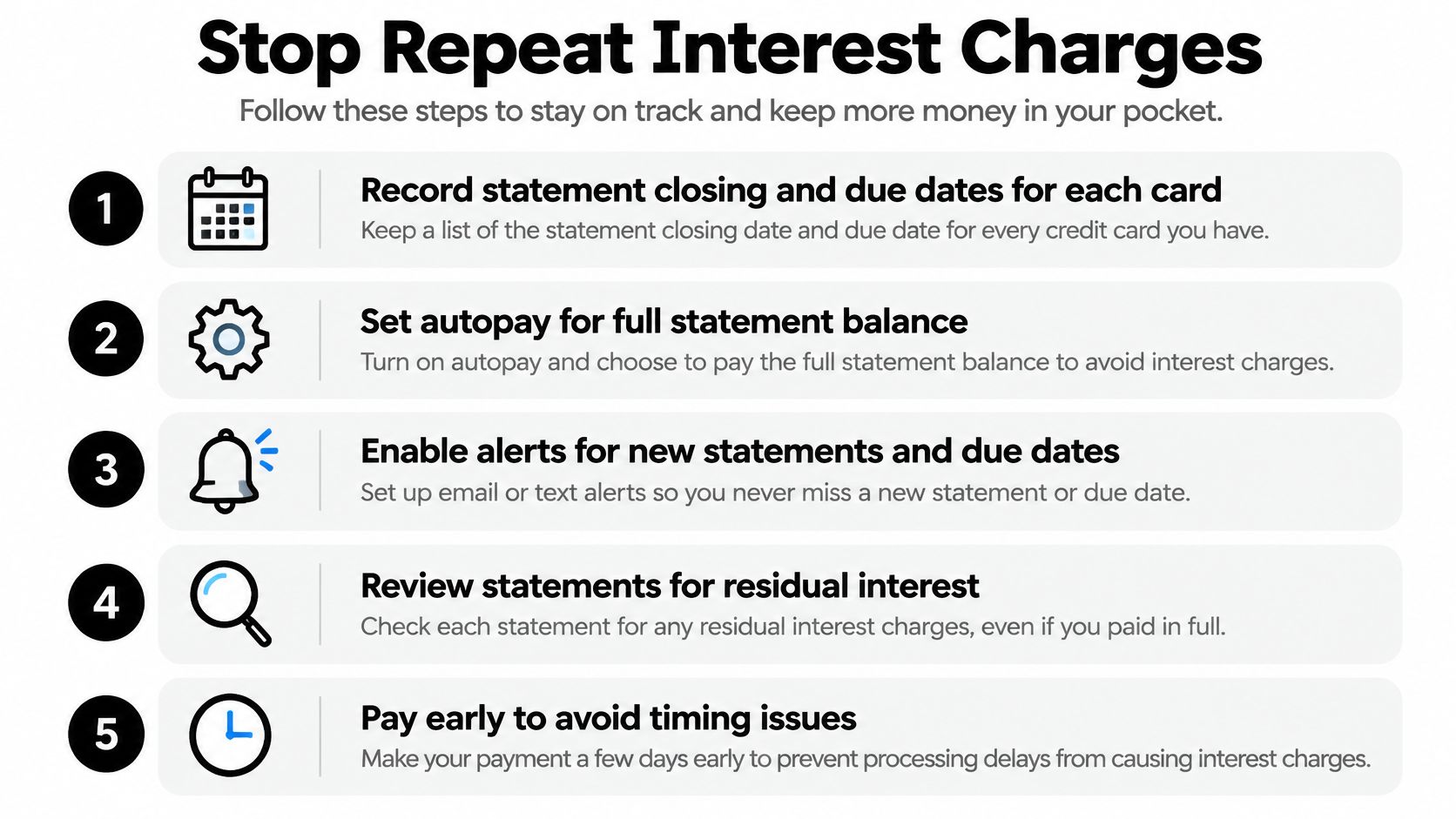
The checklist summarizes the habits that support that routine.
A practical account checklist
- Record closing and due dates. A calendar or spreadsheet should keep both dates for every card, because the statement snapshot and payment deadline serve different purposes.
- Select full-statement-balance autopay when affordable. Minimum-payment autopay doesn't preserve interest-free purchase treatment by itself, and the funding account needs enough cash for the scheduled debit.
- Build in a payment buffer. As a practical scheduling choice, a final payment can be initiated at least three business days before the deadline, with extra time where the issuer's stated processing rules require it.
- Create a post-payoff reminder. A hypothetical setup pairs an available zero-balance alert with a calendar reminder one week later, plus a new-statement notification.
- Pause new purchases during reconciliation. A temporary spending pause makes an unexplained balance easier to identify and avoids mixing fresh activity with the final payoff.
- Keep APRs and daily-cost estimates together. A spreadsheet should label each balance category separately rather than applying the purchase rate to every charge.
The credit card payment due date guide provides additional context for organizing deadlines. For households coordinating several debts, a shared calendar is more useful when it also names the account responsible for funding each payment.
Keep the follow-up active
Autopay can remain active through the next full billing cycle to catch a legitimate residual amount, provided the issuer's settings cover it. Manual payments don't always cancel scheduled withdrawals, so the next debit amount should be checked before assuming the funding account is clear.
The following video offers another format for reviewing payment habits.
For someone maintaining household records or client cash-flow schedules, Accountant She Ltd.’s budgeting skills for bookkeepers offers a related budgeting resource. Any payment plan still needs a practical cash buffer rather than a schedule that risks an unsuccessful debit.
Success looks like a quiet following statement, not merely a temporarily empty balance display.
Confirm Zero Interest Before Deciding to Keep or Close
A card can be treated as settled when the statement following the final payment confirms no remaining balance or unpaid interest, with no pending activity left to reconcile. An interest line appearing after payment isn't automatically a failure, but it must be explained and resolved before the account is filed away.
A short verification record makes that conclusion defensible:
- Payment confirmed. The receipt and effective crediting date match the issuer's records.
- Statement reconciled. Every interest charge, credit and transaction has an explanation.
- Promotions cleared. No separate promotional balance remains outstanding.
- Future treatment understood. The purchase grace-period status and any account fee are known.
The default decision
Keeping a verified, fee-free card open is a reasonable default when its available credit supports low utilization and the cardholder can avoid revolving again. There's no need to close a useful account merely because the final interest charge arrived later than expected.
Closing deserves consideration when an annual fee no longer provides worthwhile value or access to the card encourages unaffordable borrowing. A burdensome grace-period restoration requirement may also support replacing the card's spending role, though it doesn't automatically make closure the best choice.
Before proceeding, the guide to whether closing a credit card account is bad can help frame the trade-offs. Removing available credit can raise utilization across remaining accounts, so that consequence belongs in the decision.
An unresolved promotional balance calls for reconciliation before closure, not an assumption that closing makes it disappear. The documented outcome should be simple: a verified zero balance, confirmed interest status and a deliberate keep-or-close decision.
Toya AI shows which debt to pay extra on, how much interest that choice can save, and the debt-free date based on current payments. After the issuer's final statement confirms the payoff, a visit to Toya AI can help turn the remaining debts into a clear payment plan.
Ready to start your debt-free journey?
Toya AI builds a personalized payoff plan so you can see your debt-free date and save on interest.
Get Started Free