
Maxing Out Credit Card
Maxing out a credit card means charging up to the full credit limit, leaving no available credit for the next purchase. If the balance has reached the limit, the immediate priority is not paying the entire balance at any cost, it's protecting rent, food, utilities, and the minimum payment while stopping new charges.
A grocery purchase can expose the problem in seconds. A cardholder reaches the checkout, taps the card, and watches a $47 transaction decline because the card's $6,000 limit was already consumed earlier in the month. That moment feels like a credit-score crisis, but it's first a cash-flow crisis. The household has run out of borrowing room, and the next payment now competes with essential bills.
The right response is firm and orderly. Stop using the card, preserve enough cash for necessities and minimum payments, then build a payoff plan that reduces both interest and reported utilization.
Table of Contents
- The Moment You Hit Your Credit Limit
- How Maxing Out Wrecks Your Credit Score
- Why a Maxed Card Can Hurt Even When Average Utilization Is Falling
- Immediate Triage Steps When You Cannot Afford the Full Balance
- Repayment Strategies That Actually Work on a Maxed Card
- A Worked 12-Month Payoff Example
- Staying Out of Maxed-Card Territory for Good
The Moment You Hit Your Credit Limit
At the grocery terminal, the declined purchase may look like a technical glitch. Sometimes a temporary authorization hold causes a soft decline and disappears when the merchant releases it. A posted balance equal to the credit limit is different. The issuer's system sees no remaining available credit, so another purchase may be refused until a payment reduces the balance.
A card is maxed out when its balance reaches its credit limit. A large balance isn't automatically a maxed card. Someone with a $6,000 balance on a $12,000 limit has a substantial debt, but that account is using only half of its line. Someone with the same balance on a $6,000 limit has reached 100% utilization.
What the account is doing
Once the posted balance reaches the limit, three consequences appear at once:
- Cash-flow pressure: The card can no longer absorb an ordinary purchase or surprise expense.
- Interest accrual: Any carried balance continues generating interest according to the card's purchase APR.
- Utilization exposure: If the issuer reports that balance, the account shows 100% utilization to the credit bureaus.
A pending transaction can make available credit disappear before the final balance posts. That's why a cardholder may see a purchase declined even when the online account appears slightly below the limit. The issuer is reserving room for transactions that haven't settled yet.
Practical rule: Treat a card at its limit as unavailable, even if a payment or pending charge makes the displayed number look temporarily different.
The next statement and reporting cycle matters because a high balance can become the snapshot used in scoring. Paying the balance later may improve a later snapshot, but it doesn't erase the period when the account had no available credit.
People facing this problem often need help separating debt mechanics from broader financial decisions. The Gerald Technologies debt credit guide can provide useful background on debt and credit concepts, but the immediate household decision remains simple: keep essentials funded, keep the account current, and stop adding charges.
How Maxing Out Wrecks Your Credit Score
A maxed card creates a scoring problem because amounts owed represent about 30% of a FICO Score, according to FICO's credit utilization guidance. Utilization is the balance divided by the available credit, and both the individual card's ratio and the combined ratio across cards can matter.
The popular 30% rule is often treated like a cliff. FICO says it isn't a hard scoring cutoff. Lower utilization generally produces better scores, and below 10% is often cited as a strong target for maintaining or building a good FICO Score.
A card moving from 15% utilization to 100% utilization sends a much stronger risk signal than a card moving modestly within a low range. The exact score change varies by the person's complete credit profile, so a precise point estimate cannot be responsibly promised. The reporting date matters more than the day the cardholder made the purchase. If the issuer reports the balance before a payment reduces it, the bureaus may record the high utilization snapshot.
Estimated FICO Score Drop by Utilization Spike
The table below is an illustrative planning framework, not a verified scoring formula. FICO does not publish a universal point-drop schedule for every utilization change.
| Starting Score | Utilization Before | Utilization After | Estimated Drop |
|---|---|---|---|
| 740 | 15% | 100% | Varies by credit profile |
| 680 | 15% | 100% | Varies by credit profile |
| 620 | 15% | 100% | Varies by credit profile |
Paying the card down before the statement prints can restore a lower reported balance for that snapshot. It doesn't create a permanent repair. If the card reports near its limit again next month, the utilization problem can return.
That high ratio can also make new borrowing harder. A lender reviewing an application may see less available credit, greater dependence on revolving debt, and less room to handle another obligation. Approval odds and offered terms can worsen even when every payment has arrived on time.
For readers who need to reconcile statements, balances, and account activity, structured data from Credit One statements can help organize information before a payoff plan is built. A clear record prevents a cardholder from overlooking fees, pending charges, or a second account with a similar problem. The credit utilization ratio guide also explains the ratio that drives this part of the analysis.
Why a Maxed Card Can Hurt Even When Average Utilization Is Falling
Your card can be at its limit while national credit conditions look healthier. Equifax's June 2026 credit trends report reported average bankcard utilization at 20.3% in May 2026, down from 20.7% a year earlier. The Philadelphia Fed reported large-bank utilization at 19.1% in the first quarter of 2026, its lowest level in three years.
TransUnion's second-quarter 2026 data reported 261.7 million consumers with a balance and total credit card balances of $1.09 trillion. Those figures describe the market as a whole, not how debt is concentrated within one household.
Consider a person with a maxed card carrying a $10,000 limit, while several other cards have little or no balance. Those unused limits can lower the combined utilization ratio, yet the maxed account still reports 100% utilization. That card offers no spending room for an unexpected bill. The immediate problem is cash flow, with credit scoring as the second problem.
Average utilization versus concentrated stress
An economy-wide utilization rate averages millions of accounts. It cannot show whether one household has a card at its limit, several cards nearly full, or income that may not cover the next payment.
The Equifax findings describe a divided market. Average utilization can fall while high balances remain concentrated among individual borrowers. A calmer national average does nothing to restore available credit on a card that is already full.
A falling national average doesn't give a maxed cardholder more available credit.
Handle the account in front of you. If the card is at 100%, protect monthly cash flow first, stop adding charges, and direct the repayment plan toward restoring usable room. The broader market may look stable, but concentrated debt can still leave one household one expense away from a missed payment.
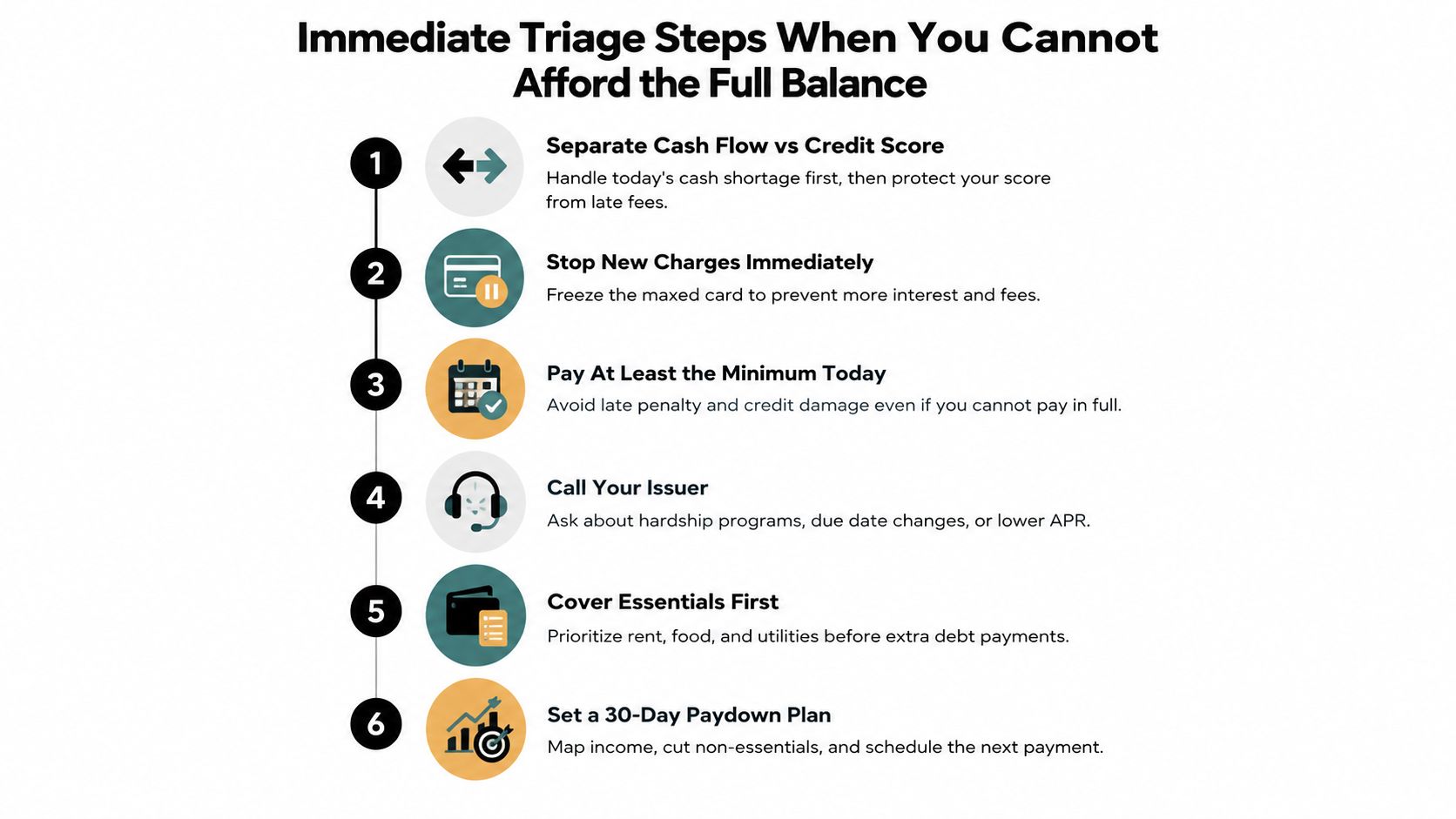
Immediate Triage Steps When You Cannot Afford the Full Balance
A cardholder who can't pay in full shouldn't drain the checking account to make the balance look better. The first task is to prevent a missed payment and stop the balance from growing. Credit-score repair matters, but an unpaid rent bill or empty grocery budget creates a more immediate crisis.
Put cash flow first
- Separate the problems. Write down the money needed for rent, food, utilities, transportation, and insurance before calculating an extra debt payment.
- Stop new charges. Remove the card from digital wallets, freeze it in the issuer's app, and use a debit account or cash for essentials that are already funded.
- Pay at least the minimum. Make the required payment by the due date. Paying the minimum isn't a payoff strategy, but missing it adds a separate problem.
- Review every card. Pull the full credit report and list each balance, limit, APR, minimum, and due date. A maxed card may be one account in a larger pattern.
A quick audit prevents a common mistake: sending every available dollar to one card while another account approaches delinquency. The list should also include pending payments and automatic subscriptions that could keep charging the maxed account.
Call before the next crisis
The issuer call comes after the account is current and the household budget is visible. The cardholder should ask directly about a hardship arrangement, a reduced minimum, a temporary rate reduction, a waived fee, or a due-date change. The representative may not offer every option, so the request should be specific and calm.
The agreement should be obtained in writing, including the payment amount, duration, interest rate, fees, and whether the issuer will close or restrict the account. A verbal promise that never appears in an account message is difficult to verify later.
Closing the card is usually the wrong move at this stage. Removing the account's credit limit can raise overall utilization and reduce available credit, even though the balance remains. The safer approach is normally to stop using the account while preserving the line, unless the issuer or a qualified counselor identifies a different reason to close it.
For cardholders considering a transfer, the zero-percent balance transfer guide can help them evaluate the offer, fees, eligibility, and repayment deadline before applying.
Repayment Strategies That Actually Work on a Maxed Card
The right payoff method depends on two facts: how many accounts need attention and how much cash remains after essentials and minimums. A maxed card calls for a strategy that reduces interest without creating a new emergency.
| Strategy | How It Works | Best For a Maxed Card? | Watch Out For |
|---|---|---|---|
| Avalanche | Pays extra money to the card with the highest APR while minimums cover the others | Yes, when interest savings are the main objective | Progress may feel slow if the highest-rate balance is large |
| Snowball | Pays extra money to the smallest balance first | Yes, when visible progress helps maintain discipline | May cost more interest than avalanche |
| Balance transfer | Moves debt to another card with a promotional APR | Often, if a new card has enough available limit and the payoff window is realistic | Transfer fees, eligibility limits, and the risk of renewed spending |
Avalanche is the mathematically clean choice for reducing interest. A cardholder with multiple balances should pay every minimum, then direct the extra amount to the highest APR. Once that account is cleared, the freed payment rolls into the next target.
Snowball is a reasonable alternative when the household keeps abandoning technically optimal plans. Clearing a small balance can create room in the budget and provide a visible win. The method only works if the paid-off card stays unused and the former payment is redirected immediately.
The balance-transfer decision
A 0% introductory balance transfer can be powerful because it pauses interest during the promotional period. It also creates a deadline. The cardholder should calculate the transfer fee, divide the transferred balance by the number of promotional months, and confirm that the resulting payment fits after essentials and minimums.
A transfer may require a different card with available credit. Some issuers block new transfers on an account that is already maxed, and a new application can create a hard inquiry or unfavorable terms. The cardholder should never treat a new credit line as permission to spend again.
The direct recommendation is to use a balance transfer only when the transfer fee is lower than the interest the household would otherwise pay and the balance can be cleared within the promotional window. If that test fails, use avalanche, or snowball when consistency is the bigger obstacle.
A Worked 12-Month Payoff Example
Consider a $5,000 balance at 24% APR on a $5,000 limit. The example assumes no new charges and uses monthly interest approximated from the stated APR. Actual issuer calculations can differ because cards commonly calculate interest using daily balances.
At $200 per month, the balance falls slowly because interest consumes a meaningful part of each payment. At $300, the debt clears inside the year under this simplified model, but the payment leaves little room for an income interruption. At $500, the balance disappears sooner and interest has less time to accumulate.
$5,000 Balance at 24% APR Across Three Payment Levels
| Monthly Payment | Months to Payoff | Total Interest Paid | Utilization at Month 6 |
|---|---|---|---|
| $200 | Longer than 12 months | Depends on the eventual payoff date | Approximately 80% |
| $300 | About 20 months under monthly amortization | Approximately $1,100 | Approximately 50% |
| $500 | About 11 months | Approximately $550 | Approximately 30% |
The $200 payment is not useless. It reduces the balance and keeps the account moving in the right direction, but it doesn't solve a 12-month payoff target. A household using this payment level needs a second lever, such as a lower APR, additional income, a spending cut, or a hardship arrangement.
The $300 payment reaches zero in roughly 20 months under this simplified amortization, not inside the year. That distinction matters. A payment can feel substantial while still leaving the household exposed to interest for many billing cycles.
The best payment is the largest amount that can be repeated without forcing new charges for food or bills.
Utilization improves before payoff. On a $5,000 limit, a $4,000 balance represents 80% utilization, a $2,500 balance represents 50%, and a $1,500 balance represents 30%. The score may respond when a lower balance is reported, but the account doesn't become debt-free until the principal reaches zero.
A cardholder should run the household's actual numbers through a credit card payoff calculator with amortization and compare a sustainable payment with an ambitious one. A plan that requires repeated borrowing is not a payoff plan.
Staying Out of Maxed-Card Territory for Good
Prevention requires a system that catches the balance before the issuer does. Three habits do most of the work: a spending ceiling below the credit limit, an automatic payment buffer, and a recurring utilization check.
Set a hard spending cap at 10% below each card's limit. That margin protects against pending authorizations, annual fees, interest, and forgotten subscriptions. A cardholder with a $5,000 limit should treat the lower internal ceiling as the binding boundary, not wait for the issuer's decline.
The second habit is an automated minimum payment plus a small buffer from a separate checking account. The separate account reduces the chance that a routine bill empties the account used for debt payments. Automatic payments don't replace monitoring, because an unexpectedly high minimum or a returned payment still requires attention.
The monthly control loop
Choose one calendar date each month and log into every issuer. Record the balance, limit, APR, minimum, and due date in a spreadsheet or note. Divide each balance by its limit, then adjust the next month's spending cap if utilization exceeds 15%.
Issuer apps can provide real-time balance alerts. Free tools such as Credit Karma or the Experian app can help track score movement, while a spreadsheet gives cardholders full control over calculations. An adaptive payoff app like Toya can also organize balances, APRs, due dates, payoff sequencing, and projected outcomes in one workflow, but it still depends on accurate connected account information and realistic payments.
For households managing rent, utilities, and variable expenses, Divvy apartment budgeting tips can help shape the broader monthly budget around fixed obligations before extra debt payments are assigned.
Anyone who pays off a maxed card should run the new system for three full billing cycles before declaring the fix stable. The balance needs to stay down after ordinary spending resumes, not only during the first motivated month.
Toya AI can connect debt accounts, organize balances, APRs, utilization, and due dates, then show how different payments affect the projected debt-free date and total cost. Visit Toya AI to start tracking the maxed card and build a payoff plan that fits the household's actual cash flow.
Ready to start your debt-free journey?
Toya AI builds a personalized payoff plan so you can see your debt-free date and save on interest.
Get Started Free