
Is Closing a Credit Card Account Bad? a Complete Guide
A card sits in a desk drawer, unused except for an annual fee or the occasional forgotten subscription. The account has an attractive limit, a long history, and no balance, so closing it seems sensible. Then a search for “is closing a credit card account bad” produces a wall of warnings about ruined credit.
That advice is incomplete. Closing a card is a tool, not a verdict. The useful question is whether closure is bad for the score this month, the credit profile over time, or the household's financial behavior. Those are different questions, and they can produce different answers.
Table of Contents
- The Question Most People Ask the Wrong Way
- How Credit Utilization Works
- What Closes When You Close an Account
- Smarter Alternatives Before You Close
- Three Real Decisions Compared Side by Side
- A Pre-Closure Checklist With Toya AI
- When Closing Is Actually the Right Move
- Putting It All Together
The Question Most People Ask the Wrong Way
Consider someone with three cards and an old department-store account that hasn't been used in years. The store card has no balance, but it still contributes an available limit. A newer card carries a balance, and another card is used for everyday purchases. Closing the old account may feel like harmless housekeeping. It could also raise utilization because the remaining balances stay the same while total available credit falls.
The same closure might be perfectly reasonable if the old card has an annual fee, creates spending temptation, or carries terms the account holder no longer wants. Keeping an account open solely because generic advice says “never close an old card” can preserve credit mechanics while prolonging a financial problem.
Bad for which outcome?
Three questions produce a better answer:
- Could closure hurt the score in the short term? Usually, the immediate concern is utilization, especially when other cards carry balances.
- Could closure affect the score over the next decade? A closed account in good standing generally remains on the credit report for up to 10 years, so its positive history doesn't vanish overnight, according to Experian's explanation of closed credit-card accounts.
- Could keeping the account open damage the person's financial life? Annual fees, unwanted spending capacity, fraud exposure, and missed payments can matter more than a temporary score change.
The decision tree is simple. Check the card's balance, credit limit, age, annual fee, behavioral risk, and upcoming borrowing plans. A high-limit card with a balance elsewhere deserves caution. A fee-heavy card that encourages overspending may deserve closure. An old, fee-free card becomes more valuable before a major application than during a period when no borrowing is planned.
Practical rule: Generic credit advice is weaker than a calculation using the account holder's actual balances, limits, and timeline.
How Credit Utilization Works
Credit utilization is the share of revolving credit currently used. Calculate it by dividing total balances by total credit limits. The balance does not need to change for utilization to rise. In Experian's credit-card closure example, $4,000 in balances divided by $10,000 of total limits equals 40% utilization. Closing a card with a $3,000 limit reduces total available credit to $7,000, raising utilization to approximately 57%.
The debt stayed the same. The available credit became smaller, so the debt represents more of the total limit.
Run the calculation before calling the issuer
Use this formula:
Total balances ÷ total credit limits = utilization
Calculate the ratio twice, once with the card included and once after removing its limit.
| Scenario | Total Balances | Total Limits | Utilization |
|---|---|---|---|
| Before closing the card | $4,000 | $10,000 | 40% |
| After closing the $3,000-limit card | $4,000 | $7,000 | Approximately 57% |
The Consumer Financial Protection Bureau advises keeping utilization under 30%. That threshold is a warning line, not an automatic scoring switch. A profile using less than roughly a third of its available credit generally has more room than one using more.
Calculate both overall utilization and each card's individual ratio if balances remain. Closing a high-limit card can change the overall percentage sharply, while closing a low-limit card may have little effect. Paying down balances before closure can limit the increase. Requesting a credit-limit increase elsewhere may also help, but the issuer can decline the request.
A simple worksheet should list every card, its current balance, its credit limit, and the proposed totals after closure. Use the numbers before making the decision, especially if an application for a mortgage, auto loan, or other credit is planned within the next 12 months. Readers who need a payoff plan can review Toya's guide to lowering credit utilization, then check the result against their own statements.
What Closes When You Close an Account
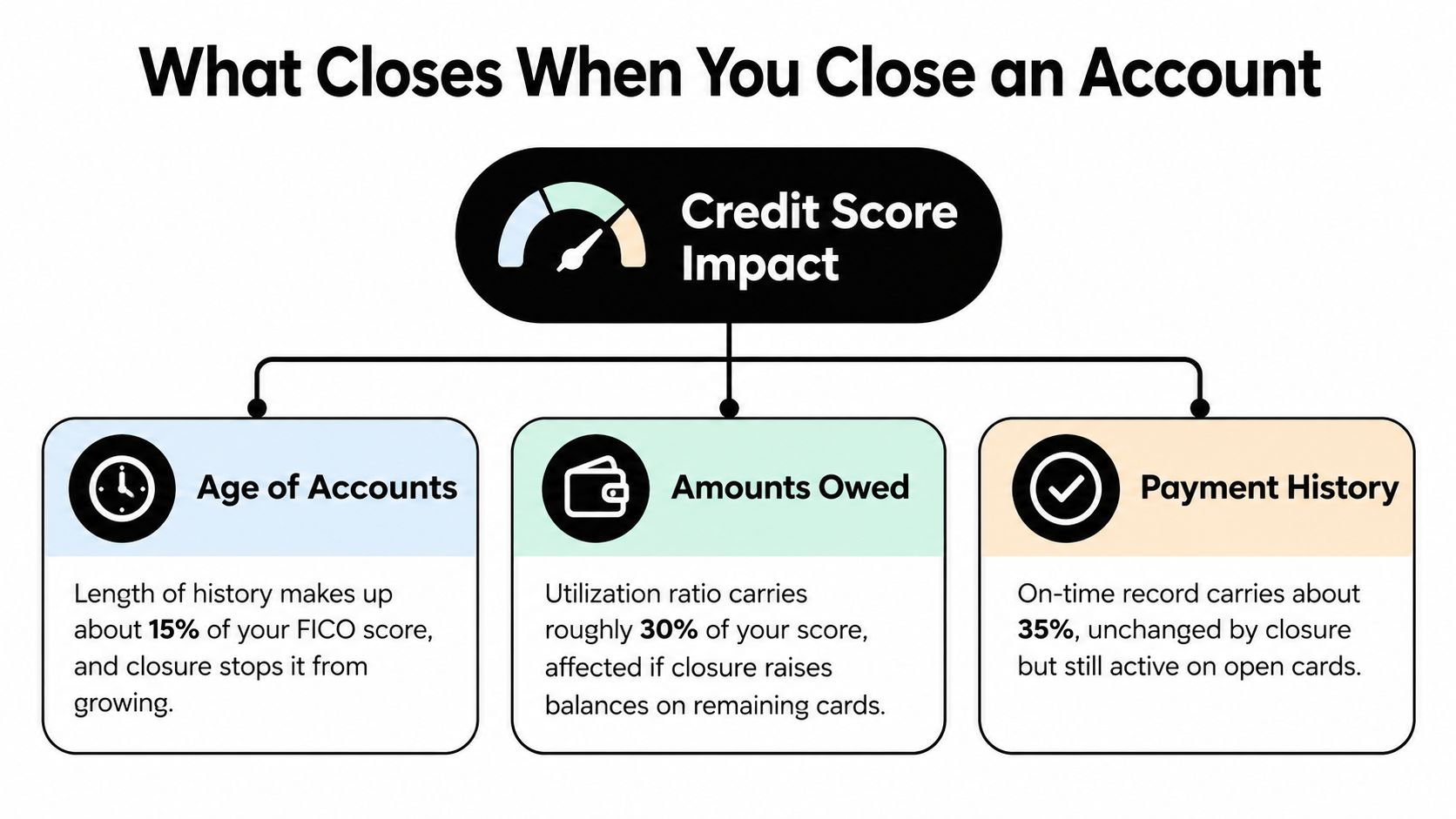
Closing a card changes several parts of a credit profile, and each part follows its own timeline. Amounts owed can change quickly when the issuer removes the card's limit from reported available credit. Account age usually changes later. Payment history does not disappear just because the account is closed.
FICO assigns roughly 30% of a score to amounts owed and about 15% to credit history length, as explained in Experian's overview of actions that can lower a score. Payment history remains the largest scoring category. Keeping an old card open never makes up for missing payments on active accounts.
The immediate effect is usually utilization
Suppose you close a 12-year-old card. Its age does not normally vanish from the credit file the next day. If the account closed in good standing, it may remain on the credit report for up to 10 years and continue contributing to credit-history calculations during that period, according to Experian's guidance on closed accounts.
The more immediate change is usually the lost credit limit. If other cards carry balances, overall utilization can rise when the issuer reports the closure. If those cards have low or zero balances, the score effect may be limited.
The warning that closing an old card instantly shortens credit history is misleading. The account can continue helping while it remains reported. The eventual age impact matters most when the closed card is one of the oldest accounts and the remaining credit file is thin.
Timing changes the recommendation
A planned mortgage, auto loan, apartment application, or new credit-card application changes the decision. If you expect to apply within the next 6 to 12 months, keep an old, fee-free card open, especially if it has a large limit. Score stability matters more than tidying up an account that is not causing a problem.
Without an upcoming application, closure gives you more control. Close the card if its fee is unjustified, it encourages spending, or it makes debt management harder. Before choosing another borrowing option, review the Nomu Finance Limited comparison guide to compare revolving credit with other forms of borrowing.
Smarter Alternatives Before You Close
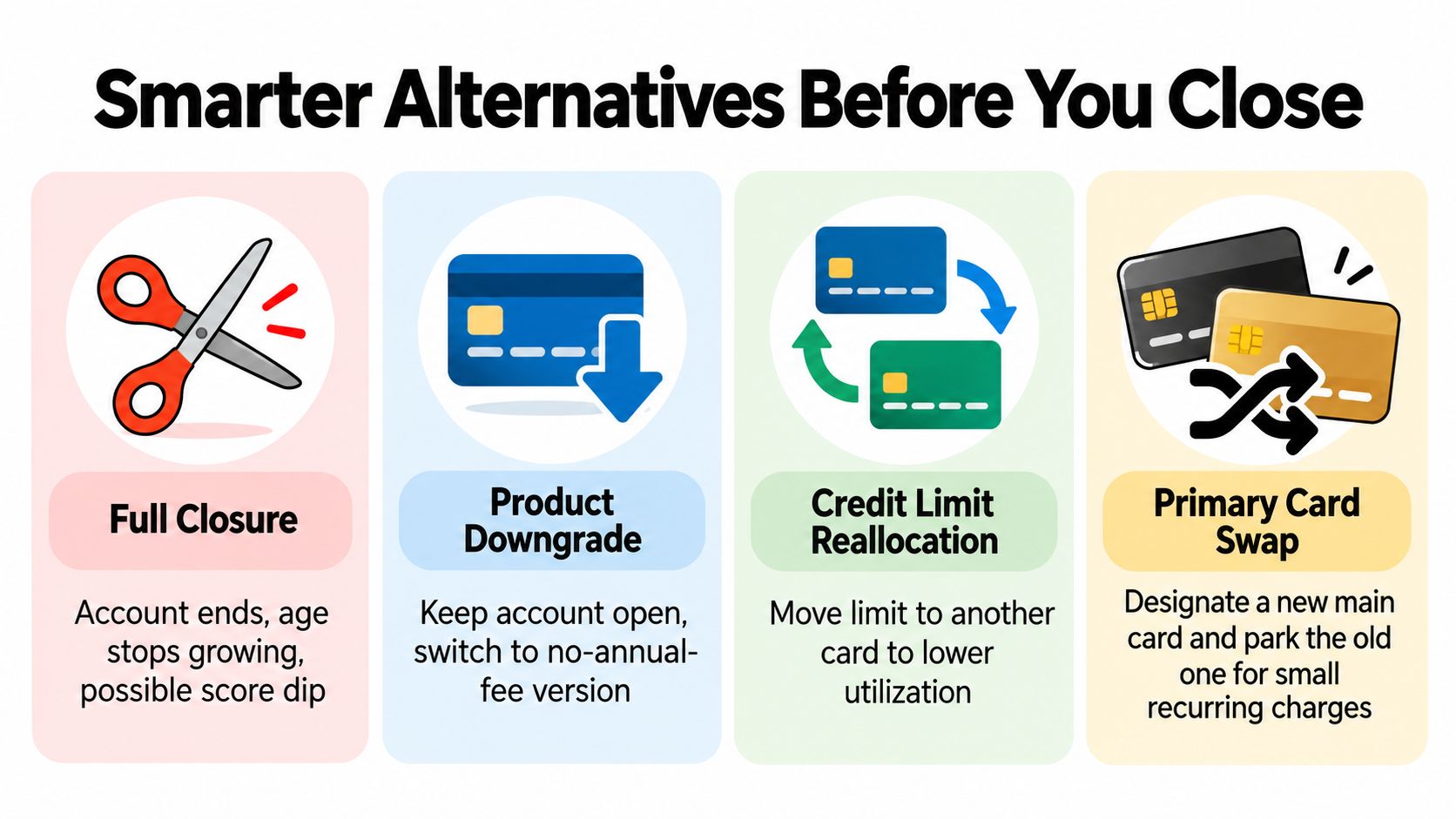
Closing a card is the most aggressive fix because it removes the account and its available limit. Start with the problem you are trying to solve. A fee, security concern, spending temptation, or unnecessary account can often be handled without ending the relationship.
The consumer guidance on closing credit cards supports separating spending control from account closure. A freeze can block new purchases, while a product change can address fees and keep the account open. Choose the option that fixes the actual problem.
Match the tool to the problem
| Option | Best fit | Utilization and age effect |
|---|---|---|
| Full closure | The card is expensive, risky, or redundant | Removes the limit and stops the account from growing older |
| Product downgrade | The annual fee is the problem | Keeps the account open when the issuer permits a no-fee product change |
| Credit-limit reduction | The available line encourages spending | Keeps the account open, but a smaller limit can raise utilization |
| Card freeze | Security or impulse use is the concern | Blocks new charges while preserving the account structure |
Call the issuer about a product downgrade when the annual fee is the main complaint. The issuer may let you switch to a no-annual-fee version without closing the existing relationship. Confirm the new terms, rewards treatment, and reporting details before accepting the change.
A credit-limit reduction can reduce spending capacity, but calculate the resulting utilization first. The smaller limit may create a new problem if other cards carry balances.
A freeze suits security concerns and impulse spending. New transactions are blocked, but the account remains on the file. Continue monitoring statements and paying any existing balance.
Choose simplicity without sacrificing control
Managing several cards becomes easier when each account has a defined role. Use one for everyday purchases, one for a recurring bill, and store the rest safely with limited access. Toya's guide to managing multiple credit cards provides a practical way to organize those accounts.
The goal is to solve the specific problem with the least damaging tool. Downgrade for fees, freeze for security, reduce limits for spending control, and close when the account's costs or risks outweigh its credit benefit.
Three Real Decisions Compared Side by Side
The same card can deserve opposite recommendations depending on the person holding it. A fee-avoider, an overspender, and a future homebuyer shouldn't follow the same script.
The fee-avoider
A card with a $450 annual fee that no longer provides useful value has a clear financial cost. If the cardholder has no balance and other cards provide enough available credit, closure may be worthwhile. The exact score effect can't be promised, and a responsible decision shouldn't assume a particular point change.
The sensible order is to ask for a fee waiver, request a product downgrade, and close only if neither option solves the problem. Rewards should be redeemed first, and subscriptions should be moved before the account ends.
The overspender
A high-limit store card can look valuable because it protects utilization. That benefit may be outweighed by the risk of new debt if the account holder repeatedly uses the line for impulse purchases. The financially healthier move may be closure, even if utilization rises temporarily.
A frozen card or limit reduction can test whether spending control improves without ending the relationship. If those measures fail, the behavioral cost of keeping the account open is more important than preserving an unused limit.
The prospective homebuyer
A person applying for a mortgage in six months with a rarely used $9,000-limit card should generally leave it open, assuming it has no serious fee or behavioral danger. Closing it could remove meaningful available credit before the lender reviews the file.
This person should avoid new balances, keep payments on time, and postpone unnecessary account changes until after the application. The recommendation isn't about loving the card. It's about protecting stability during a sensitive borrowing window.
Decision principle: A score is a means to obtain affordable credit, not a reason to preserve an account that is actively undermining debt control.
A Pre-Closure Checklist With Toya AI
A closure request should come after a short audit, not an emotional decision. The routine below takes the uncertainty out of the process.
- Pull current reports and scores. Check the account's status, reported balance, limit, and payment history.
- Create a card inventory. Record each card's balance, limit, age, annual fee, rewards, and recurring charges.
- Calculate both ratios. Run total balances divided by total limits before closure, then repeat after removing the target card.
- Check the calendar. Flag any upcoming mortgage, auto-loan, apartment, or new-card application.
- Call the issuer first. Ask about a fee waiver, product downgrade, freeze, or limit adjustment.
- Prepare the account. Redeem rewards, move subscriptions, and bring the balance to zero when possible.
- Document the closure. Request written confirmation and monitor reports for several billing cycles.
A practical example helps. A borrower with a balance on another card can compare four outcomes: close the unused card, freeze it, downgrade it, or reduce its limit. The useful comparison includes the new utilization ratio, the debt-payoff timeline, monthly interest, and whether the option removes spending access without removing available credit.
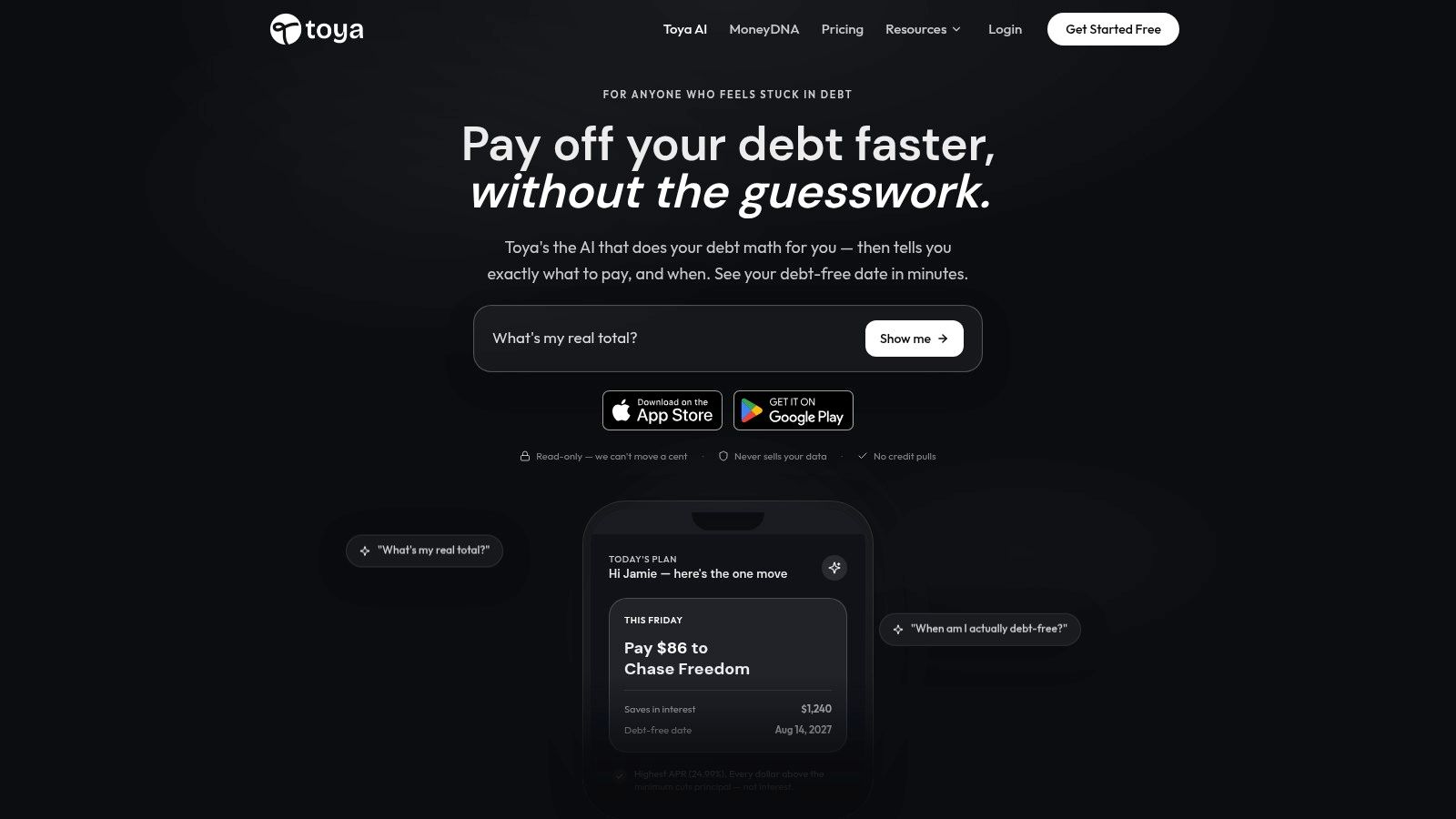
Toya AI's calculator can preview outcomes without connecting accounts, while an account connection through supported read-only partners can provide more precise information about balances, APRs, utilization, and due dates. The Toya AI debt-payoff tool can model how a closure fits into a broader payoff plan rather than treating the score as the only outcome.
This modeling matters for households carrying balances. The available 2026 New York Fed reporting places U.S. credit-card balances at $1.28 trillion, up $44 billion, as cited in FICO's discussion of closing-credit-card myths. The figure reinforces a practical point: payoff timing and utilization should be modeled together before a limit disappears.
When Closing Is Actually the Right Move
Keeping every card open isn't automatically responsible. Closure can be the right move when an annual fee delivers no value, the terms are unfavorable, fraud exposure is a concern, or the available line repeatedly triggers overspending.

A person actively paying down debt may find a large unused line psychologically dangerous. Simplifying the credit profile can make the payoff plan easier to follow, especially when the alternative is another cycle of borrowing.
The right standard is not “never close an old card.” It's whether the fees, terms, security concerns, or behavioral risks cost more than the likely score disruption. That answer should be based on balances and timing, not fear.
The video below provides another perspective on the decision.
Putting It All Together
Close the card when its fees, terms, or behavioral risk cost more than the projected score disruption, and keep it open when a major credit application is near.
Three questions settle most cases:
- Is the cardholder applying for credit soon?
- Are balances high enough that removing the limit will raise utilization sharply?
- Is the account old, fee-free, and safe to keep?
An old, fee-free card with a large limit usually stays open before a mortgage or auto-loan application. A costly or tempting card can be closed after the numbers are modeled and alternatives are checked. A card carrying a balance requires extra caution because closure doesn't erase the debt.
Within the next 24 hours, pull the credit reports, list every card's balance and limit, and calculate the ratio with and without the target account. A few minutes of math can replace a generic warning with a decision grounded in the actual profile.
Toya AI helps consumers centralize balances, APRs, utilization, and due dates, then model how payment and account decisions affect the debt-free timeline. Visit Toya AI to compare closure, freezing, and payoff choices before making the call.
Ready to start your debt-free journey?
Toya AI builds a personalized payoff plan so you can see your debt-free date and save on interest.
Get Started Free