
Interest Rate Calculator APR How to Convert and Compare
A borrower comparing a credit card balance with a personal loan may see similar annual rates and assume the costs will behave the same way. They won't. A revolving balance can accrue interest daily as the balance changes, while an installment loan follows a scheduled payment stream and may include fees that reduce the money received.
An interest rate calculator APR helps translate those offers into comparable borrowing costs. The right calculation depends on the debt type, payment timing, compounding method, fees, and whether the rate is fixed, variable, or promotional. The examples below turn those details into practical calculations for comparing offers and planning repayment.
Table of Contents
- Why Your APR Matters More Than the Sticker Rate
- Understanding APR APY and Interest Rate Differences
- How to Convert Annual APR to Monthly and Daily Rates
- Calculating Effective APR and True Borrowing Cost
- Using an Interest Rate Calculator APR in Real Life
- Putting Your APR Insights Into Action
Why Your APR Matters More Than the Sticker Rate

You are comparing two personal loans. Both advertise a similar interest rate, yet one delivers less money because it charges an origination fee. A credit card creates a different problem: interest may be based on the average daily balance, so paying earlier can change the cost even when the quoted APR remains unchanged.
APR makes these offers easier to compare because it expresses borrowing costs as an annual rate. It can account for interest and eligible charges, rather than showing only the lender's stated rate. In the European Union's Consumer Credit Directive framework, the calculation uses a present-value equation that compares drawdowns, repayments, and charges over time. Canadian regulations likewise define APR as an annualized borrowing cost and prescribe a formula for cases where costs extend beyond interest. Canada's Financial Consumer Protection Framework Regulations provide the formal definition and calculation framework.
The same APR can behave differently
Suppose two borrowers receive the same quoted APR. One carries a changing credit card balance and pays near the end of each billing cycle. The other has an installment loan with scheduled payments. Their costs will not move in the same way.
For the card, a daily periodic rate can be applied to each day's balance. A payment made earlier lowers the balances included in the calculation, while a later payment leaves more balance accruing interest. An installment loan follows a different pattern. Its cost depends on the outstanding principal, payment schedule, term, and fees, with the implied APR found by solving for the rate that matches the cash received with the scheduled repayments.
The Consumer Financial Protection Bureau reported average APRs of 25.2% for general-purpose cards and 31.3% for private-label cards in 2024, the highest levels since at least 2015. The CFPB's 2025 consumer credit card market report illustrates why rate changes and payment timing can affect both monthly interest and payoff time.
What a calculator can reveal
A useful interest rate calculator APR should test the cash flows, not divide an annual percentage by twelve. It can help you:
- Compare total borrowing cost: Include interest, financing fees, term, and payment structure.
- Model revolving debt: Apply daily periodic-rate logic to changing balances and payment dates.
- Solve installment APR: Account for fees that reduce the amount received while repayments stay scheduled.
- Test repayment choices: Show how early payments, longer billing cycles, or extra principal payments change the result.
- Check competing offers: Compare the money received and total repayment instead of relying on the lowest sticker rate.
A calculator's result still depends on its assumptions, including compounding, payment timing, and which fees qualify for inclusion. APR and APY measure different things, so the dedicated comparison in the next section prevents that confusion.
Understanding APR APY and Interest Rate Differences
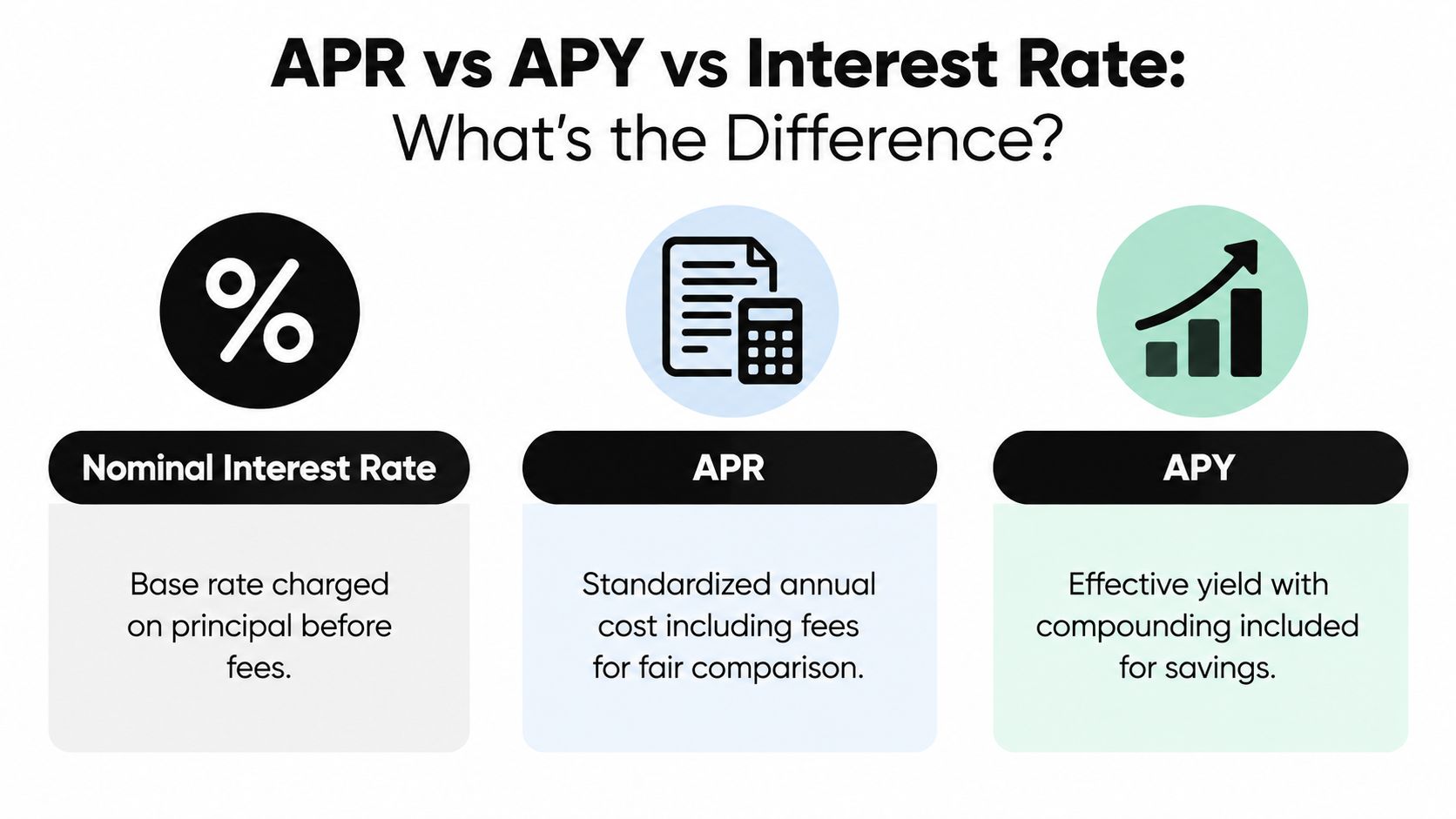
The nominal interest rate is the base percentage charged on the borrowed principal. It may be fixed for the loan term or variable over time. It doesn't necessarily include origination charges, administrative fees, points, or other borrowing costs.
APR, or annual percentage rate, broadens that view. It annualizes the cost of borrowing and includes eligible fees, allowing a borrower to compare offers on a more consistent basis. A lender's interest rate can look attractive while the APR reveals that upfront charges make the overall offer more expensive.
APY, or annual percentage yield, describes the effective return on money held in an account after compounding. For a borrower, APY usually isn't the primary comparison metric. APR focuses on the annualized cost of credit, while APY focuses on the annualized yield from deposited funds.
A simple comparison
| Measure | What it describes | Best use |
|---|---|---|
| Nominal interest rate | The base rate charged on the outstanding principal | Understanding the lender's stated rate |
| APR | The annualized borrowing cost, including eligible fees | Comparing loans and credit offers |
| APY | The effective annual yield after compounding | Comparing savings and deposit products |
Suppose two installment loans advertise the same nominal interest rate and principal. Loan A has no financing fee. Loan B includes an origination fee. The rate alone looks identical, but Loan B provides less net value to the borrower or creates a higher total cost, depending on how the fee is charged. Its APR can therefore be higher than Loan A's.
This distinction matters because APR is designed to make borrowing comparisons clearer across products and markets. A borrower comparing a personal loan, auto loan, or mortgage should inspect both the interest rate and APR. The interest rate helps explain the payment calculation, while APR helps show the broader cost.
APR and APY are not interchangeable
Compounding creates the main source of confusion. A periodic rate may be applied monthly or daily, while APY incorporates the effect of compounding on an annual basis. APR disclosures for loans follow product-specific rules and may not mean that a borrower can compound the quoted figure in the same way as a savings yield.
For credit card terminology and examples, this explanation of credit card APR can help separate the quoted annual rate from the periodic rate used to calculate interest. The practical rule is simple: use APR to compare borrowing costs, use APY to compare compounded savings yields, and inspect the product's calculation method before estimating actual charges.
How to Convert Annual APR to Monthly and Daily Rates
Two debts can quote the same APR yet produce different interest charges. A monthly installment loan may use a monthly periodic rate, while a revolving credit card often calculates interest each day against the average daily balance. Start by matching the conversion to the debt structure. Chase's explanation of APR and daily interest calculations describes the daily approach used for card interest.
Monthly conversion
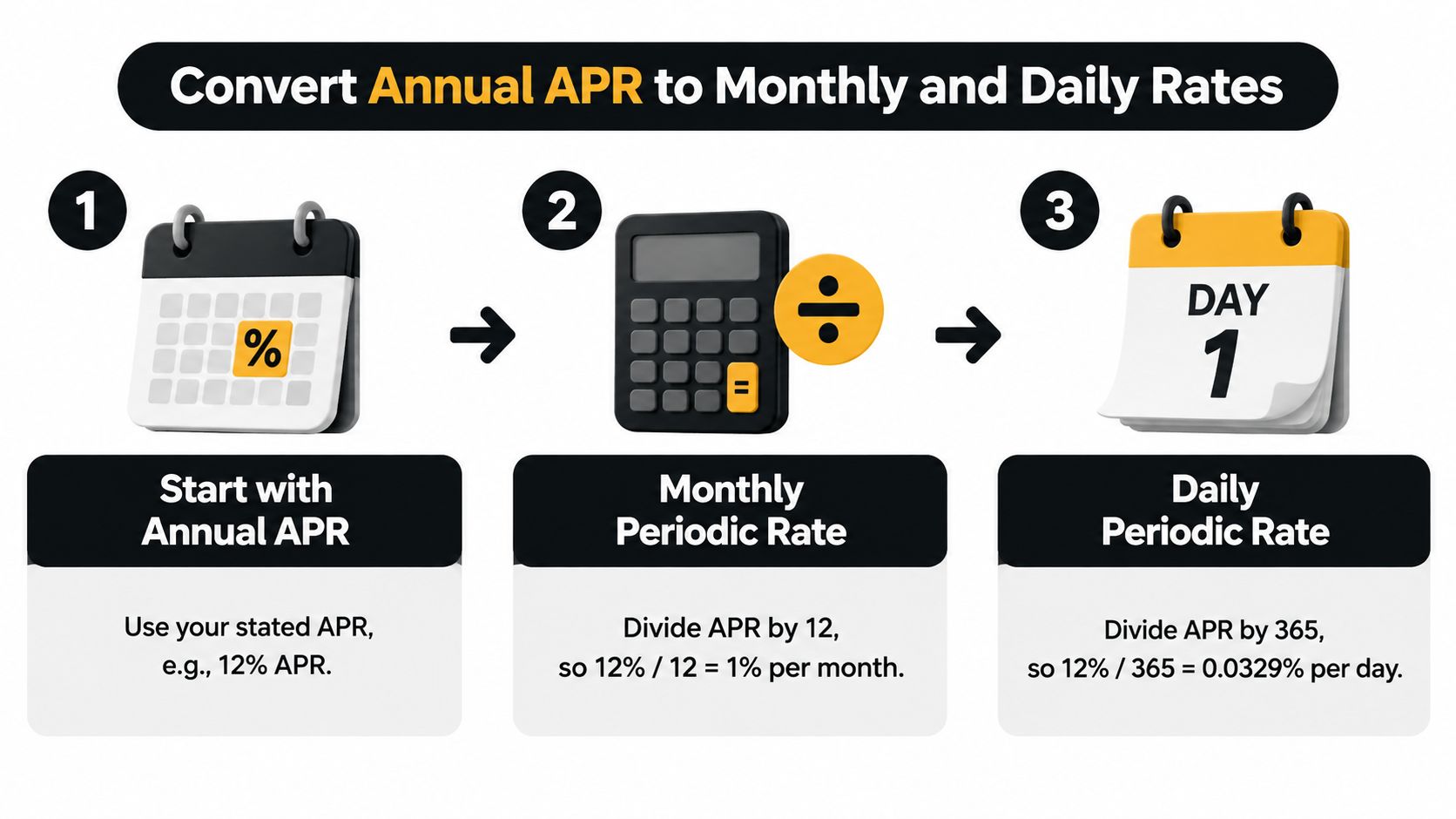
For a simple monthly periodic rate:
Monthly periodic rate = APR ÷ 12
Using 12% APR:
- 12% ÷ 12 = 1% per month
- As a decimal, 1% = 0.01
This gives a useful estimate when the product applies interest monthly. It does not automatically predict a credit card charge, because the issuer may calculate interest daily and use an average daily balance.
For a daily periodic rate:
Daily periodic rate = APR ÷ 365
Using 12% APR:
- 12% ÷ 365 = approximately 0.0329% per day
- As a decimal, that is approximately 0.000329 per day
The daily calculation then combines the rate with the balance and billing-cycle length:
Interest = daily periodic rate × average daily balance × billing-cycle days
Why billing-cycle length changes the result
Suppose an average daily balance stays at $1,000 with 12% APR. The daily periodic rate is approximately 0.000329. A 28-day cycle produces approximately $9.21 in interest, while a 31-day cycle produces approximately $10.20.
The APR did not change. The number of days changed, so the same balance accumulated interest for longer. A credit card interest calculation guide explains why a 31-day billing cycle can generate more interest than a 28-day cycle at the same annual rate.
Practical rule: APR divided by 12 is a conversion shortcut. It is not a guarantee of the actual monthly credit card charge.
Quick reference table
| Quoted APR | Monthly Periodic Rate | Daily Periodic Rate | When to Use It |
|---|---|---|---|
| 12% | 1% | Approximately 0.0329% | Monthly estimate or daily card calculation |
| 24% | 2% | Approximately 0.0658% | Monthly estimate or daily card calculation |
| 31.3% | Approximately 2.6083% | Approximately 0.0858% | Daily revolving-balance modeling |
The 31.3% APR row uses the private-label average cited earlier. Applying the same division-by-365 method gives its daily periodic rate. For a clearer explanation of monthly calculations, see this guide to monthly interest.
A revolving balance uses the daily rate repeatedly across the billing cycle. An installment loan usually applies its periodic rate within a scheduled payment formula, so dividing APR by 12 alone does not reproduce the payment or account for financing fees. The conversion identifies the periodic rate. The debt structure determines how that rate affects the final cost.
To convert a monthly periodic rate back to a nominal annual rate, multiply it by 12. To convert a daily periodic rate back to a nominal annual rate, multiply it by 365. These reverse calculations describe the quoted nominal APR and do not replace a full fee-inclusive APR calculation.
Calculating Effective APR and True Borrowing Cost
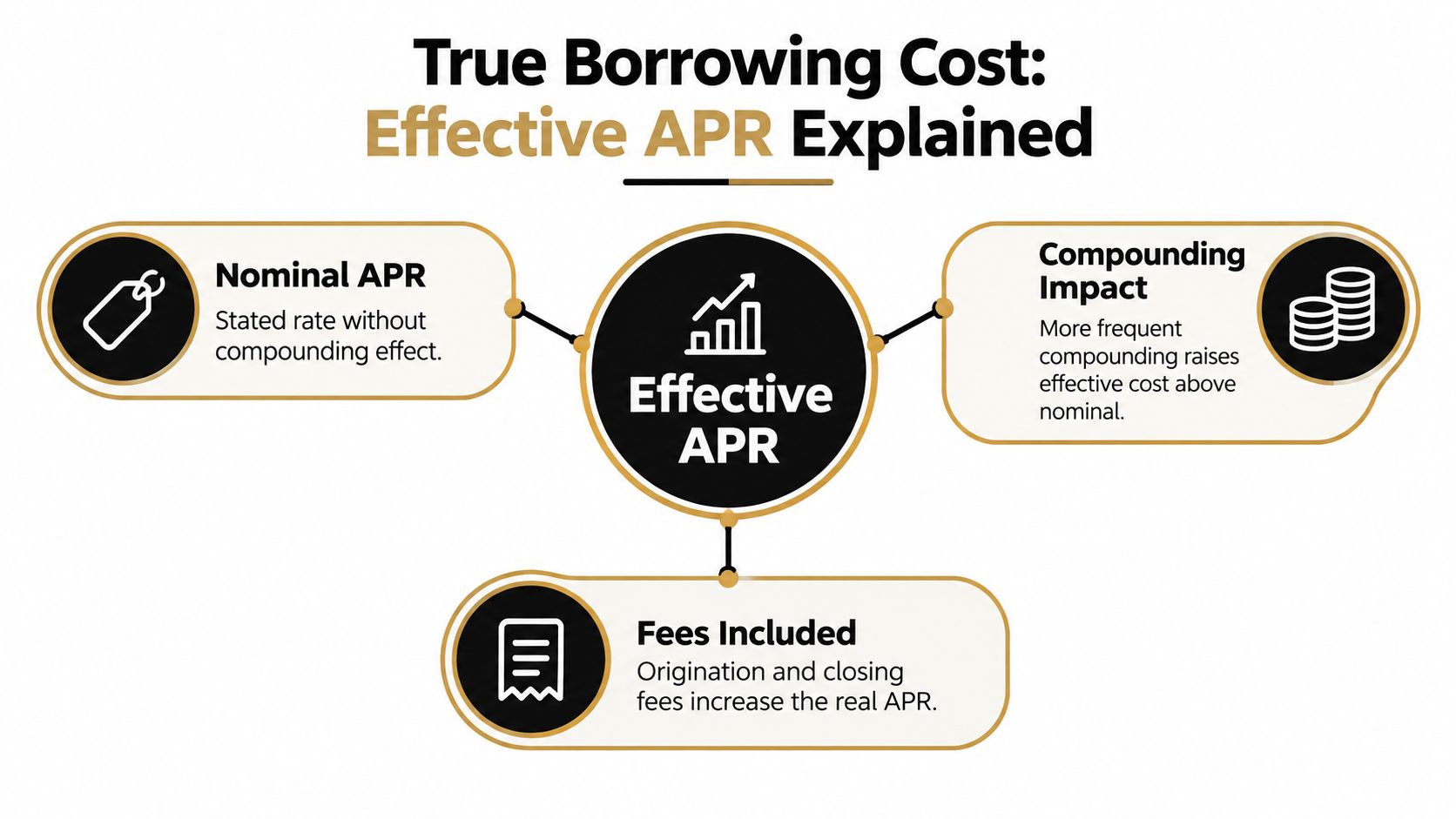
A quoted APR can understate the result a borrower sees if the calculation ignores the product's compounding method, fees, or payment timing. Effective borrowing cost reflects what happens under the repayment structure. More frequent compounding can raise the effective cost above a nominal rate, while upfront fees increase the cost because the borrower receives less usable money than the stated principal suggests.
Installment APR requires an implied-rate solve
For an installment loan, the technically correct APR is the rate that makes the present value of every scheduled payment equal to the amount financed after fees. A calculator solves for the rate that equates the discounted payment stream with the borrower's net proceeds, then annualizes that rate.
The calculation can be expressed conceptually as:
Net proceeds = present value of scheduled payments
If the loan amount is reduced by an upfront fee, the borrower's net proceeds are lower even though the payment schedule may be based on the original amount. Excluding that fee produces the nominal interest rate rather than the true borrowing cost. Investopedia's APR overview explains why installment APR calculations often require a numerical solve and why APR can equal the nominal rate only when there are no extra costs.
Independent calculator guidance describes binary-search-style iteration that can converge in roughly 30 to 40 steps to about 0.0001% precision. The APR calculator guidance from Pearson describes this numerical approach and also shows how calculators can compare offers, estimate break-even points, and model extra payments.
A fee can change which offer wins
Consider two offers with the same loan amount and term:
- Offer A: A lower nominal rate but an upfront origination fee.
- Offer B: A slightly higher nominal rate with no upfront fee.
Offer A may produce the lower payment, yet its fee means the borrower starts with less net value. If the borrower keeps the loan long enough, the lower rate may eventually offset the fee. If the borrower repays or refinances before that point, Offer B may cost less overall.
The break-even point is the moment when the cumulative interest savings from the lower rate equal the upfront fee. A calculator can find that point by comparing total costs over different holding periods. The result depends on the loan amount, payment schedule, fee, rate difference, and payoff timing, so a generic rule cannot replace the actual inputs.
Inputs that prevent misleading results
A fee-inclusive calculator should collect:
- Amount borrowed and net proceeds, especially when fees are deducted upfront.
- Nominal interest rate, including whether it's fixed or variable.
- Payment amount and frequency, because the payment stream determines the implied rate.
- Term and expected holding period, particularly when comparing a refinance or sale.
- Points, origination charges, and other financing costs, which affect APR.
A low advertised rate isn't automatically a low-cost loan. The borrower needs the rate, the fee, and the expected time in the loan.
Using an Interest Rate Calculator APR in Real Life
A calculator becomes useful when it answers a decision question. Instead of entering a rate and accepting one output, a borrower can test how balance changes, fees, payment timing, and extra payments alter the result.
Scenario one, a revolving card balance
A credit card user should enter the APR, current balance, expected payment timing, and any planned balance changes. The calculator should use the daily periodic rate and average daily balance rather than treating the balance as fixed for the entire month.
If the borrower pays down the balance early in the cycle, the average daily balance can fall. If the borrower waits until the due date, the balance may remain higher for more days. Two cards with the same APR can therefore produce different interest charges when their balances change on different dates.
The calculator should display:
- Estimated interest for the cycle
- Projected balance after payment
- Payoff date under the chosen payment
- Total interest under the current pattern
Promotional APRs need separate treatment. A promotional period may use a different rate from the standard rate, and the calculator should model the transition date instead of applying one percentage to the entire payoff period. Grace periods also matter, because paying a statement balance according to the card agreement can change whether purchase interest is charged.
Scenario two, an installment loan with fees
For a personal loan, the borrower should enter the amount financed, nominal rate, term, payment schedule, and every fee included in the disclosure. If an origination fee comes out of the proceeds, the calculator should use the net amount received when solving for APR.
A payment estimate alone doesn't answer whether the loan is affordable or competitive. The borrower should compare:
- Net proceeds received
- Scheduled payment
- Total scheduled repayment
- Fee-inclusive APR
- Total borrowing cost
- Effect of an extra fixed payment
A fixed extra payment can reduce the outstanding principal faster and shorten the payoff timeline, provided the loan terms allow additional principal payments without a penalty. The calculator should show the revised debt-free date and total interest rather than only reporting a smaller balance.
For a structured loan comparison, this loan payoff calculator resource can help borrowers focus on payoff timing and repayment outcomes alongside the rate.
Scenario three, several debts competing for cash
Multiple balances require more than a single-loan estimate. A borrower may have credit cards with high revolving APRs, a student loan, an auto loan, and a personal loan, each with its own minimum payment and due date.
A practical allocation routine looks like this:
- Reserve every required minimum payment first. Missing a due date can create fees and account problems that the APR calculation alone won't capture.
- Direct available extra cash toward one priority balance. An avalanche approach generally targets the highest APR first, while a snowball approach targets a smaller balance for a quicker visible win.
- Redirect freed minimums after a balance reaches zero. The payment previously assigned to that debt becomes extra cash for the next balance.
- Update the model after rate or budget changes. Variable APRs, promotional expirations, and irregular income can make a static payoff schedule inaccurate.
A calculator should compare baseline, avalanche, and snowball outcomes while respecting minimum-payment constraints. It should also show how changing the monthly budget affects the debt-free date rather than assuming that one steady payment will continue indefinitely.
Putting Your APR Insights Into Action
A reliable APR check comes down to three questions. First, does the calculator use the correct periodic method for the balance type? Second, does the result include fees and net proceeds? Third, does the model reflect how the borrower pays?
For a credit card, inspect the daily periodic rate, average daily balance, billing-cycle length, grace-period treatment, and promotional-rate dates. For an installment loan, inspect the payment stream, term, upfront charges, points, and whether the quoted APR was calculated from net proceeds.
A verification checklist
- Match the debt structure: Use daily balance logic for revolving credit and an implied-rate solve for installment debt.
- Enter every cost: Include origination fees, points, and financing charges that belong in the APR disclosure.
- Separate nominal rate from APR: The nominal rate explains interest on the balance. APR supports broader offer comparisons.
- Check the timing assumptions: Payment dates and billing-cycle length can change revolving interest.
- Test more than one outcome: Compare the scheduled payment with an extra-payment scenario and a realistic budget.
- Re-run after changes: Update the calculation when a variable rate, promotional period, fee, income pattern, or payment amount changes.
The result should be treated as a decision aid, not a substitute for reading the lender's disclosure. Calculator outputs depend on the inputs, and a rounded rate or missing fee can shift the comparison.
A borrower who centralizes APRs, balances, minimums, and due dates can move from isolated rate checks to an adaptive payoff plan. The most useful output isn't always the lowest monthly payment. It's the combination of manageable cash flow, a clear payoff date, and lower total borrowing cost.
Toya AI helps borrowers organize balances, APRs, utilization, and due dates, then model how different payment choices affect interest and payoff timing. Visit Toya AI to connect APR calculations with a personalized debt payoff plan and evaluate the next payment decision.
Ready to start your debt-free journey?
Toya AI builds a personalized payoff plan so you can see your debt-free date and save on interest.
Get Started Free