
How to Pay Off Private Student Loans Faster
A young professional checks the bank account after rent, groceries, credit card payments, and a car loan clear. The private student loan payment is still waiting, and the balance barely seems to move. Extra income arrives, but so do repairs, medical bills, and unpredictable work hours. The challenge isn't just paying more. It's paying enough to move quickly without creating the next financial emergency.
The most reliable answer combines high-interest debt targeting, careful refinancing decisions, automated payments, and a cash buffer. The right plan doesn't chase the fastest possible payoff at any cost. It shortens the loan timeline while keeping every other obligation current.
Table of Contents
- The High-Cost Reality of Private Student Loans
- Mastering the Debt Avalanche Method
- Evaluating Refinancing vs. Aggressive Prepayment
- Balancing Speed with Financial Resilience
- Leveraging Technology for Personalized Payoff Plans
- Your Roadmap to Becoming Debt-Free
The High-Cost Reality of Private Student Loans
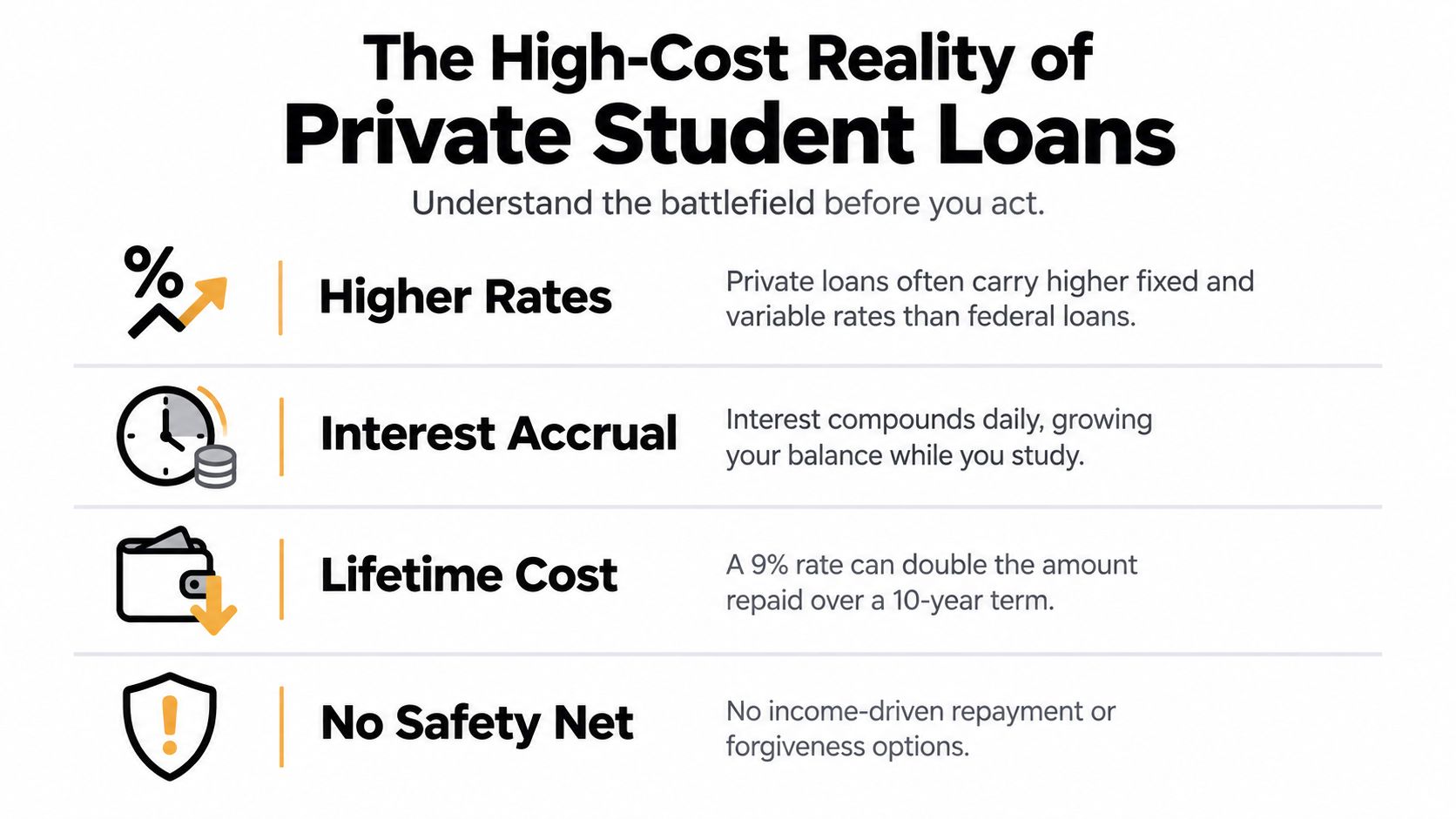
A private student loan can look manageable on the monthly statement while quietly consuming cash that could support rent, credit cards, a car loan, or an emergency reserve. Advertised fixed APRs in the United States currently span roughly 1.94% to 17.99%, while variable APRs often range from about 3.50% to 17.99%, according to current private student loan rate data. Lenders usually reserve the lowest advertised rates for borrowers who meet strict credit requirements and enroll in features such as autopay.
Historical rate surveys from Bankrate reported average private student loan rates of 9.66% for fixed-rate loans and 7.81% for variable-rate loans. At those levels, a borrower who sends only the scheduled payment gives interest more time to consume money that could reduce principal. The practical trade-off is clear: paying faster saves interest, but directing every spare dollar to the loan can leave a young professional exposed when another debt or unexpected bill arrives.
Review this student loan interest rate guide to understand how fixed and variable rates affect repayment. Then compare each loan by APR, balance, and rate type before deciding how much extra to send. A high APR deserves aggressive attention, but the plan also needs enough cash flow to keep other accounts current and preserve a basic buffer.
Why early payments matter
Borrowers can accelerate repayment sharply. A federal analysis found that the median final payment was 55 times larger than the scheduled payment, implying payoff at least 55 months ahead of schedule, and 94% of final payments exceeded the scheduled amount. Even among loans within five years of their scheduled payoff date, the median final payment was more than seven times the regular payment. The figures come from the Consumer Financial Protection Bureau's repayment research.
A dramatic lump sum is not required. Bonuses, higher earnings, lower expenses, and regular extra principal payments can all shorten the timeline. Another dataset found that between 20% and 30% of borrowers had fully repaid their loans by the end of the first year of repayment, showing that early payoff is possible when balances are smaller or cash flow is strong.
Practical rule: Treat a high-APR private loan differently from low-cost debt. Send extra money where it cuts the most interest, while keeping enough cash to withstand the next financial shock.
Mastering the Debt Avalanche Method
If three loan balances compete for your next extra payment, the smallest one may not deserve your attention. The debt avalanche sends additional money to the highest-APR loan first, reducing the balance that generates the most future interest. It is the strongest default for borrowers focused on cost, but speed must not leave you unable to handle an emergency or another debt obligation. For a fuller comparison of repayment structures, see our guide to the best student loan repayment plan.
Start with a complete inventory. A spreadsheet works if it lists every lender, current balance, APR, fixed or variable status, minimum payment, due date, and available autopay discount. Rank loans by cost, not by balance size or emotional appeal. A smaller loan can wait if a larger balance carries the higher rate.
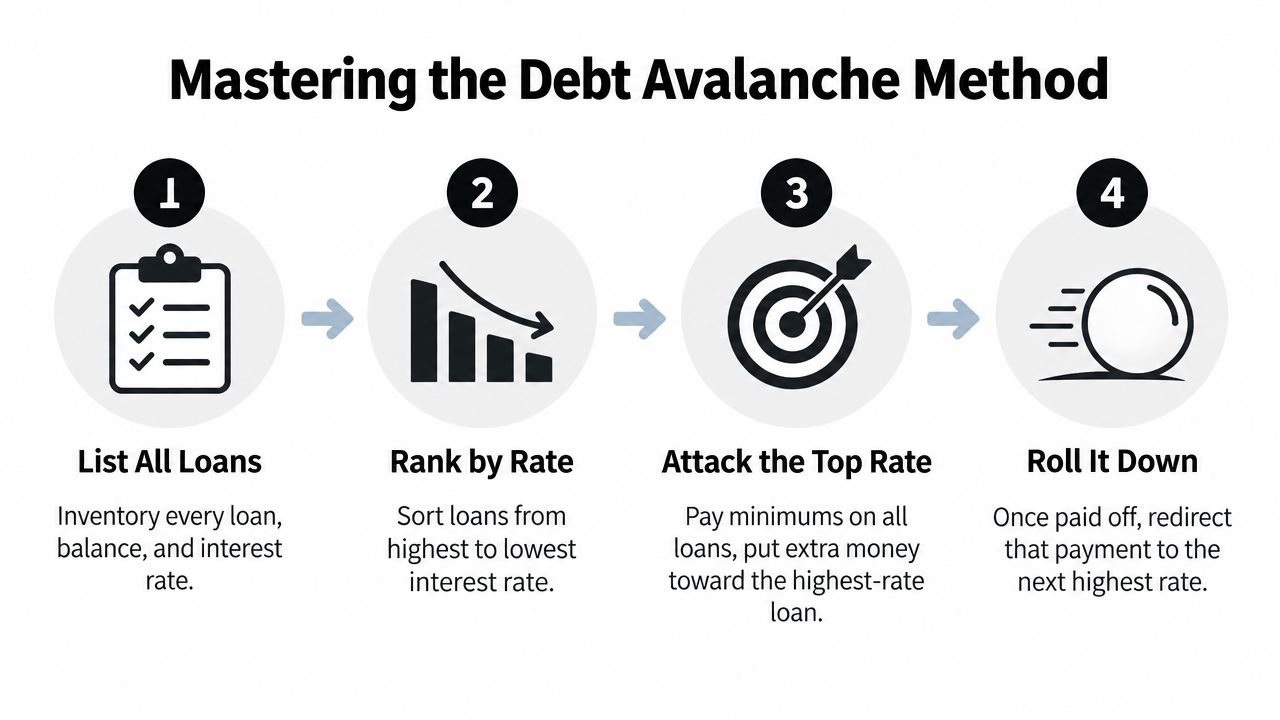
The four operating steps
List every loan: Record the balance, APR, minimum payment, due date, and loan type. One missing account can throw off the plan.
Rank by interest rate: Sort loans from highest APR to lowest. Watch variable-rate loans closely because their costs can change.
Protect the minimums: Reserve enough for every required payment. Direct each planned extra dollar to the highest-rate loan.
Roll the payment forward: After clearing that loan, add its former minimum payment to the extra amount assigned to the next target.
Consider a high-rate private loan, a lower-rate private loan, and a car loan. Splitting a modest overpayment across all three feels balanced, but it weakens the attack on the costliest balance. Minimums keep every account current. Concentration cuts interest faster, and the freed payment increases the next loan's progress without demanding an immediate lifestyle overhaul.
Because private fixed APRs can reach 17.99%, concentrating extra principal on the highest-rate loan produces the largest interest saving. Paying principal early lowers the balance on which future interest accrues. Keep enough cash for a financial shock before directing every available dollar to debt.
Use autopay, but verify the savings
Autopay can reduce the rate by 0.25% with many private lenders, according to the CFPB's student loan debt payment guidance. Confirm the discount with the lender, maintain sufficient funds in the payment account, and check that extra payments reduce principal rather than only advancing the next due date.
Set minimums to run automatically, schedule a separate overpayment for the avalanche target, and review windfalls before discretionary spending absorbs them. This system keeps repayment aggressive while preserving the cash buffer that makes the plan sustainable.
Evaluating Refinancing vs. Aggressive Prepayment
Refinancing isn't automatically the fastest route. It can lower the rate, simplify several accounts, or create a shorter repayment term. It can also produce a lower monthly payment that tempts borrowers to extend the debt rather than eliminate it.
Recent refinance rate snapshots show fixed APRs around 3.98% to 10.99% and variable APRs around 3.65% to 10.99%, while private loan rates can reach 17.99%, according to student loan refinance rate information. A borrower with a current rate near the upper end may have a compelling reason to compare offers. A borrower with a relatively low fixed rate and unstable income may gain less than expected after considering flexibility and risk.
When refinancing earns serious consideration
Refinancing is more attractive when the borrower has stable income, strong credit, a reliable emergency reserve, and a clear plan to keep the new term short. The proposed rate should be meaningfully below the existing rate, not merely lower by a negligible margin. The borrower should compare the total repayment cost, monthly obligation, fixed versus variable structure, and any fees before signing.
For example, a professional with predictable salary income and a private loan at a very high fixed APR could refinance into a lower fixed rate, keep a manageable payment, and continue sending extra money toward principal. The refinance lowers the cost of every future payment, while the aggressive payment plan shortens the timeline.
When refinancing becomes a trap
A lower rate doesn't compensate for a payment that no longer fits real life. Borrowers with commission-based income, contract work, recent job changes, or thin savings may need flexibility more than a theoretically optimized rate. A new loan can also create problems when a co-signer is involved. The borrower should review release terms, death or disability provisions, hardship options, and the consequences of missed payments before replacing the original contract.
A longer term can reduce the monthly bill but extend interest accumulation. A variable rate can begin lower and later rise. A refinance can also remove protections associated with the original arrangement, depending on the loans and contract involved. The decision should therefore compare total cost and resilience, not just the headline APR.
Refinancing should lower the cost without weakening the borrower's ability to stay current during a difficult month.
A useful decision test has three questions:
- Does the new rate create a meaningful saving? Compare the existing APR with the new APR and examine the total repayment amount.
- Can the borrower maintain the new payment during income disruption? If not, a lower rate won't create a safer plan.
- Will the borrower keep paying aggressively? A lower payment only helps if the freed cash supports principal reduction, emergency savings, or both.
For some borrowers, aggressive prepayment of the existing loan wins because it avoids a new contract and preserves flexibility. For others, refinancing a costly loan and then applying the avalanche method produces the cleaner result. The better option depends on the borrower's rate, term, cash-flow volatility, and co-signer obligations.
Balancing Speed with Financial Resilience
A payoff plan that causes missed rent, late credit card payments, or an empty bank account isn't aggressive. It's fragile. Private student loans sit inside a larger debt stack, and the fastest student loan payment can become a bad decision if it triggers delinquency elsewhere.
Estimated U.S. private student-loan balances reached $138.8 billion as of March 2026, with 74.4% in repayment, 20.7% in deferment, and 1.6% 90 or more days delinquent in Q1 2026, according to private student loan debt statistics. Those figures make the resilience question impossible to ignore. Borrowers need a plan that reduces interest while protecting the payment system around it.

Build the plan in the right order
A borrower should first identify every required payment and protect the bills that keep housing, transportation, utilities, insurance, and debt accounts current. Next comes a realistic cash reserve. The precise amount depends on income stability, household responsibilities, and upcoming expenses, so the plan should use a sustainable target rather than an arbitrary figure.
Only after those obligations are covered should the borrower set the extra student loan payment. The amount can change month to month. A stable salaried worker may commit to a fixed overpayment, while a freelancer may use a smaller base payment plus carefully assigned surplus income.
Consider a household juggling a private student loan, credit card balances, and an auto loan. If the household sends every available dollar to the student loan and then uses a credit card for a car repair, the balance may shift rather than disappear. A slower student loan payment paired with protected emergency cash can outperform a reckless sprint because it prevents new borrowing.
Use a two-speed budget
A resilient budget has a baseline payment and an acceleration payment. The baseline keeps the debt moving even during an ordinary difficult month. The acceleration payment increases when income exceeds expectations, expenses fall, or a planned cash inflow arrives.
This structure gives borrowers permission to slow down temporarily without abandoning the strategy. It also makes progress measurable. Each month, the borrower can review whether the target loan balance fell, whether all accounts stayed current, and whether the cash reserve remained intact.
Resilience beats speed when speed creates another balance.
The best question isn't “How much can be sent today?” It's “What extra payment can be repeated without forcing the household back into debt?” That answer produces a payoff plan that survives real life.
Leveraging Technology for Personalized Payoff Plans
Spreadsheets work well for a small number of loans, but they become tedious when balances, APRs, due dates, income, and payment changes all interact. Manual tracking also makes it harder to test scenarios. A borrower may know that an extra payment helps, yet still lack a clear view of which account should receive it and how the decision changes the debt-free date.
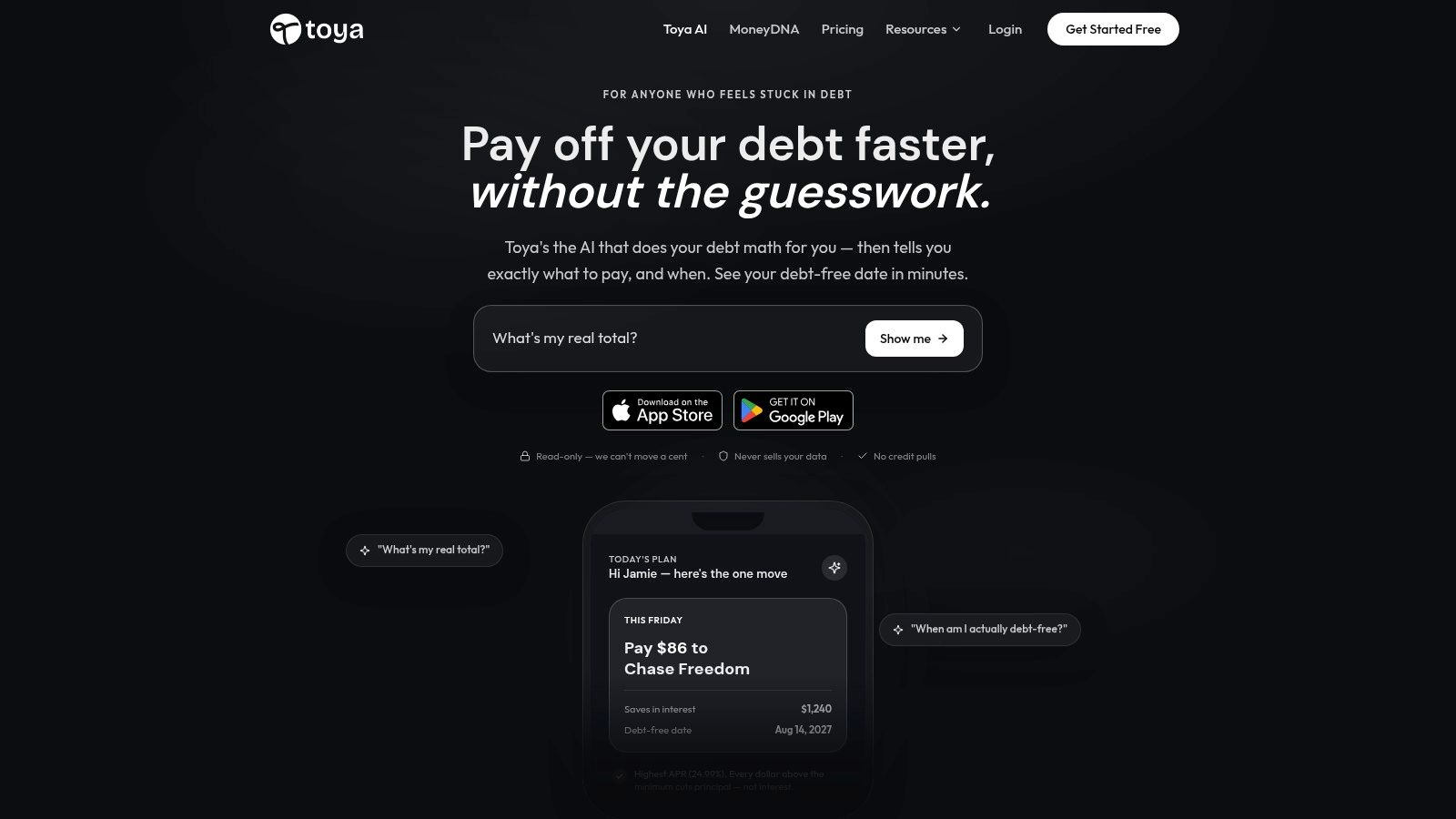
Toya AI is one option for centralizing credit cards and loans, including student loans, in a single dashboard. After a borrower securely connects accounts through supported read-only connections, the platform can organize balances, APRs, utilization, and due dates. Its payoff analysis recommends which debt to target and how payment changes affect the projected payoff date, monthly interest, and total cost.
A borrower deciding between an extra payment and a cash reserve can use a payoff calculator to compare both choices before moving money. The important benefit isn't surrendering judgment to software. It's turning scattered account information into a view that supports a deliberate decision.
Compare scenarios before changing the budget
A useful tool should answer practical questions:
- What happens if the extra payment increases? The borrower can compare a modest recurring amount with a larger but less reliable contribution.
- Which loan deserves the next dollar? APR, balance, and payment structure should determine the recommendation.
- What happens when income drops? A resilient plan needs a lower-payment scenario, not only an ideal month.
- Does refinancing improve the result? The borrower can compare current terms with a new rate and repayment period.
For borrowers who prefer manual control, a spreadsheet remains effective. It should include one row per loan, formulas for projected interest, a payment calendar, and a separate line for emergency savings. The advantage of an automated platform is speed and ongoing updates when account information changes.
A clear payoff projection is more useful than a vague promise to “pay extra.” Readers comparing scenarios can also use this student loan payoff early calculator to estimate how additional principal changes the timeline.
The following demonstration shows how a debt payoff dashboard can turn multiple obligations into an actionable plan:
Technology doesn't remove the need for budgeting. It reduces the friction between a financial decision and its consequences, which makes consistent action easier.
Your Roadmap to Becoming Debt-Free
A borrower with several private loans can start with a single afternoon of organization. The borrower lists every balance and APR, enrolls in eligible autopay discounts, protects all minimum payments, and directs extra cash to the highest-rate loan. Before refinancing, the borrower compares the new rate, term, payment, protections, and co-signer impact, while making sure the new obligation fits unstable months as well as good ones.
Next comes the resilience check. Emergency savings and other high-cost debts stay visible, rather than being sacrificed for an impressive student loan payment. Any borrower considering a new loan should also understand APR and fees before comparing offers.
The process becomes repeatable: review the budget, send the planned extra payment, verify principal application, update the loan inventory, and roll freed payments forward after each payoff. A debt-free future comes from that sequence, not from one dramatic financial decision.
Toya AI connects student loans and other debts into one payoff view, then shows how the next payment can change the debt-free date and total cost. Visit Toya AI to organize private student loans, compare payoff scenarios, and build a plan that moves faster without sacrificing financial resilience.
Ready to start your debt-free journey?
Toya AI builds a personalized payoff plan so you can see your debt-free date and save on interest.
Get Started Free