
How to Pay Off Personal Loan Faster

A borrower can make every scheduled payment, add extra cash whenever possible, and still wonder why the personal-loan balance barely moves. The problem isn't always discipline. Payment timing, amortization, and lender processing rules can determine whether an extra dollar cuts interest or merely satisfies a future installment.
The practical answer to how to pay off a personal loan faster is mechanical: reduce principal earlier, direct surplus payments correctly, choose the right debt priority, and verify every transaction. A faster payoff only works when the lender's system records the money in the way the borrower intended.
Table of Contents
- Why Extra Payments Often Fail to Save You Money
- Structuring Biweekly Payments and Principal Directives
- Choosing Between Avalanche Efficiency and Snowball Momentum
- Calculating the True Cost of Early Payoff Trade-Offs
- Automating Your Debt Strategy with AI Optimization
- Auditing Your Statements and Protecting Your Progress
Why Extra Payments Often Fail to Save You Money
A borrower sends an extra $50 with the regular payment and expects the balance to fall by the same amount. Instead, the lender may mark the account as paid ahead, apply the money to a future installment, or hold it in a suspense account until enough cash accumulates to satisfy the next required payment. The borrower has sent more money, but the principal reduction may be smaller than expected.
Most personal loans are amortized. Each payment contains both interest and principal, and the interest calculation uses the remaining principal balance. An earlier reduction therefore has more impact because every later interest calculation starts from a smaller balance. The mechanics are explained in practical detail in this guide to extra principal payments.
The balance reduction test
The key question isn't whether the lender received the payment. It's how the lender applied the payment. A borrower should check the transaction history for:
- Principal reduction: The principal balance should fall by the intended extra amount, apart from any interest or permitted fees.
- Posting date: The payment should receive a credit date that allows the lower balance to affect subsequent interest calculations.
- Payment status: The account shouldn't just show a future installment as paid while the principal remains unchanged.
- Fee treatment: Processing fees or other charges shouldn't consume the surplus unless the loan agreement expressly permits them.
A published estimate illustrates why early principal payments matter. On a $15,000 loan with a five-year term at 10% APR, a normal $318 monthly payment was projected to produce about $4,122 in interest. Adding $150 per month cut the payoff period to a little over three years and saved about $1,603 in interest, according to Fortune's personal-loan payoff estimate.
Practical rule: An extra payment has done its job only when the statement confirms that it reduced principal.
The directive that prevents misapplication
Before sending additional money, the borrower should contact the servicer through the lender's secure message system or written correspondence. The instruction should state:
“Apply the amount above the scheduled payment directly to principal. Do not advance the due date, place the funds in a suspense account, or apply the surplus to future installments. Please confirm the principal-only treatment in writing.”
That directive should accompany rounded-up payments, irregular lump sums, and any amount sent outside the normal payment channel. A borrower should retain the confirmation and compare it with the next statement. Extra principal payments generally shorten the loan term and reduce total interest, but they don't usually lower the required minimum payment on a fixed personal loan, as explained by NerdWallet's payoff guidance.
Structuring Biweekly Payments and Principal Directives
Biweekly payments make a large annual change without requiring a borrower to find a large monthly lump sum. The method is simple, but the lender's posting process matters just as much as the transfer schedule.
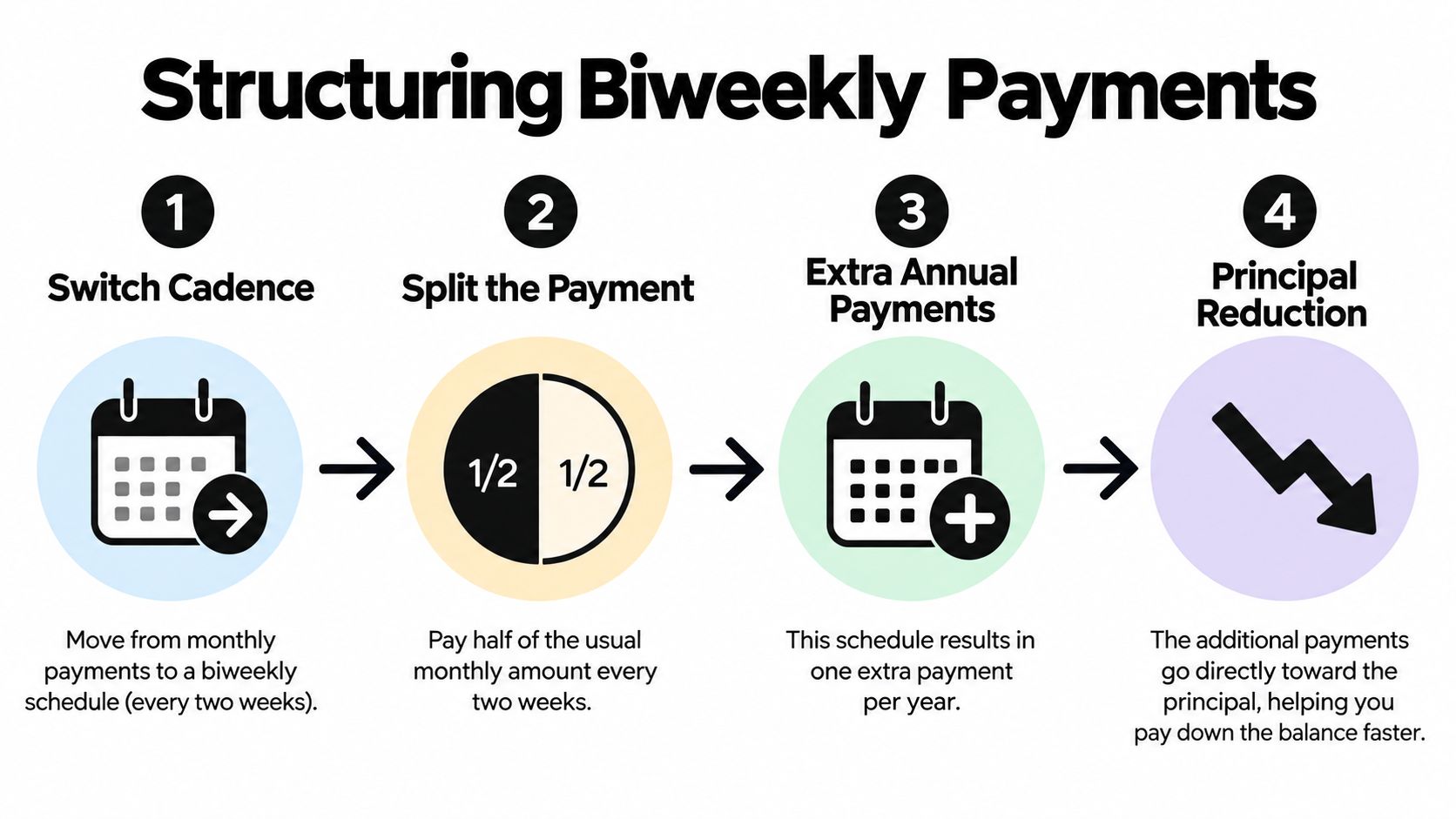
A four-step setup
- Confirm the regular payment. The borrower should record the exact required monthly amount, the due date, and the lender's rules for partial payments.
- Divide the payment by two. That half-payment becomes the transfer amount every two weeks. The schedule creates 26 half-payments per year, equivalent to 13 monthly payments, according to Bankrate's early-payoff guidance.
- Choose a reliable cadence. Transfers should occur on consistent dates tied to income, with enough time for the lender to receive and post each payment.
- Verify immediate crediting. The lender must apply each half-payment when received, rather than holding it until the second half arrives. The borrower should ask whether partial payments enter a suspense account and whether the extra annual payment goes to principal.
A benchmark example shows the potential effect. A $20,000 loan at 13% APR over 60 months fell to 54 months and saved $925.27 in interest when paid biweekly instead of monthly, based on Bankrate's payment comparison. The result depends on the contract and processing rules, so the benchmark isn't a promise for every loan.
A written principal-only instruction
A borrower sending rounded-up amounts or a lump sum can use a separate instruction:
“Please apply the enclosed additional amount to the outstanding principal of account [account number]. This is not an advance payment for future installments. Please confirm the amount applied to principal, the posting date, and any fees deducted.”
The borrower should ask whether the lender charges a prepayment penalty before activating the schedule. The extra payment produces the intended savings only if the lender posts it promptly, applies it to principal, and doesn't deduct a penalty that overwhelms the interest avoided.
The safest implementation is to automate the bank transfer, save the lender's written response, and review the first statement after the schedule begins. A payment calendar alone isn't enough. The statement must prove that the balance is declining faster.
Choosing Between Avalanche Efficiency and Snowball Momentum
The payoff order becomes decisive when a household has multiple balances. The debt avalanche sends every extra dollar to the account with the highest APR while minimum payments continue elsewhere. The debt snowball targets the smallest balance first, regardless of its interest rate.
Avalanche is the correct default for borrowers optimizing total cost. Snowball can still be useful when a quick account closure creates the motivation needed to sustain payments. The trade-off should be deliberate, not accidental.
A peer-reviewed analysis across 999 bootstrapped weight sets found average avalanche savings of $46.2 billion, or about $853 to $1,321 per household, compared with snowball. Using snowball instead of avalanche increased interest costs by an average of 2.34%. The same analysis found that snowball households often made 15% fewer total payments on average, with a 9% median reduction, which helps explain its behavioral appeal. The findings appear in the peer-reviewed debt repayment analysis.
| Strategy | Primary Focus | Interest Savings | Best For |
|---|---|---|---|
| Avalanche | Highest APR first | Usually the strongest mathematical result | Borrowers who can follow an interest-rate ranking |
| Snowball | Smallest balance first | Can cost more when APRs differ materially | Borrowers who need quick account closures to maintain momentum |
How the interest gap changes
LendingTree's scenario analysis found that avalanche beat snowball by as much as $1,292 in total interest and one month of payoff time in one case, while another mixed-debt example produced only $29 in savings. The result depends on the APR spread and balance mix, as shown in LendingTree's avalanche and snowball analysis.
A borrower with a high-rate credit card and a lower-rate personal loan should generally direct surplus cash to the card first, even if the personal loan has the smaller balance. A borrower whose rates are close may reasonably choose the smaller balance if the psychological win prevents missed payments. Before choosing, estimating total interest before paying can make the cost of each route visible.
The decision rule is straightforward: use avalanche when mathematical efficiency is the priority, and use snowball only when motivation is the factor that determines whether the plan survives. Minimum payments remain essential on every account.
Calculating the True Cost of Early Payoff Trade-Offs
Paying a personal loan faster is not automatically the best use of every available dollar. A borrower must compare the interest avoided with the cost of a prepayment penalty, the value of emergency liquidity, and any higher-rate debt competing for the same cash.
The first calculation is the break-even test:
Net benefit = interest avoided minus prepayment penalty minus unavoidable fees.
If a lender charges a penalty that exceeds the projected interest savings, an immediate payoff destroys value. The loan agreement should be checked for flat charges, percentage-based penalties, minimum-interest provisions, and restrictions on partial prepayments. A borrower should request a written payoff quote rather than relying on the balance displayed on an account dashboard.
Three competing uses for surplus cash
Emergency liquidity comes first when cash reserves are thin. A personal loan can be paid down later, but a sudden expense may force a borrower to use expensive credit if available cash has been exhausted. The safer sequence is to preserve enough accessible cash for near-term instability before making an irreversible lump-sum payment.
Higher-rate debt usually outranks a lower-rate personal loan. A household carrying revolving debt at a higher APR should compare that cost before directing all surplus money to the installment loan. The avalanche framework applies across the whole balance sheet, not just within one lender's account.
Employer-matched retirement contributions deserve a separate comparison. A contribution that earns an employer match can compete strongly with voluntary prepayment, while an unmatched contribution and a personal loan at a high APR require a more individualized calculation. The decision should use actual account rules and the loan's effective cost, not a generic slogan.
Personal-loan rates remain material. For a borrower with a 700 FICO score, a $5,000 loan, and a three-year term, the average U.S. personal-loan rate was 12.53% in September 2026. The national average at credit unions was 10.64% in the fourth quarter of 2025, while market snapshots commonly ranged from roughly 5.96% to 35.99%, according to Bankrate's personal-loan rate context.
A borrower should aggressively prepay when the loan rate is high, the penalty is absent or small, and liquidity remains adequate. Otherwise, the money may belong in an emergency reserve or a more expensive debt target.
Automating Your Debt Strategy with AI Optimization
Manual spreadsheets become fragile when balances, due dates, interest rates, and income change at different times. An AI debt platform can centralize connected account data, calculate the effect of competing payments, and show which action changes the payoff timeline most.
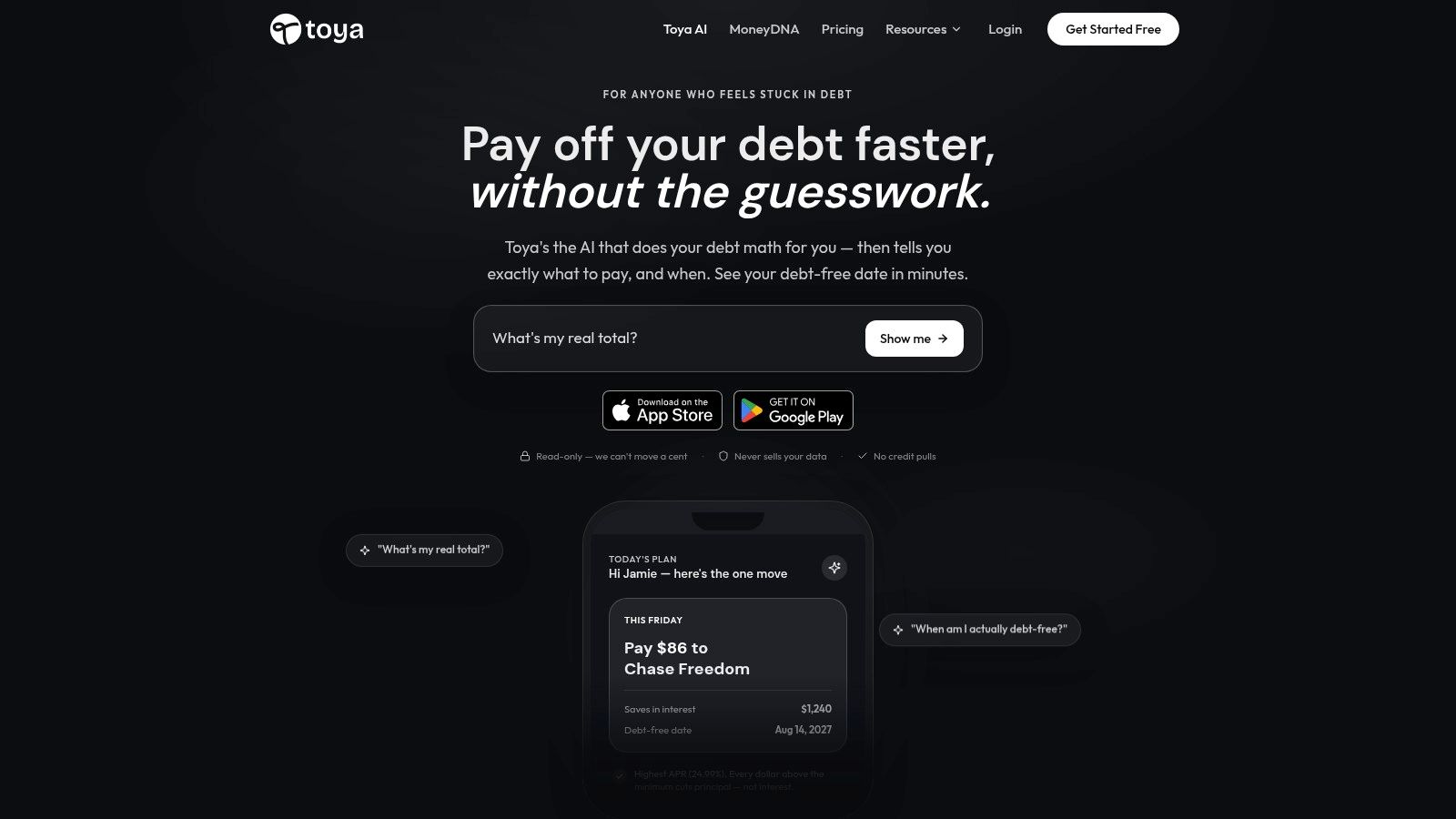
A practical system should separate visibility from execution. First, the borrower connects eligible accounts through trusted aggregation partners and checks that balances, APRs, utilization, and due dates are accurate. Next, the system compares the debts, identifies the next payment priority, and models how an extra amount affects interest and the debt-free date.
Toya AI centralizes credit cards, student loans, auto loans, personal loans, and mortgages in one dashboard after secure account connections through partners such as Plaid, Fincity, Spinwheel, and Quiltt. Its AI uses balances, APRs, timelines, and cash flow to recommend a next payment and show how the action changes payoff timing and total cost. Borrowers should still verify lender processing, because an optimization recommendation can't correct a servicer that misapplies a principal payment.
The automation must reflect real cash flow
The useful recommendation isn't always the largest possible payment. A sound system accounts for income timing, required minimums, upcoming bills, and available liquidity. If income falls, the plan should preserve minimum payments and recalculate the next priority instead of allowing an ambitious target to trigger overdrafts or missed obligations.
The workflow can be simple:
- Connect and inspect: Confirm that every balance and APR matches the latest lender statement.
- Set the constraint: Establish the surplus amount that can be used without disrupting essential bills.
- Compare outcomes: Review the interest cost and payoff date under avalanche, snowball, lump-sum, and biweekly choices.
- Execute carefully: Send the recommended amount with a principal directive where needed.
- Audit the result: Compare the next statement with the projected balance and correct discrepancies promptly.
The following video offers another visual explanation of debt payoff planning and automation.
Automation removes repetitive calculations, but it doesn't eliminate judgment. The borrower still decides how much liquidity to preserve, whether a penalty makes early payoff unattractive, and whether the lender has honored the payment instruction. More detail on the workflow appears in this guide to AI debt management.
Auditing Your Statements and Protecting Your Progress
A payoff plan can fail after the payment leaves the bank. The lender may post it late, apply it to fees, advance the due date, or record the wrong principal amount. A short statement audit catches those errors before they distort the next calculation.
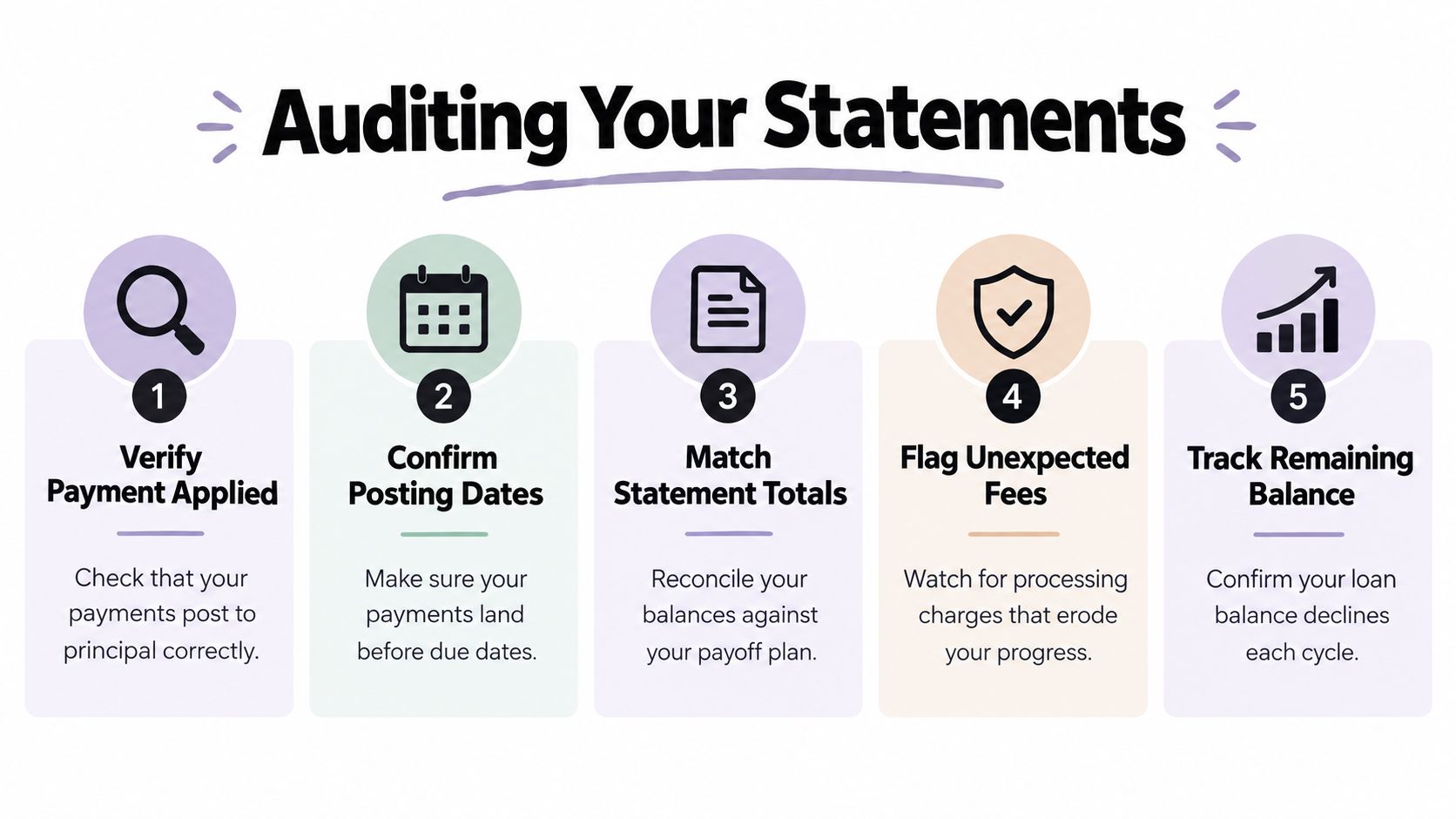
The monthly control routine
- Verify payment applied: Match the bank transaction with the lender's payment history and confirm the intended principal reduction.
- Confirm posting dates: Check that the credit date reflects when the lender received the money, not merely when the transfer was initiated.
- Match statement totals: Reconcile the opening balance, payments, interest, fees, and closing principal against the payoff plan. A structured account reconciliation guide from Snyp can help organize that comparison.
- Flag unexpected fees: Investigate processing charges, late fees, or penalties that weren't included in the payoff calculation.
- Track remaining balance: Compare the current principal with the projected balance and investigate any unexplained gap.
The borrower should save statements, payment confirmations, lender messages, and payoff quotes in one folder. If the lender misapplies a payment, the borrower should send a written correction request, attach the transaction evidence, repeat the principal-only instruction, and ask for a corrected statement. Phone calls can help, but written records create a clearer escalation trail.
A secure account connection also requires attention to access controls and data handling. Borrowers reviewing aggregation practices and read-only permissions can consult Toya AI's financial data security information before connecting accounts.
The next loan statement deserves an audit, not a quick glance. Check the principal, posting date, interest, fees, and remaining balance, then challenge any mismatch immediately so the payoff schedule reflects what happened.
Toya AI gives borrowers a centralized view of personal loans and other debts, then uses balances, APRs, due dates, and cash flow to recommend the next payment and show its effect on the debt-free date. Visit Toya AI to connect accounts, compare payoff choices, and replace guesswork with a tracked repayment plan.
Ready to start your debt-free journey?
Toya AI builds a personalized payoff plan so you can see your debt-free date and save on interest.
Get Started Free