
How to Pay Off Parent PLUS Loans: A 2026 Plan

Outstanding Parent PLUS debt reached nearly $110 billion in 2024, up more than 75% from just over $62 billion in 2014, according to the National Center for Education Statistics. For parents carrying that debt toward retirement, the priority isn't finding a smaller bill. It's choosing a payment that protects the household without adding years of avoidable interest.
Knowing how to pay off Parent PLUS loans means separating three decisions: which repayment plans remain available, whether forgiveness deserves consideration, and where extra household cash will save the most. A workable plan answers all three before the parent sends a lump sum.
Table of Contents
- Which Repayment Plans Still Work in 2026
- Build Your Loan Inventory Before Your First Extra Payment
- Run the Payoff Math on Your Balance
- Forgiveness Routes to Check Before You Accelerate
- Decide Where Each Extra Dollar Goes
- Confirm Your Debt-Free Date This Month
Which Repayment Plans Still Work in 2026
The July 1, 2026 consolidation deadline has passed. As of November 2026, a new consolidation cannot open the Parent PLUS income-based pathway described in Federal Student Aid's Parent PLUS guidance, which required consolidation to be completed and the new loan disbursed by that deadline.
An application submitted before the deadline isn't the same as a completed, disbursed loan. Parents should open StudentAid.gov or their servicer account, locate any Direct Consolidation Loan in the parent's name, and record its disbursement date. That record determines whether the income-sensitive route remains worth investigating.
Compare the realistic routes
For eligible existing loans, standard repayment provides a predictable bill and a relatively short payoff schedule. Graduated repayment offers a smaller opening payment but requires the household to absorb increases later. Extended repayment provides more room in the monthly budget, usually at a substantial lifetime interest cost.
Parent PLUS repayment options compared
| Plan | Typical term | How payments behave | Interest effect |
|---|---|---|---|
| Standard | 10 years | Fixed payment, highest monthly bill among these conventional schedules | Lowest total interest of the options when repaid on schedule |
| Graduated | Up to 10 years | Starts low and rises over time | Higher total interest than standard |
| Extended | Up to 25 years | Lower fixed payment | Usually much higher total interest |
| Income-Contingent Repayment after consolidation | Up to 25 years | Based partly on income and family size | Can raise total interest; only if consolidated by July 1, 2026 |
The table describes the established routes for eligible loans, not a promise that every account can select every plan. Under Federal Student Aid's Direct PLUS repayment guidance, post-deadline consolidations containing Parent PLUS debt may have only Tiered Standard repayment and may not qualify for Public Service Loan Forgiveness; certain eligible borrowers can access IBR after at least one full ICR payment.
Parents who consolidated in time should therefore request an eligibility review, not assume that ICR is their only possible destination. Parents who missed the deadline shouldn't consolidate now merely because older advice describes consolidation as an income-driven repayment shortcut.
Choose affordability without disguising the cost
Say a parent's salary is steady but the standard bill crowds out groceries and medical expenses. Extended repayment may create a sustainable required payment, while leaving the parent free to accelerate repayment when cash allows. Graduated repayment is less attractive when the parent expects income to fall during retirement.
Decision rule: If the standard payment fits comfortably, keep it. If it doesn't, test extended repayment first, then check whether an existing, timely consolidation qualifies for ICR.
Before requesting a switch, the parent should compare the quoted payment, remaining term, and total scheduled cost. This guide to changing a loan repayment plan provides useful context for organizing that request.
Build Your Loan Inventory Before Your First Extra Payment
The parent owns the debt, even when the child promises to pay. EdFinancial's parent-borrower guidance explains that federal consolidation cannot transfer the loan to the child, and repayment generally begins within 60 days after final disbursement, unless postponed while the student is enrolled at least half time.
A reimbursement agreement can organize family contributions. It doesn't replace the parent's responsibility to monitor the account and prevent missed payments.
Follow a repeatable account routine
Confirm the borrower. Log into each servicer account and check the borrower name on every Parent PLUS loan. A child's access to payment information doesn't establish legal ownership.
Download the loan details. Save principal, accrued interest, interest rate, required payment, and next due date. Keep individual loans separate rather than recording only the account's combined balance.
Identify the loan type. Mark each loan as Direct or older FFEL debt. That distinction helps the parent ask precise questions about repayment and forgiveness eligibility.
Document family contributions. Put any parent-child reimbursement arrangement in writing, including payment amounts, transfer dates, and what happens after a missed contribution. The parent should retain access to payment confirmations.
Get allocation instructions in writing. Ask how targeted overpayments are handled after required interest is satisfied. Request instructions that reduce the intended loan balance rather than merely advancing the next due date.
The visual checklist helps keep the account-gathering work organized.
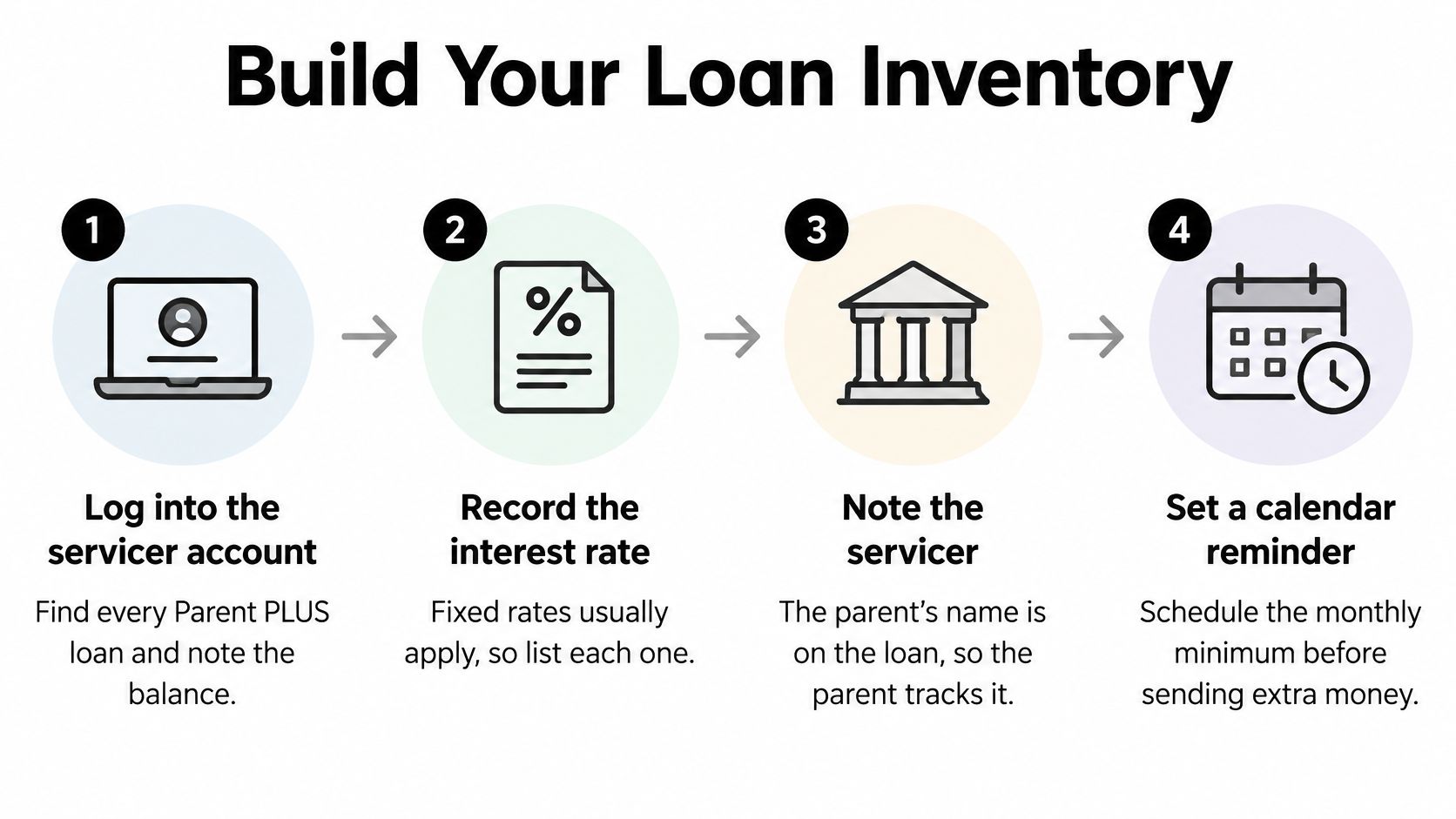
Check the rate on each loan
The fixed rate was 8.94% for Parent PLUS loans first disbursed from July 1, 2025, through June 30, 2026, according to Federal Student Aid's interest-rate schedule. That isn't a universal Parent PLUS rate; older or newer loans must be checked against their own disbursement periods.
Consider a parent holding several loans from different school years. The largest balance may carry a lower rate than a smaller loan, so targeting the largest loan automatically could waste interest savings.
Before moving money, the parent should have a single-page inventory containing:
- Loan identity: Borrower, servicer, loan type, and disbursement date.
- Current cost: Principal, accrued interest, and each loan's fixed rate.
- Payment obligations: Required payment, due date, repayment status, and plan.
- Execution details: Family contribution agreement and written overpayment instructions.
A complete inventory makes the next payment a deliberate decision rather than a guess.
Run the Payoff Math on Your Balance
A lower required payment can make the household budget workable while making the debt far more expensive. In the hypothetical calculation below, extending repayment drops the monthly bill from about $632 to $418, but the parent pays interest for much longer.
Compare the same balance on different schedules
The following illustration uses a $50,000 balance at 8.94%, with level monthly payments, no extra payments, and no additional fees or capitalization. These are rounded amortization calculations, not a servicer quote; the Federal Student Aid consolidation guide explains why extending repayment can increase total interest and why consolidation doesn't create a lower underlying rate.
Illustrative payoff on a $50,000 Parent PLUS balance at 8.94%
| Repayment term | Monthly payment | Total paid | Interest paid |
|---|---|---|---|
| 10-year standard | About $632 | About $75,800 | About $25,800 |
| 25-year extended | About $418 | About $125,300 | About $75,300 |
The extended schedule provides meaningful monthly breathing room. But a parent choosing it should recognize the trade-off: maintaining only the smaller required payment produces a much larger lifetime bill in this illustration.
Actual federal loan servicing uses account-specific balances, accrued interest, and payment timing. A calculator estimate should therefore guide the decision, while the servicer's repayment disclosure confirms the contractual schedule.
A smaller required payment is a cash-flow tool. It isn't evidence that the loan became cheaper.
Test acceleration separately
In the same hypothetical standard-plan calculation, adding $100 each month cuts repayment to about 96 months and saves roughly $5,800 in interest. The final payment would be smaller than the regular payment, and actual results would change with payment dates and servicing details.
This creates a useful distinction between required payment and chosen payment. A parent may need a lower contractual bill for protection during lean months but still choose to pay more during stronger months. That only works if the extra payment is affordable and consistently applied as intended.
Consolidation deserves the same scrutiny. Its rate is a weighted average rounded up to the nearest one-eighth of a percentage point, not a discounted refinance rate. Combining accounts may simplify administration, but simplification alone doesn't justify extending an expensive balance.
Include taxes without assuming a tax break
Interest documentation belongs in the annual household review. The Allied Tax Advisors 1098-E guide explains the form used to report student-loan interest, helping parents organize records before evaluating whether a deduction applies.
A potential deduction shouldn't become a reason to retain interest-bearing debt. The parent should compare repayment costs first and assess tax eligibility separately.
For an account-specific comparison, a student-loan debt payoff calculator can test the current balance, actual rate, remaining term, and affordable extra payment. The useful outputs are total interest and the projected debt-free date, not merely the next bill.
Forgiveness Routes to Check Before You Accelerate
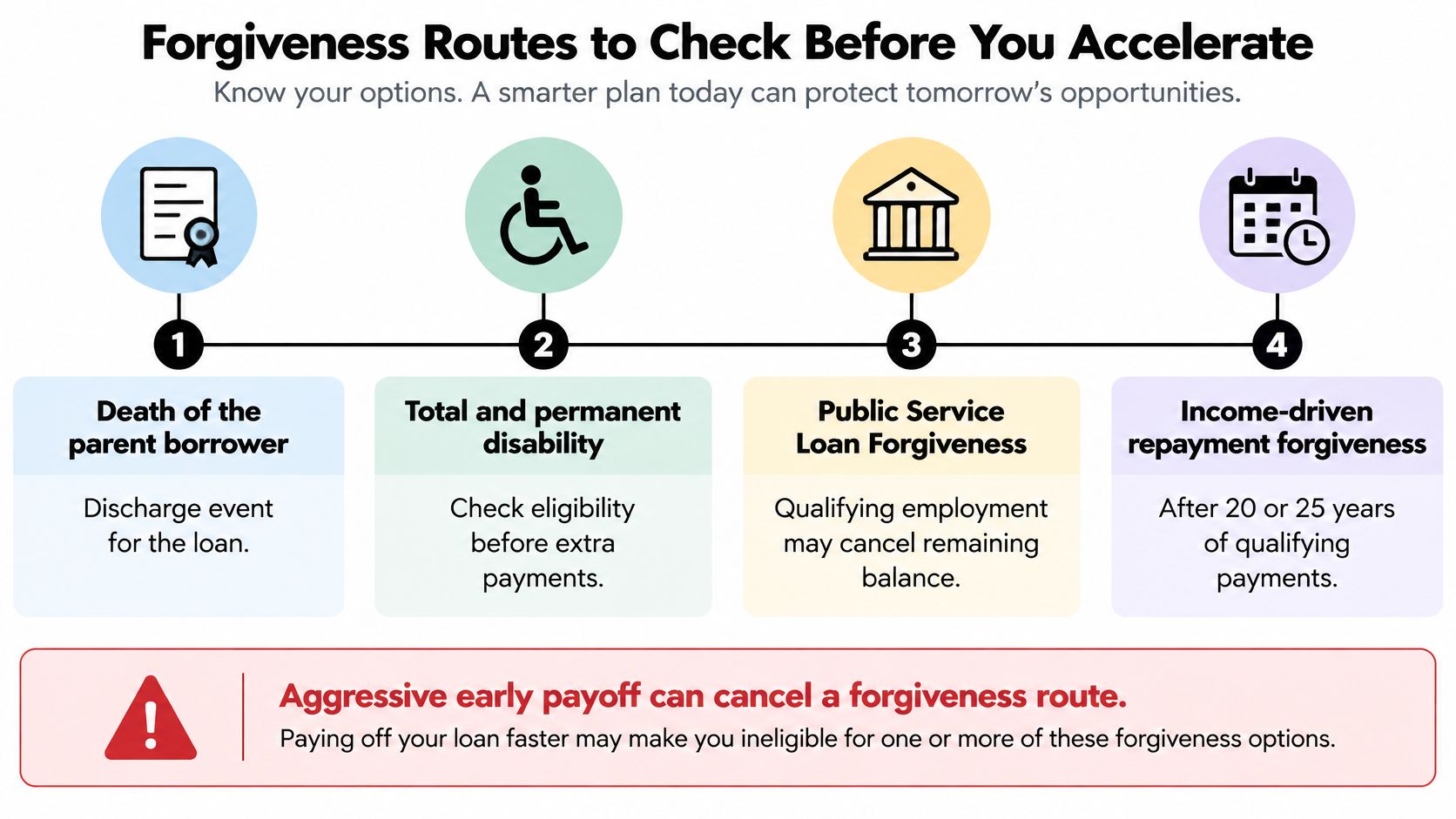
Aggressive early payoff can eliminate the balance that a forgiveness program would otherwise cancel. Before accelerating repayment, the parent should establish whether a discharge condition applies or whether a realistic forgiveness path exists.
Federal Student Aid's forgiveness and cancellation guidance identifies potential Parent PLUS discharge circumstances including the parent borrower's death, total and permanent disability, a qualifying bankruptcy discharge, or the death of the child for whom the loan was borrowed. It also describes PSLF after 120 qualifying monthly payments, effectively 10 years, and ICR forgiveness after 25 years of repayment, subject to eligibility requirements.
Check discharge conditions first
Discharge and forgiveness aren't interchangeable. A qualifying discharge event calls for the applicable application and supporting documentation, not just a more aggressive repayment schedule.
Parents facing a possible discharge should ask the servicer which application applies and how payments should be handled while the request is reviewed. They shouldn't assume that submitting an application automatically changes the amount due.
The visual overview identifies routes worth checking before money leaves the household.
Verify the public-service timeline
The parent's employment matters for PSLF, not the child's job. A parent working full time for a qualifying nonprofit should use this sequence:
- Confirm employer eligibility. Establish that the parent's government or nonprofit employment qualifies and that the applicable full-time requirement is satisfied.
- Submit employment certification so qualifying employment can be documented.
- Review the payment count. Resolve missing employment periods or disputed payments before building a household plan around forgiveness.
- Request forgiveness once the required qualifying count and all program conditions are met.
An eligible employer alone doesn't guarantee forgiveness. Loan type, repayment-plan eligibility, and qualifying payments also need confirmation.
Evaluate the remaining-balance benefit
ICR forgiveness requires an eligible consolidation and compliance with the applicable repayment rules. Parents shouldn't assume that having a long repayment term makes the balance forgivable.
Consider a nonprofit employee whose records show a credible PSLF path. Sending a large bonus to the loan could reduce the future forgiven balance without meaningfully improving household security. Keeping the required payment current and preserving cash may be the better decision.
By contrast, a parent without qualifying employment or an available income-driven route has less reason to delay a feasible payoff. A comparison of early student-loan payoff trade-offs can help frame that choice.
Before accelerating: Compare the certainty of interest savings with the expected forgiveness benefit, including eligibility risk, remaining payments, and possible tax consequences.
Decide Where Each Extra Dollar Goes
Every minimum gets paid first. An emergency reserve comes next. Only then should extra money leave the household. A parent who drains savings to reduce a federal loan may end up financing the next car repair or medical bill on a more expensive credit card.
A household review should include the loan statement, other debt statements, and the cash needed for upcoming expenses.

Prioritize the costliest debt, not the most emotional debt
Parent PLUS debt can feel especially urgent because it is tied to a child's education and a parent's approaching retirement. That emotional weight doesn't make it the most expensive account.
Consider a hypothetical household with a $50,000 Parent PLUS balance at 8.94% and a credit card charging 24% APR. After protecting minimums and necessary cash, the parent should usually target the card because each dollar of that balance costs more interest.
Nelnet's consolidation guidance provides context for federal loan repayment and consolidation trade-offs, including the importance of considering term length rather than treating a lower payment as the whole decision. Parent PLUS loans generally carry fixed rates and no prepayment penalty, so acceleration can remain available without making these loans the automatic first target.
The debt avalanche directs extra money to the highest-rate eligible debt. A cash-flow approach may instead clear a smaller account that releases a meaningful required payment. Avalanche is the default recommendation, but cash-flow relief can be justified when the household needs a more resilient monthly budget.
Make the family arrangement sustainable
A child's contribution should reflect reliable income, not an optimistic salary forecast. A new graduate with unstable hours may need a modest recurring contribution and an agreement to revisit it after employment stabilizes.
The written arrangement should address:
- The loan contribution: A fixed monthly amount and transfer date.
- The competing priority: A separate amount for the highest-rate debt.
- The interruption rule: What happens after unemployment, illness, or a missed transfer.
- The review trigger: When a raise, retirement, or major expense changes the arrangement.
Employer retirement matching also deserves protection. A parent shouldn't automatically sacrifice an available match to make an optional loan payment, especially when retirement savings are already thin.
This repayment video can accompany the household review.
Keep lump sums subordinate to the plan
Medical costs and near-term essential expenses should be funded before an irregular windfall goes to debt. A bonus isn't fully available for acceleration merely because it appears in the checking account.
The forgiveness check must also be complete before extra payments begin. Once the parent has ruled out a more valuable forgiveness strategy, the household can choose between maximum interest savings and faster monthly-payment relief.
Consistency beats occasional overreach. A repeatable extra payment that survives an ordinary bad month is more useful than a dramatic lump sum followed by new borrowing.
Confirm Your Debt-Free Date This Month
A productive planning session ends with a decision that can be carried out. The parent should bring together the loan inventory, the payoff comparison, the household budget, and any unresolved forgiveness questions, then choose an affordable payment strategy.
The starting figures need to match actual accounts. For parents checking whether scheduled payments cleared, autobankstatement's guide to reconciling balances section by section offers a practical way to compare bank activity with loan records.
Choose an action that removes uncertainty
The best action depends on what remains unresolved:
- Unclear payment allocation: Send the servicer a written request confirming how a targeted extra payment will be applied.
- Unverified forgiveness eligibility: Complete the employment or repayment review before accelerating.
- A complete, affordable plan: Set a recurring extra amount and check the first transaction against the loan statement.
The parent shouldn't automate an amount that depends on overtime, a bonus, or a child's uncertain contribution. The base plan should work from dependable income, with irregular money handled separately.
Track a date, not just a balance
Toya AI calculates a debt-free date from current payments and shows which debt should receive extra money and how much interest that saves. It builds a payoff plan from existing accounts; it isn't debt consolidation and doesn't consolidate or move debt.
Those projections support the decision, but they don't replace servicer confirmation or federal eligibility checks. A useful household plan combines a clear projection with verified account instructions.
For this month, the parent should select one concrete step, complete it, and record the resulting payoff projection. After each correctly applied extra payment, the parent can watch the debt-free date move closer.
Toya AI helps parents compare extra-payment choices across Parent PLUS loans and other household debts, showing the effect on interest and the debt-free date. Visit Toya AI to build a payoff plan from existing accounts and identify the next payment that fits the household budget.
Ready to start your debt-free journey?
Toya AI builds a personalized payoff plan so you can see your debt-free date and save on interest.
Get Started Free