
How to Pay Off Loans Early a Practical 2026 Guide
Loans payments leave the account, but the balances barely move. Five debts, three due dates, and a vague plan to “send extra when possible” create the illusion of progress without a reliable payoff path. The fastest way to pay off loans early isn't to throw money at the first balance that comes to mind. It's to verify the contract, calculate the actual cost, choose the right target, and then automate extra principal payments.
A borrower who follows that order can avoid an expensive mistake, such as paying extra on a low-rate auto loan while a high-rate credit card continues growing. The recommendations below focus on what changes the payoff date and total interest, with practical examples for student loans, cars, personal loans, mortgages, and revolving debt.
Table of Contents
- Why Most Early Loan Payoff Plans Fail Before They Start
- Building Your Debt Inventory and Mapping Every Loan
- Choosing Between Avalanche and Snowball Repayment
- Extra Payment Tactics That Shorten Your Timeline
- Refinancing and Consolidation Without Getting Burned
- Freeing Up Cash Flow and Automating the Whole System
- Your 90 Day Payoff Plan and the Questions Nobody Answers
Why Most Early Loan Payoff Plans Fail Before They Start
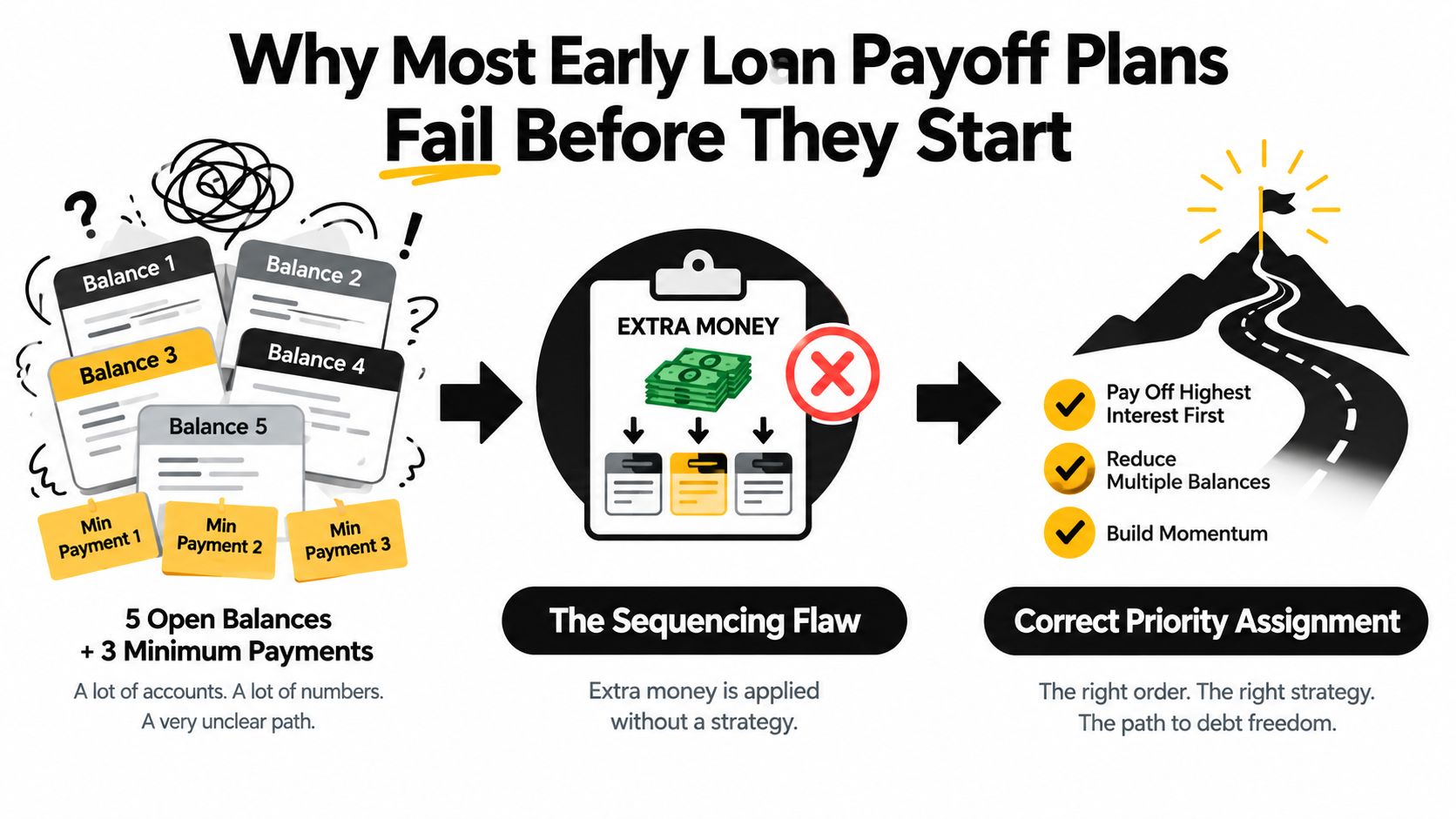
A borrower can make extra payments for months and still make a poor payoff decision. The usual mistake is starting with payment acceleration before debt diagnosis. Before sending a single additional dollar, verify the loan terms, compare effective rates, identify fees, and calculate whether early repayment improves the outcome.
Suppose a borrower sends $400 extra to a 4% car loan while leaving a 24% credit card untouched. The car balance drops faster, but the higher-cost debt continues generating expensive interest. The payment reduces debt. The priority wastes available cash.
Prepayment penalties can erase the benefit of acting early. Federal student loans can be prepaid at any time without a penalty, and paying principal sooner can reduce future interest, as explained by Bankrate's early-payoff guidance. Auto loans, mortgages, and some private products require contract-level review. The Consumer Financial Protection Bureau's explanation of prepayment penalties explains why a fee can reduce or eliminate expected savings. Read the agreement before changing your payment schedule.
The correct order of operations
Use this sequence:
- Audit every contract. Locate the penalty trigger, fee formula, and remaining interest schedule.
- Inventory the debts. Record balances, rates, minimums, loan types, and actual interest charged.
- Choose the target. Use the avalanche method for greater mathematical savings or the snowball method for behavioral momentum.
- Deploy extra payments. Add recurring principal, biweekly payments, rounded payments, or lump sums only after the first three steps.
Calculate the net result:
Net payoff benefit = future interest avoided minus prepayment fee and refinancing costs.
That formula determines whether acceleration makes financial sense. If the fee exceeds the interest saved, early payoff loses its advantage. If there is no penalty and one balance has a much higher effective rate, direct extra principal there first.
Older lending practices also show why contract review matters. A Center for Responsible Lending report described subprime penalties equal to six months of interest during an early period, sometimes roughly 4% to 5% of the original loan amount, and found these charges more common in subprime lending than conventional mortgages. Those findings do not describe every current loan, but they reinforce the right sequence: verify the contract, model the net benefit, then accelerate payments.
Building Your Debt Inventory and Mapping Every Loan
Before sending an extra dollar to any lender, build one accurate debt inventory. A spreadsheet usually takes only a few minutes. An account aggregation service can collect balances and due dates faster, but the tool matters less than putting every obligation in one view.
Use these columns:
- Creditor or loan
- Current balance
- Stated APR
- Minimum payment
- Actual interest accrued on the last statement
- Prepayment penalty clause
- Loan type
- Promotional rate end date, if applicable
Keep the actual interest accrued column. The stated APR is only a starting point. The latest statement shows what the lender charged. A variable-rate mortgage may no longer match an older rate in your records. A promotional 0% credit card may show no current interest while carrying a much higher rate after its introductory period ends.
A dashboard such as Toya AI's account aggregation resource can organize connected financial accounts. Verify every imported figure against the lender's latest statement and contract.
Sample Debt Inventory Worksheet
| Creditor / Loan | Balance | Stated APR | Minimum Payment | Monthly Interest Accrued | Prepayment Penalty? |
|---|---|---|---|---|---|
| Credit card | $7,500 | 24.99% | Not provided | About $156.19 | Check card agreement |
| Student loan | $30,000 | 6.8% | Not provided | About $170.00 | Generally no for federal loans |
| Auto loan | $19,000 | 7.2% | Not provided | About $114.00 | Check contract |
| Personal loan | $2,100 | 11.5% | Not provided | About $20.13 | Check contract |
These monthly interest figures are rough planning estimates based on balance multiplied by APR divided by 12. Daily accrual, payment timing, and compounding can change the actual charge, so treat the lender's statement as the authority.
The penalty field is a decision field
Do not leave “prepayment penalty” blank. Enter none confirmed, possible, or contract required. An unanswered field means you still cannot calculate the payoff decision.
For mortgages, inspect the agreement for the penalty period, trigger, and calculation. For auto loans, the CFPB's auto-loan guidance advises checking the contract because rules vary by loan and state. Obtain the promissory note, closing disclosure, or retail installment contract. Search for “prepayment,” “early payoff,” “yield maintenance,” and “early termination.”
Then compare the potential fee with the interest you would avoid. Accelerate only when the net savings justify the cost. That calculation belongs before the payoff strategy, not after it.
Choosing Between Avalanche and Snowball Repayment
The avalanche method directs every surplus dollar to the debt with the highest effective interest rate, while minimum payments continue on the others. It minimizes interest in the mathematical model because each extra dollar attacks the most expensive balance first.
The snowball method targets the smallest balance, regardless of rate. Once that debt disappears, its former payment rolls into the next smallest balance. The appeal is visible progress and freed cash flow, not lower interest by definition.
| Method | Order of Attack | Months to Debt-Free | Total Interest Paid | Best For |
|---|---|---|---|---|
| Avalanche | Highest effective rate first | Must be calculated from actual debts | Usually lower than snowball | Stable income and strong discipline |
| Snowball | Smallest balance first | Must be calculated from actual debts | May be higher than avalanche | Borrowers who need fast wins |
The table intentionally avoids invented portfolio results. Months and total interest depend on balances, rates, minimums, fees, and payment timing. A calculator should produce those outputs from the borrower's actual inventory, not from a fictional five-debt example.
The decision rule
Choose avalanche when income is stable, total balances exceed $40,000, multiple high-rate cards are open, and the borrower trusts the plan enough to continue without frequent emotional rewards. The method is especially compelling when a card rate is far above the rates on student, auto, or personal loans.
Choose snowball when previous payoff attempts failed, more than five debts are open, or a balance below $2,000 can be eliminated in under three months. A fast win can simplify the monthly system and make continued repayment easier.
The practical compromise is often better than ideology. A borrower might eliminate a tiny balance first, then switch to avalanche for the remaining expensive debt. A founder evaluating financing should also understand the broader concept of cost of debt for founders, because the relevant comparison is the effective cost of borrowed capital, not just the advertised rate.
Behavior beats theory: The mathematically optimal method produces no savings if the borrower abandons it.
Run both methods through the same calculator, then choose the one that fits the borrower's behavior. The difference in total interest may matter, but a consistently followed plan beats an abandoned perfect plan.
Extra Payment Tactics That Shorten Your Timeline
Before sending a dollar beyond the required payment, check two things: whether the loan permits penalty-free prepayment and whether the interest savings exceed any fee. Extra payments reduce principal sooner, leaving the lender less balance on which to charge future interest. That benefit disappears if the money is misapplied or a penalty consumes the savings.
A concrete student-loan example shows the potential. On a $30,000 loan at 6.5% APR over a standard 10-year schedule, the payment is about $341 per month, with roughly $10,900 in total interest. Adding $200 per month can shorten repayment to about 5.5 years and reduce total interest to around $5,800, according to Bankrate's example.
The requested 6.8% example cannot be verified without lender-specific amortization outputs. Use the servicer's payoff calculator or an amortization tool instead. Enter the exact balance, APR, remaining term, required payment, and proposed extra amount.
Comparing practical tactics
| Tactic | Monthly Outlay | Total Interest Paid | Months Saved | New Payoff Date |
|---|---|---|---|---|
| Standard scheduled payment | Required payment | Calculate from servicer schedule | None | Original maturity date |
| Add $200 monthly | Required payment plus $200 | About $5,800 in the verified 6.5% example | About 4.5 years in that example | About 5.5 years |
| Biweekly payments | Half payment every two weeks | Must be calculated from actual loan | Must be calculated | Depends on schedule |
| Round payments | Rounded payment amount | Must be calculated | Must be calculated | Depends on amount |
| Annual lump sum | Required payment plus available lump sum | Must be calculated | Must be calculated | Depends on timing |
Biweekly payments require careful setup. 26 half-payments equal 13 full payments per year, not 12. The extra annual payment comes from the calendar, not from a special lender benefit. Confirm that the servicer accepts the frequency and applies each payment correctly before switching.
Rounding creates a simpler routine. A borrower can round a required payment to the nearest $50 or $100, provided the extra amount reaches principal. Someone paying $341 might choose $350 or $400, then verify the allocation in the account portal.
Use lump sums deliberately. Tax refunds, bonuses, and inheritances can reduce the schedule, but keep enough cash for immediate financial shocks before sending a large payment to the lender. A smaller payment that preserves a workable emergency reserve is better than a large payment followed by new credit-card debt.
Verify the payment allocation
After every extra payment, check the account for four outcomes:
- The principal balance declined by the expected amount.
- The servicer did not place the money in a suspense or unapplied-payment account.
- The next due date changed only as intended.
- No prepayment fee appeared.
Do not accelerate a loan with an unresolved penalty clause. Review the contract first, calculate the net interest savings, and then confirm that the servicer applies the extra money to principal. That sequence prevents a payment strategy from becoming an expensive administrative mistake.
Refinancing and Consolidation Without Getting Burned
Refinancing is not automatically a payoff strategy. It's a new loan that replaces the old one, and the new rate matters less than the total cost after fees, lost protections, and term changes.
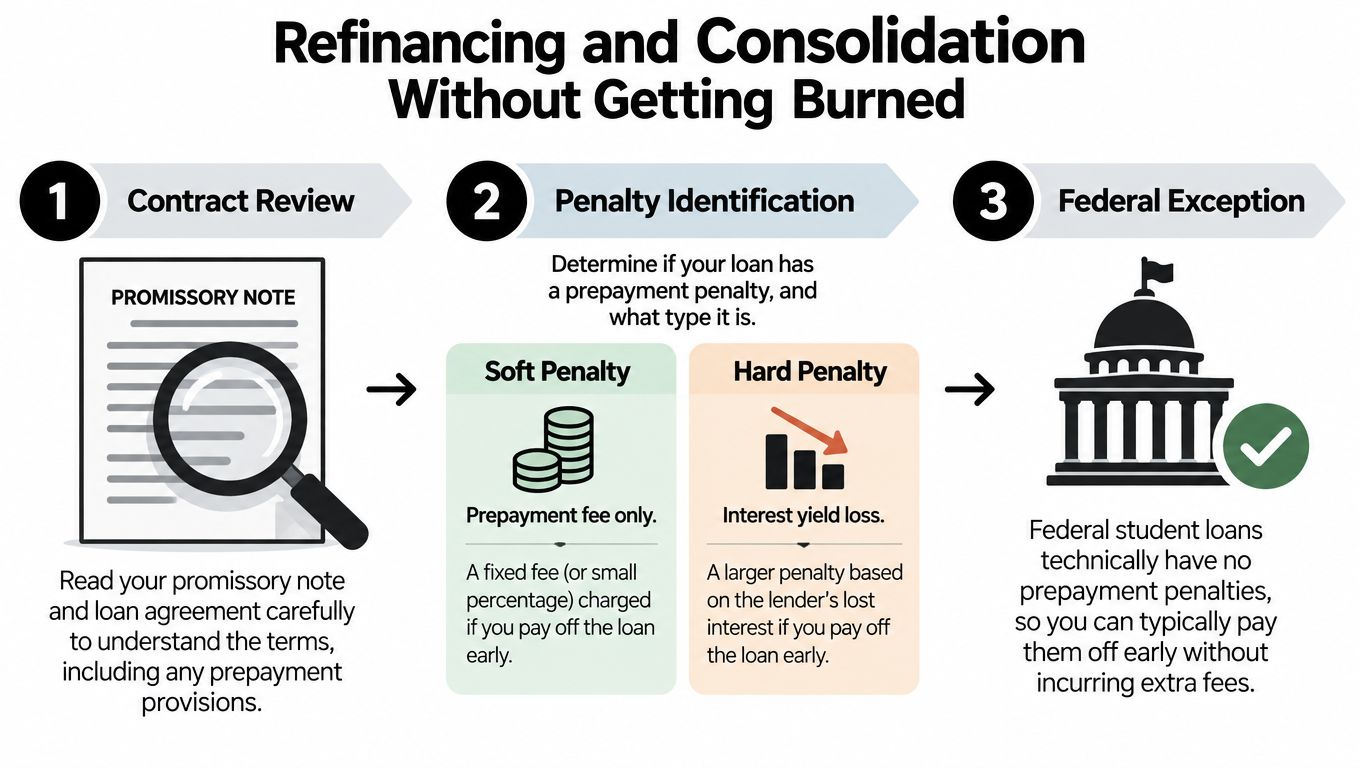
The first step is contract review. Pull the promissory note, closing documents, or loan agreement and identify what triggers a penalty. A soft penalty typically applies only to a defined action such as refinancing or selling, while a hard penalty can apply more broadly to early payoff. Mortgage penalties may use a percentage of the balance or a set number of months of interest. Some mortgage contracts can also assess a fee when a borrower pays off a fifth, or 20%, of the loan within one year, as described by Experian's overview of personal-loan prepayment penalties.
Federal student loans can be prepaid without penalty. Private student loans are generally protected from prepayment penalties under federal law, but borrowers still need to review private contracts. Auto loans and mortgages can follow different rules.
The break-even calculation
The formula is direct:
Break-even months = total refinancing costs ÷ monthly payment savings
A refinance with $4,000 in closing costs and $120 in monthly savings has a break-even point of about 33 months, because $4,000 divided by $120 is roughly 33. The new term should be at least six months shorter than the break-even period, otherwise the borrower risks paying costs without holding the loan long enough to recover them.
Borrowers assessing mortgage refinance closing cost recovery can use that calculation to test whether savings arrive before the expected sale, refinance, or payoff date.
A lower monthly payment isn't enough. Extending the term can increase total interest even when the rate falls. The comparison should include the old remaining interest, new total interest, closing costs, appraisal or origination charges, and any penalty on the old loan.
Consolidation has strategic costs
Federal consolidation can simplify federal loans, but it can change repayment economics and may remove access to income-driven repayment forgiveness. Private refinancing can produce a lower rate for a qualified borrower, but refinancing federal loans privately eliminates federal protections and can end eligibility for programs such as Public Service Loan Forgiveness.
A hard credit inquiry can cause a short-term score change. Rate shopping should be grouped within a 14-day window so the inquiries can count as one inquiry under commonly used scoring treatment, but borrowers should confirm current lender and scoring rules.
Freeing Up Cash Flow and Automating the Whole System
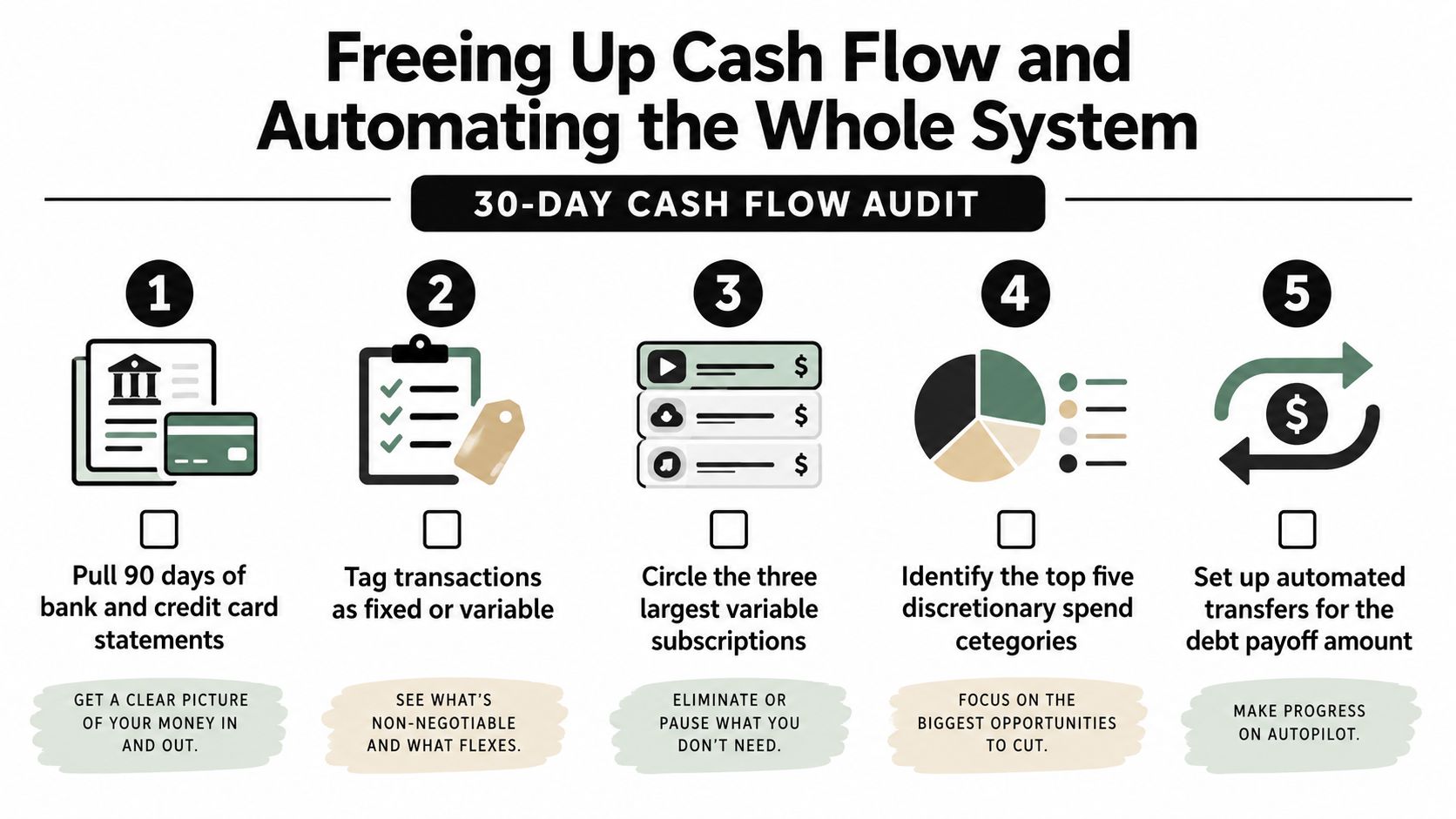
A payoff plan needs a funding source. The cleanest source is a 30-day cash-flow audit that identifies spending the household doesn't value enough to keep.
Start by pulling 90 days of bank and credit-card statements. Tag each transaction as fixed or variable. Then circle the three largest variable subscriptions and the top five discretionary spending categories that don't match the household's priorities.
The objective isn't austerity for its own sake. It's a permanent transfer from low-value spending to principal.
Turn savings into a system
A practical workflow looks like this:
- Friday review: Reserve a 20-minute weekly money check to review spending, balances, and upcoming due dates.
- Daily guardrail: Set a spending-cap notification for categories that regularly run over budget.
- Payday transfer: Schedule one automatic transfer on payday to the selected target debt.
- Single tracking view: Use one spreadsheet tab or a free tool such as Undebt.it to track balances and payment order.
- Monthly verification: Check the servicer portal every month so a misapplied payment is caught within 30 days.
The amount redirected can vary widely. Some households find a few hundred dollars after reviewing recurring charges, while others find almost nothing without changing housing, transportation, or income. The correct transfer is the amount that remains sustainable after essential bills and a cash reserve.
A cash-flow forecast can make the plan more resilient. This cash-flow forecast resource helps connect future income and expenses to the payment amount instead of treating every month as identical.
Automation should happen after the penalty audit and debt ranking. Automatic payments are powerful, but they can also automate the wrong priority.
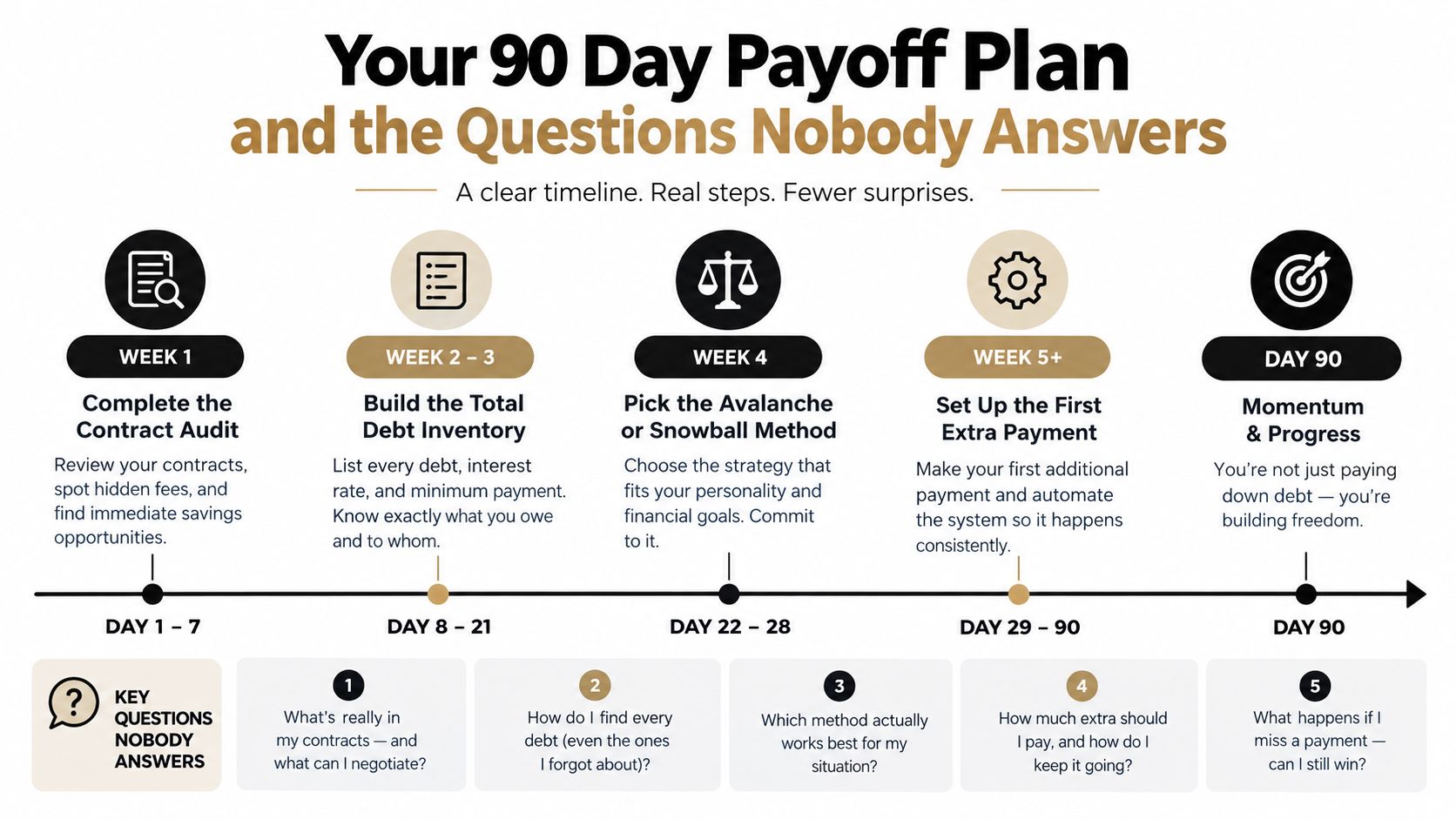
Your 90 Day Payoff Plan and the Questions Nobody Answers
A 90-day plan turns the strategy into scheduled actions rather than a promise to “start soon.”
- Week 1: Download every contract, statement, and payoff quote. Mark each penalty clause as confirmed, absent, or unresolved.
- Weeks 2 and 3: Build the complete debt inventory, including balances, APRs, minimums, actual interest, loan types, and due dates.
- Week 4: Choose avalanche or snowball. Run the selected order against the actual balances.
- Week 5: Make the first extra principal payment on the selected target.
- Weeks 6 through 8: Set up the payday transfer, weekly review, and payment-allocation checks.
- Weeks 9 through 12: Compare the projected and actual balance reductions, then adjust only after confirming the servicer's math.
A multi-loan calculator can help model the order and payment amount. The multi-loan payoff calculator is useful for comparing scenarios before changing automatic payments.
Questions borrowers keep asking
Do extra payments hurt credit scores? Paying down balances can change utilization and the account's reporting pattern, which may create a short-term score movement. It doesn't create long-term credit damage by itself. A new refinancing application can add a hard inquiry, so early payoff and new credit should be evaluated separately.
Is student-loan interest tax-deductible in 2026? Eligible borrowers may deduct up to $2,500, subject to income phase-outs and eligibility rules, as summarized by Bankrate's student-loan tax guidance. The deduction applies only to qualifying loans and circumstances, so tax documentation matters.
How does early mortgage payoff affect home equity? It increases the owner's equity by reducing the mortgage balance. It also converts liquid cash into home equity, so an emergency reserve should not be sacrificed merely to reach a zero balance sooner.
What if an emergency forces a pause? Pause extra payments, keep making required minimums, contact the servicer early, and protect essential cash flow. A temporary pause is a risk-control decision, not a failed plan.
Should low-interest debt be paid before retirement contributions? Not automatically. Capturing an available employer retirement match generally takes priority over accelerating cheap debt. High-rate revolving debt deserves more urgency, while low-rate debt can coexist with long-term investing when cash reserves and required payments are secure.
Revisit the payoff plan every quarter and update the ranking when balances, rates, fees, income, or priorities change.
Toya AI can connect credit cards, student loans, auto loans, personal loans, mortgages, and other debts into one dashboard, then recommend which payment to make next based on balances, APRs, due dates, and cash flow. Visit Toya AI to start tracking the payoff path and compare how each extra payment changes the debt-free date and total cost.
Ready to start your debt-free journey?
Toya AI builds a personalized payoff plan so you can see your debt-free date and save on interest.
Get Started Free