
How to Pay Off Auto Loan Early and Save
A borrower can make every payment on time and still feel trapped by the car loan. The balance falls slowly, extra cash disappears into the lender's system, and the payoff figure may not match the number shown on the account dashboard. The problem usually isn't motivation. It's that the loan contract, payment instructions, and payoff math haven't been checked closely enough.
Paying off an auto loan early works when extra money reaches principal, the contract doesn't impose a costly penalty, and the repayment plan fits the borrower's cash flow. The following approach focuses on those details, including the traps that often reduce the value of an early payoff.
Table of Contents
- The Math Behind Early Auto Loan Payoff
- Checking Your Contract for Hidden Payoff Traps
- Tactical Payment Strategies to Accelerate Payoff
- Refinancing Versus Making Extra Payments
- Automating Your Debt Payoff Plan
- Evaluating Alternative Exit Strategies
The Math Behind Early Auto Loan Payoff
Most simple-interest auto loans calculate interest from the remaining principal. Wells Fargo explains the daily calculation as the interest rate divided by 100, multiplied by principal, then divided by 365 or 366 days, and notes that borrowers can request a payoff quote and view daily interest through their account or statement at Experian's explanation of extra auto-loan payments.
That structure makes timing matter. A payment that reduces the balance early lowers the amount used in future daily calculations. A similar payment near the end of the schedule still helps, but there are fewer interest charges left to eliminate.
Why the first years deserve attention
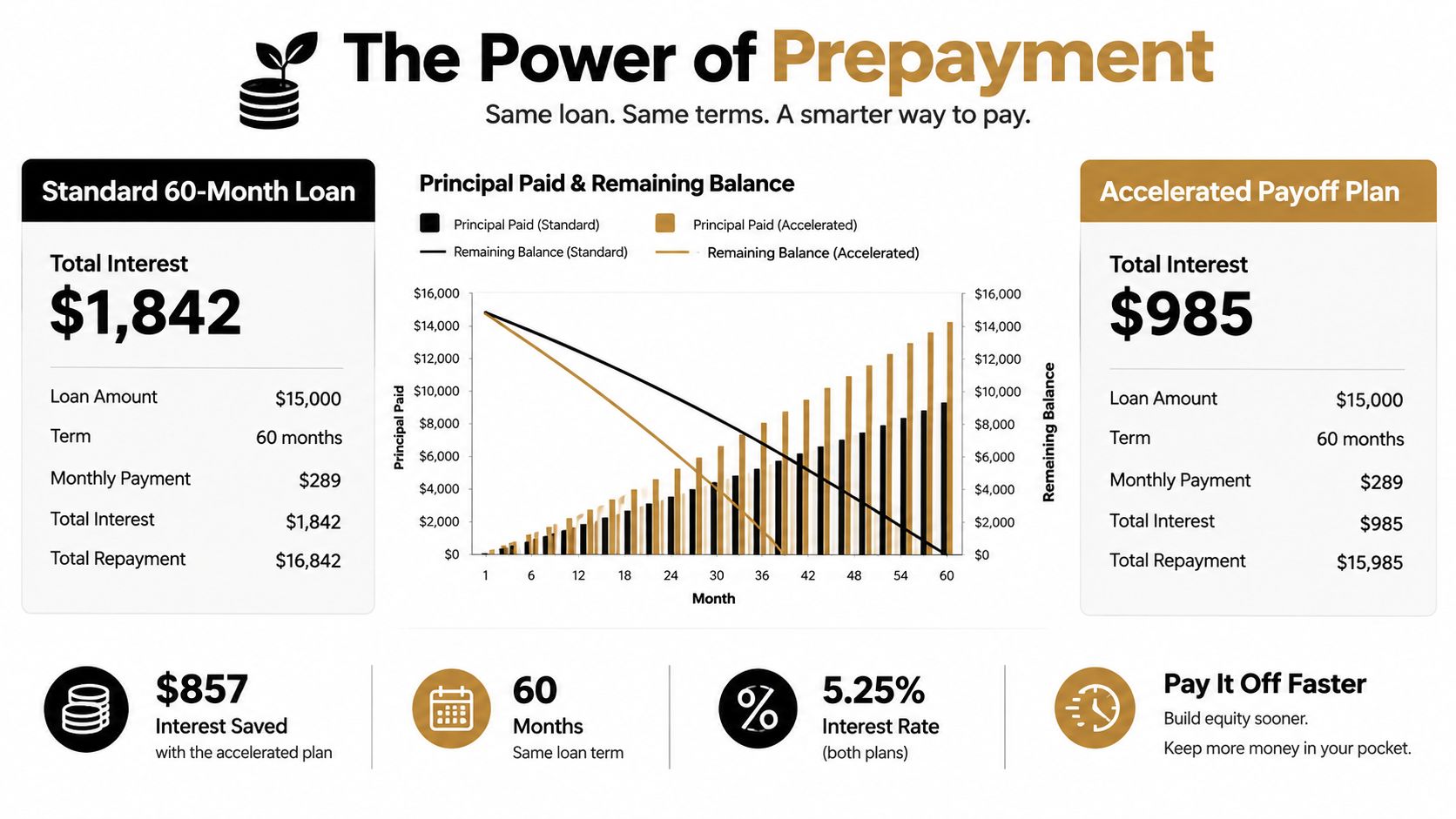
AAA provides a clear illustration using a $25,000 loan at 6.5% for six years. Its example shows approximately $1,521 in interest during the first year, compared with about $173 during the sixth year. The figures demonstrate why early principal reduction generally creates the largest savings, as documented in AAA's guide to paying off a car loan early.
The same example shows the effect of a manageable recurring increase. Adding $100 per month beginning in the second year ends the loan 13 months sooner and saves $838 in interest. Paying the remaining balance after the first year saves $3,737 in interest, according to AAA's example.
A borrower doesn't need to guess which strategy is more powerful. The earlier the principal falls, the more future interest calculations use a smaller balance.
Practical rule: Extra cash has the greatest effect when it reaches principal early and stays there.
A borrower who wants to test different payment amounts can use an auto loan payment estimator before changing the payment schedule. The useful comparison isn't only the new monthly payment. It's the difference in payoff date, total interest, and available cash after the loan ends.
Checking Your Contract for Hidden Payoff Traps
An early payoff can save interest and still disappoint you if the contract adds a fee or the servicer misapplies your extra money. In the United States, fewer than 8% of auto loans originated in 2023 included prepayment penalties, compared with roughly 12% in 2015, as summarized by Dealer1 Solutions from Federal Reserve data in its discussion of auto-loan prepayment penalties. The same summary reports penalties on about 22% of subprime loans versus about 3% of prime loans.
Those figures make a penalty less common, not impossible. Your loan agreement controls.
Find the clause before sending extra money
Search the contract for prepayment penalty, early payoff, early termination fee, rebate of unearned interest, and payoff amount. Check whether a charge applies only when you close the loan completely or also when you make additional principal payments.
The Consumer Financial Protection Bureau explains that the right to prepay without a penalty depends on the contract and applicable state law, as described in its consumer guidance on prepaying a loan. If the wording is unclear, ask the lender for a written answer before sending a lump sum.
Term length can affect the fee as well. Experian reports that in more than half of U.S. states, lenders may charge prepayment penalties on car loans with terms of 60 months or less, while loans of 61 months or more cannot be charged that fee under the stated rule. Its guide describes a typical penalty of around 2% of the outstanding balance, equal to $200 on a $10,000 balance, in Experian's prepayment penalty guide.
Stop the advance-payment mistake
An extra payment may be posted as an advance toward a future due date instead of reducing principal. The account can then show a later payment date without delivering the interest savings you expected.
Contact the servicer before paying and use precise instructions:
“Please apply the additional amount to principal only, not to future scheduled payments or fees. Please confirm how the payment will be posted.”
Set the instruction through the servicer's secure portal when available, then save the confirmation number, message, or email. Borrowers who need a broader framework for documenting and enforcing payment agreements can review that resource before relying on verbal assurances.
Tactical Payment Strategies to Accelerate Payoff
Once the contract permits early repayment and the lender confirms principal-only treatment, the strongest plan is the one that runs automatically. Manual decisions create missed opportunities. A scheduled transfer tied to payday turns the payoff into a routine expense rather than a monthly debate.
Choose a payment pattern
A borrower can use one of three practical structures:
Biweekly payments: Split the monthly payment into half-payments made every two weeks, if the lender accepts that arrangement and credits payments correctly. Lender guidance describes this structure as producing one extra full payment over a year, which can shorten the loan term. The lender must confirm whether each half-payment posts when received or waits until the full monthly amount is collected.
Round-ups: Increase the required payment to a clean number. Chase gives the example of rounding a $275 payment to $300, directing the additional $25 toward principal, as summarized in Bankrate's guide to auto-loan repayment clauses. The borrower should set the higher amount as an automatic payment and verify the first statement.
Windfalls: Apply a tax refund, work bonus, or other unexpected cash directly to principal after checking the payoff rules. A lump sum produces an immediate balance reduction, while the recurring increase keeps reducing the balance afterward.
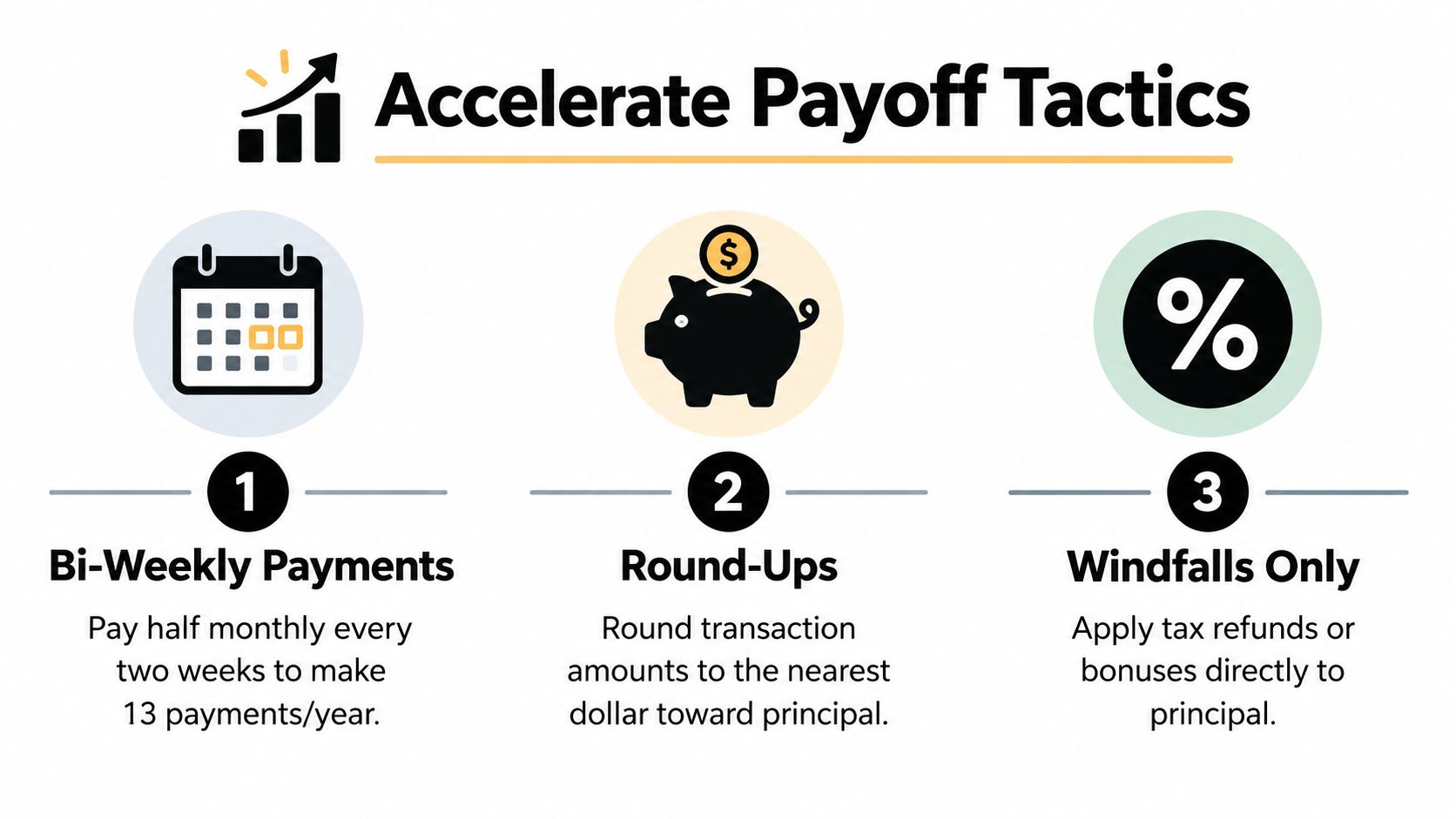
A practical schedule might split a monthly obligation across two paydays, add a fixed round-up to each regular payment, and reserve windfalls for principal reductions. The exact amount should be sustainable after essential expenses and emergency savings are covered.
Borrowers comparing broader debt-reduction methods can also review these practical UK debt reduction steps, while keeping the auto lender's specific posting rules as the controlling detail.
The loan payoff calculator for extra payments can help compare a recurring increase with a one-time payment. The output should guide the schedule, not replace confirmation from the servicer.
Refinancing Versus Making Extra Payments
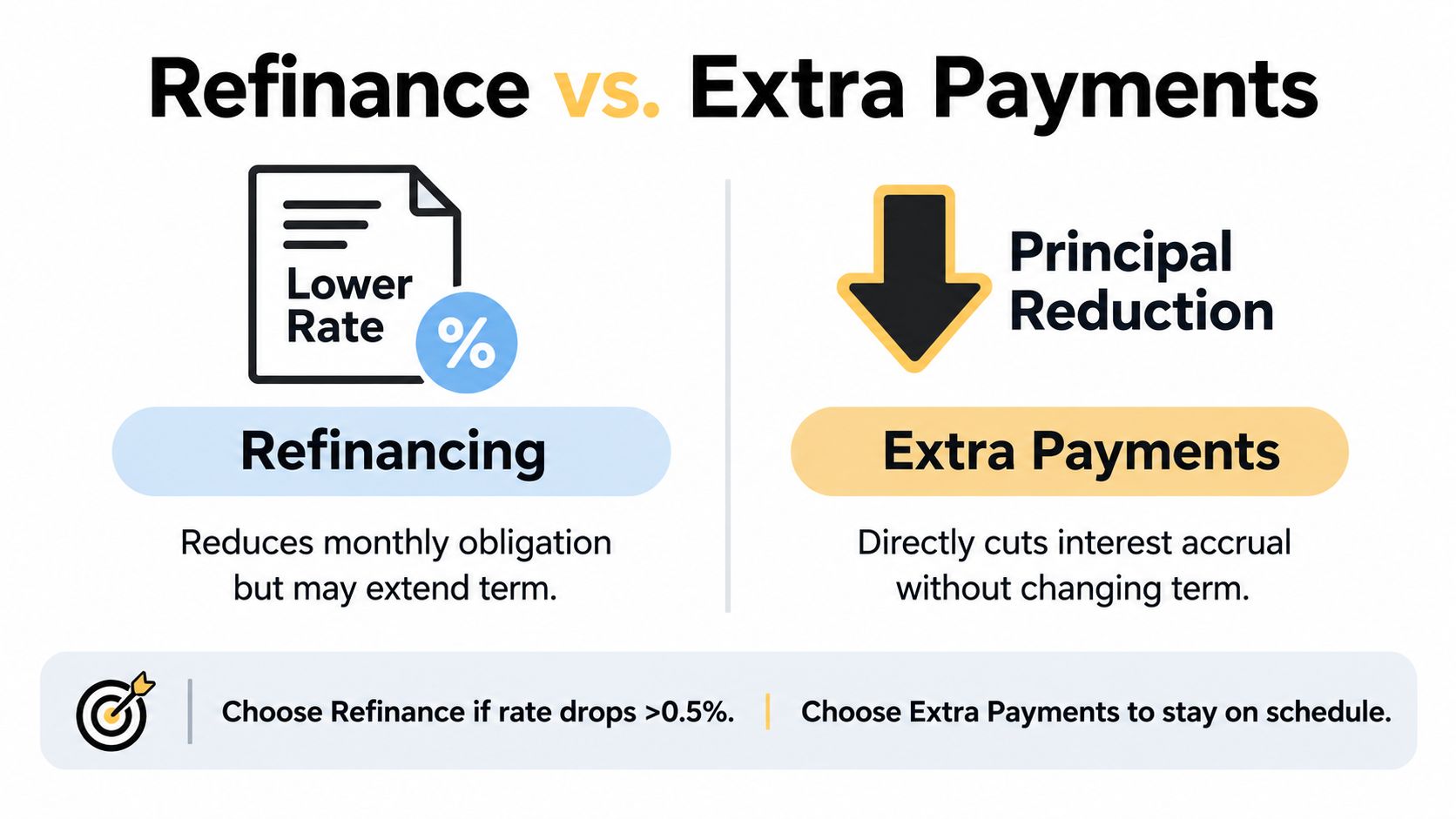
Refinancing changes the loan. Extra payments attack the existing balance. The right choice depends on whether a new interest rate creates enough savings to justify fees, paperwork, and a possible extension of the repayment term.
A lower monthly payment isn't automatically a lower total cost. A refinance can reduce the required obligation while restarting amortization over a longer schedule. That structure may leave the borrower paying interest for longer, even if the new rate is lower.
When extra payments are the cleaner option
Extra payments usually deserve priority when:
- The current rate is acceptable: Principal falls immediately without a new application, origination charge, title cost, or credit inquiry.
- The borrower can afford the current payment: A higher payment shortens the existing schedule instead of replacing it with a new one.
- The contract is already favorable: There's little reason to refinance just to change a loan that permits penalty-free principal reductions.
- The borrower wants a fixed payoff target: Extra payments preserve the existing agreement while reducing the balance faster.
The calculation is straightforward. Add all refinance costs to the expected interest savings. Then compare that total with the savings from sending the same available cash to the current principal. A refinance only makes sense when its net benefit remains positive after fees and the borrower avoids extending the term unnecessarily.
When refinancing deserves a quote
Refinancing becomes more attractive when the borrower's credit profile or available market offers have improved enough to produce a materially lower rate. The new lender should provide the total repayment amount, not only the monthly payment.
A borrower should request both scenarios in writing:
| Option | Main advantage | Main risk |
|---|---|---|
| Extra principal payments | Cuts the current balance without changing the contract | Requires consistent surplus cash |
| Refinancing | May lower the interest rate or required payment | Fees or a longer term can erase savings |
The strongest refinance structure pairs a lower rate with a term no longer than the remaining original term. If the new payment falls, the borrower can still keep paying the old amount when cash flow allows, provided the new lender applies the difference correctly to principal.
Automating Your Debt Payoff Plan
A payoff plan that depends on memory will eventually collide with a busy month. A borrower may track the balance in one spreadsheet, the due date in a calendar, and the interest rate in an old email. That fragmentation makes it difficult to decide where the next extra dollar belongs when several debts compete for cash.
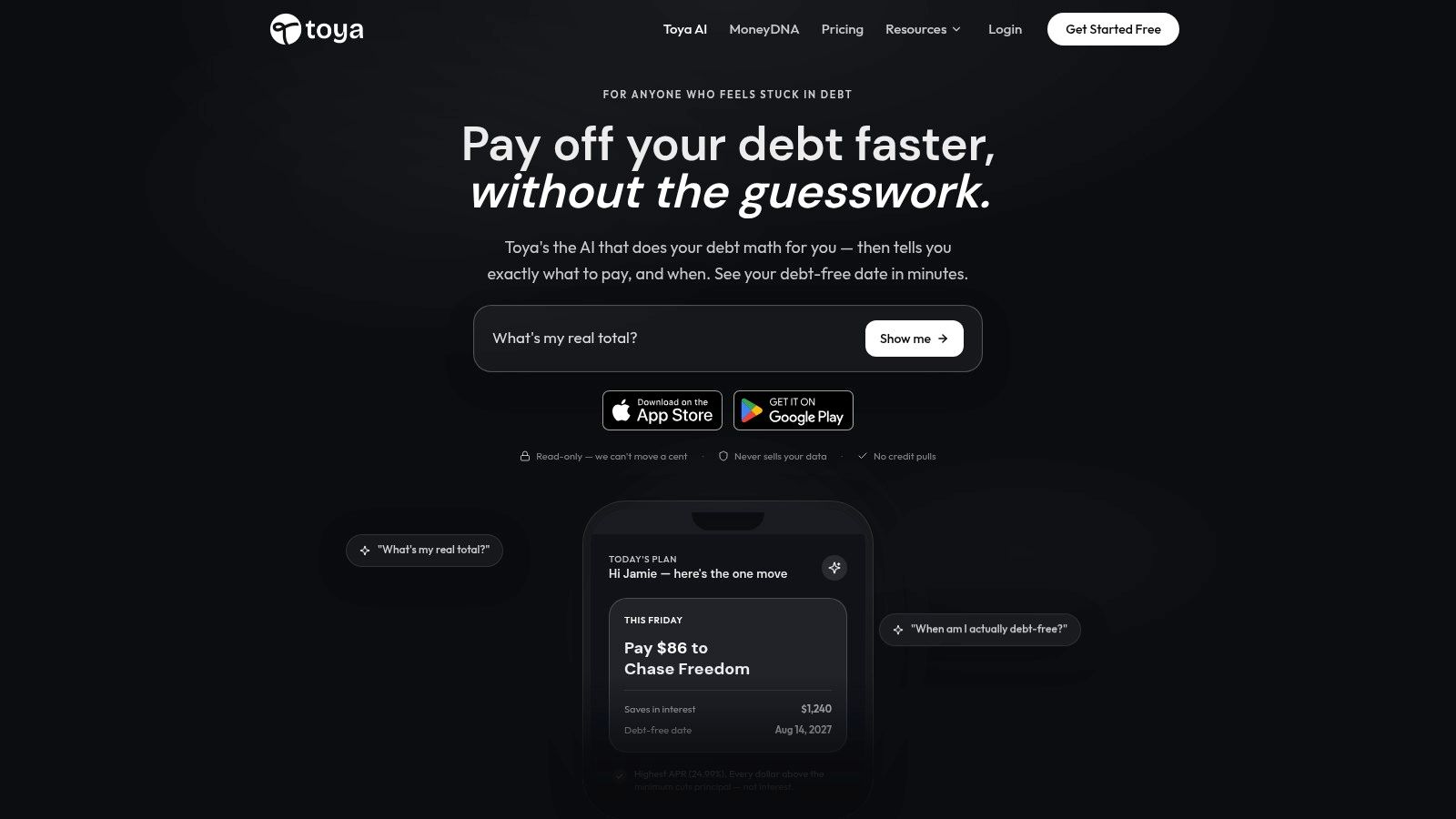
Modern debt-planning applications can centralize balances, annual percentage rates, utilization, and due dates through secure account connections. Read-only access through trusted financial-data partners can reduce manual entry, while the borrower still controls the accounts and verifies every payment instruction.
Turn a balance into a decision
The useful output isn't a dashboard full of balances. It's a clear answer to three questions:
- Which debt gets the next extra payment?
- How much does that payment change the payoff date?
- What happens to interest and monthly cash flow afterward?
An adaptive planner can compare the auto loan with credit cards, student loans, personal loans, or mortgages, then update the recommendation when a balance, rate, or income pattern changes. That matters because a fixed plan may become inefficient after another debt is paid off or a lender changes the account details.
Toya AI is one app that centralizes connected debt accounts and uses balances, rates, timelines, and cash flow to recommend a next payment. Its plans can show how an action affects the debt-free date, monthly interest, and total cost, while borrowers should still confirm principal allocation and payoff figures directly with the lender.
Automation should handle reminders, comparisons, and scheduled transfers. It shouldn't remove judgment. A borrower still needs an emergency reserve, must review unusual fees, and should stop an automatic extra payment if sending it would create a cash shortage.
Evaluating Alternative Exit Strategies
A borrower who wants out of a car loan should look at the vehicle itself before throwing more money at the balance. If the car needs major repairs, no longer fits the household, or sits in negative equity, a sale or trade may beat early payoff.
Start with the official payoff quote, not the dashboard balance. The payoff amount can include residual interest, title charges, processing fees, and contract costs that do not show up in the app. The contract controls whether a prepayment penalty exists, and the lender must state the payoff figure in writing before you decide what to do next.
Compare the exit numbers
Run the numbers in this order:
- The lender's written payoff quote and expiration date.
- The vehicle's realistic private-sale value.
- The dealer's trade-in offer.
- The gap between sale price and payoff amount.
- The cost of replacing the vehicle, including any new financing.
A private sale usually brings the strongest price, but it also means handling the lienholder, title transfer, and final payoff correctly. A dealership takes more of the paperwork off your plate, but the trade-in offer is often lower, which can leave you with a shortfall. Rolling that shortfall into another loan just hides the problem and keeps you paying for a car you already wanted to exit.
The guide to getting rid of a car payment gives a practical comparison of selling, trading, and keeping the car. Use the math, not frustration, to make the call.
A strong payoff plan also depends on execution. Keep making scheduled payments until the lender confirms the loan is closed. After the sale or payoff, get written confirmation, verify the lien release process, and save every final record. If you are automating debt paydown, make sure extra payments are applied to principal and not trapped in the lender's general payment queue.
Ready to start your debt-free journey?
Toya AI builds a personalized payoff plan so you can see your debt-free date and save on interest.
Get Started Free