
How to Clear Credit Card Debt Faster Without More Stress
The statement arrives before payday. One card needs a minimum payment, another is already charging interest, and a third balance barely moved despite last month's payment. The numbers feel scattered, but the problem usually isn't a lack of effort. It's that the money is being sent without a clear order, a cash-flow plan, or a response to the severity of the debt.
Learning how to clear credit card debt starts with replacing panic with decisions. The process is straightforward: list every balance, identify the expensive debt, protect minimum payments, create room for extra principal, and choose tools such as transfers or consolidation only when the math works. Readers who are current but revolving need a different plan from borrowers whose minimums are already strained or whose accounts are delinquent.
Table of Contents
- Take Control of Your Credit Card Debt Starting Today
- Get a Clear Picture of What You Owe and What It Costs
- Choose and Launch Your Payoff Strategy That Saves the Most
- Build a Budget That Frees Up More for Debt Payments
- Use Balance Transfers Consolidation and Negotiation Wisely
- Stay on Track Avoid Pitfalls and Know When to Get Help
Take Control of Your Credit Card Debt Starting Today
Three cards can drain a household's cash flow even when every payment arrives on time. Interest absorbs part of each payment, balances barely move, and partners may disagree about the first target. One prefers the smallest balance for a quick win. The other prefers the highest APR. Set a shared system before that disagreement turns into another missed decision.
Start with a financial reset. Gather the statements, record the actual balances and rates, and separate required bills from optional spending. The goal is accountability, not shame. You need each payment to reflect a deliberate choice.
Credit card debt is widespread and expensive. In the U.S., the Consumer Financial Protection Bureau reported that the average cardholder carried $5,288 in total credit card debt at the end of 2022, and consumers paid $3.2 trillion toward credit card debt during 2022. Those figures appear in the CFPB-related analysis of credit card repayment and minimum payments. A large payment helps only when it reaches a defined target and reduces principal efficiently.
Use this roadmap:
- Create one debt snapshot: Record balances, APRs, minimums, due dates, and account status together.
- Classify the situation: Current accounts with manageable minimums can support optimization. Strained cash flow requires stabilization first. Delinquent accounts require prompt creditor contact and professional guidance.
- Select an order: The avalanche method sends extra money to the highest APR and usually saves the most interest. The snowball method closes the smallest balance first and can build motivation.
- Fund the plan: Redirect subscriptions, flexible spending, windfalls, and added income to one target card. Do not spread extra money across every account unless stabilization requires it.
- Use tools selectively: A balance transfer, consolidation loan, rate request, or counseling plan can help when fees, terms, and cash flow support the move. None solves a budget that keeps creating new balances.
- Track the result: Watch for lower balances, smaller interest charges, and reliable payment history. If cash flow changes, adjust the payment rather than abandoning the system.
Practical rule: Assign every extra dollar before it reaches the checking account. Name the target card, payment date, and backup amount. Otherwise, the money will get divided or spent.
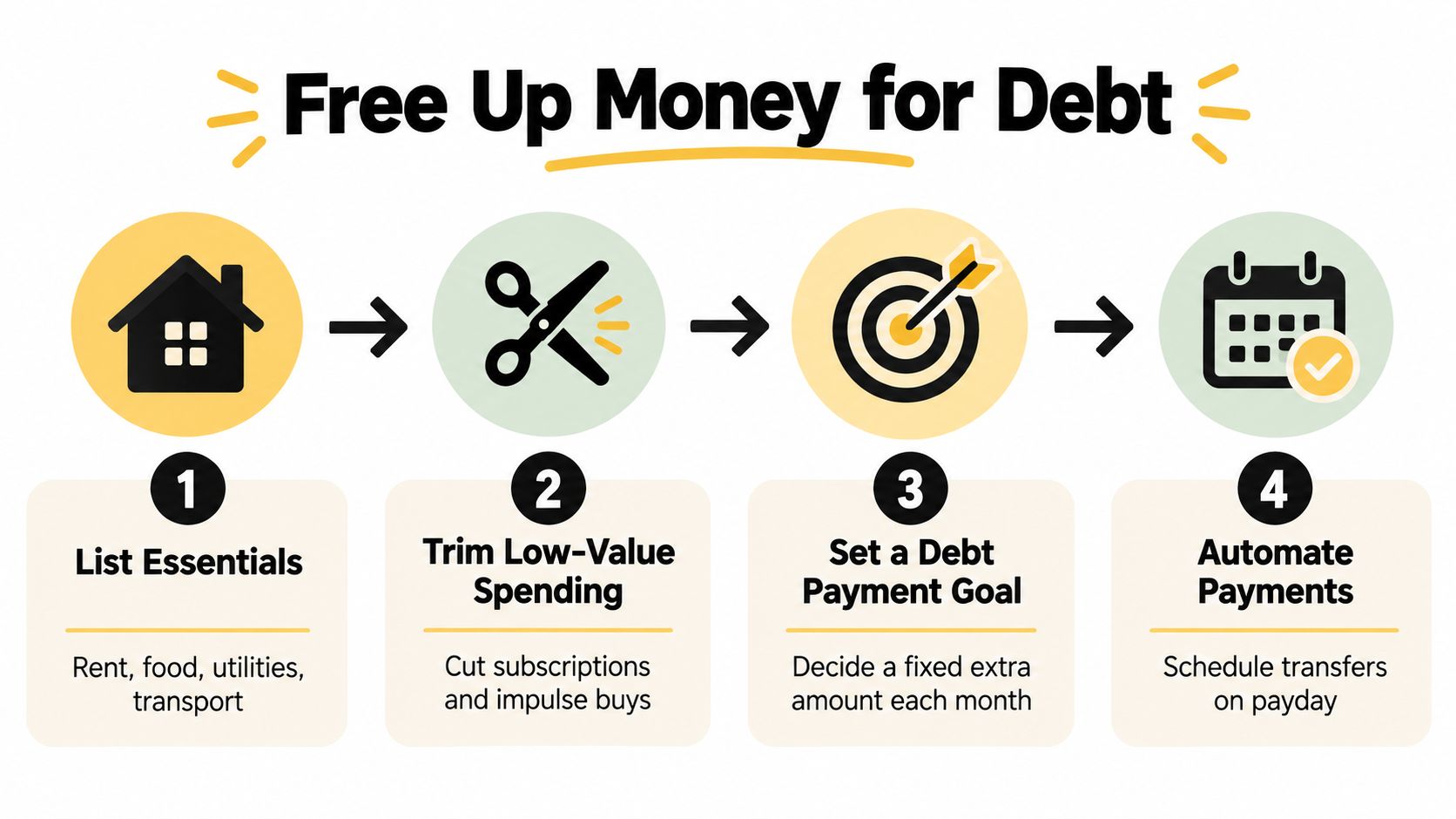
Your first payment does not need to be heroic. It must survive an ordinary month. Automate minimums, then schedule an additional payment to the chosen target after payday, reducing that extra amount temporarily when cash flow is tight and increasing it when money returns. Consistency beats a plan that works only once.
Get a Clear Picture of What You Owe and What It Costs
A payoff plan starts with facts, not the balance that looks most alarming. List every account on one page before choosing an order. Without that snapshot, a borrower can focus on the largest balance, miss a due date, or assume the minimum payment will stay unchanged. A clear inventory turns several stressful accounts into a ranked set of decisions.
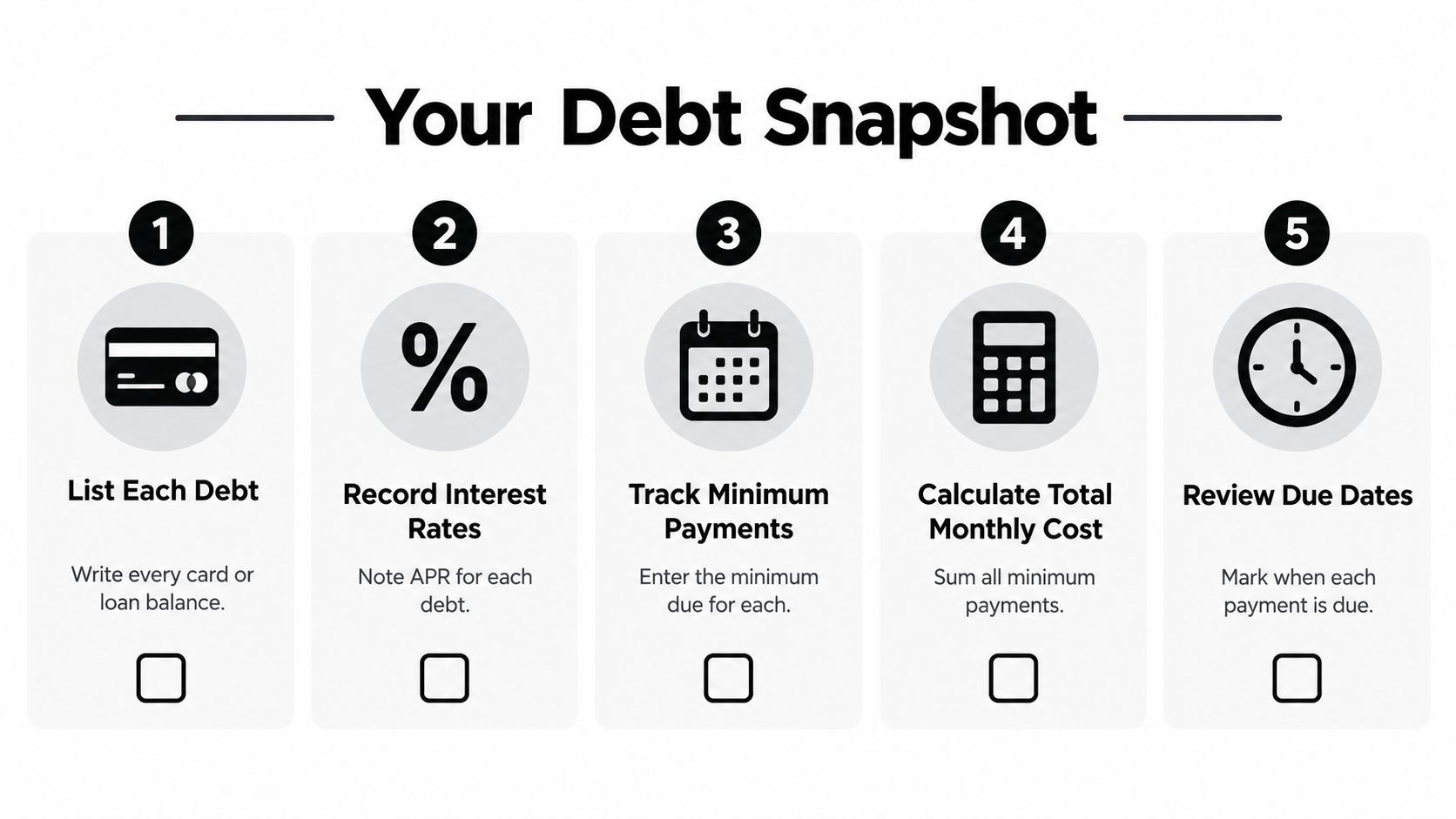
Build the debt snapshot
Use a spreadsheet, notebook, or credit card payoff calculator with amortization and create one row for each card. Record:
- Current balance: Start with the latest statement balance, then check the online account for newer transactions.
- APR: Enter the purchase APR and identify any separate cash-advance or promotional rate.
- Minimum payment: Use the amount currently required, not a rounded estimate.
- Due date: Mark the payment date and, if available, the statement closing date.
- Account status: Label each card current, late, or delinquent.
- Available credit: Include the credit limit and current utilization to show which accounts are under the most pressure.
Estimate each card's monthly interest burden with this rough planning formula: balance multiplied by APR, divided by twelve. Issuers may calculate interest daily, so this will not match every statement. It still gives you a useful comparison. A $4,000 balance at a higher APR can cost more each month than a larger balance at a lower rate. Balance size alone should not set the payoff order.
Minimum payments can keep a debt active for years. CFPB research found that many issuers set them at only about 1% of the balance plus fees and interest, according to the credit card repayment analysis cited earlier. As the balance declines, a percentage-based minimum may decline as well. Add a fixed extra payment if you want the debt to disappear on a defined schedule.
Diagnose the severity before choosing a method
A current account with manageable minimums belongs in the optimization group. After covering rent, food, utilities, transportation, required medication, and other essentials, the borrower has enough cash flow for a repeatable extra payment. The snapshot should then show which APR creates the greatest interest cost and whether a small balance can be cleared quickly without sacrificing interest savings.
Strained cash flow requires stabilization first. If minimum payments leave too little for necessities, reduce new charges, contact issuers about hardship options, and seek nonprofit credit counseling when the budget cannot support the required payments. An aggressive target payment that fails during an ordinary month is not a workable plan.
Delinquency requires prompt action. Contact the issuer, keep written records of every arrangement, and review whether a debt management plan fits the situation. New credit should not hide missed payments or postpone a creditor conversation.
Example of a three-card household
Suppose Card A carries a high APR, Card B has the largest balance but a lower APR, and Card C has the smallest balance. The household can cover all minimums but has only a limited amount left for extra repayment. The snapshot identifies whether Card A is adding the most monthly interest, whether Card C can be cleared soon enough to improve momentum, and whether the available cash flow is too fragile for either approach.
That diagnosis separates a payoff problem from a cash-flow problem. It also shows when the household needs stabilization before choosing between avalanche and snowball math. Use the recorded balances, rates, minimums, and due dates to test the plan, then revise the extra amount whenever income or required expenses change.
Choose and Launch Your Payoff Strategy That Saves the Most
Your payoff order should match both the interest math and your ability to keep paying. The avalanche method is the mathematical default: make the minimum payment on every card, then direct all extra cash to the card with the highest APR. After that balance reaches zero, roll its full payment to the next-highest APR card.
For example, with cards at 24%, 18%, and 12% APR, an extra $200 goes to the 24% card after all minimums are covered. Spreading that money across three accounts slows progress on the balance creating the most interest. The method and comparison appear in a comparison of avalanche and snowball payoff strategies.
Avalanche delivers the clearest advantage when APRs differ substantially or balances are large enough for interest to consume much of each payment. In a cited scenario involving $10,000 across multiple cards, avalanche finished three months sooner and saved about $1,215 in total interest than smallest-balance-first repayment. The result belongs to that specific mix of balances, rates, minimums, and payment amount, as shown in FundYou's payoff-method example.
The snowball method sends extra money to the smallest balance while minimums continue on the other cards. It can cost more interest, yet a quick account closure removes a bill and creates visible progress. Choose it when a purely mathematical plan has repeatedly failed because the motivation faded.
| Factor | Avalanche Method | Snowball Method |
|---|---|---|
| Target order | Highest APR first | Smallest balance first |
| Main advantage | Lowest interest cost | Fastest early account closure |
| Best fit | Borrowers comfortable waiting for visible wins | Borrowers who need momentum and simplicity |
| Main risk | Progress can feel slow | More interest may accrue |
| Payment rule | Minimums everywhere, extra on the highest APR | Minimums everywhere, extra on the smallest balance |
Use a clear decision rule
Choose avalanche when you can follow an automated order without second-guessing it. Choose snowball when a fast win is what keeps you engaged. Review this guide to which debt should be paid off first before setting the order, then write down the target card and the reason for choosing it.
Payment concentration matters. An NBER analysis found that borrowers directed only 51.5% of payments above the minimum to the high-APR card, compared with an optimal 97.1%, as reported in the NBER working paper on payment allocation. Splitting extra cash across accounts may feel balanced, but it delays repayment of the costliest balance.
If cash flow is strained, stabilize before launching an aggressive schedule. Cover minimums and necessities, stop adding new charges, and lower the extra amount to a level you can sustain. A smaller payment made every month beats a larger payment that forces new card spending.
Launch the schedule
- Put every card's minimum payment on autopay from an account with enough cash.
- Select one target card using avalanche or snowball.
- Schedule the extra payment shortly after payday.
- Stop purchases on the target card and freeze other cards if needed.
- When the target reaches zero, redirect its entire payment to the next account.
A working schedule might be minimum payments on Card B and Card C, plus every extra dollar on Card A. Keep that order until the target is cleared, unless income, APRs, or account status changes. Review the automation after each pay change, and adjust the extra amount before a shortfall triggers new borrowing. Consistency saves more than a single oversized payment followed by a return to minimums.
Build a Budget That Frees Up More for Debt Payments
A payoff strategy tells the borrower where money should go. A budget determines whether that money exists. The strongest budget protects essentials first, assigns a fixed debt amount second, and treats optional spending as adjustable rather than untouchable.
Start with a survival-level budget
List housing, utilities, groceries, transportation, insurance, medication, childcare, and required loan payments. Add irregular essentials such as vehicle maintenance or annual insurance renewals by setting aside money each pay period. The remaining cash should be divided among debt repayment, modest savings, and discretionary spending.
A young professional might discover that delivery meals, unused streaming services, and frequent rideshares consume the amount that could have funded the target card. A family might find that the issue isn't one extravagant purchase but a collection of school costs, groceries, fuel, and variable loan dates. The response differs, but both households benefit from reviewing actual transactions rather than relying on memory.
Use a simple worksheet:
- Income: Record dependable take-home pay separately from irregular income.
- Essentials: Protect the bills that keep housing, work, health, and family stable.
- Minimums: Reserve the full required amount for every account.
- Extra target payment: Set a fixed amount that can survive an ordinary month.
- Flexible spending: Give the remainder clear limits instead of pretending it won't happen.
Create extra cash without creating burnout
Cut low-value spending first. Cancel subscriptions that aren't used, reduce impulse purchases, and set a pause before nonessential online orders. A temporary reduction is easier to maintain when the household assigns the freed cash to a named target rather than allowing it to disappear into the general account.
Income can help too. Overtime, freelance work, selling unused items, or a short-term side project can produce additional repayment money. Irregular income shouldn't support the minimum-payment plan because it may not arrive every month. It works better as a scheduled principal payment when received.
Cash-flow test: If an extra payment forces the household to use a card for groceries later, the payment is too high. A smaller payment that repeats is stronger than an aggressive payment that triggers new borrowing.
Time payments around real cash flow
Schedule minimums after the paycheck that reliably covers them, then make the extra target payment after confirming essential bills have cleared. A borrower paid twice monthly can divide the planned extra payment between paydays if that reduces end-of-month pressure. The method matters less than maintaining a cash buffer and never overdrawing the payment account.
Minimum payments often shrink as balances fall because issuers calculate them as a percentage of the balance or apply a dollar floor. One source describes a common structure of roughly 2% of the balance or $25, whichever is higher, and gives an example of a $5,000 balance at 22% APR starting with a minimum of about $130 per month. The mechanics are explained in MoneyLion's credit card payoff guidance. A fixed extra principal amount prevents that shrinking minimum from extending the timeline.
Use Balance Transfers Consolidation and Negotiation Wisely
Debt tools work only when they reduce cost or make repayment reliable. They don't create income, erase spending triggers, or guarantee approval. The correct choice depends on credit standing, stable cash flow, fees, and whether the borrower can stop adding new debt.
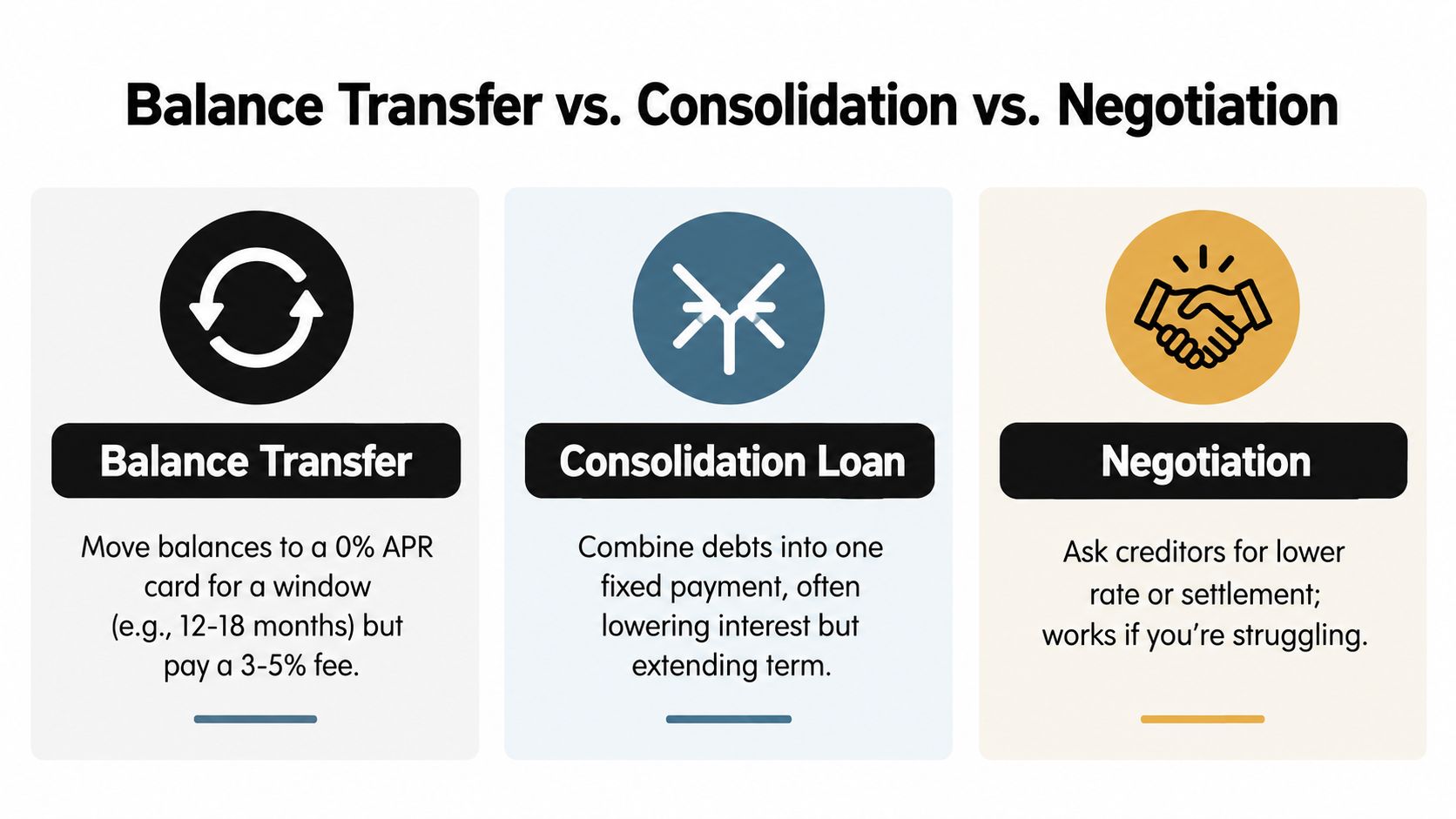
A balance transfer moves existing card debt to a new card with a promotional 0% APR period commonly lasting 12 to 21 months, while the issuer may charge an upfront fee. CFPB-based reporting places common fees at 3% to 5%, with a 4.3% average among large issuers in 2024, as described in this balance-transfer explanation. A $6,000 transfer with a 4% fee costs $240 upfront. That can be worthwhile if the interest avoided during the promotional period exceeds the fee and the borrower has a credible plan to clear the balance before the regular APR applies.
Match each tool to the situation
A transfer suits a borrower with good enough credit to qualify, reliable income, and a fixed payoff schedule. The old cards shouldn't remain available for casual spending. A transfer that creates room on old cards can increase total debt.
A personal consolidation loan can simplify several due dates into one fixed payment. It may lower the interest rate, but a longer term can increase total interest or make the debt last longer even when the monthly payment looks easier. A practical overview of how consolidation combines debts and changes repayment structure appears in Business Loan Warrior on consolidating debt.
Negotiation is appropriate when the borrower's cash flow is unstable or minimums are becoming difficult. The borrower can call the issuer, explain the hardship plainly, ask about a lower APR or hardship program, and request written confirmation of any changed terms. A lower rate helps, but the account still needs a budget that prevents new charges.
For borrowers facing near-record debt pressure, stabilization comes first. U.S. credit card balances reached about $1.26 trillion in Q2 2026, while the share of balances at least 90 days delinquent rose from 7.6% in Q3 2022 to 12.8% by Q1 2026, according to LendingTree's credit card debt statistics. Those figures reinforce a direct recommendation: someone already falling behind shouldn't chase a promotional offer before contacting creditors and a nonprofit counselor.
For a focused explanation of promotional offers and their trade-offs, readers can review zero-percent balance transfer guidance. The decision should come from fee math and repayment capacity, not the appeal of a new card.
Stay on Track Avoid Pitfalls and Know When to Get Help
A payoff plan can fail: payments continue, yet balances rise again. Track each balance, APR, minimum, target order, scheduled payment, and change since the last review. This dashboard exposes drift before it becomes another setback.

Review the plan after every statement cycle. Confirm autopay succeeded, compare the latest interest charge with the previous one, and check whether a minimum changed. If income falls, pause extra payments before missing minimums. If income rises, increase the target payment without rebuilding the whole system.
The common payoff mistake is spreading extra cash across every card. Concentrate additional money on one target, usually the highest-APR balance, unless a small balance payoff will protect your cash flow or keep you engaged. That choice determines how quickly expensive debt disappears.
A transfer or consolidation loan is not permission to spend again. Set a rule for old cards, such as no new purchases until the overall plan is stable. If delinquency has started, act before embarrassment delays the call. Contact the issuer and a nonprofit counselor, then ask what hardship options fit your situation.
Progress tracking should include credit habits. Review payment history, utilization, and report errors, then use this practical resource on ways to fix your credit score. Consistent repayment behavior matters more than chasing a quick score change.
The following video can prompt a repayment review and help organize the next action:
Get professional help when minimums cannot be paid, accounts are delinquent, one card covers another, or the budget shows no sustainable surplus. A nonprofit credit counselor can assess whether a debt management plan fits better than another loan. Debt settlement needs caution because it may involve missed payments, fees, tax consequences, and credit damage.
Your finish-line system needs three parts: autopay for minimums, one concentrated target payment, and a recurring review that responds to cash flow. Adjust the payment when income changes. Keep the structure simple enough to follow on ordinary days.
Toya AI can connect credit cards and other loans in one dashboard, organize balances, APRs, utilization, and due dates, and show how the next payment changes the projected debt-free date and total interest. Visit Toya AI to start tracking and planning for free, then review the personalized payoff guidance when the next action is unclear.
Ready to start your debt-free journey?
Toya AI builds a personalized payoff plan so you can see your debt-free date and save on interest.
Get Started Free