
How Much Will Lowering Credit Utilization Affect Score?
Lowering credit utilization can lift a score by 10 to 50 points when utilization falls below 10%, and escaping utilization of 50% or higher can lead to drops of 50 to 100 points in some cases. Because utilization has no memory in most scoring models, the improvement can appear in the next billing or reporting cycle.
A reader may have just sent a large payment to a credit card, opened a credit-monitoring app, and wondered whether the score will rise immediately, barely move, or remain unchanged. The answer depends less on the payment amount alone than on where the balance started, where it ends, which card received the payment, and whether the lower balance gets reported.
That makes the question, “how much will lowering credit utilization affect score?” more nuanced than a single calculator result. A payment that moves a card from above a major threshold to below it can matter more than a larger payment that leaves the ratio in the same range. The rest of the guide translates that scoring math into practical dollar examples, timing decisions, and a payoff order designed to produce the fastest possible score improvement.
Table of Contents
- Introduction Why Utilization Moves Your Score So Fast
- How Credit Utilization Is Calculated and Why It Matters
- How Much Your Score Could Change by Utilization Band
- Aggregate vs Per Card Utilization Which Matters More
- Worked Examples and Simple Calculator Scenarios
- How Quickly You Will See the Improvement and How to Time It
- Keep the Gains and Avoid Common Pitfalls
Introduction Why Utilization Moves Your Score So Fast
Credit utilization is one of the most responsive parts of a credit profile. Unlike payment history or account age, it reflects a recent balance snapshot. A borrower can make a payment, wait for the lender to report the new balance, and potentially see the score respond without opening a new account or waiting for an old negative mark to disappear.
The starting point matters. A borrower whose reported utilization is 50% or higher may have more room for improvement than someone already below 10%. The first borrower is moving away from a stronger risk signal, while the second is already near the range commonly associated with the greatest utilization benefit. The same payment can therefore create very different results for two otherwise similar profiles.
FICO places utilization inside its “amounts owed” category, typically 30% of a FICO score, while Experian says revolving utilization can affect approximately 20% to 30%, depending on the scoring model (Experian's explanation of credit utilization). Those figures describe the weight of the category or factor, not a guaranteed number of score points from a particular payment.
The practical answer: the fastest score lift usually comes from lowering the highest reported ratios, especially when a payment crosses below a major utilization threshold.
A useful analysis separates four questions:
- How much does the ratio fall? A payment changes the balance-to-limit relationship.
- Which account gets paid? Per-card utilization can matter alongside the overall ratio.
- When does the lender report? A payment made after the statement balance is sent may not help the next score update.
- What else is on the credit file? Payment history, age, inquiries, and account mix still influence the final score.
That combination explains why utilization deserves focused attention. It's a high-weight, fast-moving lever, but it isn't a guaranteed score switch. The strongest strategy targets the worst-used card first, gets the lower balance reported, and then keeps new charges from recreating the problem.
How Credit Utilization Is Calculated and Why It Matters
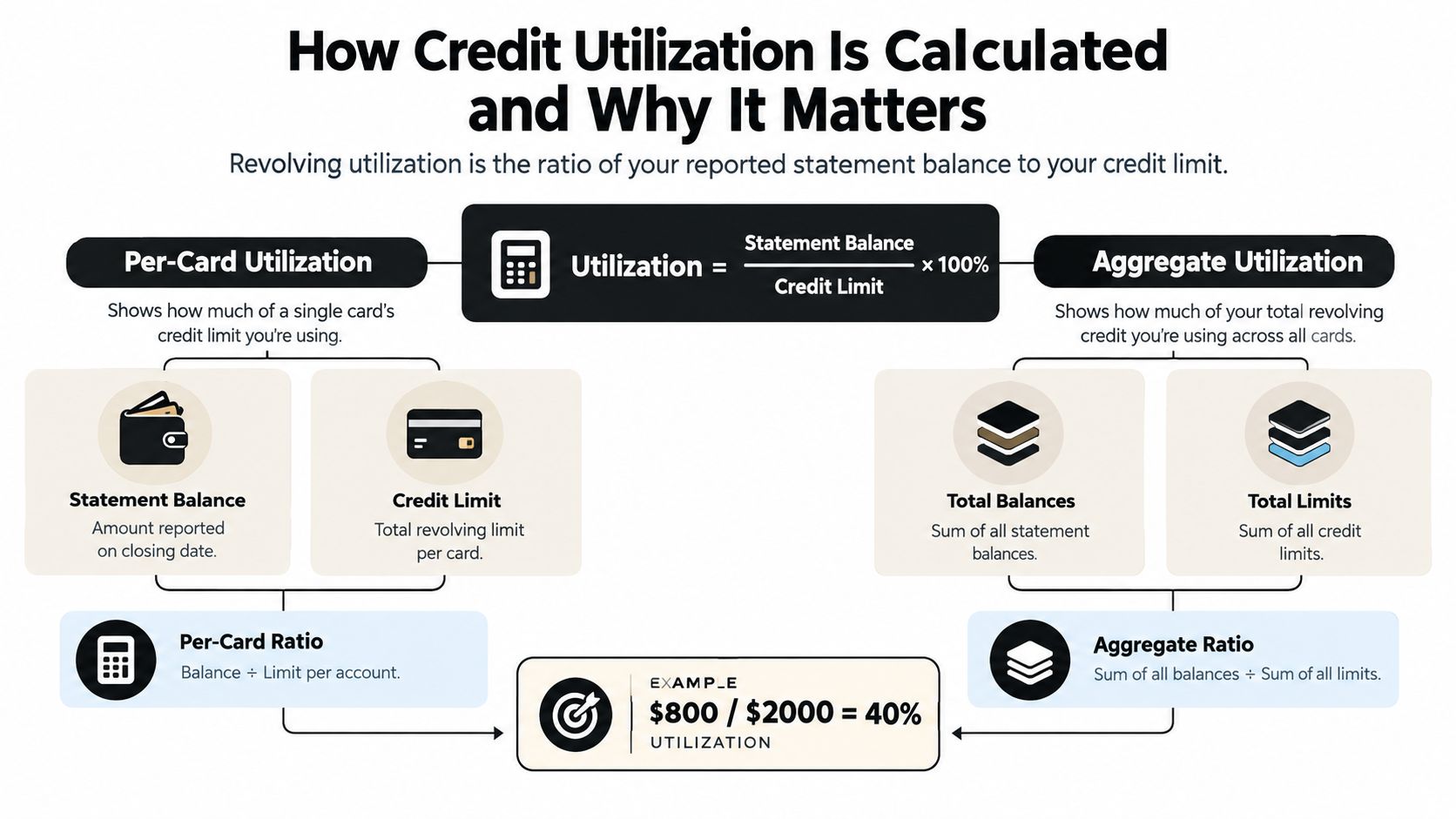
Revolving utilization compares a reported credit-card balance with the card's credit limit. A lender generally sends the statement balance to the credit bureaus, so the balance shown on the report can differ from the amount paid later at the due date.
Core formula: Credit utilization = reported revolving balance ÷ revolving credit limit × 100
For one card, the calculation is straightforward. A card showing an $800 balance on a $2,000 limit has 40% utilization. The dollar balance matters because it enters the formula, but the scoring model responds to the ratio. An $800 balance may be modest on a large limit and highly concentrated on a smaller one.
The same calculation works at the account level and across the entire revolving profile:
- Per-card utilization: each card's reported balance divided by that card's limit.
- Aggregate utilization: the balances on all revolving accounts divided by the combined limits.
- Reported balance: the amount the issuer sends to the bureaus for that reporting period, often connected to the statement cycle.
The commonly cited 30% rule is a practical ceiling. Industry guidance generally describes utilization below 30% as good, while utilization below 10% is often framed as optimal for maximizing score benefits (CBS News' overview of utilization and score movement). These are guidelines, not promises. A person at 29% isn't automatically stronger than every person at 31%, because scoring models review the full credit file and can react to other ratios at the same time.
The fuel-gauge analogy helps. A card's limit is the size of the tank, and the reported balance is the amount currently showing in it. The scoring model doesn't ask how many dollars are present. It asks how full each tank appears and how full all tanks are together.
That's why two borrowers with the same total balance can receive different signals. One may have several cards with moderate balances. Another may have nearly all the debt concentrated on one card. The aggregate ratio can look similar, but the per-card pattern can tell a different story.
For a plain-language explanation of the ratio and its calculation, readers can review what a credit utilization ratio means. The most important operational detail is simple: lowering the balance only helps the score after the lower balance is reported.
How Much Your Score Could Change by Utilization Band
There isn't a universal point formula that converts every utilization change into an exact score increase. The borrower's existing score, account history, number of cards, and other reported information all affect the result. Still, consumer-finance guidance provides useful ranges for understanding the scale of possible movement.
The broadest pattern is directional. Moving from 50% or higher utilization into the teens can create a materially better risk profile, while moving from an already low ratio to an even lower one usually produces a smaller incremental benefit. The first change removes a stronger signal of credit dependence. The second fine-tunes an already favorable position.
| Starting Utilization | Target Utilization | Illustrative Point Change |
|---|---|---|
| 50% or higher | Below 30% | Potentially 50 to 100 points, depending on the profile |
| 50% or higher | Below 10% | Potentially 50 to 100 points, depending on the profile |
| Above 30% | Below 30% | Often a meaningful improvement, with no universal point guarantee |
| Higher utilization | Below 10% | Often associated with a 10 to 50 point advantage versus higher utilization |
| Already below 10% | A still lower ratio | Usually a smaller incremental gain |
The cited ranges shouldn't be treated as promises. The 10-to-50-point advantage associated with utilization below 10% is a comparison observed in consumer-finance guidance, not a guaranteed result for every person. Likewise, a 50-to-100-point drop above 50% can occur in some cases, but another profile may move less because a different factor is limiting the score.
FICO and VantageScore may weigh and interpret profile details differently, so a score change from one model may not match a change from another. A lender may also use a specialized version rather than the score visible in a consumer app. The useful conclusion is not that one model is always more sensitive. It's that reported utilization is a current condition, and high ratios can put pressure on several score calculations at once.
For readers comparing broader credit-score effects with borrowing costs, driver credit score and rates offers additional context. Lower utilization can strengthen the credit profile, but it won't automatically erase late payments, a short account history, or recent applications.
The best expectation is a range, not a promise. A payment that crosses from above 30% to below 30%, or from above 10% to below 10%, has a stronger chance of producing a noticeable change than a payment that leaves the account in the same band.
Aggregate vs Per Card Utilization Which Matters More
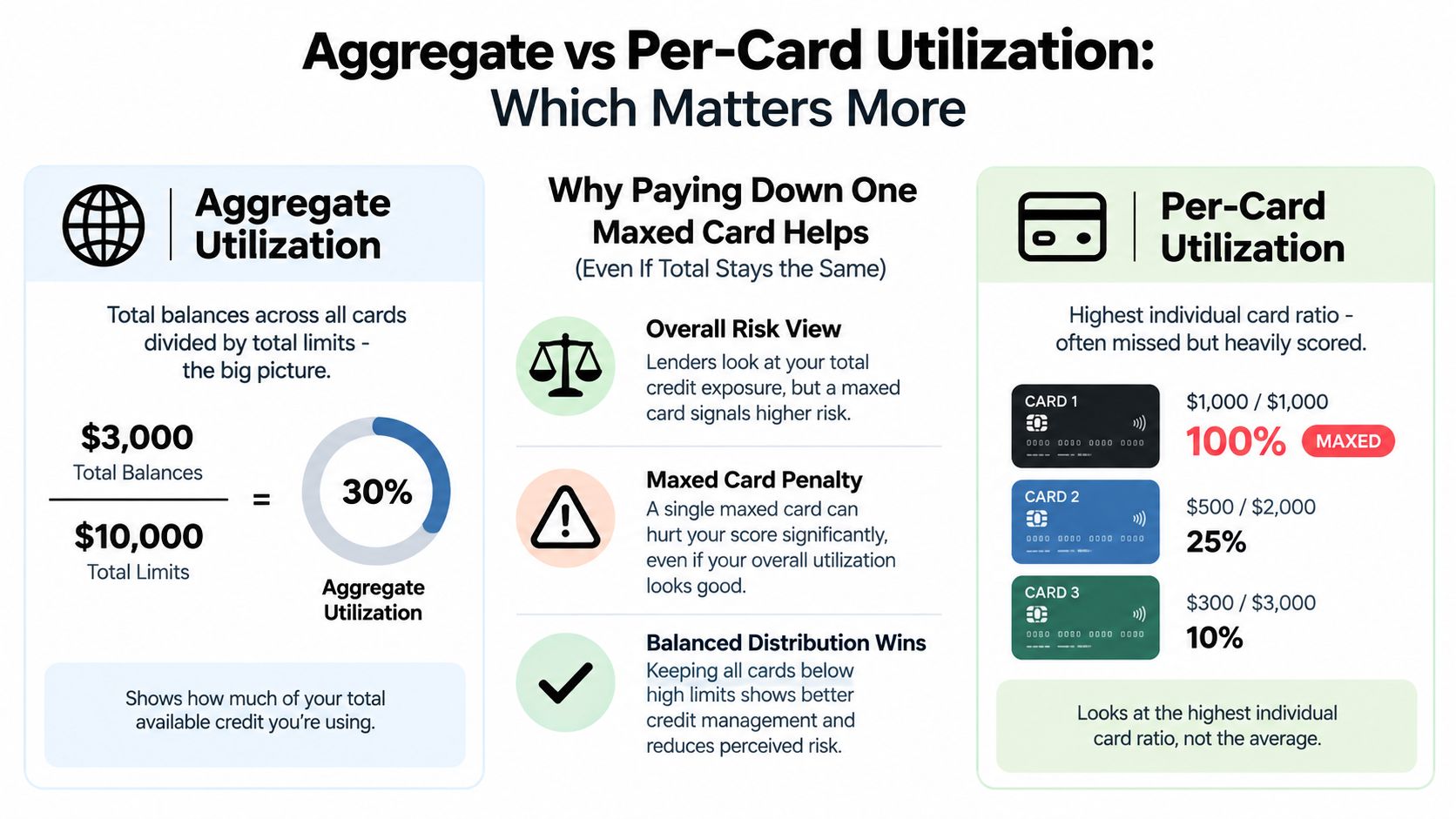
A borrower can lower total utilization and still leave one card carrying a problematic ratio. That's why the payoff order matters. Scoring models evaluate aggregate revolving utilization and individual account utilization, so the overall picture and the most heavily used card can both influence the result (myFICO's guidance on revolving utilization).
Consider two payoff choices using the same payment. Choice one sends the money to a card at 20% utilization, reducing it to a very low ratio. Choice two sends the money to a card at 75%, bringing that account below a major threshold while also reducing the total balance. Choice two will often be the more efficient score-focused move because it improves the worst individual ratio and the aggregate ratio simultaneously.
A simple payoff comparison
Suppose a borrower has two cards:
- Card A: $900 balance on a $1,000 limit, or 90%.
- Card B: $2,100 balance on a $9,000 limit, or about 23.3%.
- Combined balances: $3,000.
- Combined limits: $10,000.
- Aggregate utilization: 30%.
A payment applied to Card B may make the aggregate ratio lower, but Card A remains at 90%. The same payment applied to Card A can bring the most concentrated risk signal down sharply. Even if the aggregate result is similar, the per-card distribution is healthier.
That doesn't mean every borrower should ignore interest rates or payment obligations. Interest cost and delinquency prevention remain essential. But when the immediate objective is the fastest possible utilization-related score lift, the highest-utilization card is usually the first target.
Practical rule: reduce the card with the highest percentage first, then work toward keeping both the overall ratio and each individual card below important thresholds.
A balanced distribution can help because one nearly maxed-out card may attract more scoring pressure than several cards with moderate usage. Paying down the worst ratio first also creates a clear measurement point. After the issuer reports, the borrower can check whether the score changed and decide whether the next payment should continue on that card or move to the next-highest ratio.
Worked Examples and Simple Calculator Scenarios
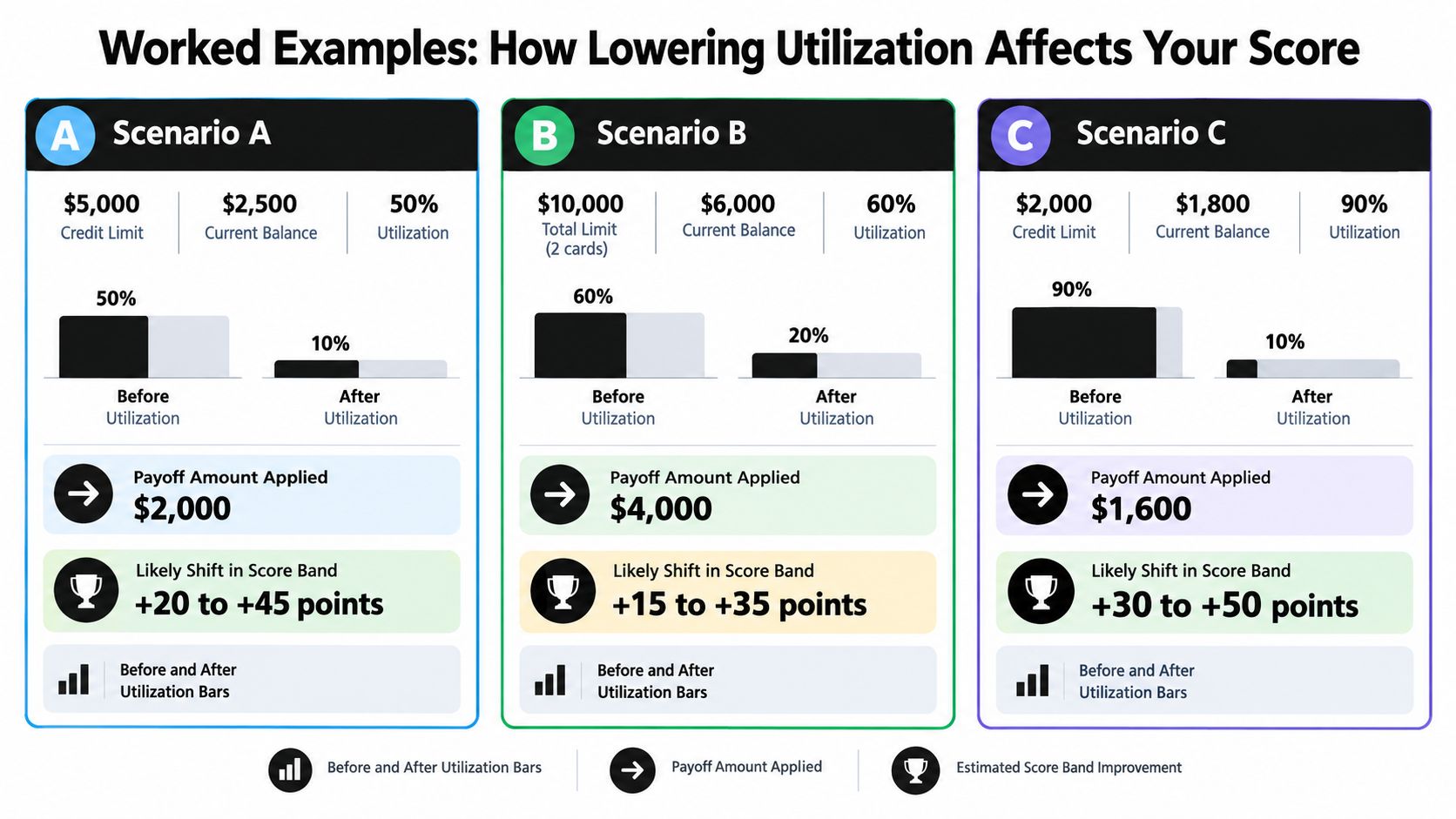
Worked numbers make the strategy easier to apply. Each example uses the same process: calculate the starting ratio, subtract the payment from the reported balance, calculate the new ratio, and identify whether the payment crossed a meaningful threshold.
Example one, a small threshold crossing
A borrower has a $10,000 total revolving limit and a $3,500 reported balance. Starting utilization is 35%. Paying $600 reduces the balance to $2,900, which brings utilization to 29%.
The payment is only a fraction of the total balance, but it crosses from above 30% to below 30%. That can matter more than a larger payment that leaves the balance at 31% or 32%, although no exact score increase is guaranteed. This is the clearest example of why the ratio, not the dollar payment alone, drives the analysis (The Credit People's utilization example).
Example two, two cards with concentrated debt
A borrower has two cards:
| Account | Limit | Starting Balance | Starting Utilization | Payment | New Balance | New Utilization |
|---|---|---|---|---|---|---|
| Card A | $4,000 | $3,200 | 80% | $2,000 | $1,200 | 30% |
| Card B | $6,000 | $800 | 13.3% | $0 | $800 | 13.3% |
| Total | $10,000 | $4,000 | 40% | $2,000 | $2,000 | 20% |
The payment lowers aggregate utilization from 40% to 20% and brings Card A to the 30% line. It also fixes the most concentrated problem, so the payment does more than reduce the total balance.
Example three, a high-utilization rescue
A card has a $2,000 limit and an $1,800 balance, producing 90% utilization. A $1,600 payment leaves a $200 balance, or 10% utilization.
That move crosses several important bands at once. Consumer-finance guidance associates utilization below 10% with a 10-to-50-point advantage versus higher utilization, while high utilization above 50% can be associated with 50-to-100-point drops in some cases. The actual rebound depends on the full credit profile, but this is the type of starting point where a borrower may see a substantial response after the lower balance reports.
A reusable calculation is:
- Add the balances and limits for the aggregate ratio.
- Divide each card's balance by its own limit.
- Apply the payment to the card with the highest utilization when score speed is the priority.
- Recalculate both the individual and combined ratios.
- Check the statement date to confirm the lower balance will be reported.
The self-check is simple: which payment moves the highest-used card below 30% or 10%, and which payment produces the largest fall in aggregate utilization?
How Quickly You Will See the Improvement and How to Time It
A payment date and a reporting date are not always the same. The due date determines when the borrower must pay to avoid late-payment consequences, while the statement closing date often determines the balance the issuer sends to the bureaus. A borrower can pay in full by the due date and still have a high statement balance reported if the payment arrives after the statement closes.
Utilization generally has no memory in most scoring models, so a lower reported balance can replace the previous ratio rather than remain as a long-term negative mark. That's why improvement often appears in the next billing or reporting cycle instead of requiring months of waiting (The Credit People on how lowering utilization can affect a score).
Timing checklist
- Find the closing date: Check each card statement for the date on which the billing period ends.
- Pay before reporting: Send the targeted payment before the statement closes, not only before the due date.
- Leave processing time: A payment needs time to post, so the borrower shouldn't wait until the last possible moment.
- Avoid replacing the balance: Large new purchases before the statement closes can offset the payment.
- Track each issuer: Different cards can report on different schedules, so one payment may appear before another.
A mid-cycle payment can help when a card is carrying a high balance. Some issuers may also respond to a request for an off-cycle update, though availability varies. The borrower should confirm the issuer's policy rather than assuming every lender will send a new balance immediately.
The central timing distinction is this: paying after the statement reports can still reduce the balance and future utilization, but it may miss the next score update. Paying before the statement closes gives the lower balance a better chance of appearing in the upcoming report.
The following video can help borrowers visualize how revolving balances and reporting interact.
Borrowers preparing for a major application may also want to understand related credit questions, including does a mortgage in principle affect credit. The same principle applies: identify which action changes the reported profile, then coordinate the timing rather than relying on the payment date alone. For issuer-specific timing, readers can review when Citi reports to credit bureaus.
Keep the Gains and Avoid Common Pitfalls
A utilization payment can improve the score, but the benefit can fade if new charges recreate the same reported ratio. The credit profile also includes account age, payment history, account mix, and recent inquiries. A lower utilization ratio can't guarantee a particular score if another part of the file is holding the result down.
Closing a card creates a separate risk. If the account closes and its credit limit no longer contributes to available revolving credit, the remaining balances can represent a larger share of the total limit. A borrower who wants to simplify accounts should calculate the new aggregate ratio first and consider whether the lost limit outweighs the convenience.
Another common mistake is watching only the total ratio. A borrower may keep aggregate utilization below 30% while allowing one small-limit card to climb close to its limit. Each statement should be reviewed at both levels, especially when balances are concentrated on one account.
A practical monitoring routine can include:
- Record every limit: Keep the current credit limit for each card in one place.
- Track reported balances: Note the statement balance, not only the amount paid after the statement.
- Rank utilization: Sort cards from the highest percentage to the lowest.
- Mark statement dates: Schedule payments early enough for them to post before closing.
- Review new charges: Check whether spending will undo the intended ratio reduction.
- Measure after reporting: Compare the next reported balances and score updates with the prior cycle.
A centralized dashboard can make this easier by displaying balances, APRs, utilization, and due dates together. Toya AI uses read-only connections through financial-data partners to centralize debt information, model payoff choices, and show how proposed payments can change a debt-free date, monthly interest, and total cost. Readers seeking a broader payoff process can review how to lower credit utilization.
The sustainable goal isn't to chase a score after every payment. It's to reduce the highest ratios, protect available limits, pay before reporting dates, and prevent new balances from reversing the progress.
Toya AI can help track utilization across credit cards while organizing balances, APRs, and due dates in one dashboard. Visit Toya AI to start free, map the next payment, and see how a payoff decision could affect the path to becoming debt-free.
Ready to start your debt-free journey?
Toya AI builds a personalized payoff plan so you can see your debt-free date and save on interest.
Get Started Free