
How Much Interest Do Credit Cards Charge in 2026?
General-purpose credit cards averaged 24.62% purchase APR in early 2025, while all credit card accounts averaged 21.58% in 2024. A carried $5,000 balance at 24.62% costs roughly $100 a month, before compounding, payments, fees, and daily-balance effects.
The annual dollar figure deserves special attention: the Federal Reserve Bank of Philadelphia's card-rate figures imply roughly $492 a year on $2,000, not on $5,000. On the larger balance, the simple annual estimate is $1,231.
That distinction gets to the heart of how much interest credit cards charge. The APR describes the rate, but the balance, payment dates, and types of transactions determine the dollars that appear on a statement.
Table of Contents
- Typical Credit Card Interest Rates in 2026
- How Your Interest Charge Is Actually Calculated
- The Five Numbers That Set Your Interest Charge
- Why Your Card Charges Different Rates on Different Balances
- What Interest Costs Over a Full Payoff
- What to Do Next with Your Own Number
Typical Credit Card Interest Rates in 2026
A carried $5,000 balance at the 2024 average for all credit card accounts costs about $90 a month in simple interest. The Federal Reserve's consumer credit release puts that average APR at 21.58%. Multiply $5,000 by 0.2158 and the year comes to $1,079. Divide by 12 and the monthly estimate is $89.92.
That dollar figure is a price on the balance left unpaid, not a personalized offer for 2026. General-purpose cards, store cards, and cash advances can post different rates. The benchmarks below describe earlier reporting periods, not a newly measured market-wide rate for the current year.
Typical credit card interest rates and what they cost
The monthly column uses one formula: balance × APR ÷ 12. It skips compounding and any change in the balance. A card agreement in the CFPB database lists 20.99% for purchases and 24.99% for cash advances on the same account. On $1,000 those rates cost about $17.49 and $20.83 a month. The cash-advance line works like a higher shelf price on the same balance: the APR steps up, and the dollar charge steps up with it.
The Reserve Bank of New Zealand reports a 19.7% weighted-average rate on personal interest-bearing advances in October 2025. That measure covers a different country and borrower group, so it is not a ranking against American cards. On $1,000 it is about $16.42 a month.
| Rate or card type | Typical APR | Approximate monthly interest on $1,000 |
|---|---|---|
| All credit card accounts, average APR, 2024 | 21.58% | $17.98 |
| Purchase APR, sample card agreement | 20.99% | $17.49 |
| Cash advance APR, same sample agreement | 24.99% | $20.83 |
| Spread from that purchase rate to that cash-advance rate | 20.99% to 24.99% | $17.49 to $20.83 |
| All-accounts average versus the sample purchase rate | 21.58% vs 20.99% | $17.98 vs $17.49 |
| New Zealand personal interest-bearing advances, October 2025 | 19.7% | $16.42 |
| New Zealand rate versus the U.S. all-accounts average | 19.7% vs 21.58% | $16.42 vs $17.98 |
The comparison rows do not add a new survey. They set the sourced rates next to each other so the dollar gap is easy to see.
A balance-to-cost lookup
Each cell shows simple annual interest / approximate monthly interest. These are comparison estimates, not a prediction of a statement charge. The running $5,000 example moves with the rate: about $87 a month at the sample purchase APR, about $90 at the all-accounts average, and about $104 at the sample cash-advance APR.
| Carried balance | At 20.99% APR | At 21.58% APR | At 24.99% APR |
|---|---|---|---|
| $1,000 | $209.90 / $17.49 | $215.80 / $17.98 | $249.90 / $20.83 |
| $2,000 | $419.80 / $34.98 | $431.60 / $35.97 | $499.80 / $41.65 |
| $5,000 | $1,049.50 / $87.46 | $1,079.00 / $89.92 | $1,249.50 / $104.13 |
| $10,000 | $2,099.00 / $174.92 | $2,158.00 / $179.83 | $2,499.00 / $208.25 |
Doubling the balance doubles the estimate. Moving the same $5,000 from 20.99% to 24.99% adds about $17 a month. Over a year of simple interest that gap is $200 ($1,249.50 minus $1,049.50).
A guide to what makes a good credit card APR helps put an offer next to these benchmarks. The figures that match a real account sit on the statement's interest-charge table and in the card agreement, on separate lines for purchases, cash advances, and balance transfers.
How Your Interest Charge Is Actually Calculated
About $98.63 for a billing cycle is the starting estimate for the running balance under the assumptions below. The CFPB's daily periodic rate explanation describes how issuers convert an annual rate into a daily rate, commonly dividing by 360 or 365, then applying it to daily balances.
The calculation uses a slightly rounded APR to keep the arithmetic easy to follow.
The visual traces the calculation from the annual percentage to the cycle charge.
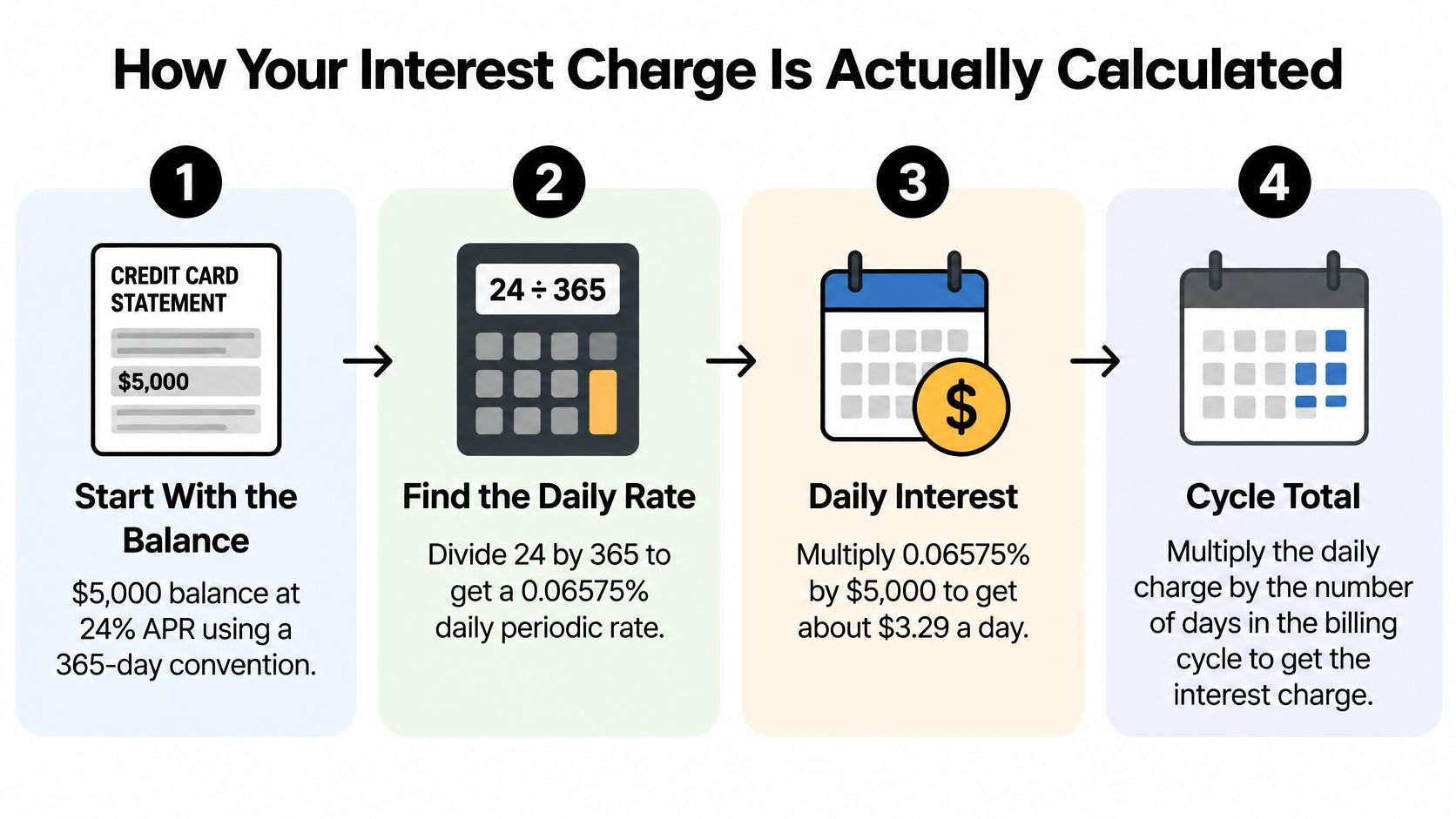
From APR to dollars per day
For this worked example, assume $5,000 at 24% APR, a 365-day convention, and a 30-day billing cycle, with no balance changes:
- Convert the annual rate. Divide 24% by 365 to obtain approximately 0.06575% per day.
- Switch to decimal form. The daily multiplier is approximately 0.000657534. Multiplying the balance by that decimal produces about $3.29 daily.
- Calculate the cycle estimate. Keeping the unrounded daily result and multiplying by the cycle length gives approximately $98.63.
The percent-to-decimal step is where calculator mistakes often happen. Entering the daily percentage as though it were already a decimal produces a substantially overstated answer.
These are simplified estimates. If an issuer adds accrued interest to the balance before calculating later interest, compounding changes the result.
Why the statement balance isn't enough
Under the average daily balance method described in the CFPB's credit card key terms, the issuer totals the daily balances, divides by the cycle's length, and applies the periodic rate. In the running example, paying $1,000 halfway through the 30-day cycle lowers the approximate average balance to $4,500, reducing interest to $88.77, a saving of about $9.86.
The arithmetic counts the original balance for the first half of the cycle and the reduced balance for the second half. It doesn't apply interest to the smaller balance shown at the end.
Practical rule: When interest is already accruing, an earlier payment lets the issuer count the lower balance for more days.
A payment can therefore help even when it doesn't clear the account. The benefit comes from reducing the amount subject to interest sooner, not from waiting for a particular statement date.
For another explanation of the calculation, the following video provides a visual walkthrough.
The agreement's interest-calculation language should identify the day-count convention and balance method. A cardholder trying to reconcile an actual charge also needs payment posting dates, new transactions, and the APR assigned to each balance category.
The Five Numbers That Set Your Interest Charge
The APR alone can't predict a statement's finance charge. A useful estimate needs the applicable rate, daily balances, day-count convention, grace-period status, and payment amount and allocation.
These inputs answer different questions. Some describe the price of borrowing; others describe how much borrowing remains and how long the issuer counts it.
The inputs that matter
- Applicable APR. A higher rate costs more on the same carried balance. A comparison should use the rate attached to that particular balance, not a promotional rate advertised for another transaction type.
- Daily balance and payment timing. The relevant balance is the amount outstanding through the cycle. A payment posted earlier affects more daily calculations.
- Day-count convention. Dividing the annual rate by a smaller day count produces a slightly higher daily rate. The agreement determines which calculation applies.
- Grace-period status. Purchase interest may be avoidable when the account qualifies and the full statement balance is paid on time.
- Payment amount and allocation. A payment's effect depends on both its size and which balance receives it.
The CFPB's credit card contract definitions explain that paying less than the full statement balance may remove the grace period and allow interest on the unpaid balance from the end of the billing period. They also explain that amounts above the required minimum generally go to the highest-rate balance first, with remaining amounts applied in descending rate order.
That creates an important distinction: meeting the payment obligation isn't the same as avoiding interest. A minimum payment may keep an account current without preserving the purchase grace period or making substantial progress against principal.
Credit card interest myths and what actually happens
| Common belief | What actually happens | Evidence or practical check |
|---|---|---|
| The APR is the amount paid on the balance | An annual rate and an observed finance-charge ratio are different measures | Compare the statement's dollar interest with the balance and period used |
| The grace period always protects the account | It generally requires the full statement balance paid by the due date | Partial payment can remove that protection |
| Paying on the due date is good enough | Interest-bearing balances accrue charges through the cycle | Earlier posting lowers the balance counted for subsequent days |
| Minimum payments keep repayment on track | Principal can decline slowly while interest continues | The CFPB example below shows how much remains |
| Every balance on a card costs the same | Purchases, transfers, promotions, and advances can have separate terms | Inspect every APR category rather than the account total |
The CFPB's minimum-payment worksheet illustrates a $300 balance at 23% APR that incurs $5.76 interest in the first month; after a $15 payment, it still stands at $290.76, and after eight such payments, $220.92 remains.
A credit card bill example can help identify these fields on an unfamiliar statement. The APR may be difficult to change immediately, but payment timing and a sustainable extra payment are decisions a household can control.
A manageable minimum payment isn't proof that the balance is shrinking at a useful pace.
Why Your Card Charges Different Rates on Different Balances
Why can interest appear after a payment? The payment may reduce one balance while another remains subject to interest, and the required minimum may not be allocated where the cardholder expects.
The CFPB's explanation of credit card interest calculations describes balance-specific calculations and payment allocation. The issuer may control the minimum-payment portion, while money above that amount generally goes first toward the highest-rate balance.
A single account can therefore contain several separate borrowing arrangements. The cardholder sees one total due, but the issuer may calculate interest separately for purchases, transfers, promotional balances, and cash advances.

A mixed-balance scenario
Suppose the running balance contains a promotional transfer, ordinary purchases, and a cash advance. The promotional portion may have favorable terms, while the other portions continue generating finance charges.
A payment large enough to cover recent purchases doesn't necessarily settle the interest-bearing categories in the way the borrower intended. The payment must be evaluated against the issuer's allocation rules and the balances outstanding when it posts.
| Balance category | What the statement needs to show | What deserves attention |
|---|---|---|
| Promotional transfer | Promotional rate, expiration terms, and remaining balance | Whether the favorable terms apply only to that transfer |
| New purchases | Purchase APR and balance subject to interest | Whether the account still qualifies for purchase grace |
| Cash advance | Advance APR and interest-bearing balance | Whether the higher-cost portion remains after payment |
| Payment | Amount, posting date, and allocation | Which category actually fell |
The sample agreement's purchase and advance rates illustrate why transaction labels matter. Its published monthly periodic rates are rounded, so estimates using those rates can differ slightly from estimates obtained by dividing the annual percentages directly.
Reading the statement line by line
A useful review starts with the interest charge calculation table, not the account summary. Each row should be matched to its APR, balance subject to interest, and resulting charge.
- Match the category. A purchase rate shouldn't be used to estimate an advance's cost.
- Check the posting date. A payment cannot lower daily balances before the issuer credits it.
- Inspect the remaining balance. An account-level reduction doesn't establish which category was repaid.
- Review promotional terms. A favorable offer doesn't automatically extend to later purchases or other transaction types.
For a statement that still doesn't reconcile, the issuer can explain the minimum-payment allocation and the balance used for each interest calculation. The question should identify a specific category and posting date rather than asking only why interest appeared.
What Interest Costs Over a Full Payoff
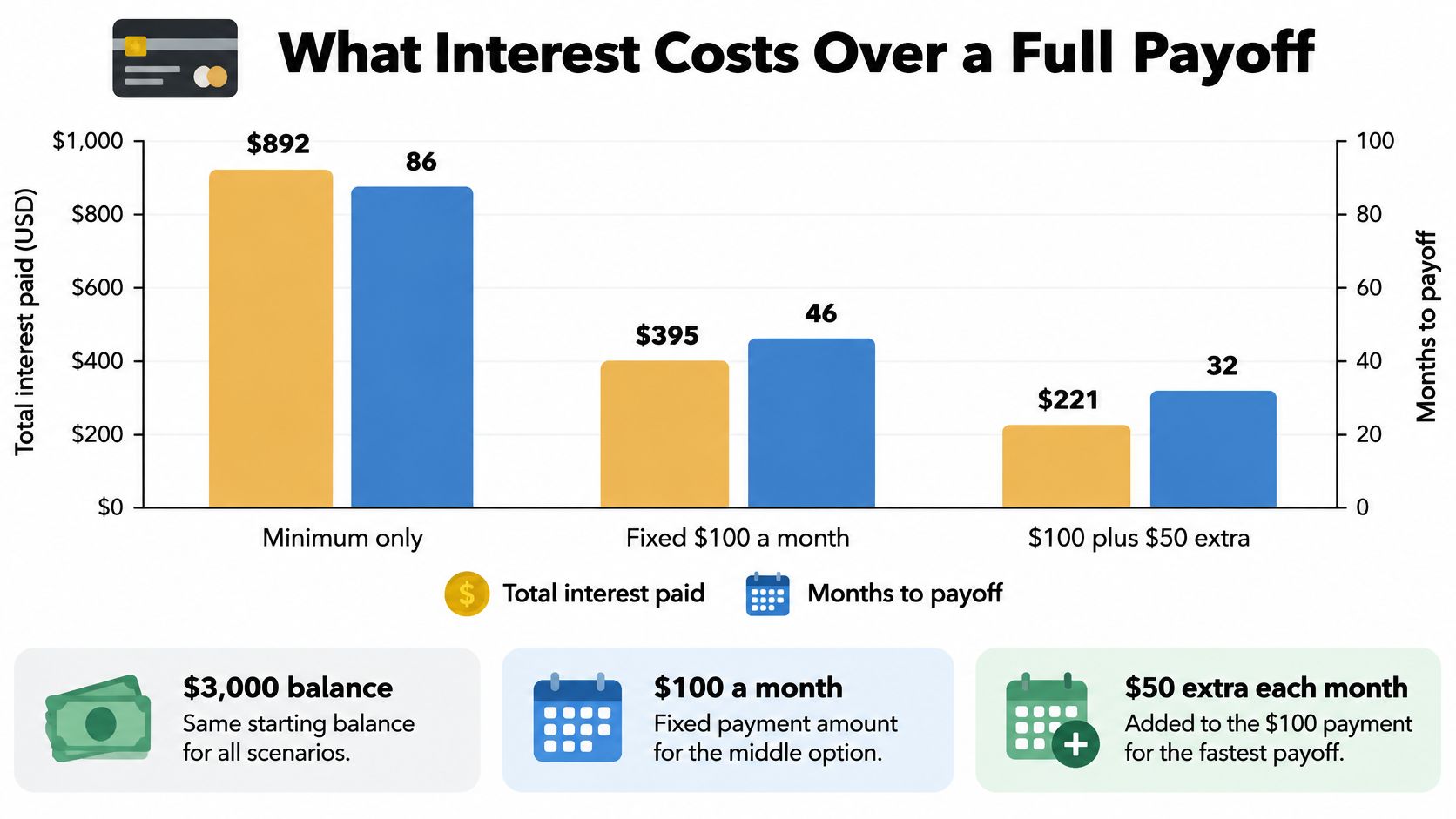
A larger fixed payment changes both total interest and the payoff date. For a meaningful comparison, the starting balance, APR, new spending, fees, and interest-calculation assumptions must stay the same.
The table below is an illustrative calculation, using a $3,000 starting balance at 24.62% APR, monthly interest calculated as APR divided by the months in a year, end-of-month payments, no fees, no new purchases, and a smaller final payment. Results are rounded because a card's daily calculation and actual payment dates will differ.
Total interest and payoff time on a $3,000 balance at 24.62% APR
| Payment strategy | Paid per month | Months to zero | Total interest paid |
|---|---|---|---|
| Minimum only | Declines according to the agreement's formula | Cannot be calculated without that formula | Cannot be established without the payment rule |
| Fixed $100 a month | $100, with a smaller final payment | Approximately 48 | Approximately $1,710 |
| Fixed $100 plus $50 extra | $150, with a smaller final payment | Approximately 27 | Approximately $900 |
The fixed-payment rows show the effect of paying more without adding further spending. A minimum-only projection needs the issuer's percentage rule, any interest-and-fee component, and its payment floor; declaring a universal payoff time would be misleading.
A credit card payoff calculator with amortization makes the comparison easier to inspect. The useful output isn't just a final date, but a schedule showing how each payment divides between interest and principal.
The visual highlights the payment strategies being compared; the explicit assumptions above govern the numerical estimates.
Timing still matters during repayment
The Federal Trade Commission's average-daily-balance example counts $400 for 15 days, $100 for 3 days, and $150 for 12 days, producing a $270 average daily balance; at 18% APR, its 1.5% monthly rate yields $4.05 in interest.
The arithmetic is the sum of each balance multiplied by the days it remained outstanding, divided by the cycle length. A lower ending balance alone doesn't describe that history.
For the running balance, moving an affordable payment earlier changes the number of days spent at the higher balance. A higher APR increases the cost of those days and makes slow repayment more expensive.
Repayment priority: A fixed payment should stay fixed as the required minimum falls, provided the household can sustain it.
The practical actions are to pay before the statement closes when possible rather than waiting for the due date, direct extra money toward the highest-rate debt, and stop treating the minimum as the repayment plan. No early-payment strategy should delay a required payment or leave essential expenses unfunded.
What to Do Next with Your Own Number
The next useful number is the estimated interest on the household's own balances. A statement, card agreement, and calculator are enough to begin.
- Find every applicable APR. Record purchase, cash-advance, transfer, and promotional rates alongside their balances. Note any promotion's expiration terms.
- Estimate the daily charge. Divide the applicable APR by the agreement's day count, convert the percentage to a decimal, and multiply by the interest-bearing balance. Multiply by the cycle length for a rough unchanged-balance estimate.
- Choose the correct payment target. When purchase grace applies, the target is the full statement balance by the due date. When full payment isn't possible, an earlier affordable payment can reduce the balance counted on subsequent days.
- Rank debts by rate. Cover required minimums everywhere, then direct spare money toward the highest-rate balance. Recheck the ranking after each statement.
- Make the process repeatable. An app can consolidate balances and recalculate a rate-ranked plan as account details change.
For payment scheduling, Superchat's guide to automate your card bill payments offers practical context; automatic payments still need sufficient funds and statement review.
This week's decision is specific: select the highest-rate balance and commit an affordable fixed extra amount to it. Record the payment date so that the decision becomes an action rather than another estimate.
Toya AI brings connected debt balances, APRs, and due dates into one dashboard and recommends which payment to make next, showing its effect on payoff time and interest. Readers can visit Toya AI to compare their current payment path with a personalized plan and identify where an extra payment can help most.
Ready to start your debt-free journey?
Toya AI builds a personalized payoff plan so you can see your debt-free date and save on interest.
Get Started Free