
How Much Extra to Pay on Mortgage: Amounts That Save

The statement says the same thing every month: one payment, one date, one balance that barely moves. After four years of on-time payments on a $300,000 loan at 6%, a borrower has handed over roughly $86,000 and reduced the balance by only about $16,000, because most of each payment covers interest rather than principal.
The instinct to send an extra $100 is right. The amount deserves a real decision rather than a guess. Paid too little, an extra payment barely registers. Paid too much, it drains the cash a household needs for tires, dental work and a furnace that quits in January. The workable number sits where the interest saving is measurable, the loan contract permits it, and the reserve still covers several months of expenses.
Table of Contents
- Extra Payment Amounts and the Time and Interest They Save
- Why Early Extra Dollars Do the Most Work
- How Your Mortgage Rate Changes the Payoff Math
- Which Competing Debts and Savings Come First
- How to Set Up Extra Payments So They Reduce Principal
- When Refinancing or Rate Changes Should Reset Your Plan
- Check Your Safe Extra Payment Amount Today
Extra Payment Amounts and the Time and Interest They Save
The quickest way to settle on an amount is to read a table built on one loan and find the row a household can hold for years. The rows below use a $300,000 balance, a 30-year term and a 6% fixed rate, where the scheduled principal and interest payment is about $1,799 a month. The stakes are bigger than they look: ICE Mortgage Technology's December 2025 Mortgage Monitor put the monthly principal and interest payment on a median-priced U.S. home at $2,126 when mortgage rates averaged 6.25%, which makes an extra $100 a small slice of the monthly outlay and an easy line to skip.
Extra monthly payment and its effect on a $300,000, 30-year, 6% mortgage
| Extra monthly payment | Payoff time | Time saved | Total interest saved |
|---|---|---|---|
| None (standard schedule) | 30 years | none | none |
| $50 | about 28 years | about 2 years 1 month | about $29,000 |
| $100 | about 26 years 1 month | about 3 years 11 months | about $53,000 |
| $200 | about 23 years 2 months | about 6 years 10 months | about $91,000 |
| $300 | about 21 years | about 9 years 0 months | about $120,000 |
| $500 | about 17 years 8 months | about 12 years 4 months | about $160,000 |
How to Read the $100 Row
Adding $100 a month retires the loan at 26 years and 1 month instead of 30, cuts about 3 years 11 months from the schedule, and keeps roughly $53,000 out of the interest column. Nothing mysterious happens: the extra money lowers principal, so every later payment charges interest on a smaller balance. The same $100 held in a savings account would not touch the mortgage balance at all.
Each Added Dollar Buys a Little Less
The interest column climbs with every row, but not in a straight line. The first $100 a month removes nearly four years and about $53,000 of interest. Going from $300 to $500 costs an extra $200 a month and returns about three more years and about $40,000. Early dollars work harder because a large balance is still there to protect.
What the Rows Assume
Assumptions behind every row: no fees, no prepayment penalty, the extra amount applied straight to principal, and property taxes, homeowners insurance and mortgage insurance left out. Every figure is rounded and approximate.
Three Numbers to Replace Before You Trust a Row
No household's loan matches the example exactly. Three inputs decide the outcome: the current balance rather than the original loan amount, the interest rate on the note, and the remaining term rather than the 30 years it started with. A borrower 11 years into the loan has 19 years left, and the same $100 will shorten that remaining schedule differently.
Run those three inputs through a tool that can calculate extra mortgage payment savings and the table turns from illustration into a forecast for one address. Test the amount twice, once as a monthly add-on and once as an annual lump sum, because the two structures land on different payoff dates even when the yearly total is identical.
Why Early Extra Dollars Do the Most Work
A statement from the first year of a loan explains almost everything about extra payments.
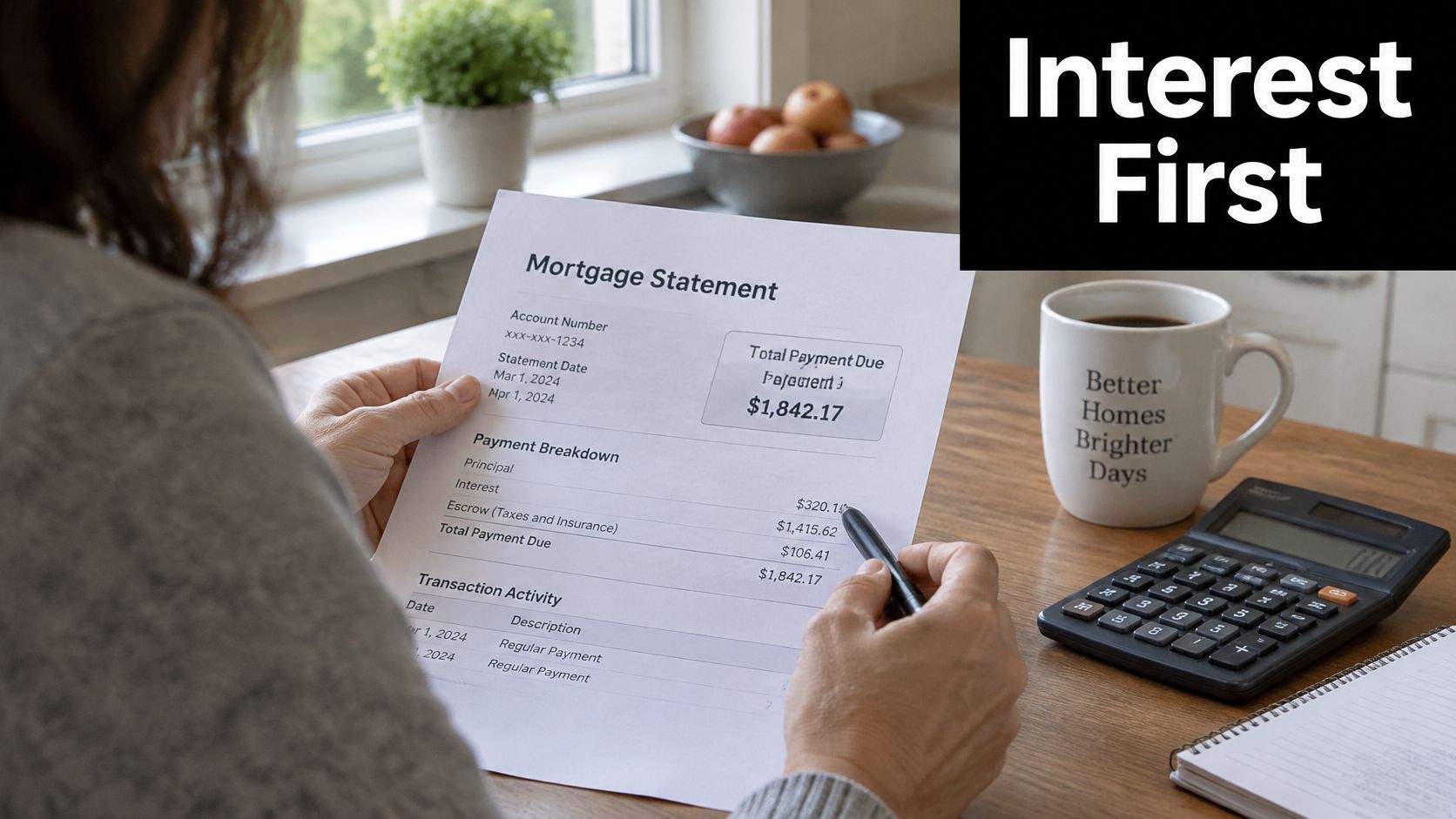
On the $300,000 example, month one charges $1,500 of interest and only about $299 of principal. More than 83 cents of every dollar goes to the cost of borrowing. That split shifts slowly, which is why starting a decade late costs far more than most borrowers expect.
Think of the mortgage as a tank with a leak. The leak rate is set by how much water remains inside, so draining the tank early shrinks every later leak. Interest behaves the same way: it's charged on whatever balance is still outstanding, so a dollar of principal removed today never generates tomorrow's charge.
The month-one arithmetic. An extra $100 in month one leaves a balance $100 lower than scheduled. Next month's interest drops by about 50 cents, and that half dollar reappears for every month the loan would otherwise have carried the extra $100. The effect compounds because the lower balance also pushes more of each later payment toward principal.
The saving only happens if the money reaches principal. The Consumer Financial Protection Bureau's monthly mortgage payment checklist tells borrowers who pay more than the amount due to ask the servicer to apply the additional money to principal. Principal is the figure used to calculate future interest, so it's the only destination that shortens the loan.
The Advance-Payment Trap
If a servicer books the extra money as an early installment instead, the balance never falls and the savings never appear. Say the scheduled payment is $2,000 and $2,250 leaves the account. The extra $250 needs a clear principal-only instruction, and the next statement should show the balance lower by the full $250 rather than the account marked paid ahead for a future month.
One rule carries the rest of this article: the earlier an extra dollar reduces principal, the more interest it removes. So the question is never whether to overpay, but how much can go now without giving up cash the household needs.
How Your Mortgage Rate Changes the Payoff Math
The same $100 a month retires a different amount of interest on a 3% loan than on a 7% loan, because every dollar of principal removed stops accruing interest priced at the note rate.
Interest saved by mortgage rate with $100 extra per month
| Mortgage rate | Standard total interest | Interest saved with $100 extra | Time saved |
|---|---|---|---|
| 3% | about $155,000 | about $19,000 | about 3 years 5 months |
| 6% | about $347,500 | about $53,000 | about 3 years 11 months |
| 7% | about $418,500 | about $69,000 | about 4 years 2 months |
Read the table in both directions. The time saved barely moves across the three rates, drifting from about 3 years 5 months to about 4 years 2 months. The interest saved more than triples, from about $19,000 to about $69,000. A borrower comparing only the years column would conclude that rate hardly matters, and would miss a gap of roughly $50,000 between the lowest and highest rows.
The One-Year Benchmark for a Single Prepayment
For a lump sum, the first-year benefit is roughly the amount prepaid multiplied by the mortgage rate, adjusted for the declining balance and payment timing. A $10,000 prepayment at 6% avoids about $600 of first-year interest, then slightly less each year after as the balance it would have earned against shrinks. The Financial Consumer Agency of Canada's mortgage guidance frames the decision around three constraints: guaranteed interest savings, liquidity, and higher-cost debt. Its accelerated-payment option is built to create the equivalent of one extra monthly payment a year, which the agency says may save thousands to tens of thousands of dollars over the life of a mortgage.
The Trade the Rate Hides
That $600 is not a market return. It doesn't swing with stocks or depend on a fund manager, and it can't be lost in a bad quarter. The catch is liquidity. Once the $10,000 becomes home equity, the household cannot spend it without refinancing or borrowing against the house, which is why prepaying is a commitment rather than a parking spot.
For a borrower at 3%, the case for extra payments rests on time saved and peace of mind, not on interest avoided. That's a legitimate reason, and it should be weighed openly against other uses for the same cash. A borrower who doesn't yet know what share of each payment is interest can start with this walkthrough on how to calculate monthly interest.
Fixed or Adjustable Changes Every Number
An adjustable-rate mortgage replaces the rate used in every calculation, sometimes after three years and sometimes twice a year. Confirm the note rate is fixed before leaning on any row above. A borrower whose rate resets soon can compare rate cut effects on mortgages to see how a lower rate would shrink both the scheduled interest and the benefit each extra dollar buys.
Before applying a row, run three checks on the amount itself. Confirm the actual note rate so the right row applies. Check the loan documents for a prepayment penalty, since a fee on early principal can cancel months of saved interest. And confirm the cash is surplus the household can leave locked in equity, because the return a prepayment earns is unreachable once it becomes part of the house.
The rate sets how much an extra dollar is worth. The loan terms and the cash cushion behind it set whether that dollar is safe to send.
Which Competing Debts and Savings Come First
The question that decides the outcome is not how much interest an extra mortgage payment saves. It's whether that cash belongs on the mortgage at all. The Consumer Financial Protection Bureau's mortgage key terms guide notes that standard payoff calculators treat maximum interest savings as automatically optimal, while ignoring liquidity, higher-interest debt, retirement matches and the need for reserves. Prepayment builds equity, but equity is not spendable cash.
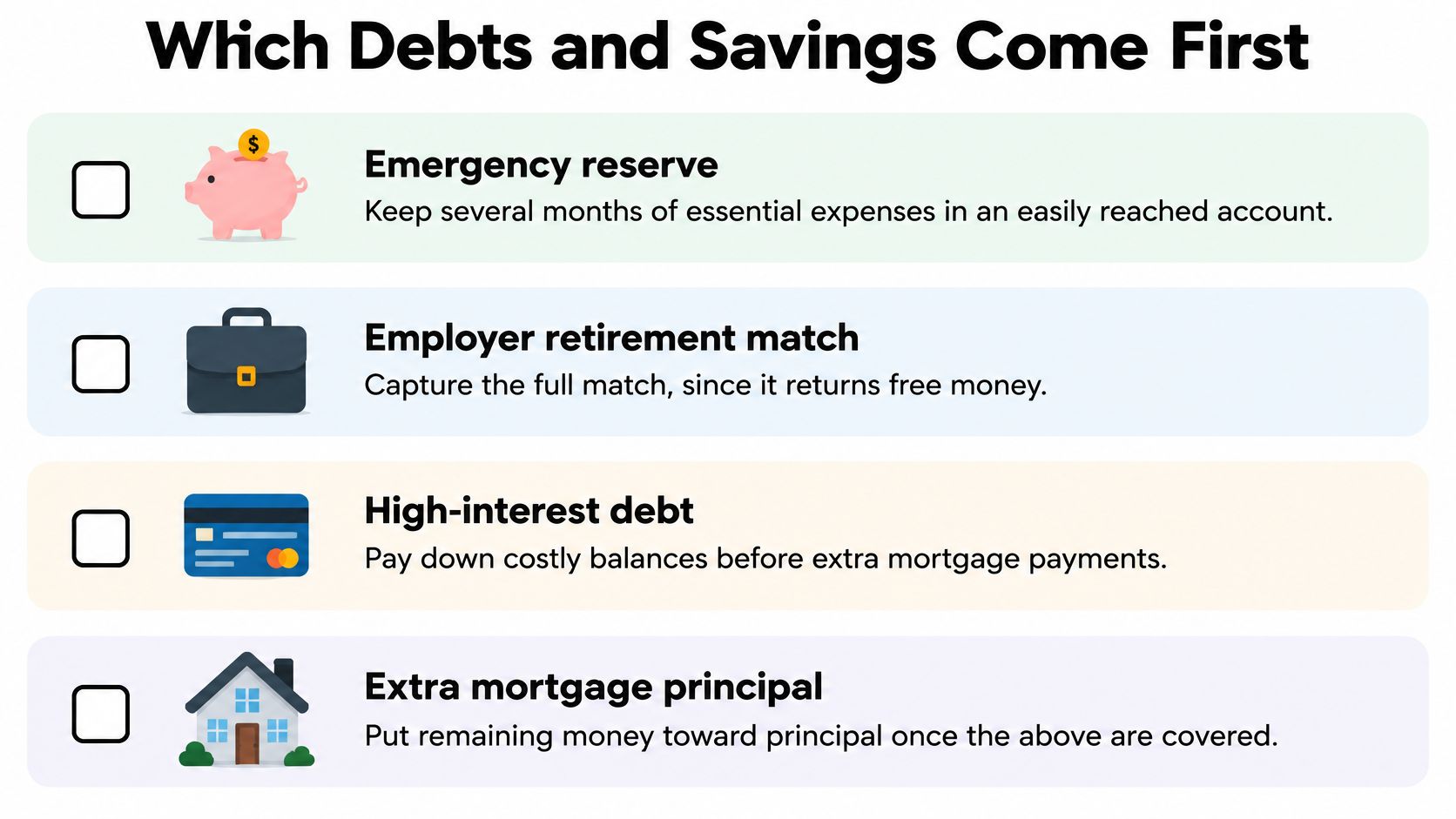
The order below holds up whether the surplus is $150 or $1,500 a month. Each step has a reason, and the reason is always the same one: some dollars return more than others.
- Build the emergency reserve first. Several months of essential expenses in an account reachable within a day or two. Without it, the next car repair goes on a card at a rate far above the mortgage.
- Take every employer retirement match. A match returns money immediately on contribution, which no mortgage prepayment can replicate.
- Clear debt priced above the mortgage rate. Card and personal loan balances at higher APRs remove more interest per dollar than any principal payment on a 6% loan.
- Then size the mortgage payment. Whatever remains, committed to principal on a schedule the household can sustain.
A Worked Surplus Example
Say a household has $400 a month spare, a $6,000 card balance at 24% APR, a 6% mortgage, and a reserve $3,000 short of target. Sending $400 to the mortgage avoids about $2 of interest in month one (0.5% of $400). Sending that $400 to the card avoids about $8 (2% of $400). The card wins four to one, and the reserve is further behind than either.
So the $400 goes to the reserve and the card until both reach target. Then the surplus is recalculated, and a portion, usually 30% to 50% of the new figure, moves to the mortgage as a permanent monthly add-on.
The Formula for a Safe Amount
Safe extra payment = monthly surplus − the amount needed to keep the reserve growing − a margin for irregular costs. Car repairs, medical bills and insurance deductibles don't arrive monthly, but they do arrive.
The result is a number, not a percentage. If a bonus or tax refund lands, run it through the same order before paying it to the lender. For a longer treatment of the debt-versus-savings trade, this guide on whether to pay off debt or save covers the sequencing in more depth.
How to Set Up Extra Payments So They Reduce Principal
Setup decides whether the extra money works at all. A payment booked as an advance on next month's due date is a loan to the servicer at zero interest.
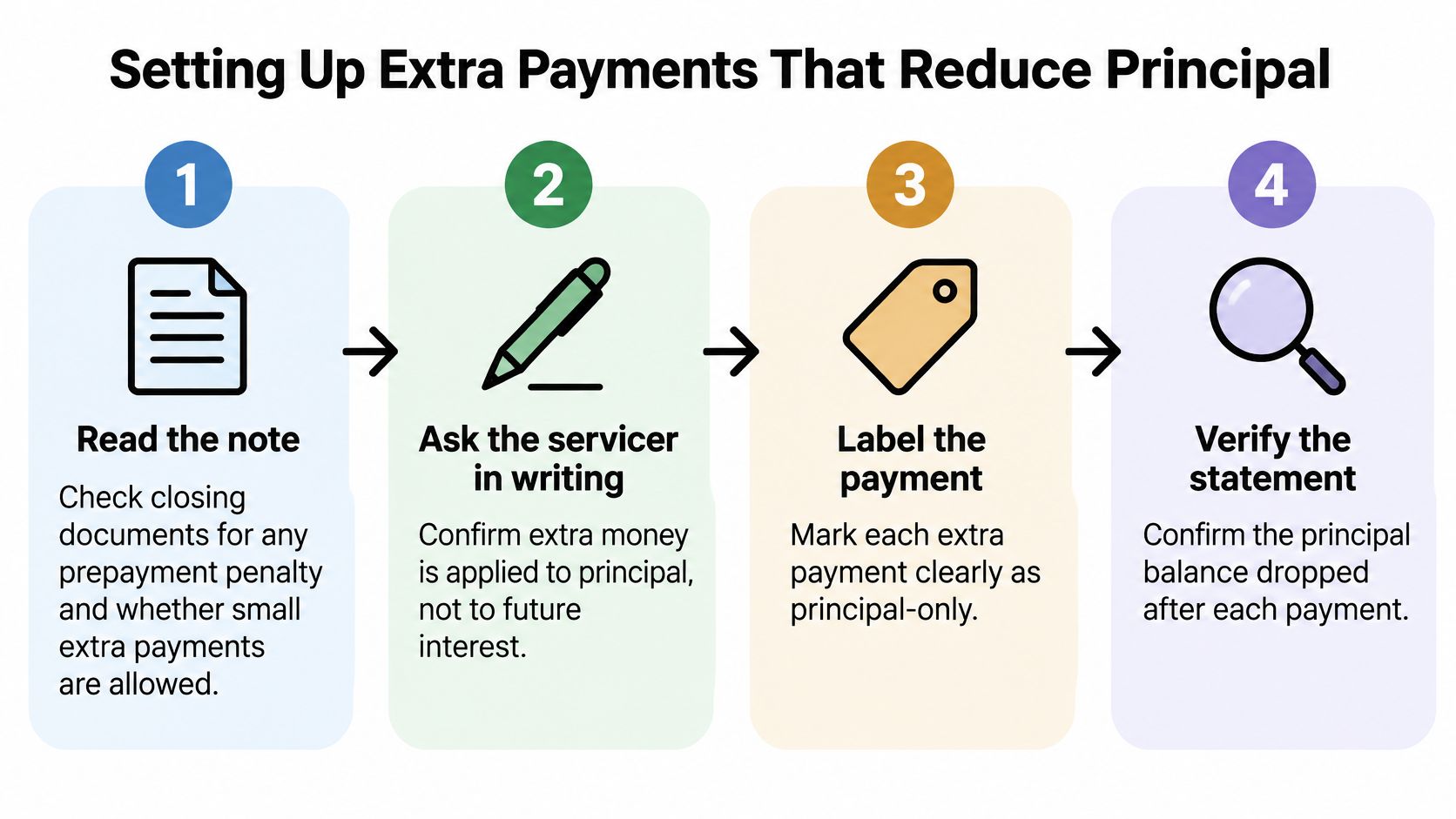
Work through these six steps once, then repeat only the last one.
- Read the note and closing documents. Look for a prepayment penalty clause and for any restriction on extra payments. These charges commonly apply when the entire mortgage is paid off through a sale or refinance within a set period, often three or five years, according to the Consumer Financial Protection Bureau's explanation of prepayment penalties. Small recurring extras normally don't trigger one. A large lump sum can.
- Ask the servicer in writing. Confirm that overpayments are applied to principal and that no fee applies to the extra-payment option, including any biweekly program. An email reply is worth keeping.
- Choose the structure. A fixed monthly add-on suits steady income. One extra full payment a year suits bonus season. A single lump sum suits an inheritance or sale proceeds.
- Label every payment principal-only. Use the servicer's online field for it, or attach a note that says exactly that. Unlabeled money is the money that gets misapplied.
- Check the next statement. The principal balance should drop by the full extra amount, and the account should not read as paid ahead. This is the only proof that step 4 worked.
- Repeat the check quarterly. Do it again after any rate reset, refinance, or change in payment amount, since servicing rules and escrow adjustments can alter how money is applied.
Two Amounts, Two Different Checks
A borrower adding $200 a month only needs confirmation that the servicer accepts extra principal with no fee, which most do. A borrower applying a $30,000 inheritance needs more: the penalty clause read in full, and a written payoff or prepayment calculation from the lender before the wire leaves.
Ask for the calculation in writing. A prepayment figure in an email is a document the household can check against the clause, and it costs nothing to request.
For background on which part of the payment moves the needle, this explanation of the principal payment covers how the balance is structured. Here's a short walkthrough of the same setup in practice.
When Refinancing or Rate Changes Should Reset Your Plan
Extra payments aren't a permanent setting. Refinance economics move, and a payment that made sense last spring may not make sense now.
Run the break-even first. Refinancing a $300,000 balance from 6% to 5% takes the principal and interest payment from about $1,799 to about $1,610, a saving of roughly $190 a month. At $6,000 in closing costs, the break-even lands around 32 months. A household expecting to move inside three years shouldn't trade liquidity for extra principal on a loan it will pay off from sale proceeds.
The wider picture supports the caution. In the Federal Housing Finance Agency's April 2025 refinance report, Urban Institute data show refinance activity stayed constrained because many borrowers held rates below 6%, while a Dallas Fed analysis found only 9% of mortgages carried rates above the 6.8% average market rate as of July 2025. The same analysis found borrowers in high-income neighborhoods prepaid more often than similarly placed borrowers in lower-income areas, so access to both prepayment and refinance is uneven.
Triggers That Justify a Reread
- A rate drop of half a point or more against your current note
- A job loss or a raise that changes the monthly surplus
- A new card or loan that outranks the mortgage on rate
- A home value change that alters equity and refinance eligibility
Keep paying extra while refinancing looks unlikely. Hold the cash in reserve when a refinance is plausible within 12 to 24 months, because closing costs are paid from savings, not equity you've already sent to the lender.
Check Your Safe Extra Payment Amount Today
Three checks turn the tables above into one number.
First, confirm the surplus. Take the monthly amount left after the emergency reserve is funded and after every card or loan priced above the mortgage rate is covered. That's the true ceiling.
Second, run the arithmetic. Put the actual balance, rate and remaining term through a calculator with and without the extra amount, then compare the payoff month and total interest against the closest row in the first table. If the saving is smaller than expected, the loan is shorter or the rate lower than the example.
Third, confirm it in writing. Ask the servicer that the extra amount is applied to principal with no fee, then check the next statement for a balance that fell by the full amount. Tools can help here: the value preview calculator in Toya AI gives a quick debt-free estimate from three numbers, connecting accounts yields exact results, and the free tier lets users link unlimited accounts and track balances, APRs and due dates at no cost with no time limit.
Then commit to one monthly figure the household can hold for a full year without leaning on a bonus or a card to cover it, and write it down with the start date. Recheck that figure whenever the rate, income, balances or loan terms change, and when a refinance becomes realistic, use the triggers above to decide whether to keep paying or hold the cash.
Toya AI builds a payoff plan that treats a mortgage as one debt among several, showing which payment to make next and how each choice shifts the debt-free date and total interest. Connect the cards, student loans and mortgage once and the plan updates as balances and rates move, so the amount you decide to send is tested against every other obligation rather than guessed. Start with the free dashboard at Toya AI and see the payoff date before committing a dollar.
Ready to start your debt-free journey?
Toya AI builds a personalized payoff plan so you can see your debt-free date and save on interest.
Get Started Free